


The Outcome-Driven Feature Canvas: How to Stop Shipping Output and Start Driving Impact
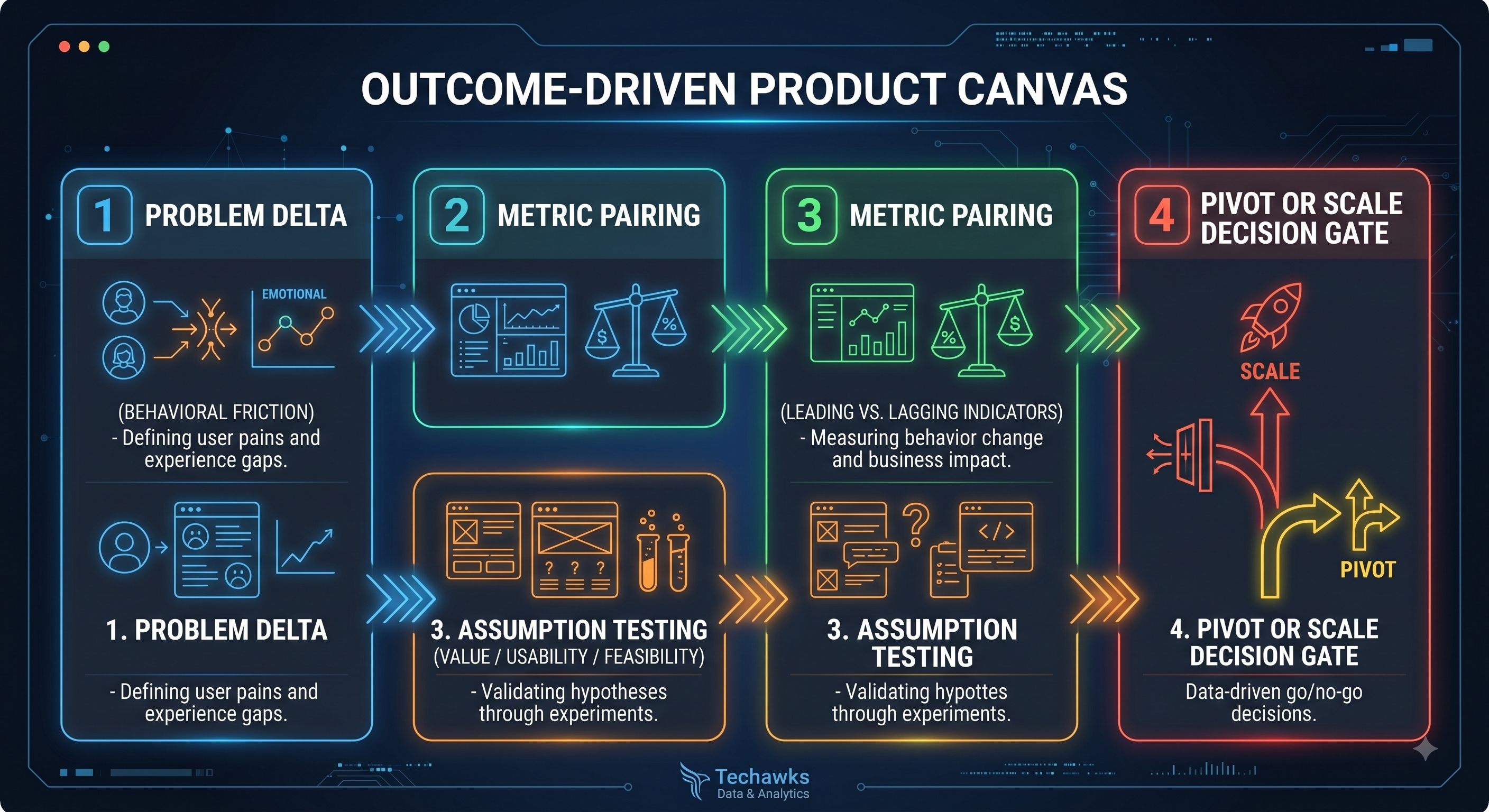
Most product roadmaps suffer from the "feature factory" trap—prioritizing deliverables based on arbitrary stakeholder wishlists rather than measurable customer problems. To shift your team from shipping outputs to driving true business outcomes, run every proposed initiative through this 4-step framework before writing a single user story:
1. Define the Problem Delta, Not the Solution
Avoid starting with "We need a filter bar on the dashboard."
Frame the friction point around behavior: "Users spend an average of 4.2 minutes locating specific transaction records, causing a 28% drop-off before export completion."
2. Establish the Leading vs. Lagging Metric Pair
Identify the lagging indicator (business impact): Monthly churn rate, net revenue retention, or customer lifetime value.
Define the leading indicator (in-product behavior): Percentage of users who complete search within 30 seconds of landing on the page.
3. Map Assumptions and the Riskiest Unknown
Categorize risks across Value (will they use it?), Usability (can they figure it out?), Feasibility (can we build it?), and Viability (does it fit our business model?).
Design the smallest possible prototype or concierge test targeted exclusively at validating the riskiest assumption.
4. Set an Explicit "Kill or Iterate" Threshold
Establish pre-launch success benchmarks with your engineering and design leads.If the leading metric does not shift by at least 15% within 30 days post-launch, commit to a scheduled retrospective to deprecate, pivot, or iterate rather than letting the feature sit as permanent UI bloat.
Key Takeaways
Frame roadmap items as friction-point problem statements, not pre-baked UI solutions.
Pair high-level lagging business metrics with direct, behavioral leading indicators.
Isolate and validate the single riskiest assumption before committing full engineering bandwidth.
Predefine quantitative criteria for when to double down, pivot, or deprecate a feature.
CTA
Want to master modern product discovery frameworks, UX heuristics, and scalable design strategy?
Join Techawks Product, UX & Design to collaborate with experienced product leaders, access practical discovery templates, and elevate your product craft.
Most product roadmaps suffer from the "feature factory" trap—prioritizing deliverables based on arbitrary stakeholder wishlists rather than measurable customer problems. To shift your team from shipping outputs to driving true business outcomes, run every proposed initiative through this 4-step framework before writing a single user story:
1. Define the Problem Delta, Not the Solution
Avoid starting with "We need a filter bar on the dashboard."
Frame the friction point around behavior: "Users spend an average of 4.2 minutes locating specific transaction records, causing a 28% drop-off before export completion."
2. Establish the Leading vs. Lagging Metric Pair
Identify the lagging indicator (business impact): Monthly churn rate, net revenue retention, or customer lifetime value.
Define the leading indicator (in-product behavior): Percentage of users who complete search within 30 seconds of landing on the page.
3. Map Assumptions and the Riskiest Unknown
Categorize risks across Value (will they use it?), Usability (can they figure it out?), Feasibility (can we build it?), and Viability (does it fit our business model?).
Design the smallest possible prototype or concierge test targeted exclusively at validating the riskiest assumption.
4. Set an Explicit "Kill or Iterate" Threshold
Establish pre-launch success benchmarks with your engineering and design leads.If the leading metric does not shift by at least 15% within 30 days post-launch, commit to a scheduled retrospective to deprecate, pivot, or iterate rather than letting the feature sit as permanent UI bloat.
Key Takeaways
Frame roadmap items as friction-point problem statements, not pre-baked UI solutions.
Pair high-level lagging business metrics with direct, behavioral leading indicators.
Isolate and validate the single riskiest assumption before committing full engineering bandwidth.
Predefine quantitative criteria for when to double down, pivot, or deprecate a feature.
CTA
Want to master modern product discovery frameworks, UX heuristics, and scalable design strategy?
Join Techawks Product, UX & Design to collaborate with experienced product leaders, access practical discovery templates, and elevate your product craft.
The Outcome-Driven Feature Canvas: How to Stop Shipping Output and Start Driving Impact
Most product roadmaps suffer from the "feature factory" trap—prioritizing deliverables based on arbitrary stakeholder wishlists rather than measurable customer problems. To shift your team from shipping outputs to driving true business outcomes, run every proposed initiative through this 4-step framework before writing a single user story:
1. Define the Problem Delta, Not the Solution
Avoid starting with "We need a filter bar on the dashboard."
Frame the friction point around behavior: "Users spend an average of 4.2 minutes locating specific transaction records, causing a 28% drop-off before export completion."
2. Establish the Leading vs. Lagging Metric Pair
Identify the lagging indicator (business impact): Monthly churn rate, net revenue retention, or customer lifetime value.
Define the leading indicator (in-product behavior): Percentage of users who complete search within 30 seconds of landing on the page.
3. Map Assumptions and the Riskiest Unknown
Categorize risks across Value (will they use it?), Usability (can they figure it out?), Feasibility (can we build it?), and Viability (does it fit our business model?).
Design the smallest possible prototype or concierge test targeted exclusively at validating the riskiest assumption.
4. Set an Explicit "Kill or Iterate" Threshold
Establish pre-launch success benchmarks with your engineering and design leads.If the leading metric does not shift by at least 15% within 30 days post-launch, commit to a scheduled retrospective to deprecate, pivot, or iterate rather than letting the feature sit as permanent UI bloat.
Key Takeaways
Frame roadmap items as friction-point problem statements, not pre-baked UI solutions.
Pair high-level lagging business metrics with direct, behavioral leading indicators.
Isolate and validate the single riskiest assumption before committing full engineering bandwidth.
Predefine quantitative criteria for when to double down, pivot, or deprecate a feature.
CTA
Want to master modern product discovery frameworks, UX heuristics, and scalable design strategy?
Join Techawks Product, UX & Design to collaborate with experienced product leaders, access practical discovery templates, and elevate your product craft.

 English
 Arabic
 French
 Spanish
 Portuguese
 Deutsch
 Turkish
 Dutch
Dutch
 Italiano
 Russian
 Romaian
 Greek
Greek