


The Product Feature Definition Checklist: 5 Gates to Clear Before Writing a Spec
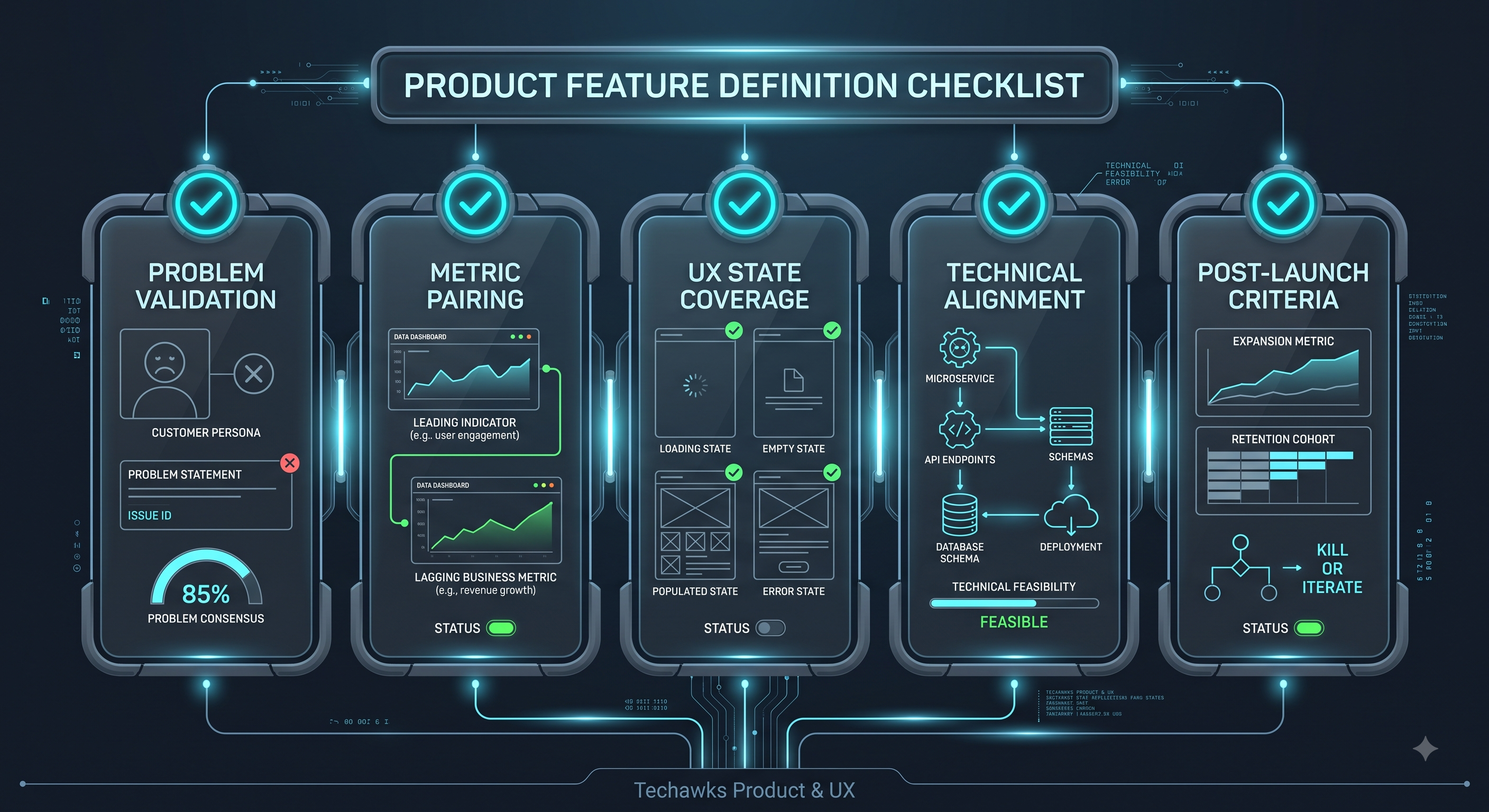
Before moving a feature proposal from discovery into design sprints and engineering backlogs, run through this 5-stage pre-flight checklist to protect your team from low-impact work:
1. Problem & Customer Validation
[ ] The problem statement is documented around observed user friction, not a specific UI solution.
[ ] Validated with qualitative user interviews or session telemetry (minimum 5 distinct data points).
[ ] Target persona is explicitly defined (primary user vs. secondary stakeholder).
2. Metric Alignment & Guardrails
[ ] Leading behavioral metric is defined (e.g., % of users completing workflow in <60s).
[ ] Primary business outcome metric is mapped (e.g., 30-day retention, expansion ARR).
[ ] Guardrail metric is established to ensure this change doesn't harm core performance (e.g., latency, support ticket volume).
3. UX & Edge Case Definition
[ ] All 4 primary UI states are mapped: Loading, Empty, Populated, and Error.
[ ] Permission and role-based access control (RBAC) levels are explicitly documented.
[ ] Mobile/responsive behavioral differences are defined and scoped.
4. Technical Feasibility & Dependency Mapping
[ ] Engineering lead has reviewed architecture requirements and flagged API/schema dependencies.
[ ] Data instrumentation requirements (event tracking names, schema properties) are listed.
[ ] Rollout strategy is determined (feature flag, phased canary release, or beta cohort).
5. Post-Launch Decision Framework
[ ] Success criteria benchmarks are set with a strict evaluation window (e.g., 30 days post-launch).
[ ] Explicit "Kill or Iterate" threshold agreed upon with stakeholders if targets are missed.
Key Takeaways
Validate the core friction point with real user telemetry before designing UI solutions.
Always pair primary success metrics with a guardrail metric to prevent unintended side effects.
Design specs must account for all 4 states: loading, empty, populated, and error.
Predefine an explicit kill/iterate threshold to prevent low-performing features from becoming permanent bloat.
CTA
Want to access structured product management toolkits, PRD frameworks, and UX strategy systems?
Join Techawks Product, UX & Design to collaborate with seasoned PMs and designers, exchange practical templates, and sharpen your product craft.
Before moving a feature proposal from discovery into design sprints and engineering backlogs, run through this 5-stage pre-flight checklist to protect your team from low-impact work:
1. Problem & Customer Validation
[ ] The problem statement is documented around observed user friction, not a specific UI solution.
[ ] Validated with qualitative user interviews or session telemetry (minimum 5 distinct data points).
[ ] Target persona is explicitly defined (primary user vs. secondary stakeholder).
2. Metric Alignment & Guardrails
[ ] Leading behavioral metric is defined (e.g., % of users completing workflow in <60s).
[ ] Primary business outcome metric is mapped (e.g., 30-day retention, expansion ARR).
[ ] Guardrail metric is established to ensure this change doesn't harm core performance (e.g., latency, support ticket volume).
3. UX & Edge Case Definition
[ ] All 4 primary UI states are mapped: Loading, Empty, Populated, and Error.
[ ] Permission and role-based access control (RBAC) levels are explicitly documented.
[ ] Mobile/responsive behavioral differences are defined and scoped.
4. Technical Feasibility & Dependency Mapping
[ ] Engineering lead has reviewed architecture requirements and flagged API/schema dependencies.
[ ] Data instrumentation requirements (event tracking names, schema properties) are listed.
[ ] Rollout strategy is determined (feature flag, phased canary release, or beta cohort).
5. Post-Launch Decision Framework
[ ] Success criteria benchmarks are set with a strict evaluation window (e.g., 30 days post-launch).
[ ] Explicit "Kill or Iterate" threshold agreed upon with stakeholders if targets are missed.
Key Takeaways
Validate the core friction point with real user telemetry before designing UI solutions.
Always pair primary success metrics with a guardrail metric to prevent unintended side effects.
Design specs must account for all 4 states: loading, empty, populated, and error.
Predefine an explicit kill/iterate threshold to prevent low-performing features from becoming permanent bloat.
CTA
Want to access structured product management toolkits, PRD frameworks, and UX strategy systems?
Join Techawks Product, UX & Design to collaborate with seasoned PMs and designers, exchange practical templates, and sharpen your product craft.
The Product Feature Definition Checklist: 5 Gates to Clear Before Writing a Spec
Before moving a feature proposal from discovery into design sprints and engineering backlogs, run through this 5-stage pre-flight checklist to protect your team from low-impact work:
1. Problem & Customer Validation
[ ] The problem statement is documented around observed user friction, not a specific UI solution.
[ ] Validated with qualitative user interviews or session telemetry (minimum 5 distinct data points).
[ ] Target persona is explicitly defined (primary user vs. secondary stakeholder).
2. Metric Alignment & Guardrails
[ ] Leading behavioral metric is defined (e.g., % of users completing workflow in <60s).
[ ] Primary business outcome metric is mapped (e.g., 30-day retention, expansion ARR).
[ ] Guardrail metric is established to ensure this change doesn't harm core performance (e.g., latency, support ticket volume).
3. UX & Edge Case Definition
[ ] All 4 primary UI states are mapped: Loading, Empty, Populated, and Error.
[ ] Permission and role-based access control (RBAC) levels are explicitly documented.
[ ] Mobile/responsive behavioral differences are defined and scoped.
4. Technical Feasibility & Dependency Mapping
[ ] Engineering lead has reviewed architecture requirements and flagged API/schema dependencies.
[ ] Data instrumentation requirements (event tracking names, schema properties) are listed.
[ ] Rollout strategy is determined (feature flag, phased canary release, or beta cohort).
5. Post-Launch Decision Framework
[ ] Success criteria benchmarks are set with a strict evaluation window (e.g., 30 days post-launch).
[ ] Explicit "Kill or Iterate" threshold agreed upon with stakeholders if targets are missed.
Key Takeaways
Validate the core friction point with real user telemetry before designing UI solutions.
Always pair primary success metrics with a guardrail metric to prevent unintended side effects.
Design specs must account for all 4 states: loading, empty, populated, and error.
Predefine an explicit kill/iterate threshold to prevent low-performing features from becoming permanent bloat.
CTA
Want to access structured product management toolkits, PRD frameworks, and UX strategy systems?
Join Techawks Product, UX & Design to collaborate with seasoned PMs and designers, exchange practical templates, and sharpen your product craft.

 English
 Arabic
 French
 Portuguese
 Deutsch
 Turkish
 Dutch
Dutch
 Italiano
 Russian
 Romaian
 Portuguese (Brazil)
 Greek
Greek