


Architecting for UPI Scale: How to Build Resilient Payment Workflows That Never Double-Charge
Building backend services that integrate with payment gateways and UPI rails requires defensive engineering against non-deterministic network states. A timeout from a payment switch does not mean a transaction failed—it often means the confirmation is simply delayed.
Follow these engineering principles to keep your transaction pipeline resilient:
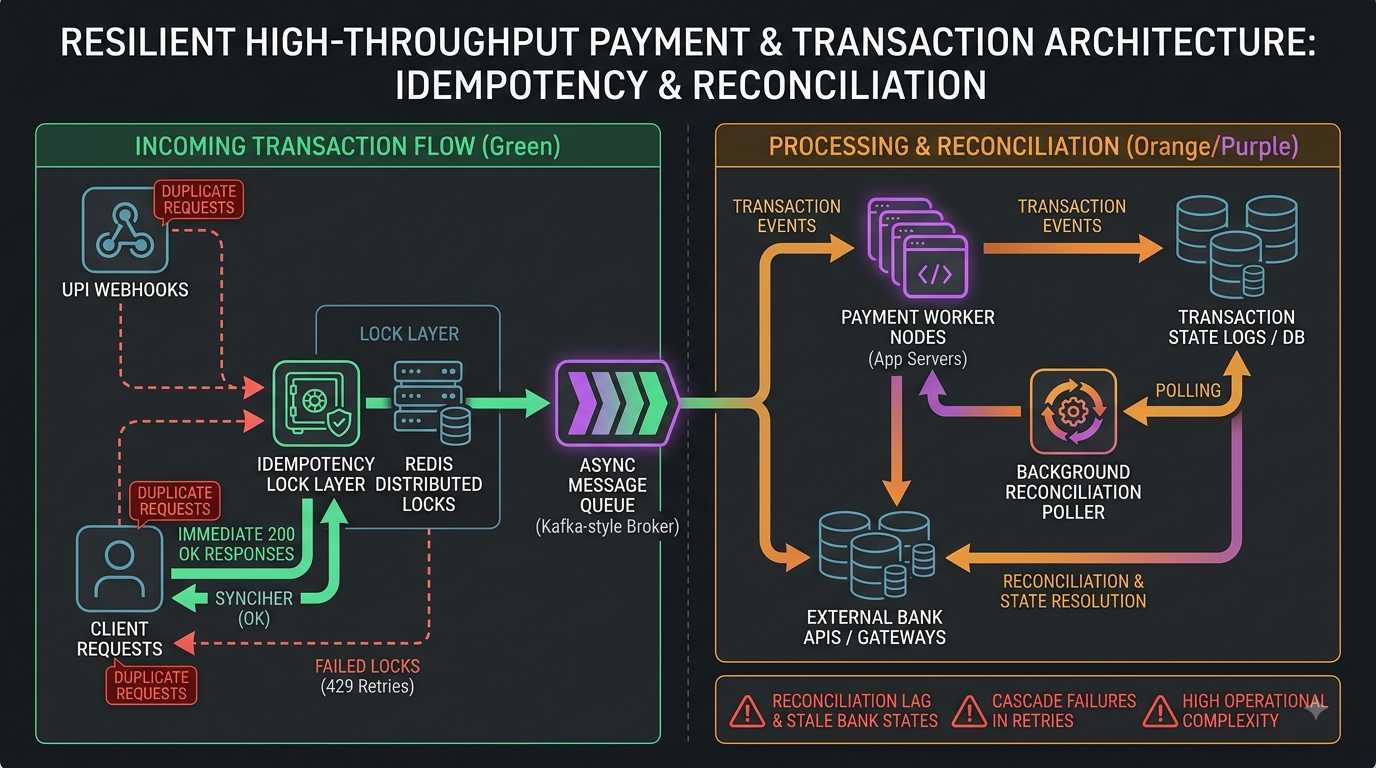
Enforce Strict Idempotency at the Ingress Layer: Every payment request must carry a unique idempotency key generated on the client side (e.g., UUIDv4 paired with order ID). Store these keys in a fast in-memory store like Redis with distributed locks. If a user double-taps the pay button or a gateway sends duplicate webhook payloads, the lock prevents parallel duplicate processing.
Decouple Webhook Ingestion from Fulfillment: Never execute heavy downstream business logic (like inventory allocation or invoice generation) directly inside your incoming webhook HTTP handler. Acknowledge the gateway with an immediate 200 OK after pushing the raw payload into a persistent message queue (e.g., Apache Kafka, AWS SQS, or RabbitMQ) for asynchronous processing.
Implement State Reconciliation Workers: Do not rely solely on real-time webhooks. Schedule background reconciliation jobs running exponential backoff polls against gateway status APIs to resolve dangling "PENDING" states caused by dropped network connections between banking nodes.
Key Takeaways
Idempotency Keys: Prevent duplicate debits and duplicate order fulfillment by enforcing distributed locks on transaction IDs.
Async Ingestion: Keep webhook receivers lightweight to prevent timeout errors from payment gateways during traffic surges.
Automated Reconciliation: Always run background pollers to resolve orphaned and pending transaction states automatically.
CTA
Join Techawks India to connect with top software engineers, discuss real-world backend architectures, and share technical insights tailored for the Indian tech ecosystem.
Building backend services that integrate with payment gateways and UPI rails requires defensive engineering against non-deterministic network states. A timeout from a payment switch does not mean a transaction failed—it often means the confirmation is simply delayed.
Follow these engineering principles to keep your transaction pipeline resilient:
Enforce Strict Idempotency at the Ingress Layer: Every payment request must carry a unique idempotency key generated on the client side (e.g., UUIDv4 paired with order ID). Store these keys in a fast in-memory store like Redis with distributed locks. If a user double-taps the pay button or a gateway sends duplicate webhook payloads, the lock prevents parallel duplicate processing.
Decouple Webhook Ingestion from Fulfillment: Never execute heavy downstream business logic (like inventory allocation or invoice generation) directly inside your incoming webhook HTTP handler. Acknowledge the gateway with an immediate 200 OK after pushing the raw payload into a persistent message queue (e.g., Apache Kafka, AWS SQS, or RabbitMQ) for asynchronous processing.
Implement State Reconciliation Workers: Do not rely solely on real-time webhooks. Schedule background reconciliation jobs running exponential backoff polls against gateway status APIs to resolve dangling "PENDING" states caused by dropped network connections between banking nodes.
Key Takeaways
Idempotency Keys: Prevent duplicate debits and duplicate order fulfillment by enforcing distributed locks on transaction IDs.
Async Ingestion: Keep webhook receivers lightweight to prevent timeout errors from payment gateways during traffic surges.
Automated Reconciliation: Always run background pollers to resolve orphaned and pending transaction states automatically.
CTA
Join Techawks India to connect with top software engineers, discuss real-world backend architectures, and share technical insights tailored for the Indian tech ecosystem.
Architecting for UPI Scale: How to Build Resilient Payment Workflows That Never Double-Charge
Building backend services that integrate with payment gateways and UPI rails requires defensive engineering against non-deterministic network states. A timeout from a payment switch does not mean a transaction failed—it often means the confirmation is simply delayed.
Follow these engineering principles to keep your transaction pipeline resilient:
Enforce Strict Idempotency at the Ingress Layer: Every payment request must carry a unique idempotency key generated on the client side (e.g., UUIDv4 paired with order ID). Store these keys in a fast in-memory store like Redis with distributed locks. If a user double-taps the pay button or a gateway sends duplicate webhook payloads, the lock prevents parallel duplicate processing.
Decouple Webhook Ingestion from Fulfillment: Never execute heavy downstream business logic (like inventory allocation or invoice generation) directly inside your incoming webhook HTTP handler. Acknowledge the gateway with an immediate 200 OK after pushing the raw payload into a persistent message queue (e.g., Apache Kafka, AWS SQS, or RabbitMQ) for asynchronous processing.
Implement State Reconciliation Workers: Do not rely solely on real-time webhooks. Schedule background reconciliation jobs running exponential backoff polls against gateway status APIs to resolve dangling "PENDING" states caused by dropped network connections between banking nodes.
Key Takeaways
Idempotency Keys: Prevent duplicate debits and duplicate order fulfillment by enforcing distributed locks on transaction IDs.
Async Ingestion: Keep webhook receivers lightweight to prevent timeout errors from payment gateways during traffic surges.
Automated Reconciliation: Always run background pollers to resolve orphaned and pending transaction states automatically.
CTA
Join Techawks India to connect with top software engineers, discuss real-world backend architectures, and share technical insights tailored for the Indian tech ecosystem.

 English
 Arabic
 French
 Spanish
 Portuguese
 Deutsch
 Turkish
 Dutch
Dutch
 Italiano
 Russian
 Romaian
 Greek
Greek