


The High-Concurrency Flash Sale Challenge: Can Your Backend Survive 50k Concurrent Checkouts Without Overselling?
Most e-commerce backends work fine during standard traffic, but high-concurrency bursts expose hidden concurrency bugs.
The Challenge Scenario:
Traffic: 50,000 users hitting the POST /checkout endpoint within a 5-second window.
Inventory: 100 units available in stock.
Constraints: Zero overselling, p99 response time under 150ms, and no distributed deadlocks on your relational database.
Evaluate your current architecture against these 3 tiers:
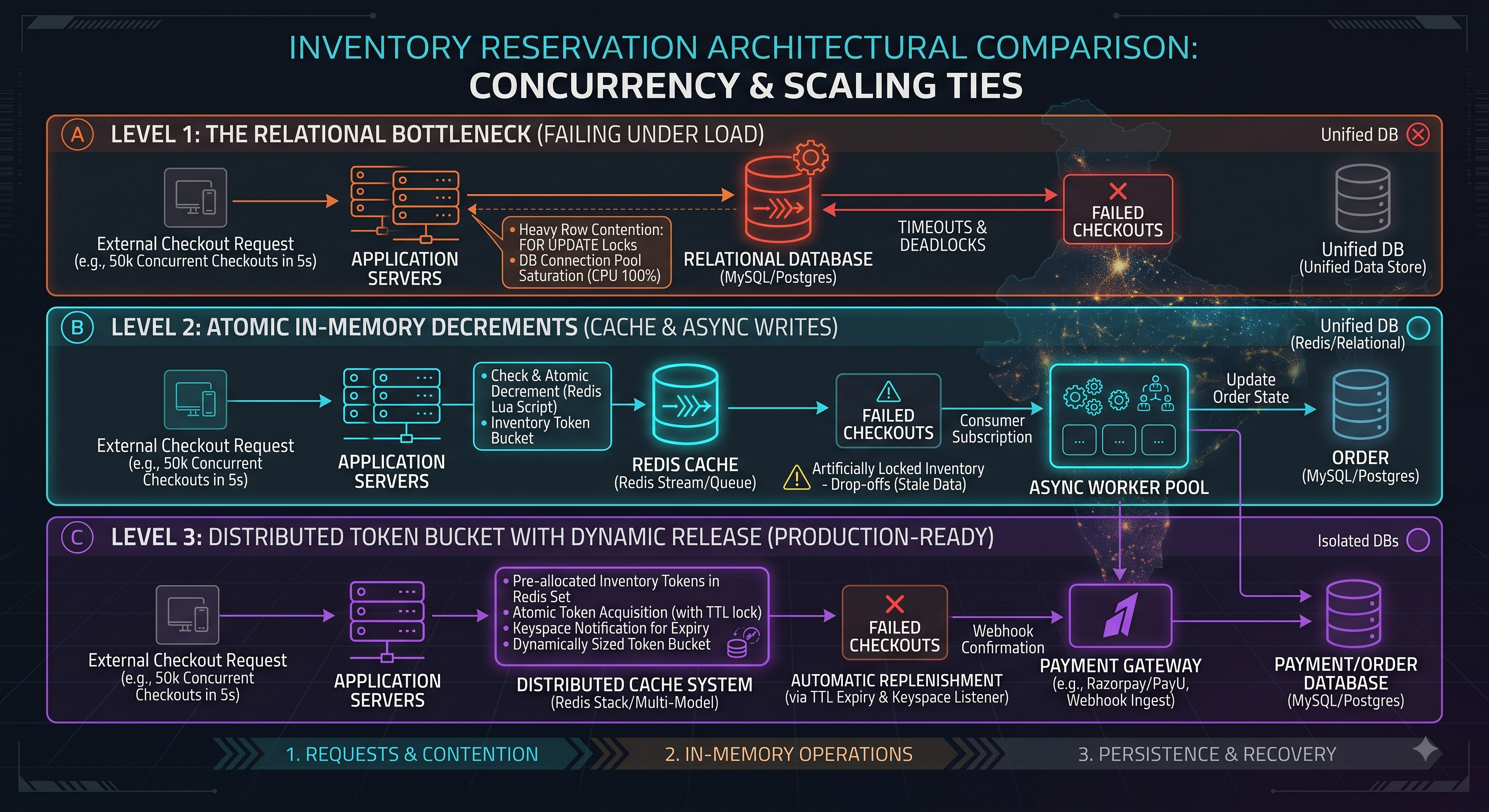
Level 1: The Relational Bottleneck (Fails under load)
Approach: Running SELECT stock FROM products WHERE id = ? FOR UPDATE directly on MySQL/PostgreSQL.
Failure Mode: Heavy row contention exhausts database connection pools, drives CPU utilization to 100%, and causes cascading gateway timeouts.
Level 2: Atomic In-Memory Decrements (Good, but edge cases remain)
Approach: Caching stock in Redis and using atomic operations (DECR or a Lua script) to check and decrement in a single step before queueing an asynchronous database write.
Pitfall to Watch: What happens when a user reserves stock via Redis but abandons their payment gateway session? Without a strict Time-To-Live (TTL) rollback strategy, your inventory becomes artificially locked and unsellable.
Level 3: Distributed Token Bucket with Dynamic Release (Production-Ready)
Approach: Pre-allocate inventory units as discrete cryptographic tokens in an in-memory Redis Set.
Execution: When a user initiates checkout, acquire an inventory token atomically with an associated Redis TTL (e.g., 8 minutes for payment completion). If payment confirmation arrives via webhook, commit the write to the database. If the TTL expires, the token automatically returns to the pool via a keyspace notification listener.
Key Takeaways
Never lock relational rows at peak: Relational locks create severe database contention during traffic spikes; move stock decrement logic into in-memory atomic layers.
Handle payment drop-offs gracefully: An inventory lock must always carry an automatic expiry mechanism to replenish uncompleted checkouts.
Decouple checkout from persistence: Treat inventory reservation as an immediate, fast-path memory operation and database settlement as an asynchronous background worker task.
CTA (Join Techawks India)
Ready to stress-test your distributed systems against real-world scale? Join Techawks India to tackle engineering challenges, benchmark high-throughput architectures, and exchange solutions with top system designers across the subcontinent.
Most e-commerce backends work fine during standard traffic, but high-concurrency bursts expose hidden concurrency bugs.
The Challenge Scenario:
Traffic: 50,000 users hitting the POST /checkout endpoint within a 5-second window.
Inventory: 100 units available in stock.
Constraints: Zero overselling, p99 response time under 150ms, and no distributed deadlocks on your relational database.
Evaluate your current architecture against these 3 tiers:
Level 1: The Relational Bottleneck (Fails under load)
Approach: Running SELECT stock FROM products WHERE id = ? FOR UPDATE directly on MySQL/PostgreSQL.
Failure Mode: Heavy row contention exhausts database connection pools, drives CPU utilization to 100%, and causes cascading gateway timeouts.
Level 2: Atomic In-Memory Decrements (Good, but edge cases remain)
Approach: Caching stock in Redis and using atomic operations (DECR or a Lua script) to check and decrement in a single step before queueing an asynchronous database write.
Pitfall to Watch: What happens when a user reserves stock via Redis but abandons their payment gateway session? Without a strict Time-To-Live (TTL) rollback strategy, your inventory becomes artificially locked and unsellable.
Level 3: Distributed Token Bucket with Dynamic Release (Production-Ready)
Approach: Pre-allocate inventory units as discrete cryptographic tokens in an in-memory Redis Set.
Execution: When a user initiates checkout, acquire an inventory token atomically with an associated Redis TTL (e.g., 8 minutes for payment completion). If payment confirmation arrives via webhook, commit the write to the database. If the TTL expires, the token automatically returns to the pool via a keyspace notification listener.
Key Takeaways
Never lock relational rows at peak: Relational locks create severe database contention during traffic spikes; move stock decrement logic into in-memory atomic layers.
Handle payment drop-offs gracefully: An inventory lock must always carry an automatic expiry mechanism to replenish uncompleted checkouts.
Decouple checkout from persistence: Treat inventory reservation as an immediate, fast-path memory operation and database settlement as an asynchronous background worker task.
CTA (Join Techawks India)
Ready to stress-test your distributed systems against real-world scale? Join Techawks India to tackle engineering challenges, benchmark high-throughput architectures, and exchange solutions with top system designers across the subcontinent.
The High-Concurrency Flash Sale Challenge: Can Your Backend Survive 50k Concurrent Checkouts Without Overselling?
Most e-commerce backends work fine during standard traffic, but high-concurrency bursts expose hidden concurrency bugs.
The Challenge Scenario:
Traffic: 50,000 users hitting the POST /checkout endpoint within a 5-second window.
Inventory: 100 units available in stock.
Constraints: Zero overselling, p99 response time under 150ms, and no distributed deadlocks on your relational database.
Evaluate your current architecture against these 3 tiers:
Level 1: The Relational Bottleneck (Fails under load)
Approach: Running SELECT stock FROM products WHERE id = ? FOR UPDATE directly on MySQL/PostgreSQL.
Failure Mode: Heavy row contention exhausts database connection pools, drives CPU utilization to 100%, and causes cascading gateway timeouts.
Level 2: Atomic In-Memory Decrements (Good, but edge cases remain)
Approach: Caching stock in Redis and using atomic operations (DECR or a Lua script) to check and decrement in a single step before queueing an asynchronous database write.
Pitfall to Watch: What happens when a user reserves stock via Redis but abandons their payment gateway session? Without a strict Time-To-Live (TTL) rollback strategy, your inventory becomes artificially locked and unsellable.
Level 3: Distributed Token Bucket with Dynamic Release (Production-Ready)
Approach: Pre-allocate inventory units as discrete cryptographic tokens in an in-memory Redis Set.
Execution: When a user initiates checkout, acquire an inventory token atomically with an associated Redis TTL (e.g., 8 minutes for payment completion). If payment confirmation arrives via webhook, commit the write to the database. If the TTL expires, the token automatically returns to the pool via a keyspace notification listener.
Key Takeaways
Never lock relational rows at peak: Relational locks create severe database contention during traffic spikes; move stock decrement logic into in-memory atomic layers.
Handle payment drop-offs gracefully: An inventory lock must always carry an automatic expiry mechanism to replenish uncompleted checkouts.
Decouple checkout from persistence: Treat inventory reservation as an immediate, fast-path memory operation and database settlement as an asynchronous background worker task.
CTA (Join Techawks India)
Ready to stress-test your distributed systems against real-world scale? Join Techawks India to tackle engineering challenges, benchmark high-throughput architectures, and exchange solutions with top system designers across the subcontinent.

 English
 Arabic
 French
 Spanish
 Portuguese
 Deutsch
 Turkish
 Dutch
Dutch
 Italiano
 Russian
 Romaian
 Portuguese (Brazil)