


Designing Cross-Region Active-Active Cloud Architectures Across US AWS & GCP Zones
Serving users distributed across North America requires balancing write-consistency trade-offs against cross-continental network latency (which consistently measures 60–80ms between us-east-1 and us-west-2).
To build a reliable cross-region active-active topology, structure your data and networking layers around three core pillars:
Global Anycast Routing & Ingress
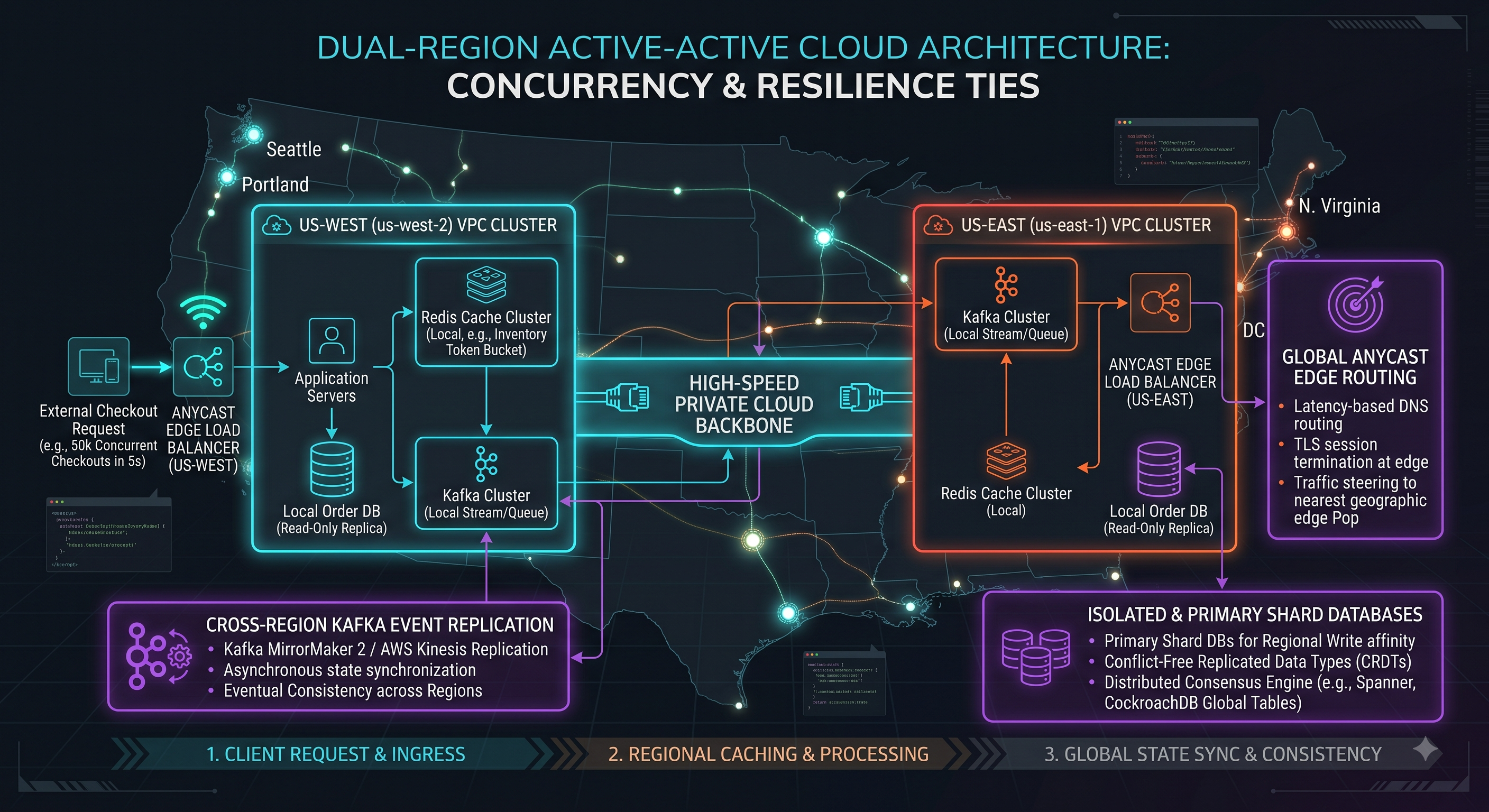
Use latency-based Anycast DNS routing (e.g., AWS Route 53 or Cloudflare) to steer client traffic to the nearest geographic edge pop.
Terminate TLS sessions at the edge and proxy connections through dedicated cloud backbone backhauls to eliminate repeated cross-country handshake overheads.
Partitioned Data Topologies
Read-Heavy Workloads: Deploy global multi-region read replicas with localized caching (Redis clusters in each region) to fulfill 95%+ of queries locally with single-digit millisecond latency.
Write-Heavy Workloads: Partition data by user locality/tenant ID. Pin US-West users to write primary shards in us-west-2 (Oregon) and US-East users to us-east-1 (N. Virginia).
Use distributed consensus engines (such as CockroachDB, Spanner, or DynamoDB Global Tables) for global entities, relying on conflict-free replicated data types (CRDTs) or Last-Write-Wins (LWW) resolution strategies.
Cross-Region Asynchronous Synchronization
Avoid synchronous cross-region database writes inside request threads.
Stream state changes across regions using distributed event logs (e.g., Apache Kafka with MirrorMaker 2 or AWS Kinesis cross-region replication) to maintain eventually consistent regional mirrors without locking active client transactions.
Key Takeaways
Localize writes by partition: Split customer traffic and data ownership by geographic affinity to prevent cross-country write locks.
Keep the hot path asynchronous: Never place cross-region network RPCs inside critical client-facing write paths.
Leverage cloud backbones: Route inter-region traffic over dedicated provider backbones rather than public transit networks to stabilize p99 latency jitter.
CTA (Join Techawks USA)
Building scalable multi-region infrastructure across North American cloud zones? Join Techawks USA to connect with staff engineers, exchange architectural patterns, and access production-grade distributed systems guides.
Serving users distributed across North America requires balancing write-consistency trade-offs against cross-continental network latency (which consistently measures 60–80ms between us-east-1 and us-west-2).
To build a reliable cross-region active-active topology, structure your data and networking layers around three core pillars:
Global Anycast Routing & Ingress
Use latency-based Anycast DNS routing (e.g., AWS Route 53 or Cloudflare) to steer client traffic to the nearest geographic edge pop.
Terminate TLS sessions at the edge and proxy connections through dedicated cloud backbone backhauls to eliminate repeated cross-country handshake overheads.
Partitioned Data Topologies
Read-Heavy Workloads: Deploy global multi-region read replicas with localized caching (Redis clusters in each region) to fulfill 95%+ of queries locally with single-digit millisecond latency.
Write-Heavy Workloads: Partition data by user locality/tenant ID. Pin US-West users to write primary shards in us-west-2 (Oregon) and US-East users to us-east-1 (N. Virginia).
Use distributed consensus engines (such as CockroachDB, Spanner, or DynamoDB Global Tables) for global entities, relying on conflict-free replicated data types (CRDTs) or Last-Write-Wins (LWW) resolution strategies.
Cross-Region Asynchronous Synchronization
Avoid synchronous cross-region database writes inside request threads.
Stream state changes across regions using distributed event logs (e.g., Apache Kafka with MirrorMaker 2 or AWS Kinesis cross-region replication) to maintain eventually consistent regional mirrors without locking active client transactions.
Key Takeaways
Localize writes by partition: Split customer traffic and data ownership by geographic affinity to prevent cross-country write locks.
Keep the hot path asynchronous: Never place cross-region network RPCs inside critical client-facing write paths.
Leverage cloud backbones: Route inter-region traffic over dedicated provider backbones rather than public transit networks to stabilize p99 latency jitter.
CTA (Join Techawks USA)
Building scalable multi-region infrastructure across North American cloud zones? Join Techawks USA to connect with staff engineers, exchange architectural patterns, and access production-grade distributed systems guides.
Designing Cross-Region Active-Active Cloud Architectures Across US AWS & GCP Zones
Serving users distributed across North America requires balancing write-consistency trade-offs against cross-continental network latency (which consistently measures 60–80ms between us-east-1 and us-west-2).
To build a reliable cross-region active-active topology, structure your data and networking layers around three core pillars:
Global Anycast Routing & Ingress
Use latency-based Anycast DNS routing (e.g., AWS Route 53 or Cloudflare) to steer client traffic to the nearest geographic edge pop.
Terminate TLS sessions at the edge and proxy connections through dedicated cloud backbone backhauls to eliminate repeated cross-country handshake overheads.
Partitioned Data Topologies
Read-Heavy Workloads: Deploy global multi-region read replicas with localized caching (Redis clusters in each region) to fulfill 95%+ of queries locally with single-digit millisecond latency.
Write-Heavy Workloads: Partition data by user locality/tenant ID. Pin US-West users to write primary shards in us-west-2 (Oregon) and US-East users to us-east-1 (N. Virginia).
Use distributed consensus engines (such as CockroachDB, Spanner, or DynamoDB Global Tables) for global entities, relying on conflict-free replicated data types (CRDTs) or Last-Write-Wins (LWW) resolution strategies.
Cross-Region Asynchronous Synchronization
Avoid synchronous cross-region database writes inside request threads.
Stream state changes across regions using distributed event logs (e.g., Apache Kafka with MirrorMaker 2 or AWS Kinesis cross-region replication) to maintain eventually consistent regional mirrors without locking active client transactions.
Key Takeaways
Localize writes by partition: Split customer traffic and data ownership by geographic affinity to prevent cross-country write locks.
Keep the hot path asynchronous: Never place cross-region network RPCs inside critical client-facing write paths.
Leverage cloud backbones: Route inter-region traffic over dedicated provider backbones rather than public transit networks to stabilize p99 latency jitter.
CTA (Join Techawks USA)
Building scalable multi-region infrastructure across North American cloud zones? Join Techawks USA to connect with staff engineers, exchange architectural patterns, and access production-grade distributed systems guides.

 English
 Arabic
 French
 Spanish
 Portuguese
 Deutsch
 Turkish
 Dutch
Dutch
 Italiano
 Russian
 Romaian
 Greek
Greek