


How to Optimize Multi-Region Cloud Egress and Cross-Zone Transit Costs
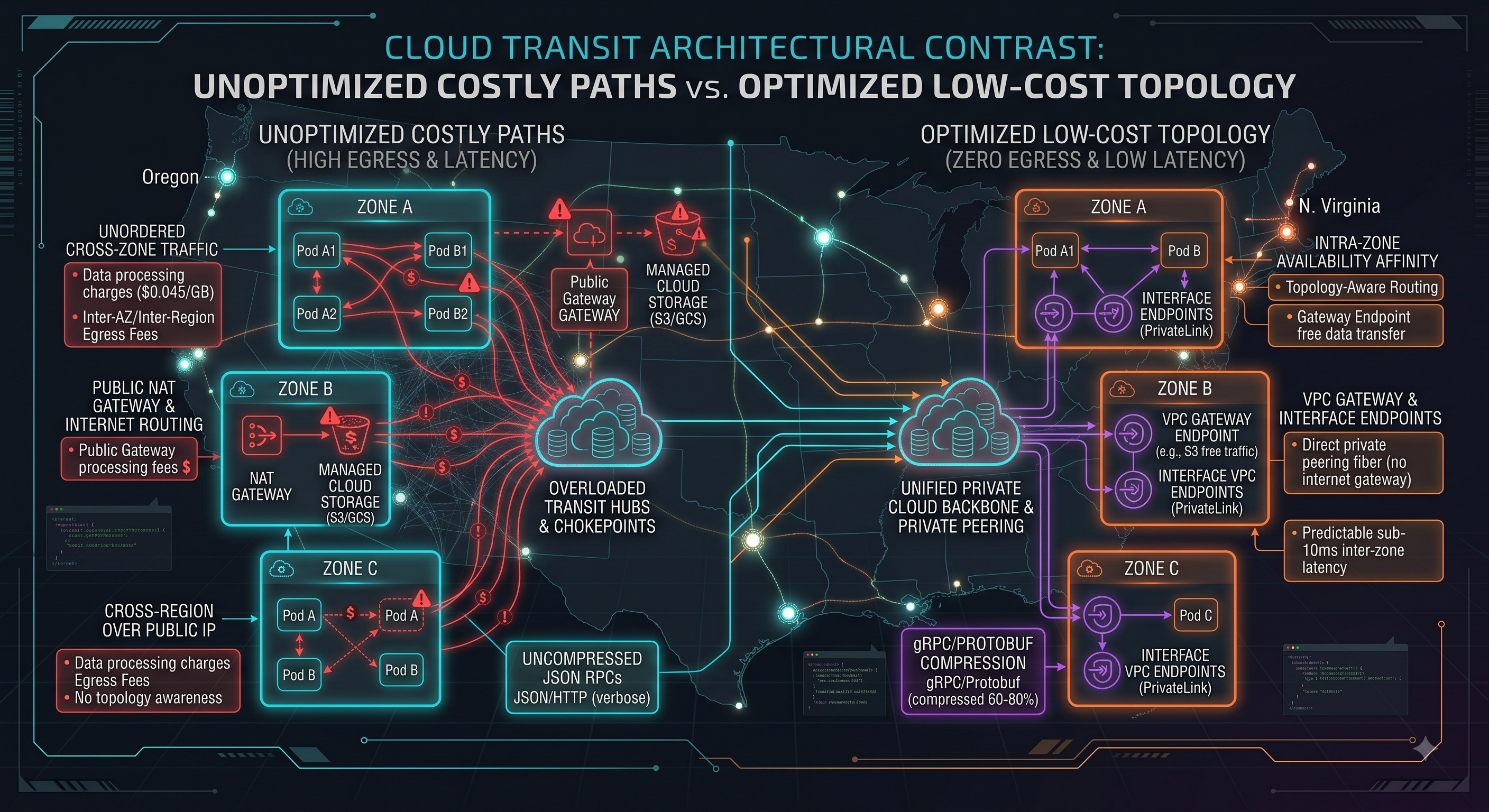
In distributed multi-region US deployments (e.g., spanning us-east-1, us-east-2, and us-west-2), sending uncompressed, un-peered data across Availability Zones (AZs) or regions accumulates massive metered costs.
Follow this tutorial to audit, route, and compress high-volume internal service traffic:
Step 1: Enforce Local Availability Zone Affinity
Traffic crossing AZ boundaries incurs charges in both directions. Configure Kubernetes topology-aware routing (topologyKeys: ["topology.kubernetes.io/zone"]) or service-mesh locality load balancing.
Ensure pods communicate with database read replicas, cache nodes, and downstream microservices residing within the same AZ before falling back to cross-zone nodes.
Step 2: Replace Public IP Routing with Gateway & Interface VPC Endpoints
When microservices access managed cloud storage (like Amazon S3 or Google Cloud Storage) via public endpoints, traffic travels over public gateways and incurs NAT gateway data processing fees (0.045/GB).
Provision free Gateway Endpoints for storage and PrivateLink/Interface Endpoints for internal API communication to keep traffic strictly on the local VPC backbone.
Step 3: Establish Direct Inter-Region VPC Peering Over Public Ingress
Avoid routing cross-region traffic over public IP internet gateways. Set up inter-region VPC peering or Cloud WAN attachments.
Inter-region private peering ensures data flows entirely over dedicated private fiber, eliminating public internet gateway surcharges and stabilizing packet jitter.
Step 4: Implement gRPC/Protobuf Payload Compression on Hot Internal Paths
Switch inter-service communication from verbose JSON over HTTP/1.1 to gRPC with HTTP/2 and Snappy or Gzip compression.
Binary protocol serialization reduces raw payload size by 60–80%, directly lowering metered cross-region data transfer volume between regional worker pools.
Key Takeaways
Keep high-frequency RPCs intra-zone: Use topology-aware routing to prevent microservices from generating unintentional cross-AZ transit costs.
Eliminate NAT gateway data processing: Route all cloud-managed service calls (S3, DynamoDB) through VPC Endpoints.
Compress internal payloads: Binary protocols like gRPC drastically cut total gigabytes transferred across regional boundaries.
CTA (Join Techawks USA)
Looking to optimize cloud architecture, infrastructure economics, and distributed systems performance? Join Techawks USA to collaborate with staff platform engineers, access architecture teardowns, and share production strategies.
In distributed multi-region US deployments (e.g., spanning us-east-1, us-east-2, and us-west-2), sending uncompressed, un-peered data across Availability Zones (AZs) or regions accumulates massive metered costs.
Follow this tutorial to audit, route, and compress high-volume internal service traffic:
Step 1: Enforce Local Availability Zone Affinity
Traffic crossing AZ boundaries incurs charges in both directions. Configure Kubernetes topology-aware routing (topologyKeys: ["topology.kubernetes.io/zone"]) or service-mesh locality load balancing.
Ensure pods communicate with database read replicas, cache nodes, and downstream microservices residing within the same AZ before falling back to cross-zone nodes.
Step 2: Replace Public IP Routing with Gateway & Interface VPC Endpoints
When microservices access managed cloud storage (like Amazon S3 or Google Cloud Storage) via public endpoints, traffic travels over public gateways and incurs NAT gateway data processing fees (0.045/GB).
Provision free Gateway Endpoints for storage and PrivateLink/Interface Endpoints for internal API communication to keep traffic strictly on the local VPC backbone.
Step 3: Establish Direct Inter-Region VPC Peering Over Public Ingress
Avoid routing cross-region traffic over public IP internet gateways. Set up inter-region VPC peering or Cloud WAN attachments.
Inter-region private peering ensures data flows entirely over dedicated private fiber, eliminating public internet gateway surcharges and stabilizing packet jitter.
Step 4: Implement gRPC/Protobuf Payload Compression on Hot Internal Paths
Switch inter-service communication from verbose JSON over HTTP/1.1 to gRPC with HTTP/2 and Snappy or Gzip compression.
Binary protocol serialization reduces raw payload size by 60–80%, directly lowering metered cross-region data transfer volume between regional worker pools.
Key Takeaways
Keep high-frequency RPCs intra-zone: Use topology-aware routing to prevent microservices from generating unintentional cross-AZ transit costs.
Eliminate NAT gateway data processing: Route all cloud-managed service calls (S3, DynamoDB) through VPC Endpoints.
Compress internal payloads: Binary protocols like gRPC drastically cut total gigabytes transferred across regional boundaries.
CTA (Join Techawks USA)
Looking to optimize cloud architecture, infrastructure economics, and distributed systems performance? Join Techawks USA to collaborate with staff platform engineers, access architecture teardowns, and share production strategies.
How to Optimize Multi-Region Cloud Egress and Cross-Zone Transit Costs
In distributed multi-region US deployments (e.g., spanning us-east-1, us-east-2, and us-west-2), sending uncompressed, un-peered data across Availability Zones (AZs) or regions accumulates massive metered costs.
Follow this tutorial to audit, route, and compress high-volume internal service traffic:
Step 1: Enforce Local Availability Zone Affinity
Traffic crossing AZ boundaries incurs charges in both directions. Configure Kubernetes topology-aware routing (topologyKeys: ["topology.kubernetes.io/zone"]) or service-mesh locality load balancing.
Ensure pods communicate with database read replicas, cache nodes, and downstream microservices residing within the same AZ before falling back to cross-zone nodes.
Step 2: Replace Public IP Routing with Gateway & Interface VPC Endpoints
When microservices access managed cloud storage (like Amazon S3 or Google Cloud Storage) via public endpoints, traffic travels over public gateways and incurs NAT gateway data processing fees (0.045/GB).
Provision free Gateway Endpoints for storage and PrivateLink/Interface Endpoints for internal API communication to keep traffic strictly on the local VPC backbone.
Step 3: Establish Direct Inter-Region VPC Peering Over Public Ingress
Avoid routing cross-region traffic over public IP internet gateways. Set up inter-region VPC peering or Cloud WAN attachments.
Inter-region private peering ensures data flows entirely over dedicated private fiber, eliminating public internet gateway surcharges and stabilizing packet jitter.
Step 4: Implement gRPC/Protobuf Payload Compression on Hot Internal Paths
Switch inter-service communication from verbose JSON over HTTP/1.1 to gRPC with HTTP/2 and Snappy or Gzip compression.
Binary protocol serialization reduces raw payload size by 60–80%, directly lowering metered cross-region data transfer volume between regional worker pools.
Key Takeaways
Keep high-frequency RPCs intra-zone: Use topology-aware routing to prevent microservices from generating unintentional cross-AZ transit costs.
Eliminate NAT gateway data processing: Route all cloud-managed service calls (S3, DynamoDB) through VPC Endpoints.
Compress internal payloads: Binary protocols like gRPC drastically cut total gigabytes transferred across regional boundaries.
CTA (Join Techawks USA)
Looking to optimize cloud architecture, infrastructure economics, and distributed systems performance? Join Techawks USA to collaborate with staff platform engineers, access architecture teardowns, and share production strategies.

 English
 Arabic
 French
 Spanish
 Portuguese
 Deutsch
 Turkish
 Dutch
Dutch
 Russian
 Romaian
 Portuguese (Brazil)
 Greek
Greek