


The Engineering SOC 2 Type II Readiness Checklist for Cloud-Native US Startups
For US B2B SaaS organizations, SOC 2 Type II compliance evaluates the operational effectiveness of your security, availability, and confidentiality controls over time.
Identity & Access Management (IAM)
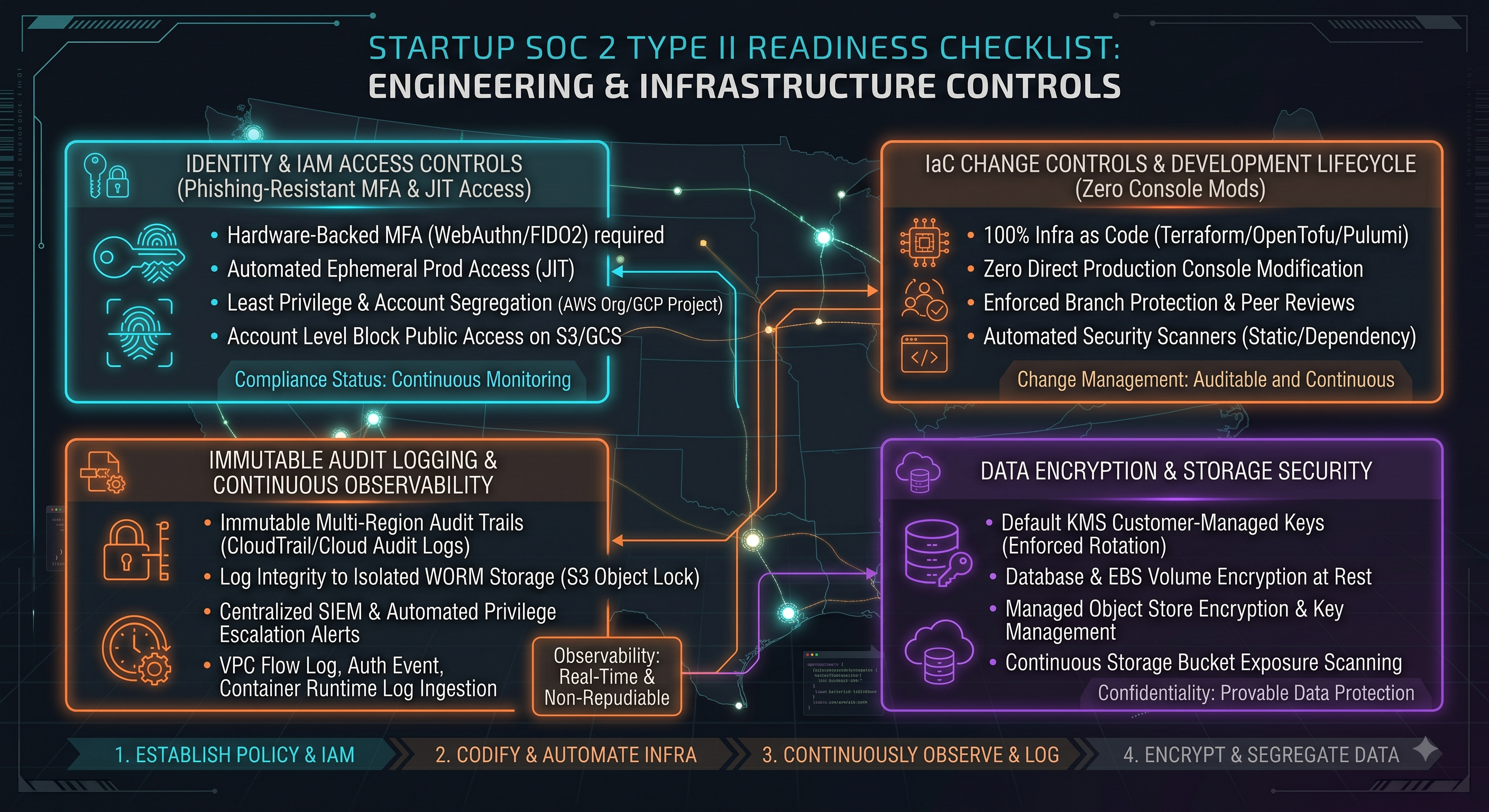
[ ] Enforce Hardware-Backed MFA: Require phishing-resistant WebAuthn/FIDO2 MFA for all identity providers (IdP) and single sign-on (SSO) accounts.
[ ] Automated Ephemeral Production Access: Eliminate static bastion SSH keys and permanent admin permissions. Implement Just-In-Time (JIT) access approval workflows with automatic session revocation after 4–8 hours.
[ ] Enforce Least Privilege & Account Segregation: Separate production, staging, and development accounts at the AWS Organization / GCP Project level.
Infrastructure as Code (IaC) & Change Controls
[ ] Zero Direct Console Modifications: Lock down write access to production cloud consoles, provisioning 100% of cloud resources through version-controlled Terraform/OpenTofu or Pulumi.
[ ] Enforced Branch Protection & Peer Reviews: Require at least one peer approval and passing automated CI/CD security scanners (static analysis, dependency checks) prior to merging code to production branches.
Audit Logging & Continuous Observability
[ ] Immutable Multi-Region Audit Trails: Enable AWS CloudTrail (or GCP Cloud Audit Logs) across all regions, streaming events to an isolated, write-once-read-many (WORM) S3 bucket with Object Lock enabled.
[ ] Centralized SIEM & Automated Alerting: Ingest VPC flow logs, authentication events, and container runtime logs into a centralized log management tool with automated alerting on privilege escalation attempts.
Data Encryption & Storage Security
[ ] Default KMS Customer-Managed Keys: Enforce automated annual key rotation for all encrypted databases, EBS volumes, and managed object stores.
[ ] Account-Level Public Access Blocks: Enable account-level block public access on S3/GCS and continuously scan storage buckets for accidental exposure.
Key Takeaways
Automate evidence gathering: Manual screenshots fail over multi-month observation periods; use automated compliance agents and immutable logging.
Segregate environments cleanly: Isolate production data entirely from development and staging VPCs to minimize audit scope.
Codify all infrastructure: If infrastructure changes aren't tracked in version control pull requests, auditors will flag change management gaps.
CTA (Join Techawks USA)
Preparing your cloud infrastructure for enterprise compliance and scaling security operations? Join Techawks USA to collaborate with senior infrastructure engineers, access battle-tested architecture templates, and streamline your security posture.
For US B2B SaaS organizations, SOC 2 Type II compliance evaluates the operational effectiveness of your security, availability, and confidentiality controls over time.
Identity & Access Management (IAM)
[ ] Enforce Hardware-Backed MFA: Require phishing-resistant WebAuthn/FIDO2 MFA for all identity providers (IdP) and single sign-on (SSO) accounts.
[ ] Automated Ephemeral Production Access: Eliminate static bastion SSH keys and permanent admin permissions. Implement Just-In-Time (JIT) access approval workflows with automatic session revocation after 4–8 hours.
[ ] Enforce Least Privilege & Account Segregation: Separate production, staging, and development accounts at the AWS Organization / GCP Project level.
Infrastructure as Code (IaC) & Change Controls
[ ] Zero Direct Console Modifications: Lock down write access to production cloud consoles, provisioning 100% of cloud resources through version-controlled Terraform/OpenTofu or Pulumi.
[ ] Enforced Branch Protection & Peer Reviews: Require at least one peer approval and passing automated CI/CD security scanners (static analysis, dependency checks) prior to merging code to production branches.
Audit Logging & Continuous Observability
[ ] Immutable Multi-Region Audit Trails: Enable AWS CloudTrail (or GCP Cloud Audit Logs) across all regions, streaming events to an isolated, write-once-read-many (WORM) S3 bucket with Object Lock enabled.
[ ] Centralized SIEM & Automated Alerting: Ingest VPC flow logs, authentication events, and container runtime logs into a centralized log management tool with automated alerting on privilege escalation attempts.
Data Encryption & Storage Security
[ ] Default KMS Customer-Managed Keys: Enforce automated annual key rotation for all encrypted databases, EBS volumes, and managed object stores.
[ ] Account-Level Public Access Blocks: Enable account-level block public access on S3/GCS and continuously scan storage buckets for accidental exposure.
Key Takeaways
Automate evidence gathering: Manual screenshots fail over multi-month observation periods; use automated compliance agents and immutable logging.
Segregate environments cleanly: Isolate production data entirely from development and staging VPCs to minimize audit scope.
Codify all infrastructure: If infrastructure changes aren't tracked in version control pull requests, auditors will flag change management gaps.
CTA (Join Techawks USA)
Preparing your cloud infrastructure for enterprise compliance and scaling security operations? Join Techawks USA to collaborate with senior infrastructure engineers, access battle-tested architecture templates, and streamline your security posture.
The Engineering SOC 2 Type II Readiness Checklist for Cloud-Native US Startups
For US B2B SaaS organizations, SOC 2 Type II compliance evaluates the operational effectiveness of your security, availability, and confidentiality controls over time.
Identity & Access Management (IAM)
[ ] Enforce Hardware-Backed MFA: Require phishing-resistant WebAuthn/FIDO2 MFA for all identity providers (IdP) and single sign-on (SSO) accounts.
[ ] Automated Ephemeral Production Access: Eliminate static bastion SSH keys and permanent admin permissions. Implement Just-In-Time (JIT) access approval workflows with automatic session revocation after 4–8 hours.
[ ] Enforce Least Privilege & Account Segregation: Separate production, staging, and development accounts at the AWS Organization / GCP Project level.
Infrastructure as Code (IaC) & Change Controls
[ ] Zero Direct Console Modifications: Lock down write access to production cloud consoles, provisioning 100% of cloud resources through version-controlled Terraform/OpenTofu or Pulumi.
[ ] Enforced Branch Protection & Peer Reviews: Require at least one peer approval and passing automated CI/CD security scanners (static analysis, dependency checks) prior to merging code to production branches.
Audit Logging & Continuous Observability
[ ] Immutable Multi-Region Audit Trails: Enable AWS CloudTrail (or GCP Cloud Audit Logs) across all regions, streaming events to an isolated, write-once-read-many (WORM) S3 bucket with Object Lock enabled.
[ ] Centralized SIEM & Automated Alerting: Ingest VPC flow logs, authentication events, and container runtime logs into a centralized log management tool with automated alerting on privilege escalation attempts.
Data Encryption & Storage Security
[ ] Default KMS Customer-Managed Keys: Enforce automated annual key rotation for all encrypted databases, EBS volumes, and managed object stores.
[ ] Account-Level Public Access Blocks: Enable account-level block public access on S3/GCS and continuously scan storage buckets for accidental exposure.
Key Takeaways
Automate evidence gathering: Manual screenshots fail over multi-month observation periods; use automated compliance agents and immutable logging.
Segregate environments cleanly: Isolate production data entirely from development and staging VPCs to minimize audit scope.
Codify all infrastructure: If infrastructure changes aren't tracked in version control pull requests, auditors will flag change management gaps.
CTA (Join Techawks USA)
Preparing your cloud infrastructure for enterprise compliance and scaling security operations? Join Techawks USA to collaborate with senior infrastructure engineers, access battle-tested architecture templates, and streamline your security posture.

 English
 Arabic
 French
 Spanish
 Portuguese
 Deutsch
 Turkish
 Dutch
Dutch
 Italiano
 Romaian
 Portuguese (Brazil)
 Greek
Greek