


Mastering Async Control Flow: How to Avoid Callback Hell and Promise Race Conditions
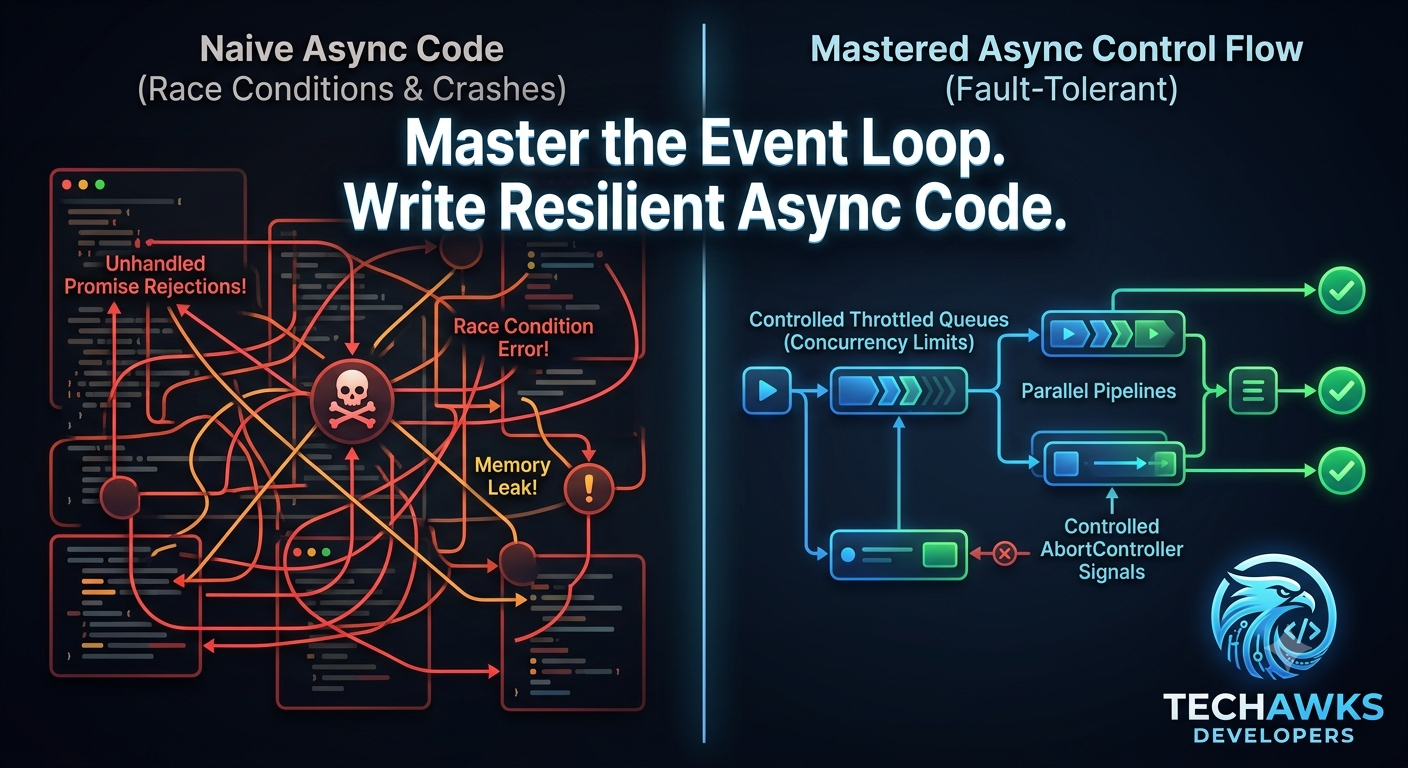
Writing robust asynchronous code requires moving beyond simple async/await syntax to master control flow execution patterns. When dealing with parallel requests, resource limits, and error handling, relying on naive loops can paralyze your application.
Here is how to write clean, predictable async code that scales:
1. Execute Parallel Requests Concurrently with Promise.allSettled
The Pitfall: Using Promise.all() fails fast—if a single promise rejects, the entire execution throws, ignoring successful responses from parallel calls.
The Solution: Use Promise.allSettled(). It waits for all promises to finish regardless of individual success or failure, returning an array of objects describing the outcome of each.
2. Prevent Memory Exhaustion with Concurrency Limits
The Pitfall: Running Promise.all() over thousands of items fires thousands of network requests or database queries simultaneously, crashing your server or triggering rate limits.
The Solution: Batch executions or use a concurrency queue (like p-limit). Limit concurrent active promises to a manageable pool size (e.g., 5 to 10 at a time).
3. Handle Race Conditions with Cancellation Signals (AbortController)
The Pitfall: Triggering rapid state changes or rapid UI fetches allows older, slower network responses to overwrite newer, faster data.
The Solution: Pass an AbortSignal to your fetch calls and cancel pending requests when new operations kick off.
4. Avoid Forgetting Return Statements in Async Wrappers
The Pitfall: Omitting return or await inside try-catch blocks causes errors inside promises to escape unhandled, bypassing local catch blocks.
The Solution: Always explicitly return await inside try-catch blocks when you need to catch rejections locally before passing the result upstream.
Key Takeaways
Choose the Right Combinator: Use Promise.allSettled() for fault-tolerant parallel executions where partial success is acceptable.
Throttle Concurrency: Never map unbounded arrays directly into Promise.all(); always control parallel execution limits.
Cancel Outdated Requests: Use AbortController to prevent race conditions and conserve bandwidth.
CTA
Struggling with async bugs or optimizing your Node.js backend performance? Join Developers & Coding to share code snippets, review design patterns, and grow your software engineering skills alongside developers worldwide.
Writing robust asynchronous code requires moving beyond simple async/await syntax to master control flow execution patterns. When dealing with parallel requests, resource limits, and error handling, relying on naive loops can paralyze your application.
Here is how to write clean, predictable async code that scales:
1. Execute Parallel Requests Concurrently with Promise.allSettled
The Pitfall: Using Promise.all() fails fast—if a single promise rejects, the entire execution throws, ignoring successful responses from parallel calls.
The Solution: Use Promise.allSettled(). It waits for all promises to finish regardless of individual success or failure, returning an array of objects describing the outcome of each.
2. Prevent Memory Exhaustion with Concurrency Limits
The Pitfall: Running Promise.all() over thousands of items fires thousands of network requests or database queries simultaneously, crashing your server or triggering rate limits.
The Solution: Batch executions or use a concurrency queue (like p-limit). Limit concurrent active promises to a manageable pool size (e.g., 5 to 10 at a time).
3. Handle Race Conditions with Cancellation Signals (AbortController)
The Pitfall: Triggering rapid state changes or rapid UI fetches allows older, slower network responses to overwrite newer, faster data.
The Solution: Pass an AbortSignal to your fetch calls and cancel pending requests when new operations kick off.
4. Avoid Forgetting Return Statements in Async Wrappers
The Pitfall: Omitting return or await inside try-catch blocks causes errors inside promises to escape unhandled, bypassing local catch blocks.
The Solution: Always explicitly return await inside try-catch blocks when you need to catch rejections locally before passing the result upstream.
Key Takeaways
Choose the Right Combinator: Use Promise.allSettled() for fault-tolerant parallel executions where partial success is acceptable.
Throttle Concurrency: Never map unbounded arrays directly into Promise.all(); always control parallel execution limits.
Cancel Outdated Requests: Use AbortController to prevent race conditions and conserve bandwidth.
CTA
Struggling with async bugs or optimizing your Node.js backend performance? Join Developers & Coding to share code snippets, review design patterns, and grow your software engineering skills alongside developers worldwide.
Mastering Async Control Flow: How to Avoid Callback Hell and Promise Race Conditions
Writing robust asynchronous code requires moving beyond simple async/await syntax to master control flow execution patterns. When dealing with parallel requests, resource limits, and error handling, relying on naive loops can paralyze your application.
Here is how to write clean, predictable async code that scales:
1. Execute Parallel Requests Concurrently with Promise.allSettled
The Pitfall: Using Promise.all() fails fast—if a single promise rejects, the entire execution throws, ignoring successful responses from parallel calls.
The Solution: Use Promise.allSettled(). It waits for all promises to finish regardless of individual success or failure, returning an array of objects describing the outcome of each.
2. Prevent Memory Exhaustion with Concurrency Limits
The Pitfall: Running Promise.all() over thousands of items fires thousands of network requests or database queries simultaneously, crashing your server or triggering rate limits.
The Solution: Batch executions or use a concurrency queue (like p-limit). Limit concurrent active promises to a manageable pool size (e.g., 5 to 10 at a time).
3. Handle Race Conditions with Cancellation Signals (AbortController)
The Pitfall: Triggering rapid state changes or rapid UI fetches allows older, slower network responses to overwrite newer, faster data.
The Solution: Pass an AbortSignal to your fetch calls and cancel pending requests when new operations kick off.
4. Avoid Forgetting Return Statements in Async Wrappers
The Pitfall: Omitting return or await inside try-catch blocks causes errors inside promises to escape unhandled, bypassing local catch blocks.
The Solution: Always explicitly return await inside try-catch blocks when you need to catch rejections locally before passing the result upstream.
Key Takeaways
Choose the Right Combinator: Use Promise.allSettled() for fault-tolerant parallel executions where partial success is acceptable.
Throttle Concurrency: Never map unbounded arrays directly into Promise.all(); always control parallel execution limits.
Cancel Outdated Requests: Use AbortController to prevent race conditions and conserve bandwidth.
CTA
Struggling with async bugs or optimizing your Node.js backend performance? Join Developers & Coding to share code snippets, review design patterns, and grow your software engineering skills alongside developers worldwide.

 English
 Arabic
 French
 Spanish
 Portuguese
 Deutsch
 Turkish
 Italiano
 Russian
 Romaian
 Portuguese (Brazil)
 Greek
Greek