


Scaling beyond 100M API calls: How Indian fintechs architect high-concurrency systems for UPI switches.
Processing instant payment flows across heterogeneous banking switches requires an architecture designed for unpredictable network latency, partial network partitions, and strict non-repudiation.
A standard synchronous database lock pattern fails under peak load because banking core systems (CBS) introduce variable 2s–5s response times, exhausting database connection pools and stalling API gateways.
3 Core Architectural Patterns Powering Large-Scale Payment Switches:
Strict Idempotency Keys & Distributed Distributed State Machines:
Every initiate request is tagged with a unique, cryptographically signed idempotency token stored in a fast in-memory store (Redis cluster) with a Time-to-Live (TTL).
If a user retries or a network timeout causes a retry, the switch routes to the existing transaction record rather than executing a duplicate debit.
Asynchronous Two-Phase Payment Queuing:
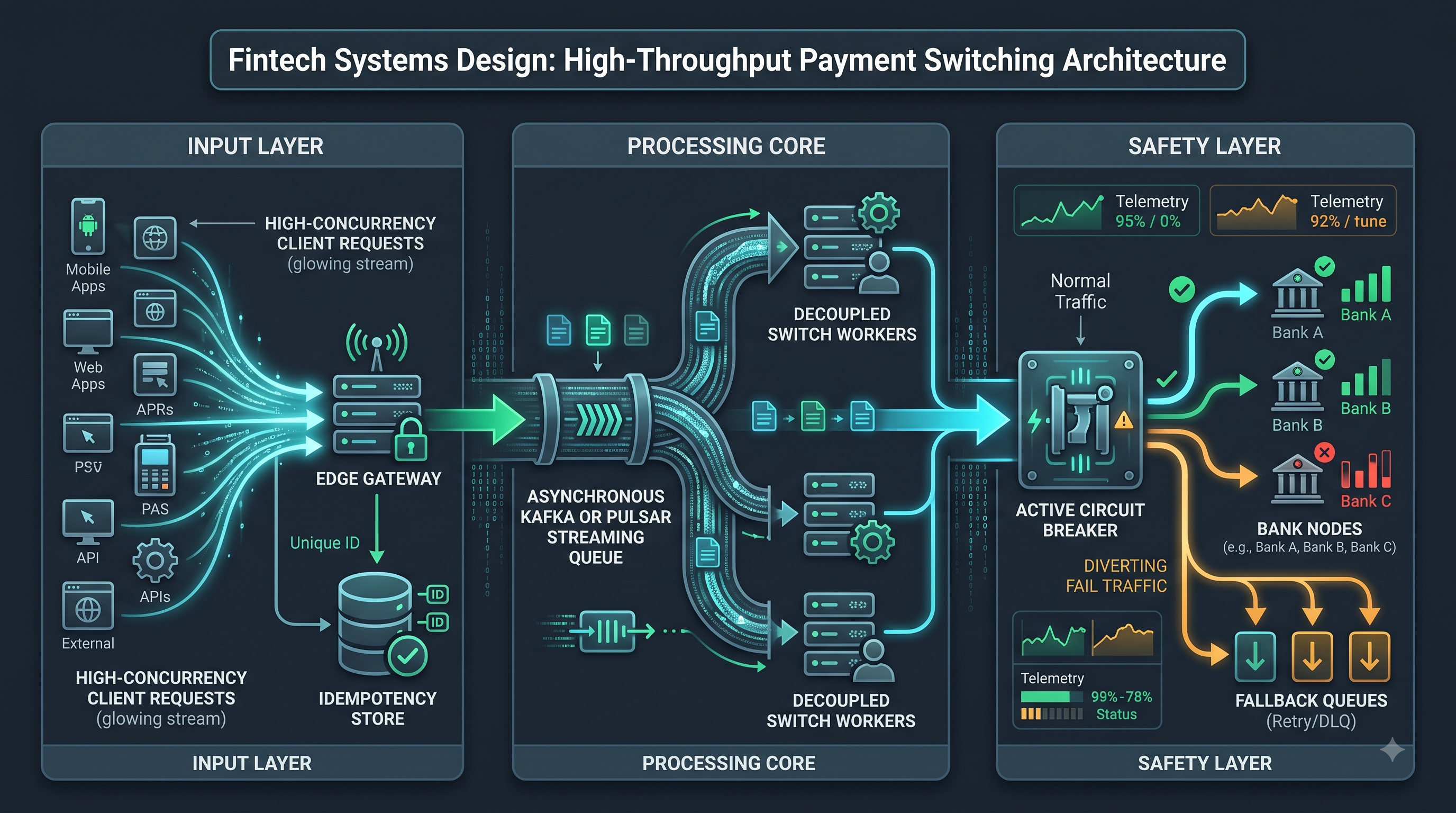
Instead of holding HTTP threads open while waiting for external bank APIs, the gateway commits the request to a distributed streaming event log (e.g., Apache Kafka or Pulsar).
Worker pools consume messages, initiate external switch handshakes, and publish state updates via real-time WebSocket connections or Webhook event workers.
Circuit Breakers & Dynamic Route Fallback:
When an upstream Remitter or Beneficiary Bank switch experiences elevated error rates (e.g., HTTP 5xx or >3% timeouts over a 30-second sliding window), an automated circuit breaker (such as Resilience4j/Envoy-level rules) trips.
Traffic dynamically routes to alternative acquiring switches or gracefully defers the transaction with clear user feedback rather than creating cascading pipeline bottlenecks.
[ Client App ] ──► [ Edge API Gateway ] ──► [ Idempotency Layer ]
│
▼
[ Event Stream (Kafka/Pulsar) ]
│
┌────────────────┴────────────────┐
▼ ▼
[ Payment Engine Worker ] [ Circuit Breaker / Health Monitor ]
│ │
▼ ▼
[ Bank Switch / NPCI ] [ Dynamic Route Evaluator ]
Discussion Question
For backend and infrastructure engineers in India: What is your primary architectural safeguard when dealing with unstable upstream third-party APIs—circuit breakers with fallback degraded modes, event-driven replay workers, or dead-letter queues? Let’s share production patterns below.
CTA
Build robust, scale-ready systems with Techawks India.
Join our Techawks India community to connect with local developers, architects, and engineering leaders building the next generation of global and domestic tech products: [Join Techawks India Community]
Processing instant payment flows across heterogeneous banking switches requires an architecture designed for unpredictable network latency, partial network partitions, and strict non-repudiation.
A standard synchronous database lock pattern fails under peak load because banking core systems (CBS) introduce variable 2s–5s response times, exhausting database connection pools and stalling API gateways.
3 Core Architectural Patterns Powering Large-Scale Payment Switches:
Strict Idempotency Keys & Distributed Distributed State Machines:
Every initiate request is tagged with a unique, cryptographically signed idempotency token stored in a fast in-memory store (Redis cluster) with a Time-to-Live (TTL).
If a user retries or a network timeout causes a retry, the switch routes to the existing transaction record rather than executing a duplicate debit.
Asynchronous Two-Phase Payment Queuing:
Instead of holding HTTP threads open while waiting for external bank APIs, the gateway commits the request to a distributed streaming event log (e.g., Apache Kafka or Pulsar).
Worker pools consume messages, initiate external switch handshakes, and publish state updates via real-time WebSocket connections or Webhook event workers.
Circuit Breakers & Dynamic Route Fallback:
When an upstream Remitter or Beneficiary Bank switch experiences elevated error rates (e.g., HTTP 5xx or >3% timeouts over a 30-second sliding window), an automated circuit breaker (such as Resilience4j/Envoy-level rules) trips.
Traffic dynamically routes to alternative acquiring switches or gracefully defers the transaction with clear user feedback rather than creating cascading pipeline bottlenecks.
[ Client App ] ──► [ Edge API Gateway ] ──► [ Idempotency Layer ]
│
▼
[ Event Stream (Kafka/Pulsar) ]
│
┌────────────────┴────────────────┐
▼ ▼
[ Payment Engine Worker ] [ Circuit Breaker / Health Monitor ]
│ │
▼ ▼
[ Bank Switch / NPCI ] [ Dynamic Route Evaluator ]
Discussion Question
For backend and infrastructure engineers in India: What is your primary architectural safeguard when dealing with unstable upstream third-party APIs—circuit breakers with fallback degraded modes, event-driven replay workers, or dead-letter queues? Let’s share production patterns below.
CTA
Build robust, scale-ready systems with Techawks India.
Join our Techawks India community to connect with local developers, architects, and engineering leaders building the next generation of global and domestic tech products: [Join Techawks India Community]
Scaling beyond 100M API calls: How Indian fintechs architect high-concurrency systems for UPI switches.
Processing instant payment flows across heterogeneous banking switches requires an architecture designed for unpredictable network latency, partial network partitions, and strict non-repudiation.
A standard synchronous database lock pattern fails under peak load because banking core systems (CBS) introduce variable 2s–5s response times, exhausting database connection pools and stalling API gateways.
3 Core Architectural Patterns Powering Large-Scale Payment Switches:
Strict Idempotency Keys & Distributed Distributed State Machines:
Every initiate request is tagged with a unique, cryptographically signed idempotency token stored in a fast in-memory store (Redis cluster) with a Time-to-Live (TTL).
If a user retries or a network timeout causes a retry, the switch routes to the existing transaction record rather than executing a duplicate debit.
Asynchronous Two-Phase Payment Queuing:
Instead of holding HTTP threads open while waiting for external bank APIs, the gateway commits the request to a distributed streaming event log (e.g., Apache Kafka or Pulsar).
Worker pools consume messages, initiate external switch handshakes, and publish state updates via real-time WebSocket connections or Webhook event workers.
Circuit Breakers & Dynamic Route Fallback:
When an upstream Remitter or Beneficiary Bank switch experiences elevated error rates (e.g., HTTP 5xx or >3% timeouts over a 30-second sliding window), an automated circuit breaker (such as Resilience4j/Envoy-level rules) trips.
Traffic dynamically routes to alternative acquiring switches or gracefully defers the transaction with clear user feedback rather than creating cascading pipeline bottlenecks.
[ Client App ] ──► [ Edge API Gateway ] ──► [ Idempotency Layer ]
│
▼
[ Event Stream (Kafka/Pulsar) ]
│
┌────────────────┴────────────────┐
▼ ▼
[ Payment Engine Worker ] [ Circuit Breaker / Health Monitor ]
│ │
▼ ▼
[ Bank Switch / NPCI ] [ Dynamic Route Evaluator ]
Discussion Question
For backend and infrastructure engineers in India: What is your primary architectural safeguard when dealing with unstable upstream third-party APIs—circuit breakers with fallback degraded modes, event-driven replay workers, or dead-letter queues? Let’s share production patterns below.
CTA
Build robust, scale-ready systems with Techawks India.
Join our Techawks India community to connect with local developers, architects, and engineering leaders building the next generation of global and domestic tech products: [Join Techawks India Community]

 English
 Arabic
 French
 Spanish
 Portuguese
 Deutsch
 Dutch
Dutch
 Italiano
 Russian
 Romaian
 Portuguese (Brazil)
 Greek
Greek