


Stop hardcoding RSA & ECC: How US engineering teams are architecting Cryptographic Agility for NIST's Post-Quantum Standards.
The transition to Post-Quantum Cryptography (PQC) finalized by NIST (FIPS 203 ML-KEM, FIPS 204 ML-DSA, and FIPS 205 SLH-DSA) introduces fundamental shifts in cryptographic parameter sizes and computational profiles:
Public Key & Ciphertext Explosion: An ML-KEM-768 public key is 1,184 bytes (compared to 64 bytes for ECDSA P-256). A naive replacement causes packet fragmentation across standard network MTU thresholds (1,500 bytes), stalling TCP/TLS handshakes.
Harvest Now, Decrypt Later (HNDL): Adversaries are actively capturing encrypted transit traffic today to decrypt retrospectively once cryptanalytically relevant quantum computers emerge.
The Architectural Solution: Cryptographic Agility (Crypto-Agility)
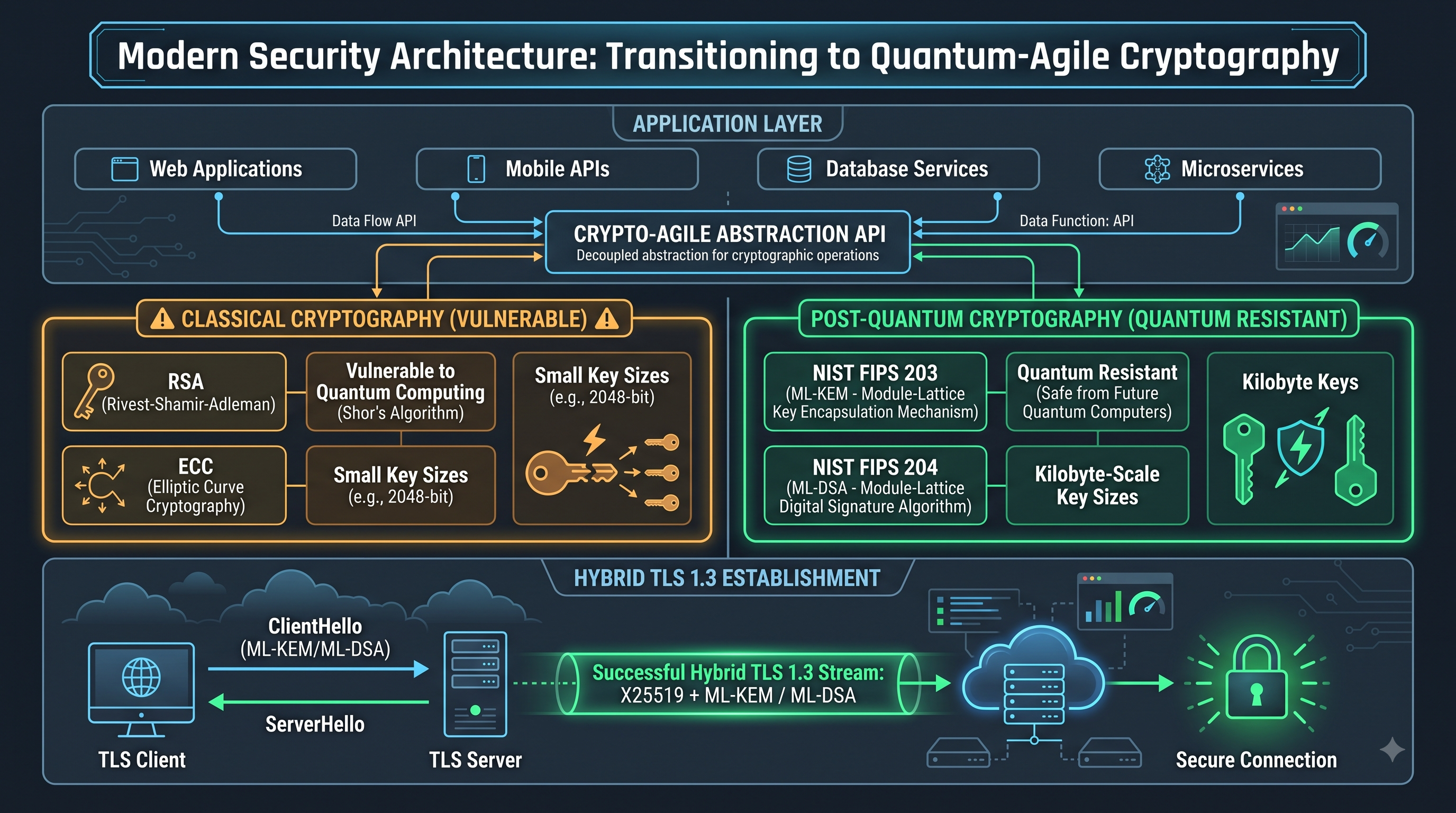
US enterprise systems, cloud platforms, and defense-adjacent infrastructure are deprecating direct cryptographic library bindings in favor of an Abstracted Cryptography Layer (ACL):
[ Application Business Logic / Microservices ]
│
▼
[ Cryptographic Abstraction API ]
(Decoupled Key Management, Signing & Encapsulation)
│
┌────────────┴────────────┐
▼ ▼
[ Classical Provider ] [ Quantum-Safe Provider ]
(ECDH / RSA-4096) (ML-KEM / ML-DSA FIPS 203/204)
│ │
└────────────┬────────────┘
▼
[ Hybrid TLS 1.3 Handshake ]
(Combined Classical + Post-Quantum Key Exchange)
3 Engineering Steps to Make Your Stack Quantum-Agile:
Adopt Hybrid Key Encapsulation (X25519 + ML-KEM):
Do not cut over to pure post-quantum algorithms immediately. Implement hybrid key exchanges in TLS 1.3 (e.g., X25519MLKEM768).
Why: It guarantees security against classical attacks even if an implementation flaw is discovered in early lattice-based math, while protecting long-life data against HNDL threats today.
Decouple Crypto Primitives from Database Schemas & Network Buffers:
Audit your relational schemas, JWT tokens, and API header buffers. If database columns storing signatures or public keys are hardcoded to VARCHAR(64) or CHAR(256), expand storage fields to handle kilobyte-scale post-quantum keys.
Automate Cryptographic Bill of Materials (CBOM):
Use automated static analysis and dynamic tracing tools to scan source repositories and container images for hardcoded crypto dependencies, deprecated ciphers, and unpinned certificate validation routines.
Discussion Question
For US cloud, backend, and security architects: Has your organization started inventorying cryptographic dependencies (CBOM) or benchmarking Hybrid TLS (X25519 + ML-KEM) overhead on ingress controllers? Where are you seeing the biggest serialization friction? Let’s share notes below.
CTA
Stay ahead of US enterprise and infrastructure architecture with Techawks USA.
Join our Techawks USA community to connect with local systems engineers, architects, and engineering leaders building resilient, modern software stacks: [Join Techawks USA Community]
The transition to Post-Quantum Cryptography (PQC) finalized by NIST (FIPS 203 ML-KEM, FIPS 204 ML-DSA, and FIPS 205 SLH-DSA) introduces fundamental shifts in cryptographic parameter sizes and computational profiles:
Public Key & Ciphertext Explosion: An ML-KEM-768 public key is 1,184 bytes (compared to 64 bytes for ECDSA P-256). A naive replacement causes packet fragmentation across standard network MTU thresholds (1,500 bytes), stalling TCP/TLS handshakes.
Harvest Now, Decrypt Later (HNDL): Adversaries are actively capturing encrypted transit traffic today to decrypt retrospectively once cryptanalytically relevant quantum computers emerge.
The Architectural Solution: Cryptographic Agility (Crypto-Agility)
US enterprise systems, cloud platforms, and defense-adjacent infrastructure are deprecating direct cryptographic library bindings in favor of an Abstracted Cryptography Layer (ACL):
[ Application Business Logic / Microservices ]
│
▼
[ Cryptographic Abstraction API ]
(Decoupled Key Management, Signing & Encapsulation)
│
┌────────────┴────────────┐
▼ ▼
[ Classical Provider ] [ Quantum-Safe Provider ]
(ECDH / RSA-4096) (ML-KEM / ML-DSA FIPS 203/204)
│ │
└────────────┬────────────┘
▼
[ Hybrid TLS 1.3 Handshake ]
(Combined Classical + Post-Quantum Key Exchange)
3 Engineering Steps to Make Your Stack Quantum-Agile:
Adopt Hybrid Key Encapsulation (X25519 + ML-KEM):
Do not cut over to pure post-quantum algorithms immediately. Implement hybrid key exchanges in TLS 1.3 (e.g., X25519MLKEM768).
Why: It guarantees security against classical attacks even if an implementation flaw is discovered in early lattice-based math, while protecting long-life data against HNDL threats today.
Decouple Crypto Primitives from Database Schemas & Network Buffers:
Audit your relational schemas, JWT tokens, and API header buffers. If database columns storing signatures or public keys are hardcoded to VARCHAR(64) or CHAR(256), expand storage fields to handle kilobyte-scale post-quantum keys.
Automate Cryptographic Bill of Materials (CBOM):
Use automated static analysis and dynamic tracing tools to scan source repositories and container images for hardcoded crypto dependencies, deprecated ciphers, and unpinned certificate validation routines.
Discussion Question
For US cloud, backend, and security architects: Has your organization started inventorying cryptographic dependencies (CBOM) or benchmarking Hybrid TLS (X25519 + ML-KEM) overhead on ingress controllers? Where are you seeing the biggest serialization friction? Let’s share notes below.
CTA
Stay ahead of US enterprise and infrastructure architecture with Techawks USA.
Join our Techawks USA community to connect with local systems engineers, architects, and engineering leaders building resilient, modern software stacks: [Join Techawks USA Community]
Stop hardcoding RSA & ECC: How US engineering teams are architecting Cryptographic Agility for NIST's Post-Quantum Standards.
The transition to Post-Quantum Cryptography (PQC) finalized by NIST (FIPS 203 ML-KEM, FIPS 204 ML-DSA, and FIPS 205 SLH-DSA) introduces fundamental shifts in cryptographic parameter sizes and computational profiles:
Public Key & Ciphertext Explosion: An ML-KEM-768 public key is 1,184 bytes (compared to 64 bytes for ECDSA P-256). A naive replacement causes packet fragmentation across standard network MTU thresholds (1,500 bytes), stalling TCP/TLS handshakes.
Harvest Now, Decrypt Later (HNDL): Adversaries are actively capturing encrypted transit traffic today to decrypt retrospectively once cryptanalytically relevant quantum computers emerge.
The Architectural Solution: Cryptographic Agility (Crypto-Agility)
US enterprise systems, cloud platforms, and defense-adjacent infrastructure are deprecating direct cryptographic library bindings in favor of an Abstracted Cryptography Layer (ACL):
[ Application Business Logic / Microservices ]
│
▼
[ Cryptographic Abstraction API ]
(Decoupled Key Management, Signing & Encapsulation)
│
┌────────────┴────────────┐
▼ ▼
[ Classical Provider ] [ Quantum-Safe Provider ]
(ECDH / RSA-4096) (ML-KEM / ML-DSA FIPS 203/204)
│ │
└────────────┬────────────┘
▼
[ Hybrid TLS 1.3 Handshake ]
(Combined Classical + Post-Quantum Key Exchange)
3 Engineering Steps to Make Your Stack Quantum-Agile:
Adopt Hybrid Key Encapsulation (X25519 + ML-KEM):
Do not cut over to pure post-quantum algorithms immediately. Implement hybrid key exchanges in TLS 1.3 (e.g., X25519MLKEM768).
Why: It guarantees security against classical attacks even if an implementation flaw is discovered in early lattice-based math, while protecting long-life data against HNDL threats today.
Decouple Crypto Primitives from Database Schemas & Network Buffers:
Audit your relational schemas, JWT tokens, and API header buffers. If database columns storing signatures or public keys are hardcoded to VARCHAR(64) or CHAR(256), expand storage fields to handle kilobyte-scale post-quantum keys.
Automate Cryptographic Bill of Materials (CBOM):
Use automated static analysis and dynamic tracing tools to scan source repositories and container images for hardcoded crypto dependencies, deprecated ciphers, and unpinned certificate validation routines.
Discussion Question
For US cloud, backend, and security architects: Has your organization started inventorying cryptographic dependencies (CBOM) or benchmarking Hybrid TLS (X25519 + ML-KEM) overhead on ingress controllers? Where are you seeing the biggest serialization friction? Let’s share notes below.
CTA
Stay ahead of US enterprise and infrastructure architecture with Techawks USA.
Join our Techawks USA community to connect with local systems engineers, architects, and engineering leaders building resilient, modern software stacks: [Join Techawks USA Community]

 Arabic
 French
 Spanish
 Portuguese
 Deutsch
 Turkish
 Dutch
Dutch
 Italiano
 Russian
 Romaian
 Portuguese (Brazil)
 Greek
Greek