


Stop building fragile Direct Debits: How UK engineering teams are moving to Commercial Variable Recurring Payments (cVRP).
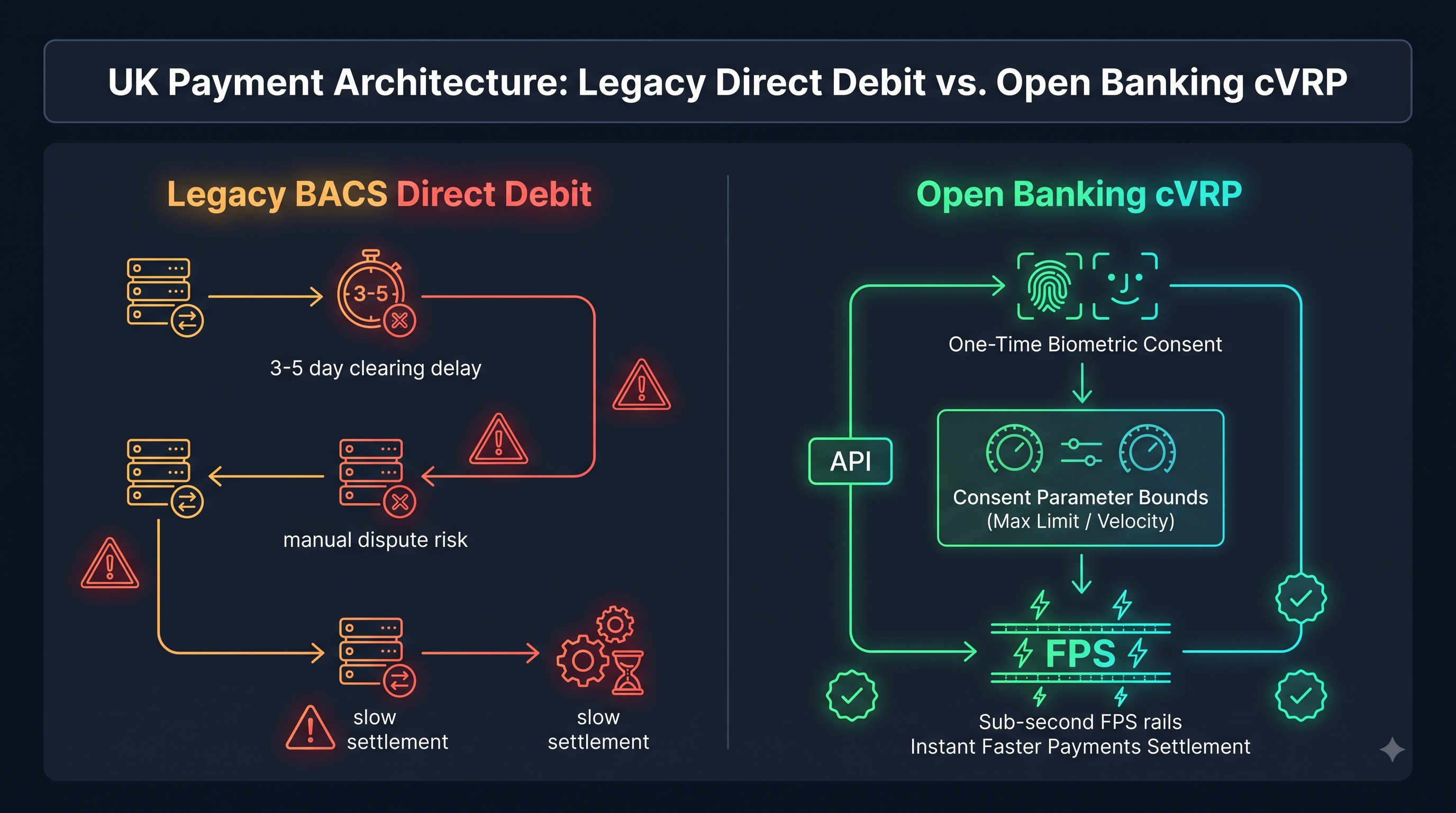
Traditional recurring payments in the UK rely either on card-on-file (high interchange fees, vulnerable to expired card churn) or BACS Direct Debits (asynchronous multi-day batch processing with no instant fund verification).
The Solution: Open Banking cVRP
Variable Recurring Payments (VRP) were originally mandated for "sweeping" (me-to-me transfers between a customer’s own accounts). With Commercial VRP (non-sweeping), merchants and third-party payment providers (PISPs) can initiate recurring merchant payments directly from a consumer’s bank account with cryptographically authenticated consent parameters.
[ Customer Device ] ── (SCA App-to-App Approval) ──► [ UK Bank ASPSP ]
│
▼
[ Cryptographic VRP Consent Record ]
├── Maximum Amount per Payment (£50)
├── Maximum Cumulative Velocity (£200/mo)
└── Expiry Date / Revocation Webhook
│
▼
[ Merchant / PISP Engine ] ── (Direct Faster Payments API) ──► [ Instant Settlement ]
3 Technical Patterns for Implementing cVRP:
Deterministic Consent Boundary Enforcement:
Before executing a payment API call, your orchestration layer must validate the transaction against the stored Open Banking consent parameters (maxIndividualAmount, periodicLimits, and validToDateTime).
If a transaction exceeds the predefined limit, your gateway must trigger a step-up Strong Customer Authentication (SCA) flow rather than failing silently.
Sub-Second Faster Payments Rails:
Unlike BACS Direct Debit, cVRP settles over the UK Faster Payments Service (FPS) in near real-time (sub-second to a few seconds).
Your ledger service must be architected for event-driven asynchronous webhooks rather than polling batch reconciliation files.
Consent State Synchronization & Revocation Webhooks:
Consumers can revoke recurring payment permissions directly from their mobile banking app without logging into the merchant portal.
Engineering teams must implement compliant inbound webhook listeners (event-notifications) to immediately update internal subscription billing state machines when a bank emits a consent revocation event.
Why This Matters for UK Software Teams:
Zero Interchange & Card Churn: Eliminates expired, lost, or stolen card failure loops while bypassing expensive interchange processing overhead.
Instant Dispute Elimination: Cryptographic biometric authentication directly in the user’s banking app during consent setup slashes unauthorized transaction claims by over 60%.
Discussion Question
For UK software architects and payments engineers: Are you currently integrating cVRP via direct Open Banking API aggregators or hybrid card/account orchestrators? What is your biggest challenge—consent lifecycle management, bank-by-bank API variability, or fallback routing? Let’s share notes below.
CTA
Master modern UK fintech infrastructure and systems engineering with Techawks UK.
Join our Techawks UK community to connect with local architects, developers, and engineering leaders building resilient, scale-ready software across the UK tech ecosystem: [Join Techawks UK Community]
Traditional recurring payments in the UK rely either on card-on-file (high interchange fees, vulnerable to expired card churn) or BACS Direct Debits (asynchronous multi-day batch processing with no instant fund verification).
The Solution: Open Banking cVRP
Variable Recurring Payments (VRP) were originally mandated for "sweeping" (me-to-me transfers between a customer’s own accounts). With Commercial VRP (non-sweeping), merchants and third-party payment providers (PISPs) can initiate recurring merchant payments directly from a consumer’s bank account with cryptographically authenticated consent parameters.
[ Customer Device ] ── (SCA App-to-App Approval) ──► [ UK Bank ASPSP ]
│
▼
[ Cryptographic VRP Consent Record ]
├── Maximum Amount per Payment (£50)
├── Maximum Cumulative Velocity (£200/mo)
└── Expiry Date / Revocation Webhook
│
▼
[ Merchant / PISP Engine ] ── (Direct Faster Payments API) ──► [ Instant Settlement ]
3 Technical Patterns for Implementing cVRP:
Deterministic Consent Boundary Enforcement:
Before executing a payment API call, your orchestration layer must validate the transaction against the stored Open Banking consent parameters (maxIndividualAmount, periodicLimits, and validToDateTime).
If a transaction exceeds the predefined limit, your gateway must trigger a step-up Strong Customer Authentication (SCA) flow rather than failing silently.
Sub-Second Faster Payments Rails:
Unlike BACS Direct Debit, cVRP settles over the UK Faster Payments Service (FPS) in near real-time (sub-second to a few seconds).
Your ledger service must be architected for event-driven asynchronous webhooks rather than polling batch reconciliation files.
Consent State Synchronization & Revocation Webhooks:
Consumers can revoke recurring payment permissions directly from their mobile banking app without logging into the merchant portal.
Engineering teams must implement compliant inbound webhook listeners (event-notifications) to immediately update internal subscription billing state machines when a bank emits a consent revocation event.
Why This Matters for UK Software Teams:
Zero Interchange & Card Churn: Eliminates expired, lost, or stolen card failure loops while bypassing expensive interchange processing overhead.
Instant Dispute Elimination: Cryptographic biometric authentication directly in the user’s banking app during consent setup slashes unauthorized transaction claims by over 60%.
Discussion Question
For UK software architects and payments engineers: Are you currently integrating cVRP via direct Open Banking API aggregators or hybrid card/account orchestrators? What is your biggest challenge—consent lifecycle management, bank-by-bank API variability, or fallback routing? Let’s share notes below.
CTA
Master modern UK fintech infrastructure and systems engineering with Techawks UK.
Join our Techawks UK community to connect with local architects, developers, and engineering leaders building resilient, scale-ready software across the UK tech ecosystem: [Join Techawks UK Community]
Stop building fragile Direct Debits: How UK engineering teams are moving to Commercial Variable Recurring Payments (cVRP).
Traditional recurring payments in the UK rely either on card-on-file (high interchange fees, vulnerable to expired card churn) or BACS Direct Debits (asynchronous multi-day batch processing with no instant fund verification).
The Solution: Open Banking cVRP
Variable Recurring Payments (VRP) were originally mandated for "sweeping" (me-to-me transfers between a customer’s own accounts). With Commercial VRP (non-sweeping), merchants and third-party payment providers (PISPs) can initiate recurring merchant payments directly from a consumer’s bank account with cryptographically authenticated consent parameters.
[ Customer Device ] ── (SCA App-to-App Approval) ──► [ UK Bank ASPSP ]
│
▼
[ Cryptographic VRP Consent Record ]
├── Maximum Amount per Payment (£50)
├── Maximum Cumulative Velocity (£200/mo)
└── Expiry Date / Revocation Webhook
│
▼
[ Merchant / PISP Engine ] ── (Direct Faster Payments API) ──► [ Instant Settlement ]
3 Technical Patterns for Implementing cVRP:
Deterministic Consent Boundary Enforcement:
Before executing a payment API call, your orchestration layer must validate the transaction against the stored Open Banking consent parameters (maxIndividualAmount, periodicLimits, and validToDateTime).
If a transaction exceeds the predefined limit, your gateway must trigger a step-up Strong Customer Authentication (SCA) flow rather than failing silently.
Sub-Second Faster Payments Rails:
Unlike BACS Direct Debit, cVRP settles over the UK Faster Payments Service (FPS) in near real-time (sub-second to a few seconds).
Your ledger service must be architected for event-driven asynchronous webhooks rather than polling batch reconciliation files.
Consent State Synchronization & Revocation Webhooks:
Consumers can revoke recurring payment permissions directly from their mobile banking app without logging into the merchant portal.
Engineering teams must implement compliant inbound webhook listeners (event-notifications) to immediately update internal subscription billing state machines when a bank emits a consent revocation event.
Why This Matters for UK Software Teams:
Zero Interchange & Card Churn: Eliminates expired, lost, or stolen card failure loops while bypassing expensive interchange processing overhead.
Instant Dispute Elimination: Cryptographic biometric authentication directly in the user’s banking app during consent setup slashes unauthorized transaction claims by over 60%.
Discussion Question
For UK software architects and payments engineers: Are you currently integrating cVRP via direct Open Banking API aggregators or hybrid card/account orchestrators? What is your biggest challenge—consent lifecycle management, bank-by-bank API variability, or fallback routing? Let’s share notes below.
CTA
Master modern UK fintech infrastructure and systems engineering with Techawks UK.
Join our Techawks UK community to connect with local architects, developers, and engineering leaders building resilient, scale-ready software across the UK tech ecosystem: [Join Techawks UK Community]

 English
 Arabic
 French
 Spanish
 Portuguese
 Deutsch
 Turkish
 Dutch
Dutch
 Italiano
 Russian
 Romaian
 Greek
Greek