


Building Sovereign AI in the Gulf: How UAE enterprise architects enforce Data Residency and On-Premise LLM Governance.
As UAE enterprises across banking, healthcare, logistics, and government accelerate AI adoption, architectures that rely on naive external API calls introduce non-compliance risks around cross-border data transfers.
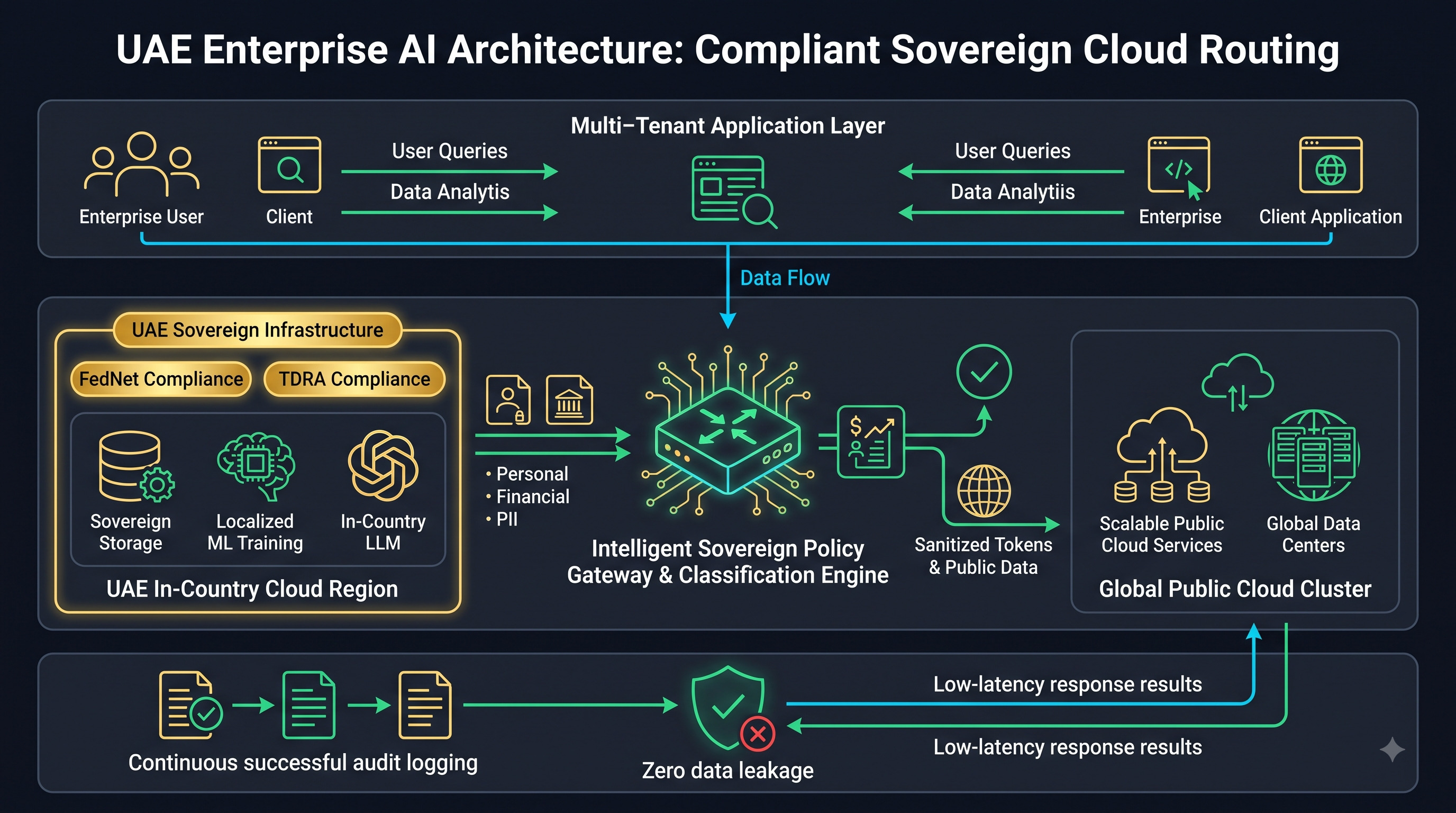
The modern standard across the UAE tech ecosystem is Hybrid Sovereign AI Routing:
[ Enterprise App / Channels ] ──► [ Sovereign Policy Gateway ]
│
┌──────────────────────────────┴──────────────────────────────┐
▼ (PII / Sensitive / Regulated) ▼ (Sanitized / Public Data)
[ In-Country UAE Cloud / Sovereign LLM ] [ Frontier Global API / Public Cloud ]
├── Hosted on UAE Cloud Regions (e.g., G42/Core42, local AWS/Azure) ├── PII Masking / Token Redaction Layer
├── Falcon / Open-Weights Models with Arabic Dialect Support └── High-Entropy Multi-Modal Reasoning
└── FedNet & TDRA Compliant Perimeter
3 Architectural Pillars for UAE AI Engineering:
Deterministic PII Classification & Token Redaction:
Before any payload leaves your local perimeter, an inline edge filter evaluates prompts against UAE-specific data patterns (e.g., Emirates ID formats, local phone prefixes, CBUAE financial identifiers).
Sensitive records are either stripped via reversible format-preserving tokenization or diverted strictly to sovereign on-soil compute clusters.
Leveraging In-Country Open Weights & Sovereign Infrastructure:
Enterprise teams are deploying open-weight foundational models (such as the UAE’s open-source Falcon series or fine-tuned LLaMA/Mistral models) inside localized UAE data centers and sovereign cloud regions (e.g., local Core42, Microsoft UAE, AWS UAE).
This guarantees that embeddings, vector databases, and inference execution never traverse international boundaries.
Bilingual & Localized Retrieval Augmented Generation (RAG):
Generic embedding models frequently underperform on Arabic morphological root variations and Gulf-specific terminology.
Production systems implement bilingual hybrid search—pairing specialized Arabic dense vector encoders with BM25 sparse keyword indices—ensuring high precision across both Arabic and English institutional datasets.
Discussion Question
For software architects, data engineers, and CTOs in the UAE: How is your team balancing the trade-off between frontier cloud model capabilities and local UAE data residency compliance? Are you deploying private open-weight models on-soil or implementing zero-retention enterprise cloud agreements? Let's discuss below.
CTA
Architect scalable, compliant systems with Techawks UAE.
Join our Techawks UAE community to connect with local architects, developers, and technology leaders shaping the future of digital infrastructure and AI in the Emirates: [Join Techawks UAE Community]
As UAE enterprises across banking, healthcare, logistics, and government accelerate AI adoption, architectures that rely on naive external API calls introduce non-compliance risks around cross-border data transfers.
The modern standard across the UAE tech ecosystem is Hybrid Sovereign AI Routing:
[ Enterprise App / Channels ] ──► [ Sovereign Policy Gateway ]
│
┌──────────────────────────────┴──────────────────────────────┐
▼ (PII / Sensitive / Regulated) ▼ (Sanitized / Public Data)
[ In-Country UAE Cloud / Sovereign LLM ] [ Frontier Global API / Public Cloud ]
├── Hosted on UAE Cloud Regions (e.g., G42/Core42, local AWS/Azure) ├── PII Masking / Token Redaction Layer
├── Falcon / Open-Weights Models with Arabic Dialect Support └── High-Entropy Multi-Modal Reasoning
└── FedNet & TDRA Compliant Perimeter
3 Architectural Pillars for UAE AI Engineering:
Deterministic PII Classification & Token Redaction:
Before any payload leaves your local perimeter, an inline edge filter evaluates prompts against UAE-specific data patterns (e.g., Emirates ID formats, local phone prefixes, CBUAE financial identifiers).
Sensitive records are either stripped via reversible format-preserving tokenization or diverted strictly to sovereign on-soil compute clusters.
Leveraging In-Country Open Weights & Sovereign Infrastructure:
Enterprise teams are deploying open-weight foundational models (such as the UAE’s open-source Falcon series or fine-tuned LLaMA/Mistral models) inside localized UAE data centers and sovereign cloud regions (e.g., local Core42, Microsoft UAE, AWS UAE).
This guarantees that embeddings, vector databases, and inference execution never traverse international boundaries.
Bilingual & Localized Retrieval Augmented Generation (RAG):
Generic embedding models frequently underperform on Arabic morphological root variations and Gulf-specific terminology.
Production systems implement bilingual hybrid search—pairing specialized Arabic dense vector encoders with BM25 sparse keyword indices—ensuring high precision across both Arabic and English institutional datasets.
Discussion Question
For software architects, data engineers, and CTOs in the UAE: How is your team balancing the trade-off between frontier cloud model capabilities and local UAE data residency compliance? Are you deploying private open-weight models on-soil or implementing zero-retention enterprise cloud agreements? Let's discuss below.
CTA
Architect scalable, compliant systems with Techawks UAE.
Join our Techawks UAE community to connect with local architects, developers, and technology leaders shaping the future of digital infrastructure and AI in the Emirates: [Join Techawks UAE Community]
Building Sovereign AI in the Gulf: How UAE enterprise architects enforce Data Residency and On-Premise LLM Governance.
As UAE enterprises across banking, healthcare, logistics, and government accelerate AI adoption, architectures that rely on naive external API calls introduce non-compliance risks around cross-border data transfers.
The modern standard across the UAE tech ecosystem is Hybrid Sovereign AI Routing:
[ Enterprise App / Channels ] ──► [ Sovereign Policy Gateway ]
│
┌──────────────────────────────┴──────────────────────────────┐
▼ (PII / Sensitive / Regulated) ▼ (Sanitized / Public Data)
[ In-Country UAE Cloud / Sovereign LLM ] [ Frontier Global API / Public Cloud ]
├── Hosted on UAE Cloud Regions (e.g., G42/Core42, local AWS/Azure) ├── PII Masking / Token Redaction Layer
├── Falcon / Open-Weights Models with Arabic Dialect Support └── High-Entropy Multi-Modal Reasoning
└── FedNet & TDRA Compliant Perimeter
3 Architectural Pillars for UAE AI Engineering:
Deterministic PII Classification & Token Redaction:
Before any payload leaves your local perimeter, an inline edge filter evaluates prompts against UAE-specific data patterns (e.g., Emirates ID formats, local phone prefixes, CBUAE financial identifiers).
Sensitive records are either stripped via reversible format-preserving tokenization or diverted strictly to sovereign on-soil compute clusters.
Leveraging In-Country Open Weights & Sovereign Infrastructure:
Enterprise teams are deploying open-weight foundational models (such as the UAE’s open-source Falcon series or fine-tuned LLaMA/Mistral models) inside localized UAE data centers and sovereign cloud regions (e.g., local Core42, Microsoft UAE, AWS UAE).
This guarantees that embeddings, vector databases, and inference execution never traverse international boundaries.
Bilingual & Localized Retrieval Augmented Generation (RAG):
Generic embedding models frequently underperform on Arabic morphological root variations and Gulf-specific terminology.
Production systems implement bilingual hybrid search—pairing specialized Arabic dense vector encoders with BM25 sparse keyword indices—ensuring high precision across both Arabic and English institutional datasets.
Discussion Question
For software architects, data engineers, and CTOs in the UAE: How is your team balancing the trade-off between frontier cloud model capabilities and local UAE data residency compliance? Are you deploying private open-weight models on-soil or implementing zero-retention enterprise cloud agreements? Let's discuss below.
CTA
Architect scalable, compliant systems with Techawks UAE.
Join our Techawks UAE community to connect with local architects, developers, and technology leaders shaping the future of digital infrastructure and AI in the Emirates: [Join Techawks UAE Community]

 English
 Arabic
 French
 Spanish
 Portuguese
 Deutsch
 Turkish
 Italiano
 Russian
 Romaian
 Portuguese (Brazil)
 Greek
Greek