


Stop assuming multi-region means compliant: How Canadian engineering teams architect for Law 25 & PIPEDA Data Sovereignty.
Building scalable applications in Canada requires balancing distributed performance with strict regulatory data residency obligations across federal and provincial jurisdictions (notably Quebec's Law 25 and public/health sector residency mandates in BC and Ontario).
A naive global failover architecture that dumps all backups, telemetry, and database replicas into US cloud regions breaks data compliance boundaries.
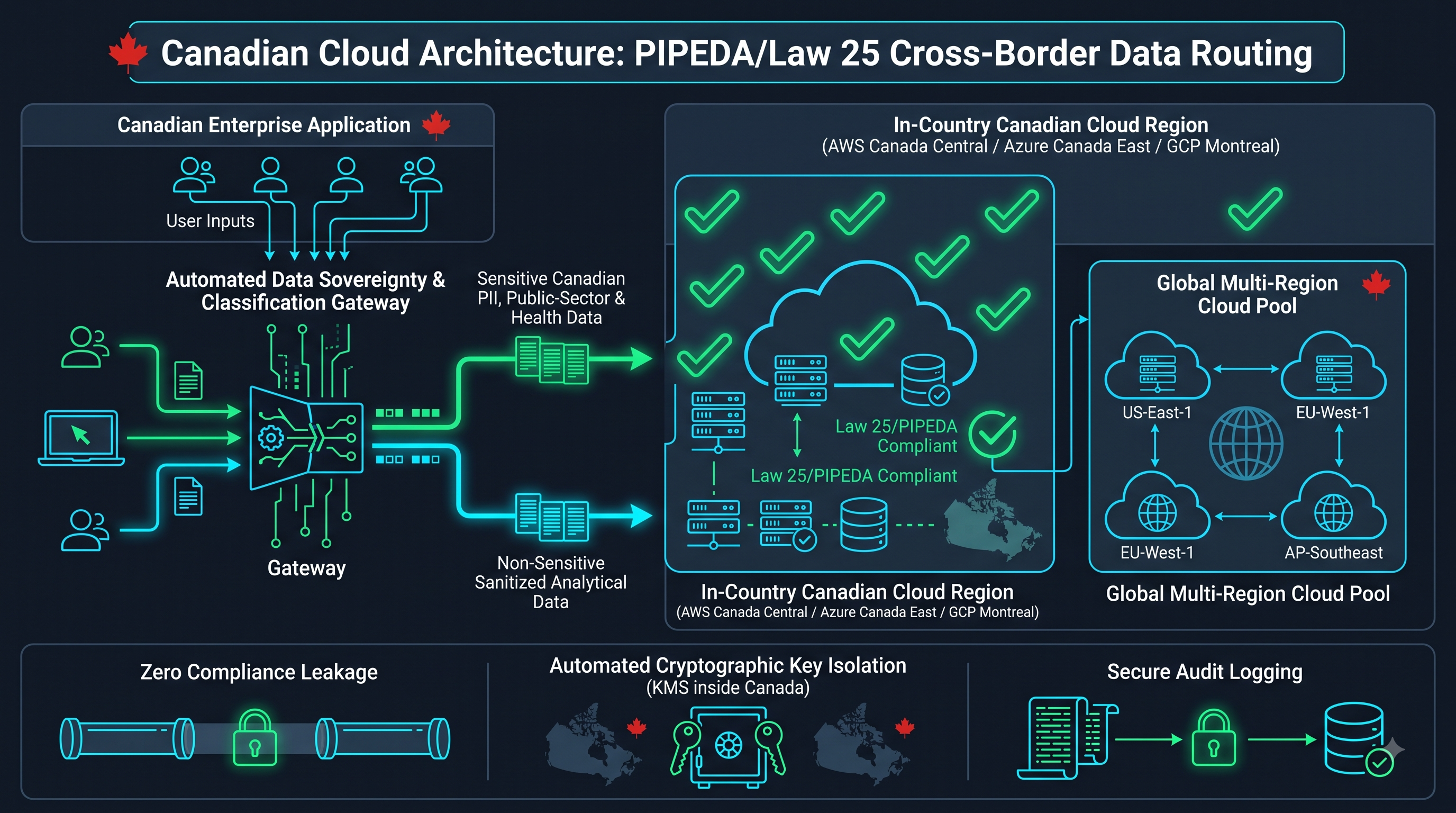
The Solution: Policy-Driven Sovereign Ingress & Key Isolation
Canadian engineering teams are adopting Geofenced Data Segmentation & In-Country Cryptographic KMS:
[ Canadian Users / Clients ] ──► [ Sovereign Ingress Gateway ]
│
┌──────────────────────────────┴──────────────────────────────┐
▼ (Regulated PII / Health / Quebec Law 25) ▼ (Sanitized / Analytical Events)
[ In-Country Canadian Cloud Region ] [ Global Multi-Region Compute ]
├── AWS Canada Central / Azure Canada East / GCP Montreal ├── Anonymized Aggregations / Public Assets
├── In-Country Dedicated KMS (Keys Never Leave Canada) └── Cross-Region Async Processing
└── Localized Vector DB & Primary RDBMS Replicas
3 Core Architectural Steps for Canadian Software Teams:
In-Country Key Management Service (KMS) Isolation:
Encrypt all persistent storage (EBS/S3/RDS) using customer-managed keys (CMKs) hosted exclusively in Canadian cloud regions (e.g., ca-central-1 or canadaeast).
Even if encrypted data is replicated for disaster recovery, keeping the cryptographic keys isolated within Canadian legal borders ensures foreign subpoenas cannot force unencrypted access.
Automated Privacy Impact Assessment (PIA) Gateways:
Implement automated data tagging and schema classification at the API Gateway layer.
Personal Identifiable Information (PII) belonging to Quebec or Canadian residents is automatically pinned to local database shards, preventing silent replication to cross-border endpoints without explicit consent telemetry.
Localized Cold & Warm Observability Pipelines:
Application logs and distributed tracing spans often leak sensitive customer tokens and addresses.
Route real-time logs through local redaction workers before streaming to global SIEM/monitoring tools (e.g., Datadog, Splunk), ensuring unmasked log archives remain in Canadian object storage.
Discussion Question
For Canadian cloud architects, DevOps leads, and software engineers: How are you managing cross-border compliance—are you running fully isolated in-country VPCs in ca-central-1, or implementing application-level field encryption with localized KMS keys? Let’s share architectural patterns below.
CTA
Build compliant, high-performance systems with Techawks Canada.
Join our Techawks Canada community to connect with local cloud engineers, software architects, and tech leaders building world-class infrastructure across Toronto, Vancouver, Montreal, and beyond: [Join Techawks Canada Community]
Building scalable applications in Canada requires balancing distributed performance with strict regulatory data residency obligations across federal and provincial jurisdictions (notably Quebec's Law 25 and public/health sector residency mandates in BC and Ontario).
A naive global failover architecture that dumps all backups, telemetry, and database replicas into US cloud regions breaks data compliance boundaries.
The Solution: Policy-Driven Sovereign Ingress & Key Isolation
Canadian engineering teams are adopting Geofenced Data Segmentation & In-Country Cryptographic KMS:
[ Canadian Users / Clients ] ──► [ Sovereign Ingress Gateway ]
│
┌──────────────────────────────┴──────────────────────────────┐
▼ (Regulated PII / Health / Quebec Law 25) ▼ (Sanitized / Analytical Events)
[ In-Country Canadian Cloud Region ] [ Global Multi-Region Compute ]
├── AWS Canada Central / Azure Canada East / GCP Montreal ├── Anonymized Aggregations / Public Assets
├── In-Country Dedicated KMS (Keys Never Leave Canada) └── Cross-Region Async Processing
└── Localized Vector DB & Primary RDBMS Replicas
3 Core Architectural Steps for Canadian Software Teams:
In-Country Key Management Service (KMS) Isolation:
Encrypt all persistent storage (EBS/S3/RDS) using customer-managed keys (CMKs) hosted exclusively in Canadian cloud regions (e.g., ca-central-1 or canadaeast).
Even if encrypted data is replicated for disaster recovery, keeping the cryptographic keys isolated within Canadian legal borders ensures foreign subpoenas cannot force unencrypted access.
Automated Privacy Impact Assessment (PIA) Gateways:
Implement automated data tagging and schema classification at the API Gateway layer.
Personal Identifiable Information (PII) belonging to Quebec or Canadian residents is automatically pinned to local database shards, preventing silent replication to cross-border endpoints without explicit consent telemetry.
Localized Cold & Warm Observability Pipelines:
Application logs and distributed tracing spans often leak sensitive customer tokens and addresses.
Route real-time logs through local redaction workers before streaming to global SIEM/monitoring tools (e.g., Datadog, Splunk), ensuring unmasked log archives remain in Canadian object storage.
Discussion Question
For Canadian cloud architects, DevOps leads, and software engineers: How are you managing cross-border compliance—are you running fully isolated in-country VPCs in ca-central-1, or implementing application-level field encryption with localized KMS keys? Let’s share architectural patterns below.
CTA
Build compliant, high-performance systems with Techawks Canada.
Join our Techawks Canada community to connect with local cloud engineers, software architects, and tech leaders building world-class infrastructure across Toronto, Vancouver, Montreal, and beyond: [Join Techawks Canada Community]
Stop assuming multi-region means compliant: How Canadian engineering teams architect for Law 25 & PIPEDA Data Sovereignty.
Building scalable applications in Canada requires balancing distributed performance with strict regulatory data residency obligations across federal and provincial jurisdictions (notably Quebec's Law 25 and public/health sector residency mandates in BC and Ontario).
A naive global failover architecture that dumps all backups, telemetry, and database replicas into US cloud regions breaks data compliance boundaries.
The Solution: Policy-Driven Sovereign Ingress & Key Isolation
Canadian engineering teams are adopting Geofenced Data Segmentation & In-Country Cryptographic KMS:
[ Canadian Users / Clients ] ──► [ Sovereign Ingress Gateway ]
│
┌──────────────────────────────┴──────────────────────────────┐
▼ (Regulated PII / Health / Quebec Law 25) ▼ (Sanitized / Analytical Events)
[ In-Country Canadian Cloud Region ] [ Global Multi-Region Compute ]
├── AWS Canada Central / Azure Canada East / GCP Montreal ├── Anonymized Aggregations / Public Assets
├── In-Country Dedicated KMS (Keys Never Leave Canada) └── Cross-Region Async Processing
└── Localized Vector DB & Primary RDBMS Replicas
3 Core Architectural Steps for Canadian Software Teams:
In-Country Key Management Service (KMS) Isolation:
Encrypt all persistent storage (EBS/S3/RDS) using customer-managed keys (CMKs) hosted exclusively in Canadian cloud regions (e.g., ca-central-1 or canadaeast).
Even if encrypted data is replicated for disaster recovery, keeping the cryptographic keys isolated within Canadian legal borders ensures foreign subpoenas cannot force unencrypted access.
Automated Privacy Impact Assessment (PIA) Gateways:
Implement automated data tagging and schema classification at the API Gateway layer.
Personal Identifiable Information (PII) belonging to Quebec or Canadian residents is automatically pinned to local database shards, preventing silent replication to cross-border endpoints without explicit consent telemetry.
Localized Cold & Warm Observability Pipelines:
Application logs and distributed tracing spans often leak sensitive customer tokens and addresses.
Route real-time logs through local redaction workers before streaming to global SIEM/monitoring tools (e.g., Datadog, Splunk), ensuring unmasked log archives remain in Canadian object storage.
Discussion Question
For Canadian cloud architects, DevOps leads, and software engineers: How are you managing cross-border compliance—are you running fully isolated in-country VPCs in ca-central-1, or implementing application-level field encryption with localized KMS keys? Let’s share architectural patterns below.
CTA
Build compliant, high-performance systems with Techawks Canada.
Join our Techawks Canada community to connect with local cloud engineers, software architects, and tech leaders building world-class infrastructure across Toronto, Vancouver, Montreal, and beyond: [Join Techawks Canada Community]

 English
 Arabic
 French
 Spanish
 Portuguese
 Deutsch
 Turkish
 Dutch
Dutch
 Russian
 Romaian
 Portuguese (Brazil)
 Greek
Greek