


Monolith vs. Microservices: When Should You Actually Break Up Your Codebase?
The tech industry often defaults to microservices as a badge of architectural maturity. However, managing distributed databases, network latency, gRPC/REST contracts, and service meshes can quickly drain a team's engineering velocity if introduced prematurely.
A well-structured modular monolith is almost always the best starting point for modern application development.
Here is how to evaluate whether your application is ready to break apart, and how to do it safely:
1. Identify True Microservice Triggers
Do not split services based on feature boundaries alone. Only split when you face clear operational divergence:
Independent Scaling Needs: A specific sub-domain (e.g., video processing or search indexing) requires massive compute, while the rest of the app runs on minimal resources.
Team Isolation Boundaries: Multiple independent engineering teams are constantly blocking each other on deployment pipelines and Git merge conflicts within a single repository.
Technology Stack Requirements: A specific service requires a low-latency language like Rust or Go, while your core API is built in Node.js or Python.
2. The Danger of the "Distributed Monolith"
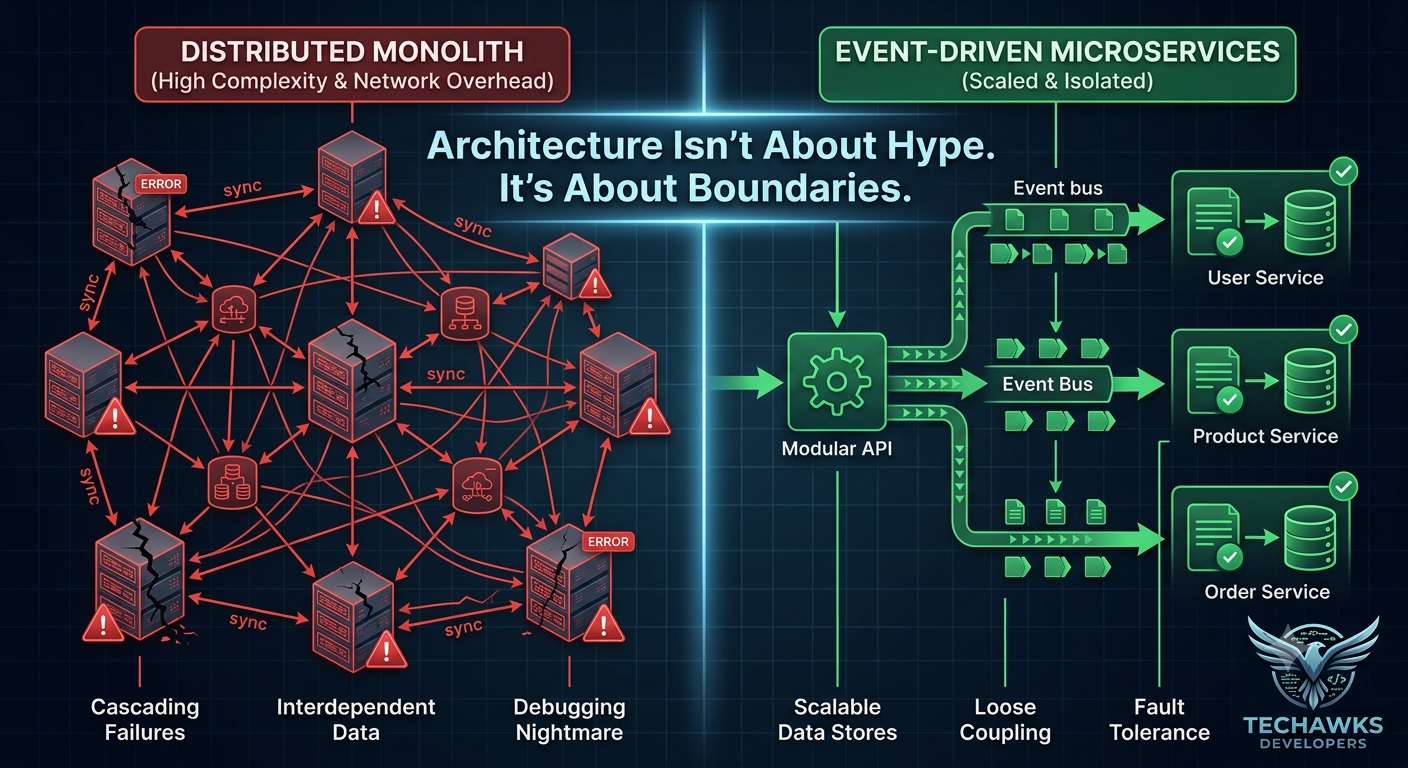
If service A cannot run without synchronously querying service B, C, and D over HTTP, you haven't built microservices—you've built a fragile, slow distributed monolith.
Actionable Rule: Favor asynchronous event-driven communication (e.g., message queues like Kafka or RabbitMQ) over synchronous HTTP calls to keep services truly decoupled.
3. How to Prepare Your Monolith for Future Extraction
Before creating a new microservice, enforce strict domain boundaries inside your existing codebase:
Keep domain schemas separate (no cross-domain SQL joins).
Communicate between modules using strictly defined internal interfaces.
Treat internal module boundaries as if they were already external APIs.
Key Takeaways
Start Modular First: Build a modular monolith first to discover natural domain boundaries before introducing distributed systems complexity.
De-couple via Events: Use asynchronous message brokers rather than synchronous HTTP requests to prevent cascading system failures.
Isolate Data Stores: True microservices must own their databases—never share a single database instance across multiple independent services.
CTA
Where does your team stand on the monolith vs. microservices spectrum? Join Developers & Coding to share your migration experiences, debate system design patterns, and level up your backend architecture skills.
The tech industry often defaults to microservices as a badge of architectural maturity. However, managing distributed databases, network latency, gRPC/REST contracts, and service meshes can quickly drain a team's engineering velocity if introduced prematurely.
A well-structured modular monolith is almost always the best starting point for modern application development.
Here is how to evaluate whether your application is ready to break apart, and how to do it safely:
1. Identify True Microservice Triggers
Do not split services based on feature boundaries alone. Only split when you face clear operational divergence:
Independent Scaling Needs: A specific sub-domain (e.g., video processing or search indexing) requires massive compute, while the rest of the app runs on minimal resources.
Team Isolation Boundaries: Multiple independent engineering teams are constantly blocking each other on deployment pipelines and Git merge conflicts within a single repository.
Technology Stack Requirements: A specific service requires a low-latency language like Rust or Go, while your core API is built in Node.js or Python.
2. The Danger of the "Distributed Monolith"
If service A cannot run without synchronously querying service B, C, and D over HTTP, you haven't built microservices—you've built a fragile, slow distributed monolith.
Actionable Rule: Favor asynchronous event-driven communication (e.g., message queues like Kafka or RabbitMQ) over synchronous HTTP calls to keep services truly decoupled.
3. How to Prepare Your Monolith for Future Extraction
Before creating a new microservice, enforce strict domain boundaries inside your existing codebase:
Keep domain schemas separate (no cross-domain SQL joins).
Communicate between modules using strictly defined internal interfaces.
Treat internal module boundaries as if they were already external APIs.
Key Takeaways
Start Modular First: Build a modular monolith first to discover natural domain boundaries before introducing distributed systems complexity.
De-couple via Events: Use asynchronous message brokers rather than synchronous HTTP requests to prevent cascading system failures.
Isolate Data Stores: True microservices must own their databases—never share a single database instance across multiple independent services.
CTA
Where does your team stand on the monolith vs. microservices spectrum? Join Developers & Coding to share your migration experiences, debate system design patterns, and level up your backend architecture skills.
Monolith vs. Microservices: When Should You Actually Break Up Your Codebase?
The tech industry often defaults to microservices as a badge of architectural maturity. However, managing distributed databases, network latency, gRPC/REST contracts, and service meshes can quickly drain a team's engineering velocity if introduced prematurely.
A well-structured modular monolith is almost always the best starting point for modern application development.
Here is how to evaluate whether your application is ready to break apart, and how to do it safely:
1. Identify True Microservice Triggers
Do not split services based on feature boundaries alone. Only split when you face clear operational divergence:
Independent Scaling Needs: A specific sub-domain (e.g., video processing or search indexing) requires massive compute, while the rest of the app runs on minimal resources.
Team Isolation Boundaries: Multiple independent engineering teams are constantly blocking each other on deployment pipelines and Git merge conflicts within a single repository.
Technology Stack Requirements: A specific service requires a low-latency language like Rust or Go, while your core API is built in Node.js or Python.
2. The Danger of the "Distributed Monolith"
If service A cannot run without synchronously querying service B, C, and D over HTTP, you haven't built microservices—you've built a fragile, slow distributed monolith.
Actionable Rule: Favor asynchronous event-driven communication (e.g., message queues like Kafka or RabbitMQ) over synchronous HTTP calls to keep services truly decoupled.
3. How to Prepare Your Monolith for Future Extraction
Before creating a new microservice, enforce strict domain boundaries inside your existing codebase:
Keep domain schemas separate (no cross-domain SQL joins).
Communicate between modules using strictly defined internal interfaces.
Treat internal module boundaries as if they were already external APIs.
Key Takeaways
Start Modular First: Build a modular monolith first to discover natural domain boundaries before introducing distributed systems complexity.
De-couple via Events: Use asynchronous message brokers rather than synchronous HTTP requests to prevent cascading system failures.
Isolate Data Stores: True microservices must own their databases—never share a single database instance across multiple independent services.
CTA
Where does your team stand on the monolith vs. microservices spectrum? Join Developers & Coding to share your migration experiences, debate system design patterns, and level up your backend architecture skills.

 English
 Arabic
 French
 Spanish
 Portuguese
 Deutsch
 Turkish
 Dutch
Dutch
 Russian
 Romaian
 Portuguese (Brazil)
 Greek
Greek