


How to Architect a UK GDPR-Compliant Data Retention Pipeline in 4 Steps
Under the UK Data Protection Act and UK GDPR principles, storing personal data indefinitely is a direct violation. Manual database cleanups are error-prone and fail audit standards. Engineering teams need a fully automated data lifecycle strategy baked directly into their backend architecture.
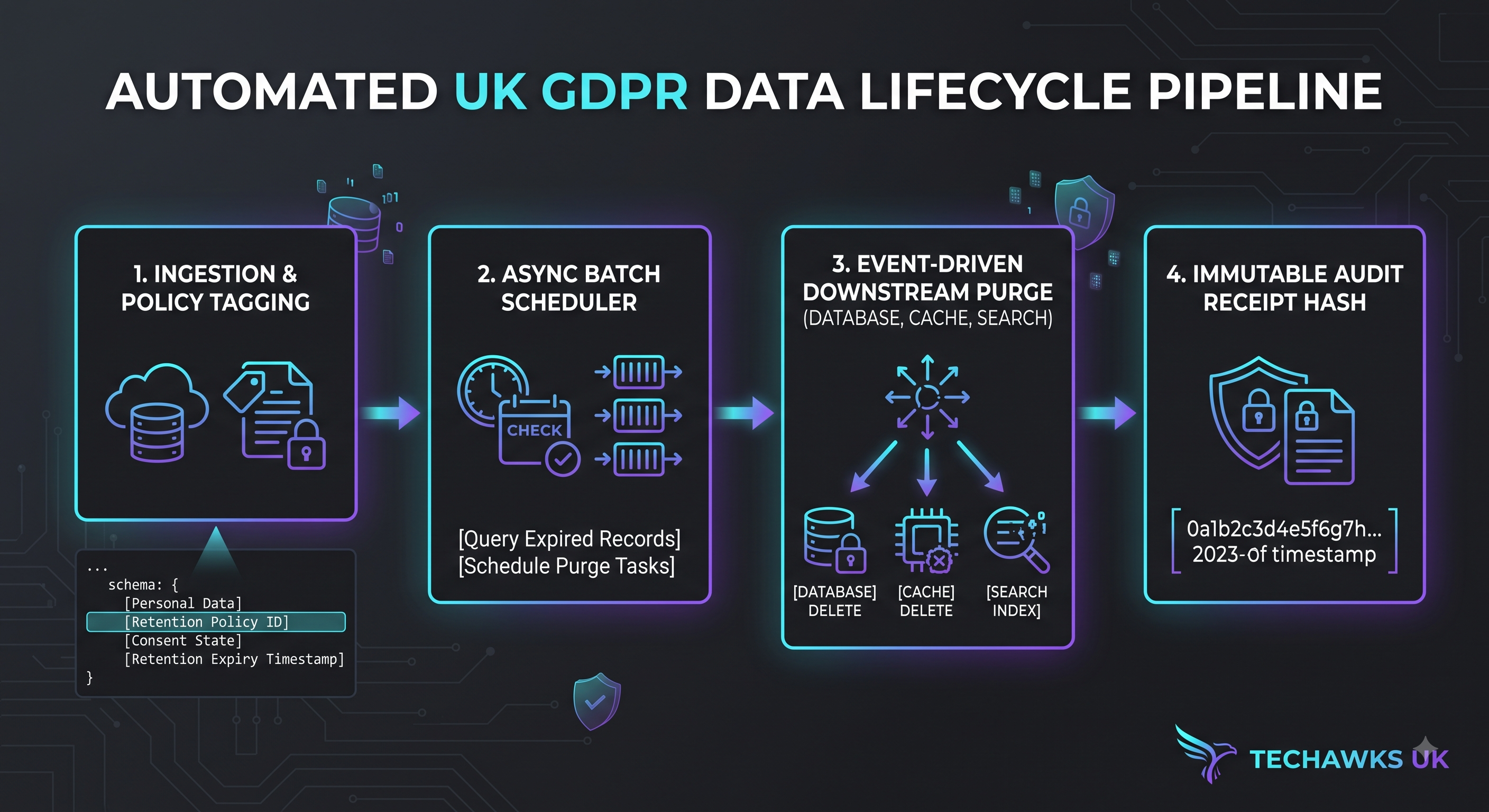
Follow this step-by-step tutorial to design an automated, audit-proof retention pipeline:
Step 1: Tag Data with Retention Policies at Ingestion
Never store unstructured timestamps alone. Add explicit metadata fields to your primary user tables (e.g., retention_category, purge_after_timestamp, consent_state). Categorize records at creation (e.g., marketing logs: 90 days; transactional records: 7 years).
Step 2: Implement Scheduled Async Batch Processing
Do not run massive, blocking DELETE queries directly against your live transactional database. Use a scheduled cron job (or serverless function like AWS Lambda / Azure Functions) that queries expired records in small, paginated batches during low-traffic windows to prevent database locks and latency spikes.
Step 3: Cascade Hard Deletes Across Downstream Stores
A user purge in your primary database must propagate to backups, read-replicas, search indexes (like Elasticsearch), and vector embeddings. Implement an event-driven architecture using an event bus (e.g., Kafka or RabbitMQ) that emits a UserPurgedEvent to trigger downstream consumer cleanups automatically.
Step 4: Generate Immutable Compliance Audit Logs
When personal records are erased, store an anonymized audit receipt containing only the operation timestamp, retention policy ID, and an irreversible record hash. This provides verifiable proof to UK Information Commissioner’s Office (ICO) auditors without retaining identifiable personal information.
Key Takeaways
Embed retention metadata directly into your schema definitions from day one.
Purge expired data asynchronously in paginated batches to avoid database contention.
Use event-driven messaging to ensure deletion cascades cleanly to caches, search indexes, and backups.
Keep lightweight, non-identifiable audit hashes to satisfy ICO compliance checks.
CTA
How does your team handle automated data purging and ICO compliance in production? Connect with local engineering leads and cloud architects by joining Techawks UK to share frameworks and best practices.
Under the UK Data Protection Act and UK GDPR principles, storing personal data indefinitely is a direct violation. Manual database cleanups are error-prone and fail audit standards. Engineering teams need a fully automated data lifecycle strategy baked directly into their backend architecture.
Follow this step-by-step tutorial to design an automated, audit-proof retention pipeline:
Step 1: Tag Data with Retention Policies at Ingestion
Never store unstructured timestamps alone. Add explicit metadata fields to your primary user tables (e.g., retention_category, purge_after_timestamp, consent_state). Categorize records at creation (e.g., marketing logs: 90 days; transactional records: 7 years).
Step 2: Implement Scheduled Async Batch Processing
Do not run massive, blocking DELETE queries directly against your live transactional database. Use a scheduled cron job (or serverless function like AWS Lambda / Azure Functions) that queries expired records in small, paginated batches during low-traffic windows to prevent database locks and latency spikes.
Step 3: Cascade Hard Deletes Across Downstream Stores
A user purge in your primary database must propagate to backups, read-replicas, search indexes (like Elasticsearch), and vector embeddings. Implement an event-driven architecture using an event bus (e.g., Kafka or RabbitMQ) that emits a UserPurgedEvent to trigger downstream consumer cleanups automatically.
Step 4: Generate Immutable Compliance Audit Logs
When personal records are erased, store an anonymized audit receipt containing only the operation timestamp, retention policy ID, and an irreversible record hash. This provides verifiable proof to UK Information Commissioner’s Office (ICO) auditors without retaining identifiable personal information.
Key Takeaways
Embed retention metadata directly into your schema definitions from day one.
Purge expired data asynchronously in paginated batches to avoid database contention.
Use event-driven messaging to ensure deletion cascades cleanly to caches, search indexes, and backups.
Keep lightweight, non-identifiable audit hashes to satisfy ICO compliance checks.
CTA
How does your team handle automated data purging and ICO compliance in production? Connect with local engineering leads and cloud architects by joining Techawks UK to share frameworks and best practices.
How to Architect a UK GDPR-Compliant Data Retention Pipeline in 4 Steps
Under the UK Data Protection Act and UK GDPR principles, storing personal data indefinitely is a direct violation. Manual database cleanups are error-prone and fail audit standards. Engineering teams need a fully automated data lifecycle strategy baked directly into their backend architecture.
Follow this step-by-step tutorial to design an automated, audit-proof retention pipeline:
Step 1: Tag Data with Retention Policies at Ingestion
Never store unstructured timestamps alone. Add explicit metadata fields to your primary user tables (e.g., retention_category, purge_after_timestamp, consent_state). Categorize records at creation (e.g., marketing logs: 90 days; transactional records: 7 years).
Step 2: Implement Scheduled Async Batch Processing
Do not run massive, blocking DELETE queries directly against your live transactional database. Use a scheduled cron job (or serverless function like AWS Lambda / Azure Functions) that queries expired records in small, paginated batches during low-traffic windows to prevent database locks and latency spikes.
Step 3: Cascade Hard Deletes Across Downstream Stores
A user purge in your primary database must propagate to backups, read-replicas, search indexes (like Elasticsearch), and vector embeddings. Implement an event-driven architecture using an event bus (e.g., Kafka or RabbitMQ) that emits a UserPurgedEvent to trigger downstream consumer cleanups automatically.
Step 4: Generate Immutable Compliance Audit Logs
When personal records are erased, store an anonymized audit receipt containing only the operation timestamp, retention policy ID, and an irreversible record hash. This provides verifiable proof to UK Information Commissioner’s Office (ICO) auditors without retaining identifiable personal information.
Key Takeaways
Embed retention metadata directly into your schema definitions from day one.
Purge expired data asynchronously in paginated batches to avoid database contention.
Use event-driven messaging to ensure deletion cascades cleanly to caches, search indexes, and backups.
Keep lightweight, non-identifiable audit hashes to satisfy ICO compliance checks.
CTA
How does your team handle automated data purging and ICO compliance in production? Connect with local engineering leads and cloud architects by joining Techawks UK to share frameworks and best practices.

 English
 Arabic
 French
 Spanish
 Deutsch
 Turkish
 Dutch
Dutch
 Italiano
 Russian
 Romaian
 Portuguese (Brazil)
 Greek
Greek