• What if the ice in your freezer could power a circuit? A new study in *Nature Physics* reveals that ordinary frozen water, long thought to be inert, actually generates electricity when bent, stretched, or twisted. This effect, called flexoelectricity, turns ice into an unexpectedly active material whose electrical signal rivals engineered electroceramics like titanium dioxide and strontium titanate.⁠

    Unlike piezoelectricity, which needs a crystal without inversion symmetry and responds under uniform stress, flexoelectricity can occur in any insulator when the shape curves unevenly. Ice fails the piezoelectric test because its hydrogen atoms are disordered across the lattice, yet when deformed it produces a clear, measurable charge.⁠

    In controlled experiments, researchers bent a slab of ice between metal plates and saw voltage rise directly with curvature, holding steady across the entire solid range up to melting. At extreme cold, they found an added twist, a thin ferroelectric surface layer that could flip its polarization under an external field while the bulk remained neutral.⁠

    This insight may help explain how thunderstorms charge up. In clouds, jagged collisions between ice crystals and graupel produce fields that spark lightning. Flexoelectricity provides a tangible mechanism for those uneven impacts to generate charge, aligning lab data with atmospheric observations.⁠

    The breakthrough also hints at new technology. Cheap, moldable, and abundant, ice could be harnessed for cold-environment sensors or pressure-to-voltage converters. By relying on shape and curvature rather than rare elements, frozen water emerges not just as a backdrop to climate but as a potential building block for electronics.⁠


    Source: s41567-025-02995-6
    What if the ice in your freezer could power a circuit? A new study in *Nature Physics* reveals that ordinary frozen water, long thought to be inert, actually generates electricity when bent, stretched, or twisted. This effect, called flexoelectricity, turns ice into an unexpectedly active material whose electrical signal rivals engineered electroceramics like titanium dioxide and strontium titanate.⁠ ⁠ Unlike piezoelectricity, which needs a crystal without inversion symmetry and responds under uniform stress, flexoelectricity can occur in any insulator when the shape curves unevenly. Ice fails the piezoelectric test because its hydrogen atoms are disordered across the lattice, yet when deformed it produces a clear, measurable charge.⁠ ⁠ In controlled experiments, researchers bent a slab of ice between metal plates and saw voltage rise directly with curvature, holding steady across the entire solid range up to melting. At extreme cold, they found an added twist, a thin ferroelectric surface layer that could flip its polarization under an external field while the bulk remained neutral.⁠ ⁠ This insight may help explain how thunderstorms charge up. In clouds, jagged collisions between ice crystals and graupel produce fields that spark lightning. Flexoelectricity provides a tangible mechanism for those uneven impacts to generate charge, aligning lab data with atmospheric observations.⁠ ⁠ The breakthrough also hints at new technology. Cheap, moldable, and abundant, ice could be harnessed for cold-environment sensors or pressure-to-voltage converters. By relying on shape and curvature rather than rare elements, frozen water emerges not just as a backdrop to climate but as a potential building block for electronics.⁠ ⁠ ⁠ Source: s41567-025-02995-6
    ·201 Views ·0 Προεπισκόπηση
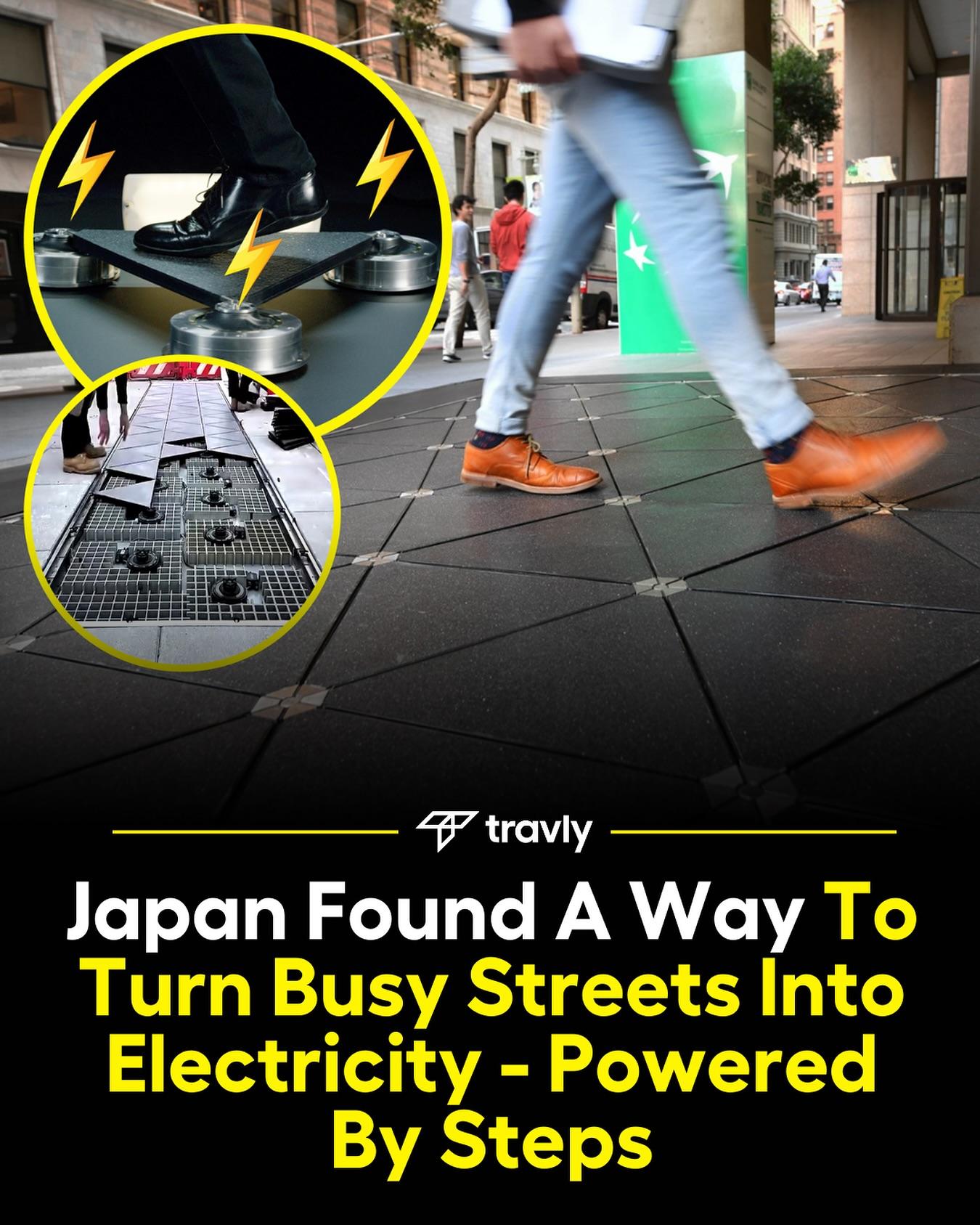
  • In Japan, every footstep is literally powering the city!

    Tokyo’s busiest hubs, like Shibuya Station and Fujisawa City Hall, are fitted with piezoelectric floor tiles (think of them as tiny energy harvesters)

    Every time someone walks across them, the pressure generates roughly 0.1 watts of electricity per step.
    Multiply that by the millions of daily commuters, and you get enough power to run LED displays, station lights, turnstiles, and more.

    This clever technology has been in action since around 2008, turning casual walking into a small but meaningful source of clean, renewable energy helping reduce carbon footprints across urban centers.

    While the energy per step is tiny, the cumulative impact in these congestion-packed areas makes every journey a step toward a greener future.

    #Piezoelectric #JapanInnovation #CleanEnergy
    #SmartCities #FvervStenCounts
    In Japan, every footstep is literally powering the city! 🔋🇯🇵 Tokyo’s busiest hubs, like Shibuya Station and Fujisawa City Hall, are fitted with piezoelectric floor tiles (think of them as tiny energy harvesters) Every time someone walks across them, the pressure generates roughly 0.1 watts of electricity per step. Multiply that by the millions of daily commuters, and you get enough power to run LED displays, station lights, turnstiles, and more. This clever technology has been in action since around 2008, turning casual walking into a small but meaningful source of clean, renewable energy helping reduce carbon footprints across urban centers. While the energy per step is tiny, the cumulative impact in these congestion-packed areas makes every journey a step toward a greener future. #Piezoelectric #JapanInnovation #CleanEnergy #SmartCities #FvervStenCounts
    ·838 Views ·0 Προεπισκόπηση
  • Chinese researchers have reportedly achieved controlled nuclear fusion between hydrogen and lithium inside a portable, fire-extinguisher-sized device—an experimental development with possible industrial and defense implications.

    Published in the peer-reviewed journal High Power Laser and Particle Beams, the study comes from the Xi’an Modern Control Technology Research Institute, part of China’s defense-industrial complex.

    Unlike traditional large-scale fusion setups, this compact reactor uses a 10-watt power supply and a mechanical hammer to generate nanosecond voltage pulses via piezoelectric ceramics. These pulses create a spinning electromagnetic field that accelerates hydrogen protons into a lithium-coated cathode, initiating fusion reactions.

    Notable aspects include the use of common hydrogen and lithium instead of rare isotopes, and a “polarised resonance” technique said to increase fusion likelihood by a million times. The reported result is a concentrated, directional neutron beam (10 billion neutrons/second), with energy output likened to that of nuclear detonations. Fast neutron beams have recognized applications in medicine, materials analysis, and potentially tactical weapons like neutron bombs.

    The system’s reported advantages include low cost, durability, and independence from external high-voltage sources. If validated and scalable, it could influence future fusion energy research—and may signal advances in China’s broader military technology efforts.

    -

    #futuretech
    Chinese researchers have reportedly achieved controlled nuclear fusion between hydrogen and lithium inside a portable, fire-extinguisher-sized device—an experimental development with possible industrial and defense implications. Published in the peer-reviewed journal High Power Laser and Particle Beams, the study comes from the Xi’an Modern Control Technology Research Institute, part of China’s defense-industrial complex. Unlike traditional large-scale fusion setups, this compact reactor uses a 10-watt power supply and a mechanical hammer to generate nanosecond voltage pulses via piezoelectric ceramics. These pulses create a spinning electromagnetic field that accelerates hydrogen protons into a lithium-coated cathode, initiating fusion reactions. Notable aspects include the use of common hydrogen and lithium instead of rare isotopes, and a “polarised resonance” technique said to increase fusion likelihood by a million times. The reported result is a concentrated, directional neutron beam (10 billion neutrons/second), with energy output likened to that of nuclear detonations. Fast neutron beams have recognized applications in medicine, materials analysis, and potentially tactical weapons like neutron bombs. The system’s reported advantages include low cost, durability, and independence from external high-voltage sources. If validated and scalable, it could influence future fusion energy research—and may signal advances in China’s broader military technology efforts. - #futuretech
    ·546 Views ·0 Προεπισκόπηση
  • A team of scientists has developed an ultralight device capable of harvesting energy from the natural vibrations of bees without hindering their flight.

    Researchers from the Beijing Institute of Technology and Sun Yat-sen University designed a miniature piezoelectric energy harvester (PEH) that weighs just 46 milligrams—lighter than a grain of rice. Made with flexible PVDF films, the device is tuned to match the bees’ natural thorax vibrations, enabling it to generate electricity while allowing the bees to hover, flip, and fly as usual.

    The device can produce up to 5.66 volts and achieve a power density of 1.27 milliwatts per cubic centimeter. By precisely aligning with the bees’ vibration frequency and adjusting the center of gravity, the researchers ensured efficient energy conversion without compromising flight stability.

    To create the harvester, they used laser-cut copper substrates bonded with PVDF films and shaped them using 3D-printed molds. Simulations validated the design, while high-speed camera footage was used to fine-tune its performance.

    The bees displayed no significant changes in flight behavior even with the device attached. However, the researchers noted that further work is needed to address challenges in energy storage and adapt the technology for other flying insects, such as dragonflies and butterflies.
    A team of scientists has developed an ultralight device capable of harvesting energy from the natural vibrations of bees without hindering their flight. Researchers from the Beijing Institute of Technology and Sun Yat-sen University designed a miniature piezoelectric energy harvester (PEH) that weighs just 46 milligrams—lighter than a grain of rice. Made with flexible PVDF films, the device is tuned to match the bees’ natural thorax vibrations, enabling it to generate electricity while allowing the bees to hover, flip, and fly as usual. The device can produce up to 5.66 volts and achieve a power density of 1.27 milliwatts per cubic centimeter. By precisely aligning with the bees’ vibration frequency and adjusting the center of gravity, the researchers ensured efficient energy conversion without compromising flight stability. To create the harvester, they used laser-cut copper substrates bonded with PVDF films and shaped them using 3D-printed molds. Simulations validated the design, while high-speed camera footage was used to fine-tune its performance. The bees displayed no significant changes in flight behavior even with the device attached. However, the researchers noted that further work is needed to address challenges in energy storage and adapt the technology for other flying insects, such as dragonflies and butterflies.
    ·256 Views ·0 Προεπισκόπηση
Techawks - Powered By Pantrade Blockchain https://techawks.com