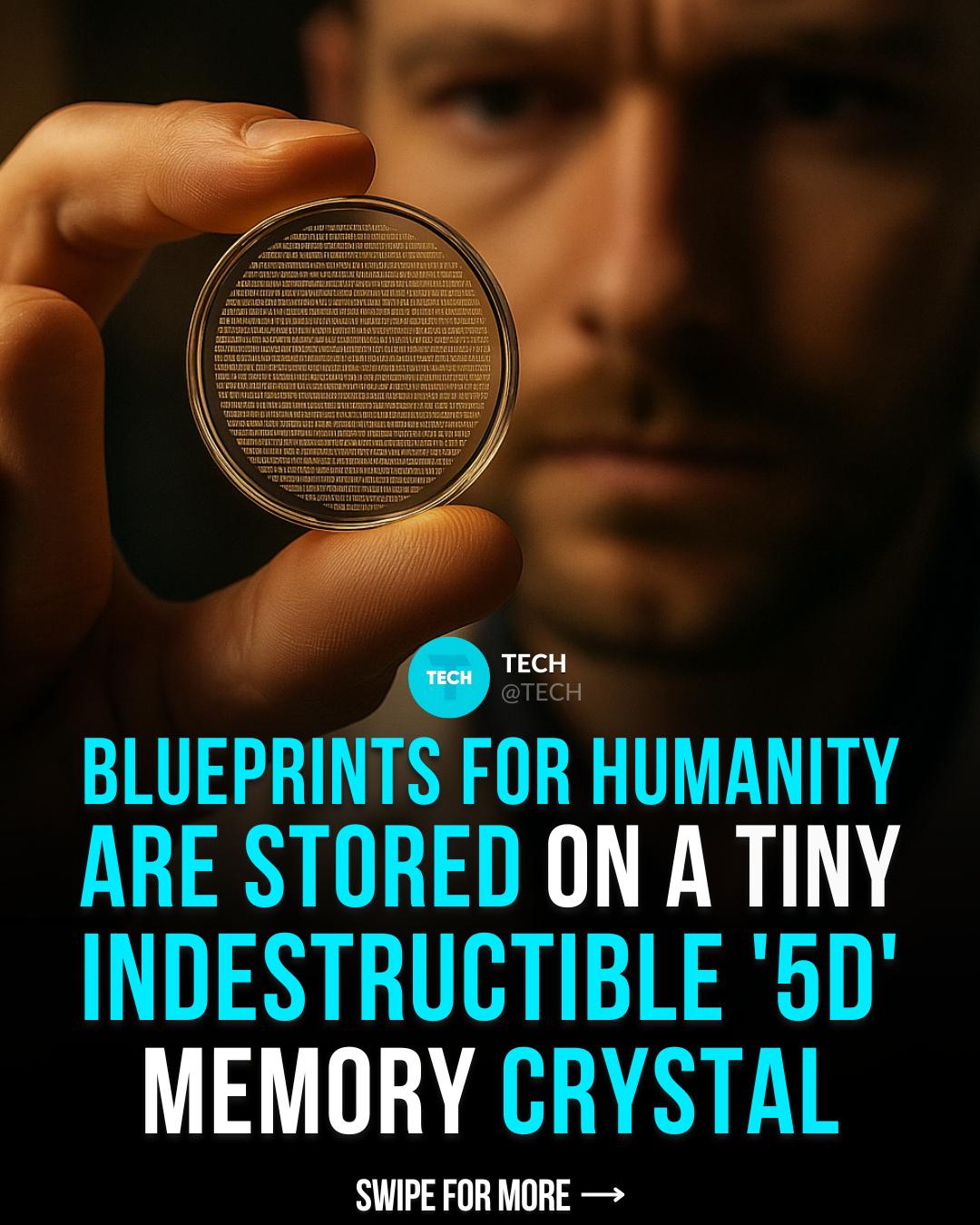
In a salt cave beneath Hallstatt, Austria, a clear glass disc no larger than a coin holds the genetic blueprint of humanity. Scientists at the University of Southampton have etched the entire human genome onto a 5D Memory Crystal, a storage medium made from fused quartz engineered to endure for billions of years. With a capacity of 360 terabytes and unmatched resilience, this crystal is built to outlast civilization.
The 5D format refers to more than just space. Using femtosecond laser pulses, researchers write data into nanostructured voids that encode information through two optical dimensions and three spatial coordinates. Unlike traditional storage, the data isn’t written on the surface, but within the crystal, forming a dense, stable lattice that resists heat, radiation, shock, and decay. It holds a Guinness World Record for durability.
The genome embedded in this crystal is no rough draft. Each of the three billion DNA base pairs, adenine, cytosine, guanine, and thymine, was sequenced 150 times for accuracy. The work, carried out with Helixwork Technologies, ensures preservation and fidelity. To help any future intelligence interpret the data, the crystal includes a visual key, diagrams of DNA structure, molecular layouts, and instructions for assembling genes into chromosomes.
The technology was inspired by the Pioneer plaques, gold-etched messages launched aboard 1970s spacecraft to communicate with intelligent life. Similarly, the 5D Memory Crystal carries a message through time. If recovered long after extinction, it could inform or even resurrect a species.
Although we can’t yet synthesize a human from a genome, advances in synthetic biology are closing the gap. In 2010, a team led by Dr. Craig Venter created the first synthetic bacterium. Whether discovered by humans, machines, or something alien, it tells a clear story, this is what we were. This is how life might begin again.
In a salt cave beneath Hallstatt, Austria, a clear glass disc no larger than a coin holds the genetic blueprint of humanity. Scientists at the University of Southampton have etched the entire human genome onto a 5D Memory Crystal, a storage medium made from fused quartz engineered to endure for billions of years. With a capacity of 360 terabytes and unmatched resilience, this crystal is built to outlast civilization.
The 5D format refers to more than just space. Using femtosecond laser pulses, researchers write data into nanostructured voids that encode information through two optical dimensions and three spatial coordinates. Unlike traditional storage, the data isn’t written on the surface, but within the crystal, forming a dense, stable lattice that resists heat, radiation, shock, and decay. It holds a Guinness World Record for durability.
The genome embedded in this crystal is no rough draft. Each of the three billion DNA base pairs, adenine, cytosine, guanine, and thymine, was sequenced 150 times for accuracy. The work, carried out with Helixwork Technologies, ensures preservation and fidelity. To help any future intelligence interpret the data, the crystal includes a visual key, diagrams of DNA structure, molecular layouts, and instructions for assembling genes into chromosomes.
The technology was inspired by the Pioneer plaques, gold-etched messages launched aboard 1970s spacecraft to communicate with intelligent life. Similarly, the 5D Memory Crystal carries a message through time. If recovered long after extinction, it could inform or even resurrect a species.
Although we can’t yet synthesize a human from a genome, advances in synthetic biology are closing the gap. In 2010, a team led by Dr. Craig Venter created the first synthetic bacterium. Whether discovered by humans, machines, or something alien, it tells a clear story, this is what we were. This is how life might begin again.
·198 Visualizações
·0 Anterior
 English
 Arabic
 French
 Spanish
 Portuguese
 Deutsch
 Turkish
 Dutch
Dutch
 Italiano
 Russian
 Romaian
 Portuguese (Brazil)
 Greek
Greek