The Sabu Disk is one of archaeology's most enduring mysteries—a 5,000-year-old artifact so unique that nearly 90 years after its discovery, experts still can't agree on what it actually was. British archaeologist Walter Bryan Emery found this extraordinary object on January 19, 1936, shattered into pieces in the tomb of Prince Sabu, a high-ranking Egyptian official from the First Dynasty (circa 3000-2800 BC) at the Saqqara necropolis.
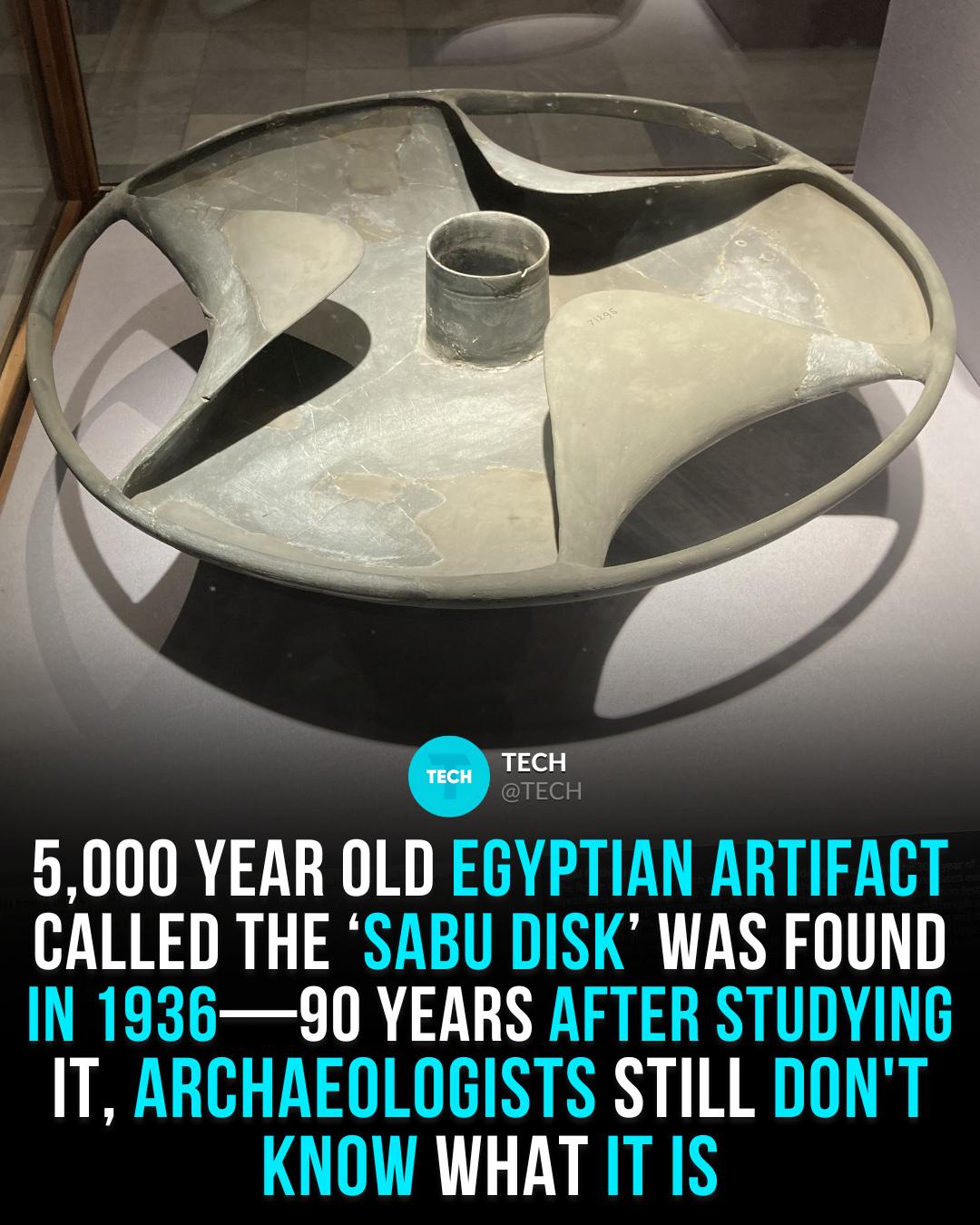
What makes this disk so fascinating isn't just its age, but its impossibly intricate design. Carved from schist—an extremely fragile, flaky stone that crumbles under pressure—the 61-centimeter artifact features three elegantly curved lobes extending from a central hub, creating what looks remarkably like a modern steering wheel with wide spokes. The precision required to craft such delicate curves from this brittle material using only stone and copper tools is hard to explain and seems almost impossible for its era.
The disk's purpose remains completely unknown, spawning decades of theories that range from plausible to bizarre. Early archaeologists dismissed it as a ceremonial vessel or incense burner, but its complex aerodynamic design suggests something far more functional. Recent scholarly work by physicist Akio Kato proposes it served as a "mash rake" for brewing beer—a gentle stirring tool that would create optimal flow patterns in hot liquid during grain fermentation.
The disk's burial context adds another layer of mystery. Found in the central chamber directly beside Prince Sabu's skeleton, it clearly held special significance—yet no similar objects have ever been discovered in Egyptian tombs. This singular example represents either an experimental creation or knowledge that was lost to history, making it truly unique among the thousands of artifacts from ancient Egypt.
Today, the restored disk sits in Cairo's Egyptian Museum, continuing to perplex visitors and scholars alike.
The Sabu Disk is one of archaeology's most enduring mysteries—a 5,000-year-old artifact so unique that nearly 90 years after its discovery, experts still can't agree on what it actually was. British archaeologist Walter Bryan Emery found this extraordinary object on January 19, 1936, shattered into pieces in the tomb of Prince Sabu, a high-ranking Egyptian official from the First Dynasty (circa 3000-2800 BC) at the Saqqara necropolis.
What makes this disk so fascinating isn't just its age, but its impossibly intricate design. Carved from schist—an extremely fragile, flaky stone that crumbles under pressure—the 61-centimeter artifact features three elegantly curved lobes extending from a central hub, creating what looks remarkably like a modern steering wheel with wide spokes. The precision required to craft such delicate curves from this brittle material using only stone and copper tools is hard to explain and seems almost impossible for its era.
The disk's purpose remains completely unknown, spawning decades of theories that range from plausible to bizarre. Early archaeologists dismissed it as a ceremonial vessel or incense burner, but its complex aerodynamic design suggests something far more functional. Recent scholarly work by physicist Akio Kato proposes it served as a "mash rake" for brewing beer—a gentle stirring tool that would create optimal flow patterns in hot liquid during grain fermentation.
The disk's burial context adds another layer of mystery. Found in the central chamber directly beside Prince Sabu's skeleton, it clearly held special significance—yet no similar objects have ever been discovered in Egyptian tombs. This singular example represents either an experimental creation or knowledge that was lost to history, making it truly unique among the thousands of artifacts from ancient Egypt.
Today, the restored disk sits in Cairo's Egyptian Museum, continuing to perplex visitors and scholars alike.
 English
 Arabic
 French
 Spanish
 Portuguese
 Deutsch
 Turkish
 Dutch
Dutch
 Italiano
 Russian
 Romaian
 Portuguese (Brazil)
 Greek
Greek