



The 50°C Compute Barrier: Why UAE Cloud Architects Are Redesigning AI Infrastructure Around Direct-to-Chip Liquid Cooling
The UAE is accelerating sovereign AI capacity at unprecedented scale—scaling multi-gigawatt compute hubs across Abu Dhabi and Dubai backed by national clean energy and grid expansion initiatives.
However, operating high-density AI clusters in the Gulf presents a unique physical computing bottleneck that Silicon Valley blueprints cannot solve: extreme ambient wet-bulb and dry-bulb temperatures.
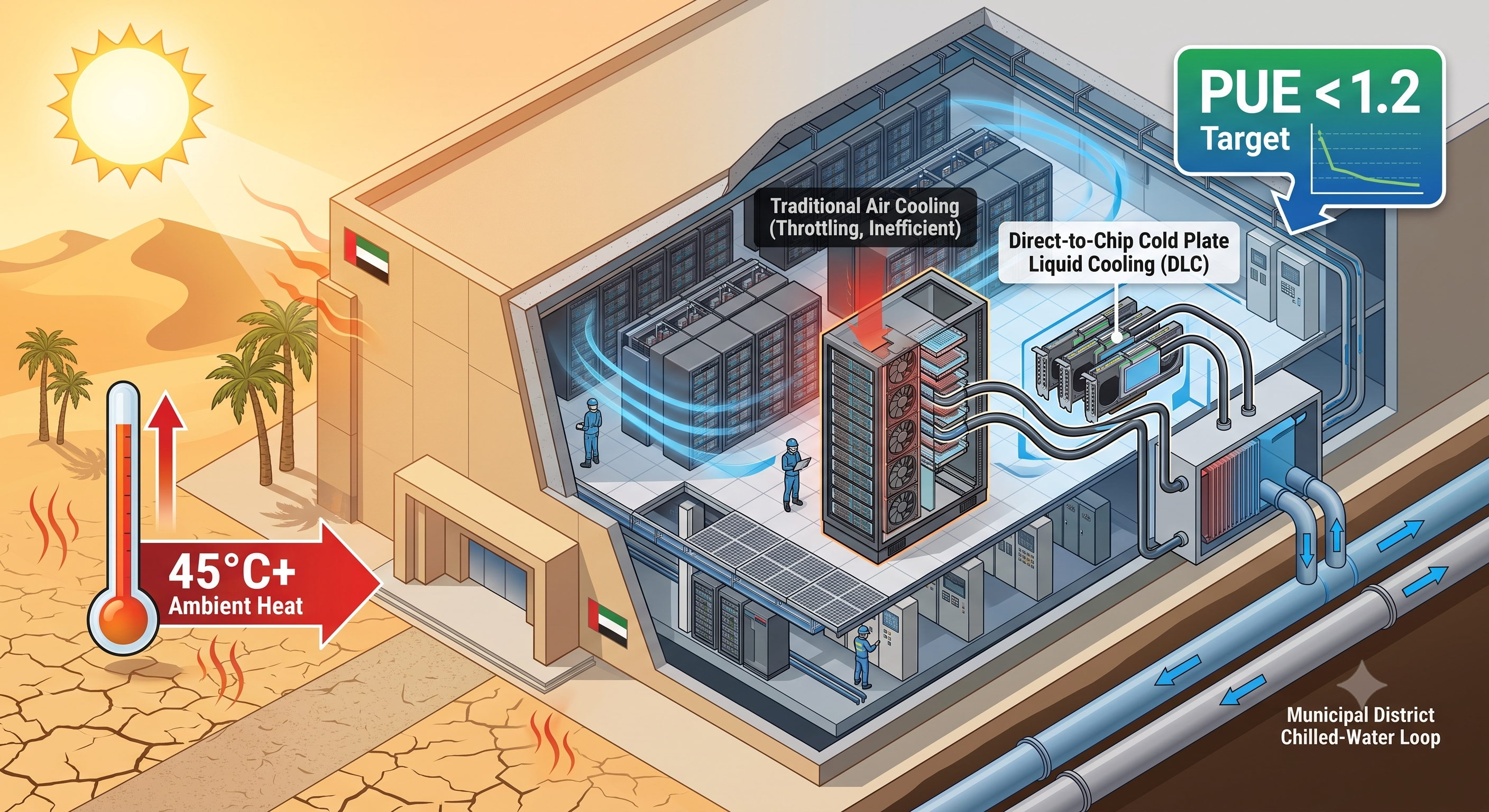
When outside ambient temperatures routinely cross 45°C to 50°C, traditional air-chilled cooling systems collapse under physical and thermodynamic limits:
The Air-Cooling Density Wall: Air heat capacity ($C_p \approx 1.005\text{ kJ/kg}\cdot\text{K}$) cannot physically evacuate heat from modern AI server racks drawing 80kW to 140kW per cabinet without creating violent internal hot spots.
Compressor Parasitic Load Spikes: Mechanical chillers forced to reject heat against high ambient desert air consume massive parasitic power, driving Power Usage Effectiveness (PUE) above 1.6 and straining local power allocations.
Severe Water Stress Risks: Relying on evaporative cooling towers in an arid environment rapidly consumes valuable desalinated municipal water supplies, clashing directly with regional sustainability and net-zero frameworks.
The Engineering Solution: Closed-Loop Direct-to-Chip (D2C) & Facility Water Loops (FWS)To build mission-critical AI clusters resilient against desert ambient heat, regional infrastructure architects are engineering high-delta-T liquid cooling topologies:
Direct-to-Chip Cold Plates (Primary Loop): Replace copper server heat sinks with micro-channel liquid cold plates clamped directly onto the GPU and CPU dies. Dielectric fluids or treated water-glycol mixtures capture over 75% to 85% of component heat directly at the source, preventing heat from ever entering the data hall air envelope.
Warm-Water Cooling & Dry-Cooler Heat Rejection: By maintaining secondary loop supply temperatures at 32°C to 40°C, facilities can reject thermal heat to outdoor dry coolers using standard sensible heat exchange without requiring mechanical refrigeration or evaporative water consumption, maintaining a target PUE below 1.25 even in high-heat seasons.
Intelligent Coolant Distribution Units (CDUs) & Telemetry Isolation: Isolate the facility water system (FWS) from the technology cooling system (TCS) using intelligent CDUs equipped with automated differential pressure sensors, sub-second leak-detection valves, and N+1 redundant variable-speed circulating pumps.
Thermal-Aware Job Scheduling: Integrate datacenter building management system (BMS) telemetry directly into the Kubernetes / Slurm compute orchestrator. When external ambient thermal conditions peak during mid-day, non-latency-critical training checkpoints dynamically throttle GPU power caps by 5%–10% to smooth thermal dissipation.
Building sovereign AI in the Middle East requires designing from the physical hardware layer up. When your thermal architecture handles the harshest environments natively, your computational advantage is unshakeable.
Discussion Question
For cloud engineers, infrastructure architects, and datacenter leads in the UAE:
has your organization migrated high-density AI clusters to direct-to-chip liquid cooling or immersion tanks, and how are you managing secondary facility loop heat rejection without excessive water consumption?
CTA
Join Techawks UAE: Connect with leading Middle Eastern cloud architects, infrastructure engineers, and systems developers discussing regional sovereign AI infrastructure, high-density datacenter design, and robust distributed systems. Link in bio/comments.
The 50°C Compute Barrier: Why UAE Cloud Architects Are Redesigning AI Infrastructure Around Direct-to-Chip Liquid Cooling
The UAE is accelerating sovereign AI capacity at unprecedented scale—scaling multi-gigawatt compute hubs across Abu Dhabi and Dubai backed by national clean energy and grid expansion initiatives.
However, operating high-density AI clusters in the Gulf presents a unique physical computing bottleneck that Silicon Valley blueprints cannot solve: extreme ambient wet-bulb and dry-bulb temperatures.
When outside ambient temperatures routinely cross 45°C to 50°C, traditional air-chilled cooling systems collapse under physical and thermodynamic limits:
The Air-Cooling Density Wall: Air heat capacity ($C_p \approx 1.005\text{ kJ/kg}\cdot\text{K}$) cannot physically evacuate heat from modern AI server racks drawing 80kW to 140kW per cabinet without creating violent internal hot spots.
Compressor Parasitic Load Spikes: Mechanical chillers forced to reject heat against high ambient desert air consume massive parasitic power, driving Power Usage Effectiveness (PUE) above 1.6 and straining local power allocations.
Severe Water Stress Risks: Relying on evaporative cooling towers in an arid environment rapidly consumes valuable desalinated municipal water supplies, clashing directly with regional sustainability and net-zero frameworks.
The Engineering Solution: Closed-Loop Direct-to-Chip (D2C) & Facility Water Loops (FWS)To build mission-critical AI clusters resilient against desert ambient heat, regional infrastructure architects are engineering high-delta-T liquid cooling topologies:
Direct-to-Chip Cold Plates (Primary Loop): Replace copper server heat sinks with micro-channel liquid cold plates clamped directly onto the GPU and CPU dies. Dielectric fluids or treated water-glycol mixtures capture over 75% to 85% of component heat directly at the source, preventing heat from ever entering the data hall air envelope.
Warm-Water Cooling & Dry-Cooler Heat Rejection: By maintaining secondary loop supply temperatures at 32°C to 40°C, facilities can reject thermal heat to outdoor dry coolers using standard sensible heat exchange without requiring mechanical refrigeration or evaporative water consumption, maintaining a target PUE below 1.25 even in high-heat seasons.
Intelligent Coolant Distribution Units (CDUs) & Telemetry Isolation: Isolate the facility water system (FWS) from the technology cooling system (TCS) using intelligent CDUs equipped with automated differential pressure sensors, sub-second leak-detection valves, and N+1 redundant variable-speed circulating pumps.
Thermal-Aware Job Scheduling: Integrate datacenter building management system (BMS) telemetry directly into the Kubernetes / Slurm compute orchestrator. When external ambient thermal conditions peak during mid-day, non-latency-critical training checkpoints dynamically throttle GPU power caps by 5%–10% to smooth thermal dissipation.
Building sovereign AI in the Middle East requires designing from the physical hardware layer up. When your thermal architecture handles the harshest environments natively, your computational advantage is unshakeable.
Discussion Question
For cloud engineers, infrastructure architects, and datacenter leads in the UAE:
has your organization migrated high-density AI clusters to direct-to-chip liquid cooling or immersion tanks, and how are you managing secondary facility loop heat rejection without excessive water consumption?
CTA
Join Techawks UAE: Connect with leading Middle Eastern cloud architects, infrastructure engineers, and systems developers discussing regional sovereign AI infrastructure, high-density datacenter design, and robust distributed systems. Link in bio/comments.


 English
 Arabic
 French
 Spanish
 Portuguese
 Deutsch
 Dutch
 Italiano
 Russian
 Romaian
 Portuguese (Brazil)
 Greek