AI creates wonders, but it also drains power. Every image or answer comes at the cost of processors running nonstop, pumping out heat and burning energy. Now scientists have found a striking alternative: letting light, not silicon, do the heavy lifting.
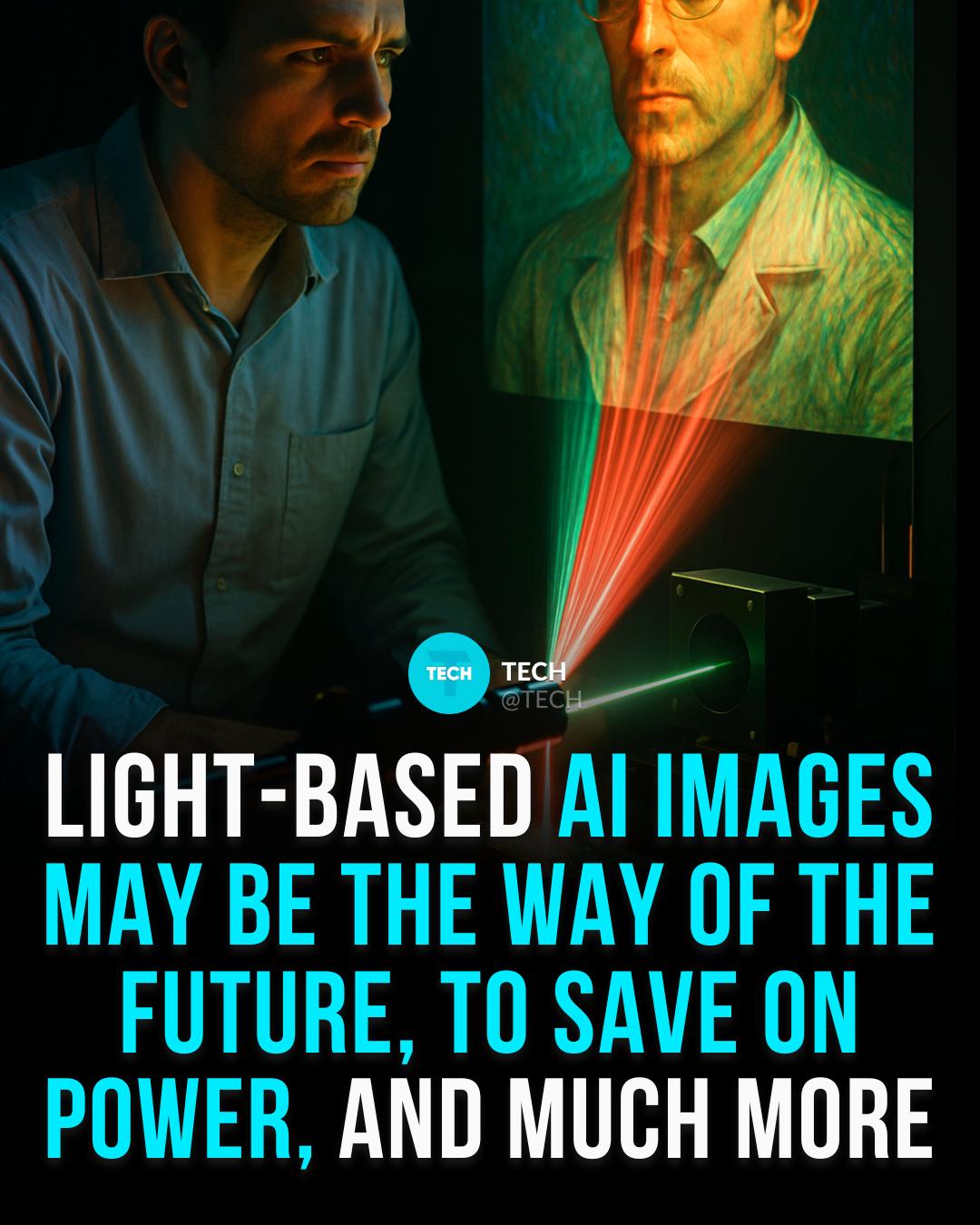
At UCLA, researchers designed an “optical generative model” described in Nature. Instead of grinding through thousands of digital steps, their system uses laser beams and liquid crystal screens, called spatial light modulators, to imprint static into light and decode it instantly into images. This snapshot method removes the need for repetitive computation, generating results in a single flash.
The efficiency gap is enormous. Standard diffusion models burn hundreds or thousands of joules per image, while the optical system consumes only a few millijoules, millions of times less. In tests, it recreated digits, faces, and Van Gogh-style art with quality nearly equal to digital models. Because each image is tied to a unique light pattern, the method also offers built-in security, allowing only the correct decoder to reconstruct the picture.
Though still in early stages, the technology could shrink into photonic chips, opening the door to ultra-efficient AI glasses, medical imaging tools, or portable creative devices. As AI continues to scale worldwide, this work suggests a different path forward—one where photons replace processors, and energy costs fade into the background.
AI creates wonders, but it also drains power. Every image or answer comes at the cost of processors running nonstop, pumping out heat and burning energy. Now scientists have found a striking alternative: letting light, not silicon, do the heavy lifting.
At UCLA, researchers designed an “optical generative model” described in Nature. Instead of grinding through thousands of digital steps, their system uses laser beams and liquid crystal screens, called spatial light modulators, to imprint static into light and decode it instantly into images. This snapshot method removes the need for repetitive computation, generating results in a single flash.
The efficiency gap is enormous. Standard diffusion models burn hundreds or thousands of joules per image, while the optical system consumes only a few millijoules, millions of times less. In tests, it recreated digits, faces, and Van Gogh-style art with quality nearly equal to digital models. Because each image is tied to a unique light pattern, the method also offers built-in security, allowing only the correct decoder to reconstruct the picture.
Though still in early stages, the technology could shrink into photonic chips, opening the door to ultra-efficient AI glasses, medical imaging tools, or portable creative devices. As AI continues to scale worldwide, this work suggests a different path forward—one where photons replace processors, and energy costs fade into the background.
 English
 Arabic
 French
 Spanish
 Portuguese
 Deutsch
 Turkish
 Dutch
Dutch
 Italiano
 Russian
 Romaian
 Portuguese (Brazil)
 Greek
Greek