• On Election Day, two AI startups tried convincing the world their AI chatbots were good enough to be an accurate, real-time source of information during a high-stakes presidential election: xAI and Perplexity.

    Elon Musk’s Grok failed almost instantly, offering wrong answers about races’ outcomes before the polls had even closed.

    On the other hand, Perplexity offered helpful, real-time election insights and maps throughout the night, linking to reliable resources and offering historical context where appropriate.

    Perplexity took a risky bet, and it paid off.

    Read all about the risky bet and how it paid off at the link in the bio

    Article by Maxwell Zeff

    Image Credits: Maxwell Zeff

    #TechCrunch #technews #artificialintelligence #startup #chatbot #AI #genAI

    On Election Day, two AI startups tried convincing the world their AI chatbots were good enough to be an accurate, real-time source of information during a high-stakes presidential election: xAI and Perplexity. Elon Musk’s Grok failed almost instantly, offering wrong answers about races’ outcomes before the polls had even closed. On the other hand, Perplexity offered helpful, real-time election insights and maps throughout the night, linking to reliable resources and offering historical context where appropriate. Perplexity took a risky bet, and it paid off. Read all about the risky bet and how it paid off at the link in the bio 👆 Article by Maxwell Zeff Image Credits: Maxwell Zeff #TechCrunch #technews #artificialintelligence #startup #chatbot #AI #genAI
    ·361 Views ·0 önizleme

  • Microsoft has launched a free Generative AI course that typically costs $999 in schools.

    It includes 21 lessons, teaches you how to build real-world GenAI apps, and comes with no paywall or hidden catch.

    Don’t forget to SAVE this for later!

    https://learn.microsoft.com/en-us/shows/generative-ai-for-beginners/

    #ai #artificialintelligence #aitools #aihacks #chatgpt #tech #technology
    🚨 Microsoft has launched a free Generative AI course that typically costs $999 in schools. 📚 It includes 21 lessons, teaches you how to build real-world GenAI apps, and comes with no paywall or hidden catch. Don’t forget to SAVE this for later! ✅ 🔗 https://learn.microsoft.com/en-us/shows/generative-ai-for-beginners/ #ai #artificialintelligence #aitools #aihacks #chatgpt #tech #technology
    ·188 Views ·0 önizleme
  • ChatGPT users discovered an interesting phenomenon over the weekend: the chatbot refuses to answer questions about “David Mayer.” Asking it to do so causes it to freeze up instantly. Conspiracy theories have ensued — but a more ordinary reason may be at the heart of this strange behavior.

    But what began as a one-off curiosity soon bloomed as people discovered it isn’t just David Mayer who ChatGPT can’t name.

    Also found to crash the service are the names Brian Hood, Jonathan Turley, Jonathan Zittrain, David Faber, and Guido Scorza. (No doubt more have been discovered since then, so this list is not exhaustive.)

    Who are these men? And why does ChatGPT hate them so?

    Find out at the link in the bio

    Article by Devin Coldewey

    Image Credits: Getty Images; TechCrunch / OpenAI

    #TechCrunch #technews #artificialintelligence #OpenAI #ChatGPT #generativeAI #GenAI
    ChatGPT users discovered an interesting phenomenon over the weekend: the chatbot refuses to answer questions about “David Mayer.” Asking it to do so causes it to freeze up instantly. Conspiracy theories have ensued — but a more ordinary reason may be at the heart of this strange behavior. But what began as a one-off curiosity soon bloomed as people discovered it isn’t just David Mayer who ChatGPT can’t name. Also found to crash the service are the names Brian Hood, Jonathan Turley, Jonathan Zittrain, David Faber, and Guido Scorza. (No doubt more have been discovered since then, so this list is not exhaustive.) Who are these men? And why does ChatGPT hate them so? Find out at the link in the bio 👆 Article by Devin Coldewey Image Credits: Getty Images; TechCrunch / OpenAI #TechCrunch #technews #artificialintelligence #OpenAI #ChatGPT #generativeAI #GenAI
    ·408 Views ·0 önizleme
  • A staging page on a website used by OpenAI refers to a “ChatGPT Pro” plan that includes all the benefits of ChatGPT Plus, as well as new goodies.

    Recall that ChatGPT Plus is an upgraded version of OpenAI’s AI-powered chatbot platform, ChatGPT.

    According to the leaked page, which was uncovered by software engineer Tibor Blaho on X, ChatGPT Pro provides unlimited access to all of OpenAI’s models, including the full version of its o1 “reasoning” model, a distilled release of o1 called o1-mini, and GPT-4o.

    Unlike most AI, o1, o1-mini, and other reasoning models effectively fact-check themselves. This helps them avoid some of the pitfalls that normally trip up models, with the downside being that they often take longer to arrive at solutions.

    Read more on the leaked page at the link in the bio

    Article by Kyle Wiggers

    Image Credits: Leon Neal / Staff / Getty Images

    #TechCrunch #technews #artificialintelligence #OpenAI #ChatGPT #GenAI
    A staging page on a website used by OpenAI refers to a “ChatGPT Pro” plan that includes all the benefits of ChatGPT Plus, as well as new goodies. Recall that ChatGPT Plus is an upgraded version of OpenAI’s AI-powered chatbot platform, ChatGPT. According to the leaked page, which was uncovered by software engineer Tibor Blaho on X, ChatGPT Pro provides unlimited access to all of OpenAI’s models, including the full version of its o1 “reasoning” model, a distilled release of o1 called o1-mini, and GPT-4o. Unlike most AI, o1, o1-mini, and other reasoning models effectively fact-check themselves. This helps them avoid some of the pitfalls that normally trip up models, with the downside being that they often take longer to arrive at solutions. Read more on the leaked page at the link in the bio 👆 Article by Kyle Wiggers Image Credits: Leon Neal / Staff / Getty Images #TechCrunch #technews #artificialintelligence #OpenAI #ChatGPT #GenAI
    ·295 Views ·0 önizleme
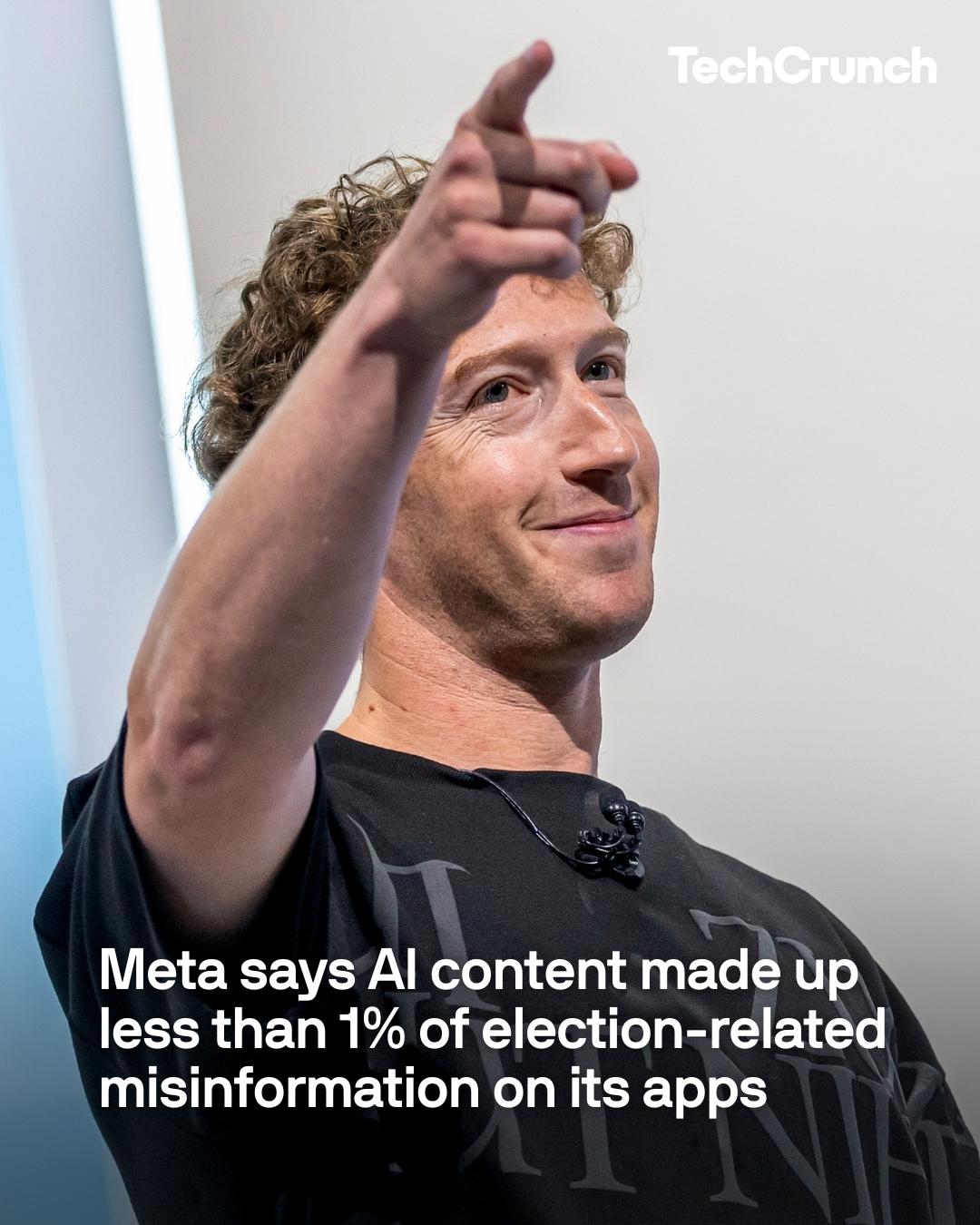
  • At the start of the year, there were widespread concerns about how generative AI could be used to interfere in global elections to spread propaganda and disinformation.

    Fast-forward to the end of the year, Meta claims those fears did not play out, at least on its platforms, as it shared that the technology had limited impact across Facebook, Instagram, and Threads.

    The company says its findings are based on content around major elections in the U.S., Bangladesh, Indonesia, India, Pakistan, the EU Parliament, France, the U.K., South Africa, Mexico, and Brazil.

    Meta notes that its Imagine AI image generator rejected 590,000 requests to create images of President-elect Trump, Vice President-elect Vance, Vice President Harris, Governor Walz, and President Biden in the month leading up to election day in order to prevent people from creating election-related deepfakes.

    Read more on Meta's claims at the link in the bio

    Article by Aisha Malik

    Image Credits: Bloomberg / Contributor / Getty Images; Meta

    #TechCrunch #technews #artificialintelligence #Meta #MarkZuckerberg #GenerativeAI #GenAI
    At the start of the year, there were widespread concerns about how generative AI could be used to interfere in global elections to spread propaganda and disinformation. Fast-forward to the end of the year, Meta claims those fears did not play out, at least on its platforms, as it shared that the technology had limited impact across Facebook, Instagram, and Threads. The company says its findings are based on content around major elections in the U.S., Bangladesh, Indonesia, India, Pakistan, the EU Parliament, France, the U.K., South Africa, Mexico, and Brazil. Meta notes that its Imagine AI image generator rejected 590,000 requests to create images of President-elect Trump, Vice President-elect Vance, Vice President Harris, Governor Walz, and President Biden in the month leading up to election day in order to prevent people from creating election-related deepfakes. Read more on Meta's claims at the link in the bio 👆 Article by Aisha Malik Image Credits: Bloomberg / Contributor / Getty Images; Meta #TechCrunch #technews #artificialintelligence #Meta #MarkZuckerberg #GenerativeAI #GenAI
    ·796 Views ·0 önizleme
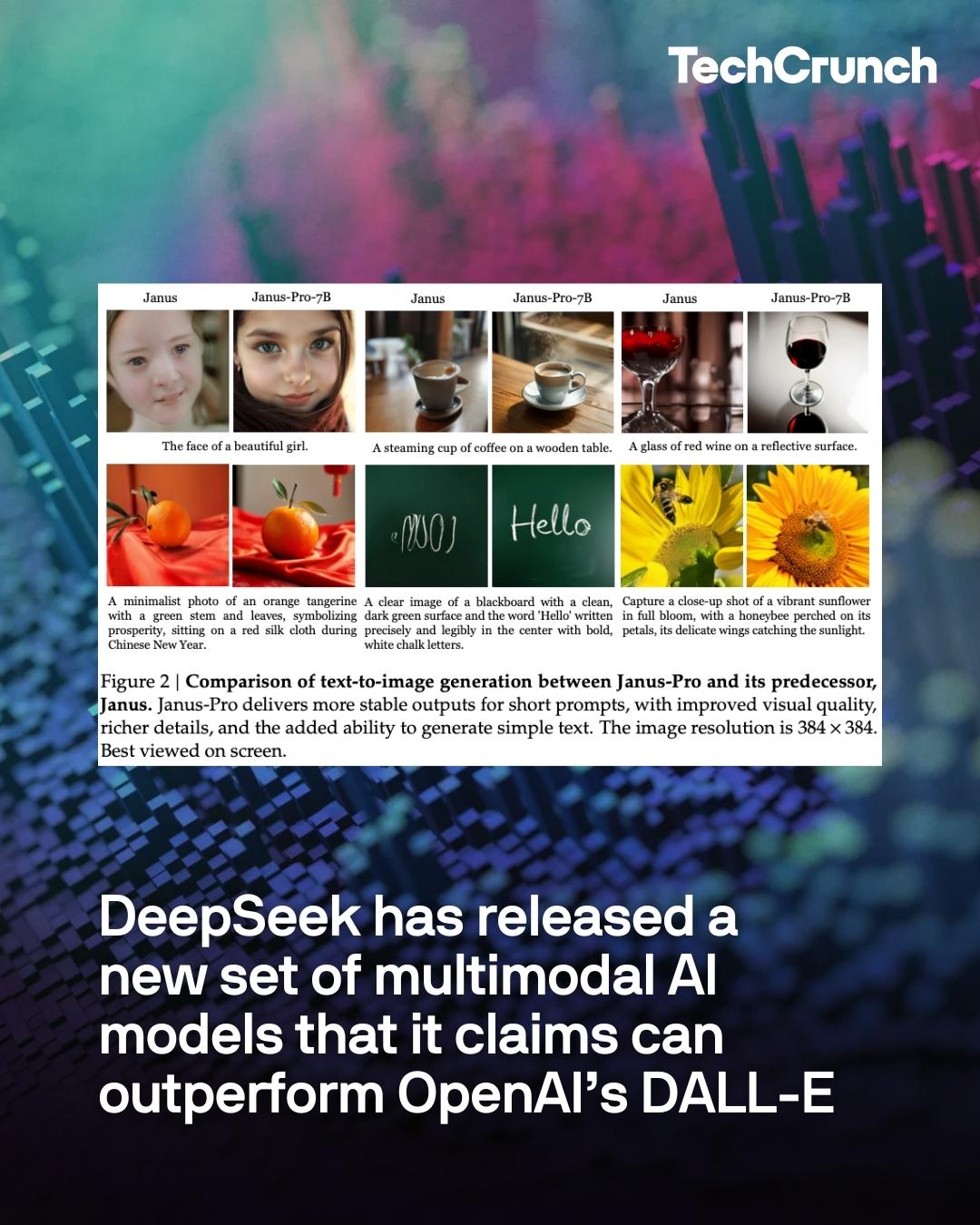
  • DeepSeek, the viral AI company, has released a new set of multimodal AI models that it claims can outperform OpenAI’s DALL-E 3.

    The models, which are available for download from the AI dev platform Hugging Face, are part of a new model family that DeepSeek is calling Janus-Pro. They range in size from 1 billion to 7 billion parameters.

    Parameters roughly correspond to a model’s problem-solving skills, and models with more parameters generally perform better than those with fewer parameters.

    Janus-Pro, which DeepSeek describes as a “novel autoregressive framework,” can both analyze and create new images. According to the company, on two AI evaluation benchmarks, GenEval and DPG-Bench, the largest Janus-Pro model, Janus-Pro-7B, beats DALL-E 3 as well as models such as PixArt-alpha, Emu3-Gen, and Stability AI‘s Stable Diffusion XL.

    Read more on Janus-Pro at the link in the bio

    Article by Kyle Wiggers

    Image Credits: Getty Images / DeepSeek

    #TechCrunch #technews #artificialintelligence #DeepSeek #GenAI #OpenAI
    DeepSeek, the viral AI company, has released a new set of multimodal AI models that it claims can outperform OpenAI’s DALL-E 3. The models, which are available for download from the AI dev platform Hugging Face, are part of a new model family that DeepSeek is calling Janus-Pro. They range in size from 1 billion to 7 billion parameters. Parameters roughly correspond to a model’s problem-solving skills, and models with more parameters generally perform better than those with fewer parameters. Janus-Pro, which DeepSeek describes as a “novel autoregressive framework,” can both analyze and create new images. According to the company, on two AI evaluation benchmarks, GenEval and DPG-Bench, the largest Janus-Pro model, Janus-Pro-7B, beats DALL-E 3 as well as models such as PixArt-alpha, Emu3-Gen, and Stability AI‘s Stable Diffusion XL. Read more on Janus-Pro at the link in the bio 👆 Article by Kyle Wiggers Image Credits: Getty Images / DeepSeek #TechCrunch #technews #artificialintelligence #DeepSeek #GenAI #OpenAI
    ·307 Views ·0 önizleme
  • Can you blame them?

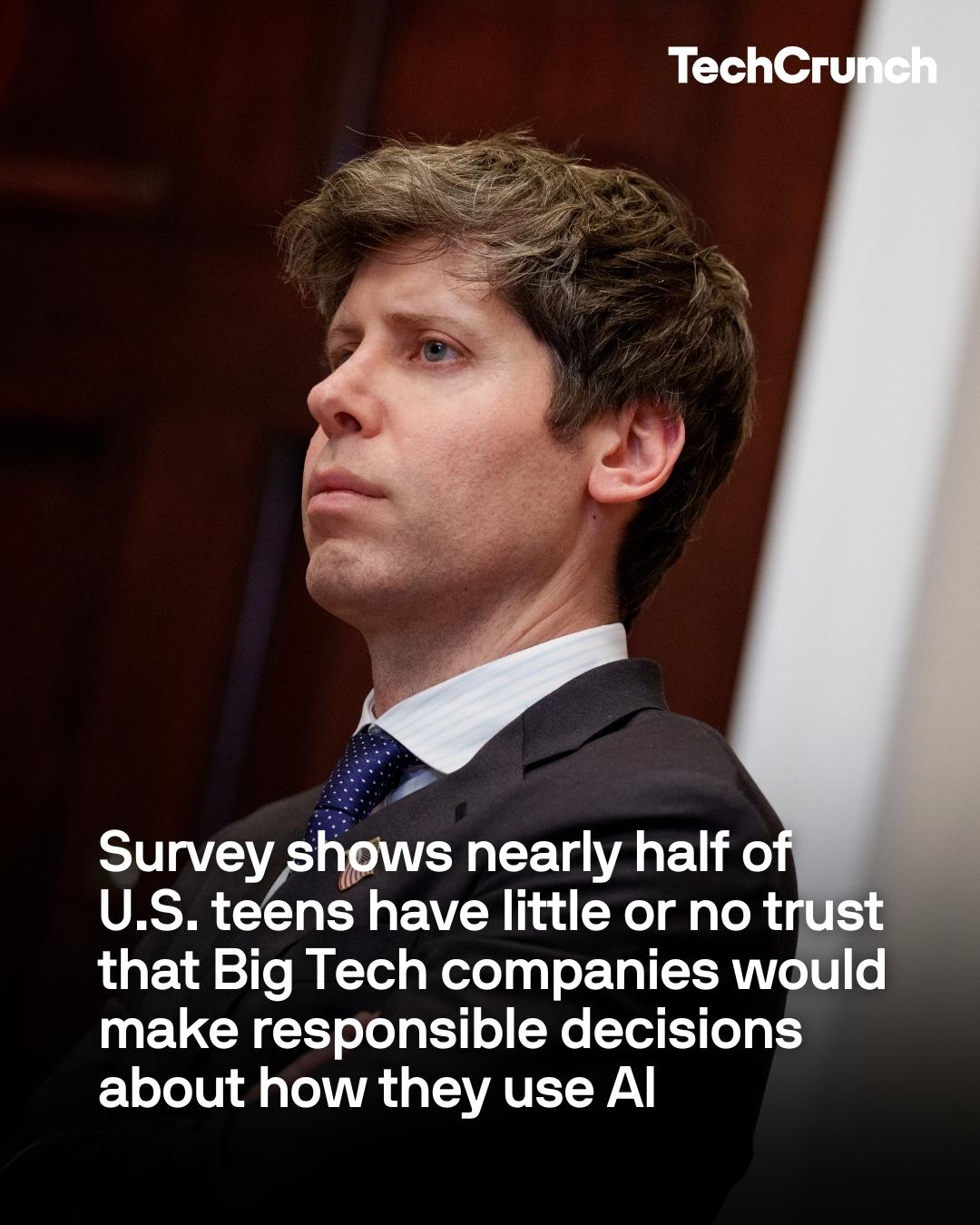
    In a study released by Common Sense Media — a nonprofit offering reviews and ratings for media and technology — the organization surveyed over 1,000 teens on whether major technology companies like Google, Apple, Meta, TikTok, and Microsoft cared about their well-being and safety, made ethical decisions, protected their private data, and more.

    In all cases, a majority of teens reported low levels of trust in these tech companies with 47% of those surveyed not believing these companies will make responsible decisions over their use of AI.

    The new study builds on Common Sense’s prior research about the adoption of generative AI among teens and also focuses on how GenAI is impacting the larger media landscape.

    Read more findings from the survey at the link in the bio

    Article by Sarah Perez

    Image Credits: Andrew Harnik / Staff / Getty Images

    #TechCrunch #technews #socialmedia #Meta #Facebook #Instagram #TikTok
    Can you blame them? In a study released by Common Sense Media — a nonprofit offering reviews and ratings for media and technology — the organization surveyed over 1,000 teens on whether major technology companies like Google, Apple, Meta, TikTok, and Microsoft cared about their well-being and safety, made ethical decisions, protected their private data, and more. In all cases, a majority of teens reported low levels of trust in these tech companies with 47% of those surveyed not believing these companies will make responsible decisions over their use of AI. The new study builds on Common Sense’s prior research about the adoption of generative AI among teens and also focuses on how GenAI is impacting the larger media landscape. Read more findings from the survey at the link in the bio 👆 Article by Sarah Perez Image Credits: Andrew Harnik / Staff / Getty Images #TechCrunch #technews #socialmedia #Meta #Facebook #Instagram #TikTok
    ·372 Views ·0 önizleme
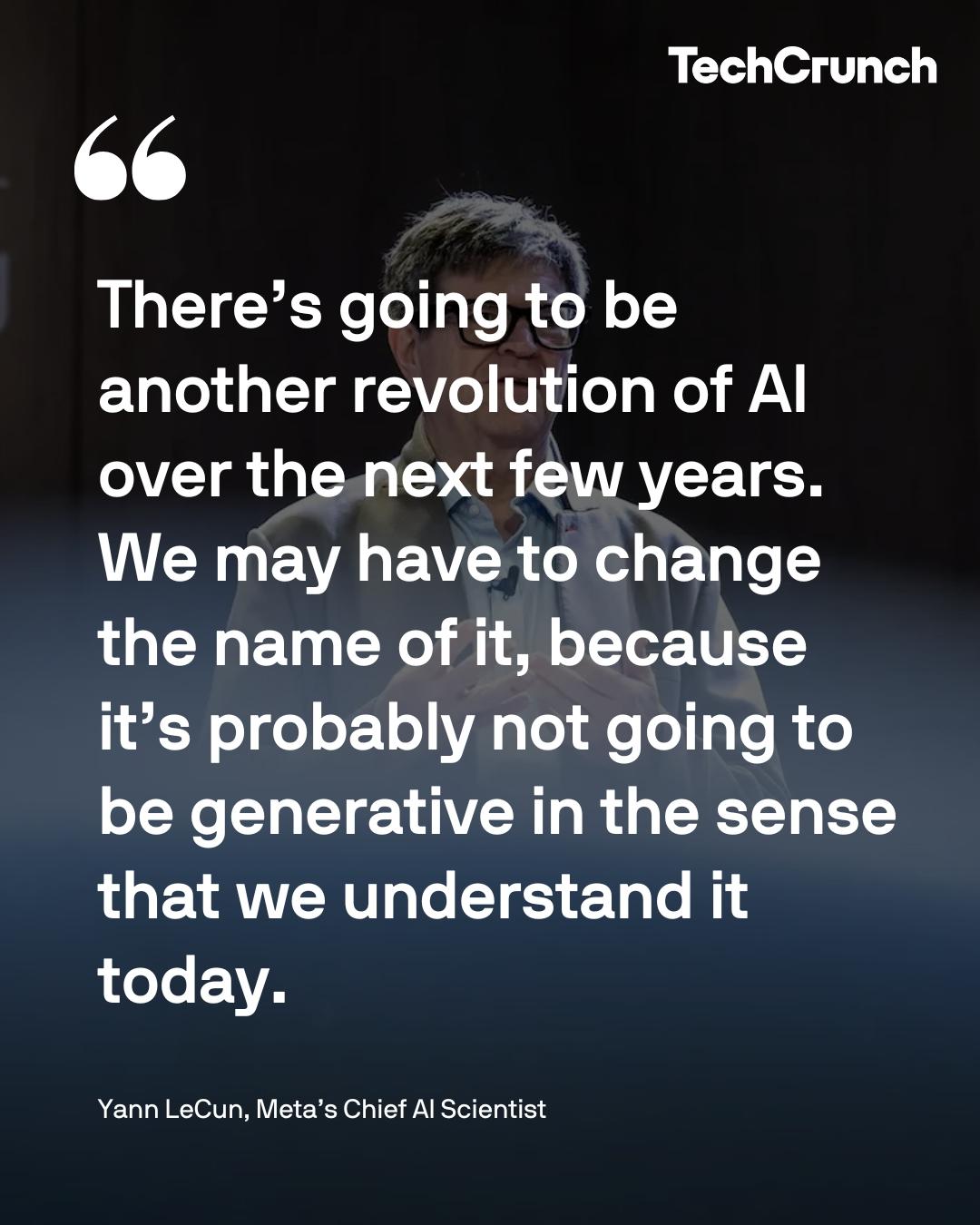
  • Meta’s chief AI scientist, Yann LeCun, says that a “new paradigm of AI architectures” will emerge in the next three to five years, going far beyond the capabilities of existing AI systems.

    Speaking in a session dubbed “Debating Technology” at Davos on Thursday, LeCun said that the “flavor of AI” that we have at the moment — that is, generative AI and large language models (LLMs) — isn’t really up to all that much. It’s useful, sure, but falls short on many fronts.

    “I think the shelf life of the current [LLM] paradigm is fairly short, probably three to five years,” LeCun said. “I think within five years, nobody in their right mind would use them anymore, at least not as the central component of an AI system. I think [….] we’re going to see the emergence of a new paradigm for AI architectures, which may not have the limitations of current AI systems.”

    Read more of LeCun's thoughts on the future of AI at the link in the bio

    Article by Paul Sawers

    Image Credits: FABRICE COFFRINI / AFP / Getty Images

    #TechCrunch #technews #artificialintelligence #Meta #LLM #GenAI
    Meta’s chief AI scientist, Yann LeCun, says that a “new paradigm of AI architectures” will emerge in the next three to five years, going far beyond the capabilities of existing AI systems. Speaking in a session dubbed “Debating Technology” at Davos on Thursday, LeCun said that the “flavor of AI” that we have at the moment — that is, generative AI and large language models (LLMs) — isn’t really up to all that much. It’s useful, sure, but falls short on many fronts. “I think the shelf life of the current [LLM] paradigm is fairly short, probably three to five years,” LeCun said. “I think within five years, nobody in their right mind would use them anymore, at least not as the central component of an AI system. I think [….] we’re going to see the emergence of a new paradigm for AI architectures, which may not have the limitations of current AI systems.” Read more of LeCun's thoughts on the future of AI at the link in the bio 👆 Article by Paul Sawers Image Credits: FABRICE COFFRINI / AFP / Getty Images #TechCrunch #technews #artificialintelligence #Meta #LLM #GenAI
    ·649 Views ·0 önizleme
  • Meta’s chief AI scientist, Yann LeCun, says that a “new paradigm of AI architectures” will emerge in the next three to five years, going far beyond the capabilities of existing AI systems.

    Speaking in a session dubbed “Debating Technology” at Davos on Thursday, LeCun said that “LLMs are good at manipulating language, but not at thinking,” LeCun said. “So that’s what we’re working on — having systems build mental models of the world. If the plan that we’re working on succeeds, with the timetable that we hope, within three to five years we’ll have systems that are a completely different paradigm.

    They may have some level of common sense. They may be able to learn how the world works from observing the world and maybe interacting with it.”

    Read more of LeCun's thoughts on the future of AI at the link in the bio

    Article by FABRICE COFFRINI / AFP / Getty Images

    Image Credits: Paul Sawers

    #TechCrunch #technews #artificialintelligence #Meta #GenAI #LLM
    Meta’s chief AI scientist, Yann LeCun, says that a “new paradigm of AI architectures” will emerge in the next three to five years, going far beyond the capabilities of existing AI systems. Speaking in a session dubbed “Debating Technology” at Davos on Thursday, LeCun said that “LLMs are good at manipulating language, but not at thinking,” LeCun said. “So that’s what we’re working on — having systems build mental models of the world. If the plan that we’re working on succeeds, with the timetable that we hope, within three to five years we’ll have systems that are a completely different paradigm. They may have some level of common sense. They may be able to learn how the world works from observing the world and maybe interacting with it.” Read more of LeCun's thoughts on the future of AI at the link in the bio 👆 Article by FABRICE COFFRINI / AFP / Getty Images Image Credits: Paul Sawers #TechCrunch #technews #artificialintelligence #Meta #GenAI #LLM
    ·556 Views ·0 önizleme
  • On Tuesday, Google introduced a new, free consumer version of its AI code completion and assistance tool, Gemini Code Assist, which the company calls Gemini Code Assist for individuals.

    The company also rolled out Gemini Code Assist for GitHub, a code review “agent” designed to automatically look for bugs in code and offer suggestions directly within GitHub.

    Code Assist for individuals lets developers use a chat window to talk in natural language with a Google AI model that can access and edit their codebase. Much like GitHub’s popular Copilot tool, Gemini Code Assist for individuals can fix bugs, complete sections of code, or explain parts of the codebase that don’t make sense.

    Google’s AI coding assistant uses a variant of the company’s Gemini 2.0 AI model that’s been fine-tuned for coding applications.

    Read more on Gemini Code Assist at the link in the bio

    Article by Maxwell Zeff

    Image Credits: J. David Ake / Contributor / Getty Images

    #TechCrunch #technews #artificialintelligence #coding #GenAI #Google #developer
    On Tuesday, Google introduced a new, free consumer version of its AI code completion and assistance tool, Gemini Code Assist, which the company calls Gemini Code Assist for individuals. The company also rolled out Gemini Code Assist for GitHub, a code review “agent” designed to automatically look for bugs in code and offer suggestions directly within GitHub. Code Assist for individuals lets developers use a chat window to talk in natural language with a Google AI model that can access and edit their codebase. Much like GitHub’s popular Copilot tool, Gemini Code Assist for individuals can fix bugs, complete sections of code, or explain parts of the codebase that don’t make sense. Google’s AI coding assistant uses a variant of the company’s Gemini 2.0 AI model that’s been fine-tuned for coding applications. Read more on Gemini Code Assist at the link in the bio 👆 Article by Maxwell Zeff Image Credits: J. David Ake / Contributor / Getty Images #TechCrunch #technews #artificialintelligence #coding #GenAI #Google #developer
    ·210 Views ·0 önizleme
Arama Sonuçları
Techawks - Powered By Pantrade Blockchain https://techawks.com