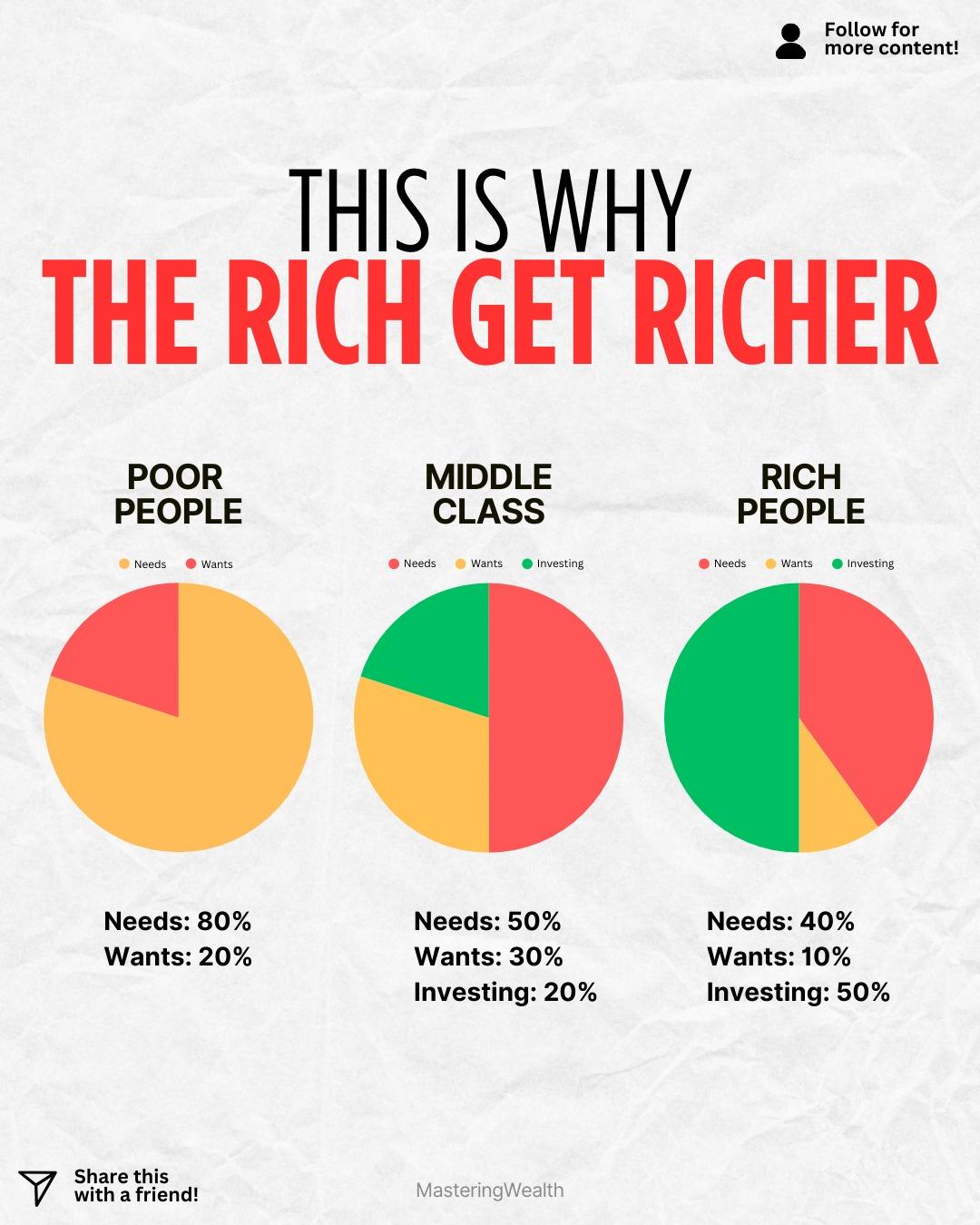
• Most people never realize that the biggest difference between poor people middle class people and rich people is not just income. The difference is how each group allocates their money and how much of their cash flow goes toward building future wealth. The chart shows three spending patterns that create completely different financial outcomes over time.

    Poor people spend the majority of their money on needs and the rest usually goes toward wants which leaves nothing left to invest. With no money invested there is no growth and no long term wealth building taking place. This creates a cycle where every dollar is already spent before it even arrives.

    Middle class people split their budget between needs wants and a small amount for investing. This is better than not investing at all but usually not enough to create true financial freedom. Without increasing the investing percentage it becomes difficult to break out of the paycheck to paycheck rhythm.

    Rich people prioritize investing first which is why they continue to grow wealth over time. Half of their money goes toward investments which then generate more money through compound growth. That reinvested growth is what keeps expanding their net worth year after year.

    When you study the habits of wealthy people you realize it is not just about earning more money but about keeping more of it. The more you invest the more your money begins working for you instead of you constantly working for money. Even small changes in your percentages can change your long term financial trajectory.

    If you want the link to see my dividend portfolio and learn how I personally invest for long term income comment Stocks and I will send it to you.

    Which of the three spending patterns do you feel you are closest to right now and what percentage do you want to work toward next?

    For more content that breaks down money in a simple and visual way make sure to follow @MasteringWealth for daily financial education.

    This content is for educational purposes only and should not be taken as financial advice. Always do your own research or speak with a licensed professional before making financial decisions.
    Most people never realize that the biggest difference between poor people middle class people and rich people is not just income. The difference is how each group allocates their money and how much of their cash flow goes toward building future wealth. The chart shows three spending patterns that create completely different financial outcomes over time. Poor people spend the majority of their money on needs and the rest usually goes toward wants which leaves nothing left to invest. With no money invested there is no growth and no long term wealth building taking place. This creates a cycle where every dollar is already spent before it even arrives. Middle class people split their budget between needs wants and a small amount for investing. This is better than not investing at all but usually not enough to create true financial freedom. Without increasing the investing percentage it becomes difficult to break out of the paycheck to paycheck rhythm. Rich people prioritize investing first which is why they continue to grow wealth over time. Half of their money goes toward investments which then generate more money through compound growth. That reinvested growth is what keeps expanding their net worth year after year. When you study the habits of wealthy people you realize it is not just about earning more money but about keeping more of it. The more you invest the more your money begins working for you instead of you constantly working for money. Even small changes in your percentages can change your long term financial trajectory. If you want the link to see my dividend portfolio and learn how I personally invest for long term income comment Stocks and I will send it to you. Which of the three spending patterns do you feel you are closest to right now and what percentage do you want to work toward next? For more content that breaks down money in a simple and visual way make sure to follow @MasteringWealth for daily financial education. ⚠️ This content is for educational purposes only and should not be taken as financial advice. Always do your own research or speak with a licensed professional before making financial decisions.
    ·171 Views ·0 Reviews

  • They ignore your growth, but study every flaw. #business #life #quote
    They ignore your growth, but study every flaw. #business #life #quote
    ·59 Views ·0 Reviews
  • Cities around the world have actually run experiments where sidewalks are split into two lanes, one for people walking normally, and one for people who text while moving.

    The goal? Reduce those everyday collisions caused by distracted walking and study how people behave in crowded spaces.

    From National Geographic’s social experiment in Washington D.C. to Mlab Antwerp’s “text walking lane” in Belgium, these trials became viral examples of how cities are trying to adapt to modern habits.

    It really makes you think: should our public spaces evolve just because our phone habits did? Tell us what you think
    Cities around the world have actually run experiments where sidewalks are split into two lanes, one for people walking normally, and one for people who text while moving. The goal? Reduce those everyday collisions caused by distracted walking and study how people behave in crowded spaces. From National Geographic’s social experiment in Washington D.C. to Mlab Antwerp’s “text walking lane” in Belgium, these trials became viral examples of how cities are trying to adapt to modern habits. It really makes you think: should our public spaces evolve just because our phone habits did? Tell us what you think 👀👇
    ·89 Views ·0 Reviews
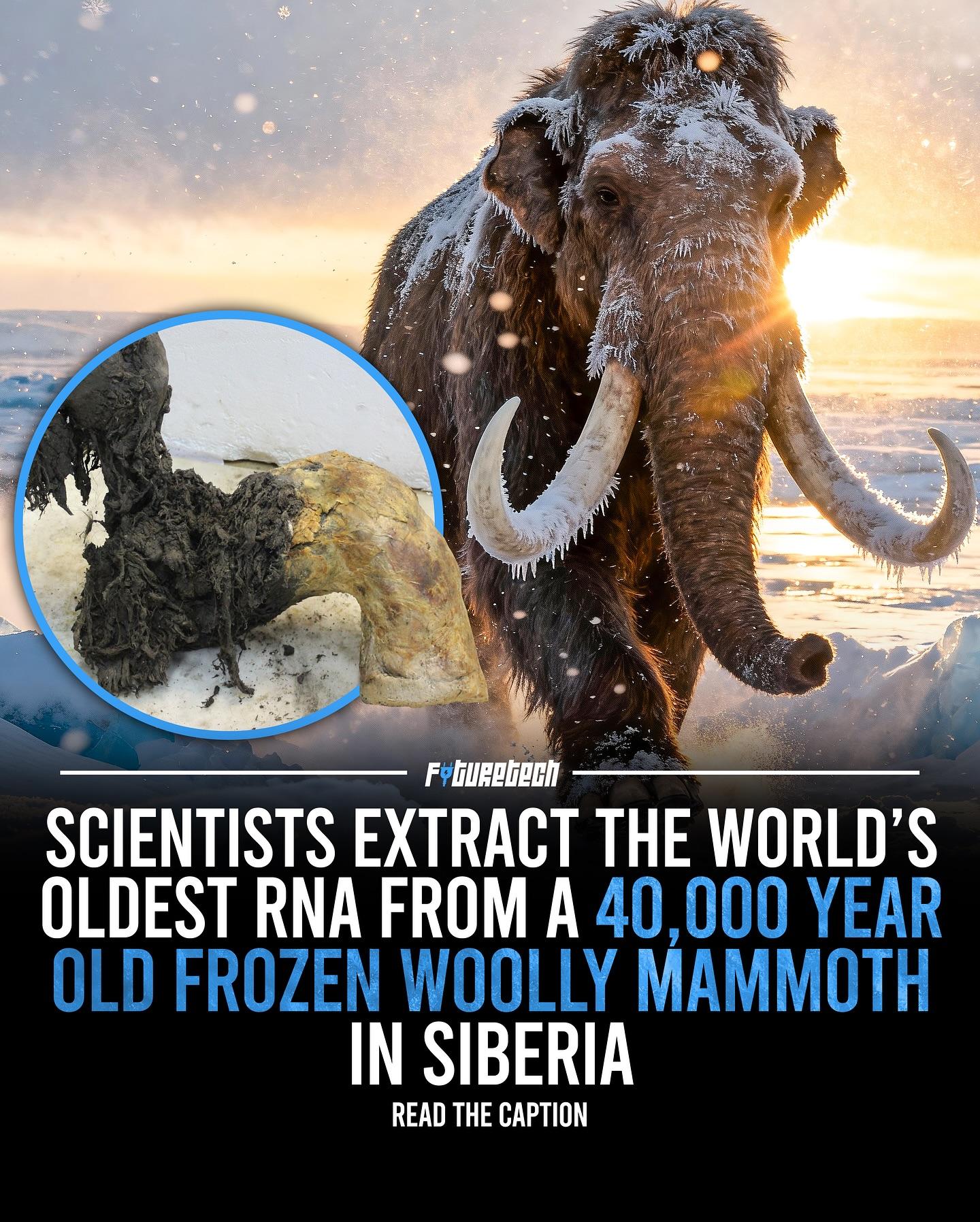
  • Scientists at Stockholm University have successfully isolated and sequenced RNA from Yuka, a 40,000-year-old woolly mammoth from the Ice Age, marking the first time RNA this ancient has ever been recovered.

    Yuka was found in Siberia’s Arctic by tusk hunters, her body exceptionally preserved in permafrost, including her tissues, fur, and even brain.

    The extracted RNA is the oldest ever identified and reveals which genes were active in the mammoth’s cells shortly before she died. Researchers also detected ancient microRNAs and distinctive mutations confirming the material truly belonged to a mammoth.

    According to a study published in Cell, the discovery shows that RNA can remain intact for tens of thousands of years in frozen environments, opening new possibilities for studying the biology, traits, and health of long-extinct species.

    Follow us @FutureTech for more!
    Scientists at Stockholm University have successfully isolated and sequenced RNA from Yuka, a 40,000-year-old woolly mammoth from the Ice Age, marking the first time RNA this ancient has ever been recovered. Yuka was found in Siberia’s Arctic by tusk hunters, her body exceptionally preserved in permafrost, including her tissues, fur, and even brain. The extracted RNA is the oldest ever identified and reveals which genes were active in the mammoth’s cells shortly before she died. Researchers also detected ancient microRNAs and distinctive mutations confirming the material truly belonged to a mammoth. According to a study published in Cell, the discovery shows that RNA can remain intact for tens of thousands of years in frozen environments, opening new possibilities for studying the biology, traits, and health of long-extinct species. 👉 Follow us @FutureTech for more! 🔌
    ·58 Views ·0 Reviews
  • A recent study published in the Journal of Psychiatric Research followed over 30,000 parents aged 50+ and found that those with at least one son experienced a modestly faster rate of cognitive decline compared to parents with only daughters.

    The researchers suggest this may reflect caregiving and emotional-support patterns in later life—daughters often take on informal supporting roles, which may help protect parental brain health.

    While this doesn’t mean raising a son causes quicker decline, it highlights how family dynamics, social support and long-term relationships influence mental health and ageing.

    Follow for more @mindset.therapy
    A recent study published in the Journal of Psychiatric Research followed over 30,000 parents aged 50+ and found that those with at least one son experienced a modestly faster rate of cognitive decline compared to parents with only daughters. The researchers suggest this may reflect caregiving and emotional-support patterns in later life—daughters often take on informal supporting roles, which may help protect parental brain health. While this doesn’t mean raising a son causes quicker decline, it highlights how family dynamics, social support and long-term relationships influence mental health and ageing. Follow for more 👉 @mindset.therapy
    ·59 Views ·0 Reviews
  • Flossing could become the future of vaccination. In a groundbreaking study, researchers demonstrated that vaccine-coated dental floss can trigger robust immune responses by targeting a thin, permeable tissue between the teeth and gums called the junctional epithelium. Unlike other parts of the mouth, this layer is rich in immune cells and naturally leaky—perfect for absorbing vaccine molecules.⁠

    Using this method, scientists vaccinated mice against influenza by flossing their teeth with strands coated in inactivated virus. The results were remarkable: mice developed strong immunity not only in their gums, but throughout their bodies. Antibodies were detected in saliva, feces, lungs, spleens, and even bone marrow, indicating both mucosal and systemic immune protection. All vaccinated mice survived a lethal flu exposure. Unvaccinated ones did not.⁠

    The immune response was also sustained over time, showing promise for long-term protection. Researchers successfully repeated the method with other vaccine types, including mRNA and protein-based formulations, further confirming the versatility of the approach. Notably, eating or drinking after flossing didn’t diminish its effectiveness.⁠

    The team also tested delivery with human volunteers using floss picks coated in dye. Around 60% of the dye reached the target tissue—an encouraging sign that floss-based vaccines could be viable for people, too. The technique avoids risks linked to nasal sprays and bypasses needle use entirely.⁠

    Beyond effectiveness, this method offers practical advantages: it’s needle-free, requires no refrigeration, and could even be mailed. While it may not work for infants or people with advanced gum disease, it has the potential to revolutionize mass immunization efforts.⁠

    Source: s41551-025-01451-3
    Flossing could become the future of vaccination. In a groundbreaking study, researchers demonstrated that vaccine-coated dental floss can trigger robust immune responses by targeting a thin, permeable tissue between the teeth and gums called the junctional epithelium. Unlike other parts of the mouth, this layer is rich in immune cells and naturally leaky—perfect for absorbing vaccine molecules.⁠ ⁠ Using this method, scientists vaccinated mice against influenza by flossing their teeth with strands coated in inactivated virus. The results were remarkable: mice developed strong immunity not only in their gums, but throughout their bodies. Antibodies were detected in saliva, feces, lungs, spleens, and even bone marrow, indicating both mucosal and systemic immune protection. All vaccinated mice survived a lethal flu exposure. Unvaccinated ones did not.⁠ ⁠ The immune response was also sustained over time, showing promise for long-term protection. Researchers successfully repeated the method with other vaccine types, including mRNA and protein-based formulations, further confirming the versatility of the approach. Notably, eating or drinking after flossing didn’t diminish its effectiveness.⁠ ⁠ The team also tested delivery with human volunteers using floss picks coated in dye. Around 60% of the dye reached the target tissue—an encouraging sign that floss-based vaccines could be viable for people, too. The technique avoids risks linked to nasal sprays and bypasses needle use entirely.⁠ ⁠ Beyond effectiveness, this method offers practical advantages: it’s needle-free, requires no refrigeration, and could even be mailed. While it may not work for infants or people with advanced gum disease, it has the potential to revolutionize mass immunization efforts.⁠ ⁠ Source: s41551-025-01451-3
    ·38 Views ·0 Reviews
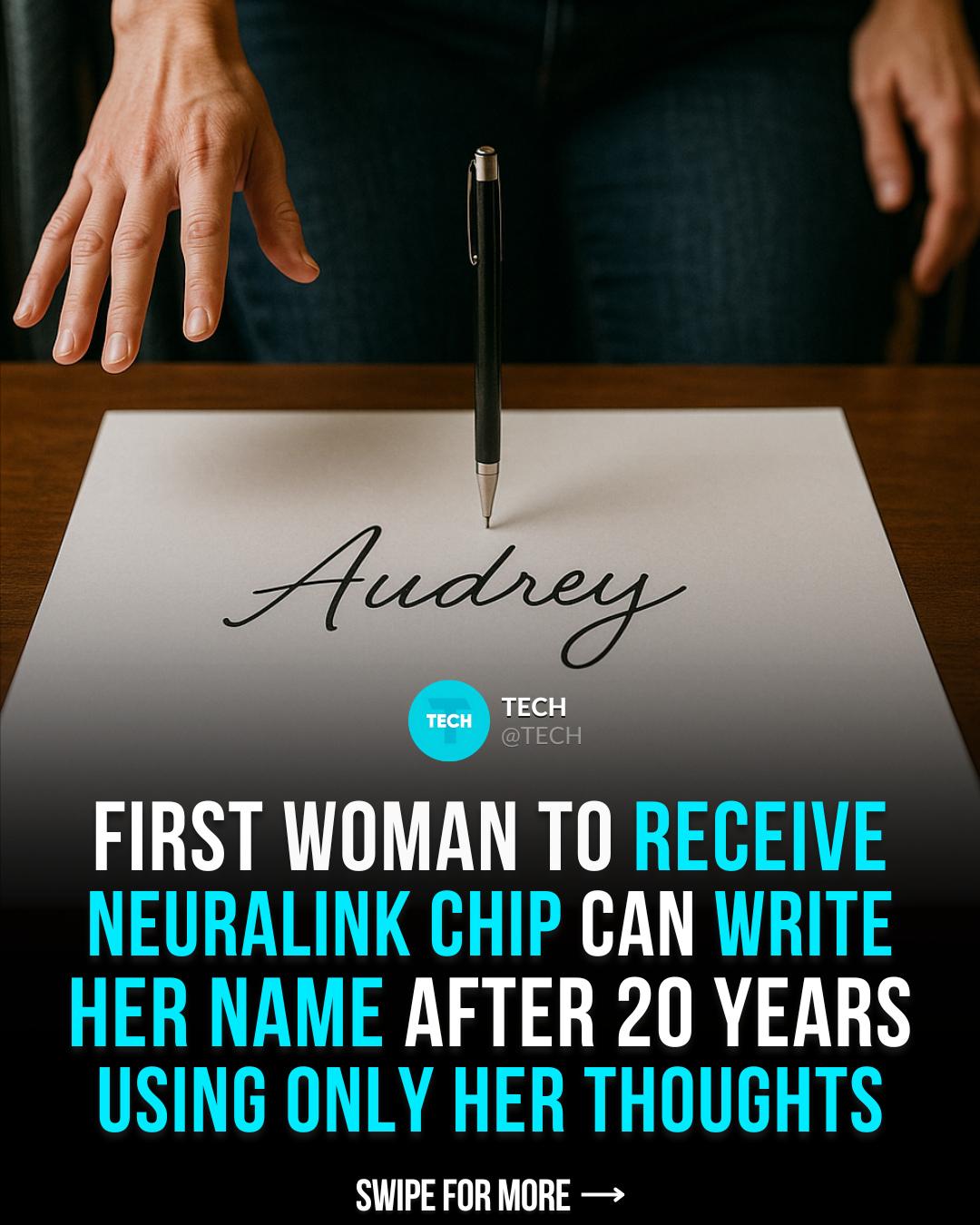
  • After 20 years of paralysis, Audrey Crews has written her name again—not with her hands, but with her mind. Thanks to a brain-computer interface (BCI) implant from Elon Musk’s company Neuralink, Crews is now able to control her computer purely through thought. The achievement marks a turning point for human-machine interaction and the future of assistive technology.⁠

    In a viral post on X, Crews shared a digital signature written telepathically, alongside playful doodles—a heart, a face, even a slice of pizza—all drawn using only her brain signals. The implant, embedded in her motor cortex, includes 128 ultra-thin threads that detect neural activity and translate it into digital commands. Crews, now designated Patient 9 in Neuralink’s PRIME study, called the experience "liberating."⁠

    The surgery was performed at the University of Miami, where doctors drilled a small hole in her skull to install the quarter-sized chip. While the implant doesn’t restore movement, it opens the door to "digital autonomy" for those with spinal injuries or neurodegenerative diseases. Elon Musk responded to her demonstration by noting, “She is controlling her computer just by thinking. Most people don’t realize this is possible.”⁠

    Neuralink’s team says this is only the beginning. Future versions of the device could enable more complex actions like speaking through a synthetic voice or navigating full digital environments. For Crews, each digital mark she makes is a triumph of persistence and progress. The line between biology and machine is blurring—and for millions, that could mean a new way forward.⁠

    Image Credits: Audrey Crews/X
    After 20 years of paralysis, Audrey Crews has written her name again—not with her hands, but with her mind. Thanks to a brain-computer interface (BCI) implant from Elon Musk’s company Neuralink, Crews is now able to control her computer purely through thought. The achievement marks a turning point for human-machine interaction and the future of assistive technology.⁠ ⁠ In a viral post on X, Crews shared a digital signature written telepathically, alongside playful doodles—a heart, a face, even a slice of pizza—all drawn using only her brain signals. The implant, embedded in her motor cortex, includes 128 ultra-thin threads that detect neural activity and translate it into digital commands. Crews, now designated Patient 9 in Neuralink’s PRIME study, called the experience "liberating."⁠ ⁠ The surgery was performed at the University of Miami, where doctors drilled a small hole in her skull to install the quarter-sized chip. While the implant doesn’t restore movement, it opens the door to "digital autonomy" for those with spinal injuries or neurodegenerative diseases. Elon Musk responded to her demonstration by noting, “She is controlling her computer just by thinking. Most people don’t realize this is possible.”⁠ ⁠ Neuralink’s team says this is only the beginning. Future versions of the device could enable more complex actions like speaking through a synthetic voice or navigating full digital environments. For Crews, each digital mark she makes is a triumph of persistence and progress. The line between biology and machine is blurring—and for millions, that could mean a new way forward.⁠ ⁠ Image Credits: Audrey Crews/X
    ·101 Views ·0 Reviews
  • The universe may be preparing to put on its most spectacular show yet. A new study from physicists at UMass Amherst suggests there is a 90 percent chance we will witness a black hole explosion within the next decade, a cosmic finale that could rewrite the laws of physics. These blasts would come not from the massive black holes we know, but from primordial black holes, tiny relics formed in the chaos after the Big Bang, now burning out after billions of years.⁠

    Stephen Hawking first predicted that black holes slowly evaporate by emitting faint quantum radiation. As they lose mass, they grow hotter, spitting out particles faster until they collapse in a final burst. For stellar or supermassive black holes, that process takes longer than the age of the universe. But asteroid-mass primordial black holes could be dying right now, within view of our telescopes.⁠

    The breakthrough came when researchers proposed a bold twist. If these black holes carried a small dark electric charge, linked to a hypothetical particle called a “dark electron,” their evaporation would stall for eons before ending suddenly in an explosive discharge. This simple adjustment turns an event once thought to occur only once every 100,000 years into something that might happen every ten.⁠

    The implications are staggering. An explosion would not only confirm Hawking radiation and the existence of primordial black holes, it would unleash a definitive catalog of the universe’s building blocks. Everything from electrons and quarks to possible dark matter candidates could appear in the debris, along with entirely new particles. One brief flash could illuminate mysteries that particle colliders and decades of experiments have yet to touch.⁠

    Source: 10.1103/nwgd-g3zl
    The universe may be preparing to put on its most spectacular show yet. A new study from physicists at UMass Amherst suggests there is a 90 percent chance we will witness a black hole explosion within the next decade, a cosmic finale that could rewrite the laws of physics. These blasts would come not from the massive black holes we know, but from primordial black holes, tiny relics formed in the chaos after the Big Bang, now burning out after billions of years.⁠ ⁠ Stephen Hawking first predicted that black holes slowly evaporate by emitting faint quantum radiation. As they lose mass, they grow hotter, spitting out particles faster until they collapse in a final burst. For stellar or supermassive black holes, that process takes longer than the age of the universe. But asteroid-mass primordial black holes could be dying right now, within view of our telescopes.⁠ ⁠ The breakthrough came when researchers proposed a bold twist. If these black holes carried a small dark electric charge, linked to a hypothetical particle called a “dark electron,” their evaporation would stall for eons before ending suddenly in an explosive discharge. This simple adjustment turns an event once thought to occur only once every 100,000 years into something that might happen every ten.⁠ ⁠ The implications are staggering. An explosion would not only confirm Hawking radiation and the existence of primordial black holes, it would unleash a definitive catalog of the universe’s building blocks. Everything from electrons and quarks to possible dark matter candidates could appear in the debris, along with entirely new particles. One brief flash could illuminate mysteries that particle colliders and decades of experiments have yet to touch.⁠ ⁠ Source: 10.1103/nwgd-g3zl
    ·99 Views ·0 Reviews
  • Researchers at the University of Calgary and Canada’s National Research Council have captured evidence that all living things emit an ultra-faint light, known as biophotons, which disappears at death. Using high-sensitivity cameras, the team recorded photon emissions from mice and plant leaves, revealing a sharp drop once the mice were euthanized, even though their body temperature was maintained.⁠

    Biophotons are thought to arise from reactive oxygen species, unstable molecules produced during normal metabolism and stress. When these molecules interact with fats or proteins, electrons shift and release a photon as they return to their resting state. While too weak for the human eye to detect, the emissions fall within visible wavelengths, meaning living organisms literally shimmer on a microscopic scale.⁠

    In plants, the glow grew brighter when leaves were physically injured or chemically stressed. Damaged regions shone far more intensely than healthy tissue for hours, underscoring the link between stress and photon output. Similar findings have been observed across a wide range of species and tissues, from bacteria to heart cells, but this study shows the effect in whole organisms with striking clarity.⁠

    Biophoton monitoring may provide a non-invasive diagnostic tool, revealing cellular stress in real time across medicine, agriculture, and microbiology. Scientists imagine tracking organ health without surgery, monitoring crop vitality during droughts, or even mapping subtle changes in the brain. The research suggests that the faintest flicker of light could become a powerful new way to measure vitality.⁠

    Source: 10.1021/acs.jpclett.4c03546
    Researchers at the University of Calgary and Canada’s National Research Council have captured evidence that all living things emit an ultra-faint light, known as biophotons, which disappears at death. Using high-sensitivity cameras, the team recorded photon emissions from mice and plant leaves, revealing a sharp drop once the mice were euthanized, even though their body temperature was maintained.⁠ ⁠ Biophotons are thought to arise from reactive oxygen species, unstable molecules produced during normal metabolism and stress. When these molecules interact with fats or proteins, electrons shift and release a photon as they return to their resting state. While too weak for the human eye to detect, the emissions fall within visible wavelengths, meaning living organisms literally shimmer on a microscopic scale.⁠ ⁠ In plants, the glow grew brighter when leaves were physically injured or chemically stressed. Damaged regions shone far more intensely than healthy tissue for hours, underscoring the link between stress and photon output. Similar findings have been observed across a wide range of species and tissues, from bacteria to heart cells, but this study shows the effect in whole organisms with striking clarity.⁠ ⁠ Biophoton monitoring may provide a non-invasive diagnostic tool, revealing cellular stress in real time across medicine, agriculture, and microbiology. Scientists imagine tracking organ health without surgery, monitoring crop vitality during droughts, or even mapping subtle changes in the brain. The research suggests that the faintest flicker of light could become a powerful new way to measure vitality.⁠ ⁠ Source: 10.1021/acs.jpclett.4c03546
    ·139 Views ·0 Reviews
  • Polish has unexpectedly emerged as a powerhouse language for artificial intelligence. A new benchmark developed by researchers at the University of Maryland, Microsoft, and UMass Amherst shows that when AI models are pushed into long-context tasks, Polish outperforms 25 other languages, including English and Chinese. The test, called ONERULER, evaluated how well major systems from OpenAI, Google, Meta, Qwen, and DeepSeek could retrieve and synthesize information across documents stretching up to 128,000 tokens.⁠

    The results flip long-held assumptions about linguistic dominance in machine learning. English and Chinese may saturate global training data, but abundant data does not guarantee deeper comprehension. Under heavy context loads, models handled Polish with an average accuracy of 88 percent, placing English sixth and Chinese near the bottom. Slavic and Romance languages consistently scored well, hinting that inflected grammar, Latin or Cyrillic scripts, and more regular syntactic patterns may help models track meaning across long passages.⁠

    That advantage becomes even clearer in demanding “needle-in-a-haystack” tasks, where systems must surface a single buried detail from a book-length text. Polish not only held its lead but widened it, suggesting that the structure of a language can shape how effectively a model encodes relationships within sprawling inputs. Meanwhile, low-resource languages such as Swahili and Sesotho struggled, and Chinese models showed particular difficulty, revealing how tokenization and writing systems influence model behavior.⁠

    The findings arrive at a moment when Poland is investing heavily in national AI efforts, including its own large language model, PLLuM. The study underscores a broader lesson for the field: multilingual diversity is not just a cultural goal, it is a technical one, and languages with smaller global footprints may hold surprising advantages for the next generation of AI.⁠

    Source: 10.48550/arXiv.2503.01996
    Polish has unexpectedly emerged as a powerhouse language for artificial intelligence. A new benchmark developed by researchers at the University of Maryland, Microsoft, and UMass Amherst shows that when AI models are pushed into long-context tasks, Polish outperforms 25 other languages, including English and Chinese. The test, called ONERULER, evaluated how well major systems from OpenAI, Google, Meta, Qwen, and DeepSeek could retrieve and synthesize information across documents stretching up to 128,000 tokens.⁠ ⁠ The results flip long-held assumptions about linguistic dominance in machine learning. English and Chinese may saturate global training data, but abundant data does not guarantee deeper comprehension. Under heavy context loads, models handled Polish with an average accuracy of 88 percent, placing English sixth and Chinese near the bottom. Slavic and Romance languages consistently scored well, hinting that inflected grammar, Latin or Cyrillic scripts, and more regular syntactic patterns may help models track meaning across long passages.⁠ ⁠ That advantage becomes even clearer in demanding “needle-in-a-haystack” tasks, where systems must surface a single buried detail from a book-length text. Polish not only held its lead but widened it, suggesting that the structure of a language can shape how effectively a model encodes relationships within sprawling inputs. Meanwhile, low-resource languages such as Swahili and Sesotho struggled, and Chinese models showed particular difficulty, revealing how tokenization and writing systems influence model behavior.⁠ ⁠ The findings arrive at a moment when Poland is investing heavily in national AI efforts, including its own large language model, PLLuM. The study underscores a broader lesson for the field: multilingual diversity is not just a cultural goal, it is a technical one, and languages with smaller global footprints may hold surprising advantages for the next generation of AI.⁠ ⁠ Source: 10.48550/arXiv.2503.01996
    ·199 Views ·0 Reviews
More Results
Techawks - Powered By Pantrade Blockchain https://techawks.com