• Where Does Technical Debt Accumulate Fastest in Your System?


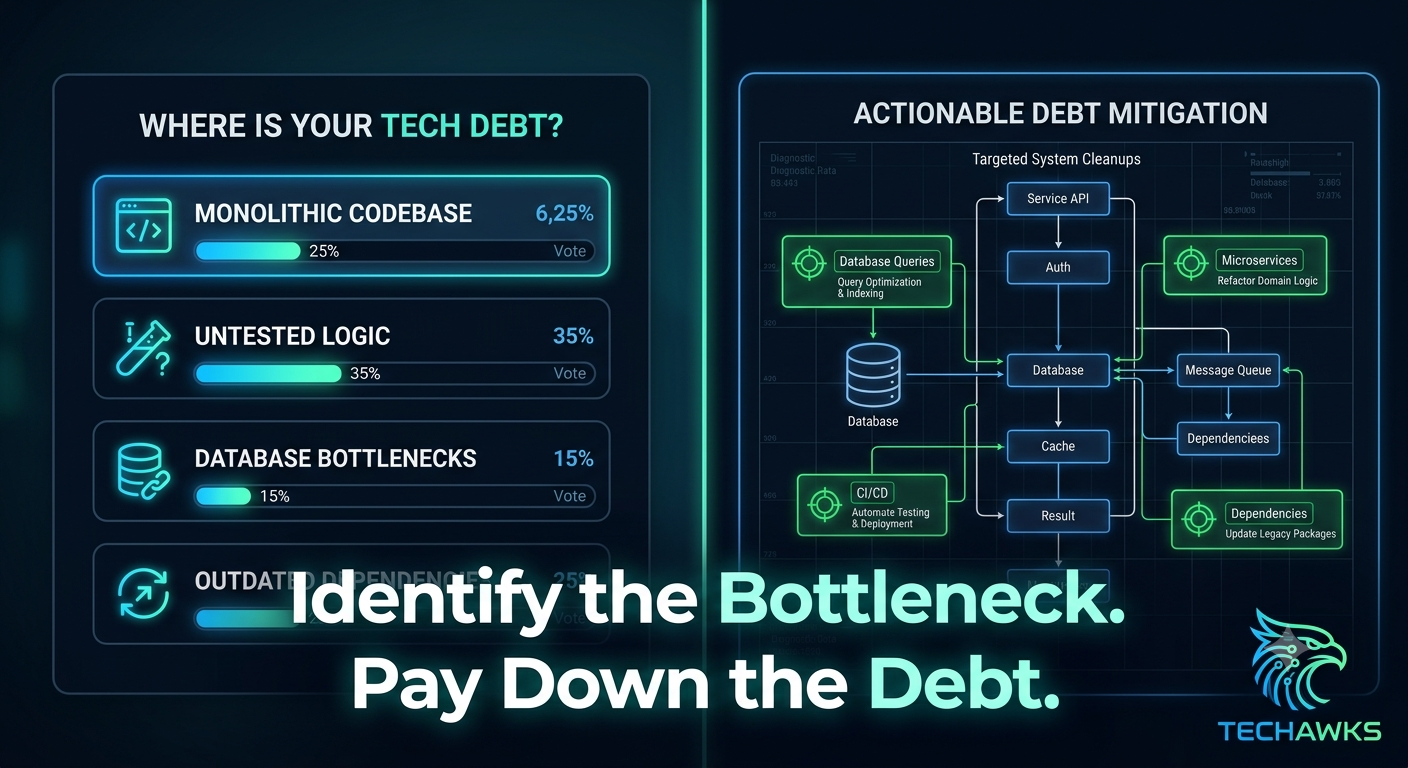
    Every production application carries technical debt. The key to maintaining long-term developer velocity isn't striving for pristine, zero-debt code—it's identifying which architectural shortcuts generate high interest and addressing them before they cause system-wide failures.
    Which area of technical debt currently slows down your team the most?


    Unindexed / Monolithic Databases: Slow queries, missing indexes, tight schema coupling, or missing migration strategies.
    Untested Edge Cases: Low test coverage, missing integration tests, or relying exclusively on manual QA before releases.
    Hardcoded Business Logic: Missing abstractions, magic numbers, deeply nested if/else blocks, and lack of modularity.
    Outdated Dependencies: Legacy frameworks, unpatched security vulnerabilities, or abandoned third-party libraries.


    How to Tackle the Highest-Interest Debt:
    If Database Debt Is Winning:
    Audit your query execution plans using EXPLAIN ANALYZE.
    Add missing indexes on frequently queried columns and introduce read replicas before attempting a database split.


    If Testing Debt Is Winning:
    Stop trying to write 100% unit tests retroactively.
    Focus on end-to-end integration tests for your 3 most critical user paths (e.g., Auth, Checkout, Data Export) to build a deployment safety net.


    If Logic Debt Is Winning:
    Adopt the "Boy Scout Rule": leave the file cleaner than you found it.
    Apply guard clauses and extract multi-responsibility functions into single-purpose helpers during regular feature work.


    If Dependency Debt Is Winning:
    Automate dependency updates using tools like Dependabot or Renovate.
    Schedule quarterly maintenance sprints dedicated purely to major version upgrades.


    Key Take aways
    Prioritize High-Interest Debt: Focus refactoring efforts on code paths that are modified frequently or directly impact system performance.
    Integrate Cleanup into Sprints: Reserve 15-20% of engineering bandwidth per iteration to handle maintenance alongside new features.
    Automate Prevention: Use linters, automated test suites, and CI/CD checks to prevent low-quality code from reaching main branches.


    CTA
    Cast your vote above! Join the Techawks General Community to discuss how senior engineers manage refactoring backlogs, negotiate technical debt with product managers, and keep production systems scalable.
    Where Does Technical Debt Accumulate Fastest in Your System? Every production application carries technical debt. The key to maintaining long-term developer velocity isn't striving for pristine, zero-debt code—it's identifying which architectural shortcuts generate high interest and addressing them before they cause system-wide failures. Which area of technical debt currently slows down your team the most? Unindexed / Monolithic Databases: Slow queries, missing indexes, tight schema coupling, or missing migration strategies. Untested Edge Cases: Low test coverage, missing integration tests, or relying exclusively on manual QA before releases. Hardcoded Business Logic: Missing abstractions, magic numbers, deeply nested if/else blocks, and lack of modularity. Outdated Dependencies: Legacy frameworks, unpatched security vulnerabilities, or abandoned third-party libraries. How to Tackle the Highest-Interest Debt: If Database Debt Is Winning: Audit your query execution plans using EXPLAIN ANALYZE. Add missing indexes on frequently queried columns and introduce read replicas before attempting a database split. If Testing Debt Is Winning: Stop trying to write 100% unit tests retroactively. Focus on end-to-end integration tests for your 3 most critical user paths (e.g., Auth, Checkout, Data Export) to build a deployment safety net. If Logic Debt Is Winning: Adopt the "Boy Scout Rule": leave the file cleaner than you found it. Apply guard clauses and extract multi-responsibility functions into single-purpose helpers during regular feature work. If Dependency Debt Is Winning: Automate dependency updates using tools like Dependabot or Renovate. Schedule quarterly maintenance sprints dedicated purely to major version upgrades. Key Take aways Prioritize High-Interest Debt: Focus refactoring efforts on code paths that are modified frequently or directly impact system performance. Integrate Cleanup into Sprints: Reserve 15-20% of engineering bandwidth per iteration to handle maintenance alongside new features. Automate Prevention: Use linters, automated test suites, and CI/CD checks to prevent low-quality code from reaching main branches. CTA Cast your vote above! Join the Techawks General Community to discuss how senior engineers manage refactoring backlogs, negotiate technical debt with product managers, and keep production systems scalable.
    0 Kommentare 0 Geteilt 862 Ansichten 0 Bewertungen
  • Nano Satellites Driving Innovation Across the Global Space Industry
    The increasing adoption of the Nano Satellite Market is creating new opportunities in the global aerospace sector by providing affordable and efficient solutions for various space-based applications. Nano satellites have transformed traditional satellite development by reducing manufacturing complexity, lowering launch expenses, and enabling faster deployment. These compact spacecraft are...
    0 Kommentare 0 Geteilt 428 Ansichten 0 Bewertungen
  • RAG Architecture Explained: How to Stop LLM Hallucinations with Retrieval-Augmented Generation


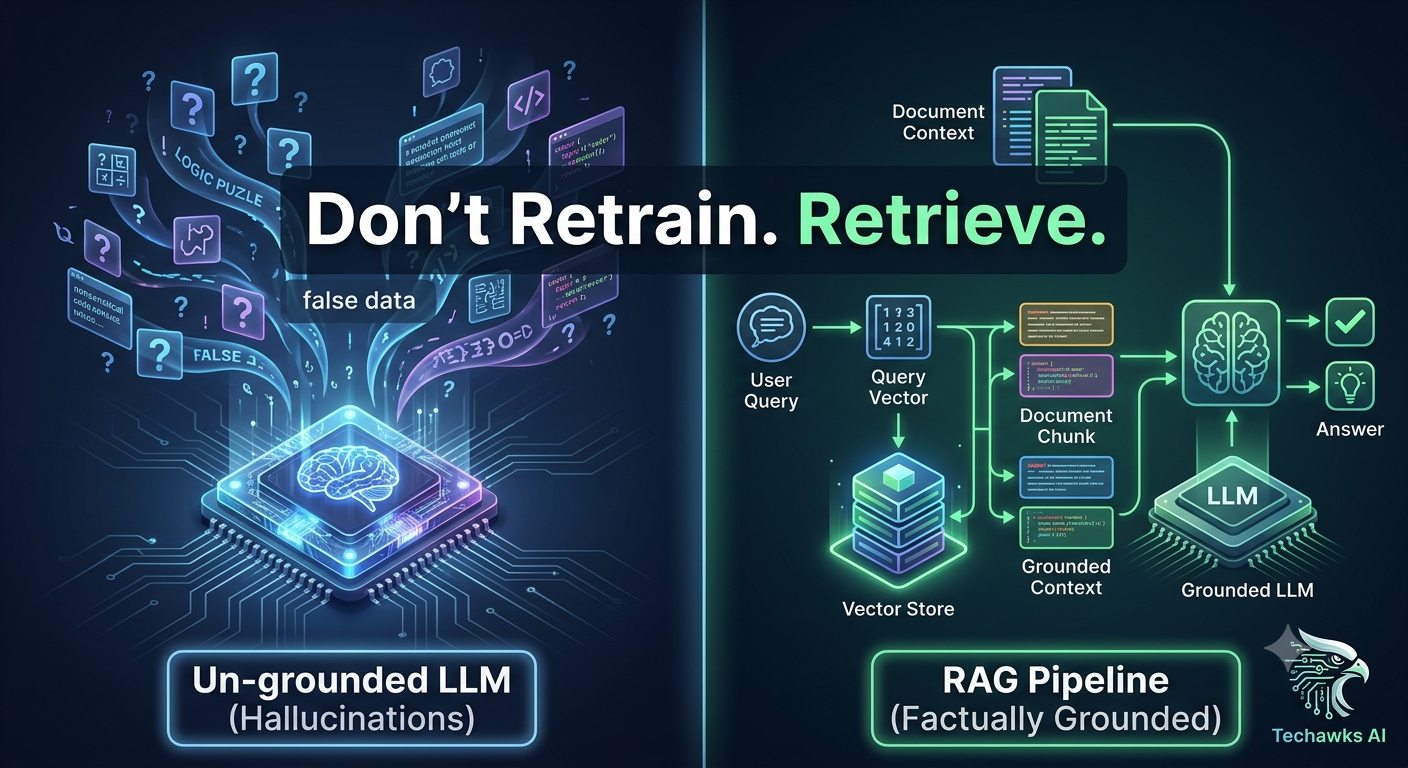
    Fine-tuning an LLM to teach it custom knowledge is expensive, time-consuming, and hard to update. Retrieval-Augmented Generation (RAG) offers a far more practical solution: instead of retraining the model, you retrieve context from your own vector database and feed it directly into the prompt at runtime.If you are building LLM applications, here is the step-by-step pipeline to build an effective RAG system:


    1. Document Ingestion & ChunkingThe Process:
    Raw text documents (PDFs, docs, databases) are split into smaller text chunks.Actionable Tip: Keep chunks between 250 to 500 tokens with a 10–20% overlap. Chunks that are too large dilute semantic specificity, while chunks that are too small lose crucial context.
    2. Vector Embedding & StorageThe Process:
    A specialized embedding model converts text chunks into mathematical vectors (numerical arrays) that represent semantic meaning.Actionable Tip: Store these vectors in a dedicated vector database (e.g., Pinecone, Qdrant, Chroma, or pgvector). Ensure you use the exact same embedding model during both indexing and user querying.
    3. Context Retrieval & Semantic SearchThe Process:
    When a user asks a question, their prompt is converted into a vector. The database finds the top $K$ most similar text chunks using cosine similarity or Euclidean distance.Actionable Tip: Implement a hybrid search strategy (combining dense vector search with sparse keyword search like BM25) to catch both semantic intent and exact phrase matches.
    4. Prompt Synthesis & GenerationThe Process:
    The retrieved text chunks are injected into the system prompt as "context" alongside the user's original query.Actionable Tip: Frame your prompt strictly: "Answer the user's question using ONLY the provided context below. If the answer cannot be found in the context, state 'I do not have enough information'.


    "Key Takeaways"
    RAG vs. Fine-Tuning: RAG provides real-time data access and lower compute overhead; fine-tuning is best reserved for altering model tone or syntax style.Quality Depends on Chunking: Retrieval accuracy hinges on clean document preprocessing and strategic chunk size selection.Enforce Strict Guardrails: Always instruct the LLM to decline answering if the retrieved vector context lacks necessary facts.


    CTA
    Building your first RAG pipeline or optimizing vector search latency? Join AI Builders & Enthusiasts to exchange architectures, benchmark embedding models, and collaborate with AI developers worldwide.
    RAG Architecture Explained: How to Stop LLM Hallucinations with Retrieval-Augmented Generation Fine-tuning an LLM to teach it custom knowledge is expensive, time-consuming, and hard to update. Retrieval-Augmented Generation (RAG) offers a far more practical solution: instead of retraining the model, you retrieve context from your own vector database and feed it directly into the prompt at runtime.If you are building LLM applications, here is the step-by-step pipeline to build an effective RAG system: 1. Document Ingestion & ChunkingThe Process: Raw text documents (PDFs, docs, databases) are split into smaller text chunks.Actionable Tip: Keep chunks between 250 to 500 tokens with a 10–20% overlap. Chunks that are too large dilute semantic specificity, while chunks that are too small lose crucial context. 2. Vector Embedding & StorageThe Process: A specialized embedding model converts text chunks into mathematical vectors (numerical arrays) that represent semantic meaning.Actionable Tip: Store these vectors in a dedicated vector database (e.g., Pinecone, Qdrant, Chroma, or pgvector). Ensure you use the exact same embedding model during both indexing and user querying. 3. Context Retrieval & Semantic SearchThe Process: When a user asks a question, their prompt is converted into a vector. The database finds the top $K$ most similar text chunks using cosine similarity or Euclidean distance.Actionable Tip: Implement a hybrid search strategy (combining dense vector search with sparse keyword search like BM25) to catch both semantic intent and exact phrase matches. 4. Prompt Synthesis & GenerationThe Process: The retrieved text chunks are injected into the system prompt as "context" alongside the user's original query.Actionable Tip: Frame your prompt strictly: "Answer the user's question using ONLY the provided context below. If the answer cannot be found in the context, state 'I do not have enough information'. "Key Takeaways" RAG vs. Fine-Tuning: RAG provides real-time data access and lower compute overhead; fine-tuning is best reserved for altering model tone or syntax style.Quality Depends on Chunking: Retrieval accuracy hinges on clean document preprocessing and strategic chunk size selection.Enforce Strict Guardrails: Always instruct the LLM to decline answering if the retrieved vector context lacks necessary facts. CTA Building your first RAG pipeline or optimizing vector search latency? Join AI Builders & Enthusiasts to exchange architectures, benchmark embedding models, and collaborate with AI developers worldwide.
    0 Kommentare 0 Geteilt 2KB Ansichten 0 Bewertungen
  • Small Language Models vs. LLMs: When Should You Downsize in Production?
    While frontier models excel at general reasoning and creative generation, pushing every production task through a massive 70B+ parameter model is often overkill. Small Language Models (SLMs)—ranging from 1B to 8B parameters—are proving to be leaner, faster, and more cost-effective when trained or fine-tuned for specific, bounded workloads.
    Let's break down when downsizing makes sense for your system architecture:


    When to Choose Small Language Models (SLMs):
    Strict Latency Limits: If your application requires real-time responses (e.g., autocomplete, edge devices, live voice agents), SLMs deliver single-digit millisecond latency.
    Domain-Specific Tasks: For structured tasks like classification, sentiment analysis, entity extraction, or SQL translation, a fine-tuned 3B model often matches or beats a zero-shot flagship model.
    Data Privacy & On-Prem Deployments: Running SLMs locally or within private VPCs ensures sensitive customer data never leaves your infrastructure boundaries.
    Cost Efficiency at Scale: When processing millions of daily API requests, running lightweight self-hosted instances slashes infrastructure spend compared to token-based cloud pricing.


    When to Stick with Large Language Models (LLMs):
    Complex Multi-Step Reasoning: Heavy logic puzzles, multi-agent orchestration, and broad open-ended problem solving still require high parameter capacity.
    Zero-Shot Flexibility: If your application handles unpredictable user inputs without defined schemas, larger models provide broader fallback knowledge.


    Actionable Advice for System Design:
    Adopt a Router-Based Architecture: Do not choose just one model size. Place an intelligent routing layer at the API entry point. Direct simple, structured prompts to a fast, cheap SLM, and route complex, ambiguous tasks to a flagship LLM.


    Key Takeaways
    Specialization Beats Scale: A focused 3B model fine-tuned on clean, domain-specific data will frequently outperform a massive generalist model for narrow tasks.
    Architect for Latency and Cost: Defaulting to giant cloud LLMs introduces unnecessary financial and performance bottlenecks at scale.
    Use Model Routing: Combine the speed of SLMs and the reasoning of LLMs using an adaptive routing layer in your AI pipeline.


    CTA
    How are you balancing model size, latency, and costs in your AI stack? Join AI Builders & Enthusiasts to share your benchmark results, discuss model routing techniques, and connect with developers building production AI.
    Small Language Models vs. LLMs: When Should You Downsize in Production? While frontier models excel at general reasoning and creative generation, pushing every production task through a massive 70B+ parameter model is often overkill. Small Language Models (SLMs)—ranging from 1B to 8B parameters—are proving to be leaner, faster, and more cost-effective when trained or fine-tuned for specific, bounded workloads. Let's break down when downsizing makes sense for your system architecture: When to Choose Small Language Models (SLMs): Strict Latency Limits: If your application requires real-time responses (e.g., autocomplete, edge devices, live voice agents), SLMs deliver single-digit millisecond latency. Domain-Specific Tasks: For structured tasks like classification, sentiment analysis, entity extraction, or SQL translation, a fine-tuned 3B model often matches or beats a zero-shot flagship model. Data Privacy & On-Prem Deployments: Running SLMs locally or within private VPCs ensures sensitive customer data never leaves your infrastructure boundaries. Cost Efficiency at Scale: When processing millions of daily API requests, running lightweight self-hosted instances slashes infrastructure spend compared to token-based cloud pricing. When to Stick with Large Language Models (LLMs): Complex Multi-Step Reasoning: Heavy logic puzzles, multi-agent orchestration, and broad open-ended problem solving still require high parameter capacity. Zero-Shot Flexibility: If your application handles unpredictable user inputs without defined schemas, larger models provide broader fallback knowledge. Actionable Advice for System Design: Adopt a Router-Based Architecture: Do not choose just one model size. Place an intelligent routing layer at the API entry point. Direct simple, structured prompts to a fast, cheap SLM, and route complex, ambiguous tasks to a flagship LLM. Key Takeaways Specialization Beats Scale: A focused 3B model fine-tuned on clean, domain-specific data will frequently outperform a massive generalist model for narrow tasks. Architect for Latency and Cost: Defaulting to giant cloud LLMs introduces unnecessary financial and performance bottlenecks at scale. Use Model Routing: Combine the speed of SLMs and the reasoning of LLMs using an adaptive routing layer in your AI pipeline. CTA How are you balancing model size, latency, and costs in your AI stack? Join AI Builders & Enthusiasts to share your benchmark results, discuss model routing techniques, and connect with developers building production AI.
    0 Kommentare 0 Geteilt 2KB Ansichten 0 Bewertungen
  • How to Build an AI Agent Evaluator: Step-by-Step Benchmarking for Production LLMs

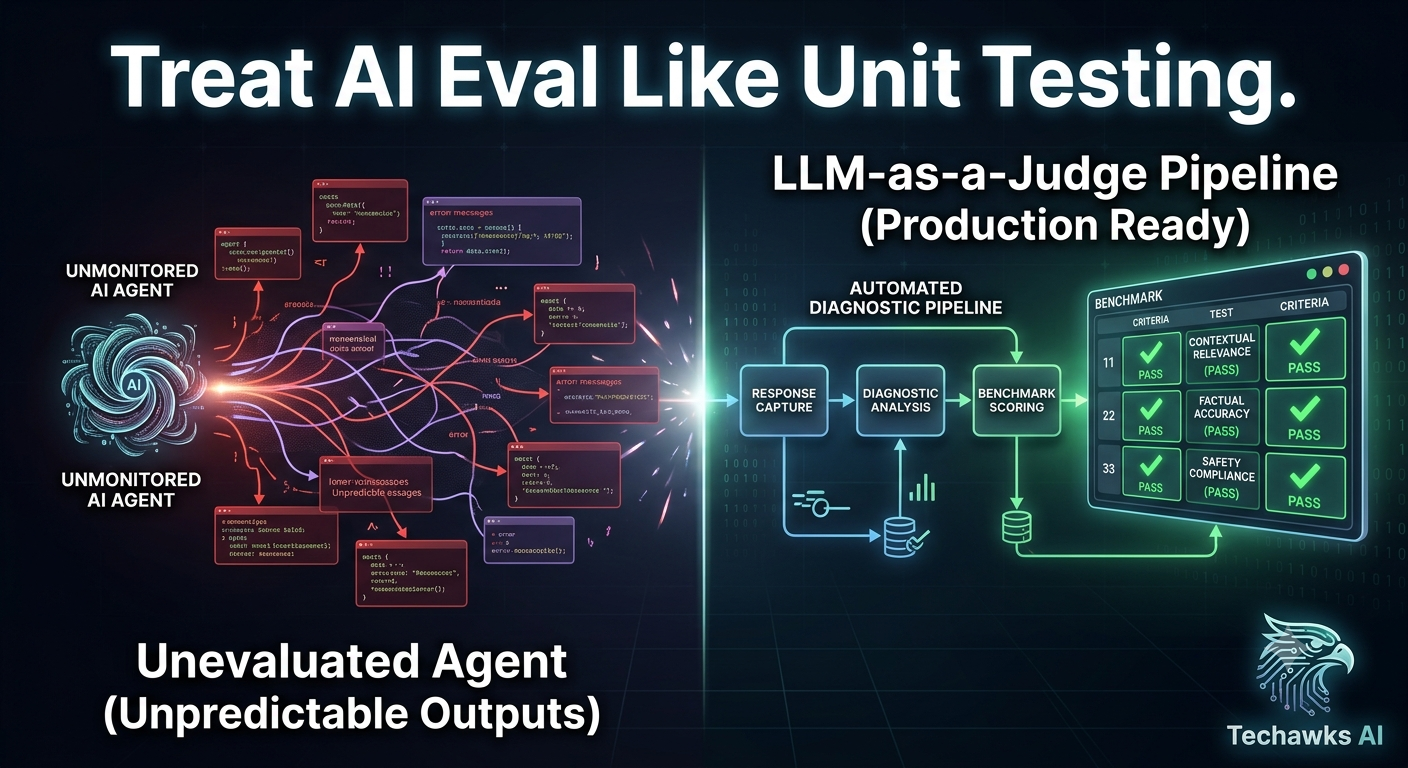
    Evaluating AI agents manually does not scale. To ensure your AI application maintains quality across updates, you need automated benchmarks that score agent outputs on consistency, relevance, and safety.Follow this step-by-step tutorial to implement an LLM-as-a-Judge evaluation pipeline:
    Step 1:
    Define Your Evaluation Criteria & RubricInstead of asking an evaluator LLM "Is this response good?", define explicit numerical scoring metrics with precise pass/fail rules:
    Groundedness (1–5): Does the response rely strictly on provided context without introducing hallucinations?Answer Relevance (1–5): Does the output directly answer every part of the user query?Tone & Safety (Pass/Fail): Does the output follow corporate guidelines and avoid sensitive topic violations?
    Step 2:
    Actionable Tip: Use JSON mode or schema enforcement (Pydantic/Zod) to prevent parsing errors during automated test runs.
    Step 3:
    Run Batch Evaluations in ParallelDo not evaluate responses synchronously during user sessions. Store prompt-response pairs in a queue and process evaluations asynchronously in batches using a faster inference model.
    Step 4:
    Track Metrics & Set CI/CD Quality GatesIntegrate evaluation scores into your deployment pipeline. If a prompt tweak or fine-tuned model checkpoint causes the average Groundedness Score to drop below $4.2 / 5.0$, automatically fail the CI build and block deployment.
    Key Takeaways
    Automate Quality Control: LLM-as-a-Judge provides fast, reproducible feedback loops for agent performance.Require Structured Reasoning: Mandate that evaluator models output explicit reasoning alongside numerical scores for easier debugging.Set Hard CI/CD Thresholds: Prevent regression by gating production releases on automated evaluation benchmarks.
    CTA
    How are you testing and benchmarking your AI agents before deployment? Join AI Builders & Enthusiasts to exchange prompt evaluation rubrics, share framework comparisons, and build reliable AI systems with engineers worldwide.
    How to Build an AI Agent Evaluator: Step-by-Step Benchmarking for Production LLMs Evaluating AI agents manually does not scale. To ensure your AI application maintains quality across updates, you need automated benchmarks that score agent outputs on consistency, relevance, and safety.Follow this step-by-step tutorial to implement an LLM-as-a-Judge evaluation pipeline: Step 1: Define Your Evaluation Criteria & RubricInstead of asking an evaluator LLM "Is this response good?", define explicit numerical scoring metrics with precise pass/fail rules: Groundedness (1–5): Does the response rely strictly on provided context without introducing hallucinations?Answer Relevance (1–5): Does the output directly answer every part of the user query?Tone & Safety (Pass/Fail): Does the output follow corporate guidelines and avoid sensitive topic violations? Step 2: Actionable Tip: Use JSON mode or schema enforcement (Pydantic/Zod) to prevent parsing errors during automated test runs. Step 3: Run Batch Evaluations in ParallelDo not evaluate responses synchronously during user sessions. Store prompt-response pairs in a queue and process evaluations asynchronously in batches using a faster inference model. Step 4: Track Metrics & Set CI/CD Quality GatesIntegrate evaluation scores into your deployment pipeline. If a prompt tweak or fine-tuned model checkpoint causes the average Groundedness Score to drop below $4.2 / 5.0$, automatically fail the CI build and block deployment. Key Takeaways Automate Quality Control: LLM-as-a-Judge provides fast, reproducible feedback loops for agent performance.Require Structured Reasoning: Mandate that evaluator models output explicit reasoning alongside numerical scores for easier debugging.Set Hard CI/CD Thresholds: Prevent regression by gating production releases on automated evaluation benchmarks. CTA How are you testing and benchmarking your AI agents before deployment? Join AI Builders & Enthusiasts to exchange prompt evaluation rubrics, share framework comparisons, and build reliable AI systems with engineers worldwide.
    0 Kommentare 0 Geteilt 1KB Ansichten 0 Bewertungen
  • The Rise of Investment Opportunities in Public Relations and Media Relations Services Market Share
    The investment landscape within the Public Relations and Media Relations Services market is becoming increasingly attractive, with a projected market size of USD 26.7 billion anticipated by 2035. This growth trajectory, marked by a CAGR of 2.9%, signals a shift in how public relations is approached in the digital age. As brands prioritize authentic communication and digital engagement, new...
    0 Kommentare 0 Geteilt 392 Ansichten 0 Bewertungen
  • Mastering Async Control Flow: How to Avoid Callback Hell and Promise Race Conditions


    Writing robust asynchronous code requires moving beyond simple async/await syntax to master control flow execution patterns. When dealing with parallel requests, resource limits, and error handling, relying on naive loops can paralyze your application.


    Here is how to write clean, predictable async code that scales:
    1. Execute Parallel Requests Concurrently with Promise.allSettled
    The Pitfall: Using Promise.all() fails fast—if a single promise rejects, the entire execution throws, ignoring successful responses from parallel calls.
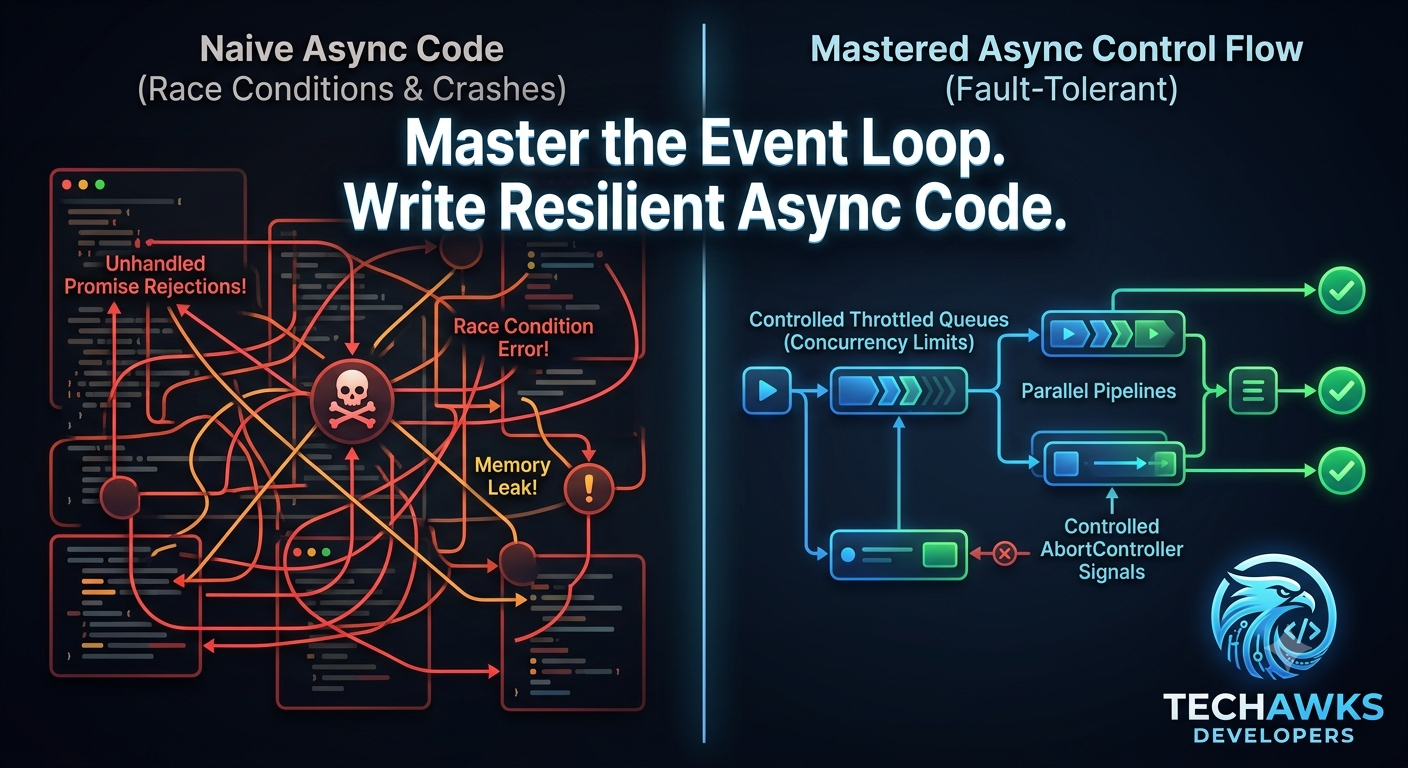
    The Solution: Use Promise.allSettled(). It waits for all promises to finish regardless of individual success or failure, returning an array of objects describing the outcome of each.
    2. Prevent Memory Exhaustion with Concurrency Limits
    The Pitfall: Running Promise.all() over thousands of items fires thousands of network requests or database queries simultaneously, crashing your server or triggering rate limits.
    The Solution: Batch executions or use a concurrency queue (like p-limit). Limit concurrent active promises to a manageable pool size (e.g., 5 to 10 at a time).
    3. Handle Race Conditions with Cancellation Signals (AbortController)
    The Pitfall: Triggering rapid state changes or rapid UI fetches allows older, slower network responses to overwrite newer, faster data.
    The Solution: Pass an AbortSignal to your fetch calls and cancel pending requests when new operations kick off.
    4. Avoid Forgetting Return Statements in Async Wrappers
    The Pitfall: Omitting return or await inside try-catch blocks causes errors inside promises to escape unhandled, bypassing local catch blocks.


    The Solution: Always explicitly return await inside try-catch blocks when you need to catch rejections locally before passing the result upstream.


    Key Takeaways
    Choose the Right Combinator: Use Promise.allSettled() for fault-tolerant parallel executions where partial success is acceptable.
    Throttle Concurrency: Never map unbounded arrays directly into Promise.all(); always control parallel execution limits.
    Cancel Outdated Requests: Use AbortController to prevent race conditions and conserve bandwidth.


    CTA
    Struggling with async bugs or optimizing your Node.js backend performance? Join Developers & Coding to share code snippets, review design patterns, and grow your software engineering skills alongside developers worldwide.
    Mastering Async Control Flow: How to Avoid Callback Hell and Promise Race Conditions Writing robust asynchronous code requires moving beyond simple async/await syntax to master control flow execution patterns. When dealing with parallel requests, resource limits, and error handling, relying on naive loops can paralyze your application. Here is how to write clean, predictable async code that scales: 1. Execute Parallel Requests Concurrently with Promise.allSettled The Pitfall: Using Promise.all() fails fast—if a single promise rejects, the entire execution throws, ignoring successful responses from parallel calls. The Solution: Use Promise.allSettled(). It waits for all promises to finish regardless of individual success or failure, returning an array of objects describing the outcome of each. 2. Prevent Memory Exhaustion with Concurrency Limits The Pitfall: Running Promise.all() over thousands of items fires thousands of network requests or database queries simultaneously, crashing your server or triggering rate limits. The Solution: Batch executions or use a concurrency queue (like p-limit). Limit concurrent active promises to a manageable pool size (e.g., 5 to 10 at a time). 3. Handle Race Conditions with Cancellation Signals (AbortController) The Pitfall: Triggering rapid state changes or rapid UI fetches allows older, slower network responses to overwrite newer, faster data. The Solution: Pass an AbortSignal to your fetch calls and cancel pending requests when new operations kick off. 4. Avoid Forgetting Return Statements in Async Wrappers The Pitfall: Omitting return or await inside try-catch blocks causes errors inside promises to escape unhandled, bypassing local catch blocks. The Solution: Always explicitly return await inside try-catch blocks when you need to catch rejections locally before passing the result upstream. Key Takeaways Choose the Right Combinator: Use Promise.allSettled() for fault-tolerant parallel executions where partial success is acceptable. Throttle Concurrency: Never map unbounded arrays directly into Promise.all(); always control parallel execution limits. Cancel Outdated Requests: Use AbortController to prevent race conditions and conserve bandwidth. CTA Struggling with async bugs or optimizing your Node.js backend performance? Join Developers & Coding to share code snippets, review design patterns, and grow your software engineering skills alongside developers worldwide.
    0 Kommentare 0 Geteilt 2KB Ansichten 0 Bewertungen
  • Monolith vs. Microservices: When Should You Actually Break Up Your Codebase?


    The tech industry often defaults to microservices as a badge of architectural maturity. However, managing distributed databases, network latency, gRPC/REST contracts, and service meshes can quickly drain a team's engineering velocity if introduced prematurely.
    A well-structured modular monolith is almost always the best starting point for modern application development.
    Here is how to evaluate whether your application is ready to break apart, and how to do it safely:


    1. Identify True Microservice Triggers
    Do not split services based on feature boundaries alone. Only split when you face clear operational divergence:
    Independent Scaling Needs: A specific sub-domain (e.g., video processing or search indexing) requires massive compute, while the rest of the app runs on minimal resources.
    Team Isolation Boundaries: Multiple independent engineering teams are constantly blocking each other on deployment pipelines and Git merge conflicts within a single repository.
    Technology Stack Requirements: A specific service requires a low-latency language like Rust or Go, while your core API is built in Node.js or Python.


    2. The Danger of the "Distributed Monolith"
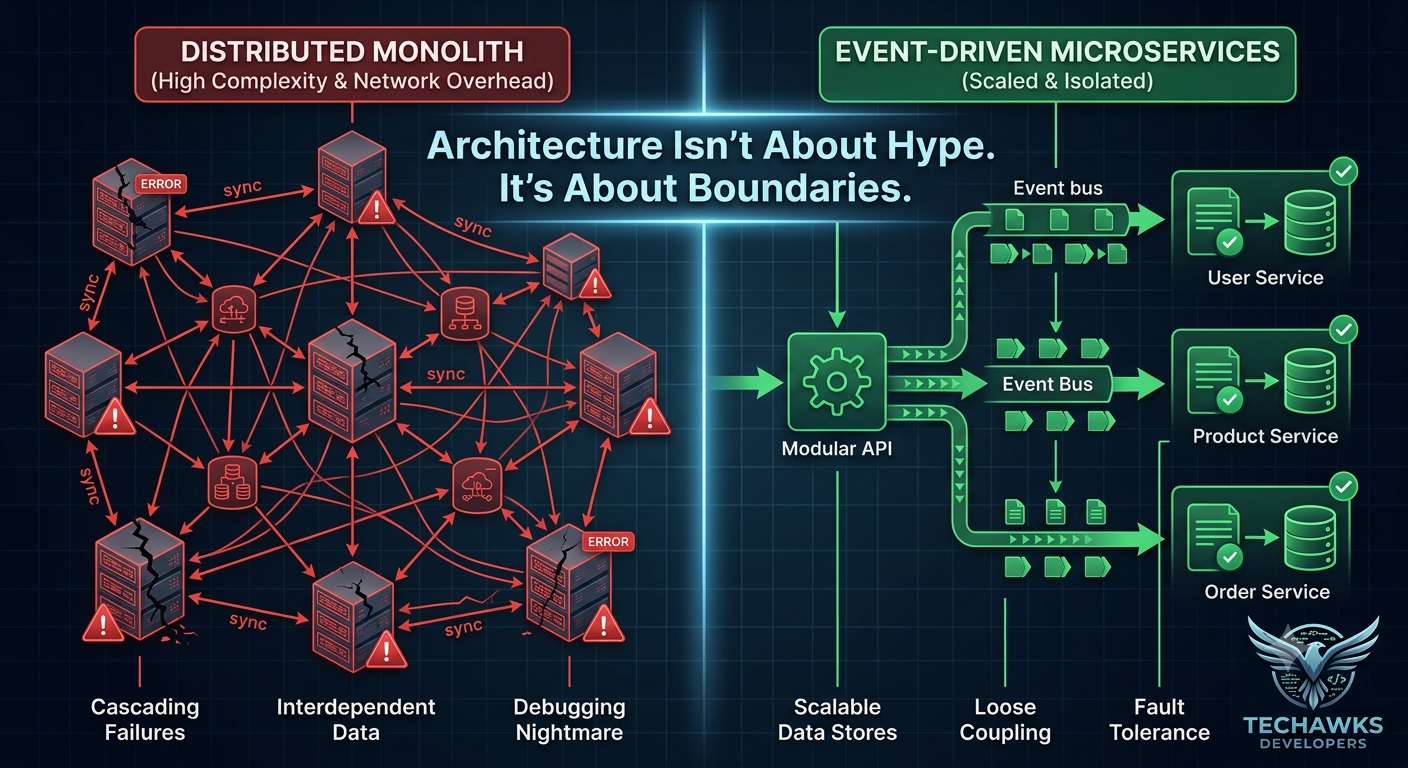
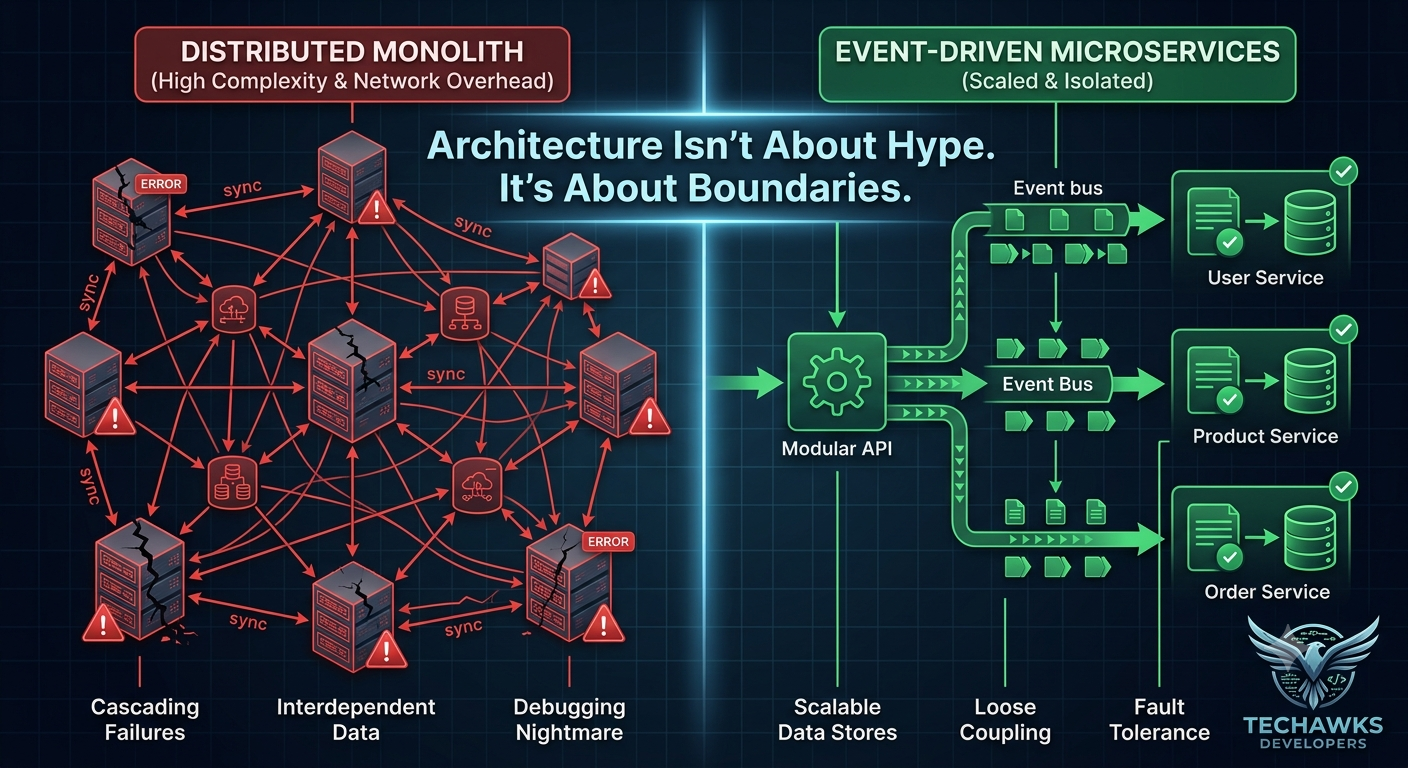
    If service A cannot run without synchronously querying service B, C, and D over HTTP, you haven't built microservices—you've built a fragile, slow distributed monolith.
    Actionable Rule: Favor asynchronous event-driven communication (e.g., message queues like Kafka or RabbitMQ) over synchronous HTTP calls to keep services truly decoupled.


    3. How to Prepare Your Monolith for Future Extraction
    Before creating a new microservice, enforce strict domain boundaries inside your existing codebase:
    Keep domain schemas separate (no cross-domain SQL joins).
    Communicate between modules using strictly defined internal interfaces.
    Treat internal module boundaries as if they were already external APIs.


    Key Takeaways
    Start Modular First: Build a modular monolith first to discover natural domain boundaries before introducing distributed systems complexity.
    De-couple via Events: Use asynchronous message brokers rather than synchronous HTTP requests to prevent cascading system failures.
    Isolate Data Stores: True microservices must own their databases—never share a single database instance across multiple independent services.


    CTA
    Where does your team stand on the monolith vs. microservices spectrum? Join Developers & Coding to share your migration experiences, debate system design patterns, and level up your backend architecture skills.
    Monolith vs. Microservices: When Should You Actually Break Up Your Codebase? The tech industry often defaults to microservices as a badge of architectural maturity. However, managing distributed databases, network latency, gRPC/REST contracts, and service meshes can quickly drain a team's engineering velocity if introduced prematurely. A well-structured modular monolith is almost always the best starting point for modern application development. Here is how to evaluate whether your application is ready to break apart, and how to do it safely: 1. Identify True Microservice Triggers Do not split services based on feature boundaries alone. Only split when you face clear operational divergence: Independent Scaling Needs: A specific sub-domain (e.g., video processing or search indexing) requires massive compute, while the rest of the app runs on minimal resources. Team Isolation Boundaries: Multiple independent engineering teams are constantly blocking each other on deployment pipelines and Git merge conflicts within a single repository. Technology Stack Requirements: A specific service requires a low-latency language like Rust or Go, while your core API is built in Node.js or Python. 2. The Danger of the "Distributed Monolith" If service A cannot run without synchronously querying service B, C, and D over HTTP, you haven't built microservices—you've built a fragile, slow distributed monolith. Actionable Rule: Favor asynchronous event-driven communication (e.g., message queues like Kafka or RabbitMQ) over synchronous HTTP calls to keep services truly decoupled. 3. How to Prepare Your Monolith for Future Extraction Before creating a new microservice, enforce strict domain boundaries inside your existing codebase: Keep domain schemas separate (no cross-domain SQL joins). Communicate between modules using strictly defined internal interfaces. Treat internal module boundaries as if they were already external APIs. Key Takeaways Start Modular First: Build a modular monolith first to discover natural domain boundaries before introducing distributed systems complexity. De-couple via Events: Use asynchronous message brokers rather than synchronous HTTP requests to prevent cascading system failures. Isolate Data Stores: True microservices must own their databases—never share a single database instance across multiple independent services. CTA Where does your team stand on the monolith vs. microservices spectrum? Join Developers & Coding to share your migration experiences, debate system design patterns, and level up your backend architecture skills.
    0 Kommentare 0 Geteilt 2KB Ansichten 0 Bewertungen
  • How to Build a Custom Rate Limiter from Scratch with Redis and Node.js


    Rate limiting is an essential defense layer for any backend API. While simple fixed-window algorithms (like resetting counts every minute) are easy to code, they are vulnerable to traffic spikes at window boundaries.
    The Sliding Window Log pattern eliminates boundary spikes by tracking individual request timestamps per user in Redis using sorted sets (ZSET).


    Follow this step-by-step tutorial to implement a production-ready sliding window rate limiter:


    Step 1: Set Up the Redis Sorted Set Strategy
    Instead of a simple counter key, store each request timestamp inside a Redis ZSET where:
    Key: rate_limit:{user_id_or_ip}
    Member: Unique Request ID / Timestamp
    Score: Epoch Timestamp (milliseconds)


    Step 2: Clean Up Old Request Logs
    When a request arrives at your API middleware, immediately remove all timestamps older than the allowed window limit (e.g., older than 60 seconds ago):
    JavaScript
    const windowSizeInMs = 60 * 1000;
    const now = Date.now();
    const clearBefore = now - windowSizeInMs;
    // Remove expired entries from the sorted set
    await redis.zremrangebyscore(userKey, 0, clearBefore);


    Step 3: Count Requests Within the Active Window
    Fetch the current number of valid requests remaining in the sorted set for the current window:
    JavaScript
    const currentRequestCount = await redis.zcard(userKey);
    if (currentRequestCount >= MAX_ALLOWED_REQUESTS) {
    // Exceeded rate limit
    return res.status(429).json({
    error: 'Too Many Requests',
    retryAfter: 60


    Step 4: Record the Current Request & Set Expiration
    If the request is within the limit, add the current timestamp to Redis and refresh the key's TTL to prevent idle memory leaks:
    JavaScript
    // Add current request
    await redis.zadd(userKey, now, `${now}-${Math.random()}`);
    // Set key expiration to prevent stale data buildup
    await redis.pexpire(userKey, windowSizeInMs);
    next(); // Continue to API handler


    Step 5: Wrap Execution in an Atomic Redis Multi Transaction
    To eliminate race conditions between reading and writing to Redis across concurrent server nodes, execute ZREMRANGEBYSCORE, ZCARD, ZADD, and PEXPIRE within a single redis.multi() transaction block or a custom Lua script.


    Key Takeaways
    Prefer Sliding Windows: Avoid boundary-burst vulnerabilities inherent in fixed-window algorithms.
    Keep Data Lean: Always auto-expire Redis keys using PEXPIRE to maintain minimal memory footprint.
    Ensure Atomicity: Use Redis Lua scripts or multi transactions to guarantee thread safety during high concurrency.


    CTA
    How do you handle API throttling and load protection in your stack? Join Developers & Coding to discuss backend design patterns, benchmark database solutions, and build resilient infrastructure with engineers around the globe.
    How to Build a Custom Rate Limiter from Scratch with Redis and Node.js Rate limiting is an essential defense layer for any backend API. While simple fixed-window algorithms (like resetting counts every minute) are easy to code, they are vulnerable to traffic spikes at window boundaries. The Sliding Window Log pattern eliminates boundary spikes by tracking individual request timestamps per user in Redis using sorted sets (ZSET). Follow this step-by-step tutorial to implement a production-ready sliding window rate limiter: Step 1: Set Up the Redis Sorted Set Strategy Instead of a simple counter key, store each request timestamp inside a Redis ZSET where: Key: rate_limit:{user_id_or_ip} Member: Unique Request ID / Timestamp Score: Epoch Timestamp (milliseconds) Step 2: Clean Up Old Request Logs When a request arrives at your API middleware, immediately remove all timestamps older than the allowed window limit (e.g., older than 60 seconds ago): JavaScript const windowSizeInMs = 60 * 1000; const now = Date.now(); const clearBefore = now - windowSizeInMs; // Remove expired entries from the sorted set await redis.zremrangebyscore(userKey, 0, clearBefore); Step 3: Count Requests Within the Active Window Fetch the current number of valid requests remaining in the sorted set for the current window: JavaScript const currentRequestCount = await redis.zcard(userKey); if (currentRequestCount >= MAX_ALLOWED_REQUESTS) { // Exceeded rate limit return res.status(429).json({ error: 'Too Many Requests', retryAfter: 60 Step 4: Record the Current Request & Set Expiration If the request is within the limit, add the current timestamp to Redis and refresh the key's TTL to prevent idle memory leaks: JavaScript // Add current request await redis.zadd(userKey, now, `${now}-${Math.random()}`); // Set key expiration to prevent stale data buildup await redis.pexpire(userKey, windowSizeInMs); next(); // Continue to API handler Step 5: Wrap Execution in an Atomic Redis Multi Transaction To eliminate race conditions between reading and writing to Redis across concurrent server nodes, execute ZREMRANGEBYSCORE, ZCARD, ZADD, and PEXPIRE within a single redis.multi() transaction block or a custom Lua script. Key Takeaways Prefer Sliding Windows: Avoid boundary-burst vulnerabilities inherent in fixed-window algorithms. Keep Data Lean: Always auto-expire Redis keys using PEXPIRE to maintain minimal memory footprint. Ensure Atomicity: Use Redis Lua scripts or multi transactions to guarantee thread safety during high concurrency. CTA How do you handle API throttling and load protection in your stack? Join Developers & Coding to discuss backend design patterns, benchmark database solutions, and build resilient infrastructure with engineers around the globe.
    0 Kommentare 0 Geteilt 1KB Ansichten 0 Bewertungen
  • How Stereolithography (SLA) 3D Printing Services Market Size is Set to Expand
    The Stereolithography (SLA) 3D Printing Services market is on the verge of significant expansion, projected to reach a robust USD 10.5 billion by 2035, up from USD 4.5 billion in 2024. This remarkable growth reflects a compound annual growth rate (CAGR) of 8.01%, revealing a trajectory fueled by diverse applications and technological advancements. Such an upward trend is not just confined to...
    0 Kommentare 0 Geteilt 417 Ansichten 0 Bewertungen