





Startup Founders & Entrepreneurs is the Techawks community for startup founders, co-founders, entrepreneurs, innovators, and aspiring business builders creating the next generation of technology and AI-driven companies. Connect with like-minded people, exchange ideas, and learn from real startup experiences.
Members can discuss product development, MVP validation, fundraising, growth marketing, AI adoption, hiring, scaling, leadership, and business strategy. Share lessons learned, discover new opportunities, find collaborators, and build meaningful connections within the startup ecosystem.
Members can discuss product development, MVP validation, fundraising, growth marketing, AI adoption, hiring, scaling, leadership, and business strategy. Share lessons learned, discover new opportunities, find collaborators, and build meaningful connections within the startup ecosystem.
-
Public Group
-
63 Posts
-
63 Photos
-
0 Videos
-
Reviews
-
Science and Technology
Search

 Arabic
 French
 Spanish
 Portuguese
 Deutsch
 Turkish
 Dutch
Dutch
 Italiano
 Russian
 Romaian
 Portuguese (Brazil)
 Greek
Greek
Recent Updates
-
The MVP Trap: 4 Strategic Technical Decisions Founders Must Make Before Scaling
Every founder faces the tension between shipping product iterations today and keeping infrastructure stable for tomorrow. Taking on technical shortcuts is often the right call to find product-market fit. The trap occurs when temporary MVP shortcuts become permanent architecture without deliberate engineering checkpoints.
Here are 4 strategic architectural decisions founders and engineering leads must align on before scaling:
Protect the Load-Bearing Walls (Core Data Models & Identity)
The MVP Shortcut: Storing fragmented JSON blobs, skipping foreign key constraints, or using quick third-party auth wrappers to get a dashboard running over a weekend.
The Strategic Shift: You can rewrite frontends and replace APIs overnight, but fixing corrupted, un-normalized transactional data or messy tenant models post-launch requires high-risk database surgery. Lock in normalized, strict schemas for core business entities (money, users, billing, permissions) while keeping UI and peripheral features flexible.
Decouple "Throwaway Experiments" from Core Business Engines
The MVP Shortcut: Hardcoding experimental feature logic, promotional flows, and edge-case pilots directly into primary database tables and core routes.
The Strategic Shift: Isolate experimental features behind feature flags and decoupled service layers. When a customer pilot or marketing experiment fails, the codebase should allow you to delete that code without triggering cascading regressions across billing or onboarding flows.
Establish an Explicit "Debt Budget" Post-Validation
The MVP Shortcut: Running consecutive sprints focused 100% on feature delivery until deployment velocity grinds to a halt and outages multiply.
The Strategic Shift: Once retention signals and unit economics prove users want the product, allocate a non-negotiable 15–20% of every sprint cycle to technical debt repayment (e.g., refactoring brittle components, database indexing, automated staging pipelines). Treating debt repayment as a scheduled business expense prevents massive, company-halting multi-month rewrites.
Buy the Commodity, Build the Core Moat
The MVP Shortcut: Spending early engineering cycles rolling custom authentication, in-house message brokers, or bespoke deployment scripts to avoid $50/month SaaS bills.
The Strategic Shift: Use battle-tested managed services (e.g., managed databases, established auth providers, cloud object stores) for foundational plumbing. Reserve internal engineering capital exclusively for the proprietary algorithms, unique workflows, and domain logic that constitute your product's competitive moat.
Key Takeaways
Data models outlive your UI: Enforce strict boundaries and integrity on financial, identity, and tenancy data from day one.
Isolate early experiments: Keep speculative features modular so they can be pruned without breaking production stability.
Budget for refactoring: Dedicate an ongoing percentage of sprint bandwidth to paying down shortcuts before they compound into roadmap paralysis.
Focus on your differentiator: Outsource commodity infrastructure to managed services and focus development hours on your core value proposition.
CTA
What early architectural or technical shortcut bought you speed early on, but later came back to haunt your scaling roadmap? Or what decision saved your team from a painful rebuild?
Share your war stories, MVP trade-offs, and lessons learned in the comments below.The MVP Trap: 4 Strategic Technical Decisions Founders Must Make Before Scaling Every founder faces the tension between shipping product iterations today and keeping infrastructure stable for tomorrow. Taking on technical shortcuts is often the right call to find product-market fit. The trap occurs when temporary MVP shortcuts become permanent architecture without deliberate engineering checkpoints. Here are 4 strategic architectural decisions founders and engineering leads must align on before scaling: Protect the Load-Bearing Walls (Core Data Models & Identity) The MVP Shortcut: Storing fragmented JSON blobs, skipping foreign key constraints, or using quick third-party auth wrappers to get a dashboard running over a weekend. The Strategic Shift: You can rewrite frontends and replace APIs overnight, but fixing corrupted, un-normalized transactional data or messy tenant models post-launch requires high-risk database surgery. Lock in normalized, strict schemas for core business entities (money, users, billing, permissions) while keeping UI and peripheral features flexible. Decouple "Throwaway Experiments" from Core Business Engines The MVP Shortcut: Hardcoding experimental feature logic, promotional flows, and edge-case pilots directly into primary database tables and core routes. The Strategic Shift: Isolate experimental features behind feature flags and decoupled service layers. When a customer pilot or marketing experiment fails, the codebase should allow you to delete that code without triggering cascading regressions across billing or onboarding flows. Establish an Explicit "Debt Budget" Post-Validation The MVP Shortcut: Running consecutive sprints focused 100% on feature delivery until deployment velocity grinds to a halt and outages multiply. The Strategic Shift: Once retention signals and unit economics prove users want the product, allocate a non-negotiable 15–20% of every sprint cycle to technical debt repayment (e.g., refactoring brittle components, database indexing, automated staging pipelines). Treating debt repayment as a scheduled business expense prevents massive, company-halting multi-month rewrites. Buy the Commodity, Build the Core Moat The MVP Shortcut: Spending early engineering cycles rolling custom authentication, in-house message brokers, or bespoke deployment scripts to avoid $50/month SaaS bills. The Strategic Shift: Use battle-tested managed services (e.g., managed databases, established auth providers, cloud object stores) for foundational plumbing. Reserve internal engineering capital exclusively for the proprietary algorithms, unique workflows, and domain logic that constitute your product's competitive moat. Key Takeaways Data models outlive your UI: Enforce strict boundaries and integrity on financial, identity, and tenancy data from day one. Isolate early experiments: Keep speculative features modular so they can be pruned without breaking production stability. Budget for refactoring: Dedicate an ongoing percentage of sprint bandwidth to paying down shortcuts before they compound into roadmap paralysis. Focus on your differentiator: Outsource commodity infrastructure to managed services and focus development hours on your core value proposition. CTA What early architectural or technical shortcut bought you speed early on, but later came back to haunt your scaling roadmap? Or what decision saved your team from a painful rebuild? Share your war stories, MVP trade-offs, and lessons learned in the comments below.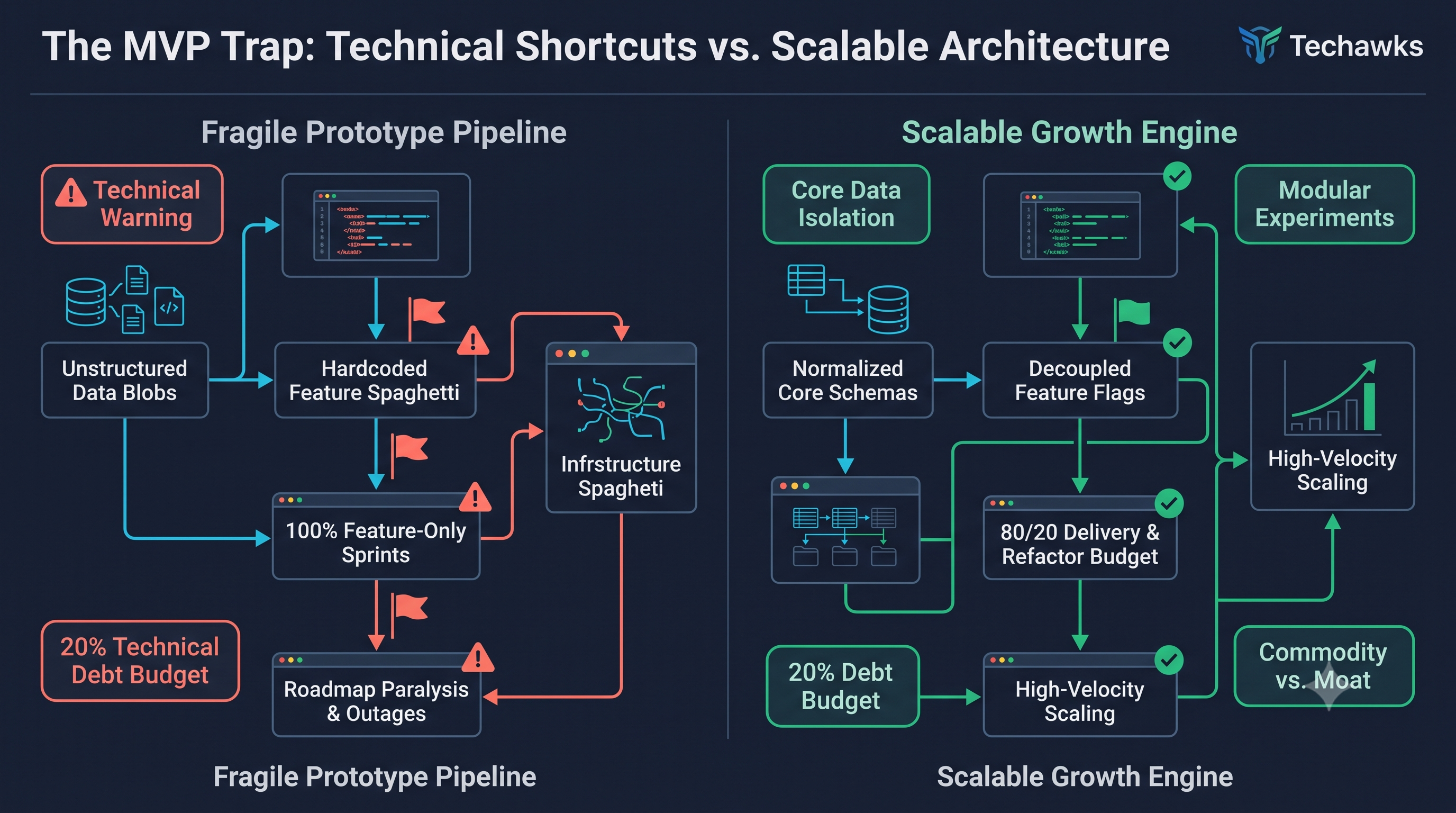 0 Comments 0 Shares 53 Views 0 Reviews
 -
The 80% Margin Illusion: Why AI-Native Founders Must Ditch Flat Subscriptions for Hybrid Unit Economics
For fifteen years, the venture-backed SaaS playbook was built on 80% to 90% gross margins. You wrote software once, hosted it on multi-tenant relational databases, and added new users at near-zero marginal cost.
In AI-first companies, however, every interaction burns real inference compute. Industry benchmarks show AI-native SaaS gross margins clustering between 50% and 60%—with thin wrappers dropping as low as 25%. While foundation model token prices fall, product complexity rises faster: multi-step retrieval, chain-of-thought verification, and continuous background evaluations consume more tokens per workflow than falling prices can offset.
If your startup charges flat per-seat rates while paying upstream API or GPU vendors on variable consumption, your top 10% most active customers are quietly eroding your runway.
To build a durable, venture-backable AI company today, founders must re-engineer their product and monetization architecture around three unit-economic levers:
1. The Shift to Hybrid or Outcome-Based Pricing
Pure consumption pricing scares enterprise procurement with unpredictable bills, but pure per-seat subscriptions leave founders carrying unbounded inference risk.
The Fix: Implement a platform base + tiered credit allocation model. Charge a predictable subscription floor that covers platform access and a generous baseline of routine tasks, paired with metered, overage-based billing or outcome-based milestones (e.g., successful lead conversions, resolved tickets, or executed contracts) for complex, compute-intensive agent runs.
2. Intelligent Model Routing as Gross Margin Defense
Sending 100% of user traffic to flagship frontier models is an architectural failure, not a product feature.
The Fix: Deploy an upstream intent router. 70–80% of routine user inputs (parsing, classification, light formatting) can be resolved using ultra-fast, small quantized models or cached embeddings at a fraction of the cost. Reserve frontier reasoning models exclusively for complex edge cases, verification gates, or high-stakes generation.
3. Moats Move to the System of Record, Not the Model
If your startup's core differentiation is a system prompt and a slick interface, you are exposed to rapid commoditization whenever base models release point updates.
The Fix: Integrate deeply into the customer's proprietary workflow. Moats in 2026 belong to products that hold proprietary organizational context, maintain complex multi-system state, and create feedback loops where daily user corrections continually refine domain-specific adapters and evaluation datasets.
Discussion Question
Founders and operators: How is your startup structuring AI pricing and COGS? Have you transitioned from flat per-seat subscriptions to hybrid/credit models, and what architectural steps (caching, model routing, self-hosting) had the biggest impact on your gross margins?
CTA (Encourage founders to share lessons)
Drop your pricing experiments, margin hurdles, and architecture lessons in the comments below. Let's break down what's actually working in the wild!The 80% Margin Illusion: Why AI-Native Founders Must Ditch Flat Subscriptions for Hybrid Unit Economics For fifteen years, the venture-backed SaaS playbook was built on 80% to 90% gross margins. You wrote software once, hosted it on multi-tenant relational databases, and added new users at near-zero marginal cost. In AI-first companies, however, every interaction burns real inference compute. Industry benchmarks show AI-native SaaS gross margins clustering between 50% and 60%—with thin wrappers dropping as low as 25%. While foundation model token prices fall, product complexity rises faster: multi-step retrieval, chain-of-thought verification, and continuous background evaluations consume more tokens per workflow than falling prices can offset. If your startup charges flat per-seat rates while paying upstream API or GPU vendors on variable consumption, your top 10% most active customers are quietly eroding your runway. To build a durable, venture-backable AI company today, founders must re-engineer their product and monetization architecture around three unit-economic levers: 1. The Shift to Hybrid or Outcome-Based Pricing Pure consumption pricing scares enterprise procurement with unpredictable bills, but pure per-seat subscriptions leave founders carrying unbounded inference risk. The Fix: Implement a platform base + tiered credit allocation model. Charge a predictable subscription floor that covers platform access and a generous baseline of routine tasks, paired with metered, overage-based billing or outcome-based milestones (e.g., successful lead conversions, resolved tickets, or executed contracts) for complex, compute-intensive agent runs. 2. Intelligent Model Routing as Gross Margin Defense Sending 100% of user traffic to flagship frontier models is an architectural failure, not a product feature. The Fix: Deploy an upstream intent router. 70–80% of routine user inputs (parsing, classification, light formatting) can be resolved using ultra-fast, small quantized models or cached embeddings at a fraction of the cost. Reserve frontier reasoning models exclusively for complex edge cases, verification gates, or high-stakes generation. 3. Moats Move to the System of Record, Not the Model If your startup's core differentiation is a system prompt and a slick interface, you are exposed to rapid commoditization whenever base models release point updates. The Fix: Integrate deeply into the customer's proprietary workflow. Moats in 2026 belong to products that hold proprietary organizational context, maintain complex multi-system state, and create feedback loops where daily user corrections continually refine domain-specific adapters and evaluation datasets. Discussion Question Founders and operators: How is your startup structuring AI pricing and COGS? Have you transitioned from flat per-seat subscriptions to hybrid/credit models, and what architectural steps (caching, model routing, self-hosting) had the biggest impact on your gross margins? CTA (Encourage founders to share lessons) Drop your pricing experiments, margin hurdles, and architecture lessons in the comments below. Let's break down what's actually working in the wild! 0 Comments 0 Shares 4 Views 0 Reviews
 -
Technical Debt vs. Sluggish Delivery: A Founder’s Framework for Intentional Architecture Trade-Offs
In the earliest stages of a startup, code quality is not measured by academic elegance or theoretical infinite scale. It is measured by your speed of validated learning per dollar spent.
Yet, most technical founders fall into one of two traps: building a distributed event-driven microservices fleet for zero initial users, or hacking together an undocumented, tightly coupled monolith with zero transactional safety that grinds product iterations to a halt by customer fifty.
Here is a practical framework to manage technical debt deliberately, ensuring your engineering speed remains an asset rather than a hidden balance-sheet liability.
1. Separate "Reversible" from "Irreversible" Architectural Bets
Borrowing from Amazon’s Type 1 (irreversible) vs. Type 2 (reversible) decisions, categorize technical choices before writing code:
Irreversible (Get These Right on Day 1):
Core relational data schema and foreign key boundaries (e.g., billing, ledger, tenant isolation).
Authentication, authorization scopes, and data residency boundaries.
API contracts exposed to third-party integrations or mobile clients.
Reversible (Optimize for Speed & Disposability):
Asynchronous queues vs. simple background workers (e.g., cron jobs or Postgres-backed queues like pg-boss).
Monolith vs. microservices (always start as a modular monolith).
Self-hosted infrastructure vs. managed PaaS (e.g., fly.io, Render, AWS ECS over bare-metal Kubernetes).
2. Implement the "Debt Ledger" in Your Sprint Cycles
Technical shortcuts should never be invisible:
Whenever an engineer implements a hack to hit a customer deadline (e.g., bypassing an idempotent retry mechanism or hardcoding an integration payload), require a Debt Ticket logged directly into your backlog.
Annotate the ticket with two numbers:
Principal: Time saved today (e.g., Saved 3 days of development).
Interest: Operational friction added per month (e.g., Requires manual database fix if customer retries checkout).
If interest begins to exceed 10% of total sprint velocity, the ticket gets automatically prioritized into the next release.
3. Establish the 80/20 Maintenance Allocation
Founders often promise investors or sales teams 100% feature velocity until the product abruptly stalls under bug backlogs:
Commit to a hard 80/20 rule: 80% sprint capacity dedicated to customer discovery and revenue features; 20% strictly reserved for infrastructure refactoring, test automation, and debt remediation.
This ring-fences technical health and eliminates the contentious debate over "feature work vs. tech debt."
4. Know the Exact Metric Trigger to Refactor
Never refactor based on developer boredom or abstract aesthetic desires. Refactor only when operational thresholds are breached:
Database Connection Saturation: When pool utilization consistently hits 75% at peak hours.
Deployment Lead Time: When continuous deployment cycle time stretches from 10 minutes to over 45 minutes due to fragile test suites.
Support Ticket Ratio: When bugs from legacy hacks account for more than 15% of inbound customer queries.
Key Takeaways
Categorize Decisions: Enforce rigorous architectural discipline on data schemas and auth; aggressively cut corners on background workers and hosting orchestration.
Track the Debt Ledger: Treat technical shortcuts like financial loans—track the principal saved and the recurring interest paid in operational overhead.
The 80/20 Rule: Guarantee 20% continuous engineering capacity for technical hardening to prevent catastrophic code freezes later.
Refactor on Telemetry, Not Taste: Use concrete operational triggers (deployment lead time, database load, error rates) to justify re-architecting systems.
CTA
What was the most expensive piece of technical debt you took on to ship faster—and was it ultimately worth the trade-off?
Did your early architectural choices survive your first 1,000 customers, or did you have to execute a painful ground-up rewrite? Share your hardest-earned engineering lessons below.Technical Debt vs. Sluggish Delivery: A Founder’s Framework for Intentional Architecture Trade-Offs In the earliest stages of a startup, code quality is not measured by academic elegance or theoretical infinite scale. It is measured by your speed of validated learning per dollar spent. Yet, most technical founders fall into one of two traps: building a distributed event-driven microservices fleet for zero initial users, or hacking together an undocumented, tightly coupled monolith with zero transactional safety that grinds product iterations to a halt by customer fifty. Here is a practical framework to manage technical debt deliberately, ensuring your engineering speed remains an asset rather than a hidden balance-sheet liability. 1. Separate "Reversible" from "Irreversible" Architectural Bets Borrowing from Amazon’s Type 1 (irreversible) vs. Type 2 (reversible) decisions, categorize technical choices before writing code: Irreversible (Get These Right on Day 1): Core relational data schema and foreign key boundaries (e.g., billing, ledger, tenant isolation). Authentication, authorization scopes, and data residency boundaries. API contracts exposed to third-party integrations or mobile clients. Reversible (Optimize for Speed & Disposability): Asynchronous queues vs. simple background workers (e.g., cron jobs or Postgres-backed queues like pg-boss). Monolith vs. microservices (always start as a modular monolith). Self-hosted infrastructure vs. managed PaaS (e.g., fly.io, Render, AWS ECS over bare-metal Kubernetes). 2. Implement the "Debt Ledger" in Your Sprint Cycles Technical shortcuts should never be invisible: Whenever an engineer implements a hack to hit a customer deadline (e.g., bypassing an idempotent retry mechanism or hardcoding an integration payload), require a Debt Ticket logged directly into your backlog. Annotate the ticket with two numbers: Principal: Time saved today (e.g., Saved 3 days of development). Interest: Operational friction added per month (e.g., Requires manual database fix if customer retries checkout). If interest begins to exceed 10% of total sprint velocity, the ticket gets automatically prioritized into the next release. 3. Establish the 80/20 Maintenance Allocation Founders often promise investors or sales teams 100% feature velocity until the product abruptly stalls under bug backlogs: Commit to a hard 80/20 rule: 80% sprint capacity dedicated to customer discovery and revenue features; 20% strictly reserved for infrastructure refactoring, test automation, and debt remediation. This ring-fences technical health and eliminates the contentious debate over "feature work vs. tech debt." 4. Know the Exact Metric Trigger to Refactor Never refactor based on developer boredom or abstract aesthetic desires. Refactor only when operational thresholds are breached: Database Connection Saturation: When pool utilization consistently hits 75% at peak hours. Deployment Lead Time: When continuous deployment cycle time stretches from 10 minutes to over 45 minutes due to fragile test suites. Support Ticket Ratio: When bugs from legacy hacks account for more than 15% of inbound customer queries. Key Takeaways Categorize Decisions: Enforce rigorous architectural discipline on data schemas and auth; aggressively cut corners on background workers and hosting orchestration. Track the Debt Ledger: Treat technical shortcuts like financial loans—track the principal saved and the recurring interest paid in operational overhead. The 80/20 Rule: Guarantee 20% continuous engineering capacity for technical hardening to prevent catastrophic code freezes later. Refactor on Telemetry, Not Taste: Use concrete operational triggers (deployment lead time, database load, error rates) to justify re-architecting systems. CTA What was the most expensive piece of technical debt you took on to ship faster—and was it ultimately worth the trade-off? Did your early architectural choices survive your first 1,000 customers, or did you have to execute a painful ground-up rewrite? Share your hardest-earned engineering lessons below.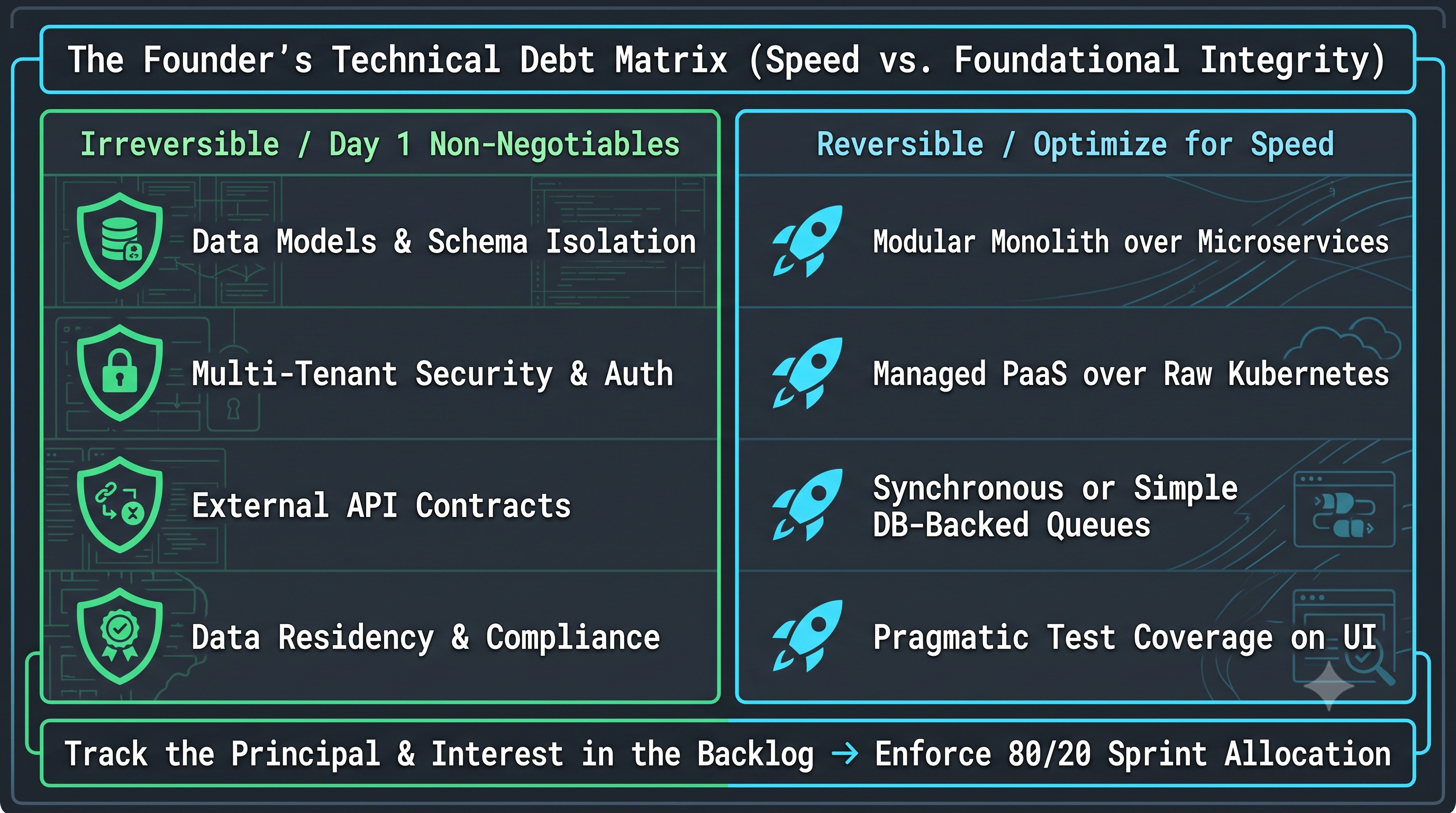 0 Comments 0 Shares 81 Views 0 Reviews
 -
The Death of 80% SaaS Margins: The 5-Point AI Unit Economics Checklist for Founders
For fifteen years, the venture playbook was simple: achieve product-market fit, price at $30–$100/seat/month, and enjoy 75% to 85% gross margins because hosting costs scaled sub-linearly.
AI-native applications broke that math. With multi-step agent loops, long-context RAG pipelines, and per-token inference bills, compute is now a direct Cost of Goods Sold (COGS). AI startups running unconstrained frontier models frequently operate at compressed 30% to 55% gross margins—turning growth into an accelerating burn rate.
Before pitching your next round or setting your commercial pricing tiers, audit your startup's unit economics with this 5-point production checklist:
1. Calculate Gross Margin After Compute (GMAC)
Traditional gross margin hides compute liabilities under blended cloud hosting costs.
Isolate direct AI COGS: token bills, vector database reads/writes, GPU rental hours, and downstream data API costs.
Calculate GMAC = (Revenue - Direct Compute COGS) / Revenue. Aim for a floor of 50% at Seed and build an architectural pathway to 65%+ by Series A.
2. Kill Pure Per-Seat Pricing in Favor of Hybrid Metering
Flat per-seat subscriptions incentivize users to run heavy agent loops without cost accountability, causing a 5x to 10x cost variance between casual and power users.
Shift to a hybrid monetization model: a baseline platform subscription fee covering platform access plus metered work credits or outcome-based billing (e.g., successful resolutions, processed leads, executed workflows).
3. Implement Tiered Model Cascades (Task-Based Routing)
Defaulting every user query to a flagship model (like Claude 3.7 Sonnet or GPT-4.5) is an economic failure mode.
Build an intelligent ingress router: dispatch simple data extraction, classification, and formatting tasks to distilled, quantized local or small models (0.1x the cost). Reserve flagship frontier models strictly for non-deterministic multi-step reasoning.
4. Enforce Prompt Caching & Token Topology Discipline
Multi-turn agents regenerate huge prompt prefixes on every iteration, compounding input costs.
Audit your context assembly to ensure system prompts and tool schemas are pinned to maximize inference prefix cache hits (saving 50% to 80% on input token costs). Evict redundant conversation history and intermediate tool outputs using background semantic compaction.
5. Track Compute-Adjusted LTV:CAC
Standard Lifetime Value (LTV) formulas assume 80% contribution margins. If your gross margin is 45%, your actual customer lifetime value is nearly sliced in half.
Recalculate your payback period and LTV:CAC ratio using your compute-adjusted gross margin. If a customer acquisition cost takes 18 months to recover due to inference overhead, your customer acquisition engine is structurally insolvent.
Discussion Question
For founders and operators building AI products: what is your current Gross Margin After Compute (GMAC), and have you had to move away from flat seat-based pricing to stay ahead of inference bills?
CTA (Encourage founders to share lessons)
Building and scaling a venture-backed tech startup? Drop your pricing lessons, margin experiments, or unit economic challenges in the comments below. Let’s share the real operational numbers behind building sustainable tech companies.The Death of 80% SaaS Margins: The 5-Point AI Unit Economics Checklist for Founders For fifteen years, the venture playbook was simple: achieve product-market fit, price at $30–$100/seat/month, and enjoy 75% to 85% gross margins because hosting costs scaled sub-linearly. AI-native applications broke that math. With multi-step agent loops, long-context RAG pipelines, and per-token inference bills, compute is now a direct Cost of Goods Sold (COGS). AI startups running unconstrained frontier models frequently operate at compressed 30% to 55% gross margins—turning growth into an accelerating burn rate. Before pitching your next round or setting your commercial pricing tiers, audit your startup's unit economics with this 5-point production checklist: 1. Calculate Gross Margin After Compute (GMAC) Traditional gross margin hides compute liabilities under blended cloud hosting costs. Isolate direct AI COGS: token bills, vector database reads/writes, GPU rental hours, and downstream data API costs. Calculate GMAC = (Revenue - Direct Compute COGS) / Revenue. Aim for a floor of 50% at Seed and build an architectural pathway to 65%+ by Series A. 2. Kill Pure Per-Seat Pricing in Favor of Hybrid Metering Flat per-seat subscriptions incentivize users to run heavy agent loops without cost accountability, causing a 5x to 10x cost variance between casual and power users. Shift to a hybrid monetization model: a baseline platform subscription fee covering platform access plus metered work credits or outcome-based billing (e.g., successful resolutions, processed leads, executed workflows). 3. Implement Tiered Model Cascades (Task-Based Routing) Defaulting every user query to a flagship model (like Claude 3.7 Sonnet or GPT-4.5) is an economic failure mode. Build an intelligent ingress router: dispatch simple data extraction, classification, and formatting tasks to distilled, quantized local or small models (0.1x the cost). Reserve flagship frontier models strictly for non-deterministic multi-step reasoning. 4. Enforce Prompt Caching & Token Topology Discipline Multi-turn agents regenerate huge prompt prefixes on every iteration, compounding input costs. Audit your context assembly to ensure system prompts and tool schemas are pinned to maximize inference prefix cache hits (saving 50% to 80% on input token costs). Evict redundant conversation history and intermediate tool outputs using background semantic compaction. 5. Track Compute-Adjusted LTV:CAC Standard Lifetime Value (LTV) formulas assume 80% contribution margins. If your gross margin is 45%, your actual customer lifetime value is nearly sliced in half. Recalculate your payback period and LTV:CAC ratio using your compute-adjusted gross margin. If a customer acquisition cost takes 18 months to recover due to inference overhead, your customer acquisition engine is structurally insolvent. Discussion Question For founders and operators building AI products: what is your current Gross Margin After Compute (GMAC), and have you had to move away from flat seat-based pricing to stay ahead of inference bills? CTA (Encourage founders to share lessons) Building and scaling a venture-backed tech startup? Drop your pricing lessons, margin experiments, or unit economic challenges in the comments below. Let’s share the real operational numbers behind building sustainable tech companies. 0 Comments 0 Shares 9 Views 0 Reviews
 -
Can Your Early-Stage Architecture Survive a 10x User Spike Without Bleeding Runway? The Unit Economics Reality Check.
In the early days of building a product, speed of shipping is everything. But optimizing exclusively for feature delivery while treating infrastructure as an afterthought creates structural unit-economic debt that quietly drains runway long before product-market fit matures.
Take the Techawks Founder Unit-Economics Challenge this week to audit whether your core architecture scales linearly or exponentially:
Calculate Your True Cost-to-Serve Per Active Tenant
The Problem: Founders track high-level cloud aggregate spend (e.g., "$4,200/month") without isolating how much compute, egress, and database I/O an individual paying customer actually consumes.
The Fix: Tag resources by tenant tier or segment usage. If an enterprise customer paying $500/month drives $650 in unindexed multi-tenant database queries and LLM token re-runs, isolate their workload or adjust your contract boundaries immediately.
Audit "Convenience Architecture" Overkill
The Problem: Early-stage stacks frequently spin up distributed microservices, multi-region Kafka clusters, and unmanaged serverless functions that incur idle minimum charges and cross-service network egress fees for sub-10,000 DAU workloads.
The Fix: Consolidate into a disciplined modular monolith running on right-sized container clusters (ECS/Fly.io/Hetzner) or a managed single-instance PostgreSQL with connection pooling. Defer distributed systems overhead until single-node vertical scaling limits are genuinely reached.
Kill Uncached Synthetic API & LLM Query Loops
The Problem: Chaining multi-agent LLM calls, third-party enrichment APIs, and external webhooks without semantic caching burns cash on every page refresh for static results.
The Fix: Put an aggressive semantic or deterministic caching layer (Redis / SQLite at edge) in front of every paid upstream API. Enforce strict budget caps and dead-letter queues to prevent unbounded automated retry loops from draining your billing account overnight.
Key Takeaways
Gross Margin Is an Engineering Metric: Cloud architecture decisions directly dictate your startup’s gross margins and valuation multiple.
Earn Your Complexity: A clean, optimized monolithic relational datastore beats a fragmented, costly microservices cluster every time at seed stage.
Cap Upstream Exposure: Never connect unthrottled third-party API or AI model calls directly to user-triggered endpoints without strict rate limits and caching.
CTA (Encourage founders to share lessons)
What was your earliest "infrastructure shock" moment as a founder?
Which service or architecture decision quietly ate into your runway before you caught it?
What architectural simplifications gave your startup the longest runway extension?
Drop your breakdown, hard-learned lessons, and stack trade-offs below!Can Your Early-Stage Architecture Survive a 10x User Spike Without Bleeding Runway? The Unit Economics Reality Check. In the early days of building a product, speed of shipping is everything. But optimizing exclusively for feature delivery while treating infrastructure as an afterthought creates structural unit-economic debt that quietly drains runway long before product-market fit matures. Take the Techawks Founder Unit-Economics Challenge this week to audit whether your core architecture scales linearly or exponentially: Calculate Your True Cost-to-Serve Per Active Tenant The Problem: Founders track high-level cloud aggregate spend (e.g., "$4,200/month") without isolating how much compute, egress, and database I/O an individual paying customer actually consumes. The Fix: Tag resources by tenant tier or segment usage. If an enterprise customer paying $500/month drives $650 in unindexed multi-tenant database queries and LLM token re-runs, isolate their workload or adjust your contract boundaries immediately. Audit "Convenience Architecture" Overkill The Problem: Early-stage stacks frequently spin up distributed microservices, multi-region Kafka clusters, and unmanaged serverless functions that incur idle minimum charges and cross-service network egress fees for sub-10,000 DAU workloads. The Fix: Consolidate into a disciplined modular monolith running on right-sized container clusters (ECS/Fly.io/Hetzner) or a managed single-instance PostgreSQL with connection pooling. Defer distributed systems overhead until single-node vertical scaling limits are genuinely reached. Kill Uncached Synthetic API & LLM Query Loops The Problem: Chaining multi-agent LLM calls, third-party enrichment APIs, and external webhooks without semantic caching burns cash on every page refresh for static results. The Fix: Put an aggressive semantic or deterministic caching layer (Redis / SQLite at edge) in front of every paid upstream API. Enforce strict budget caps and dead-letter queues to prevent unbounded automated retry loops from draining your billing account overnight. Key Takeaways Gross Margin Is an Engineering Metric: Cloud architecture decisions directly dictate your startup’s gross margins and valuation multiple. Earn Your Complexity: A clean, optimized monolithic relational datastore beats a fragmented, costly microservices cluster every time at seed stage. Cap Upstream Exposure: Never connect unthrottled third-party API or AI model calls directly to user-triggered endpoints without strict rate limits and caching. CTA (Encourage founders to share lessons) What was your earliest "infrastructure shock" moment as a founder? Which service or architecture decision quietly ate into your runway before you caught it? What architectural simplifications gave your startup the longest runway extension? Drop your breakdown, hard-learned lessons, and stack trade-offs below! 0 Comments 0 Shares 51 Views 0 Reviews
 -
Myth vs Fact: Is 80% Gross Margin Still the Gold Standard for Tech Startups?
The classic definition of software profitability was near-zero marginal cost per user. With intelligent workflows, that model has broken down:
❌ Myth 1: "AI startups enjoy the same 80%+ gross margins as legacy B2B SaaS."
The Reality: Every customer interaction now incurs real, metered compute costs. Industry benchmarks show that while traditional SaaS companies maintained 75%–85% gross margins, AI-native startups average between 50% and 60% gross margins. Even when per-token API prices fall, enterprise applications add agentic multi-hop loops, semantic re-rankers, automated evaluations, and background data indexing—offsetting token price cuts and keeping structural inference costs between 4% to 9% of revenue.
❌ Myth 2: "Seat-based pricing ($49/seat/month) is still the best monetization model."
The Reality: Seat-based pricing creates a catastrophic margin mismatch for AI products. If a power user deploys autonomous agents or complex document reasoning 50 times a day, their inference compute quickly surpasses their monthly subscription price. The industry is moving rapidly toward hybrid consumption and outcome-based pricing: charging an upfront platform baseline plus metered credits, task-based billing, or value-metric pricing tied directly to completed work units.
❌ Myth 3: "Early-stage founders should ignore unit economics until Series B."
The Reality: In today’s disciplined funding climate, investors scrutinize Burn Multiples, Cost to Serve, and Gross Margin Trajectories at Seed and Series A. Treating inference compute as a generic "hosting overhead" line item instead of allocating it to customer COGS hides negative unit economics. When your customer acquisition costs (CAC) are compounded by high serving costs, scaling volume burns cash faster instead of creating operating leverage.
What Actually Works for Founders in 2026
Model Routing & Tiered Compute: Route 80% of routine user queries through fine-tuned small language models (SLMs) or cached embedding lookups, saving high-latency frontier reasoning models exclusively for complex edge cases.
Instrument Per-Customer Unit Margins: Track GPU and token spend down to individual client IDs so you can flag power users eroding your margin profile.
Build Workflow Moats, Not Wrapper Moats: Models are commodities; deep domain integration, proprietary telemetry loops, and mission-critical workflows are where defensible enterprise pricing power lives.
Discussion Question
Founders and operators: How has adding AI or automation impacted your gross margin structure? Are you sticking to flat monthly subscriptions, or have you transitioned to hybrid/usage-based pricing to protect your unit economics?
CTA
Share your lessons with the community! Drop your real-world insights, pricing experiments, or margin optimization tips in the comments below. Let’s trade notes on building durable, high-margin businesses. 🦅🚀Myth vs Fact: Is 80% Gross Margin Still the Gold Standard for Tech Startups? The classic definition of software profitability was near-zero marginal cost per user. With intelligent workflows, that model has broken down: ❌ Myth 1: "AI startups enjoy the same 80%+ gross margins as legacy B2B SaaS." The Reality: Every customer interaction now incurs real, metered compute costs. Industry benchmarks show that while traditional SaaS companies maintained 75%–85% gross margins, AI-native startups average between 50% and 60% gross margins. Even when per-token API prices fall, enterprise applications add agentic multi-hop loops, semantic re-rankers, automated evaluations, and background data indexing—offsetting token price cuts and keeping structural inference costs between 4% to 9% of revenue. ❌ Myth 2: "Seat-based pricing ($49/seat/month) is still the best monetization model." The Reality: Seat-based pricing creates a catastrophic margin mismatch for AI products. If a power user deploys autonomous agents or complex document reasoning 50 times a day, their inference compute quickly surpasses their monthly subscription price. The industry is moving rapidly toward hybrid consumption and outcome-based pricing: charging an upfront platform baseline plus metered credits, task-based billing, or value-metric pricing tied directly to completed work units. ❌ Myth 3: "Early-stage founders should ignore unit economics until Series B." The Reality: In today’s disciplined funding climate, investors scrutinize Burn Multiples, Cost to Serve, and Gross Margin Trajectories at Seed and Series A. Treating inference compute as a generic "hosting overhead" line item instead of allocating it to customer COGS hides negative unit economics. When your customer acquisition costs (CAC) are compounded by high serving costs, scaling volume burns cash faster instead of creating operating leverage. What Actually Works for Founders in 2026 Model Routing & Tiered Compute: Route 80% of routine user queries through fine-tuned small language models (SLMs) or cached embedding lookups, saving high-latency frontier reasoning models exclusively for complex edge cases. Instrument Per-Customer Unit Margins: Track GPU and token spend down to individual client IDs so you can flag power users eroding your margin profile. Build Workflow Moats, Not Wrapper Moats: Models are commodities; deep domain integration, proprietary telemetry loops, and mission-critical workflows are where defensible enterprise pricing power lives. Discussion Question Founders and operators: How has adding AI or automation impacted your gross margin structure? Are you sticking to flat monthly subscriptions, or have you transitioned to hybrid/usage-based pricing to protect your unit economics? CTA Share your lessons with the community! Drop your real-world insights, pricing experiments, or margin optimization tips in the comments below. Let’s trade notes on building durable, high-margin businesses. 🦅🚀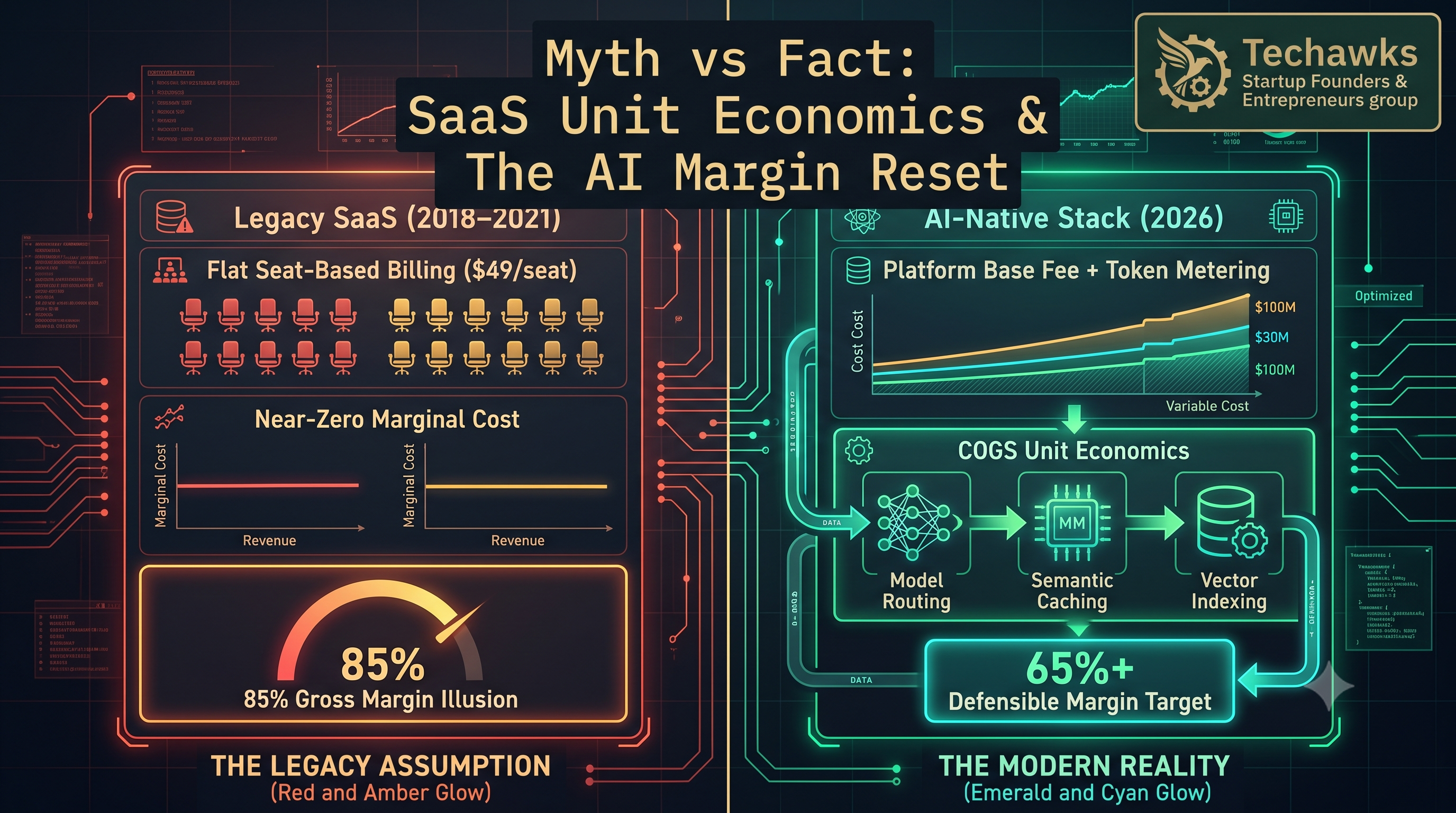 0 Comments 0 Shares 30 Views 0 Reviews
 -
PostHog vs. Mixpanel: The Modern Analytics Stack for Early-Stage Startups
When instrumenting your first core product loops, choosing between a specialized behavioral analytics platform and an integrated product operating system directly impacts both engineering bandwidth and subscription burn.
Here is an honest breakdown of where PostHog and Mixpanel fit into a founder’s roadmap:
PostHog (The All-in-One Product Operating System):
Tool Consolidation: PostHog packages event analytics, session recordings, feature flags, A/B experimentation, user surveys, and error tracking into one unified platform.
Engineering-First Ergonomics: Features single-line SDK initialization, automatic event capture, SQL access (HogQL), and an open-source core. You can run on their hosted cloud or self-host within your own VPC for strict data sovereignty.
Cost-Efficiency at Early Scale: Instead of paying for Mixpanel + Hotjar + LaunchDarkly + Sentry, early-stage startups can run an entire feedback and instrumentation stack within PostHog's generous multi-product free tiers.
The Trade-Off: The interface prioritizes developer utility over non-technical polish; query builders can feel dense for purely commercial or marketing-focused co-founders.
Mixpanel (The Polished Behavioral Standard):
Specialized Event Analytics: Mixpanel focuses intently on core behavioral metrics—complex multi-step funnels, cohort retention curves, and non-linear user drop-off flows.
Executive & PM Accessibility: Reports, segmentation breakdowns, and lifecycle graphs are intuitive out of the box, allowing non-technical founders, growth leads, and investors to build dashboards without writing custom queries.
High-Volume Event Generosity: Mixpanel’s core tier provides generous event volume quotas dedicated specifically to tracking behavioral actions.
The Trade-Off: It does not natively replace your experimentation, session replay, or feature-flagging infrastructure—forcing founders to integrate and pay for additional SaaS vendors as needs expand.
The Founder Rule of Thumb: If you are an engineering-led team needing rapid, full-stack product telemetry (recordings, flags, and analytics) on a lean budget, PostHog eliminates tool bloat. If you have dedicated growth marketers or non-technical product leads who need pristine behavioral funnel insights without touching code, Mixpanel remains the benchmark.
Key Takeaways
Consolidation beats sprawl: Combining analytics, session replays, and feature flags under one platform saves engineering integration hours and SaaS overhead.
Autocapture vs. Precision Tracking: PostHog enables rapid retro-active event discovery via autocapture; Mixpanel emphasizes intentional, cleanly modeled event schemas.
Data ownership: PostHog provides open-source self-hosting and SQL-based querying; Mixpanel operates as a managed, high-polish cloud service.
Budget protection: Audit the total stack cost across all point solutions before choosing a single-purpose analytics tool.
CTA (Encourage founders to share lessons)
Let’s talk instrumentation and early runway:
What does your startup's user analytics stack look like today? Did you start with an all-in-one platform like PostHog, or did you pair Mixpanel with standalone tools for session replay and feature flags? Share your architecture lessons and trade-offs in the comments!PostHog vs. Mixpanel: The Modern Analytics Stack for Early-Stage Startups When instrumenting your first core product loops, choosing between a specialized behavioral analytics platform and an integrated product operating system directly impacts both engineering bandwidth and subscription burn. Here is an honest breakdown of where PostHog and Mixpanel fit into a founder’s roadmap: PostHog (The All-in-One Product Operating System): Tool Consolidation: PostHog packages event analytics, session recordings, feature flags, A/B experimentation, user surveys, and error tracking into one unified platform. Engineering-First Ergonomics: Features single-line SDK initialization, automatic event capture, SQL access (HogQL), and an open-source core. You can run on their hosted cloud or self-host within your own VPC for strict data sovereignty. Cost-Efficiency at Early Scale: Instead of paying for Mixpanel + Hotjar + LaunchDarkly + Sentry, early-stage startups can run an entire feedback and instrumentation stack within PostHog's generous multi-product free tiers. The Trade-Off: The interface prioritizes developer utility over non-technical polish; query builders can feel dense for purely commercial or marketing-focused co-founders. Mixpanel (The Polished Behavioral Standard): Specialized Event Analytics: Mixpanel focuses intently on core behavioral metrics—complex multi-step funnels, cohort retention curves, and non-linear user drop-off flows. Executive & PM Accessibility: Reports, segmentation breakdowns, and lifecycle graphs are intuitive out of the box, allowing non-technical founders, growth leads, and investors to build dashboards without writing custom queries. High-Volume Event Generosity: Mixpanel’s core tier provides generous event volume quotas dedicated specifically to tracking behavioral actions. The Trade-Off: It does not natively replace your experimentation, session replay, or feature-flagging infrastructure—forcing founders to integrate and pay for additional SaaS vendors as needs expand. The Founder Rule of Thumb: If you are an engineering-led team needing rapid, full-stack product telemetry (recordings, flags, and analytics) on a lean budget, PostHog eliminates tool bloat. If you have dedicated growth marketers or non-technical product leads who need pristine behavioral funnel insights without touching code, Mixpanel remains the benchmark. Key Takeaways Consolidation beats sprawl: Combining analytics, session replays, and feature flags under one platform saves engineering integration hours and SaaS overhead. Autocapture vs. Precision Tracking: PostHog enables rapid retro-active event discovery via autocapture; Mixpanel emphasizes intentional, cleanly modeled event schemas. Data ownership: PostHog provides open-source self-hosting and SQL-based querying; Mixpanel operates as a managed, high-polish cloud service. Budget protection: Audit the total stack cost across all point solutions before choosing a single-purpose analytics tool. CTA (Encourage founders to share lessons) Let’s talk instrumentation and early runway: What does your startup's user analytics stack look like today? Did you start with an all-in-one platform like PostHog, or did you pair Mixpanel with standalone tools for session replay and feature flags? Share your architecture lessons and trade-offs in the comments! 0 Comments 0 Shares 89 Views 0 Reviews
 -
The Headcount Vanity Trap: Why Top VCs in 2026 Are Judging Founders on ARR-per-Employee, Not Team Size
The defining metric of early-stage venture health has officially flipped. For a decade, startup traction was measured by headcount expansion and massive hiring blitzes. Today, venture partners evaluate early-stage leverage through a single unforgiving lens: ARR generated per full-time employee (FTE).
Median B2B SaaS ARR-per-employee climbed to $193K—a 29% jump year-over-year—while top-decile AI-native startups are exceeding $1M to $2M+ ARR per head with teams under 25 people. Meanwhile, Carta benchmarks show average late-stage headcounts down nearly 29% from their peak.
Hiring before achieving non-linear output doesn’t just burn capital; it introduces communication overhead, slows product iteration, and dilutes founder equity.
To scale revenue faster than headcount, adopt these three founder operational guardrails:
Build the "Automation-First" Hiring Gate
Before writing a job specification, split the role into two buckets: mechanical execution vs. human judgment. If more than 60% of the daily responsibilities involve repeatable data aggregation, boilerplate drafting, or ticket routing, build an automated agentic pipeline (e.g., using n8n, custom tool-calling agents, or webhook workflows) and skip the hire.
Hire for Systems Architecture, Not Task Execution
When you do make early technical or growth hires, prioritize candidates who view themselves as force multipliers. You don't need five junior engineers writing CRUD endpoints; you need one senior systems architect who can coordinate code-generation agents, design deterministic evaluation harnesses, and maintain high codebase cohesion.
Anchor Go-To-Market (GTM) on Signal Over Brute Force
The days of hiring ten junior SDRs to blast cold outreach are dead. Modern lean GTM stacks leverage automated waterfall enrichment and trigger-based outbound workflows. Lean teams of two GTM leads are generating enterprise pipelines that previously required an entire floor of sales reps.
In 2026, building a small, lethal team is not a compromise—it is the ultimate competitive advantage.
Discussion Question
What is your startup’s current target for ARR-per-employee, and which department have you kept leanest by leveraging AI/automation workflows?
CTA (Encourage founders to share lessons)
Are you building lean or rethinking your hiring roadmap this quarter? Share your biggest lessons, organizational trade-offs, or stack optimizations in the comments below—let’s compare notes!The Headcount Vanity Trap: Why Top VCs in 2026 Are Judging Founders on ARR-per-Employee, Not Team Size The defining metric of early-stage venture health has officially flipped. For a decade, startup traction was measured by headcount expansion and massive hiring blitzes. Today, venture partners evaluate early-stage leverage through a single unforgiving lens: ARR generated per full-time employee (FTE). Median B2B SaaS ARR-per-employee climbed to $193K—a 29% jump year-over-year—while top-decile AI-native startups are exceeding $1M to $2M+ ARR per head with teams under 25 people. Meanwhile, Carta benchmarks show average late-stage headcounts down nearly 29% from their peak. Hiring before achieving non-linear output doesn’t just burn capital; it introduces communication overhead, slows product iteration, and dilutes founder equity. To scale revenue faster than headcount, adopt these three founder operational guardrails: Build the "Automation-First" Hiring Gate Before writing a job specification, split the role into two buckets: mechanical execution vs. human judgment. If more than 60% of the daily responsibilities involve repeatable data aggregation, boilerplate drafting, or ticket routing, build an automated agentic pipeline (e.g., using n8n, custom tool-calling agents, or webhook workflows) and skip the hire. Hire for Systems Architecture, Not Task Execution When you do make early technical or growth hires, prioritize candidates who view themselves as force multipliers. You don't need five junior engineers writing CRUD endpoints; you need one senior systems architect who can coordinate code-generation agents, design deterministic evaluation harnesses, and maintain high codebase cohesion. Anchor Go-To-Market (GTM) on Signal Over Brute Force The days of hiring ten junior SDRs to blast cold outreach are dead. Modern lean GTM stacks leverage automated waterfall enrichment and trigger-based outbound workflows. Lean teams of two GTM leads are generating enterprise pipelines that previously required an entire floor of sales reps. In 2026, building a small, lethal team is not a compromise—it is the ultimate competitive advantage. Discussion Question What is your startup’s current target for ARR-per-employee, and which department have you kept leanest by leveraging AI/automation workflows? CTA (Encourage founders to share lessons) Are you building lean or rethinking your hiring roadmap this quarter? Share your biggest lessons, organizational trade-offs, or stack optimizations in the comments below—let’s compare notes! 0 Comments 0 Shares 64 Views 0 Reviews
 -
The True PMF Metric: What single indicator proves your startup has found product-market fit?
Founders often mistake early enthusiasm, free sign-ups, or vanity traction for genuine product-market fit. In reality, you can raise capital, get press, and still build something users easily abandon once a paywall or real workflow friction appears.
Seasoned operators recognize that PMF isn't a vague feeling—it is measurable behavior. It is the exact inflection point where demand begins pulling the product out of your hands faster than your team can build it.
When you evaluate whether a product is truly ready to scale, which concrete metric gives you the highest confidence?
Poll Question:
What single metric best validates true product-market fit for an early-stage startup?
[ ] Cohort retention flattening (High organic day-30/month-6 retention curves)
[ ] Organic inbound pull (Negative churn, word-of-mouth referral velocity)
[ ] Unprompted willingness to pay (Immediate renewal without heavy sales discounts)
[ ] The Sean Ellis test (>40% saying they’d be "very disappointed" without the product)
Key Takeaways
Retention curves never lie: If your monthly retention curve doesn't flatten parallel to the x-axis, scaling acquisition simply pours capital into a leaky bucket.
Pricing is the ultimate validation: Free users will forgive missing features and validate your ego; customers writing recurring checks validate your actual value proposition.
Distinguish growth from pull: Virality and ad spend can fake traction temporarily, but unprompted referrals and net revenue retention (NRR) prove deep-rooted utility.
CTA (Encourage founders to share lessons)
Cast your vote above, and let’s discuss in the comments: What was the exact moment or metric that confirmed you had crossed into genuine product-market fit—or realized you needed to pivot?The True PMF Metric: What single indicator proves your startup has found product-market fit? Founders often mistake early enthusiasm, free sign-ups, or vanity traction for genuine product-market fit. In reality, you can raise capital, get press, and still build something users easily abandon once a paywall or real workflow friction appears. Seasoned operators recognize that PMF isn't a vague feeling—it is measurable behavior. It is the exact inflection point where demand begins pulling the product out of your hands faster than your team can build it. When you evaluate whether a product is truly ready to scale, which concrete metric gives you the highest confidence? Poll Question: What single metric best validates true product-market fit for an early-stage startup? [ ] Cohort retention flattening (High organic day-30/month-6 retention curves) [ ] Organic inbound pull (Negative churn, word-of-mouth referral velocity) [ ] Unprompted willingness to pay (Immediate renewal without heavy sales discounts) [ ] The Sean Ellis test (>40% saying they’d be "very disappointed" without the product) Key Takeaways Retention curves never lie: If your monthly retention curve doesn't flatten parallel to the x-axis, scaling acquisition simply pours capital into a leaky bucket. Pricing is the ultimate validation: Free users will forgive missing features and validate your ego; customers writing recurring checks validate your actual value proposition. Distinguish growth from pull: Virality and ad spend can fake traction temporarily, but unprompted referrals and net revenue retention (NRR) prove deep-rooted utility. CTA (Encourage founders to share lessons) Cast your vote above, and let’s discuss in the comments: What was the exact moment or metric that confirmed you had crossed into genuine product-market fit—or realized you needed to pivot? 0 Comments 0 Shares 101 Views 0 Reviews
 -
The End of Per-Seat SaaS: Why AI Agents Are Breaking Traditional Startup Unit Economics
For twenty years, B2B software economics relied on a predictable rule: more employees equaled more seats, which expanded Net Revenue Retention (NRR). Traditional SaaS enjoyed near-zero marginal costs per additional user, giving software companies enviable 80%+ gross margins.
Agentic software breaks this model entirely:
The Revenue Cannibalization Paradox: If your autonomous workflow tool resolves 80% of customer support tickets or drafts legal contracts automatically, customer headcount shrinks. Charging $50/seat per human user penalizes you for making the customer more efficient.
The Compute COGS Trap: Unlike legacy databases where a power user adds fractions of a cent in hosting costs, every agentic reasoning loop, tool invocation, and retrieval burns direct GPU compute. Flat-rate pricing with unlimited agent runs causes your AI COGS ratio to spike, compressing margins below 40%.
Founders navigating this shift are abandoning pure seat licenses and re-architecting their revenue mechanics around Work-Completed & Hybrid Consumption Models:
Price the Output, Not the Login
Shift the core billing unit from an active human chair to a verified business outcome:
Customer support: Billed per successfully resolved ticket (with human-escalated tickets exempt or discounted).
Sales automation: Billed per qualified pipeline opportunity generated.
Data engineering: Billed per reconciled ledger or completed migration pipeline.
The Hybrid Floor Architecture
Pure consumption pricing scares enterprise CFOs who demand predictable annual budgets. The resilient model combines:
Base Platform Retainer: Covers system access, compliance guarantees, data retention, and custom integrations (providing predictable baseline ARR).
Prepaid Task Credits with Profitable Overages: Includes a baseline volume of autonomous tasks, scaling on metered units thereafter to protect compute margins against heavy users.
Compute-Aware Feature Tiering
Do not deploy high-parameter frontier reasoning models on commodity background tasks. Route deterministic steps through lightweight local/specialized SLMs, reserving frontier models strictly for high-context edge cases. Protecting your gross margin is as much an infrastructure design choice as a pricing strategy.
If your product sells labor replacement, charging for software access misaligns your business. Price the work your software finishes, not the human sitting in front of the screen.
Discussion Question
Has your startup felt the margin pressure of compute costs or pushback on seat-based pricing? What billing metric (outcome-based, credits, or hybrid base + usage) has given you the cleanest alignment between customer value and gross margins?
CTA
Founders and operators: chime in below! Share what pricing experiments have worked (or completely backfired) as you build and monetize AI-native products.The End of Per-Seat SaaS: Why AI Agents Are Breaking Traditional Startup Unit Economics For twenty years, B2B software economics relied on a predictable rule: more employees equaled more seats, which expanded Net Revenue Retention (NRR). Traditional SaaS enjoyed near-zero marginal costs per additional user, giving software companies enviable 80%+ gross margins. Agentic software breaks this model entirely: The Revenue Cannibalization Paradox: If your autonomous workflow tool resolves 80% of customer support tickets or drafts legal contracts automatically, customer headcount shrinks. Charging $50/seat per human user penalizes you for making the customer more efficient. The Compute COGS Trap: Unlike legacy databases where a power user adds fractions of a cent in hosting costs, every agentic reasoning loop, tool invocation, and retrieval burns direct GPU compute. Flat-rate pricing with unlimited agent runs causes your AI COGS ratio to spike, compressing margins below 40%. Founders navigating this shift are abandoning pure seat licenses and re-architecting their revenue mechanics around Work-Completed & Hybrid Consumption Models: Price the Output, Not the Login Shift the core billing unit from an active human chair to a verified business outcome: Customer support: Billed per successfully resolved ticket (with human-escalated tickets exempt or discounted). Sales automation: Billed per qualified pipeline opportunity generated. Data engineering: Billed per reconciled ledger or completed migration pipeline. The Hybrid Floor Architecture Pure consumption pricing scares enterprise CFOs who demand predictable annual budgets. The resilient model combines: Base Platform Retainer: Covers system access, compliance guarantees, data retention, and custom integrations (providing predictable baseline ARR). Prepaid Task Credits with Profitable Overages: Includes a baseline volume of autonomous tasks, scaling on metered units thereafter to protect compute margins against heavy users. Compute-Aware Feature Tiering Do not deploy high-parameter frontier reasoning models on commodity background tasks. Route deterministic steps through lightweight local/specialized SLMs, reserving frontier models strictly for high-context edge cases. Protecting your gross margin is as much an infrastructure design choice as a pricing strategy. If your product sells labor replacement, charging for software access misaligns your business. Price the work your software finishes, not the human sitting in front of the screen. Discussion Question Has your startup felt the margin pressure of compute costs or pushback on seat-based pricing? What billing metric (outcome-based, credits, or hybrid base + usage) has given you the cleanest alignment between customer value and gross margins? CTA Founders and operators: chime in below! Share what pricing experiments have worked (or completely backfired) as you build and monetize AI-native products. 0 Comments 0 Shares 104 Views 0 Reviews
 -
The "Default Dead" Trap: Why Early Traction Masquerades as Product-Market Fit
Early revenue produces a dangerous dopamine hit. It’s easy to look at an initial spike in sign-ups, assume product-market fit (PMF) is solved, and prematurely pour resources into scaling customer acquisition.
Six months later, churn spikes, cohort retention flattens, and the burn rate catches up.
True PMF isn't demonstrated by initial conversions—it’s proven by what happens after the novelty fades:
Retention over acquisition: If 80% of your new cohort abandons the platform by day 60, doubling your ad spend or sales outreach just accelerates cash burn. Fix the leak before increasing the water flow.
Founder-led sales distortion: Founders are extraordinary sales reps because passion, charisma, and bespoke feature promises close deals. If an independent rep or self-serve flow can't close the same profile, the product isn't selling itself yet.
The "hair on fire" litmus test: Are users building their daily workflows around your tool, or are they treating it as an easily replaceable convenience? If pulling the product causes genuine operational friction, you have defensibility.
Scaling before retention is the fastest way to turn early momentum into quiet failure.
Key Takeaways
Cohort Health First: A high-churn funnel cannot be fixed with top-of-funnel volume.
Separate Pitch from Product: Verify that the offer converts without the founder personally pushing it across the line.
Qualify Pain Points: True traction means your solution is mission-critical, not just a "nice-to-have" pilot.
CTA
Let’s talk post-mortems and hard pivots:
What was the most misleading metric or false signal you mistook for real product-market fit early on?
What specific change in user behavior finally proved your product was indispensable? Drop your battle-tested lessons below.The "Default Dead" Trap: Why Early Traction Masquerades as Product-Market Fit Early revenue produces a dangerous dopamine hit. It’s easy to look at an initial spike in sign-ups, assume product-market fit (PMF) is solved, and prematurely pour resources into scaling customer acquisition. Six months later, churn spikes, cohort retention flattens, and the burn rate catches up. True PMF isn't demonstrated by initial conversions—it’s proven by what happens after the novelty fades: Retention over acquisition: If 80% of your new cohort abandons the platform by day 60, doubling your ad spend or sales outreach just accelerates cash burn. Fix the leak before increasing the water flow. Founder-led sales distortion: Founders are extraordinary sales reps because passion, charisma, and bespoke feature promises close deals. If an independent rep or self-serve flow can't close the same profile, the product isn't selling itself yet. The "hair on fire" litmus test: Are users building their daily workflows around your tool, or are they treating it as an easily replaceable convenience? If pulling the product causes genuine operational friction, you have defensibility. Scaling before retention is the fastest way to turn early momentum into quiet failure. Key Takeaways Cohort Health First: A high-churn funnel cannot be fixed with top-of-funnel volume. Separate Pitch from Product: Verify that the offer converts without the founder personally pushing it across the line. Qualify Pain Points: True traction means your solution is mission-critical, not just a "nice-to-have" pilot. CTA Let’s talk post-mortems and hard pivots: What was the most misleading metric or false signal you mistook for real product-market fit early on? What specific change in user behavior finally proved your product was indispensable? Drop your battle-tested lessons below.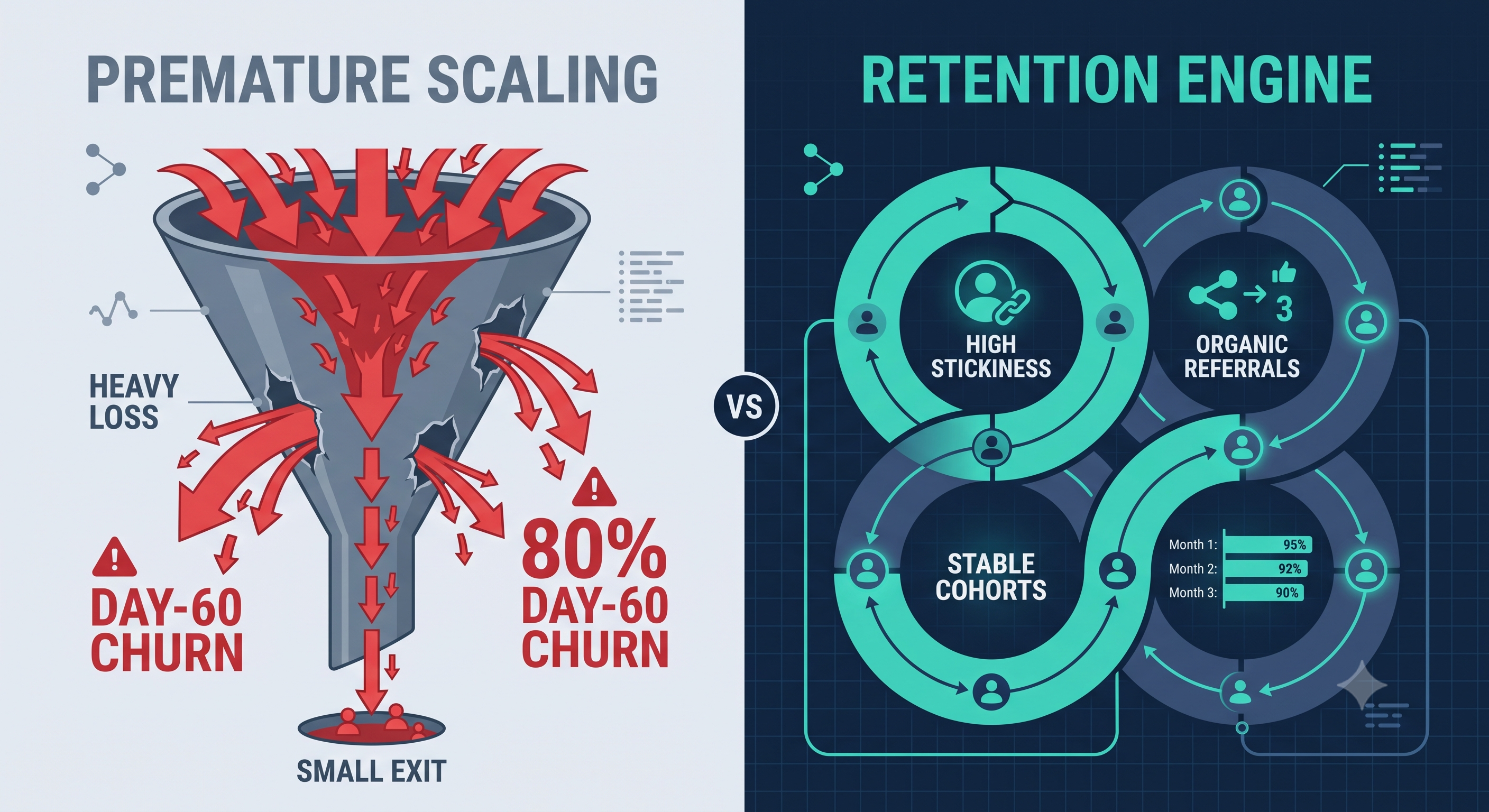 0 Comments 0 Shares 108 Views 0 Reviews
 -
The Feature Velocity Trap: Why Building Faster Won't Save a Leaky Retention Bucket
Early-stage founders often mistake technical output for market validation. When early users churn, the instinctive reaction is almost always to ship more: add one more integration, polish the UI, or build the niche capability that two enterprise prospects casually mentioned on a demo call.
Shipping more features to fix poor retention is like pouring water into a bucket full of holes—it increases operational burn without solving structural drag:
The "Next-Feature Fallacy": Users rarely abandon an early product because it lacks a 10th secondary tool. They leave because the core problem they signed up to solve took too long to resolve, was too complex to configure, or didn't deliver visible ROI within the first 10 minutes (the Time-to-Value gap).
The Codebase Tax on Iteration: Every net-new feature introduces downstream regression risks, increases testing overhead, bloats onboarding flows, and fragments documentation. A complex product is significantly harder to pivot when you finally discover your true wedge.
The Illusion of Activity: Writing code and clearing Jira tickets provides a comforting psychological hit of productivity. Talking to 15 churned users about why they uninstalled your software feels uncomfortable and ambiguous—but it yields the only signal that matters.
High-survival founding teams isolate retention using a disciplined diagnostic process before touching code:
Map the Natural Frequency of Use: Determine whether your product is daily (messaging), weekly (analytics), or monthly (payroll). Measuring a monthly tax app against daily active usage metrics leads to flawed product decisions.
Instrument the Critical Activation Milestone: Identify the exact action that correlates with long-term retention (e.g., inviting 2 teammates, creating 1 automated workflow). Strip away every screen, tooltip, and optional setting between sign-up and that exact moment.
Conduct Churn Post-Mortems: Group churned users into two distinct buckets: "Wrong ICP" (never should have signed up) versus "Broken Core" (right persona, failed expectation). Only build for the second group.
Key Takeaways
Adding features to an unvalidated product dilutes your core value proposition and accelerates burn.
Optimize relentlessly for Time-to-Value (TTV); reduce the friction required to reach your product's primary activation event.
Diagnose retention drop-off through qualitative user teardowns before writing more code.
CTA
What was the single hardest feature or product line you had to kill or refuse to build after realizing it was distracting from your core retention loop?
Drop your early-stage product trade-offs, hard lessons, and customer discovery shifts below.The Feature Velocity Trap: Why Building Faster Won't Save a Leaky Retention Bucket Early-stage founders often mistake technical output for market validation. When early users churn, the instinctive reaction is almost always to ship more: add one more integration, polish the UI, or build the niche capability that two enterprise prospects casually mentioned on a demo call. Shipping more features to fix poor retention is like pouring water into a bucket full of holes—it increases operational burn without solving structural drag: The "Next-Feature Fallacy": Users rarely abandon an early product because it lacks a 10th secondary tool. They leave because the core problem they signed up to solve took too long to resolve, was too complex to configure, or didn't deliver visible ROI within the first 10 minutes (the Time-to-Value gap). The Codebase Tax on Iteration: Every net-new feature introduces downstream regression risks, increases testing overhead, bloats onboarding flows, and fragments documentation. A complex product is significantly harder to pivot when you finally discover your true wedge. The Illusion of Activity: Writing code and clearing Jira tickets provides a comforting psychological hit of productivity. Talking to 15 churned users about why they uninstalled your software feels uncomfortable and ambiguous—but it yields the only signal that matters. High-survival founding teams isolate retention using a disciplined diagnostic process before touching code: Map the Natural Frequency of Use: Determine whether your product is daily (messaging), weekly (analytics), or monthly (payroll). Measuring a monthly tax app against daily active usage metrics leads to flawed product decisions. Instrument the Critical Activation Milestone: Identify the exact action that correlates with long-term retention (e.g., inviting 2 teammates, creating 1 automated workflow). Strip away every screen, tooltip, and optional setting between sign-up and that exact moment. Conduct Churn Post-Mortems: Group churned users into two distinct buckets: "Wrong ICP" (never should have signed up) versus "Broken Core" (right persona, failed expectation). Only build for the second group. Key Takeaways Adding features to an unvalidated product dilutes your core value proposition and accelerates burn. Optimize relentlessly for Time-to-Value (TTV); reduce the friction required to reach your product's primary activation event. Diagnose retention drop-off through qualitative user teardowns before writing more code. CTA What was the single hardest feature or product line you had to kill or refuse to build after realizing it was distracting from your core retention loop? Drop your early-stage product trade-offs, hard lessons, and customer discovery shifts below. 0 Comments 0 Shares 198 Views 0 Reviews
More Stories