



Techawks Developers is a dedicated community for software developers, programmers, engineers, and tech enthusiasts who are passionate about building modern applications and exploring the future of technology. Whether you're learning your first programming language or leading enterprise projects, you'll find valuable discussions, resources, and networking opportunities.
Join conversations on programming languages, AI development, web and mobile technologies, cloud computing, DevOps, open-source projects, cybersecurity, APIs, system design, and software architecture. Learn from experienced developers, showcase your work, solve coding challenges, and collaborate on innovative projects.
Join conversations on programming languages, AI development, web and mobile technologies, cloud computing, DevOps, open-source projects, cybersecurity, APIs, system design, and software architecture. Learn from experienced developers, showcase your work, solve coding challenges, and collaborate on innovative projects.
-
PBID: 0230001500000004
-
35 oameni carora le place asta
-
58 Postari
-
58 Fotografii
-
0 Video
-
previzualizare
-
Science and Technology
Căutare

 English
 Arabic
 French
 Spanish
 Portuguese
 Deutsch
 Turkish
 Dutch
Dutch
 Italiano
 Russian
 Portuguese (Brazil)
 Greek
Greek
Recent Actualizat
-
The Concurrency Illusion: Why async/await Won’t Save You From Data Races
A pervasive bug pattern keeps surfacing across modern backends: developers conflate asynchronous scheduling with mutual exclusion.
Async runtimes (like Node's Event Loop, Go runtimes, Tokio in Rust, or Python’s AsyncIO) solve I/O blocking. They do not serialize logic interleaved across execution yields.
Consider a classic balance check:
JavaScript
// A catastrophic race condition hidden in plain sight
async function withdraw(userId, amount) {
const balance = await db.getBalance(userId); // Yield point
if (balance >= amount) {
const newBalance = balance - amount;
await db.setBalance(userId, newBalance); // Yield point
return true;
}
return false;
}
What goes wrong under concurrency:
Request A fetches the balance ($100) and yields while waiting on I/O.
Before Request A resumes, Request B fetches the exact same balance ($100).
Both evaluate balance >= amount as true.
Both write back decremented totals independently.
You’ve double-spent the account because an await statement is an explicit surrender of execution control.
The Fix: Move Concurrency Control to the State Boundary
Don't patch this by sprinkling arbitrary in-memory mutexes across distributed nodes. Use these three patterns instead:
Atomic Database Mutations: Never read-modify-write in the application layer if your storage engine can do it atomically:
UPDATE accounts SET balance = balance - :amount WHERE id = :id AND balance >= :amount;
Optimistic Locking: Introduce an internal monotonic version column. Fail or retry transactions when UPDATE ... WHERE id = :id AND version = :currentVersion returns zero modified rows.
Partition-Keyed Actor Queues: If state must live in memory, route all updates for a specific userId through a dedicated single-threaded FIFO worker queue or stateful actor.
Asynchronous code makes waiting cheap, but state coordination remains expensive. Write code that assumes interleaving will happen at every yield point.
Discussion Question
What’s the nastiest concurrency bug you’ve had to debug in production—and was the fix in application memory or the database layer?
CTA
Sharpen your engineering fundamentals, master system patterns, and write bulletproof code. Join Developers & Coding at Techawks Developers.The Concurrency Illusion: Why async/await Won’t Save You From Data Races A pervasive bug pattern keeps surfacing across modern backends: developers conflate asynchronous scheduling with mutual exclusion. Async runtimes (like Node's Event Loop, Go runtimes, Tokio in Rust, or Python’s AsyncIO) solve I/O blocking. They do not serialize logic interleaved across execution yields. Consider a classic balance check: JavaScript // A catastrophic race condition hidden in plain sight async function withdraw(userId, amount) { const balance = await db.getBalance(userId); // Yield point if (balance >= amount) { const newBalance = balance - amount; await db.setBalance(userId, newBalance); // Yield point return true; } return false; } What goes wrong under concurrency: Request A fetches the balance ($100) and yields while waiting on I/O. Before Request A resumes, Request B fetches the exact same balance ($100). Both evaluate balance >= amount as true. Both write back decremented totals independently. You’ve double-spent the account because an await statement is an explicit surrender of execution control. The Fix: Move Concurrency Control to the State Boundary Don't patch this by sprinkling arbitrary in-memory mutexes across distributed nodes. Use these three patterns instead: Atomic Database Mutations: Never read-modify-write in the application layer if your storage engine can do it atomically: UPDATE accounts SET balance = balance - :amount WHERE id = :id AND balance >= :amount; Optimistic Locking: Introduce an internal monotonic version column. Fail or retry transactions when UPDATE ... WHERE id = :id AND version = :currentVersion returns zero modified rows. Partition-Keyed Actor Queues: If state must live in memory, route all updates for a specific userId through a dedicated single-threaded FIFO worker queue or stateful actor. Asynchronous code makes waiting cheap, but state coordination remains expensive. Write code that assumes interleaving will happen at every yield point. Discussion Question What’s the nastiest concurrency bug you’ve had to debug in production—and was the fix in application memory or the database layer? CTA Sharpen your engineering fundamentals, master system patterns, and write bulletproof code. Join Developers & Coding at Techawks Developers.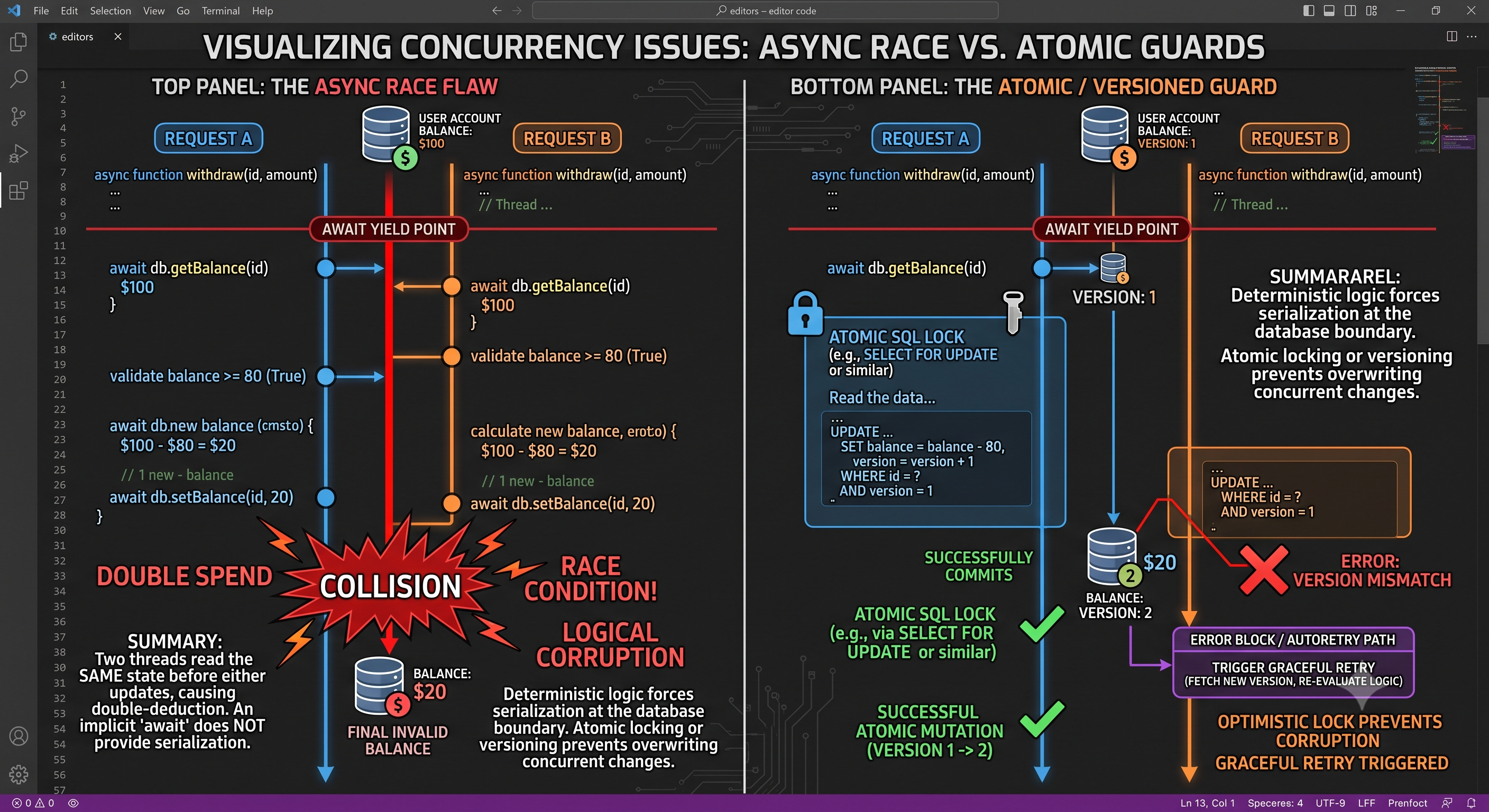 0 Commentarii 0 Distribuiri 62 Views 0 previzualizare
 -
Your Server Actions Are Quietly Breaking API Security Boundaries
The rise of integrated full-stack frameworks (Next.js, Nuxt, Remix/React Router) blurred the line between client and backend logic. Writing 'use server' or inline RPC-style server actions lets you run backend database calls directly from UI components without setting up a dedicated REST or GraphQL route.
It feels like magic. But architectural convenience is masking a critical security anti-pattern.
A server action is not an internal private method; it is an open, publicly addressable HTTP POST endpoint generated automatically by your framework bundler. When developers treat server functions like standard module code, they forget standard API defense layers:
Hidden Endpoints Are Not Private Endpoints: Obfuscated hash routes generated by bundlers are easily sniffed in network inspect panels. Anyone can replay, manipulate, or script requests directly against your action ID without touching your UI components.
UI Checks Do Not Guard Invocations: Disabling a submit button or hiding an element behind client-side role checks does zero server-side enforcement. If the authorization check isn't running inside the boundary of the server function itself, an attacker can invoke it with arbitrary payloads.
Missing Schema Parsers: Calling an internal database ORM call directly with function arguments skips runtime validation. Without tools like Zod or Valibot explicitly parsing formData or objects inside the action, you are vulnerable to mass-assignment attacks and unsanitized parameters.
The Golden Rule for Modern Full-Stack Functions:
Treat every single server action exactly like an exposed public webhook. Validate the incoming schema, verify the session/tenant identity inside the action body, and apply explicit rate limits at the handler boundary.
Discussion Question
Do you write centralized middleware wrappers for your inline server actions, or are authorization checks still being manually copy-pasted across individual function files?
CTA (Join Developers & Coding)
Tired of framework magic turning into production vulnerabilities?
👉 Join the Techawks Developers & Coding Community to break down real-world full-stack architecture, master clean defensive patterns, and build secure systems with engineers who value fundamentals:Your Server Actions Are Quietly Breaking API Security Boundaries The rise of integrated full-stack frameworks (Next.js, Nuxt, Remix/React Router) blurred the line between client and backend logic. Writing 'use server' or inline RPC-style server actions lets you run backend database calls directly from UI components without setting up a dedicated REST or GraphQL route. It feels like magic. But architectural convenience is masking a critical security anti-pattern. A server action is not an internal private method; it is an open, publicly addressable HTTP POST endpoint generated automatically by your framework bundler. When developers treat server functions like standard module code, they forget standard API defense layers: Hidden Endpoints Are Not Private Endpoints: Obfuscated hash routes generated by bundlers are easily sniffed in network inspect panels. Anyone can replay, manipulate, or script requests directly against your action ID without touching your UI components. UI Checks Do Not Guard Invocations: Disabling a submit button or hiding an element behind client-side role checks does zero server-side enforcement. If the authorization check isn't running inside the boundary of the server function itself, an attacker can invoke it with arbitrary payloads. Missing Schema Parsers: Calling an internal database ORM call directly with function arguments skips runtime validation. Without tools like Zod or Valibot explicitly parsing formData or objects inside the action, you are vulnerable to mass-assignment attacks and unsanitized parameters. The Golden Rule for Modern Full-Stack Functions: Treat every single server action exactly like an exposed public webhook. Validate the incoming schema, verify the session/tenant identity inside the action body, and apply explicit rate limits at the handler boundary. Discussion Question Do you write centralized middleware wrappers for your inline server actions, or are authorization checks still being manually copy-pasted across individual function files? CTA (Join Developers & Coding) Tired of framework magic turning into production vulnerabilities? 👉 Join the Techawks Developers & Coding Community to break down real-world full-stack architecture, master clean defensive patterns, and build secure systems with engineers who value fundamentals: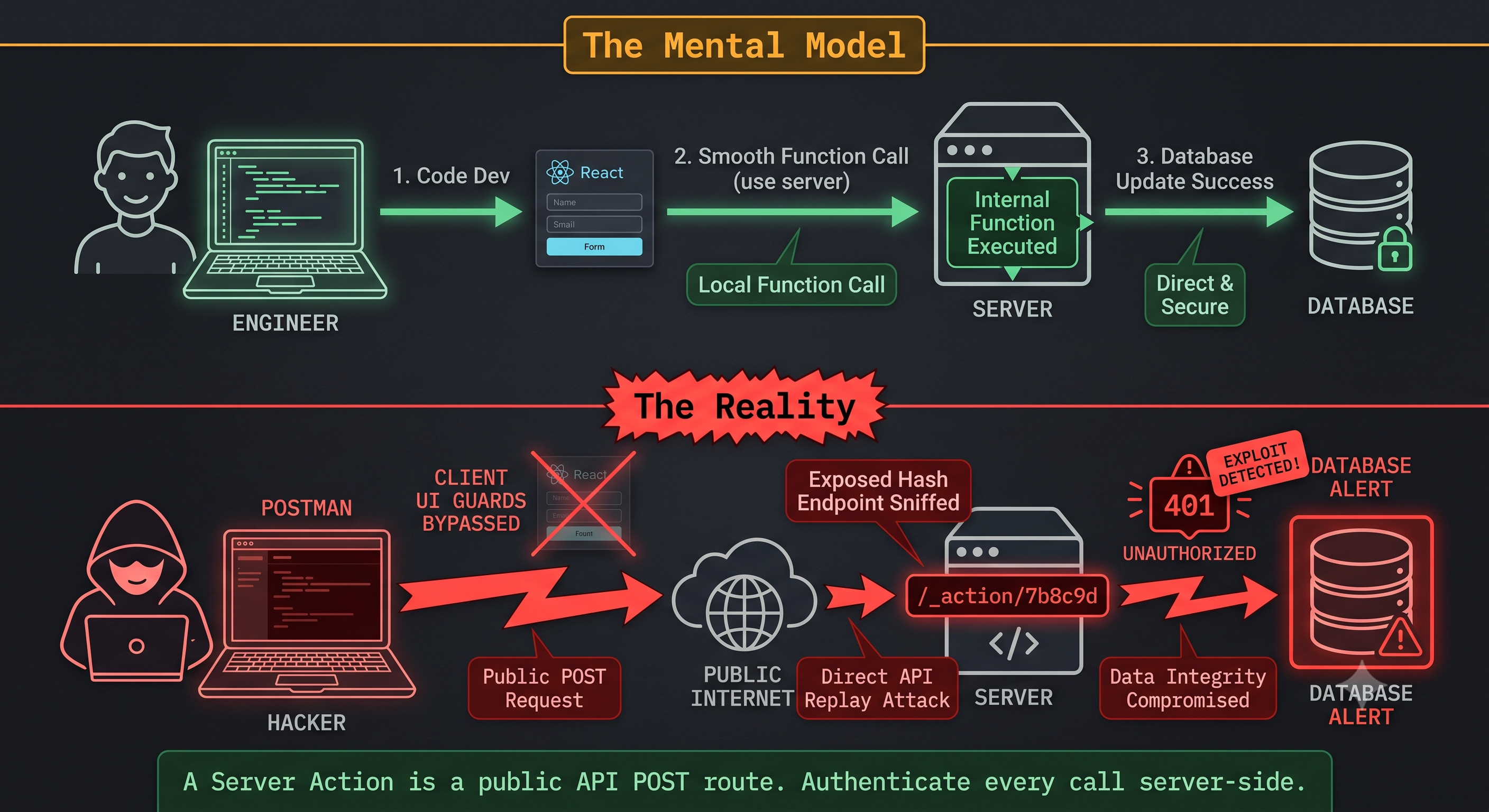 0 Commentarii 0 Distribuiri 92 Views 0 previzualizare
 -
Building Resilient Agentic Loops: A Developer's Practical Checklist
The shift from manual coding to intent-driven agent orchestration means developers must focus heavily on control flow design. To ensure your AI agents operate reliably in production without spiraling out of control, run them through this engineering checklist:
Explicit Router Setup: Decouple intent ingestion from execution by routing user goals through a dedicated Orchestrator Router node.
Bounded Plan Generation: Force your agent to generate a structured, step-by-step execution plan before hitting any external tools.
Deterministic Tool Execution: Wrap API calls and tool interactions in strict error handlers with predictable timeout boundaries.
Self-Reflective Validation Checks: Implement automated validation logic after every tool execution step to verify if the output actually satisfies the intermediate goal.
Max-Iteration Safeguards: Hardcode a maximum recursion or loop limit to prevent runaway execution costs and infinite loops.
Discussion Question:
What strategy do you use to handle infinite loop prevention when building autonomous multi-agent systems? Drop your approach below!
CTA (Join Developers & Coding):
Level up your architecture skills and build smarter systems—Join Developers & Coding with Techawks today!Building Resilient Agentic Loops: A Developer's Practical Checklist The shift from manual coding to intent-driven agent orchestration means developers must focus heavily on control flow design. To ensure your AI agents operate reliably in production without spiraling out of control, run them through this engineering checklist: Explicit Router Setup: Decouple intent ingestion from execution by routing user goals through a dedicated Orchestrator Router node. Bounded Plan Generation: Force your agent to generate a structured, step-by-step execution plan before hitting any external tools. Deterministic Tool Execution: Wrap API calls and tool interactions in strict error handlers with predictable timeout boundaries. Self-Reflective Validation Checks: Implement automated validation logic after every tool execution step to verify if the output actually satisfies the intermediate goal. Max-Iteration Safeguards: Hardcode a maximum recursion or loop limit to prevent runaway execution costs and infinite loops. Discussion Question: What strategy do you use to handle infinite loop prevention when building autonomous multi-agent systems? Drop your approach below! CTA (Join Developers & Coding): Level up your architecture skills and build smarter systems—Join Developers & Coding with Techawks today!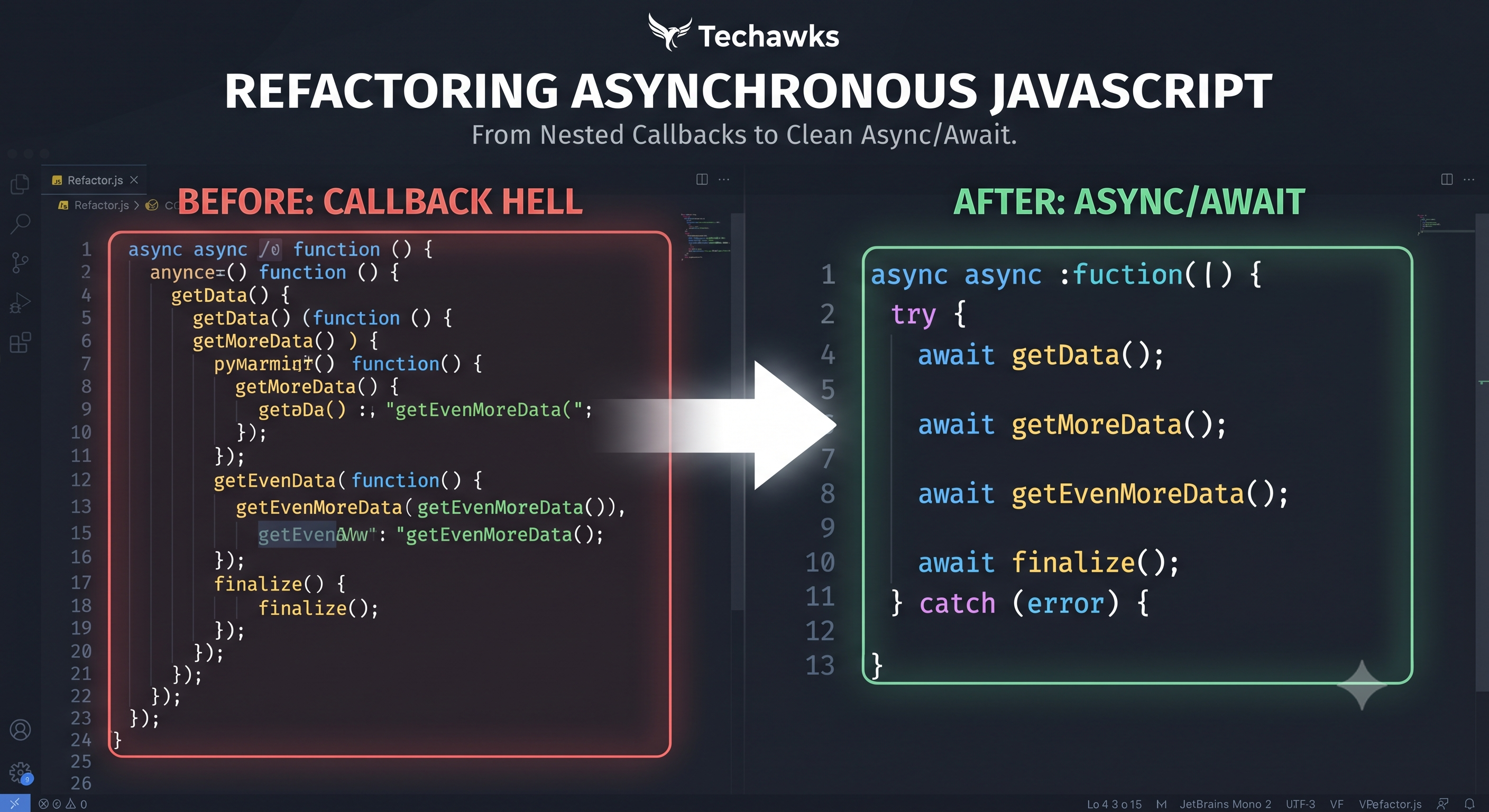 0 Commentarii 0 Distribuiri 113 Views 0 previzualizare
 -
Stop Writing Brittle Code: Why Defensive Design Beats Endless Try-Catch Blocks
Most developers are taught error handling as an afterthought: wrap the risky operation, log an error string, and return null or an empty object.
In production systems, this creates Silent State Corruption. When a function returns null, every caller up the stack must remember to check for it. Forget one check, and you trigger an unhandled runtime failure three services away.
The industry standard for resilient systems is moving away from exception-driven flow control toward Result Type Modeling and Parse, Don't Validate.
TypeScript
// ❌ ANTI-PATTERN: Exception-driven flow control
async function getUser(id: string): Promise<User | null> {
try {
const raw = await db.query(id);
return raw as User; // Blind type assertion
} catch (err) {
console.error(err);
return null; // Passes undefined failure state upstream
}
}
// ✅ PRODUCTION READY: Typed Result Pattern + Runtime Parsing
type Result<T, E> = { ok: true; data: T } | { ok: false; error: E };
async function getUserSafe(id: string): Promise<Result<User, DatabaseError | ValidationError>> {
const queryResult = await db.safeQuery(id);
if (!queryResult.ok) {
return { ok: false, error: new DatabaseError(queryResult.msg) };
}
// Parse schema at the boundary; never trust raw inputs
const parsed = UserSchema.safeParse(queryResult.raw);
if (!parsed.success) {
return { ok: false, error: new ValidationError(parsed.error) };
}
return { ok: true, data: parsed.data };
}
Why This Changes Your Codebase:
Compile-Time Enforcement: Callers cannot access result.data without narrowing result.ok === true. The compiler forces you to handle failure explicitly before runtime.
Boundary Validation: By validating data shape immediately at the boundary (API responses, DB queries, message queues) using schemas like Zod or TypeBox, inner domain logic never has to check if properties exist.
Traceable Domain Errors: Instead of generic Error instances, return tagged union error types that document exactly what failure modes an operation can trigger.
Exceptions should be reserved for truly exceptional conditions (e.g., out-of-memory or dropped socket connections), not expected domain states like missing records or invalid inputs.
Discussion Question
How does your team handle domain error propagation in production—Result/Either types, explicit custom exception hierarchies, or middleware-level error boundaries? What trade-offs have you seen in developer velocity?
CTA
Ready to write cleaner, production-grade code that doesn't break at 3 AM?
👉 Join the Techawks Developers & Coding Community to exchange code reviews, architectural design patterns, and engineering practices with active builders.Stop Writing Brittle Code: Why Defensive Design Beats Endless Try-Catch Blocks Most developers are taught error handling as an afterthought: wrap the risky operation, log an error string, and return null or an empty object. In production systems, this creates Silent State Corruption. When a function returns null, every caller up the stack must remember to check for it. Forget one check, and you trigger an unhandled runtime failure three services away. The industry standard for resilient systems is moving away from exception-driven flow control toward Result Type Modeling and Parse, Don't Validate. TypeScript // ❌ ANTI-PATTERN: Exception-driven flow control async function getUser(id: string): Promise<User | null> { try { const raw = await db.query(id); return raw as User; // Blind type assertion } catch (err) { console.error(err); return null; // Passes undefined failure state upstream } } // ✅ PRODUCTION READY: Typed Result Pattern + Runtime Parsing type Result<T, E> = { ok: true; data: T } | { ok: false; error: E }; async function getUserSafe(id: string): Promise<Result<User, DatabaseError | ValidationError>> { const queryResult = await db.safeQuery(id); if (!queryResult.ok) { return { ok: false, error: new DatabaseError(queryResult.msg) }; } // Parse schema at the boundary; never trust raw inputs const parsed = UserSchema.safeParse(queryResult.raw); if (!parsed.success) { return { ok: false, error: new ValidationError(parsed.error) }; } return { ok: true, data: parsed.data }; } Why This Changes Your Codebase: Compile-Time Enforcement: Callers cannot access result.data without narrowing result.ok === true. The compiler forces you to handle failure explicitly before runtime. Boundary Validation: By validating data shape immediately at the boundary (API responses, DB queries, message queues) using schemas like Zod or TypeBox, inner domain logic never has to check if properties exist. Traceable Domain Errors: Instead of generic Error instances, return tagged union error types that document exactly what failure modes an operation can trigger. Exceptions should be reserved for truly exceptional conditions (e.g., out-of-memory or dropped socket connections), not expected domain states like missing records or invalid inputs. Discussion Question How does your team handle domain error propagation in production—Result/Either types, explicit custom exception hierarchies, or middleware-level error boundaries? What trade-offs have you seen in developer velocity? CTA Ready to write cleaner, production-grade code that doesn't break at 3 AM? 👉 Join the Techawks Developers & Coding Community to exchange code reviews, architectural design patterns, and engineering practices with active builders.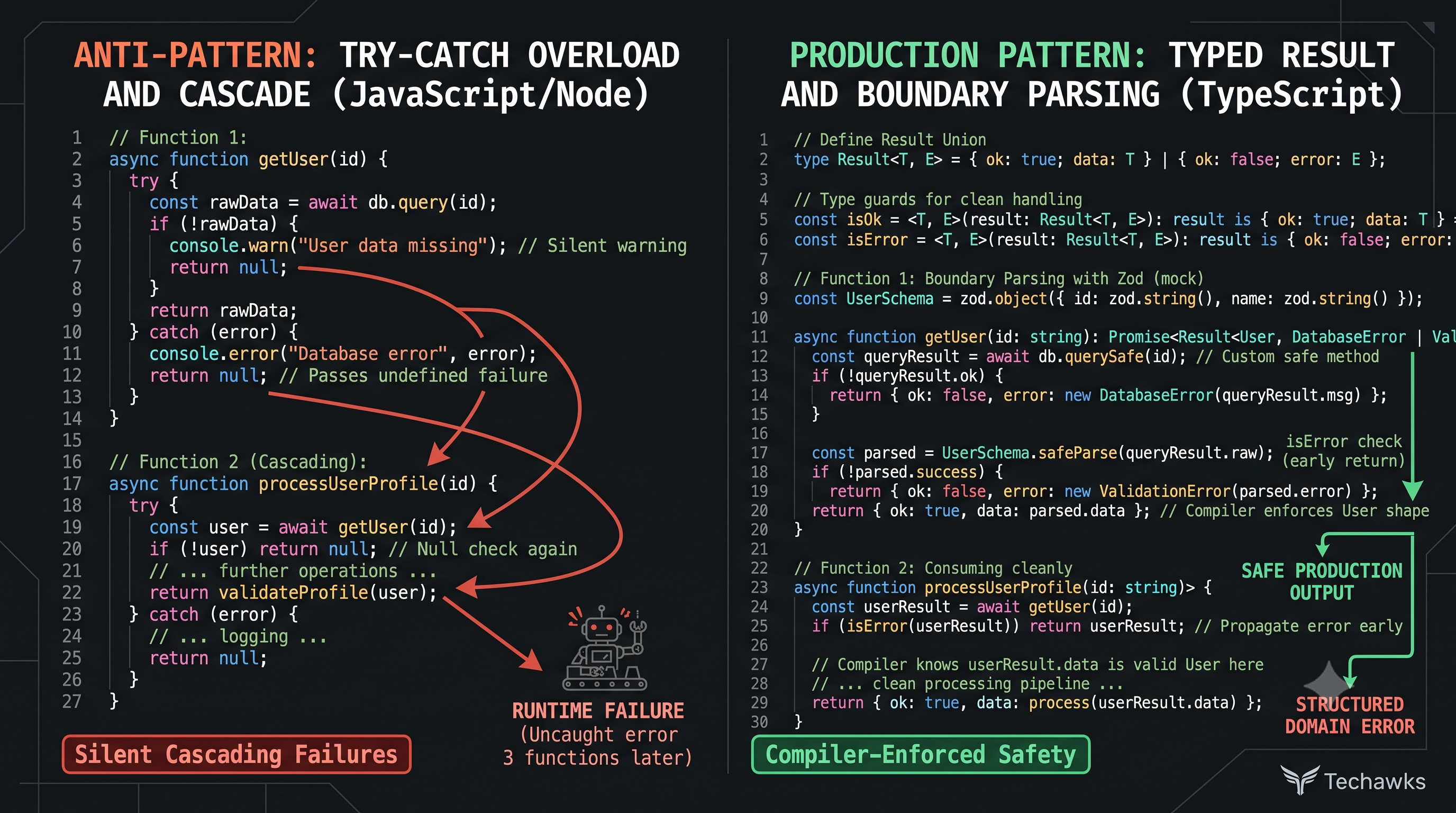 0 Commentarii 0 Distribuiri 161 Views 0 previzualizare
 -
Stop Writing Dual-Write Microservices: The Outbox Pattern You Should Be Implementing
Here is a classic anti-pattern found in backend services:
TypeScript
// The dangerous "Dual-Write"
async function createOrder(orderData) {
const order = await db.orders.insert(orderData); // Step 1: DB write succeeds
await eventBus.publish("OrderCreated", order); // Step 2: Network partition / Crash happens here!
return order;
}
If the application crashes, network drops, or the broker rejects the event after Step 1, your database committed state that downstream systems will never know about.
Wrapping both in a distributed transaction (2PC) hurts latency and throughput. Swapping the order—publishing the event first—is worse, because a database write failure leaves phantom events in your event stream.
The Fix: The Transactional Outbox Pattern
Instead of calling your message broker over the network in your application request lifecycle, leverage the ACID guarantees of your primary database:
Atomic Dual-Write in a Single Engine: Create an outbox table in the same database schema as your domain tables. When mutating data, insert your business entity and write the corresponding integration event into the outbox table within the same local database transaction:
SQL
BEGIN TRANSACTION;
INSERT INTO orders (id, customer_id, total) VALUES ('ord_101', 'cust_42', 150.00);
INSERT INTO outbox (id, aggregate_type, payload, status)
VALUES ('evt_201', 'Order', '{"id":"ord_101","total":150.00}', 'PENDING');
COMMIT;
Decoupled Asynchronous Relay: A separate asynchronous worker reads events from the outbox table and publishes them to the broker. You can implement this via:
Polling Publisher: A scheduled query with SELECT ... FOR UPDATE SKIP LOCKED for low-to-medium scale.
Change Data Capture (CDC): Tools like Debezium reading the database write-ahead log (WAL) directly for ultra-low latency and zero database read overhead.
Guaranteed At-Least-Once Delivery: Because your database guarantees the transaction either commits both the entity and the outbox event or rolls back both, you eliminate silent data corruption at the root.
Discussion Question
When decoupling services, do you rely on Change Data Capture (CDC) against the WAL, polling-based outbox processors, or idempotent consumer retries to handle split-brain events?
CTA
Level up your backend architectures and write production-grade code. Join thousands of backend engineers, system designers, and software craftspeople in Developers & Coding.Stop Writing Dual-Write Microservices: The Outbox Pattern You Should Be Implementing Here is a classic anti-pattern found in backend services: TypeScript // The dangerous "Dual-Write" async function createOrder(orderData) { const order = await db.orders.insert(orderData); // Step 1: DB write succeeds await eventBus.publish("OrderCreated", order); // Step 2: Network partition / Crash happens here! return order; } If the application crashes, network drops, or the broker rejects the event after Step 1, your database committed state that downstream systems will never know about. Wrapping both in a distributed transaction (2PC) hurts latency and throughput. Swapping the order—publishing the event first—is worse, because a database write failure leaves phantom events in your event stream. The Fix: The Transactional Outbox Pattern Instead of calling your message broker over the network in your application request lifecycle, leverage the ACID guarantees of your primary database: Atomic Dual-Write in a Single Engine: Create an outbox table in the same database schema as your domain tables. When mutating data, insert your business entity and write the corresponding integration event into the outbox table within the same local database transaction: SQL BEGIN TRANSACTION; INSERT INTO orders (id, customer_id, total) VALUES ('ord_101', 'cust_42', 150.00); INSERT INTO outbox (id, aggregate_type, payload, status) VALUES ('evt_201', 'Order', '{"id":"ord_101","total":150.00}', 'PENDING'); COMMIT; Decoupled Asynchronous Relay: A separate asynchronous worker reads events from the outbox table and publishes them to the broker. You can implement this via: Polling Publisher: A scheduled query with SELECT ... FOR UPDATE SKIP LOCKED for low-to-medium scale. Change Data Capture (CDC): Tools like Debezium reading the database write-ahead log (WAL) directly for ultra-low latency and zero database read overhead. Guaranteed At-Least-Once Delivery: Because your database guarantees the transaction either commits both the entity and the outbox event or rolls back both, you eliminate silent data corruption at the root. Discussion Question When decoupling services, do you rely on Change Data Capture (CDC) against the WAL, polling-based outbox processors, or idempotent consumer retries to handle split-brain events? CTA Level up your backend architectures and write production-grade code. Join thousands of backend engineers, system designers, and software craftspeople in Developers & Coding. 0 Commentarii 0 Distribuiri 144 Views 0 previzualizare
 -
Stop Writing Defensive Null Checks: Use the Rust-Inspired Result Pattern in TypeScript
In standard JavaScript and TypeScript, functions throw exceptions implicitly. When a function signature looks like:
function parseConfig(raw: string): AppConfig { ... }
The type system tells you nothing about failure modes. If parsing fails, it throws at runtime. The caller has no idea it needs a try/catch until production logs blow up with uncaught exceptions.
The Problem with Exceptions for Expected Errors
Exceptions should be reserved for exceptional, unrecoverable system failures (e.g., out-of-memory, network hardware drop). Domain failures—like validation errors, failed lookups, or bad payloads—are expected states. Treating them as thrown exceptions destroys type safety and complicates control flow.
The Fix: Explicit Result<T, E>
Borrowing from Rust’s Result<T, E>, we model success and failure as explicit return values instead of hidden throws.
// 1. Define the algebraic Result type
export type Result<T, E = Error> =
| { ok: true; value: T }
| { ok: false; error: E };
export const Ok = <T>(value: T): Result<T, never> => ({ ok: true, value });
export const Err = <E>(error: E): Result<never, E> => ({ ok: false, error });
How to Implement It in Real Code:
Instead of throwing inside your business logic, wrap your outcomes:
interface ValidationError {
field: string;
reason: string;
}
function parsePort(input: string): Result<number, ValidationError> {
const port = Number(input);
if (isNaN(port) || port <= 0 || port > 65535) {
return Err({ field: "PORT", reason: "Must be a valid integer between 1 and 65535" });
}
return Ok(port);
}
How It Enforces Safe Consuming:
TypeScript’s discriminated union forces the developer to check result.ok before accessing result.value. Attempting to read result.value when ok: false is rejected at compile time:
TypeScript
const result = parsePort(process.env.APP_PORT ?? "");
if (!result.ok) {
// TypeScript knows 'result.error' is safely typed here
console.error(`Config failure on ${result.error.field}: ${result.error.reason}`);
process.exit(1);
}
// Compiler guarantees 'result.value' exists and is a number
const port = result.value;
server.listen(port);
Why This Upgrades Your Architecture:
Self-Documenting Signatures: Callers instantly see every failure mode in their IDE without reading source code.
Zero Uncaught Explosions: Errors are treated as normal control flow, making multi-step pipelines easily composable.
Deterministic Testing: You test predictable data structures rather than asserting whether a method threw an exception.
Discussion Question
Do you rely on explicit union types/monadic patterns like Result in your TypeScript backend, or do you still prefer native try/catch and custom exception classes? What tradeoffs have you seen in large codebases?
CTA (Join Developers & Coding)
Ready to sharpen your software craft with modern architecture patterns, typed systems, and clean code principles? Join the Developers & Coding community to collaborate on production patterns with peers worldwide.Stop Writing Defensive Null Checks: Use the Rust-Inspired Result Pattern in TypeScript In standard JavaScript and TypeScript, functions throw exceptions implicitly. When a function signature looks like: function parseConfig(raw: string): AppConfig { ... } The type system tells you nothing about failure modes. If parsing fails, it throws at runtime. The caller has no idea it needs a try/catch until production logs blow up with uncaught exceptions. The Problem with Exceptions for Expected Errors Exceptions should be reserved for exceptional, unrecoverable system failures (e.g., out-of-memory, network hardware drop). Domain failures—like validation errors, failed lookups, or bad payloads—are expected states. Treating them as thrown exceptions destroys type safety and complicates control flow. The Fix: Explicit Result<T, E> Borrowing from Rust’s Result<T, E>, we model success and failure as explicit return values instead of hidden throws. // 1. Define the algebraic Result type export type Result<T, E = Error> = | { ok: true; value: T } | { ok: false; error: E }; export const Ok = <T>(value: T): Result<T, never> => ({ ok: true, value }); export const Err = <E>(error: E): Result<never, E> => ({ ok: false, error }); How to Implement It in Real Code: Instead of throwing inside your business logic, wrap your outcomes: interface ValidationError { field: string; reason: string; } function parsePort(input: string): Result<number, ValidationError> { const port = Number(input); if (isNaN(port) || port <= 0 || port > 65535) { return Err({ field: "PORT", reason: "Must be a valid integer between 1 and 65535" }); } return Ok(port); } How It Enforces Safe Consuming: TypeScript’s discriminated union forces the developer to check result.ok before accessing result.value. Attempting to read result.value when ok: false is rejected at compile time: TypeScript const result = parsePort(process.env.APP_PORT ?? ""); if (!result.ok) { // TypeScript knows 'result.error' is safely typed here console.error(`Config failure on ${result.error.field}: ${result.error.reason}`); process.exit(1); } // Compiler guarantees 'result.value' exists and is a number const port = result.value; server.listen(port); Why This Upgrades Your Architecture: Self-Documenting Signatures: Callers instantly see every failure mode in their IDE without reading source code. Zero Uncaught Explosions: Errors are treated as normal control flow, making multi-step pipelines easily composable. Deterministic Testing: You test predictable data structures rather than asserting whether a method threw an exception. Discussion Question Do you rely on explicit union types/monadic patterns like Result in your TypeScript backend, or do you still prefer native try/catch and custom exception classes? What tradeoffs have you seen in large codebases? CTA (Join Developers & Coding) Ready to sharpen your software craft with modern architecture patterns, typed systems, and clean code principles? Join the Developers & Coding community to collaborate on production patterns with peers worldwide. 0 Commentarii 0 Distribuiri 173 Views 0 previzualizare
 -
Stop Bypassing the Type System: Enforcing Parse, Don’t Validate with Zod & TypeScript
In modern software engineering, TypeScript guarantees static type safety at compile time, but it disappears completely at runtime. When untrusted data arrives from an external API, a database query, or user input, developers frequently write imperative if (!data.id) validations and then use type assertions (as User) to silence the compiler.
This pattern breaks the fundamental design principle: Parse, Don't Validate.
When you merely validate data, you verify its shape and throw an error if it is invalid, but you return nothing structural to the type system. When you parse data, you take unstructured input, verify it against a contract, and produce a guaranteed typed domain object in a single execution step.
The Anti-Pattern: Validate and Force-Cast
TypeScript
interface UserProfile {
id: string;
email: string;
age: number;
}
// ❌ Risky: Runtime check followed by an unsafe cast
function handleProfile(rawInput: unknown): UserProfile {
if (typeof rawInput !== "object" || rawInput === null) {
throw new Error("Invalid payload");
}
// TypeScript compiler is forced to trust you here:
return rawInput as UserProfile;
}
The Production Pattern: Parse into Guaranteed Types
Instead of manual assertion, define your schema as the single source of truth using a parser like Zod, Valibot, or ArkType:
TypeScript
import { z } from "zod";
// 1. Define the schema contract
const UserProfileSchema = z.object({
id: z.string().uuid(),
email: z.string().email(),
age: z.number().int().positive(),
isActive: z.boolean().default(true),
});
// 2. Infer the static type directly from the runtime schema
type UserProfile = z.infer<typeof UserProfileSchema>;
// 3. Parse and sanitize in one step
function handleProfile(rawInput: unknown): UserProfile {
// .parse() throws a structured ZodError if invalid
// and returns a strongly-typed, sanitized UserProfile on success
return UserProfileSchema.parse(rawInput);
}
Why This Matters in Production:
Elimination of Shotgun Parsing: Data verification happens strictly at the application boundary (controllers, event listeners, API fetch layers). The interior layers of your application receive strictly parsed, valid entities.
Zero Drift Between Types & Runtime Rules: Inferred types dynamically update whenever validation requirements change, eliminating out-of-sync types and dead code.
Data Transformation & Coercion: Parsers allow you to normalize inputs (e.g., stripping unknown keys, trimming strings, parsing date strings into Date objects) safely during the ingestion phase.
Discussion Question
Do you define your database/API schemas in TypeScript interfaces first, or do you infer your domain types directly from runtime validation schemas like Zod or TypeBox?
CTA
Sharpen your engineering craft.
Join the Developers & Coding community at Techawks to explore production code patterns, clean system design, and advanced TypeScript techniques with fellow developers.Stop Bypassing the Type System: Enforcing Parse, Don’t Validate with Zod & TypeScript In modern software engineering, TypeScript guarantees static type safety at compile time, but it disappears completely at runtime. When untrusted data arrives from an external API, a database query, or user input, developers frequently write imperative if (!data.id) validations and then use type assertions (as User) to silence the compiler. This pattern breaks the fundamental design principle: Parse, Don't Validate. When you merely validate data, you verify its shape and throw an error if it is invalid, but you return nothing structural to the type system. When you parse data, you take unstructured input, verify it against a contract, and produce a guaranteed typed domain object in a single execution step. The Anti-Pattern: Validate and Force-Cast TypeScript interface UserProfile { id: string; email: string; age: number; } // ❌ Risky: Runtime check followed by an unsafe cast function handleProfile(rawInput: unknown): UserProfile { if (typeof rawInput !== "object" || rawInput === null) { throw new Error("Invalid payload"); } // TypeScript compiler is forced to trust you here: return rawInput as UserProfile; } The Production Pattern: Parse into Guaranteed Types Instead of manual assertion, define your schema as the single source of truth using a parser like Zod, Valibot, or ArkType: TypeScript import { z } from "zod"; // 1. Define the schema contract const UserProfileSchema = z.object({ id: z.string().uuid(), email: z.string().email(), age: z.number().int().positive(), isActive: z.boolean().default(true), }); // 2. Infer the static type directly from the runtime schema type UserProfile = z.infer<typeof UserProfileSchema>; // 3. Parse and sanitize in one step function handleProfile(rawInput: unknown): UserProfile { // .parse() throws a structured ZodError if invalid // and returns a strongly-typed, sanitized UserProfile on success return UserProfileSchema.parse(rawInput); } Why This Matters in Production: Elimination of Shotgun Parsing: Data verification happens strictly at the application boundary (controllers, event listeners, API fetch layers). The interior layers of your application receive strictly parsed, valid entities. Zero Drift Between Types & Runtime Rules: Inferred types dynamically update whenever validation requirements change, eliminating out-of-sync types and dead code. Data Transformation & Coercion: Parsers allow you to normalize inputs (e.g., stripping unknown keys, trimming strings, parsing date strings into Date objects) safely during the ingestion phase. Discussion Question Do you define your database/API schemas in TypeScript interfaces first, or do you infer your domain types directly from runtime validation schemas like Zod or TypeBox? CTA Sharpen your engineering craft. Join the Developers & Coding community at Techawks to explore production code patterns, clean system design, and advanced TypeScript techniques with fellow developers.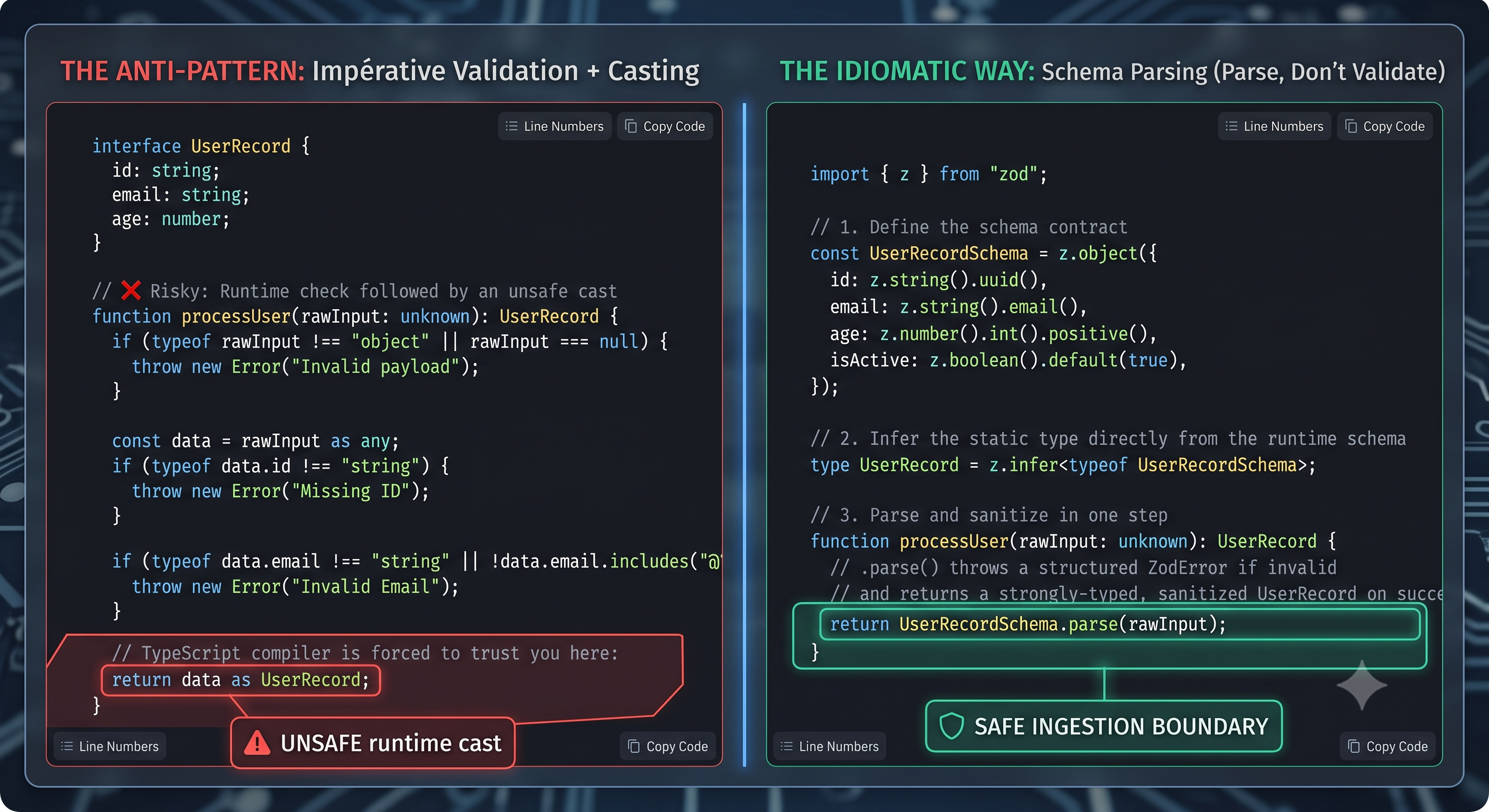 0 Commentarii 0 Distribuiri 196 Views 0 previzualizare
 -
The Anti-Pattern in Modern Codebases: Stop Letting AI Blindly Write Unsound Types
With over 75% of boilerplate and functional logic now assisted by generative AI, engineering teams are encountering an insidious new bottleneck: The Illusion of Type Safety.
When an LLM produces TypeScript or typed Python, it prioritizes satisfying the compiler over runtime reality. The most common pitfall is casting untrusted API responses with direct assertion:
TypeScript
// ❌ The dangerous shortcut: Pure type assertion
interface UserPayload {
id: string;
role: "admin" | "member";
permissions: string[];
}
async function fetchUser(id: string): Promise<UserPayload> {
const res = await fetch(`/api/users/${id}`);
return (await res.json()) as UserPayload; // Compile passes, but runtime is unverified!
}
If the upstream service drops permissions or returns role: "guest", TypeScript remains silent—until an undefined access blows up your production error boundary.
Here is how resilient codebases enforce true boundary integrity:
Parse, Don't Cast: Treat compile-time types as downstream contracts, not validation. Use runtime schema validators (like Zod, Valibot, or ArkType) to guarantee that inputs structurally conform before execution.
TypeScript
// ✅ Defensively validated at the boundary
import { z } from "zod";
const UserSchema = z.object({
id: z.string(),
role: z.enum(["admin", "member"]),
permissions: z.array(z.string()),
});
type UserPayload = z.infer<typeof UserSchema>;
async function fetchUser(id: string): Promise<UserPayload> {
const res = await fetch(`/api/users/${id}`);
const rawData = await res.json();
return UserSchema.parse(rawData); // Throws deterministically if payload shape deviates
}
Make Illegal States Unrepresentable: Avoid optional spaghetti (status?: string, error?: string). Use discriminated unions so your code cannot physically compile into an invalid domain state.
Audit Generated Invariants: The differentiator between a junior copy-paster and a senior systems engineer is knowing where the compiler's guarantees end and where runtime evaluation begins.
Discussion Question
POLL: What is the most frequent cause of production runtime crashes in your current stack?
Type assertions (as Type) masking payload changes
Unhandled edge cases in asynchronous state / race conditions
Third-party API contract drift & unvalidated inputs
AI-generated code that compiled cleanly but held logical flaws
Vote below and share how your team enforces defensive schemas at your boundaries!
CTA
Ready to level up your software engineering craft, debug production systems, and build alongside fellow developers?
👉 Join Developers & Coding [link in bio/comments] to trade real-world architecture patterns, review production code, and sharpen your engineering fundamentals.The Anti-Pattern in Modern Codebases: Stop Letting AI Blindly Write Unsound Types With over 75% of boilerplate and functional logic now assisted by generative AI, engineering teams are encountering an insidious new bottleneck: The Illusion of Type Safety. When an LLM produces TypeScript or typed Python, it prioritizes satisfying the compiler over runtime reality. The most common pitfall is casting untrusted API responses with direct assertion: TypeScript // ❌ The dangerous shortcut: Pure type assertion interface UserPayload { id: string; role: "admin" | "member"; permissions: string[]; } async function fetchUser(id: string): Promise<UserPayload> { const res = await fetch(`/api/users/${id}`); return (await res.json()) as UserPayload; // Compile passes, but runtime is unverified! } If the upstream service drops permissions or returns role: "guest", TypeScript remains silent—until an undefined access blows up your production error boundary. Here is how resilient codebases enforce true boundary integrity: Parse, Don't Cast: Treat compile-time types as downstream contracts, not validation. Use runtime schema validators (like Zod, Valibot, or ArkType) to guarantee that inputs structurally conform before execution. TypeScript // ✅ Defensively validated at the boundary import { z } from "zod"; const UserSchema = z.object({ id: z.string(), role: z.enum(["admin", "member"]), permissions: z.array(z.string()), }); type UserPayload = z.infer<typeof UserSchema>; async function fetchUser(id: string): Promise<UserPayload> { const res = await fetch(`/api/users/${id}`); const rawData = await res.json(); return UserSchema.parse(rawData); // Throws deterministically if payload shape deviates } Make Illegal States Unrepresentable: Avoid optional spaghetti (status?: string, error?: string). Use discriminated unions so your code cannot physically compile into an invalid domain state. Audit Generated Invariants: The differentiator between a junior copy-paster and a senior systems engineer is knowing where the compiler's guarantees end and where runtime evaluation begins. Discussion Question POLL: What is the most frequent cause of production runtime crashes in your current stack? Type assertions (as Type) masking payload changes Unhandled edge cases in asynchronous state / race conditions Third-party API contract drift & unvalidated inputs AI-generated code that compiled cleanly but held logical flaws Vote below and share how your team enforces defensive schemas at your boundaries! CTA Ready to level up your software engineering craft, debug production systems, and build alongside fellow developers? 👉 Join Developers & Coding [link in bio/comments] to trade real-world architecture patterns, review production code, and sharpen your engineering fundamentals. 0 Commentarii 0 Distribuiri 145 Views 0 previzualizare
 -
The 2026 Developer Paradox: Why Writing Code Is Cheap, but Reading Code Is Worth $250k
Generating syntax has become virtually free. With IDE agents and automated completion, the sheer volume of code entering production repositories has skyrocketed. But engineering organizations are discovering an uncomfortable consequence: AI technical debt is compounding faster than teams can review it.
LLMs tend to solve problems by appending code rather than refactoring existing abstractions. They generate 40 lines where a standard library utility takes 3, introduce subtle edge-case hallucinations, and create inconsistent patterns across files.
Because writing code is no longer the bottleneck, code verification, cognitive load reduction, and interface design have become the primary career differentiators.
What This Means for Your Engineering Career
Junior developers are being judged on how fast they ship features. Senior and Staff engineers are being hired for their ability to keep codebases readable, maintainable, and safe to delete.
If you want to build durable leverage as a software developer, master these three practices:
Design Inverted Contracts (Interface-First Engineering)
Never ask an AI assistant to "design the feature." Define strict TypeScript types, Go interfaces, or Protobuf contracts yourself first. Restrict the generation boundary: let the tool populate implementation logic, but enforce that data structures and module boundaries strictly conform to your schema.
The "Explain-or-Delete" Rule
If an agent drafts a clever 50-line regex or a complex concurrency handler and you cannot clearly explain its time complexity and failure modes to a peer, do not merge it. Magic code in a pull request is immediate legacy debt.
Incorporate Mutation & Invariant Testing
Vanilla unit tests written by generative tools often test for "happy paths" that mirror the generated bug. Protect critical paths with property-based testing and mutation tests that intentionally break logic to verify whether your test suite actually catches regressions.
The takeaway: Code is a liability, not an asset. The best developers aren't the ones who prompt the fastest; they are the gatekeepers who know how to keep systems simple, decoupled, and verifiable.
Discussion Question
How has your team changed PR reviews with AI coding assistants in the loop? Are you seeing more code churn and subtle boilerplate bloat, or have your review cycles actually sped up?
CTA
Want to sharpen your architectural judgment, build bulletproof testing practices, and write clean, resilient code alongside senior software engineers?
👉 Join the Developers & Coding Community at Techawks to access code reviews, design patterns, and engineering masterclasses.The 2026 Developer Paradox: Why Writing Code Is Cheap, but Reading Code Is Worth $250k Generating syntax has become virtually free. With IDE agents and automated completion, the sheer volume of code entering production repositories has skyrocketed. But engineering organizations are discovering an uncomfortable consequence: AI technical debt is compounding faster than teams can review it. LLMs tend to solve problems by appending code rather than refactoring existing abstractions. They generate 40 lines where a standard library utility takes 3, introduce subtle edge-case hallucinations, and create inconsistent patterns across files. Because writing code is no longer the bottleneck, code verification, cognitive load reduction, and interface design have become the primary career differentiators. What This Means for Your Engineering Career Junior developers are being judged on how fast they ship features. Senior and Staff engineers are being hired for their ability to keep codebases readable, maintainable, and safe to delete. If you want to build durable leverage as a software developer, master these three practices: Design Inverted Contracts (Interface-First Engineering) Never ask an AI assistant to "design the feature." Define strict TypeScript types, Go interfaces, or Protobuf contracts yourself first. Restrict the generation boundary: let the tool populate implementation logic, but enforce that data structures and module boundaries strictly conform to your schema. The "Explain-or-Delete" Rule If an agent drafts a clever 50-line regex or a complex concurrency handler and you cannot clearly explain its time complexity and failure modes to a peer, do not merge it. Magic code in a pull request is immediate legacy debt. Incorporate Mutation & Invariant Testing Vanilla unit tests written by generative tools often test for "happy paths" that mirror the generated bug. Protect critical paths with property-based testing and mutation tests that intentionally break logic to verify whether your test suite actually catches regressions. The takeaway: Code is a liability, not an asset. The best developers aren't the ones who prompt the fastest; they are the gatekeepers who know how to keep systems simple, decoupled, and verifiable. Discussion Question How has your team changed PR reviews with AI coding assistants in the loop? Are you seeing more code churn and subtle boilerplate bloat, or have your review cycles actually sped up? CTA Want to sharpen your architectural judgment, build bulletproof testing practices, and write clean, resilient code alongside senior software engineers? 👉 Join the Developers & Coding Community at Techawks to access code reviews, design patterns, and engineering masterclasses.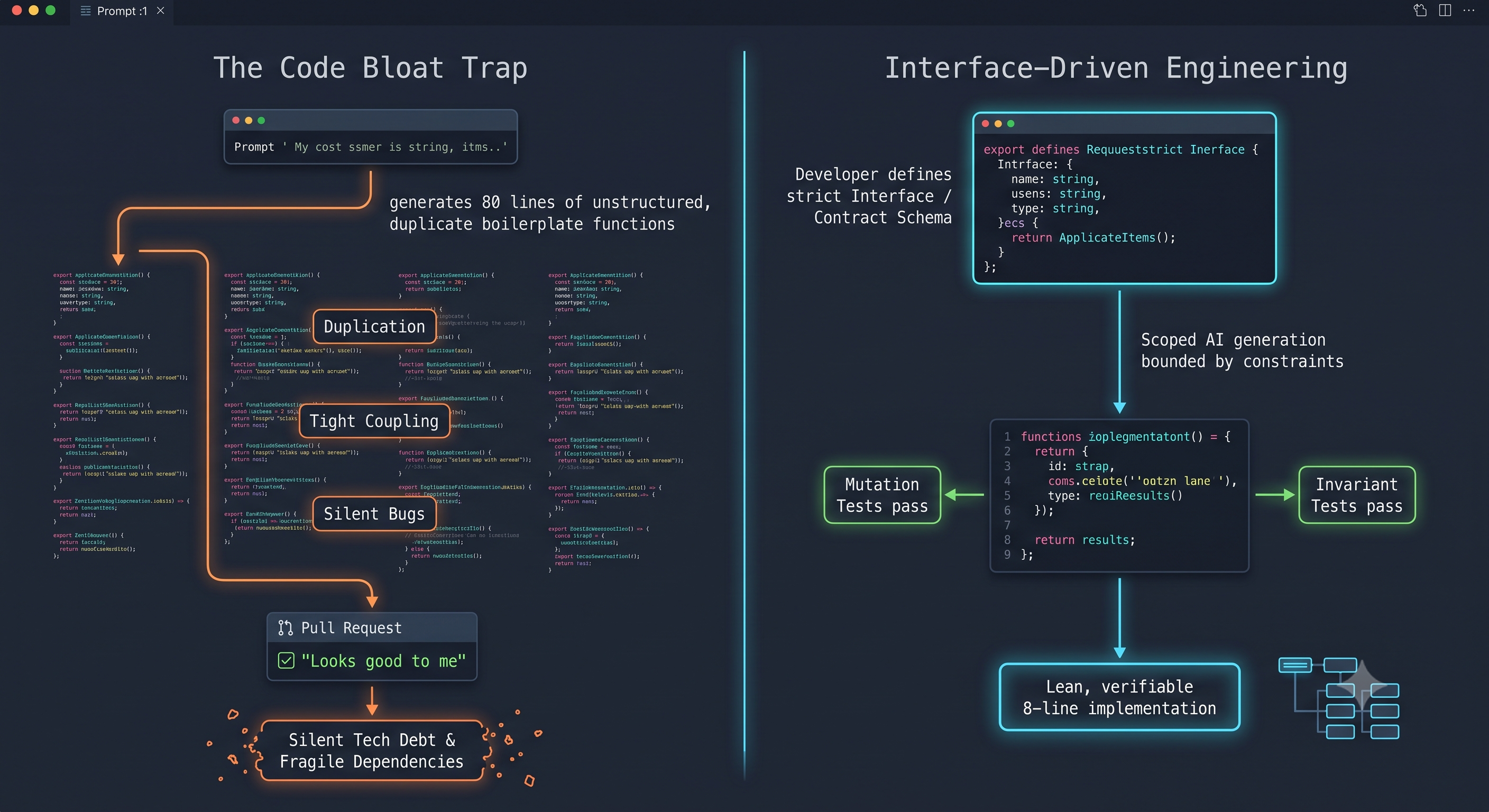 0 Commentarii 0 Distribuiri 126 Views 0 previzualizare
 -
Stop Writing Manual Cleanup Logic: Explicit Resource Management (using) in Modern TypeScript
Every developer knows the standard ritual for handling disposables: initialize the resource, nest your logic in a try block, and remember to call .close(), .release(), or .dispose() inside a finally block.
One missed finally or an unhandled rethrow in an asynchronous generator, and your application quietly bleeds open sockets or file descriptors.
JavaScript and TypeScript now standardize resource lifecycle management directly at the syntax level through the TC39 Explicit Resource Management proposal (Symbol.dispose and Symbol.asyncDispose).
Instead of trusting developers to clean up manually:
The runtime binds the resource lifetime directly to the lexical block scope.
Disposal executes deterministically the microsecond the block terminates—whether by return, break, or a raised exception.
Nested resource cleanup happens in reverse order of initialization (LIFO), replicating RAII (Resource Acquisition Is Initialization) patterns from C++ and Rust.
The Coding Lesson: Refactoring to using
Before: Defensive try...finally nesting
TypeScript
async function processBatch(fileId: string) {
const client = await pool.connect();
const reader = await openTelemetrySpan("batch-process");
try {
const data = await client.query("SELECT * FROM jobs WHERE id = $1", [fileId]);
return transform(data);
} finally {
reader.end();
client.release(); // Forgetting this or throwing here leaks the connection
}
}
After: Deterministic Lexical Disposal with await using
Make your client implement Symbol.asyncDispose, then bind it with using:
TypeScript
// 1. Define the disposable interface
class ManagedConnection {
// ... connection logic
async [Symbol.asyncDispose]() {
await this.release();
}
}
// 2. Consume with zero cleanup overhead
async function processBatch(fileId: string) {
await using client = await pool.connect();
using span = openTelemetrySpan("batch-process");
const data = await client.query("SELECT * FROM jobs WHERE id = $1", [fileId]);
return transform(data);
// 'span' and 'client' dispose automatically in LIFO order right here!
}
How to Adopt It Today
Set "target": "ES2022" or later in your tsconfig.json.
Add "lib": ["ESNext.Disposable"] or run on modern Node.js / Bun runtimes.
Replace manual wrapper classes around connection pools, Redis locks, and file handlers with Symbol.dispose and Symbol.asyncDispose.
Discussion Question
Have you migrated your backend service layers to using declarations, or are you still relying on traditional wrapper classes and try...finally blocks? What is holding your team back from adopting modern disposables?
CTA
Join Developers & Coding: Connect with software engineers, systems architects, and developers mastering modern programming paradigms, language primitives, and clean architecturesStop Writing Manual Cleanup Logic: Explicit Resource Management (using) in Modern TypeScript Every developer knows the standard ritual for handling disposables: initialize the resource, nest your logic in a try block, and remember to call .close(), .release(), or .dispose() inside a finally block. One missed finally or an unhandled rethrow in an asynchronous generator, and your application quietly bleeds open sockets or file descriptors. JavaScript and TypeScript now standardize resource lifecycle management directly at the syntax level through the TC39 Explicit Resource Management proposal (Symbol.dispose and Symbol.asyncDispose). Instead of trusting developers to clean up manually: The runtime binds the resource lifetime directly to the lexical block scope. Disposal executes deterministically the microsecond the block terminates—whether by return, break, or a raised exception. Nested resource cleanup happens in reverse order of initialization (LIFO), replicating RAII (Resource Acquisition Is Initialization) patterns from C++ and Rust. The Coding Lesson: Refactoring to using Before: Defensive try...finally nesting TypeScript async function processBatch(fileId: string) { const client = await pool.connect(); const reader = await openTelemetrySpan("batch-process"); try { const data = await client.query("SELECT * FROM jobs WHERE id = $1", [fileId]); return transform(data); } finally { reader.end(); client.release(); // Forgetting this or throwing here leaks the connection } } After: Deterministic Lexical Disposal with await using Make your client implement Symbol.asyncDispose, then bind it with using: TypeScript // 1. Define the disposable interface class ManagedConnection { // ... connection logic async [Symbol.asyncDispose]() { await this.release(); } } // 2. Consume with zero cleanup overhead async function processBatch(fileId: string) { await using client = await pool.connect(); using span = openTelemetrySpan("batch-process"); const data = await client.query("SELECT * FROM jobs WHERE id = $1", [fileId]); return transform(data); // 'span' and 'client' dispose automatically in LIFO order right here! } How to Adopt It Today Set "target": "ES2022" or later in your tsconfig.json. Add "lib": ["ESNext.Disposable"] or run on modern Node.js / Bun runtimes. Replace manual wrapper classes around connection pools, Redis locks, and file handlers with Symbol.dispose and Symbol.asyncDispose. Discussion Question Have you migrated your backend service layers to using declarations, or are you still relying on traditional wrapper classes and try...finally blocks? What is holding your team back from adopting modern disposables? CTA Join Developers & Coding: Connect with software engineers, systems architects, and developers mastering modern programming paradigms, language primitives, and clean architectures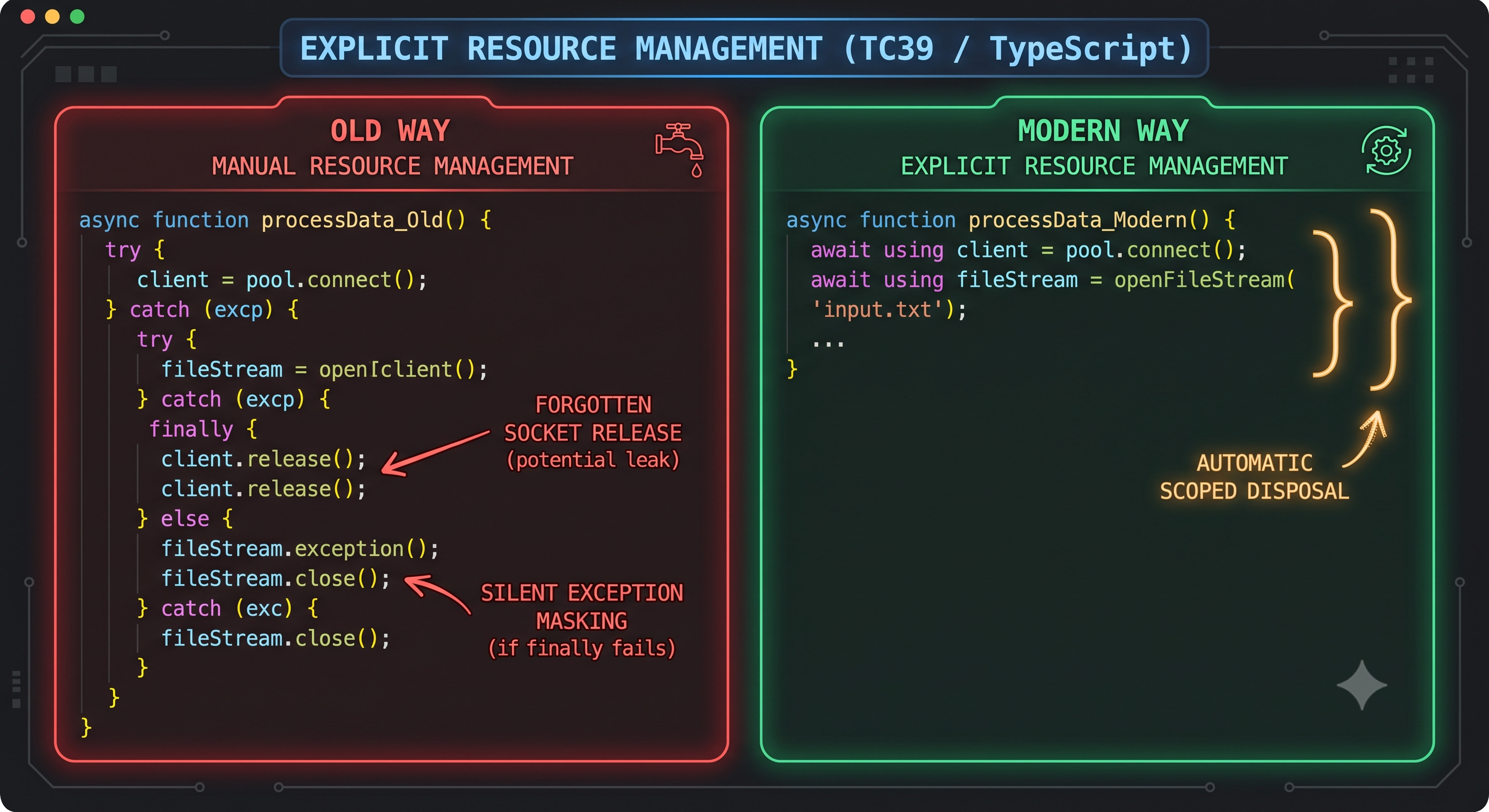 0 Commentarii 0 Distribuiri 749 Views 0 previzualizare
 -
The Zero-else Challenge: Why Guard Clauses Will Instantly Level Up Your Codebase
Deep nesting is the silent killer of readability. Every time you wrap a block of business logic inside another else branch, you force the next developer (and your future self) to keep an invisible stack of state conditions in their head just to trace a single execution path.
The easiest way to write cleaner, more resilient, and self-documenting code is to adopt Bouncer Pattern Programming.
Take the Zero-else Challenge on your next pull request:
Invert the Condition and Return EarlyInstead of checking if the input is valid and wrapping 40 lines of logic inside the block, check for the failure condition immediately. Exit, throw, or return early at the very top:TypeScript// ❌ Arrow Anti-Pattern
function processUser(user) {
if (user) {
if (user.isActive) {
if (user.hasPermission) {
// actual core logic hidden here
} else {
throw new Error("Forbidden");
}
} else {
throw new Error("Inactive");
}
} else {
throw new Error("Not Found");
}
}
// ✅ Guard Clauses
function processUser(user) {
if (!user) throw new Error("Not Found");
if (!user.isActive) throw new Error("Inactive");
if (!user.hasPermission) throw new Error("Forbidden");
// Flat, unindented core execution path
}
Replace Conditional Branching with Lookup Tables
If you find yourself writing chained else if statements or sprawling switch blocks to handle types, map them into a Record or hash map. State lookups are O(1), decouple action from condition, and make adding new variants trivial without mutating control flow.
Treat the Happy Path as the Main EventThe core intent of your function should live at indentation level 0. Everything else is just security checking tickets at the door. If input passes the guards, it flows linearly straight down.
When you remove the else keyword, your cyclomatic complexity drops, unit tests become dead simple, and edge cases stop hiding in dark corners.
Key Takeaways
Deeply nested control flow dramatically increases cognitive load and hides edge-case bugs.
Guard clauses handle preconditions and failures upfront, keeping the happy path flat and readable.
Invert your logic: test for what can go wrong first, exit immediately, and let valid data flow through.
Dynamic dispatch or lookup tables beat sprawling else if chains for mapping states.
CTA
Ready to sharpen your software craftsmanship and build cleaner architectures?
Join the Developers & Coding community to review real-world PRs, debate clean code patterns, and grow with engineers who care about code quality.The Zero-else Challenge: Why Guard Clauses Will Instantly Level Up Your Codebase Deep nesting is the silent killer of readability. Every time you wrap a block of business logic inside another else branch, you force the next developer (and your future self) to keep an invisible stack of state conditions in their head just to trace a single execution path. The easiest way to write cleaner, more resilient, and self-documenting code is to adopt Bouncer Pattern Programming. Take the Zero-else Challenge on your next pull request: Invert the Condition and Return EarlyInstead of checking if the input is valid and wrapping 40 lines of logic inside the block, check for the failure condition immediately. Exit, throw, or return early at the very top:TypeScript// ❌ Arrow Anti-Pattern function processUser(user) { if (user) { if (user.isActive) { if (user.hasPermission) { // actual core logic hidden here } else { throw new Error("Forbidden"); } } else { throw new Error("Inactive"); } } else { throw new Error("Not Found"); } } // ✅ Guard Clauses function processUser(user) { if (!user) throw new Error("Not Found"); if (!user.isActive) throw new Error("Inactive"); if (!user.hasPermission) throw new Error("Forbidden"); // Flat, unindented core execution path } Replace Conditional Branching with Lookup Tables If you find yourself writing chained else if statements or sprawling switch blocks to handle types, map them into a Record or hash map. State lookups are O(1), decouple action from condition, and make adding new variants trivial without mutating control flow. Treat the Happy Path as the Main EventThe core intent of your function should live at indentation level 0. Everything else is just security checking tickets at the door. If input passes the guards, it flows linearly straight down. When you remove the else keyword, your cyclomatic complexity drops, unit tests become dead simple, and edge cases stop hiding in dark corners. Key Takeaways Deeply nested control flow dramatically increases cognitive load and hides edge-case bugs. Guard clauses handle preconditions and failures upfront, keeping the happy path flat and readable. Invert your logic: test for what can go wrong first, exit immediately, and let valid data flow through. Dynamic dispatch or lookup tables beat sprawling else if chains for mapping states. CTA Ready to sharpen your software craftsmanship and build cleaner architectures? Join the Developers & Coding community to review real-world PRs, debate clean code patterns, and grow with engineers who care about code quality.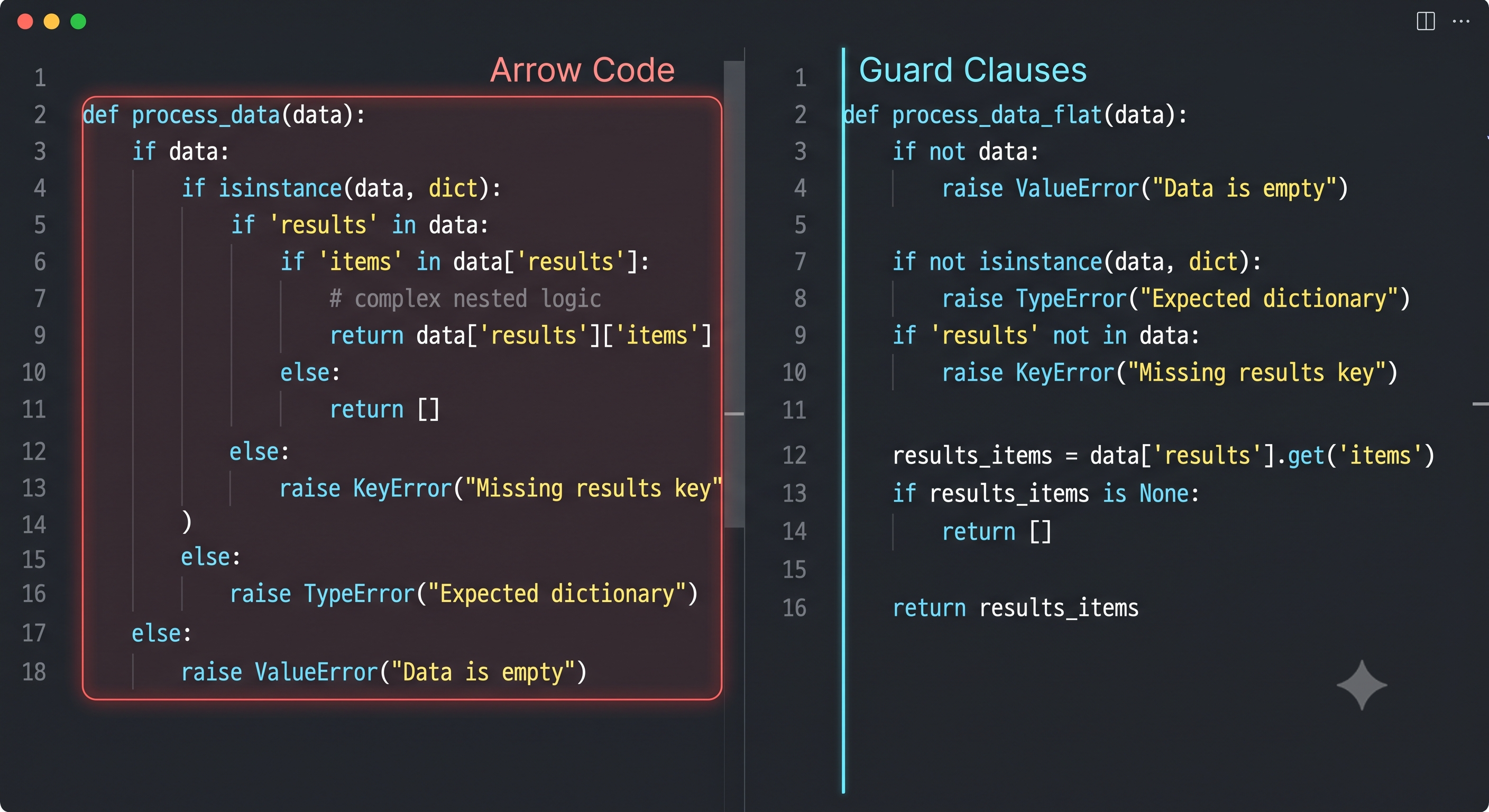 0 Commentarii 0 Distribuiri 120 Views 0 previzualizare
 -
The 100% Code Coverage Illusion: Why Green CI Pipelines Still Ship Production Incidents
Engineering teams routinely elevate test coverage percentages into the ultimate proxy for code quality. Teams mandate 90%+ thresholds, celebrate fully shaded green coverage heatmaps, and assume that because a line was executed by a test runner, it is protected from breaking in the wild.
In practice, high code coverage often breeds dangerous complacency.
Myth: Reaching 95% to 100% line coverage means your codebase is well-tested and resilient against regression bugs.
Fact: Line coverage only measures whether an interpreter stepped through an instruction. It does not measure whether your assertions validated the resulting state, handled unhandled network failures, or tested boundary states.
Why this matters for your engineering team:
When engineering culture emphasizes coverage percentage as a hard gate, developers inevitably game the metric. They write tests that execute 50 lines of complex logic without asserting edge-case outputs, or they heavily mock external dependencies until the test suite is verifying nothing more than its own mocks.
TypeScript
// ❌ 100% Line Coverage, 0% Bug Prevention
test("processOrder runs successfully", () => {
const result = processOrder({ id: "123", total: -50, items: [] });
expect(result).toBeDefined(); // Passes line execution, misses invalid state bug!
});
// ✅ Property & Boundary Assertion
test("rejects order with negative total or empty cart", () => {
expect(() => processOrder({ id: "123", total: -50, items: [] }))
.toThrow(ValidationError);
});
How to test for actual software resilience:
Adopt Mutation Testing
Run a mutation testing tool (such as Stryker or Mutmut). These tools inject artificial bugs into your code (inverting conditionals, altering arithmetic) and check if your test suite fails. If your tests still pass when logic is mutated, your tests have high coverage but zero detection capability.
Prioritize Boundary & Invariant Testing Over Lines
Test system invariants: empty arrays, integer overflows, null values, expired tokens, and race conditions. A function with 60% coverage that thoroughly asserts state invariants under erratic network conditions is far more reliable than one with 100% coverage executing only the happy path.
Audit Your Mock-to-Code Ratio
If your test file contains 80 lines of mock setup to test 10 lines of implementation, you aren't testing code; you're testing an imaginary execution environment. Use lightweight integration tests with ephemeral containers (like Testcontainers) instead of mocking every single database call and external client.
High-leverage engineering isn't about satisfying a test runner’s coverage metric. It is about proving that critical invariants hold true under unexpected failure.
Discussion Question
What is the most severe production bug your team has ever shipped that still slipped past a suite of passing unit tests?
CTA
Ready to sharpen your software craftsmanship and move past cosmetic engineering metrics? Join the Developers & Coding community to review real-world architectural patterns, debate clean code practices, and level up your engineering standards. Link below.The 100% Code Coverage Illusion: Why Green CI Pipelines Still Ship Production Incidents Engineering teams routinely elevate test coverage percentages into the ultimate proxy for code quality. Teams mandate 90%+ thresholds, celebrate fully shaded green coverage heatmaps, and assume that because a line was executed by a test runner, it is protected from breaking in the wild. In practice, high code coverage often breeds dangerous complacency. Myth: Reaching 95% to 100% line coverage means your codebase is well-tested and resilient against regression bugs. Fact: Line coverage only measures whether an interpreter stepped through an instruction. It does not measure whether your assertions validated the resulting state, handled unhandled network failures, or tested boundary states. Why this matters for your engineering team: When engineering culture emphasizes coverage percentage as a hard gate, developers inevitably game the metric. They write tests that execute 50 lines of complex logic without asserting edge-case outputs, or they heavily mock external dependencies until the test suite is verifying nothing more than its own mocks. TypeScript // ❌ 100% Line Coverage, 0% Bug Prevention test("processOrder runs successfully", () => { const result = processOrder({ id: "123", total: -50, items: [] }); expect(result).toBeDefined(); // Passes line execution, misses invalid state bug! }); // ✅ Property & Boundary Assertion test("rejects order with negative total or empty cart", () => { expect(() => processOrder({ id: "123", total: -50, items: [] })) .toThrow(ValidationError); }); How to test for actual software resilience: Adopt Mutation Testing Run a mutation testing tool (such as Stryker or Mutmut). These tools inject artificial bugs into your code (inverting conditionals, altering arithmetic) and check if your test suite fails. If your tests still pass when logic is mutated, your tests have high coverage but zero detection capability. Prioritize Boundary & Invariant Testing Over Lines Test system invariants: empty arrays, integer overflows, null values, expired tokens, and race conditions. A function with 60% coverage that thoroughly asserts state invariants under erratic network conditions is far more reliable than one with 100% coverage executing only the happy path. Audit Your Mock-to-Code Ratio If your test file contains 80 lines of mock setup to test 10 lines of implementation, you aren't testing code; you're testing an imaginary execution environment. Use lightweight integration tests with ephemeral containers (like Testcontainers) instead of mocking every single database call and external client. High-leverage engineering isn't about satisfying a test runner’s coverage metric. It is about proving that critical invariants hold true under unexpected failure. Discussion Question What is the most severe production bug your team has ever shipped that still slipped past a suite of passing unit tests? CTA Ready to sharpen your software craftsmanship and move past cosmetic engineering metrics? Join the Developers & Coding community to review real-world architectural patterns, debate clean code practices, and level up your engineering standards. Link below.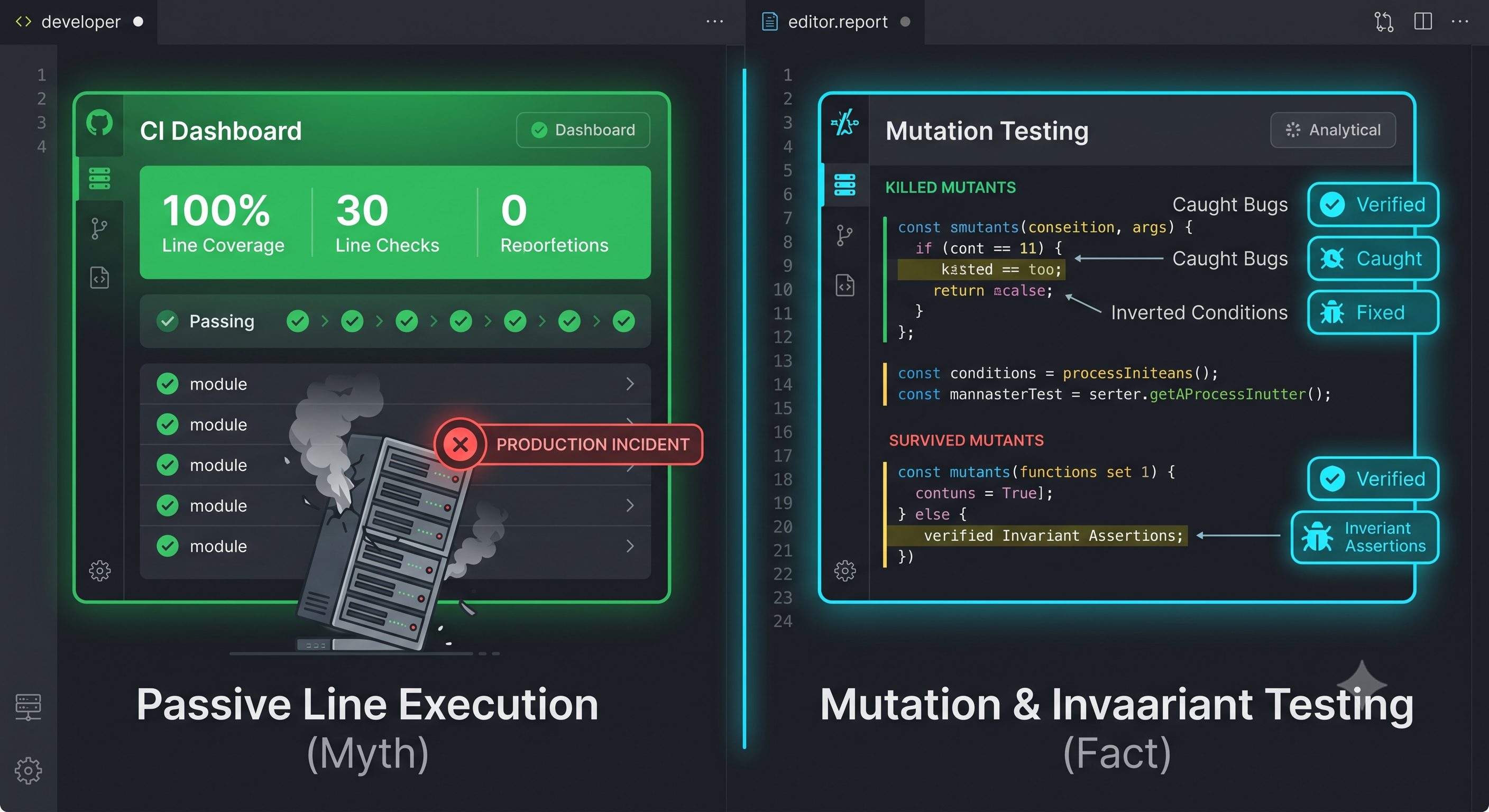 0 Commentarii 0 Distribuiri 138 Views 0 previzualizare
Mai multe povesti