 English
 Arabic
 French
 Spanish
 Portuguese
 Deutsch
 Turkish
 Dutch
Dutch
 Italiano
 Russian
 Romaian
 Portuguese (Brazil)
 Greek
Greek
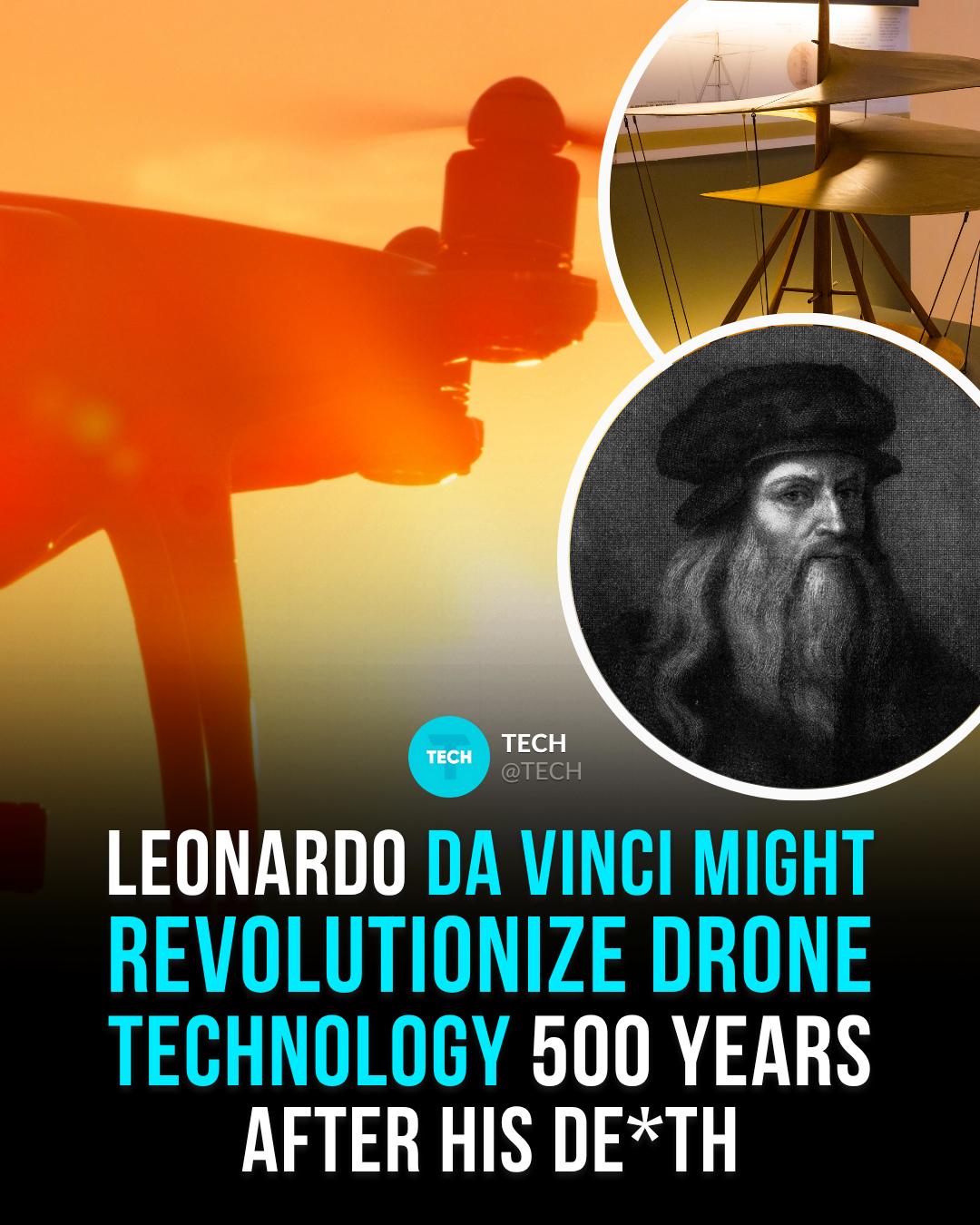
A Renaissance-era sketch may hold the key to building quieter drones. Scientists at Johns Hopkins University have revived Leonardo da Vinci’s “aerial screw,” a spiral rotor concept from the 1480s, and found it has a modern application: reducing the noise and energy demands of drone propellers. Through detailed computer simulations, they discovered that the helical rotor design offers surprising acoustic and aerodynamic benefits.
Unlike the sharp, narrow blades found on most commercial drones, da Vinci’s aerial screw has a broad, corkscrew-like surface that spins more slowly. That slower spin—and the smoother distribution of lift—means less turbulent airflow and fewer of the shrill, high-frequency tones typically produced by fast-spinning blades. Though the aerial screw generates slightly less lift than standard rotors, it compensates with greater surface area, resulting in more stable flight with far less noise and reduced mechanical power.
The implications for urban drone use are significant. Drones are increasingly being deployed for deliveries, inspections, and emergency response, but their noise—often compared to a swarm of angry bees—remains a major public complaint. A quieter rotor system could help drones integrate more seamlessly into everyday life without disturbing communities, especially in crowded cities where even subtle sounds can escalate into constant background noise.
While the researchers aren’t suggesting we swap all modern drone blades for da Vinci’s screw, they argue it’s time to revisit unconventional rotor shapes. Innovations sometimes mean looking forward—but other times, they mean rediscovering what we left behind. In this case, an idea sketched in the margins of history could reshape the future of flight, combining ancient vision with modern engineering.
Source: 2506.10223
#drones #technews #innovation #sciencefacts #engineering #futuretech #quiettech #davinci #designideas #droneflight #aerodynamics #techhistory #noisecanceling #urbanmobility
Unlike the sharp, narrow blades found on most commercial drones, da Vinci’s aerial screw has a broad, corkscrew-like surface that spins more slowly. That slower spin—and the smoother distribution of lift—means less turbulent airflow and fewer of the shrill, high-frequency tones typically produced by fast-spinning blades. Though the aerial screw generates slightly less lift than standard rotors, it compensates with greater surface area, resulting in more stable flight with far less noise and reduced mechanical power.
The implications for urban drone use are significant. Drones are increasingly being deployed for deliveries, inspections, and emergency response, but their noise—often compared to a swarm of angry bees—remains a major public complaint. A quieter rotor system could help drones integrate more seamlessly into everyday life without disturbing communities, especially in crowded cities where even subtle sounds can escalate into constant background noise.
While the researchers aren’t suggesting we swap all modern drone blades for da Vinci’s screw, they argue it’s time to revisit unconventional rotor shapes. Innovations sometimes mean looking forward—but other times, they mean rediscovering what we left behind. In this case, an idea sketched in the margins of history could reshape the future of flight, combining ancient vision with modern engineering.
Source: 2506.10223
#drones #technews #innovation #sciencefacts #engineering #futuretech #quiettech #davinci #designideas #droneflight #aerodynamics #techhistory #noisecanceling #urbanmobility
A Renaissance-era sketch may hold the key to building quieter drones. Scientists at Johns Hopkins University have revived Leonardo da Vinci’s “aerial screw,” a spiral rotor concept from the 1480s, and found it has a modern application: reducing the noise and energy demands of drone propellers. Through detailed computer simulations, they discovered that the helical rotor design offers surprising acoustic and aerodynamic benefits.
Unlike the sharp, narrow blades found on most commercial drones, da Vinci’s aerial screw has a broad, corkscrew-like surface that spins more slowly. That slower spin—and the smoother distribution of lift—means less turbulent airflow and fewer of the shrill, high-frequency tones typically produced by fast-spinning blades. Though the aerial screw generates slightly less lift than standard rotors, it compensates with greater surface area, resulting in more stable flight with far less noise and reduced mechanical power.
The implications for urban drone use are significant. Drones are increasingly being deployed for deliveries, inspections, and emergency response, but their noise—often compared to a swarm of angry bees—remains a major public complaint. A quieter rotor system could help drones integrate more seamlessly into everyday life without disturbing communities, especially in crowded cities where even subtle sounds can escalate into constant background noise.
While the researchers aren’t suggesting we swap all modern drone blades for da Vinci’s screw, they argue it’s time to revisit unconventional rotor shapes. Innovations sometimes mean looking forward—but other times, they mean rediscovering what we left behind. In this case, an idea sketched in the margins of history could reshape the future of flight, combining ancient vision with modern engineering.
Source: 2506.10223
#drones #technews #innovation #sciencefacts #engineering #futuretech #quiettech #davinci #designideas #droneflight #aerodynamics #techhistory #noisecanceling #urbanmobility
·146 Views
·0 Reviews
