English
 Arabic
 French
 Spanish
 Portuguese
 Deutsch
 Turkish
 Dutch
Dutch
 Italiano
 Russian
 Romaian
 Portuguese (Brazil)
 Greek
Greek
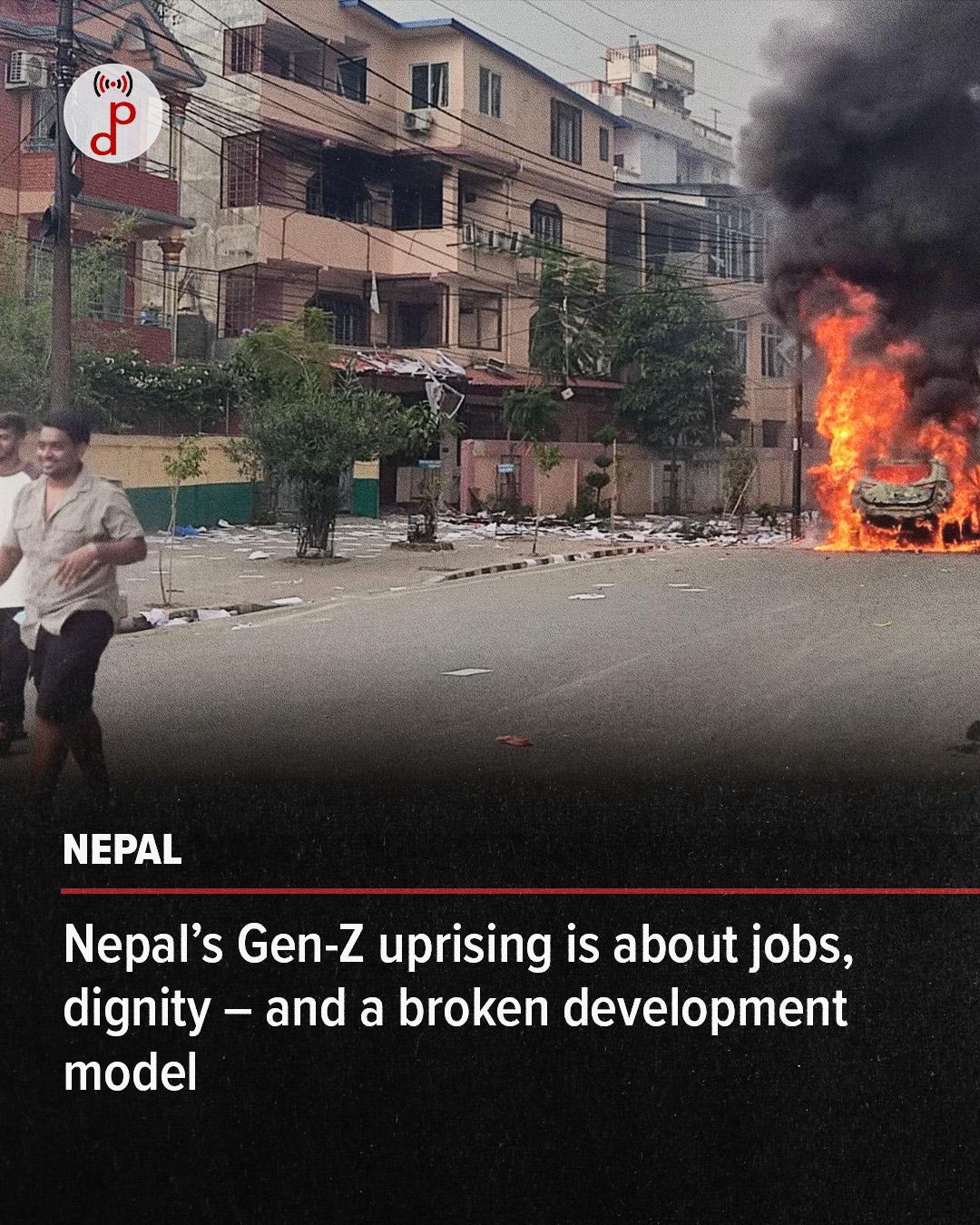
The resignation of Nepali PM KP Oli, amid massive youth-driven protests has raised many questions for the people of Nepal and its once united Left. While many have accused the uprising about merely being in response to a social media ban, the roots are much deeper.
Atul Chandra and Pramesh Pokharel write, “It is tempting – especially from afar – to narrate this as a clash over digital freedoms. That would be analytically thin. For Gen-Z Nepalis, platforms are not just entertainment; they are job boards, news wires, organizing tools, and social lifelines. Shutting them off – after years of economic drift – felt like collective punishment. But the deeper story is structural: Nepal’s growth has been stabilized by remittances rather than transformed by domestic investment capable of producing dignified work. In FY 2024/25, the Department of Foreign Employment issued 839,266 exit labor permits – staggering out-migration for a country of ~30 million. Remittances hovered around 33% of GDP in 2024, among the highest ratios worldwide. These numbers speak to survival, not social progress; they are a referendum on a model that exports its youth to low-wage contracts while importing basics, and that depends on patronage rather than productivity.”
Read the full article by Atul Chandra and Pramesh Pokharel on our website.
Atul Chandra and Pramesh Pokharel write, “It is tempting – especially from afar – to narrate this as a clash over digital freedoms. That would be analytically thin. For Gen-Z Nepalis, platforms are not just entertainment; they are job boards, news wires, organizing tools, and social lifelines. Shutting them off – after years of economic drift – felt like collective punishment. But the deeper story is structural: Nepal’s growth has been stabilized by remittances rather than transformed by domestic investment capable of producing dignified work. In FY 2024/25, the Department of Foreign Employment issued 839,266 exit labor permits – staggering out-migration for a country of ~30 million. Remittances hovered around 33% of GDP in 2024, among the highest ratios worldwide. These numbers speak to survival, not social progress; they are a referendum on a model that exports its youth to low-wage contracts while importing basics, and that depends on patronage rather than productivity.”
Read the full article by Atul Chandra and Pramesh Pokharel on our website.
The resignation of Nepali PM KP Oli, amid massive youth-driven protests has raised many questions for the people of Nepal and its once united Left. While many have accused the uprising about merely being in response to a social media ban, the roots are much deeper.
Atul Chandra and Pramesh Pokharel write, “It is tempting – especially from afar – to narrate this as a clash over digital freedoms. That would be analytically thin. For Gen-Z Nepalis, platforms are not just entertainment; they are job boards, news wires, organizing tools, and social lifelines. Shutting them off – after years of economic drift – felt like collective punishment. But the deeper story is structural: Nepal’s growth has been stabilized by remittances rather than transformed by domestic investment capable of producing dignified work. In FY 2024/25, the Department of Foreign Employment issued 839,266 exit labor permits – staggering out-migration for a country of ~30 million. Remittances hovered around 33% of GDP in 2024, among the highest ratios worldwide. These numbers speak to survival, not social progress; they are a referendum on a model that exports its youth to low-wage contracts while importing basics, and that depends on patronage rather than productivity.”
📲 Read the full article by Atul Chandra and Pramesh Pokharel on our website.
·669 Visualizações
·0 Anterior