 English
 Arabic
 French
 Spanish
 Portuguese
 Deutsch
 Turkish
 Dutch
Dutch
 Italiano
 Russian
 Romaian
 Portuguese (Brazil)
 Greek
Greek
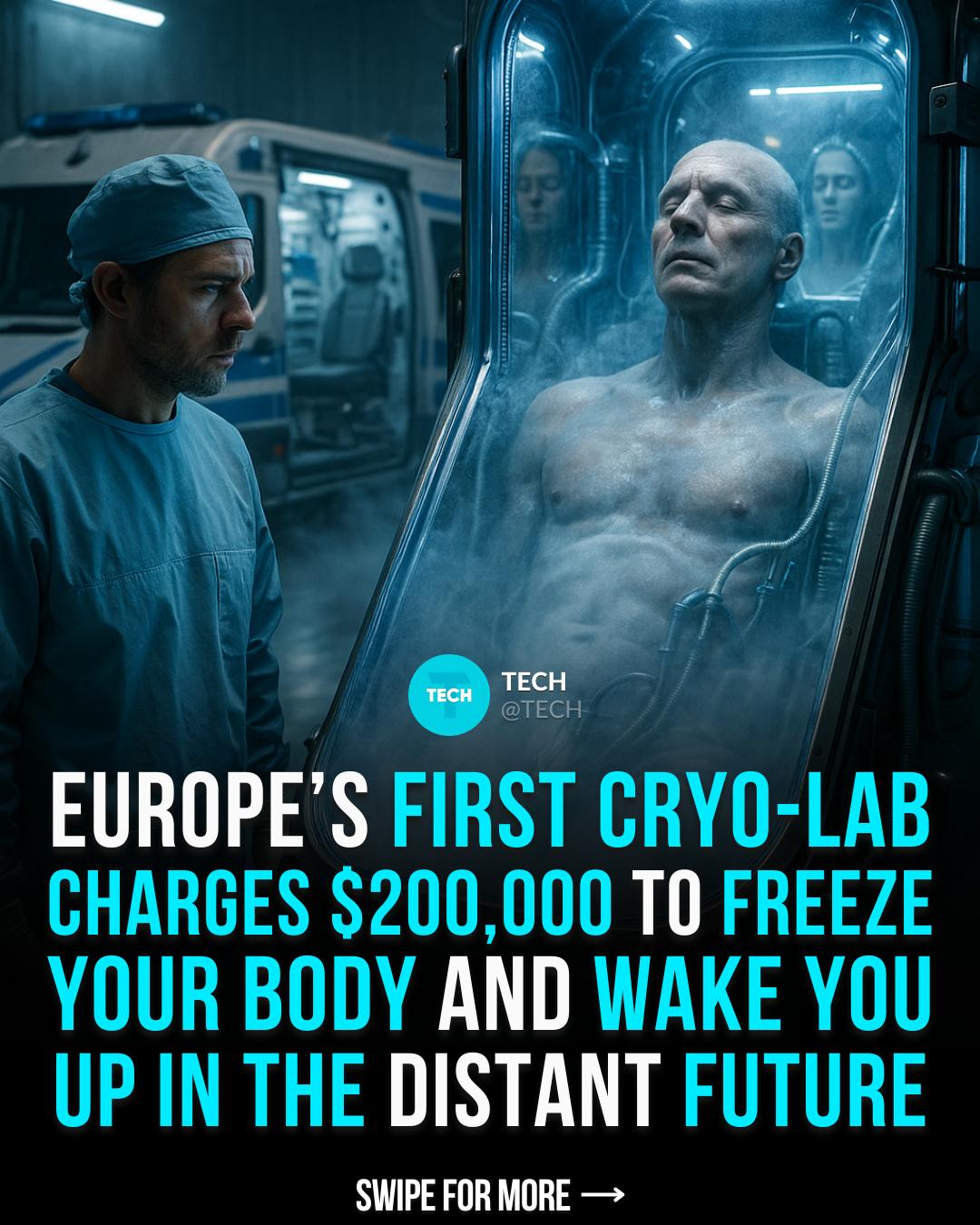
A Berlin-based startup is betting on the idea that death might not be permanent. Tomorrow Bio offers cryopreservation, cooling the body to around –196°C in liquid nitrogen after legal death, with the hope that future medical advances could one day reverse the process.
For roughly $200,000 for whole-body storage, or about $83,000 for the brain alone, plus a modest monthly membership, clients get 24/7 access to mobile medical teams. These retrofitted ambulances act as surgical suites, beginning the process immediately to prevent ice crystal damage. Bodily fluids are replaced with a cryoprotective “medical-grade antifreeze” before slow cooling to final storage in Switzerland, where the bodies can be preserved indefinitely without electricity.
The company says six people and five pets have already been preserved, with about 650 members signed up, most in their 30s to 40s, often tech professionals. In 2025, Tomorrow Bio plans to expand into the U.S., aiming to make cryonics more accessible and reduce costs over time. Demand, they say, has been fueled by growing interest in life extension and by the COVID-19 pandemic, which heightened public awareness of mortality.
Supporters compare cryonics to once-unthinkable medical advances like organ transplants, arguing that the procedure could give even a small chance of revival versus none at all. Critics counter that no organism with a human-level brain has been revived, and that decomposition begins as soon as the heart stops, making the process biologically implausible.
The company stresses there are no guarantees, and revival might take 50, 500, or even 1,000 years if it is possible at all. But for those drawn by the possibility of “time travel” into the future, indefinite preservation without ongoing power offers a tantalizing gamble against the finality of death.
#tech #biotech #cryonics #innovation #futuretech #medicaltechnology #startups #lifeextension #sciencenews
For roughly $200,000 for whole-body storage, or about $83,000 for the brain alone, plus a modest monthly membership, clients get 24/7 access to mobile medical teams. These retrofitted ambulances act as surgical suites, beginning the process immediately to prevent ice crystal damage. Bodily fluids are replaced with a cryoprotective “medical-grade antifreeze” before slow cooling to final storage in Switzerland, where the bodies can be preserved indefinitely without electricity.
The company says six people and five pets have already been preserved, with about 650 members signed up, most in their 30s to 40s, often tech professionals. In 2025, Tomorrow Bio plans to expand into the U.S., aiming to make cryonics more accessible and reduce costs over time. Demand, they say, has been fueled by growing interest in life extension and by the COVID-19 pandemic, which heightened public awareness of mortality.
Supporters compare cryonics to once-unthinkable medical advances like organ transplants, arguing that the procedure could give even a small chance of revival versus none at all. Critics counter that no organism with a human-level brain has been revived, and that decomposition begins as soon as the heart stops, making the process biologically implausible.
The company stresses there are no guarantees, and revival might take 50, 500, or even 1,000 years if it is possible at all. But for those drawn by the possibility of “time travel” into the future, indefinite preservation without ongoing power offers a tantalizing gamble against the finality of death.
#tech #biotech #cryonics #innovation #futuretech #medicaltechnology #startups #lifeextension #sciencenews
A Berlin-based startup is betting on the idea that death might not be permanent. Tomorrow Bio offers cryopreservation, cooling the body to around –196°C in liquid nitrogen after legal death, with the hope that future medical advances could one day reverse the process.
For roughly $200,000 for whole-body storage, or about $83,000 for the brain alone, plus a modest monthly membership, clients get 24/7 access to mobile medical teams. These retrofitted ambulances act as surgical suites, beginning the process immediately to prevent ice crystal damage. Bodily fluids are replaced with a cryoprotective “medical-grade antifreeze” before slow cooling to final storage in Switzerland, where the bodies can be preserved indefinitely without electricity.
The company says six people and five pets have already been preserved, with about 650 members signed up, most in their 30s to 40s, often tech professionals. In 2025, Tomorrow Bio plans to expand into the U.S., aiming to make cryonics more accessible and reduce costs over time. Demand, they say, has been fueled by growing interest in life extension and by the COVID-19 pandemic, which heightened public awareness of mortality.
Supporters compare cryonics to once-unthinkable medical advances like organ transplants, arguing that the procedure could give even a small chance of revival versus none at all. Critics counter that no organism with a human-level brain has been revived, and that decomposition begins as soon as the heart stops, making the process biologically implausible.
The company stresses there are no guarantees, and revival might take 50, 500, or even 1,000 years if it is possible at all. But for those drawn by the possibility of “time travel” into the future, indefinite preservation without ongoing power offers a tantalizing gamble against the finality of death.
#tech #biotech #cryonics #innovation #futuretech #medicaltechnology #startups #lifeextension #sciencenews
·251 Views
·0 Reviews
