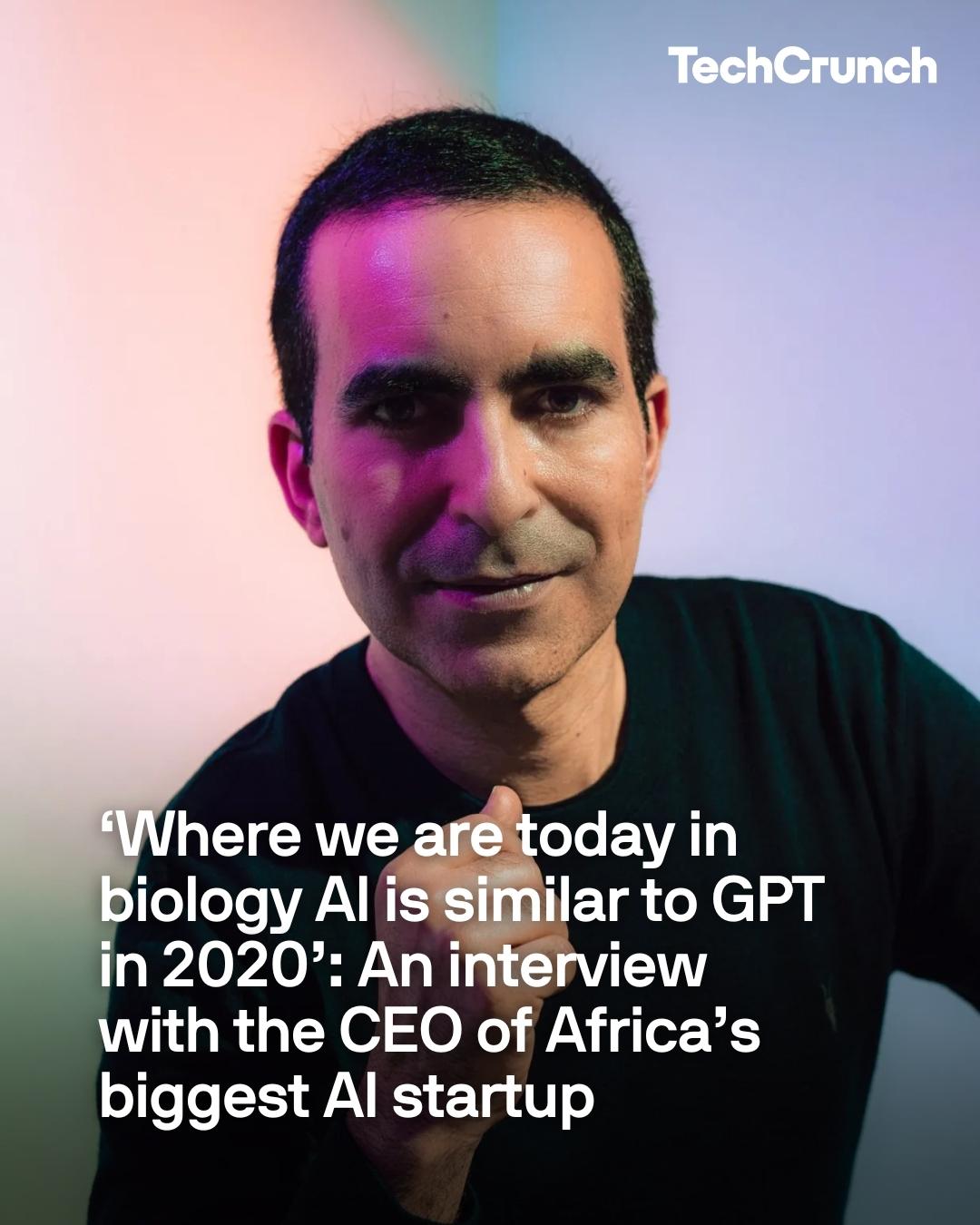
• BioNTech’s $550M acquisition of African AI startup InstaDeep is paying off.

    InstaDeep, known for its cutting-edge AI applications, continues to operate independently while boosting BioNTech’s biotech capabilities. In just over a year, the AI company has accelerated BioNTech’s drug and vaccine development, improving processes like tissue analysis by 5x.

    Their collaboration now includes breakthrough projects like AI-driven protein design and cancer-fighting innovations. Despite the biotech focus, InstaDeep is still making waves outside pharma, solving industrial challenges like railway scheduling and locust outbreak detection in Africa.

    With over 400 employees globally, InstaDeep is thriving under BioNTech’s wing and pushing the frontier of AI innovation across industries.

    Read our interview with InstaDeep's CEO Karim Beguir at the link in the bio

    Article by Tage Kene-Okafor

    Image Credits: InstaDeep; BioNTech

    #TechCrunch #technews #artificialintelligence #startup #founder #venturecapital
    BioNTech’s $550M acquisition of African AI startup InstaDeep is paying off. InstaDeep, known for its cutting-edge AI applications, continues to operate independently while boosting BioNTech’s biotech capabilities. In just over a year, the AI company has accelerated BioNTech’s drug and vaccine development, improving processes like tissue analysis by 5x. Their collaboration now includes breakthrough projects like AI-driven protein design and cancer-fighting innovations. Despite the biotech focus, InstaDeep is still making waves outside pharma, solving industrial challenges like railway scheduling and locust outbreak detection in Africa. With over 400 employees globally, InstaDeep is thriving under BioNTech’s wing and pushing the frontier of AI innovation across industries. Read our interview with InstaDeep's CEO Karim Beguir at the link in the bio 👆 Article by Tage Kene-Okafor Image Credits: InstaDeep; BioNTech #TechCrunch #technews #artificialintelligence #startup #founder #venturecapital
    ·90 Views ·0 Προεπισκόπηση

  • FuriosaAI, a South Korean startup that makes chips for AI applications, has rejected an $800 million acquisition offer from Meta, opting instead to focus on developing and producing its AI chips, according to a local media report.

    Disagreements over post-acquisition business strategy and organizational structure, rather than price issues, caused the negotiations to break down, the report said.

    Along with other tech companies building large language models (LLMs) for various AI applications, Meta has been trying to reduce its reliance on Nvidia for chips that are specialized for training and building LLMs. The tech giant last year unveiled its custom AI chips, and in January said it would invest up to $65 billion this year to support its AI initiatives.

    Meanwhile, FuriosaAI is reportedly in talks with investors to raise approximately $48 million (KRW 70 billion), and aims to complete the fundraise this month.

    Read more on FuriosaAI at the link in the bio

    Article by Kate Park

    Image Credits: Getty Images; FuriosaAI

    #TechCrunch #technews #artificialintelligence #startup #Meta #MarkZuckerberg
    FuriosaAI, a South Korean startup that makes chips for AI applications, has rejected an $800 million acquisition offer from Meta, opting instead to focus on developing and producing its AI chips, according to a local media report. Disagreements over post-acquisition business strategy and organizational structure, rather than price issues, caused the negotiations to break down, the report said. Along with other tech companies building large language models (LLMs) for various AI applications, Meta has been trying to reduce its reliance on Nvidia for chips that are specialized for training and building LLMs. The tech giant last year unveiled its custom AI chips, and in January said it would invest up to $65 billion this year to support its AI initiatives. Meanwhile, FuriosaAI is reportedly in talks with investors to raise approximately $48 million (KRW 70 billion), and aims to complete the fundraise this month. Read more on FuriosaAI at the link in the bio 👆 Article by Kate Park Image Credits: Getty Images; FuriosaAI #TechCrunch #technews #artificialintelligence #startup #Meta #MarkZuckerberg
    ·237 Views ·0 Προεπισκόπηση
  • After thousands of applications and weeks of review, the 200 startups competing in this year's Battlefield have been revealed. Every year, this class of competitors across a wide range of fields are vetted and explored, before a final group of 20 compete in-person in a pitch competition at our Disrupt event.

    And when all is said and done, one startup is the victor, taking home an equity-free $100K and a wealth of attention as they join the pantheon of other Battlefield alumni like Discord, Cloudflare, Dropbox, Fitbit and more.

    You can take a look at this year's slate of startups via the link in our bio, and sign up to keep tabs on the lead-up to the big Disrupt competition that kicks off October 27 in San Francisco, amid the rest of our packed lineup of speakers, workshops and networking opportunities.
    After thousands of applications and weeks of review, the 200 startups competing in this year's Battlefield have been revealed. Every year, this class of competitors across a wide range of fields are vetted and explored, before a final group of 20 compete in-person in a pitch competition at our Disrupt event. And when all is said and done, one startup is the victor, taking home an equity-free $100K and a wealth of attention as they join the pantheon of other Battlefield alumni like Discord, Cloudflare, Dropbox, Fitbit and more. You can take a look at this year's slate of startups via the link in our bio, and sign up to keep tabs on the lead-up to the big Disrupt competition that kicks off October 27 in San Francisco, amid the rest of our packed lineup of speakers, workshops and networking opportunities.
    ·139 Views ·0 Προεπισκόπηση
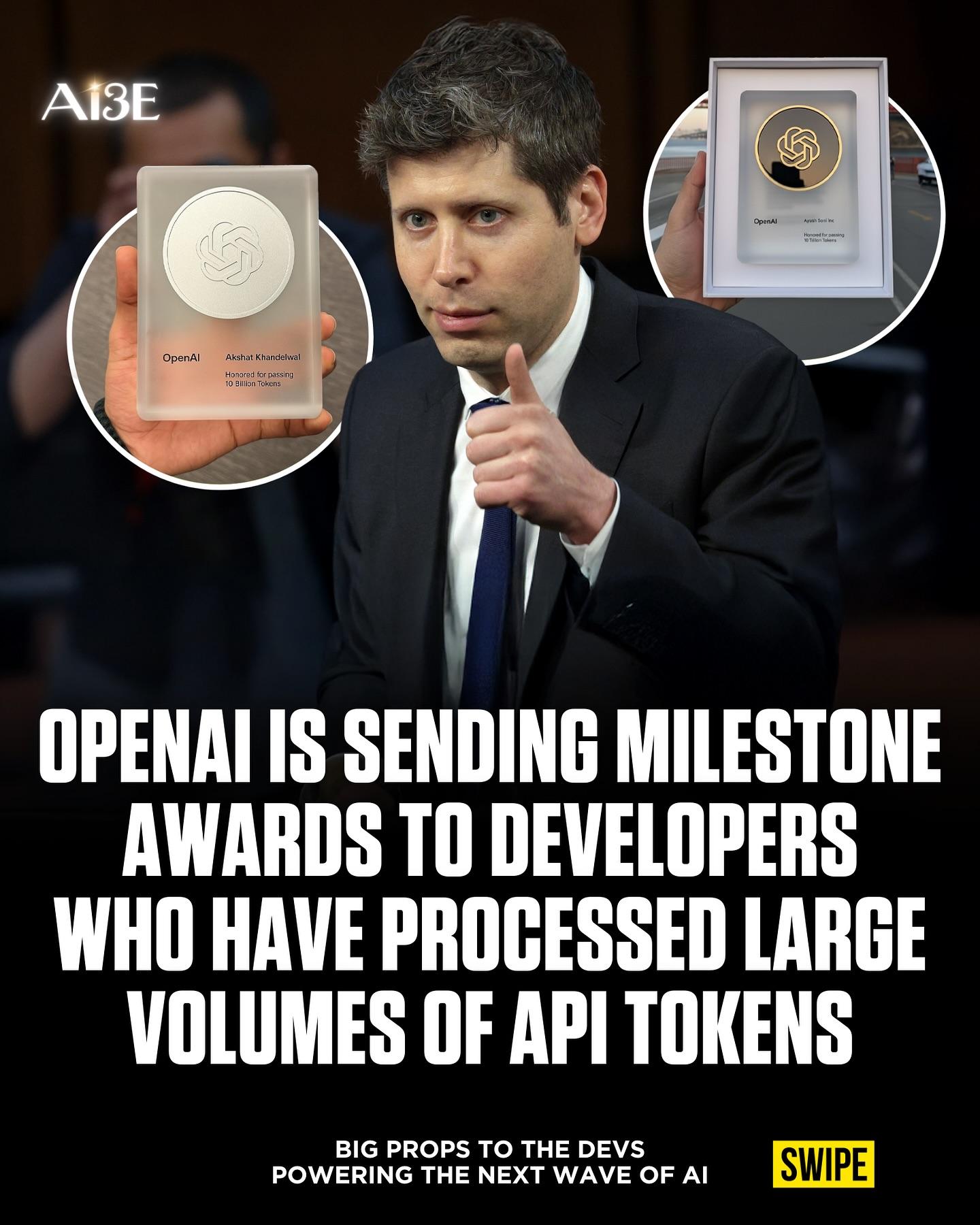
  • OpenAI has started recognizing developers who have reached major usage milestones on its API platform by sending them physical awards called “Tokens of Appreciation.”

    These awards are given to developers whose applications have processed billions or even trillions of tokens through the OpenAI API, highlighting their significant contribution to the ecosystem’s growth.

    Recipients have shared images of the awards online, featuring frosted glass plaques engraved with the OpenAI logo and the developer’s name, celebrating achievements such as 10 billion or 10 trillion tokens processed.

    The initiative aims to build a stronger sense of community and acknowledge the creators powering thousands of AI applications built on OpenAI’s technology.

    Follow us (@artificialintelligenceee) for everything latest from the AI world.

    Source: OpenAI Community
    Credits: @akshatk7/X @ayysoni/X @silasalberti/X @edwinarbus/X
    OpenAI has started recognizing developers who have reached major usage milestones on its API platform by sending them physical awards called “Tokens of Appreciation.” These awards are given to developers whose applications have processed billions or even trillions of tokens through the OpenAI API, highlighting their significant contribution to the ecosystem’s growth. Recipients have shared images of the awards online, featuring frosted glass plaques engraved with the OpenAI logo and the developer’s name, celebrating achievements such as 10 billion or 10 trillion tokens processed. The initiative aims to build a stronger sense of community and acknowledge the creators powering thousands of AI applications built on OpenAI’s technology. Follow us (👉@artificialintelligenceee) for everything latest from the AI world. Source: OpenAI Community Credits: @akshatk7/X @ayysoni/X @silasalberti/X @edwinarbus/X
    ·66 Views ·0 Προεπισκόπηση
  • Baldness might soon meet its match in a patch made from sugar. Scientists have engineered a dissolving microneedle system that fuses minoxidil, the main ingredient in Rogaine, with stevioside, the natural sweetener from the Stevia plant. The result is a tiny grid of microscopic spikes that melt into the scalp, releasing medication directly to the roots of hair growth.⁠

    Developed by teams in China and Australia and published in *Advanced Healthcare Materials*, the invention solves two of minoxidil’s biggest problems: it doesn’t dissolve well in water, and it barely seeps through skin. By building the microneedles out of stevioside, researchers found a way to make the drug more soluble, more absorbable, and far more effective than traditional topical solutions.⁠

    Microneedles work by creating painless channels through the skin’s outer layer, then dissolving to deliver their contents exactly where hair follicles lie. Stevioside, a molecule with both water-loving and water-repelling sides, behaves like a natural carrier, wrapping around minoxidil and ferrying it deep into the epidermis without the sting or irritation of alcohol-based treatments.⁠

    In lab tests using pig ear tissue, more than 85% of the drug penetrated the skin, with nearly 20% staying in place, over twice the amount seen with regular liquid minoxidil. When tested on mice bred to mimic pattern baldness, the patch spurred regrowth in roughly 67% of the treated area within 35 days, compared to just 25% for standard applications.⁠

    The technology could streamline hair restoration routines, reducing the need for daily treatments and avoiding messy solvents. Still, human biology remains the ultimate test, since hair growth cycles in people are slower and influenced by many factors. Clinical trials will determine whether this sweet innovation can turn a pantry staple into the next revolution in hair loss therapy.⁠

    #tech #biotech #dermatology #hairloss #minoxidil #microneedles #stevia #regenerativemedicine #innovation

    Source: 10.1002/adhm.202503575
    Baldness might soon meet its match in a patch made from sugar. Scientists have engineered a dissolving microneedle system that fuses minoxidil, the main ingredient in Rogaine, with stevioside, the natural sweetener from the Stevia plant. The result is a tiny grid of microscopic spikes that melt into the scalp, releasing medication directly to the roots of hair growth.⁠ ⁠ Developed by teams in China and Australia and published in *Advanced Healthcare Materials*, the invention solves two of minoxidil’s biggest problems: it doesn’t dissolve well in water, and it barely seeps through skin. By building the microneedles out of stevioside, researchers found a way to make the drug more soluble, more absorbable, and far more effective than traditional topical solutions.⁠ ⁠ Microneedles work by creating painless channels through the skin’s outer layer, then dissolving to deliver their contents exactly where hair follicles lie. Stevioside, a molecule with both water-loving and water-repelling sides, behaves like a natural carrier, wrapping around minoxidil and ferrying it deep into the epidermis without the sting or irritation of alcohol-based treatments.⁠ ⁠ In lab tests using pig ear tissue, more than 85% of the drug penetrated the skin, with nearly 20% staying in place, over twice the amount seen with regular liquid minoxidil. When tested on mice bred to mimic pattern baldness, the patch spurred regrowth in roughly 67% of the treated area within 35 days, compared to just 25% for standard applications.⁠ ⁠ The technology could streamline hair restoration routines, reducing the need for daily treatments and avoiding messy solvents. Still, human biology remains the ultimate test, since hair growth cycles in people are slower and influenced by many factors. Clinical trials will determine whether this sweet innovation can turn a pantry staple into the next revolution in hair loss therapy.⁠ ⁠ #tech #biotech #dermatology #hairloss #minoxidil #microneedles #stevia #regenerativemedicine #innovation⁠ ⁠ Source: 10.1002/adhm.202503575
    ·225 Views ·0 Προεπισκόπηση
  • After thousands of applications and weeks of review, the 200 startups competing in this year's Battlefield have been revealed. Every year, this class of competitors across a wide range of fields are vetted and explored, before a final group of 20 compete in-person in a pitch competition at our Disrupt event.

    And when all is said and done, one startup is the victor, taking home an equity-free $100K and a wealth of attention as they join the pantheon of other Battlefield alumni like Discord, Cloudflare, Dropbox, Fitbit and more.

    You can take a look at this year's slate of startups via the link in our bio, and sign up to keep tabs on the lead-up to the big Disrupt competition that kicks off October 27 in San Francisco, amid the rest of our packed lineup of speakers, workshops and networking opportunities.
    After thousands of applications and weeks of review, the 200 startups competing in this year's Battlefield have been revealed. Every year, this class of competitors across a wide range of fields are vetted and explored, before a final group of 20 compete in-person in a pitch competition at our Disrupt event. And when all is said and done, one startup is the victor, taking home an equity-free $100K and a wealth of attention as they join the pantheon of other Battlefield alumni like Discord, Cloudflare, Dropbox, Fitbit and more. You can take a look at this year's slate of startups via the link in our bio, and sign up to keep tabs on the lead-up to the big Disrupt competition that kicks off October 27 in San Francisco, amid the rest of our packed lineup of speakers, workshops and networking opportunities.
    ·226 Views ·0 Προεπισκόπηση
  • Tucked inside certain CT scanners is a surprising gadget you might not expect: the Xbox Kinect.

    First launched in 2010 as a motion-sensing camera for the Xbox 360, it was designed to capture players’ movements for gaming. But its sophisticated infrared depth sensor quickly proved useful far beyond entertainment.

    In medical settings, the Kinect’s ability to detect precise motion helps improve imaging by monitoring how patients move and position themselves. Researchers have also tapped into its potential for affordable 3D scanning, robotics applications, and even gesture-based controls in labs and factories.

    What began as a gaming accessory has quietly evolved into a valuable tool for science and medicine.

    Love Technology? Follow @FutureTech
    Tucked inside certain CT scanners is a surprising gadget you might not expect: the Xbox Kinect. First launched in 2010 as a motion-sensing camera for the Xbox 360, it was designed to capture players’ movements for gaming. But its sophisticated infrared depth sensor quickly proved useful far beyond entertainment. In medical settings, the Kinect’s ability to detect precise motion helps improve imaging by monitoring how patients move and position themselves. Researchers have also tapped into its potential for affordable 3D scanning, robotics applications, and even gesture-based controls in labs and factories. What began as a gaming accessory has quietly evolved into a valuable tool for science and medicine. Love Technology? 👉 Follow @FutureTech 🔌
    ·272 Views ·0 Προεπισκόπηση
  • In a quiet lab at the City University of Hong Kong, researchers have built a device that lets you taste the virtual world.⁠

    This sleek, lollipop-shaped interface delivers nine vivid flavors—sugar, salt, citric acid, cherry, passion fruit, green tea, milk, durian, and grapefruit—using flavored hydrogels and precise electrical stimulation. It's not just a gimmick. The device uses iontophoresis, a method where charged ions transport food-safe chemicals to the surface of the lollipop, where they mix with saliva to trigger realistic taste sensations. The stronger the electrical current, the more intense the flavor.⁠

    Compared to earlier attempts involving bulky chemical sprays or awkward electrodes, this innovation is compact, portable, and refreshingly low-power. Weighing just 15 grams, the device is embedded with ultrathin circuit boards, Bluetooth connectivity, and a 3D-printed nylon shell. The red algae-based hydrogels sit in nine taste channels and activate only when stimulated, ensuring flavor delivery remains clean, safe, and user-controlled.⁠

    Scent integration adds another layer of realism, with seven odor channels enriching the user’s flavor perception. Its potential applications stretch beyond gaming. Imagine taste-testing food before buying it online, training chefs in a virtual classroom, or helping diagnose taste disorders with a digital lick instead of lab samples.⁠

    Each session currently lasts about an hour, limited by the shrinking gels, but researchers are already working on longer-lasting and more versatile designs. It’s a taste of what’s to come in extended reality—where digital worlds may soon engage all five senses with stunning fidelity.⁠

    #vr #virtualreality #xr #futuretech #wearabletech #hci #taste #immersivetech #multisensory #techinnovation #augmentedreality #mixedreality

    Source: 10.1073/pnas.2412116121
    In a quiet lab at the City University of Hong Kong, researchers have built a device that lets you taste the virtual world.⁠ ⁠ This sleek, lollipop-shaped interface delivers nine vivid flavors—sugar, salt, citric acid, cherry, passion fruit, green tea, milk, durian, and grapefruit—using flavored hydrogels and precise electrical stimulation. It's not just a gimmick. The device uses iontophoresis, a method where charged ions transport food-safe chemicals to the surface of the lollipop, where they mix with saliva to trigger realistic taste sensations. The stronger the electrical current, the more intense the flavor.⁠ ⁠ Compared to earlier attempts involving bulky chemical sprays or awkward electrodes, this innovation is compact, portable, and refreshingly low-power. Weighing just 15 grams, the device is embedded with ultrathin circuit boards, Bluetooth connectivity, and a 3D-printed nylon shell. The red algae-based hydrogels sit in nine taste channels and activate only when stimulated, ensuring flavor delivery remains clean, safe, and user-controlled.⁠ ⁠ Scent integration adds another layer of realism, with seven odor channels enriching the user’s flavor perception. Its potential applications stretch beyond gaming. Imagine taste-testing food before buying it online, training chefs in a virtual classroom, or helping diagnose taste disorders with a digital lick instead of lab samples.⁠ ⁠ Each session currently lasts about an hour, limited by the shrinking gels, but researchers are already working on longer-lasting and more versatile designs. It’s a taste of what’s to come in extended reality—where digital worlds may soon engage all five senses with stunning fidelity.⁠ ⁠ #vr #virtualreality #xr #futuretech #wearabletech #hci #taste #immersivetech #multisensory #techinnovation #augmentedreality #mixedreality⁠ ⁠ Source: 10.1073/pnas.2412116121
    ·265 Views ·0 Προεπισκόπηση
  • China just unveiled a tiny 6G powerhouse: an “all-frequency” chip that spans 0.5 to 115 gigahertz and topped 100 gigabits per second in lab tests. Built by teams at Peking University and City University of Hong Kong, the 11 mm by 1.7 mm device consolidates what once required nine separate radio systems into a single thumbnail-sized package, stitching together low microwave bands with millimeter-wave and terahertz for both reach and raw speed.⁠

    The secret is photonic-electronic fusion. A broadband electro-optic modulator converts wireless signals into light, photonic components process them, and tunable lasers mix frequencies on the fly. In trials, the chip maintained stable links across its full span and could retune 6 GHz in about 180 microseconds, hundreds of times faster than a blink, while sustaining single-channel rates above 100 Gbps.⁠

    Coverage agility is built in. If one band is blocked or noisy, “frequency navigation” hops instantly to a clearer channel, preserving continuity in crowded arenas, dense cities, or challenging terrains. High bands handle ultra-low-latency tasks like immersive VR or telesurgery, while lower bands push signals across rural regions, underwater corridors, and even space, an explicit aim to narrow the urban-rural digital gap where typical speeds hover near 20 Mbps.⁠

    Researchers say this is also a hardware foundation for AI-native networks, radios that sense their environment and algorithmically adapt in real time. Next up are plug-and-play modules no larger than a USB stick for phones, base stations, drones, and IoT gear. If commercialized, networking stops being a patchwork of bands and boxes and becomes a single, programmable spectrum fabric, transforming global connectivity and opening the door to unprecedented applications in automation, medicine, and exploration.⁠

    #6g #wireless #photonics #ai #telecom #chips #china #terahertz #futureofconnectivity #innovation #iot #vr #automation
    China just unveiled a tiny 6G powerhouse: an “all-frequency” chip that spans 0.5 to 115 gigahertz and topped 100 gigabits per second in lab tests. Built by teams at Peking University and City University of Hong Kong, the 11 mm by 1.7 mm device consolidates what once required nine separate radio systems into a single thumbnail-sized package, stitching together low microwave bands with millimeter-wave and terahertz for both reach and raw speed.⁠ ⁠ The secret is photonic-electronic fusion. A broadband electro-optic modulator converts wireless signals into light, photonic components process them, and tunable lasers mix frequencies on the fly. In trials, the chip maintained stable links across its full span and could retune 6 GHz in about 180 microseconds, hundreds of times faster than a blink, while sustaining single-channel rates above 100 Gbps.⁠ ⁠ Coverage agility is built in. If one band is blocked or noisy, “frequency navigation” hops instantly to a clearer channel, preserving continuity in crowded arenas, dense cities, or challenging terrains. High bands handle ultra-low-latency tasks like immersive VR or telesurgery, while lower bands push signals across rural regions, underwater corridors, and even space, an explicit aim to narrow the urban-rural digital gap where typical speeds hover near 20 Mbps.⁠ ⁠ Researchers say this is also a hardware foundation for AI-native networks, radios that sense their environment and algorithmically adapt in real time. Next up are plug-and-play modules no larger than a USB stick for phones, base stations, drones, and IoT gear. If commercialized, networking stops being a patchwork of bands and boxes and becomes a single, programmable spectrum fabric, transforming global connectivity and opening the door to unprecedented applications in automation, medicine, and exploration.⁠ ⁠ #6g #wireless #photonics #ai #telecom #chips #china #terahertz #futureofconnectivity #innovation #iot #vr #automation
    ·316 Views ·0 Προεπισκόπηση
  • Most crystals sit quietly in their rigid lattices, but researchers have uncovered one with a startling ability: it can inhale and exhale oxygen like a living system. The thin-film oxide SrFe0.5Co0.5O2.5 releases oxygen in a reducing gas, then reabsorbs it in oxygen, cycling repeatedly at relatively low temperatures without breaking down. Each time, the crystal restores itself fully, making it both durable and dynamic.⁠

    The surprise lies in its selectivity. Only cobalt ions shift their charge state while iron remains stable, a rare form of control that triggers a reversible structural change. As oxygen leaves, the crystal grows clearer and more insulating, its lattice subtly expanding. When oxygen returns, conductivity rises again and transparency fades, demonstrating a finely tuned switch for multiple properties.⁠

    This oxygen control is crucial for technologies like solid oxide fuel cells, which generate electricity from hydrogen. Achieving stable cycling at about 400 °C—hundreds of degrees below many predecessors—could cut costs and expand where these cells can operate. The same principle could enable smart windows that automatically regulate light and heat, or thermal transistors that direct heat flow with the precision of electrical circuits.⁠

    Practical challenges remain, including cobalt’s high cost and problematic mining practices, as well as the need to scale from thin laboratory films to robust real-world devices. But the discovery marks a leap forward, showing that crystals can be engineered to act as programmable, reversible oxygen systems with applications in clean energy and adaptive electronics.⁠

    #materials #energy #cleanenergy #fuelcells #smartwindows #perovskite #oxides #hydrogen #nanotechnology
    Most crystals sit quietly in their rigid lattices, but researchers have uncovered one with a startling ability: it can inhale and exhale oxygen like a living system. The thin-film oxide SrFe0.5Co0.5O2.5 releases oxygen in a reducing gas, then reabsorbs it in oxygen, cycling repeatedly at relatively low temperatures without breaking down. Each time, the crystal restores itself fully, making it both durable and dynamic.⁠ ⁠ The surprise lies in its selectivity. Only cobalt ions shift their charge state while iron remains stable, a rare form of control that triggers a reversible structural change. As oxygen leaves, the crystal grows clearer and more insulating, its lattice subtly expanding. When oxygen returns, conductivity rises again and transparency fades, demonstrating a finely tuned switch for multiple properties.⁠ ⁠ This oxygen control is crucial for technologies like solid oxide fuel cells, which generate electricity from hydrogen. Achieving stable cycling at about 400 °C—hundreds of degrees below many predecessors—could cut costs and expand where these cells can operate. The same principle could enable smart windows that automatically regulate light and heat, or thermal transistors that direct heat flow with the precision of electrical circuits.⁠ ⁠ Practical challenges remain, including cobalt’s high cost and problematic mining practices, as well as the need to scale from thin laboratory films to robust real-world devices. But the discovery marks a leap forward, showing that crystals can be engineered to act as programmable, reversible oxygen systems with applications in clean energy and adaptive electronics.⁠ ⁠ #materials #energy #cleanenergy #fuelcells #smartwindows #perovskite #oxides #hydrogen #nanotechnology
    ·252 Views ·0 Προεπισκόπηση
Αναζήτηση αποτελεσμάτων
Techawks - Powered By Pantrade Blockchain https://techawks.com