• When Fernando Ortiz Monasterio first gazed at the gray forest of highway pillars choking Mexico City’s Periférico, he saw potential. Not concrete. Not gridlock. But a vertical garden—one that would breathe life into one of the world’s most polluted capitals.⁠

    What followed was a transformation both literal and symbolic. Today, more than 1,000 columns of the Anillo Periférico are wrapped in dense, vibrant greenery. Dubbed Vía Verde, the project spans over 60,000 square meters of vertical gardens, irrigated by reclaimed water and sustained by recycled materials. No soil required—just innovation, textile, and hydroponics.⁠

    The system is intelligent. Each pillar contains sensors that monitor light, temperature, and moisture. They communicate in real time, triggering precision irrigation to conserve resources while maximizing plant health. These aren’t just decorative installations—they’re engineered ecosystems.⁠

    Ambitious by design, Vía Verde claims to filter 27,000 tons of air pollutants a year, trap heavy metals, and generate clean oxygen for tens of thousands. But the benefits go beyond air quality. The gardens reduce urban heat, dampen traffic noise, and even provide jobs—many filled by community workers and rehabilitating inmates.⁠

    Still, not everyone is convinced. Critics argue the project is more about aesthetics than impact. Replacing smog with succulents, they say, doesn’t address the core issue: car dependency. For the cost of one vertical column, the city could plant 300 trees.⁠

    Even Ortiz admits this is just a beginning. His firm is pushing to expand Vía Verde across rooftops, bridges, and tunnels—10 million square meters by 2030. But that would still fall short of WHO’s recommended green space per resident.⁠

    The vision is bold. The execution, ongoing. But even in a city of concrete and chaos, it’s possible to grow something green.⁠
    When Fernando Ortiz Monasterio first gazed at the gray forest of highway pillars choking Mexico City’s Periférico, he saw potential. Not concrete. Not gridlock. But a vertical garden—one that would breathe life into one of the world’s most polluted capitals.⁠ ⁠ What followed was a transformation both literal and symbolic. Today, more than 1,000 columns of the Anillo Periférico are wrapped in dense, vibrant greenery. Dubbed Vía Verde, the project spans over 60,000 square meters of vertical gardens, irrigated by reclaimed water and sustained by recycled materials. No soil required—just innovation, textile, and hydroponics.⁠ ⁠ The system is intelligent. Each pillar contains sensors that monitor light, temperature, and moisture. They communicate in real time, triggering precision irrigation to conserve resources while maximizing plant health. These aren’t just decorative installations—they’re engineered ecosystems.⁠ ⁠ Ambitious by design, Vía Verde claims to filter 27,000 tons of air pollutants a year, trap heavy metals, and generate clean oxygen for tens of thousands. But the benefits go beyond air quality. The gardens reduce urban heat, dampen traffic noise, and even provide jobs—many filled by community workers and rehabilitating inmates.⁠ ⁠ Still, not everyone is convinced. Critics argue the project is more about aesthetics than impact. Replacing smog with succulents, they say, doesn’t address the core issue: car dependency. For the cost of one vertical column, the city could plant 300 trees.⁠ ⁠ Even Ortiz admits this is just a beginning. His firm is pushing to expand Vía Verde across rooftops, bridges, and tunnels—10 million square meters by 2030. But that would still fall short of WHO’s recommended green space per resident.⁠ ⁠ The vision is bold. The execution, ongoing. But even in a city of concrete and chaos, it’s possible to grow something green.⁠ ⁠
    ·101 Views ·0 voorbeeld
  • Cities are learning to cool with time, not just power. So-called ice batteries, thermal energy storage tanks that freeze liquid overnight, let buildings ride the next day’s heat on yesterday’s cold. Shifting chillers to off-peak hours trims grid stress when temperatures spike and electricity is priciest, creating a smoother balance between supply and demand.⁠

    The numbers are real, not theoretical. Manhattan’s 30-story Eleven Madison freezes roughly 500,000 pounds of ice each night and reports up to a 40% cut in cooling costs. Trane and others have installed more than 4,000 systems worldwide, a tiny slice of six million U.S. commercial buildings but a proof that scaling is possible and increasingly attractive in hotter climates.⁠

    The tech is getting smarter at the material level. In The Journal of Physical Chemistry C, a Texas A&M team led by Patrick Shamberger tuned salt hydrates, salts that lock in water molecules, to freeze and thaw at HVAC-friendly temperatures without degrading. Their focus is phase segregation, the tendency for the material to split into solid and liquid zones over many cycles. By optimizing “nucleation particles,” especially those containing barium, the system triggers cleaner, repeatable freezing with higher efficiency.⁠

    Why this matters now: cooling already eats about 20% of building electricity, and AI data centers are adding heavy, always-on thermal loads. Ice batteries do not eliminate energy use, but they move it to when power is cleaner and cheaper, lowering peak demand and postponing the need for new plants.⁠

    A century after barges hauled river ice down the Hudson, engineered ice may again be the quiet workhorse that keeps modern life comfortable, only this time with chemistry doing the steering and research ensuring decades of reliable performance.⁠

    #tech #energy #hvac #buildings #energystorage #grid #climate #datacenters #materials
    Cities are learning to cool with time, not just power. So-called ice batteries, thermal energy storage tanks that freeze liquid overnight, let buildings ride the next day’s heat on yesterday’s cold. Shifting chillers to off-peak hours trims grid stress when temperatures spike and electricity is priciest, creating a smoother balance between supply and demand.⁠ ⁠ The numbers are real, not theoretical. Manhattan’s 30-story Eleven Madison freezes roughly 500,000 pounds of ice each night and reports up to a 40% cut in cooling costs. Trane and others have installed more than 4,000 systems worldwide, a tiny slice of six million U.S. commercial buildings but a proof that scaling is possible and increasingly attractive in hotter climates.⁠ ⁠ The tech is getting smarter at the material level. In The Journal of Physical Chemistry C, a Texas A&M team led by Patrick Shamberger tuned salt hydrates, salts that lock in water molecules, to freeze and thaw at HVAC-friendly temperatures without degrading. Their focus is phase segregation, the tendency for the material to split into solid and liquid zones over many cycles. By optimizing “nucleation particles,” especially those containing barium, the system triggers cleaner, repeatable freezing with higher efficiency.⁠ ⁠ Why this matters now: cooling already eats about 20% of building electricity, and AI data centers are adding heavy, always-on thermal loads. Ice batteries do not eliminate energy use, but they move it to when power is cleaner and cheaper, lowering peak demand and postponing the need for new plants.⁠ ⁠ A century after barges hauled river ice down the Hudson, engineered ice may again be the quiet workhorse that keeps modern life comfortable, only this time with chemistry doing the steering and research ensuring decades of reliable performance.⁠ ⁠ #tech #energy #hvac #buildings #energystorage #grid #climate #datacenters #materials
    ·114 Views ·0 voorbeeld
  • A clear coating that turns ordinary windows into quiet power plants just cleared its first big test. Researchers at Nanjing University built a colorless, unidirectional solar concentrator that paints onto glass, keeps the view intact, and routes part of the sunlight to slim photovoltaic strips hidden along the pane’s edge.⁠

    The trick lies in cholesteric liquid crystals, a class of layered, helix-shaped materials that interact with light in precise ways. Stacked into ultrathin films, they selectively diffract one polarization of light, then steer those photons into the glass like a waveguide, where edge-mounted cells convert them to electricity. In plain English, most light passes through as normal, while a targeted slice is siphoned sideways for power.⁠

    Clarity holds up. Lab measurements show about 64.2 percent visible light transmission and a 91.3 percent color rendering index, so scenes look natural. Under green laser tests, up to 38.1 percent of incident energy was captured at the edges, and under full-spectrum conditions, the optical guiding efficiency reached 18.1 percent. A one-inch demo powered a 10-milliwatt fan outdoors, proving the idea works in practice.⁠

    Scale matters here, and the outlook is practical. Modeling suggests a two-meter-wide coated window could concentrate sunlight roughly 50×, cutting required solar cell area by as much as 75 percent. The films are made via photoalignment and polymerization, compatible with roll-to-roll manufacturing, and designed for durable retrofits onto existing glass. Researchers also stress the long-term stability of the design, noting it can withstand environmental exposure while remaining cost effective and visually unobtrusive.⁠

    Today’s system reports a modest 3.7 percent power conversion efficiency, but it can pair with high-performance cells like gallium arsenide and is engineered for steady gains. If windows become generators, architecture turns into infrastructure, and cities start harvesting the daylight they already own.⁠

    #tech #solar #renewableenergy #cleantech #architecture #materials #liquidcrystals #sustainability #energyefficiency

    Source: 10.1186/s43074-025-00178-3
    A clear coating that turns ordinary windows into quiet power plants just cleared its first big test. Researchers at Nanjing University built a colorless, unidirectional solar concentrator that paints onto glass, keeps the view intact, and routes part of the sunlight to slim photovoltaic strips hidden along the pane’s edge.⁠ ⁠ The trick lies in cholesteric liquid crystals, a class of layered, helix-shaped materials that interact with light in precise ways. Stacked into ultrathin films, they selectively diffract one polarization of light, then steer those photons into the glass like a waveguide, where edge-mounted cells convert them to electricity. In plain English, most light passes through as normal, while a targeted slice is siphoned sideways for power.⁠ ⁠ Clarity holds up. Lab measurements show about 64.2 percent visible light transmission and a 91.3 percent color rendering index, so scenes look natural. Under green laser tests, up to 38.1 percent of incident energy was captured at the edges, and under full-spectrum conditions, the optical guiding efficiency reached 18.1 percent. A one-inch demo powered a 10-milliwatt fan outdoors, proving the idea works in practice.⁠ ⁠ Scale matters here, and the outlook is practical. Modeling suggests a two-meter-wide coated window could concentrate sunlight roughly 50×, cutting required solar cell area by as much as 75 percent. The films are made via photoalignment and polymerization, compatible with roll-to-roll manufacturing, and designed for durable retrofits onto existing glass. Researchers also stress the long-term stability of the design, noting it can withstand environmental exposure while remaining cost effective and visually unobtrusive.⁠ ⁠ Today’s system reports a modest 3.7 percent power conversion efficiency, but it can pair with high-performance cells like gallium arsenide and is engineered for steady gains. If windows become generators, architecture turns into infrastructure, and cities start harvesting the daylight they already own.⁠ ⁠ #tech #solar #renewableenergy #cleantech #architecture #materials #liquidcrystals #sustainability #energyefficiency⁠ ⁠ Source: 10.1186/s43074-025-00178-3
    ·141 Views ·0 voorbeeld
  • GameStop will host a unique “Trade Anything” Day on December 6, letting customers bring almost any item in exchange for store credit. The event is meant to draw people into stores with its unusual concept. While taxidermy is allowed, a long banned list includes hazardous materials, lithium-ion batteries, alcohol, drugs, computers, small electronics, TVs, jewelry, gift cards, and items resembling body parts. Store staff will decide what qualifies, and each store has a specific container to limit item size. GameStop hasn’t revealed how trades will be valued, adding more curiosity to the event.
    What kind of unusual items do you think people will bring to this event?

    #GameStop

    [Follow @gamenewsplusnet]

    Hashtags:

    #Gaming #VideoGames #Game #Gamer #GameNewsPlus
    GameStop will host a unique “Trade Anything” Day on December 6, letting customers bring almost any item in exchange for store credit. The event is meant to draw people into stores with its unusual concept. While taxidermy is allowed, a long banned list includes hazardous materials, lithium-ion batteries, alcohol, drugs, computers, small electronics, TVs, jewelry, gift cards, and items resembling body parts. Store staff will decide what qualifies, and each store has a specific container to limit item size. GameStop hasn’t revealed how trades will be valued, adding more curiosity to the event. What kind of unusual items do you think people will bring to this event? #GameStop [Follow @gamenewsplusnet] Hashtags: #Gaming #VideoGames #Game #Gamer #GameNewsPlus
    ·187 Views ·0 voorbeeld
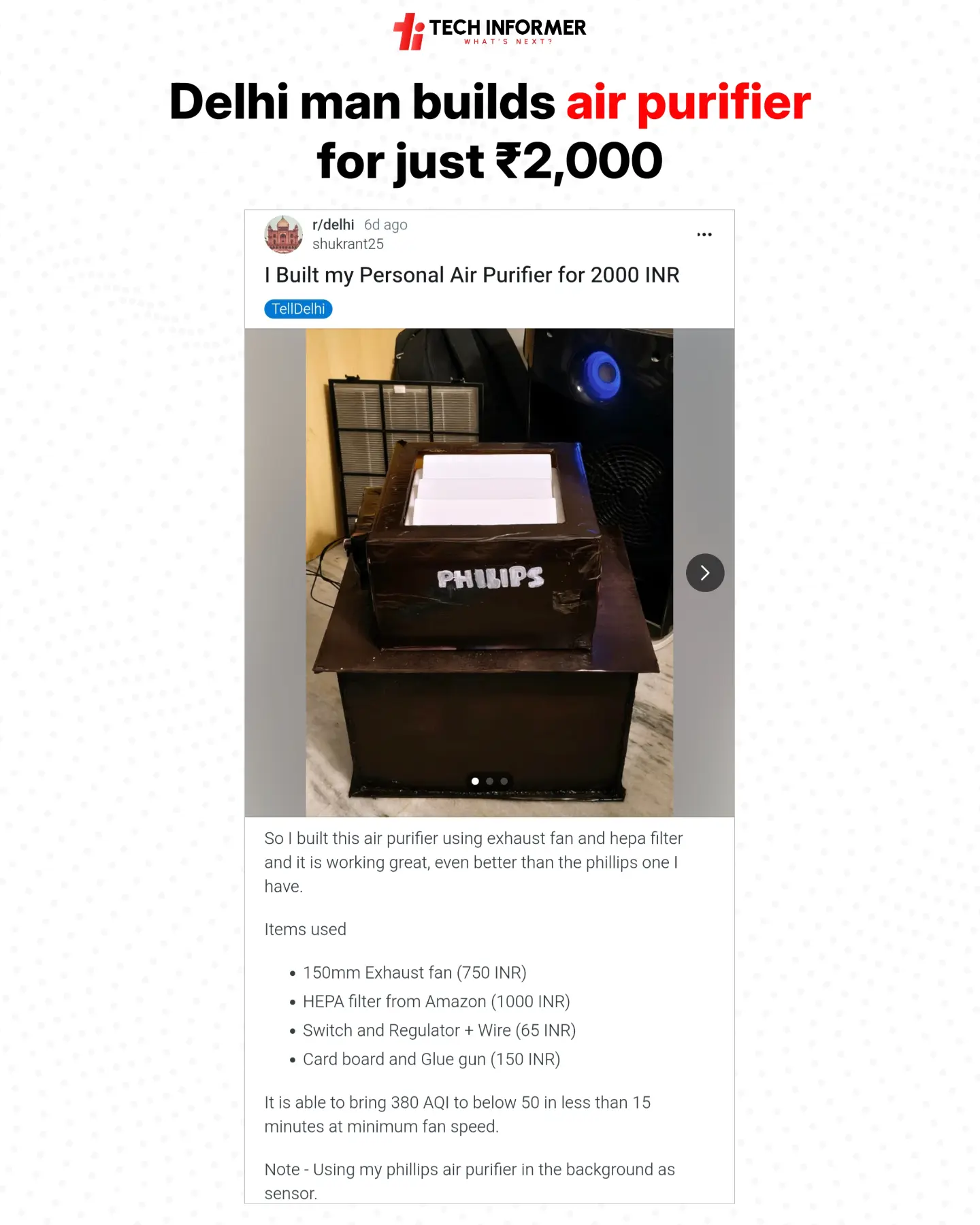
  • According to the creator, the setup used a 150mm exhaust fan (₹750), a HEPA filter from Amazon (₹1,000), and basic materials like a switch, wire, regulator, cardboard, and a glue gun, costing about ₹150 in total.

    #Techinformer #AirPurifier
    According to the creator, the setup used a 150mm exhaust fan (₹750), a HEPA filter from Amazon (₹1,000), and basic materials like a switch, wire, regulator, cardboard, and a glue gun, costing about ₹150 in total. #Techinformer #AirPurifier
    ·92 Views ·0 voorbeeld
  • A leaf-sized robot skims across a pond, its tiny legs ticking in rhythm with invisible heat pulses. The magic isn’t in a motor, it’s in the way it’s made. University of Virginia engineers devised HydroSpread, a manufacturing method that builds soft machines directly on liquid, where fragile films form flawlessly and complex shapes are cut with light.⁠

    Instead of peeling ultrathin polymers from glass and hoping they survive, droplets land on water and self-spread into uniform, hair-thin sheets. A laser etches fins, legs, even intricate logos, while the liquid substrate wicks away heat to prevent warping. The result is precision without the usual casualties, and patterns detailed enough to choreograph motion at millimeter scale.⁠

    Those sheets become bilayer actuators, two layers that expand differently when warmed. Under an infrared lamp, they bend and snap on command, turning tiny temperature swings into thrust. In demos, HydroFlexor paddled with fin-like strokes and HydroBuckler “walked” on water by buckling its legs, echoing the surface-savvy gait of strider insects.⁠

    Because fabrication happens on water from the start, integration gets easier: microheaters, magnetic fillers, or light-responsive materials can be added without risky transfers. That opens a path to autonomous micromachines that steer with sunlight or fields instead of bulky batteries and gears.⁠

    The same approach could also deliver skin-conforming medical sensors, flexible circuits that shrug off bends, and fleets of disposable samplers that skim lakes for pollutants. HydroSpread isn’t just a clever trick, it’s a playbook for building machines that thrive where rigid tech fails.⁠

    #softrobotics #robotics #materials #microbots #uva #scienceadvances #environmentalmonitoring #wearables #biomimetics
    A leaf-sized robot skims across a pond, its tiny legs ticking in rhythm with invisible heat pulses. The magic isn’t in a motor, it’s in the way it’s made. University of Virginia engineers devised HydroSpread, a manufacturing method that builds soft machines directly on liquid, where fragile films form flawlessly and complex shapes are cut with light.⁠ ⁠ Instead of peeling ultrathin polymers from glass and hoping they survive, droplets land on water and self-spread into uniform, hair-thin sheets. A laser etches fins, legs, even intricate logos, while the liquid substrate wicks away heat to prevent warping. The result is precision without the usual casualties, and patterns detailed enough to choreograph motion at millimeter scale.⁠ ⁠ Those sheets become bilayer actuators, two layers that expand differently when warmed. Under an infrared lamp, they bend and snap on command, turning tiny temperature swings into thrust. In demos, HydroFlexor paddled with fin-like strokes and HydroBuckler “walked” on water by buckling its legs, echoing the surface-savvy gait of strider insects.⁠ ⁠ Because fabrication happens on water from the start, integration gets easier: microheaters, magnetic fillers, or light-responsive materials can be added without risky transfers. That opens a path to autonomous micromachines that steer with sunlight or fields instead of bulky batteries and gears.⁠ ⁠ The same approach could also deliver skin-conforming medical sensors, flexible circuits that shrug off bends, and fleets of disposable samplers that skim lakes for pollutants. HydroSpread isn’t just a clever trick, it’s a playbook for building machines that thrive where rigid tech fails.⁠ ⁠ #softrobotics #robotics #materials #microbots #uva #scienceadvances #environmentalmonitoring #wearables #biomimetics
    ·206 Views ·0 voorbeeld
  • China just cranked a superconducting magnet to 35.1 tesla, roughly 351,000 gauss, about 700,000 times Earth’s field, and kept it stable for 30 minutes before a clean shutdown. Built by the Institute of Plasma Physics at the Chinese Academy of Sciences, the all-superconducting system pairs a high-temperature insert coil with low-temperature outer coils, creating a tougher, steadier field without quenching or drift.⁠

    The hybrid “magnet sandwich” mattered because engineers had to tame stress concentration, shielding currents, and multi-field coupling at cryogenic temperatures. By refining materials and geometry, they delivered record strength in a steady, fully superconducting device, a new platform for experiments that demand brute magnetic power with razor stability.⁠

    This matters for fusion, where magnetic cages confine plasma hotter than the Sun. ASIPP is a key supplier to ITER and to China’s domestic fusion program, and advances like this inform future correction coils, feeders, and high-field subsystems. Beyond reactors, stronger stable fields can accelerate NMR spectroscopy, maglev transport, electromagnetic propulsion, induction heating, and ultra-efficient power systems.⁠

    At the opposite extreme of scale, UC Berkeley engineers flew the smallest untethered robot yet, 9.4 millimeters across and only 21 milligrams. It lifts off when an external magnetic field spins a tiny rotor, hovers around 310 hertz, climbs near 340 hertz, steers by field orientation, and even recovers from gentle bumps without onboard sensors.⁠

    Range is currently about 10 centimeters from the coils, however beamformed fields, lighter designs, and onboard converters could unlock micro fliers with cameras and sensors for inspections, search and rescue, or greenhouse pollination. Magnetic control is stretching from star-hot plasmas to rice-grain robots, and the toolkit is getting sharper at both ends.⁠

    #tech #superconductors #fusion #magnetics #robotics #microdrones #energy #china #ucberkeley
    China just cranked a superconducting magnet to 35.1 tesla, roughly 351,000 gauss, about 700,000 times Earth’s field, and kept it stable for 30 minutes before a clean shutdown. Built by the Institute of Plasma Physics at the Chinese Academy of Sciences, the all-superconducting system pairs a high-temperature insert coil with low-temperature outer coils, creating a tougher, steadier field without quenching or drift.⁠ ⁠ The hybrid “magnet sandwich” mattered because engineers had to tame stress concentration, shielding currents, and multi-field coupling at cryogenic temperatures. By refining materials and geometry, they delivered record strength in a steady, fully superconducting device, a new platform for experiments that demand brute magnetic power with razor stability.⁠ ⁠ This matters for fusion, where magnetic cages confine plasma hotter than the Sun. ASIPP is a key supplier to ITER and to China’s domestic fusion program, and advances like this inform future correction coils, feeders, and high-field subsystems. Beyond reactors, stronger stable fields can accelerate NMR spectroscopy, maglev transport, electromagnetic propulsion, induction heating, and ultra-efficient power systems.⁠ ⁠ At the opposite extreme of scale, UC Berkeley engineers flew the smallest untethered robot yet, 9.4 millimeters across and only 21 milligrams. It lifts off when an external magnetic field spins a tiny rotor, hovers around 310 hertz, climbs near 340 hertz, steers by field orientation, and even recovers from gentle bumps without onboard sensors.⁠ ⁠ Range is currently about 10 centimeters from the coils, however beamformed fields, lighter designs, and onboard converters could unlock micro fliers with cameras and sensors for inspections, search and rescue, or greenhouse pollination. Magnetic control is stretching from star-hot plasmas to rice-grain robots, and the toolkit is getting sharper at both ends.⁠ ⁠ #tech #superconductors #fusion #magnetics #robotics #microdrones #energy #china #ucberkeley
    ·224 Views ·0 voorbeeld
  • Inside a high-pressure lab in Germany, scientists have done something remarkable, they’ve made ice that forms at room temperature. At Europe’s XFEL facility, researchers compressed liquid water to 2 gigapascals, about 20,000 times the air pressure at sea level, and watched it transform into a completely new phase called ice XXI. It’s a version of water that only appears under crushing force and disappears just as quickly.⁠

    The team used a dynamic diamond anvil cell to ramp pressure in about 10 milliseconds, then release it over one second, repeating the cycle more than a thousand times. XFEL’s million-frames-per-second flashes filmed atoms in motion, turning freezing into a process they could finally see. Follow-up diffraction at PETRA III confirmed the strange structure forming in real time, giving scientists a clearer picture of how water behaves under extreme stress.⁠

    What they found was extraordinary, a tetragonal crystal built from huge repeating units, 152 water molecules per cell, unlike any other known ice. Ice XXI is metastable, meaning it lingers briefly even when another form should be more stable. In several trials, it appeared as a midpoint on the journey toward the high-pressure phase known as ice VI, revealing hidden transitions in water’s complex behavior.⁠

    Those atomic snapshots reach far beyond Earth. Mapping multiple freezing and melting pathways under extreme pressure helps explain what water might do inside icy moons like Titan and Ganymede, where layers of exotic ice could lie buried. The findings also hint that studying water under these conditions could guide the design of new materials built to withstand extreme environments.⁠

    Source: s41563-025-02364-x
    Inside a high-pressure lab in Germany, scientists have done something remarkable, they’ve made ice that forms at room temperature. At Europe’s XFEL facility, researchers compressed liquid water to 2 gigapascals, about 20,000 times the air pressure at sea level, and watched it transform into a completely new phase called ice XXI. It’s a version of water that only appears under crushing force and disappears just as quickly.⁠ ⁠ The team used a dynamic diamond anvil cell to ramp pressure in about 10 milliseconds, then release it over one second, repeating the cycle more than a thousand times. XFEL’s million-frames-per-second flashes filmed atoms in motion, turning freezing into a process they could finally see. Follow-up diffraction at PETRA III confirmed the strange structure forming in real time, giving scientists a clearer picture of how water behaves under extreme stress.⁠ ⁠ What they found was extraordinary, a tetragonal crystal built from huge repeating units, 152 water molecules per cell, unlike any other known ice. Ice XXI is metastable, meaning it lingers briefly even when another form should be more stable. In several trials, it appeared as a midpoint on the journey toward the high-pressure phase known as ice VI, revealing hidden transitions in water’s complex behavior.⁠ ⁠ Those atomic snapshots reach far beyond Earth. Mapping multiple freezing and melting pathways under extreme pressure helps explain what water might do inside icy moons like Titan and Ganymede, where layers of exotic ice could lie buried. The findings also hint that studying water under these conditions could guide the design of new materials built to withstand extreme environments.⁠ ⁠ Source: s41563-025-02364-x
    ·123 Views ·0 voorbeeld
  • Baldness might soon meet its match in a patch made from sugar. Scientists have engineered a dissolving microneedle system that fuses minoxidil, the main ingredient in Rogaine, with stevioside, the natural sweetener from the Stevia plant. The result is a tiny grid of microscopic spikes that melt into the scalp, releasing medication directly to the roots of hair growth.⁠

    Developed by teams in China and Australia and published in *Advanced Healthcare Materials*, the invention solves two of minoxidil’s biggest problems: it doesn’t dissolve well in water, and it barely seeps through skin. By building the microneedles out of stevioside, researchers found a way to make the drug more soluble, more absorbable, and far more effective than traditional topical solutions.⁠

    Microneedles work by creating painless channels through the skin’s outer layer, then dissolving to deliver their contents exactly where hair follicles lie. Stevioside, a molecule with both water-loving and water-repelling sides, behaves like a natural carrier, wrapping around minoxidil and ferrying it deep into the epidermis without the sting or irritation of alcohol-based treatments.⁠

    In lab tests using pig ear tissue, more than 85% of the drug penetrated the skin, with nearly 20% staying in place, over twice the amount seen with regular liquid minoxidil. When tested on mice bred to mimic pattern baldness, the patch spurred regrowth in roughly 67% of the treated area within 35 days, compared to just 25% for standard applications.⁠

    The technology could streamline hair restoration routines, reducing the need for daily treatments and avoiding messy solvents. Still, human biology remains the ultimate test, since hair growth cycles in people are slower and influenced by many factors. Clinical trials will determine whether this sweet innovation can turn a pantry staple into the next revolution in hair loss therapy.⁠

    #tech #biotech #dermatology #hairloss #minoxidil #microneedles #stevia #regenerativemedicine #innovation

    Source: 10.1002/adhm.202503575
    Baldness might soon meet its match in a patch made from sugar. Scientists have engineered a dissolving microneedle system that fuses minoxidil, the main ingredient in Rogaine, with stevioside, the natural sweetener from the Stevia plant. The result is a tiny grid of microscopic spikes that melt into the scalp, releasing medication directly to the roots of hair growth.⁠ ⁠ Developed by teams in China and Australia and published in *Advanced Healthcare Materials*, the invention solves two of minoxidil’s biggest problems: it doesn’t dissolve well in water, and it barely seeps through skin. By building the microneedles out of stevioside, researchers found a way to make the drug more soluble, more absorbable, and far more effective than traditional topical solutions.⁠ ⁠ Microneedles work by creating painless channels through the skin’s outer layer, then dissolving to deliver their contents exactly where hair follicles lie. Stevioside, a molecule with both water-loving and water-repelling sides, behaves like a natural carrier, wrapping around minoxidil and ferrying it deep into the epidermis without the sting or irritation of alcohol-based treatments.⁠ ⁠ In lab tests using pig ear tissue, more than 85% of the drug penetrated the skin, with nearly 20% staying in place, over twice the amount seen with regular liquid minoxidil. When tested on mice bred to mimic pattern baldness, the patch spurred regrowth in roughly 67% of the treated area within 35 days, compared to just 25% for standard applications.⁠ ⁠ The technology could streamline hair restoration routines, reducing the need for daily treatments and avoiding messy solvents. Still, human biology remains the ultimate test, since hair growth cycles in people are slower and influenced by many factors. Clinical trials will determine whether this sweet innovation can turn a pantry staple into the next revolution in hair loss therapy.⁠ ⁠ #tech #biotech #dermatology #hairloss #minoxidil #microneedles #stevia #regenerativemedicine #innovation⁠ ⁠ Source: 10.1002/adhm.202503575
    ·208 Views ·0 voorbeeld
  • First, a fridge without the fumes. Scientists at Lawrence Berkeley National Laboratory have built a new “ionocaloric” cycle that cools by moving ions through a material to shift its melting point, the same physics behind road salt melting ice. In lab tests, a sodium–iodine salt and ethylene carbonate delivered a 25 °C temperature swing using under one volt, a bigger lift than most solid-state “caloric” approaches and without hydrofluorocarbon refrigerants.⁠

    Because it toggles a solid–liquid phase change, the working fluid can be pumped, avoiding compressors and complex valves. The team’s models suggest efficiency on par with, or better than, today’s vapor-compression systems. Using ethylene carbonate, which can be synthesized from captured CO₂, the refrigerant footprint could be not just low but potentially carbon-negative. If prototypes scale, the same cycle could also supply efficient water and process heating, trimming emissions from buildings and industry that are notoriously hard to decarbonize.⁠

    Now, a data center that chills with the sea. Off Shanghai, Hailanyun’s first commercial underwater AI facility places sealed server pods beneath offshore wind turbines and circulates seawater across radiators to carry heat away. Internal assessments with a Chinese institute report at least 30% lower electricity use for cooling compared with land sites, and the company says the farm is powered 97% by the nearby wind array.⁠

    One operational pod holds 198 racks, enough for roughly 396–792 AI-ready servers, and the company claims capacity to train a GPT-3.5-class model in a day. Microsoft’s earlier Project Natick found submerged servers can fail less often, but scaling raises new risks, including thermal plumes, acoustic sabotage, corrosion, biofouling, and slow maintenance cycles. From ions to oceans, cooling is being rewired for an AI-hungry, climate-strained future.⁠

    #tech #ai #cooling #climate #datacenters #materials #energy #sustainability #berkeleylab

    Source: 10.1126/science.ade1696
    First, a fridge without the fumes. Scientists at Lawrence Berkeley National Laboratory have built a new “ionocaloric” cycle that cools by moving ions through a material to shift its melting point, the same physics behind road salt melting ice. In lab tests, a sodium–iodine salt and ethylene carbonate delivered a 25 °C temperature swing using under one volt, a bigger lift than most solid-state “caloric” approaches and without hydrofluorocarbon refrigerants.⁠ ⁠ Because it toggles a solid–liquid phase change, the working fluid can be pumped, avoiding compressors and complex valves. The team’s models suggest efficiency on par with, or better than, today’s vapor-compression systems. Using ethylene carbonate, which can be synthesized from captured CO₂, the refrigerant footprint could be not just low but potentially carbon-negative. If prototypes scale, the same cycle could also supply efficient water and process heating, trimming emissions from buildings and industry that are notoriously hard to decarbonize.⁠ ⁠ Now, a data center that chills with the sea. Off Shanghai, Hailanyun’s first commercial underwater AI facility places sealed server pods beneath offshore wind turbines and circulates seawater across radiators to carry heat away. Internal assessments with a Chinese institute report at least 30% lower electricity use for cooling compared with land sites, and the company says the farm is powered 97% by the nearby wind array.⁠ ⁠ One operational pod holds 198 racks, enough for roughly 396–792 AI-ready servers, and the company claims capacity to train a GPT-3.5-class model in a day. Microsoft’s earlier Project Natick found submerged servers can fail less often, but scaling raises new risks, including thermal plumes, acoustic sabotage, corrosion, biofouling, and slow maintenance cycles. From ions to oceans, cooling is being rewired for an AI-hungry, climate-strained future.⁠ ⁠ #tech #ai #cooling #climate #datacenters #materials #energy #sustainability #berkeleylab⁠ ⁠ Source: 10.1126/science.ade1696
    ·169 Views ·0 voorbeeld
Zoekresultaten
Techawks - Powered By Pantrade Blockchain https://techawks.com