• Which Skill Has Contributed Most to Your Career Growth in the Indian Tech Industry?


    As engineering roles in India become more specialized and high-impact, developers and tech professionals face a crucial question: where should you invest your upskilling time for the highest long-term ROI?
    While writing clean code is baseline, mid-to-senior engineers often report that non-coding or high-level architecture skills created their biggest career breakthroughs. We want to hear from the community across Bengaluru, NCR, Pune, Hyderabad, and beyond.


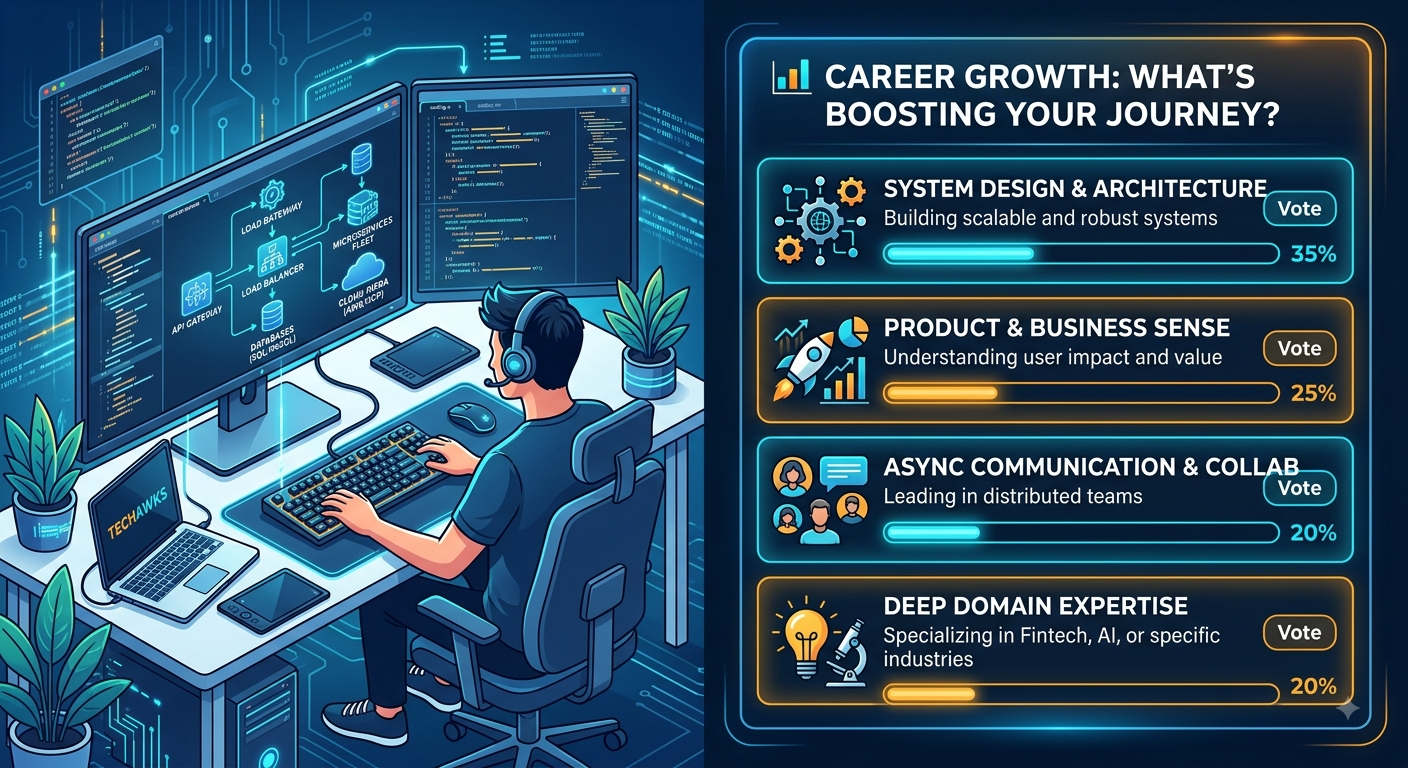
    📊 POLL: Which area of expertise has accelerated your tech career the most?
    A) System Design & Distributed Architecture (Scalability, low-latency, cloud infra)
    B) Product & Business Sense (Understanding ROI, metrics, and user impact)
    C) Async & Cross-Border Communication (Design docs, PR reviews, remote collab)
    D) Deep Domain Expertise (Fintech, AI/ML, SaaS, DevTools)
    (Cast your vote above and share your top career advice in the comments below!)


    Actionable Advice to Accelerate Your Career in Tech
    Regardless of your chosen path, here are 3 practical habits to boost your growth in the Indian tech market:


    Document Your Decisions with ADRs
    Don't just write code—document why choices were made. Writing Architecture Decision Records (ADRs) demonstrates senior-level thinking and builds trust across distributed product teams.
    Understand the Economics of Your Tech Stack
    Transition from a feature executor to a business contributor by analyzing cloud costs, API response times, and system efficiency. Engineers who optimize for both performance and cost always stand out.
    Contribute to Open Source or Public Technical Writing
    Build a public proof-of-work. Publishing technical post-mortems, system design breakdowns, or open-source contributions gives you leverage far beyond a traditional resume.


    Key Takeaways
    Think Beyond Syntax: Career growth correlates with system design, domain knowledge, and business impact.
    Master Async Communication: Clear technical writing and documentation elevate your visibility in global and remote engineering teams.
    Build Proof-of-Work: Leverage public contributions, technical blogs, and open-source work to stand out in a competitive talent market.


    CTA
    Looking to connect with top developers, level up your system design skills, and navigate your tech career in India?


    Join Techawks India today to participate in community discussions, access career playbooks, and network with leading engineers!
    Which Skill Has Contributed Most to Your Career Growth in the Indian Tech Industry? As engineering roles in India become more specialized and high-impact, developers and tech professionals face a crucial question: where should you invest your upskilling time for the highest long-term ROI? While writing clean code is baseline, mid-to-senior engineers often report that non-coding or high-level architecture skills created their biggest career breakthroughs. We want to hear from the community across Bengaluru, NCR, Pune, Hyderabad, and beyond. 📊 POLL: Which area of expertise has accelerated your tech career the most? A) System Design & Distributed Architecture (Scalability, low-latency, cloud infra) B) Product & Business Sense (Understanding ROI, metrics, and user impact) C) Async & Cross-Border Communication (Design docs, PR reviews, remote collab) D) Deep Domain Expertise (Fintech, AI/ML, SaaS, DevTools) (Cast your vote above and share your top career advice in the comments below!) Actionable Advice to Accelerate Your Career in Tech Regardless of your chosen path, here are 3 practical habits to boost your growth in the Indian tech market: Document Your Decisions with ADRs Don't just write code—document why choices were made. Writing Architecture Decision Records (ADRs) demonstrates senior-level thinking and builds trust across distributed product teams. Understand the Economics of Your Tech Stack Transition from a feature executor to a business contributor by analyzing cloud costs, API response times, and system efficiency. Engineers who optimize for both performance and cost always stand out. Contribute to Open Source or Public Technical Writing Build a public proof-of-work. Publishing technical post-mortems, system design breakdowns, or open-source contributions gives you leverage far beyond a traditional resume. Key Takeaways Think Beyond Syntax: Career growth correlates with system design, domain knowledge, and business impact. Master Async Communication: Clear technical writing and documentation elevate your visibility in global and remote engineering teams. Build Proof-of-Work: Leverage public contributions, technical blogs, and open-source work to stand out in a competitive talent market. CTA Looking to connect with top developers, level up your system design skills, and navigate your tech career in India? Join Techawks India today to participate in community discussions, access career playbooks, and network with leading engineers!
    0 Commenti 0 condivisioni 319 Views 0 Anteprima
  • The Tech Job Seeker’s Blueprint: 4 Pillars to Stand Out in Today’s Technical Hiring Market


    In a competitive tech hiring landscape, landing a standout role requires more than meeting basic job description requirements. Technical recruiters and hiring managers look past generic skill lists—they search for candidates who demonstrate ownership, business context, and problem-solving velocity.
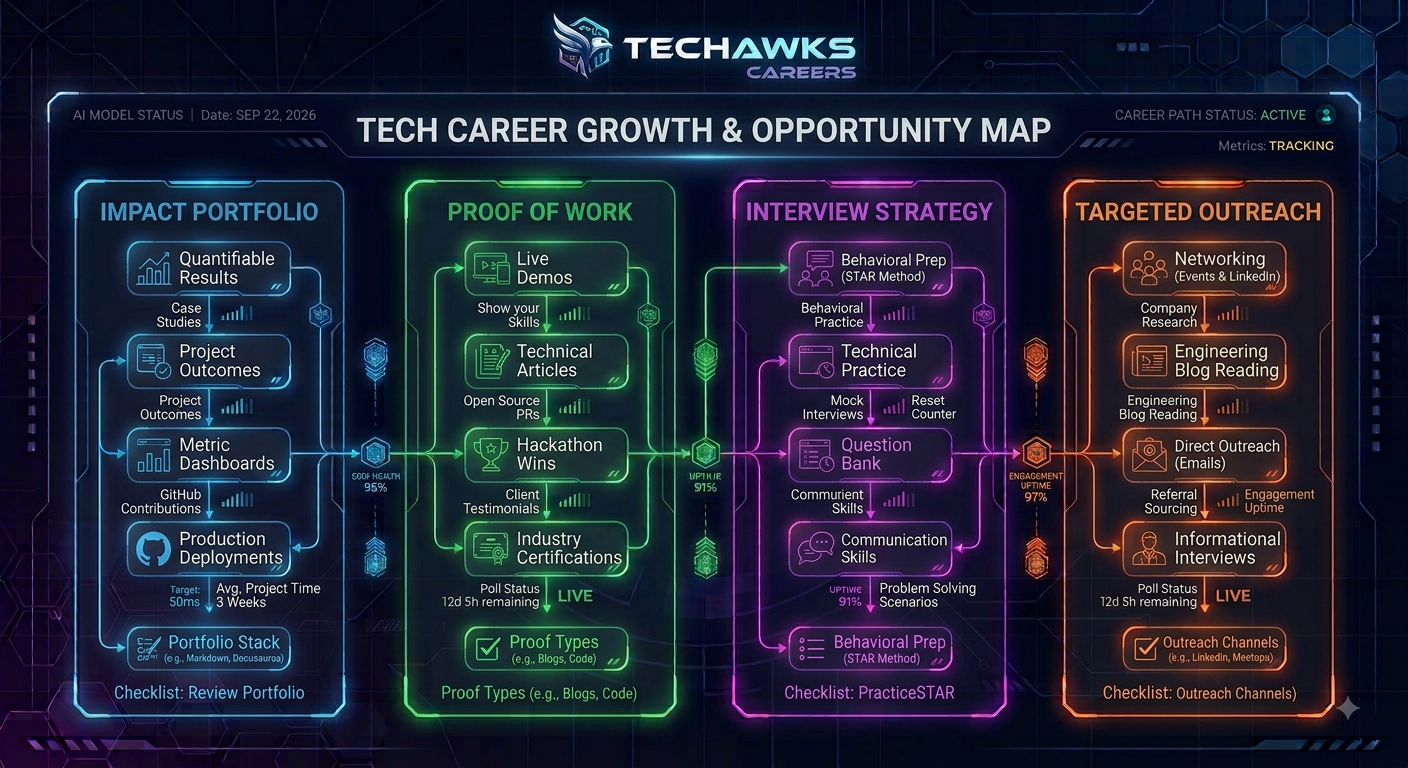
    To elevate your job search strategy from reactive applying to intentional positioning, build your job hunt around four evergreen career pillars:


    1. Shift from a "Skill Resume" to an "Impact Portfolio"
    The Reality: Listing frameworks (e.g., React, Python, Docker) tells recruiters what tools you know, but not what you can achieve with them.
    The Action: Frame your experience using quantifiable outcomes. Instead of "Built REST APIs with Node.js," write "Architected Node.js microservices that reduced database latency by 35% and handled 10,000 requests per second."


    2. Showcase Proof of Work Through Open Architecture
    The Reality: Personal projects that replicate basic tutorial apps rarely impress senior engineering interviewers.
    The Action: Build and document projects that demonstrate real-world constraints. Highlight trade-offs you made—such as database choices, caching layers, or error-handling strategies. Include clear README documentation and deployment links in your public repositories.


    3. Master the Behavioral & Systems Interview Hybrid
    The Reality: Technical competence gets you through coding screens, but communication and collaboration seal job offers.
    The Action: Structure behavioral responses using the STAR method (Situation, Task, Action, Result). When answering technical questions, think out loud, articulate trade-offs, and ask clarifying constraints before jumping directly into code.


    4. Reverse-Engineer Target Companies Before Applying
    The Reality: Mass-applying yields low conversion rates compared to targeted outreach.
    The Action: Research the tech stack, open-source contributions, and engineering blogs of target companies. Reach out directly to engineering leads with specific questions or insights about their public projects rather than generic cold messages.


    Key Takeaways
    Quantify Your Impact: Translate technical tasks into measurable business value and system performance metrics.
    Document Problem-Solving: Treat your portfolio projects like production software with architectural documentation and trade-off analyses.
    Communicate Thought Processes: During technical interviews, focus on clear reasoning, active listening, and structured collaboration over pure code speed.


    CTA
    Looking for your next technical milestone or seeking career guidance from experienced industry hiring managers? Join Tech Jobs & Opportunities today to discover curated job openings, review interview strategies, and accelerate your career growth.
    The Tech Job Seeker’s Blueprint: 4 Pillars to Stand Out in Today’s Technical Hiring Market In a competitive tech hiring landscape, landing a standout role requires more than meeting basic job description requirements. Technical recruiters and hiring managers look past generic skill lists—they search for candidates who demonstrate ownership, business context, and problem-solving velocity. To elevate your job search strategy from reactive applying to intentional positioning, build your job hunt around four evergreen career pillars: 1. Shift from a "Skill Resume" to an "Impact Portfolio" The Reality: Listing frameworks (e.g., React, Python, Docker) tells recruiters what tools you know, but not what you can achieve with them. The Action: Frame your experience using quantifiable outcomes. Instead of "Built REST APIs with Node.js," write "Architected Node.js microservices that reduced database latency by 35% and handled 10,000 requests per second." 2. Showcase Proof of Work Through Open Architecture The Reality: Personal projects that replicate basic tutorial apps rarely impress senior engineering interviewers. The Action: Build and document projects that demonstrate real-world constraints. Highlight trade-offs you made—such as database choices, caching layers, or error-handling strategies. Include clear README documentation and deployment links in your public repositories. 3. Master the Behavioral & Systems Interview Hybrid The Reality: Technical competence gets you through coding screens, but communication and collaboration seal job offers. The Action: Structure behavioral responses using the STAR method (Situation, Task, Action, Result). When answering technical questions, think out loud, articulate trade-offs, and ask clarifying constraints before jumping directly into code. 4. Reverse-Engineer Target Companies Before Applying The Reality: Mass-applying yields low conversion rates compared to targeted outreach. The Action: Research the tech stack, open-source contributions, and engineering blogs of target companies. Reach out directly to engineering leads with specific questions or insights about their public projects rather than generic cold messages. Key Takeaways Quantify Your Impact: Translate technical tasks into measurable business value and system performance metrics. Document Problem-Solving: Treat your portfolio projects like production software with architectural documentation and trade-off analyses. Communicate Thought Processes: During technical interviews, focus on clear reasoning, active listening, and structured collaboration over pure code speed. CTA Looking for your next technical milestone or seeking career guidance from experienced industry hiring managers? Join Tech Jobs & Opportunities today to discover curated job openings, review interview strategies, and accelerate your career growth.
    0 Commenti 0 condivisioni 107 Views 0 Anteprima
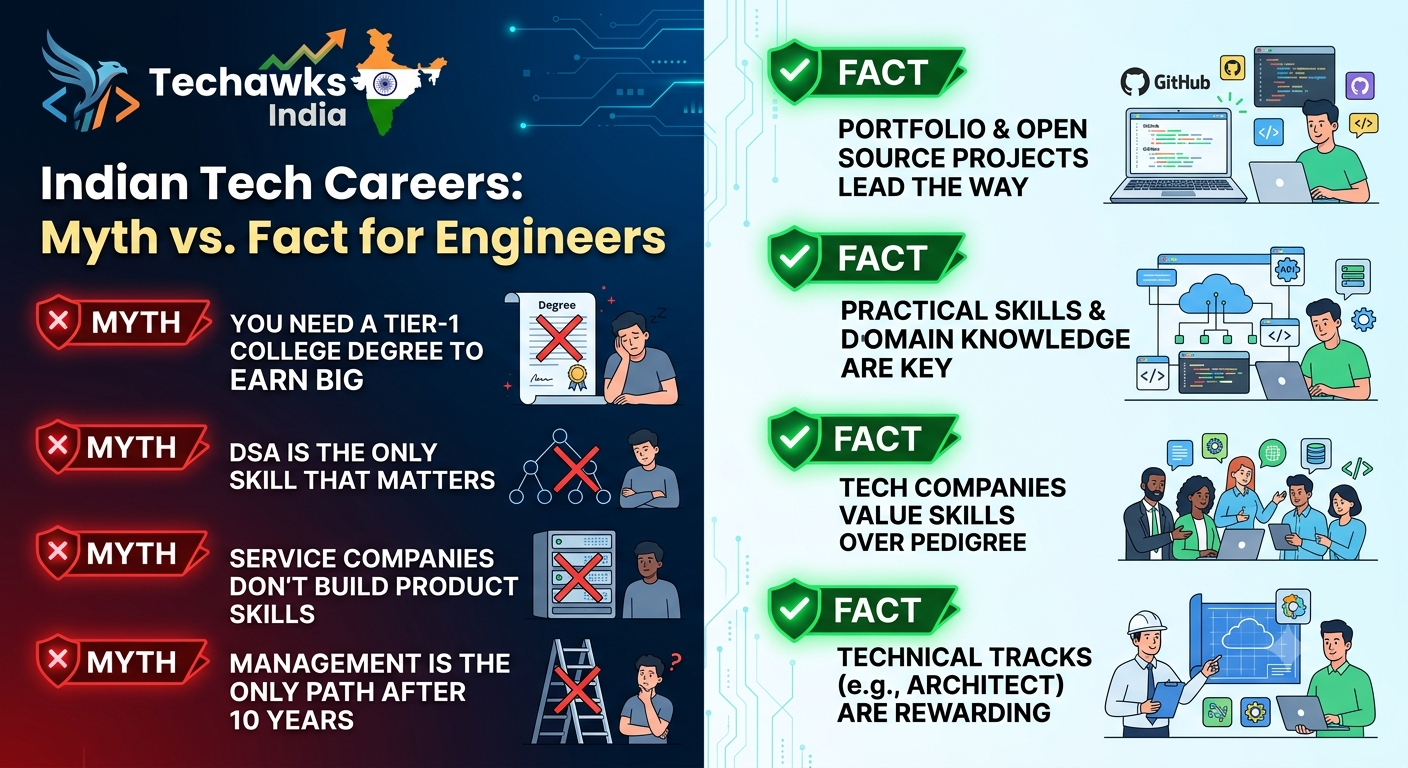
  • Myth vs. Fact: 4 Tech Career Myths Holding Indian Developers Back
    Navigating the Indian tech industry can feel overwhelming with all the conflicting advice on LinkedIn and YouTube. To build a sustainable, high-growth engineering career, you need to separate outdated norms from real-world hiring standards.


    Here are four common myths that hold talented Indian engineers back:


    Myth 1: Competitive Programming (DSA) is All That Matters for Product Companies
    ❌ Myth: Grinding 1,000+ LeetCode problems is the only way to get hired by top product firms and startups in India.
    ✅ Fact: While Data Structures & Algorithms get you through the initial screening, practical system design, clean coding standards, and real-world project execution determine whether you clear system design rounds or land senior roles.
    Actionable Advice: Balance your preparation—spend 40% of your time on problem-solving fundamentals and 60% building production-ready projects with proper logging, testing, and containerization.


    Myth 2: Service-to-Product Company Switching is Impossible
    ❌ Myth: If you start your career in an IT services firm, product-based companies and high-growth startups will automatically reject your resume.
    ✅ Fact: Product companies care about individual capability, system ownership, and domain depth—not your previous employer's business model.
    Actionable Advice: Highlight core engineering outcomes on your resume. Document open-source contributions, build high-concurrency side projects, and showcase public proof of work on GitHub or tech blogs.


    Myth 3: Moving to Management is the Only Way to Scale Salary in India
    ❌ Myth: You must transition into Engineering Manager or Project Manager roles by age 30 to earn a top-tier compensation package.
    ✅ Fact: The Indian tech ecosystem has matured. Individual Contributor (IC) tracks—such as Staff Engineer, Principal Architect, and Specialist—offer equal or higher compensation without requiring people management.
    Actionable Advice: Focus on deepening your domain expertise (e.g., Cloud Architecture, Distributed Systems, AI Infrastructure) if you prefer technical depth over administrative management.


    Myth 4: Notice Periods of 90 Days Render You Unhireable
    ❌ Myth: Having a standard 90-day notice period in India means product startups will never consider your application.
    ✅ Fact: While startups prefer fast joiners, strong candidate evaluations frequently lead companies to buy out notice periods or wait for exceptional talent.
    Actionable Advice: Be upfront during HR screens, keep your technical skills sharp to negotiate buyout terms, and use the last 30 days of your notice period to aggressively interview once your availability is immediate.


    Key Takeaways
    Proof over prestige: Practical project execution and system design skills matter far more than college pedigree or previous company brand.
    Technical depth pays: You don't have to abandon hands-on coding to achieve senior-level compensation in India.
    Control your narrative: Build a public tech presence (GitHub, technical writing) to stand out regardless of your notice period or current company background.


    CTA
    🇮🇳 Ready to cut through the noise and elevate your engineering career? Join the Techawks India community to connect with fellow developers, access system design guides, and attend local tech discussions!


    👉 [Join Techawks India]
    Myth vs. Fact: 4 Tech Career Myths Holding Indian Developers Back Navigating the Indian tech industry can feel overwhelming with all the conflicting advice on LinkedIn and YouTube. To build a sustainable, high-growth engineering career, you need to separate outdated norms from real-world hiring standards. Here are four common myths that hold talented Indian engineers back: Myth 1: Competitive Programming (DSA) is All That Matters for Product Companies ❌ Myth: Grinding 1,000+ LeetCode problems is the only way to get hired by top product firms and startups in India. ✅ Fact: While Data Structures & Algorithms get you through the initial screening, practical system design, clean coding standards, and real-world project execution determine whether you clear system design rounds or land senior roles. Actionable Advice: Balance your preparation—spend 40% of your time on problem-solving fundamentals and 60% building production-ready projects with proper logging, testing, and containerization. Myth 2: Service-to-Product Company Switching is Impossible ❌ Myth: If you start your career in an IT services firm, product-based companies and high-growth startups will automatically reject your resume. ✅ Fact: Product companies care about individual capability, system ownership, and domain depth—not your previous employer's business model. Actionable Advice: Highlight core engineering outcomes on your resume. Document open-source contributions, build high-concurrency side projects, and showcase public proof of work on GitHub or tech blogs. Myth 3: Moving to Management is the Only Way to Scale Salary in India ❌ Myth: You must transition into Engineering Manager or Project Manager roles by age 30 to earn a top-tier compensation package. ✅ Fact: The Indian tech ecosystem has matured. Individual Contributor (IC) tracks—such as Staff Engineer, Principal Architect, and Specialist—offer equal or higher compensation without requiring people management. Actionable Advice: Focus on deepening your domain expertise (e.g., Cloud Architecture, Distributed Systems, AI Infrastructure) if you prefer technical depth over administrative management. Myth 4: Notice Periods of 90 Days Render You Unhireable ❌ Myth: Having a standard 90-day notice period in India means product startups will never consider your application. ✅ Fact: While startups prefer fast joiners, strong candidate evaluations frequently lead companies to buy out notice periods or wait for exceptional talent. Actionable Advice: Be upfront during HR screens, keep your technical skills sharp to negotiate buyout terms, and use the last 30 days of your notice period to aggressively interview once your availability is immediate. Key Takeaways Proof over prestige: Practical project execution and system design skills matter far more than college pedigree or previous company brand. Technical depth pays: You don't have to abandon hands-on coding to achieve senior-level compensation in India. Control your narrative: Build a public tech presence (GitHub, technical writing) to stand out regardless of your notice period or current company background. CTA 🇮🇳 Ready to cut through the noise and elevate your engineering career? Join the Techawks India community to connect with fellow developers, access system design guides, and attend local tech discussions! 👉 [Join Techawks India]
    0 Commenti 0 condivisioni 1K Views 0 Anteprima
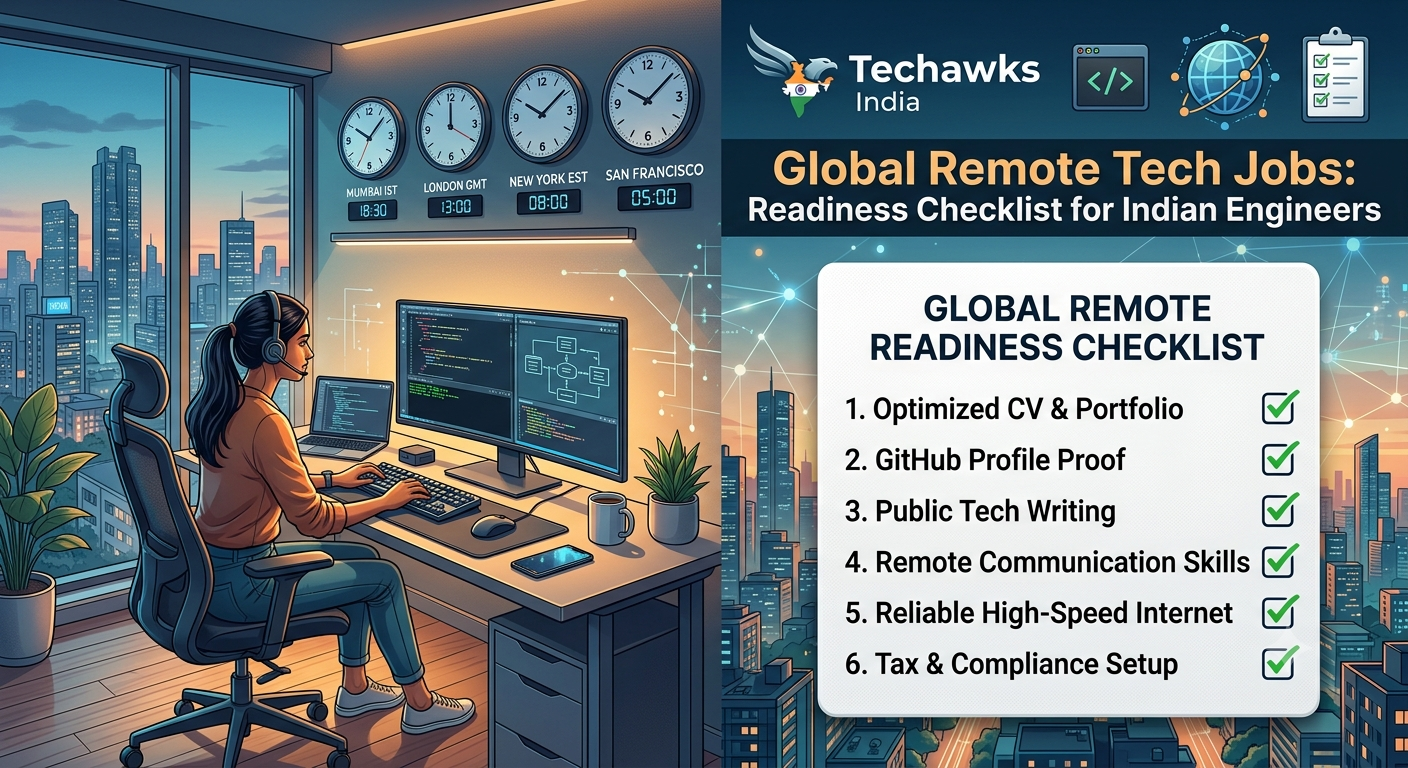
  • The Ultimate Checklist for Landing Remote Tech Jobs from India (USD/EUR Pay)
    Breaking into global remote tech roles requires shifting your approach from traditional local hiring norms to global developer expectations. Use this checklist to audit your profiles, tools, and setup before applying.


    1. Resume & Global Compliance
    Single-Page PDF: Trim multi-page CVs into a clean, concise single-page resume (no photos or personal details like age/marital status).
    Impact-First Bullet Points: Frame accomplishments using metrics (e.g., "Reduced latency by 35% using Redis caching" instead of "Worked on Redis").
    ATS Optimization: Keep layout simple and readable by Applicant Tracking Systems without complex tables or graphics.


    2. Digital Presence & Open Proof
    Optimized GitHub Profile: Pin 2–3 fully documented projects with detailed README.md files, architectural diagrams, and live demo links.
    Public Writing / Tech Blogs: Document your learning or technical challenges on platforms like Hashnode, Dev.to, or Medium.
    LinkedIn Alignment: Align headline to specific roles (e.g., "Backend Engineer | Go & Distributed Systems") rather than generic designations.


    3. Remote Readiness & Communication
    Async-First Communication Skills: Practice writing clear, complete pull request descriptions, documentation, and technical specs.
    English Proficiency in Tech Contexts: Ensure clear spoken and written technical communication for cross-time-zone team setups.


    4. Financial & Compliance Setup
    Cross-Border Payment Accounts: Set up and verify accounts on platforms like Wise, Payoneer, or Deel.
    GST & Taxation Awareness: Understand basic tax implications for foreign inward remittances (LUT filing, Form 15CA/15CB, GST exemption for exports).


    5. Workstation Infrastructure
    High-Speed Internet + Backup: Maintain a reliable primary fiber connection and a reliable mobile/UPS backup for zero downtime during interviews.
    Ergonomic & Quiet Space: Ensure a clean background and clear audio setup (noise-canceling mic) for video calls across time zones.


    Key Takeaways
    Proof over promises: Global remote recruiters value open-source contributions and live projects over college degrees or company brand names.
    Asynchronous clarity is king: Clear written documentation and self-management are mandatory skills for remote developers.
    Prep the backend early: Setting up payment pathways and understanding tax rules upfront prevents headaches once you land an offer.


    CTA
    🇮🇳 Looking to grow your tech career, build high-impact projects, and connect with top Indian developers? Join the Techawks India community today for developer meetups, career guides, and technical discussions!


    👉 [Join Techawks India]
    The Ultimate Checklist for Landing Remote Tech Jobs from India (USD/EUR Pay) Breaking into global remote tech roles requires shifting your approach from traditional local hiring norms to global developer expectations. Use this checklist to audit your profiles, tools, and setup before applying. 1. Resume & Global Compliance Single-Page PDF: Trim multi-page CVs into a clean, concise single-page resume (no photos or personal details like age/marital status). Impact-First Bullet Points: Frame accomplishments using metrics (e.g., "Reduced latency by 35% using Redis caching" instead of "Worked on Redis"). ATS Optimization: Keep layout simple and readable by Applicant Tracking Systems without complex tables or graphics. 2. Digital Presence & Open Proof Optimized GitHub Profile: Pin 2–3 fully documented projects with detailed README.md files, architectural diagrams, and live demo links. Public Writing / Tech Blogs: Document your learning or technical challenges on platforms like Hashnode, Dev.to, or Medium. LinkedIn Alignment: Align headline to specific roles (e.g., "Backend Engineer | Go & Distributed Systems") rather than generic designations. 3. Remote Readiness & Communication Async-First Communication Skills: Practice writing clear, complete pull request descriptions, documentation, and technical specs. English Proficiency in Tech Contexts: Ensure clear spoken and written technical communication for cross-time-zone team setups. 4. Financial & Compliance Setup Cross-Border Payment Accounts: Set up and verify accounts on platforms like Wise, Payoneer, or Deel. GST & Taxation Awareness: Understand basic tax implications for foreign inward remittances (LUT filing, Form 15CA/15CB, GST exemption for exports). 5. Workstation Infrastructure High-Speed Internet + Backup: Maintain a reliable primary fiber connection and a reliable mobile/UPS backup for zero downtime during interviews. Ergonomic & Quiet Space: Ensure a clean background and clear audio setup (noise-canceling mic) for video calls across time zones. Key Takeaways Proof over promises: Global remote recruiters value open-source contributions and live projects over college degrees or company brand names. Asynchronous clarity is king: Clear written documentation and self-management are mandatory skills for remote developers. Prep the backend early: Setting up payment pathways and understanding tax rules upfront prevents headaches once you land an offer. CTA 🇮🇳 Looking to grow your tech career, build high-impact projects, and connect with top Indian developers? Join the Techawks India community today for developer meetups, career guides, and technical discussions! 👉 [Join Techawks India]
    0 Commenti 0 condivisioni 1K Views 0 Anteprima
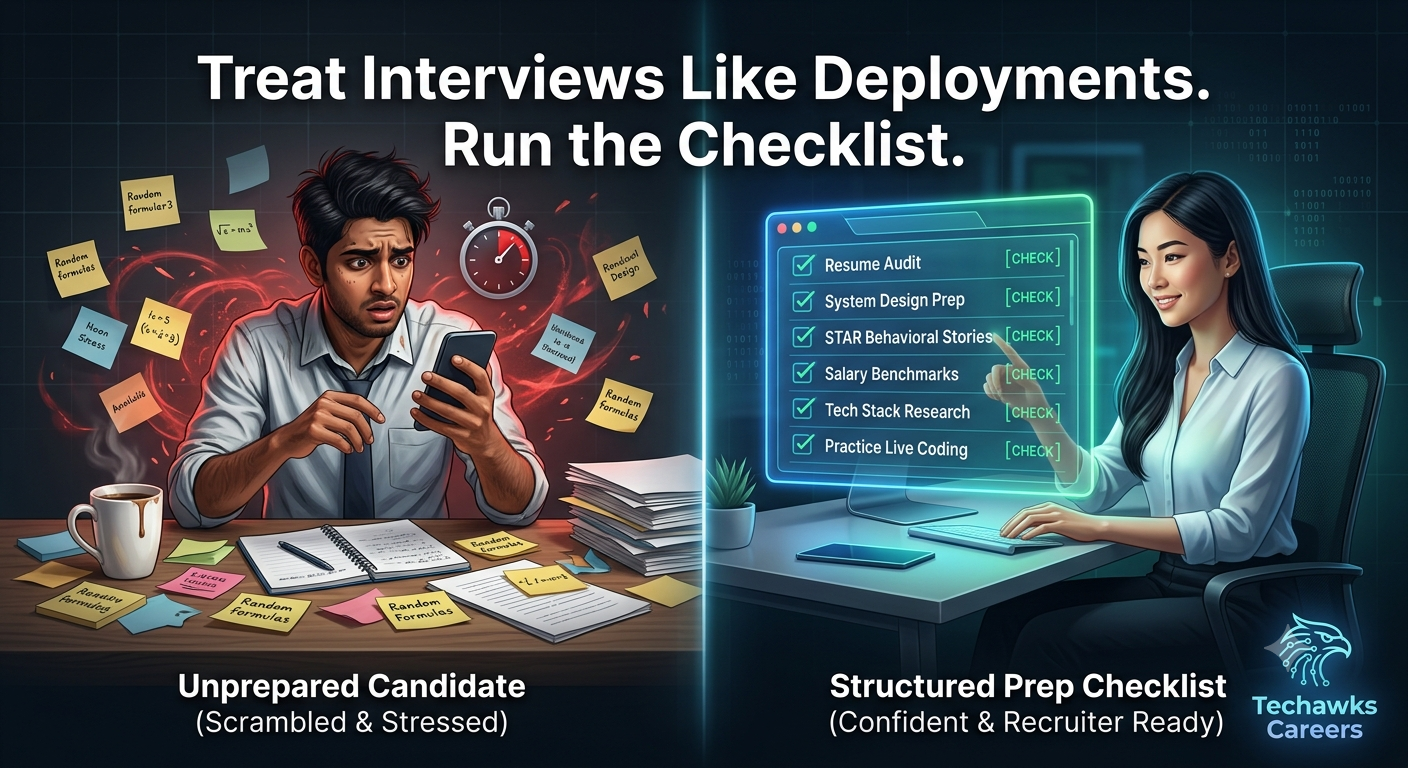
  • The Ultimate Pre-Interview Tech Checklist: 10 Critical Steps Before Every First Round
    Passing first-round technical and recruiter screens requires more than scanning your resume an hour before the call. To project confidence, competence, and clarity, treat your interview preparation like a deployment checklist.


    Work through these 10 actionable steps 24 to 48 hours before every interview:


    Phase 1: Company & Product Reconnaissance
    1. Test the Core Product: Sign up for the company’s product or app, try its main features, and note two areas of smooth UX and two potential technical improvements.
    2. Map the Tech Stack: Review engineering job postings, tech blogs, or GitHub profiles from the company to identify their primary databases, frameworks, and cloud providers.
    3. Research Recent Milestones: Identify recent product launches, major feature releases, or technical blog posts to ask informed questions during the interview.


    Phase 2: Technical & Behavioral Alignment
    4. Audit Your Resume Bullet Points: Be prepared to explain the architectural decisions, trade-offs, and metrics behind every project listed on your resume.
    5. Prepare 3 STAR Stories: Prepare concise Situation-Task-Action-Result (STAR) stories highlighting a complex bug fix, a technical trade-off debate, and a cross-functional disagreement.
    6. Rehearse Your "Tell Me About Yourself" Pitch: Keep your professional background pitch under 90 seconds, focusing on technical growth, recent impact, and why this specific role fits your trajectory.


    Phase 3: System & Live Coding Setup
    7. Verify Your Local Environment: Test your IDE, terminal extensions, node/python runtime versions, and local webcams to prevent technical glitches during live coding screens.
    8. Bookmark Documentation Quick-Links: Keep language syntax docs, standard library references, and key API specs open in separate browser tabs for quick reference.


    Phase 4: Strategic Questions for the Hiring Team
    9. Prepare 3 Reverse-Interview Questions: Draft questions focused on engineering culture, deployment frequency, on-call schedules, or tech debt management.
    10. Define Your Salary Expectation Range: Research benchmark salary data for the position, level, and location so you can answer compensation questions confidently.


    Key Takeaways
    Systematize Preparation: Treat every interview prep like a deployment procedure to eliminate missed details.
    Understand the Business: Candidates who test the actual product and understand company constraints stand out immediately.
    Control the Technical Environment: Eliminate setup friction by auditing your local IDE and testing equipment well ahead of time.


    CTA
    How do you prepare for high-stakes technical interviews? Join Tech Jobs & Opportunities to access downloadable interview checklists, review salary benchmarks, and practice mock interviews with fellow software engineers.
    The Ultimate Pre-Interview Tech Checklist: 10 Critical Steps Before Every First Round Passing first-round technical and recruiter screens requires more than scanning your resume an hour before the call. To project confidence, competence, and clarity, treat your interview preparation like a deployment checklist. Work through these 10 actionable steps 24 to 48 hours before every interview: Phase 1: Company & Product Reconnaissance 1. Test the Core Product: Sign up for the company’s product or app, try its main features, and note two areas of smooth UX and two potential technical improvements. 2. Map the Tech Stack: Review engineering job postings, tech blogs, or GitHub profiles from the company to identify their primary databases, frameworks, and cloud providers. 3. Research Recent Milestones: Identify recent product launches, major feature releases, or technical blog posts to ask informed questions during the interview. Phase 2: Technical & Behavioral Alignment 4. Audit Your Resume Bullet Points: Be prepared to explain the architectural decisions, trade-offs, and metrics behind every project listed on your resume. 5. Prepare 3 STAR Stories: Prepare concise Situation-Task-Action-Result (STAR) stories highlighting a complex bug fix, a technical trade-off debate, and a cross-functional disagreement. 6. Rehearse Your "Tell Me About Yourself" Pitch: Keep your professional background pitch under 90 seconds, focusing on technical growth, recent impact, and why this specific role fits your trajectory. Phase 3: System & Live Coding Setup 7. Verify Your Local Environment: Test your IDE, terminal extensions, node/python runtime versions, and local webcams to prevent technical glitches during live coding screens. 8. Bookmark Documentation Quick-Links: Keep language syntax docs, standard library references, and key API specs open in separate browser tabs for quick reference. Phase 4: Strategic Questions for the Hiring Team 9. Prepare 3 Reverse-Interview Questions: Draft questions focused on engineering culture, deployment frequency, on-call schedules, or tech debt management. 10. Define Your Salary Expectation Range: Research benchmark salary data for the position, level, and location so you can answer compensation questions confidently. Key Takeaways Systematize Preparation: Treat every interview prep like a deployment procedure to eliminate missed details. Understand the Business: Candidates who test the actual product and understand company constraints stand out immediately. Control the Technical Environment: Eliminate setup friction by auditing your local IDE and testing equipment well ahead of time. CTA How do you prepare for high-stakes technical interviews? Join Tech Jobs & Opportunities to access downloadable interview checklists, review salary benchmarks, and practice mock interviews with fellow software engineers.
    0 Commenti 0 condivisioni 2K Views 0 Anteprima
  • Technical Interviews vs. On-the-Job Reality: Are System Design Frameworks Overrated?
    Standard technical interviews rely heavily on structured frameworks: memorizing estimation formulas, drawing textbook diagrams, and implementing generic algorithms. However, production engineering environments rarely look like pristine interview whiteboards.
    In real engineering teams, you face incomplete requirements, legacy technical debt, tight budgets, and cross-functional friction.
    To stand out in senior-level interviews and build a resilient career, you need to demonstrate practical engineering intuition over memorized scripts:


    1. Challenge Interview Assumptions Respectfully
    The Interview Script: Immediately starts drawing database schemas and load balancer layers for a hypothetical system.
    The Practical Approach: Ask probing questions first. What is the team's existing tech stack? What are the reliability requirements? Is speed to market more critical than high availability for this MVP?


    2. Focus on Operational Cost and Team Bandwidth
    The Interview Script: Recommends complex microservices, dedicated caching layers, and multi-region replication by default.
    The Practical Approach: Evaluate solutions based on total cost of ownership (TCO). A simple, well-monitored monolith hosted on managed infrastructure is often far better for a small engineering team than a high-maintenance distributed system.


    3. Discuss Failure Modes and Incident Recovery
    The Interview Script: Designs a system that assumes every service operates with 100% uptime.
    The Practical Approach: Proactively explain what happens when components fail. How does the system degrade gracefully? How do engineers debug issues during a midnight production outage?


    How to Practice for Practical Technical Interviews:
    Instead of only memorizing system design templates, conduct post-mortems on real open-source architecture decisions. Read engineering blogs from companies detailing their production outages, data migrations, and architectural refactors to understand real-world trade-offs.


    Key Takeaways
    Prioritize Trade-Offs Over Perfection: Perfect architectures don't exist; candidate evaluations center on your ability to weigh costs, complexity, and performance.
    Emphasize Maintainability: Show interviewers that you care about code readability, monitoring, and operational overhead.
    Ask Clarifying Business Questions: Frame technical decisions around business constraints before picking tools or frameworks.


    CTA
    How do you prepare for technical interviews without relying on rigid memorization? Join Tech Jobs & Opportunities to discuss interview experiences, benchmark salary data, and get feedback on your system design approaches from senior engineers.
    Technical Interviews vs. On-the-Job Reality: Are System Design Frameworks Overrated? Standard technical interviews rely heavily on structured frameworks: memorizing estimation formulas, drawing textbook diagrams, and implementing generic algorithms. However, production engineering environments rarely look like pristine interview whiteboards. In real engineering teams, you face incomplete requirements, legacy technical debt, tight budgets, and cross-functional friction. To stand out in senior-level interviews and build a resilient career, you need to demonstrate practical engineering intuition over memorized scripts: 1. Challenge Interview Assumptions Respectfully The Interview Script: Immediately starts drawing database schemas and load balancer layers for a hypothetical system. The Practical Approach: Ask probing questions first. What is the team's existing tech stack? What are the reliability requirements? Is speed to market more critical than high availability for this MVP? 2. Focus on Operational Cost and Team Bandwidth The Interview Script: Recommends complex microservices, dedicated caching layers, and multi-region replication by default. The Practical Approach: Evaluate solutions based on total cost of ownership (TCO). A simple, well-monitored monolith hosted on managed infrastructure is often far better for a small engineering team than a high-maintenance distributed system. 3. Discuss Failure Modes and Incident Recovery The Interview Script: Designs a system that assumes every service operates with 100% uptime. The Practical Approach: Proactively explain what happens when components fail. How does the system degrade gracefully? How do engineers debug issues during a midnight production outage? How to Practice for Practical Technical Interviews: Instead of only memorizing system design templates, conduct post-mortems on real open-source architecture decisions. Read engineering blogs from companies detailing their production outages, data migrations, and architectural refactors to understand real-world trade-offs. Key Takeaways Prioritize Trade-Offs Over Perfection: Perfect architectures don't exist; candidate evaluations center on your ability to weigh costs, complexity, and performance. Emphasize Maintainability: Show interviewers that you care about code readability, monitoring, and operational overhead. Ask Clarifying Business Questions: Frame technical decisions around business constraints before picking tools or frameworks. CTA How do you prepare for technical interviews without relying on rigid memorization? Join Tech Jobs & Opportunities to discuss interview experiences, benchmark salary data, and get feedback on your system design approaches from senior engineers.
    0 Commenti 0 condivisioni 2K Views 0 Anteprima