


• Is Your AI Agent Production-Ready or an IAM Liability?


    As US enterprises shift from simple LLM wrappers to multi-step autonomous AI agents, enterprise security architecture is hitting a wall.


    When an agent plans dynamically, executes tool calls, and accesses downstream databases, standard perimeter defenses and static service accounts fail. If an agent’s identity inherits broad user permissions or runs unchecked API tokens, a single prompt injection can trigger unintended writes, data leakage, or runaway tool execution.


    Before you push that autonomous workflow to production, run your architecture against this Production AI Agent Readiness Checklist:


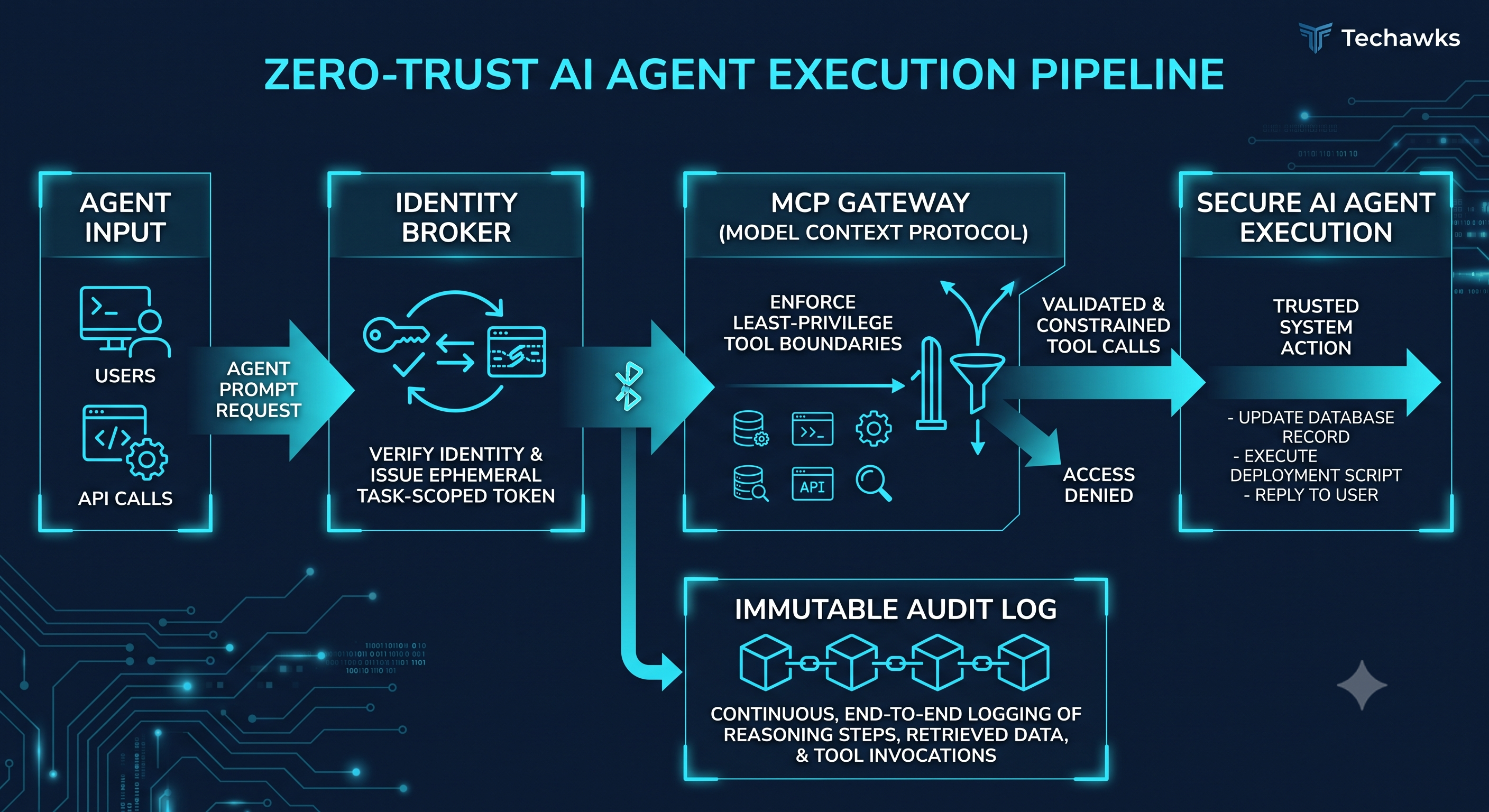
    [ ] Ephemeral, Task-Scoped Identity: Does the agent hold long-lived credentials, or does it request short-lived, brokered tokens strictly bound to its current runtime task?


    [ ] Tool-Level Blast Radius Bounds: Are MCP (Model Context Protocol) and API permissions constrained to least-privilege, blocking administrative escalation or unauthorized schema modifications?


    [ ] Deterministic Step & Loop Caps: Have you established hard limits on execution retries, tool iteration cycles, and autonomous timeouts to prevent runaway API spend and deadlocks?


    [ ] Indirect Prompt Injection Filters: Is incoming content from web pages, emails, or retrieval stores sanitized and isolated before parsing into the agent’s execution context?


    [ ] Non-Repudiation Audit Trails: Can your security team reconstruct an immutable, end-to-end log of the agent’s reasoning steps, data retrieved, tool invocations, and user confirmations?


    [ ] Context-Aware Human-in-the-Loop (HITL): Are irreversible actions (e.g., financial disbursements, record deletion) protected by intentional review gates rather than passive, click-through confirmations?


    Autonomous systems need rigorous, zero-trust infrastructure. If you can’t isolate the agent's identity, you haven't built an automated workflow—you've built an ungoverned backdoor.


    Discussion Question
    What is your team’s biggest architectural bottleneck when moving autonomous agents from sandbox to production—identity management, prompt injection defense, or execution limits?


    CTA
    Join Techawks USA to connect with enterprise engineers, cloud architects, and security leaders building the next generation of resilient AI infrastructure.
    Is Your AI Agent Production-Ready or an IAM Liability? As US enterprises shift from simple LLM wrappers to multi-step autonomous AI agents, enterprise security architecture is hitting a wall. When an agent plans dynamically, executes tool calls, and accesses downstream databases, standard perimeter defenses and static service accounts fail. If an agent’s identity inherits broad user permissions or runs unchecked API tokens, a single prompt injection can trigger unintended writes, data leakage, or runaway tool execution. Before you push that autonomous workflow to production, run your architecture against this Production AI Agent Readiness Checklist: [ ] Ephemeral, Task-Scoped Identity: Does the agent hold long-lived credentials, or does it request short-lived, brokered tokens strictly bound to its current runtime task? [ ] Tool-Level Blast Radius Bounds: Are MCP (Model Context Protocol) and API permissions constrained to least-privilege, blocking administrative escalation or unauthorized schema modifications? [ ] Deterministic Step & Loop Caps: Have you established hard limits on execution retries, tool iteration cycles, and autonomous timeouts to prevent runaway API spend and deadlocks? [ ] Indirect Prompt Injection Filters: Is incoming content from web pages, emails, or retrieval stores sanitized and isolated before parsing into the agent’s execution context? [ ] Non-Repudiation Audit Trails: Can your security team reconstruct an immutable, end-to-end log of the agent’s reasoning steps, data retrieved, tool invocations, and user confirmations? [ ] Context-Aware Human-in-the-Loop (HITL): Are irreversible actions (e.g., financial disbursements, record deletion) protected by intentional review gates rather than passive, click-through confirmations? Autonomous systems need rigorous, zero-trust infrastructure. If you can’t isolate the agent's identity, you haven't built an automated workflow—you've built an ungoverned backdoor. Discussion Question What is your team’s biggest architectural bottleneck when moving autonomous agents from sandbox to production—identity management, prompt injection defense, or execution limits? CTA Join Techawks USA to connect with enterprise engineers, cloud architects, and security leaders building the next generation of resilient AI infrastructure.
    0 Kommentare 0 Geteilt 473 Ansichten 0 Bewertungen
  • MFA Won't Save You: How Token Theft and AiTM Phishing Bypass Traditional Authentication


    Most cybersecurity learners focus heavily on credential cracking: brute-forcing hashes, credential stuffing, and credential stuffing defense.


    Adversaries have largely abandoned trying to guess or crack passwords. Instead, modern intrusion chains exploit a fundamental design premise of the web: post-authentication trust.


    Once a user passes MFA—whether via SMS, an authenticator push, or biometric verification—the application issues a bearer token (such as a session cookie or OAuth access token). From that point forward, the server only checks if the bearer token is valid, not who holds it.


    The Attack Vector: Adversary-in-the-Middle (AiTM)


    Rather than cloning static login pages, attackers deploy reverse-proxy frameworks (like Evilginx).


    The victim visits what looks like a legitimate login portal.


    The proxy server transparently relays authentication requests directly to the legitimate service.


    The user solves the real MFA challenge.


    The legitimate service responds with an authenticated session cookie.


    The proxy captures that cookie in transit, bypassing MFA entirely without ever cracking a single key.


    How Modern Security Teams Defend the Session:


    Transition to FIDO2 / Passkeys (Origin-Bound Authentication): Unlike push notifications or TOTP codes, FIDO2/WebAuthn ties authentication to the browser's cryptographic origin. A phishing proxy running on auth-verify-security.com cannot satisfy the cryptographic challenge intended for the legitimate domain.


    Continuous Access Evaluation (CAE) / DPoP: Implement Demonstrating Proof-of-Possession (DPoP) at the application layer. DPoP binds access tokens to a client-generated private key, ensuring stolen bearer tokens cannot be replayed from an unauthorized IP or client.


    Device Telemetry and Impossible Travel Rules: Enforce conditional access policies that revoke session validity when a token abruptly changes ASN, TLS fingerprint, or geographic origin mid-session.


    Authentication is not a one-time gate at login; it is a continuous posture. If your security model trusts a bearer token indefinitely, you haven't secured the perimeter—you’ve just postponed the breach.


    Discussion Question
    In your lab or organization, how are you mitigating token theft: enforcing FIDO2 hardware keys, setting strict token lifetimes with DPoP, or relying on identity threat detection (ITDR) telemetry?


    CTA
    Sharpen your offensive and defensive security fundamentals. Join ethical hackers, SOC analysts, and security researchers inside Cybersecurity & Ethical Hacking to dissect real-world malware, audit threat vectors, and master enterprise defense.
    MFA Won't Save You: How Token Theft and AiTM Phishing Bypass Traditional Authentication Most cybersecurity learners focus heavily on credential cracking: brute-forcing hashes, credential stuffing, and credential stuffing defense. Adversaries have largely abandoned trying to guess or crack passwords. Instead, modern intrusion chains exploit a fundamental design premise of the web: post-authentication trust. Once a user passes MFA—whether via SMS, an authenticator push, or biometric verification—the application issues a bearer token (such as a session cookie or OAuth access token). From that point forward, the server only checks if the bearer token is valid, not who holds it. The Attack Vector: Adversary-in-the-Middle (AiTM) Rather than cloning static login pages, attackers deploy reverse-proxy frameworks (like Evilginx). The victim visits what looks like a legitimate login portal. The proxy server transparently relays authentication requests directly to the legitimate service. The user solves the real MFA challenge. The legitimate service responds with an authenticated session cookie. The proxy captures that cookie in transit, bypassing MFA entirely without ever cracking a single key. How Modern Security Teams Defend the Session: Transition to FIDO2 / Passkeys (Origin-Bound Authentication): Unlike push notifications or TOTP codes, FIDO2/WebAuthn ties authentication to the browser's cryptographic origin. A phishing proxy running on auth-verify-security.com cannot satisfy the cryptographic challenge intended for the legitimate domain. Continuous Access Evaluation (CAE) / DPoP: Implement Demonstrating Proof-of-Possession (DPoP) at the application layer. DPoP binds access tokens to a client-generated private key, ensuring stolen bearer tokens cannot be replayed from an unauthorized IP or client. Device Telemetry and Impossible Travel Rules: Enforce conditional access policies that revoke session validity when a token abruptly changes ASN, TLS fingerprint, or geographic origin mid-session. Authentication is not a one-time gate at login; it is a continuous posture. If your security model trusts a bearer token indefinitely, you haven't secured the perimeter—you’ve just postponed the breach. Discussion Question In your lab or organization, how are you mitigating token theft: enforcing FIDO2 hardware keys, setting strict token lifetimes with DPoP, or relying on identity threat detection (ITDR) telemetry? CTA Sharpen your offensive and defensive security fundamentals. Join ethical hackers, SOC analysts, and security researchers inside Cybersecurity & Ethical Hacking to dissect real-world malware, audit threat vectors, and master enterprise defense.
    0 Kommentare 0 Geteilt 258 Ansichten 0 Bewertungen
  • vLLM vs. SGLang in Production: Picking the Right High-Throughput Inference Engine for Multi-Agent Architectures


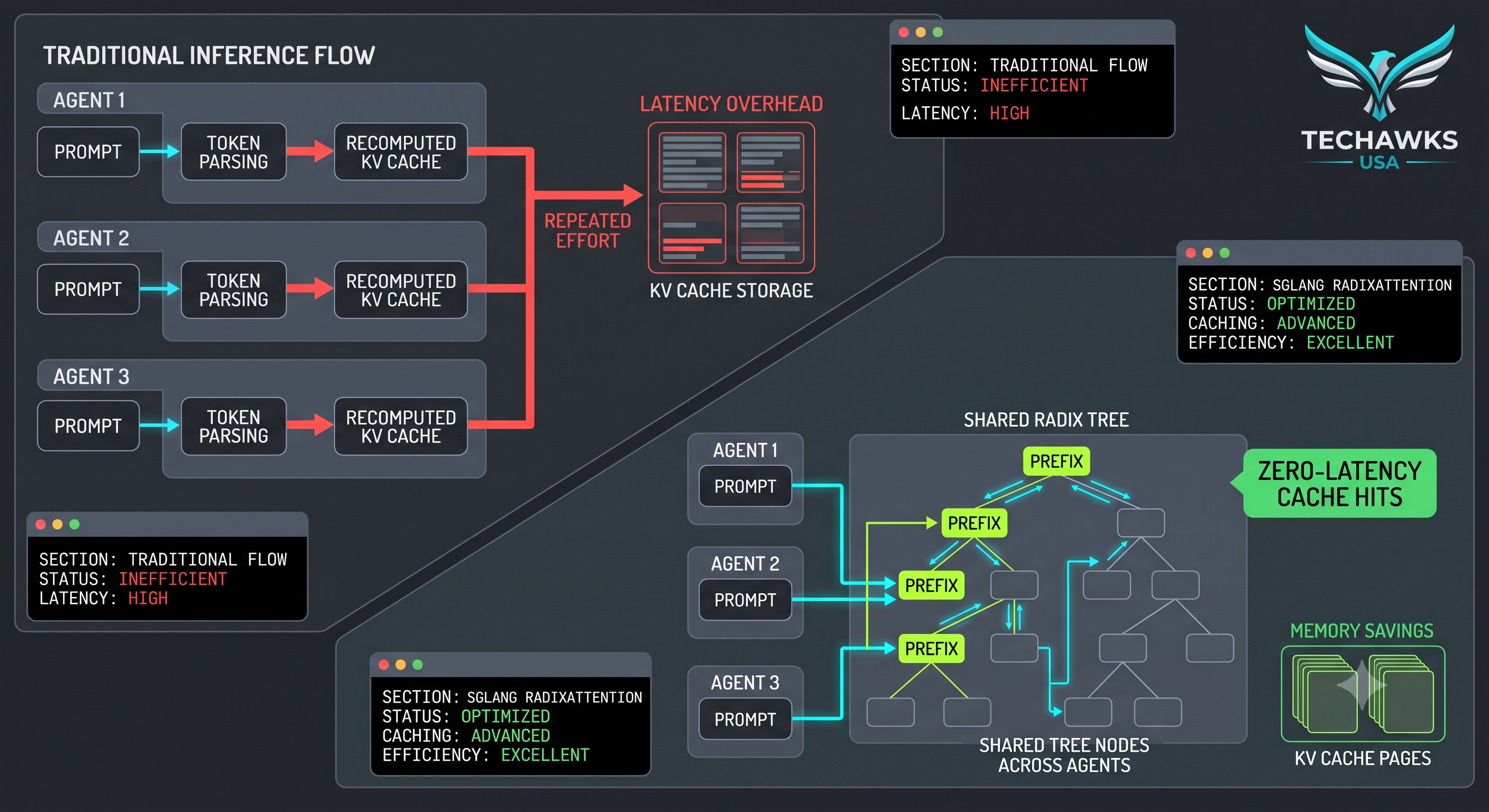
    As LLM workloads transition from single-turn chat completion to multi-step autonomous agents, the performance bottleneck shifts from raw token generation speed to KV cache reuse efficiency.
    If your backend coordinates dozens of autonomous agent loops or complex Model Context Protocol (MCP) servers, choosing between vLLM and SGLang dictates both your monthly cloud GPU compute spend and Time-to-First-Token (TTFT) latency.


    1. Why Prefix Caching Dictates Agent Performance
    In agentic pipelines, 70% to 90% of prompt tokens—such as tool schemas, MCP definitions, and recurring system instructions—are reused across consecutive turns.
    vLLM (PagedAttention): Allocates memory using fixed-size memory pages to eliminate KV-cache fragmentation. Excellent for continuous batching and linear, high-throughput API endpoints.
    SGLang (RadixAttention): Organizes KV cache along a hierarchical Radix tree. When multiple agents share identical tool descriptions or conversational branches, SGLang reuses the cached KV tree directly, bypassing prompt reprocessing.


    2. Head-to-Head Architecture Breakdown
    Architectural Dimension, vLLM (v0.6+), SGLang (PyTorch Ecosystem)
    Core Memory Mechanism, PagedAttention (Page-level granularity), RadixAttention (Radix-tree KV matching)
    Best-Fit Workload, "High-concurrency chat, bulk batching, unique queries", "Multi-turn agent loops, code execution, structured JSON"
    Tool / Grammar Execution, Standard Outlines / Regex guided generation, Native frontend compiler with sub-graph execution
    Ecosystem & Deployment, "Broadest hardware support (AWS, GCP, RunPod, Ray)", Tight PyTorch integration; optimized for dynamic branching


    3. Engineering Recommendations for US Tech Stacks
    Choose vLLM if your service handles user-facing RAG applications with distinct query contexts or large-scale batch embeddings where shared context reuse across concurrent users is minimal.
    Choose SGLang if you are building tool-calling loops, multi-agent evaluation frameworks, or systems using large context schemas (e.g., Anthropic MCP setups) where Radix tree caching slashes TTFT by 3x–5x.


    Discussion Question
    For teams managing self-hosted agent pipelines: Are you running RadixAttention-based engines like SGLang in production, or are managed inference routers handling prefix caching for your clusters?


    Call to Action (CTA)
    Join Techawks USA — Engage with senior US software architects, AI engineers, and DevOps leads exploring scalable cloud infrastructure, AI runtime optimizations, and next-gen DevTools.
    vLLM vs. SGLang in Production: Picking the Right High-Throughput Inference Engine for Multi-Agent Architectures As LLM workloads transition from single-turn chat completion to multi-step autonomous agents, the performance bottleneck shifts from raw token generation speed to KV cache reuse efficiency. If your backend coordinates dozens of autonomous agent loops or complex Model Context Protocol (MCP) servers, choosing between vLLM and SGLang dictates both your monthly cloud GPU compute spend and Time-to-First-Token (TTFT) latency. 1. Why Prefix Caching Dictates Agent Performance In agentic pipelines, 70% to 90% of prompt tokens—such as tool schemas, MCP definitions, and recurring system instructions—are reused across consecutive turns. vLLM (PagedAttention): Allocates memory using fixed-size memory pages to eliminate KV-cache fragmentation. Excellent for continuous batching and linear, high-throughput API endpoints. SGLang (RadixAttention): Organizes KV cache along a hierarchical Radix tree. When multiple agents share identical tool descriptions or conversational branches, SGLang reuses the cached KV tree directly, bypassing prompt reprocessing. 2. Head-to-Head Architecture Breakdown Architectural Dimension, vLLM (v0.6+), SGLang (PyTorch Ecosystem) Core Memory Mechanism, PagedAttention (Page-level granularity), RadixAttention (Radix-tree KV matching) Best-Fit Workload, "High-concurrency chat, bulk batching, unique queries", "Multi-turn agent loops, code execution, structured JSON" Tool / Grammar Execution, Standard Outlines / Regex guided generation, Native frontend compiler with sub-graph execution Ecosystem & Deployment, "Broadest hardware support (AWS, GCP, RunPod, Ray)", Tight PyTorch integration; optimized for dynamic branching 3. Engineering Recommendations for US Tech Stacks Choose vLLM if your service handles user-facing RAG applications with distinct query contexts or large-scale batch embeddings where shared context reuse across concurrent users is minimal. Choose SGLang if you are building tool-calling loops, multi-agent evaluation frameworks, or systems using large context schemas (e.g., Anthropic MCP setups) where Radix tree caching slashes TTFT by 3x–5x. Discussion Question For teams managing self-hosted agent pipelines: Are you running RadixAttention-based engines like SGLang in production, or are managed inference routers handling prefix caching for your clusters? Call to Action (CTA) Join Techawks USA — Engage with senior US software architects, AI engineers, and DevOps leads exploring scalable cloud infrastructure, AI runtime optimizations, and next-gen DevTools.
    0 Kommentare 0 Geteilt 156 Ansichten 0 Bewertungen
  • Myth vs Fact: Why Indexing Every Foreign Key Won’t Save Your Database Performance


    Database optimization isn't about slapping indexes on every relational column—it’s about understanding execution plans, cardinality, and write amplification.


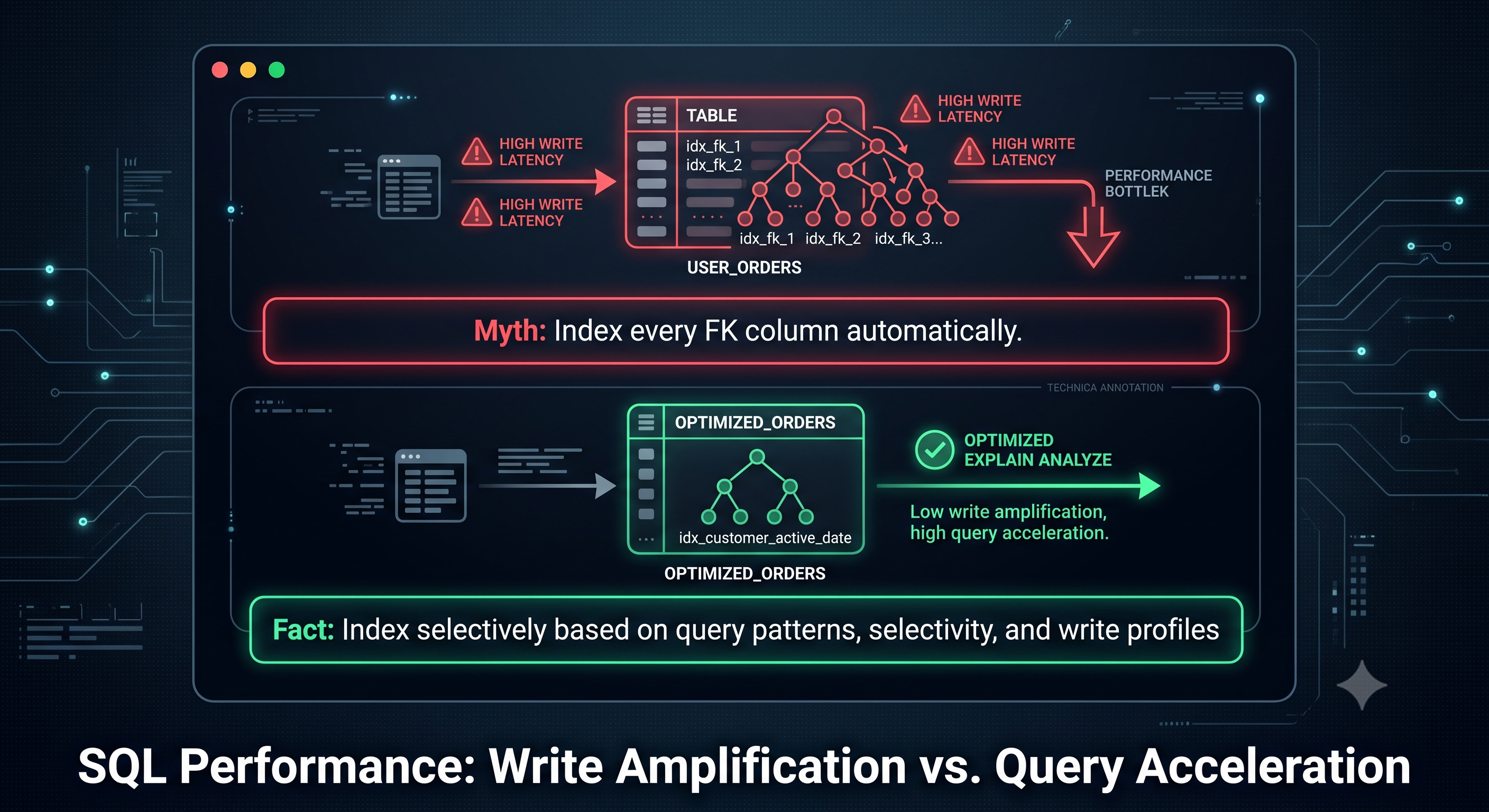
    Myth: "Always create an index on every Foreign Key (FK) column to make your relational queries and joins faster."
    Fact: An unconsidered index on a low-cardinality or high-write column provides negligible join speedup while degrading insert/update throughput, inflating write-ahead logs (WAL), and bloating memory buffers.


    [ Table Write / INSERT / UPDATE ]

    ├──▶ Writes base tuple to Heap Page
    ├──▶ Updates Index 1 (Primary Key)
    ├──▶ Updates Index 2 (FK Index A) ──▶ Write Amplification & Buffer Bloat
    └──▶ Updates Index 3 (FK Index B)
    Why This Matters in Modern Backend Engineering:
    The Low-Cardinality Trap: If a foreign key points to an enum-like status table or a boolean flag (e.g., user_type_id with 3 values across 5M rows), the query planner will frequently ignore the index and perform a Sequential Scan anyway.
    Write Amplification: Every row mutation (INSERT, UPDATE, DELETE) forces the database engine to synchronously update every associated B-tree index, splitting index pages and trashing shared memory buffers.
    HOT (Heap-Only Tuple) Invalidation: In engines like PostgreSQL, updating a row that contains an indexed column prevents HOT optimization, generating excessive table bloat and vacuum pressure.


    What You Should Do Instead:
    Index for Join Patterns, Not Existence: Index a foreign key only if you regularly query parent-child relationships from the child side (e.g., WHERE child.parent_id = ?) or if parent rows undergo frequent cascades (ON DELETE CASCADE).


    Leverage Partial & Composite Indexes: If you only query active records, don't index the whole table:


    SQL
    -- Bad: Indexes all 10M rows unconditionally
    CREATE INDEX idx_orders_customer_id ON orders(customer_id);


    -- Better: Partial index targeting active query workloads
    CREATE INDEX idx_active_orders_customer
    ON orders(customer_id)
    WHERE status = 'pending';
    Inspect the Planner: Always run EXPLAIN (ANALYZE, BUFFERS) before committing an index to production to confirm index scans are actually chosen over sequential scans.


    Discussion Question
    What is the worst index-related production bottleneck or write-amplification issue your team has ever had to debug?


    CTA (Join Developers & Coding)
    💻 Join the Techawks Developers & Coding Community: Connect with software engineers, backend architects, and system developers worldwide to level up your SQL performance, system design patterns, and clean code practices.


    👉 [Link to Techawks Developers & Coding Community]
    Myth vs Fact: Why Indexing Every Foreign Key Won’t Save Your Database Performance Database optimization isn't about slapping indexes on every relational column—it’s about understanding execution plans, cardinality, and write amplification. Myth: "Always create an index on every Foreign Key (FK) column to make your relational queries and joins faster." Fact: An unconsidered index on a low-cardinality or high-write column provides negligible join speedup while degrading insert/update throughput, inflating write-ahead logs (WAL), and bloating memory buffers. [ Table Write / INSERT / UPDATE ] │ ├──▶ Writes base tuple to Heap Page ├──▶ Updates Index 1 (Primary Key) ├──▶ Updates Index 2 (FK Index A) ──▶ Write Amplification & Buffer Bloat └──▶ Updates Index 3 (FK Index B) Why This Matters in Modern Backend Engineering: The Low-Cardinality Trap: If a foreign key points to an enum-like status table or a boolean flag (e.g., user_type_id with 3 values across 5M rows), the query planner will frequently ignore the index and perform a Sequential Scan anyway. Write Amplification: Every row mutation (INSERT, UPDATE, DELETE) forces the database engine to synchronously update every associated B-tree index, splitting index pages and trashing shared memory buffers. HOT (Heap-Only Tuple) Invalidation: In engines like PostgreSQL, updating a row that contains an indexed column prevents HOT optimization, generating excessive table bloat and vacuum pressure. What You Should Do Instead: Index for Join Patterns, Not Existence: Index a foreign key only if you regularly query parent-child relationships from the child side (e.g., WHERE child.parent_id = ?) or if parent rows undergo frequent cascades (ON DELETE CASCADE). Leverage Partial & Composite Indexes: If you only query active records, don't index the whole table: SQL -- Bad: Indexes all 10M rows unconditionally CREATE INDEX idx_orders_customer_id ON orders(customer_id); -- Better: Partial index targeting active query workloads CREATE INDEX idx_active_orders_customer ON orders(customer_id) WHERE status = 'pending'; Inspect the Planner: Always run EXPLAIN (ANALYZE, BUFFERS) before committing an index to production to confirm index scans are actually chosen over sequential scans. Discussion Question What is the worst index-related production bottleneck or write-amplification issue your team has ever had to debug? CTA (Join Developers & Coding) 💻 Join the Techawks Developers & Coding Community: Connect with software engineers, backend architects, and system developers worldwide to level up your SQL performance, system design patterns, and clean code practices. 👉 [Link to Techawks Developers & Coding Community]
    0 Kommentare 0 Geteilt 198 Ansichten 0 Bewertungen
  • The Software Engineer’s Resume Blueprint: How to Pass the 6-Second Recruiter Screen


    Standing out in today’s hiring environment isn't about padding your tech stack list with buzzwords. It’s about clearly communicating business impact, technical ownership, and problem-solving capability.
    Whether you are applying for your first developer role or a senior engineering position, use this actionable blueprint to structure high-converting resume bullet points:


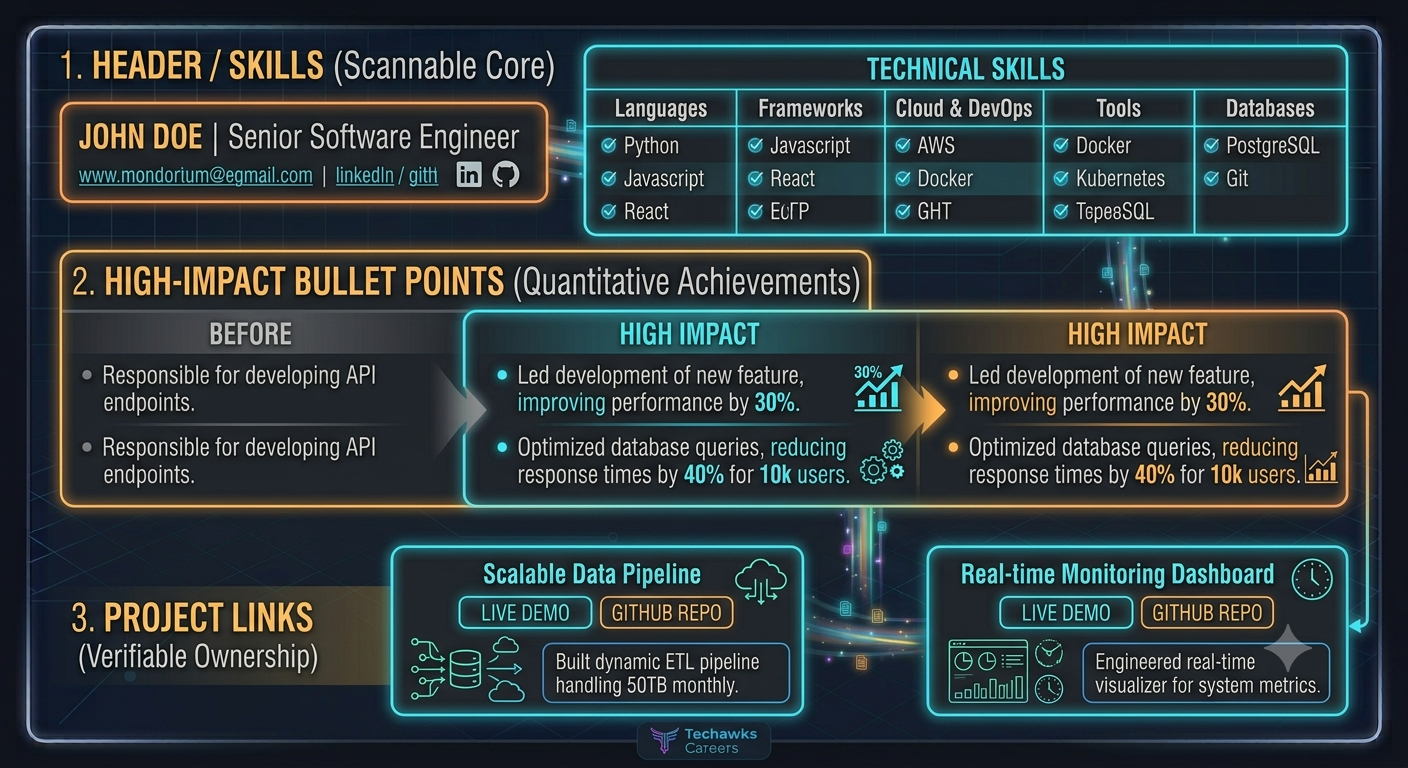
    Adopt the Action + Context + Outcome Formula
    The Bad: "Responsible for building REST APIs in Node.js."
    The Fix: Frame every project accomplishment using the Google XYZ framework ("Accomplished [X], as measured by [Y], by doing [Z]").
    Example: "Reduced API response latency by 42% by implementing a Redis caching layer for high-volume database queries."


    Categorize Your Skills Strategy
    Don't dump 30 programming languages and frameworks into an unsorted block at the top.
    Group skills logically into categories: Languages, Frameworks & Libraries, Databases & Storage, and Cloud & DevOps. Place the tools you are most proficient with first.


    Showcase System Scale & Problem Complexity
    Metrics matter. Whenever possible, include numbers that quantify scale: throughput, active users, data volume, deployment frequency, or test coverage improvements.
    If working on a side project, quantify performance metrics (e.g., "Engineered a RAG pipeline handling 10k+ vector lookups under 200ms").


    Highlight Engineering Trade-offs & Ownership
    In project descriptions, briefly note why you chose a specific technology over an alternative.
    Highlight cross-functional collaboration, such as leading architecture reviews, mentoring junior devs, or establishing testing standards.


    Keep Formatting Aggressively Scannable
    Stick to a single-page format (two pages only if you have 8+ years of experience).
    Use clean line spacing, bold key metrics, and link directly to active GitHub repositories or live production demos.


    Key Takeaways
    Focus on impact over duties: Quantify results with specific numbers, metrics, and business outcomes.
    Format for scannability: Group your technical skills logically so recruiters can evaluate fit instantly.
    Showcase trade-offs: Prove that you understand why you chose certain tools, not just how to use them.


    CTA
    Looking to land your next technical role, polish your resume, or prepare for tough technical interviews?


    [Join Tech Jobs & Opportunities] to access curated job listings, resume teardowns, and career growth strategies from experienced tech recruiters and engineering leaders.


    Suggested Image
    The Software Engineer’s Resume Blueprint: How to Pass the 6-Second Recruiter Screen Standing out in today’s hiring environment isn't about padding your tech stack list with buzzwords. It’s about clearly communicating business impact, technical ownership, and problem-solving capability. Whether you are applying for your first developer role or a senior engineering position, use this actionable blueprint to structure high-converting resume bullet points: Adopt the Action + Context + Outcome Formula The Bad: "Responsible for building REST APIs in Node.js." The Fix: Frame every project accomplishment using the Google XYZ framework ("Accomplished [X], as measured by [Y], by doing [Z]"). Example: "Reduced API response latency by 42% by implementing a Redis caching layer for high-volume database queries." Categorize Your Skills Strategy Don't dump 30 programming languages and frameworks into an unsorted block at the top. Group skills logically into categories: Languages, Frameworks & Libraries, Databases & Storage, and Cloud & DevOps. Place the tools you are most proficient with first. Showcase System Scale & Problem Complexity Metrics matter. Whenever possible, include numbers that quantify scale: throughput, active users, data volume, deployment frequency, or test coverage improvements. If working on a side project, quantify performance metrics (e.g., "Engineered a RAG pipeline handling 10k+ vector lookups under 200ms"). Highlight Engineering Trade-offs & Ownership In project descriptions, briefly note why you chose a specific technology over an alternative. Highlight cross-functional collaboration, such as leading architecture reviews, mentoring junior devs, or establishing testing standards. Keep Formatting Aggressively Scannable Stick to a single-page format (two pages only if you have 8+ years of experience). Use clean line spacing, bold key metrics, and link directly to active GitHub repositories or live production demos. Key Takeaways Focus on impact over duties: Quantify results with specific numbers, metrics, and business outcomes. Format for scannability: Group your technical skills logically so recruiters can evaluate fit instantly. Showcase trade-offs: Prove that you understand why you chose certain tools, not just how to use them. CTA Looking to land your next technical role, polish your resume, or prepare for tough technical interviews? [Join Tech Jobs & Opportunities] to access curated job listings, resume teardowns, and career growth strategies from experienced tech recruiters and engineering leaders. Suggested Image
    0 Kommentare 0 Geteilt 988 Ansichten 0 Bewertungen
  • How to Build a Tech Portfolio That Gets You Hired (Without Any Work Experience)


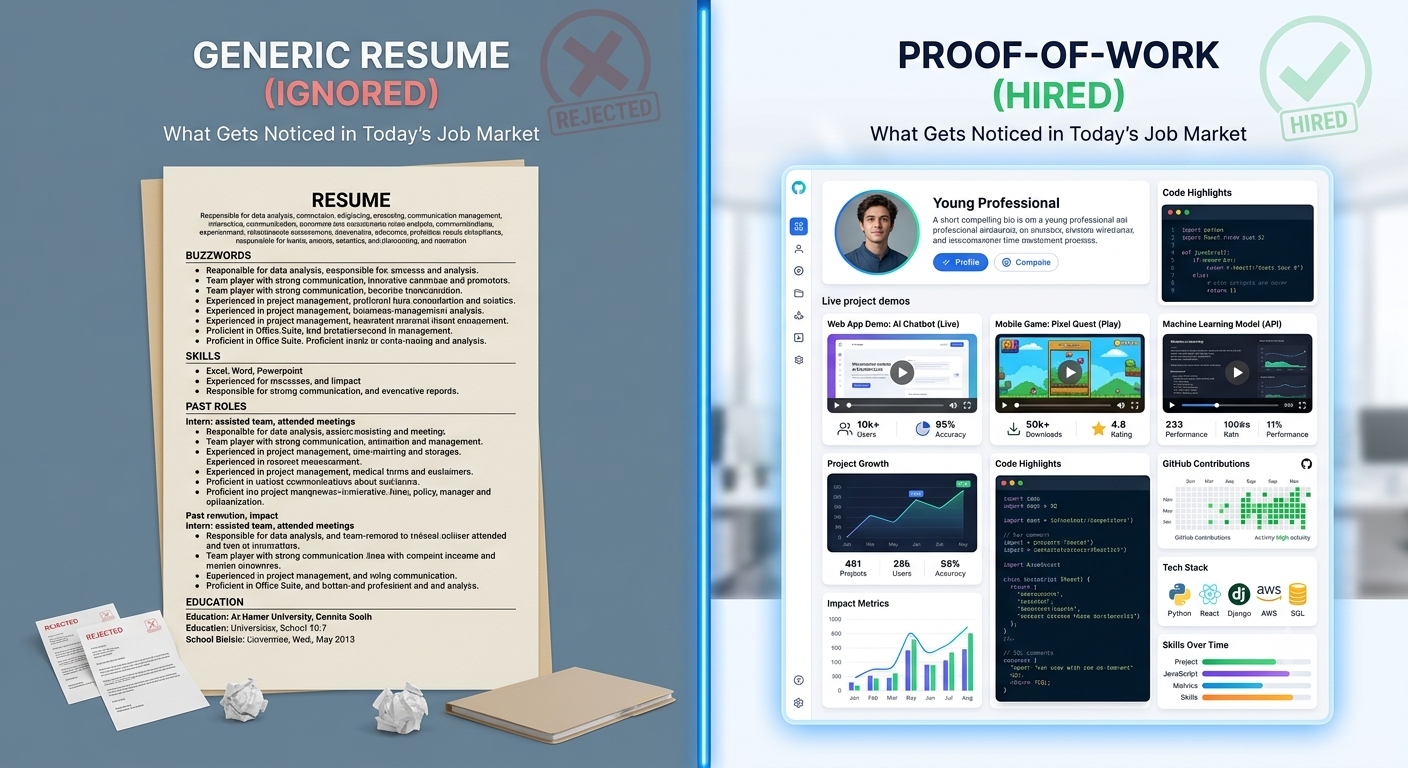
    Most students make the same mistake: they fill their GitHub or portfolio site with tutorial projects—like basic weather apps, simple to-do lists, or cloned landing pages. Hiring managers recognize these immediately and scroll right past.
    To build a portfolio that actually commands attention from recruiters and hiring managers, follow this three-step blueprint:


    1. Build "Pain Point" Projects, Not Tutorial Clones
    Instead of following a video guide step-by-step, identify a minor inconvenience in your daily student life or local community and build a software solution for it.
    Bad Example: A generic library management system from a class assignment.
    Good Example: A custom web scraper that alerts your group chat the second a closed college class section opens up.


    2. Document the "Why," Not Just the Code
    Employers hire problem solvers, not syntax memorizers. For every project featured on your portfolio, include a clear README file or project write-up that answers:
    The Problem: What specific issue were you trying to solve?
    Technical Decisions: Why did you choose framework X over framework Y?
    Trade-offs & Challenges: What broke, and how did you debug it?


    3. Deploy and Make It Accessible
    A GitHub repository with code is fine, but a live, working link is infinitely better.
    Deploy your web apps using free hosting platforms like Vercel, Render, or Netlify.
    Include a short (30 to 60-second) video demo or GIF at the top of your repository so recruiters can see your project in action instantly without having to clone and run your code locally.


    Key Takeaways
    Ditch the Clones: One unique, self-driven project easily outweighs five step-by-step tutorial projects.
    Show Your Thinking: Document your architecture choices and debugging process to demonstrate engineering maturity.
    Make It Live: Always provide a live demo or video walkthrough so non-technical screeners can see your work in seconds.


    CTA
    Ready to land your dream tech role?
    [Join Students in Tech] to get your portfolio reviewed by industry mentors, collaborate on open-source projects, and connect with fellow student builders!
    How to Build a Tech Portfolio That Gets You Hired (Without Any Work Experience) Most students make the same mistake: they fill their GitHub or portfolio site with tutorial projects—like basic weather apps, simple to-do lists, or cloned landing pages. Hiring managers recognize these immediately and scroll right past. To build a portfolio that actually commands attention from recruiters and hiring managers, follow this three-step blueprint: 1. Build "Pain Point" Projects, Not Tutorial Clones Instead of following a video guide step-by-step, identify a minor inconvenience in your daily student life or local community and build a software solution for it. Bad Example: A generic library management system from a class assignment. Good Example: A custom web scraper that alerts your group chat the second a closed college class section opens up. 2. Document the "Why," Not Just the Code Employers hire problem solvers, not syntax memorizers. For every project featured on your portfolio, include a clear README file or project write-up that answers: The Problem: What specific issue were you trying to solve? Technical Decisions: Why did you choose framework X over framework Y? Trade-offs & Challenges: What broke, and how did you debug it? 3. Deploy and Make It Accessible A GitHub repository with code is fine, but a live, working link is infinitely better. Deploy your web apps using free hosting platforms like Vercel, Render, or Netlify. Include a short (30 to 60-second) video demo or GIF at the top of your repository so recruiters can see your project in action instantly without having to clone and run your code locally. Key Takeaways Ditch the Clones: One unique, self-driven project easily outweighs five step-by-step tutorial projects. Show Your Thinking: Document your architecture choices and debugging process to demonstrate engineering maturity. Make It Live: Always provide a live demo or video walkthrough so non-technical screeners can see your work in seconds. CTA Ready to land your dream tech role? [Join Students in Tech] to get your portfolio reviewed by industry mentors, collaborate on open-source projects, and connect with fellow student builders!
    0 Kommentare 0 Geteilt 1KB Ansichten 0 Bewertungen
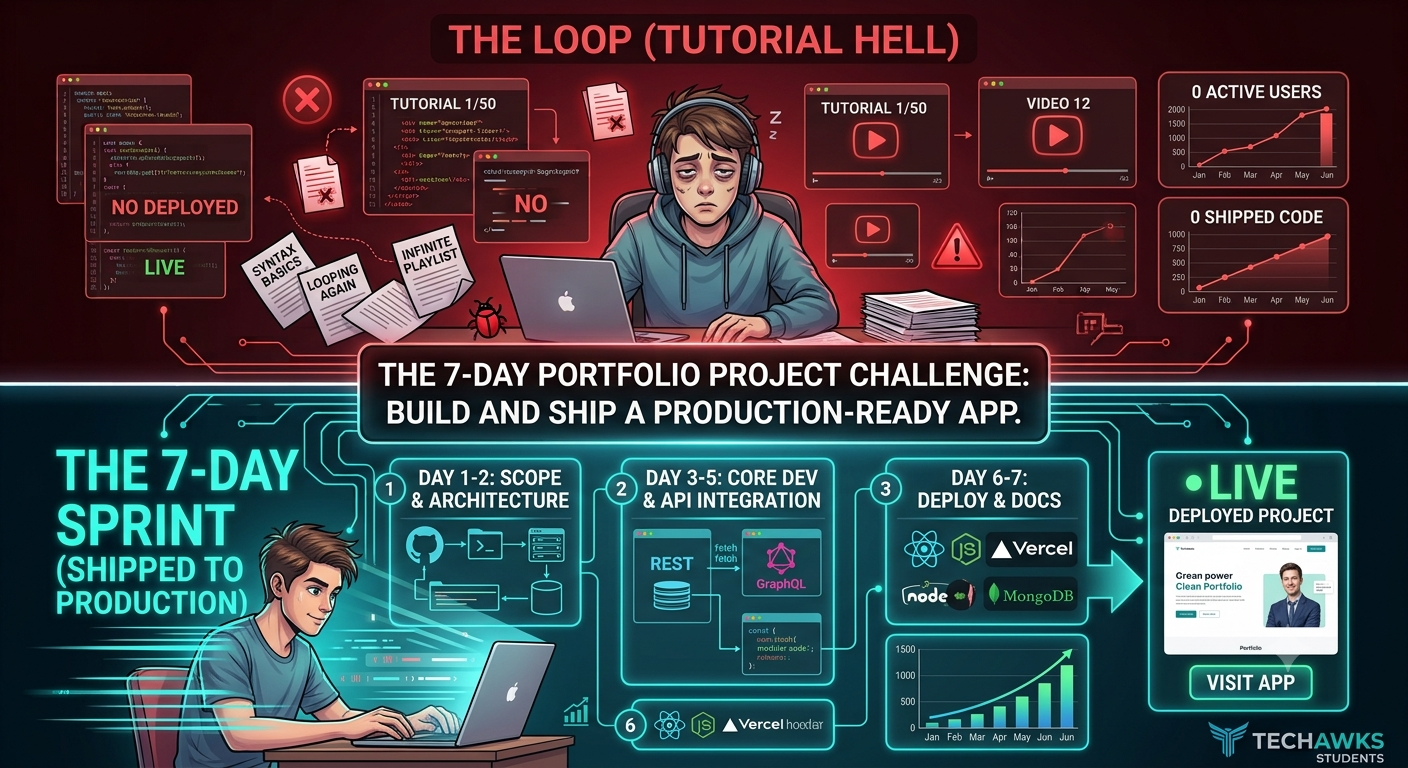
  • The 7-Day Portfolio Project Challenge: Build and Ship a Production-Ready App
    Most student portfolios are filled with identical assignments: basic todo lists, weather apps, or generic clones. Hiring managers skip right past these because they don't demonstrate real-world engineering decisions.


    To stand out in entry-level tech applications, you need to showcase project ownership, API integration, and deployment. Here is your 7-day blueprint to ship a functional, production-ready app:


    Days 1–2: Scope & Architecture
    The Goal: Define a small problem and map your stack.
    The Action: Pick a niche utility app (e.g., a lightweight developer cheat-sheet generator, a localized study-timer with stats, or a simple markdown parser).
    The Rule: Keep the feature set minimal. Define maximum 2 core endpoints/pages. Draw your database schema and UI layout on paper before opening your IDE.


    Days 3–5: Core Development & Integration
    The Goal: Build the functional core using real data or external APIs.
    The Action: Write clean, modular code. Implement essential features first:
    Fetch dynamic data using a public REST or GraphQL API.
    Handle loading, error, and empty states gracefully in your UI.
    The Rule: Don't get stuck styling early. Make it work first, then make it look clean.


    Days 6–7: Deploy, Document & Ship
    The Goal: Put your code live on the internet with a professional repository.
    The Action: Deploy: Host your app live using free hosting platforms (e.g., Vercel, Render, Netlify, or GitHub Pages).
    Write the README: Include a clear project description, system architecture diagram, tech stack badges, local setup instructions, and key technical challenges solved.
    Share: Post a 30-second screen recording of your working app on LinkedIn or X with a live link.


    Key Takeaways
    Ship over perfect: A deployed, 80%-featured project online beats a 100%-featured project sitting on your local localhost.
    Document your engineering decisions: A well-structured README.md explaining why you chose specific tools is as important as the code itself.
    Break out of tutorial loops: Learn just enough syntax to start building, then Google and solve edge cases as you hit them in production.


    CTA (Join Students in Tech)
    Ready to build in public, get code reviews from experienced mentors, and collaborate with ambitious peers? [Join Students in Tech] to share your projects, participate in hackathons, and level up your engineering skills!
    The 7-Day Portfolio Project Challenge: Build and Ship a Production-Ready App Most student portfolios are filled with identical assignments: basic todo lists, weather apps, or generic clones. Hiring managers skip right past these because they don't demonstrate real-world engineering decisions. To stand out in entry-level tech applications, you need to showcase project ownership, API integration, and deployment. Here is your 7-day blueprint to ship a functional, production-ready app: Days 1–2: Scope & Architecture The Goal: Define a small problem and map your stack. The Action: Pick a niche utility app (e.g., a lightweight developer cheat-sheet generator, a localized study-timer with stats, or a simple markdown parser). The Rule: Keep the feature set minimal. Define maximum 2 core endpoints/pages. Draw your database schema and UI layout on paper before opening your IDE. Days 3–5: Core Development & Integration The Goal: Build the functional core using real data or external APIs. The Action: Write clean, modular code. Implement essential features first: Fetch dynamic data using a public REST or GraphQL API. Handle loading, error, and empty states gracefully in your UI. The Rule: Don't get stuck styling early. Make it work first, then make it look clean. Days 6–7: Deploy, Document & Ship The Goal: Put your code live on the internet with a professional repository. The Action: Deploy: Host your app live using free hosting platforms (e.g., Vercel, Render, Netlify, or GitHub Pages). Write the README: Include a clear project description, system architecture diagram, tech stack badges, local setup instructions, and key technical challenges solved. Share: Post a 30-second screen recording of your working app on LinkedIn or X with a live link. Key Takeaways Ship over perfect: A deployed, 80%-featured project online beats a 100%-featured project sitting on your local localhost. Document your engineering decisions: A well-structured README.md explaining why you chose specific tools is as important as the code itself. Break out of tutorial loops: Learn just enough syntax to start building, then Google and solve edge cases as you hit them in production. CTA (Join Students in Tech) Ready to build in public, get code reviews from experienced mentors, and collaborate with ambitious peers? [Join Students in Tech] to share your projects, participate in hackathons, and level up your engineering skills!
    0 Kommentare 0 Geteilt 2KB Ansichten 0 Bewertungen
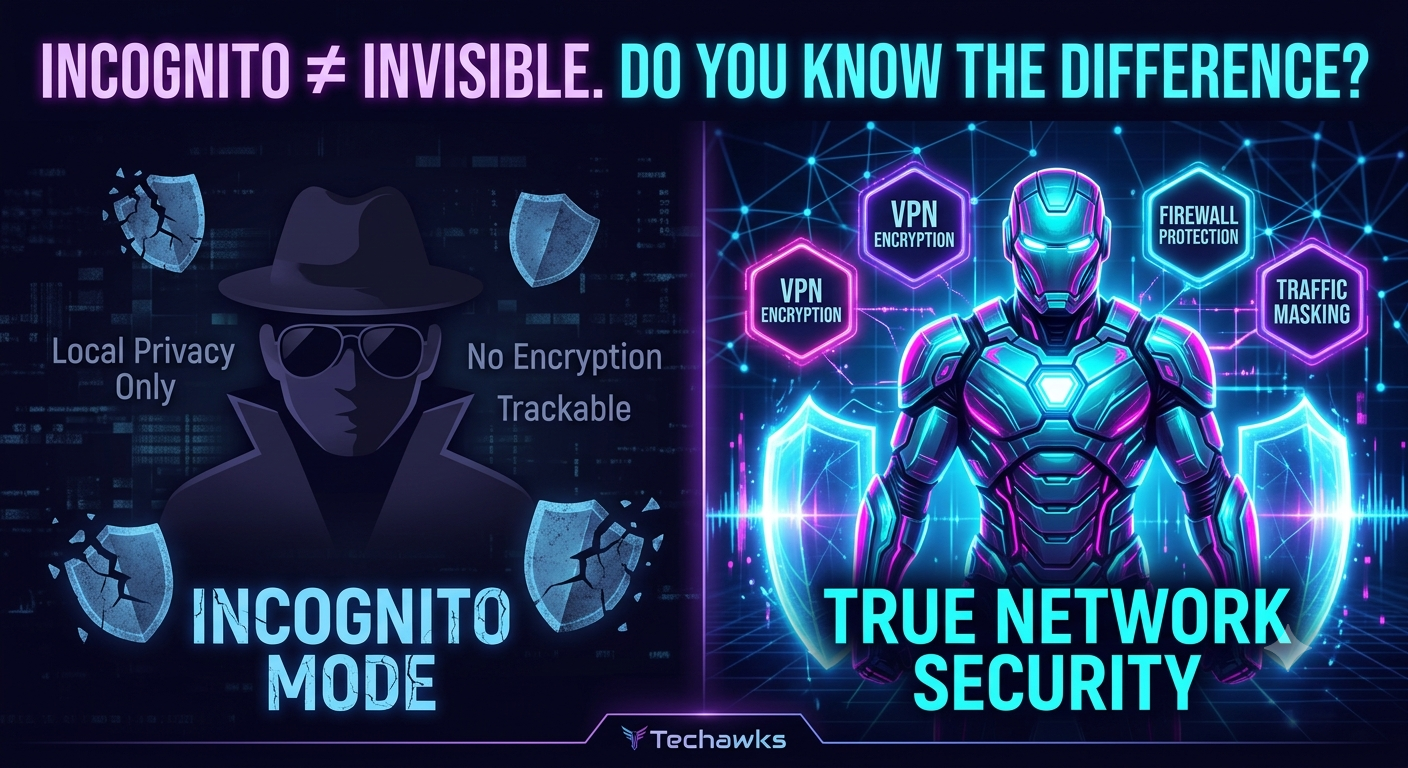
  • Myth Busted: Is Incognito Mode Actually Keeping You Safe? 🕵️‍♂️
    ❌ MYTH: "Incognito Mode makes me completely anonymous and safe from hackers."
    Many people believe that opening a private window creates an impenetrable shield around their device, hiding their location, blocking malware, and stopping websites from tracking them.
    ✅ FACT: It only hides your browsing activity from other people using your device.
    Private browsing simply stops your browser from saving your local search history, cookies, and form data. It does not hide your activity from external networks or protect you against malicious threats.


    What Incognito Mode DOES and DOESN'T Do:
    Feature Incognito Mode 🕶️ What You Actually Need 🛡️
    Local History Clears history on your device Standard browser feature
    IP Address & Location ❌ Still visible VPN (Virtual Private Network)
    ISP & Employer Tracking ❌ Still visible Encrypted Traffic / VPN
    Malware & Phishing Protection ❌ No protection Antivirus & Security Awareness


    Practical Steps to Stay Truly Secure
    Use a Trustworthy VPN: If you want to hide your IP address and encrypt your internet traffic from network snoops, rely on a VPN—not Incognito Mode.
    Layer Your Security: Use modern browser extensions like ad-blockers and HTTPS-enforcers alongside updated antivirus software.
    Practice Cyber Hygiene: Never assume private browsing protects you from download links or fake login pages. Phishing scams work regardless of your browser mode!


    Key Takeaways
    Local vs. Network Privacy: Incognito mode only protects your privacy locally (on your screen), not across the web.
    Visibility Remains: Your Internet Service Provider (ISP), network admin, and the websites you visit can still track you.
    No Security Armor: Private browsing does not block malware, viruses, or phishing attacks.


    CTA
    Want to go beyond basic privacy myths and master real network defense?
    Join the Techawks Cybersecurity & Ethical Hacking Program today to build hands-on skills, learn how real tracking works, and launch your career in cybersecurity! 🚀
    Myth Busted: Is Incognito Mode Actually Keeping You Safe? 🕵️‍♂️ ❌ MYTH: "Incognito Mode makes me completely anonymous and safe from hackers." Many people believe that opening a private window creates an impenetrable shield around their device, hiding their location, blocking malware, and stopping websites from tracking them. ✅ FACT: It only hides your browsing activity from other people using your device. Private browsing simply stops your browser from saving your local search history, cookies, and form data. It does not hide your activity from external networks or protect you against malicious threats. What Incognito Mode DOES and DOESN'T Do: Feature Incognito Mode 🕶️ What You Actually Need 🛡️ Local History Clears history on your device Standard browser feature IP Address & Location ❌ Still visible VPN (Virtual Private Network) ISP & Employer Tracking ❌ Still visible Encrypted Traffic / VPN Malware & Phishing Protection ❌ No protection Antivirus & Security Awareness Practical Steps to Stay Truly Secure Use a Trustworthy VPN: If you want to hide your IP address and encrypt your internet traffic from network snoops, rely on a VPN—not Incognito Mode. Layer Your Security: Use modern browser extensions like ad-blockers and HTTPS-enforcers alongside updated antivirus software. Practice Cyber Hygiene: Never assume private browsing protects you from download links or fake login pages. Phishing scams work regardless of your browser mode! Key Takeaways Local vs. Network Privacy: Incognito mode only protects your privacy locally (on your screen), not across the web. Visibility Remains: Your Internet Service Provider (ISP), network admin, and the websites you visit can still track you. No Security Armor: Private browsing does not block malware, viruses, or phishing attacks. CTA Want to go beyond basic privacy myths and master real network defense? Join the Techawks Cybersecurity & Ethical Hacking Program today to build hands-on skills, learn how real tracking works, and launch your career in cybersecurity! 🚀
    0 Kommentare 0 Geteilt 1KB Ansichten 0 Bewertungen