• Beyond the Region Lock: Why US Platform Teams Are Migrating to Local-First AI Architectures in 2026
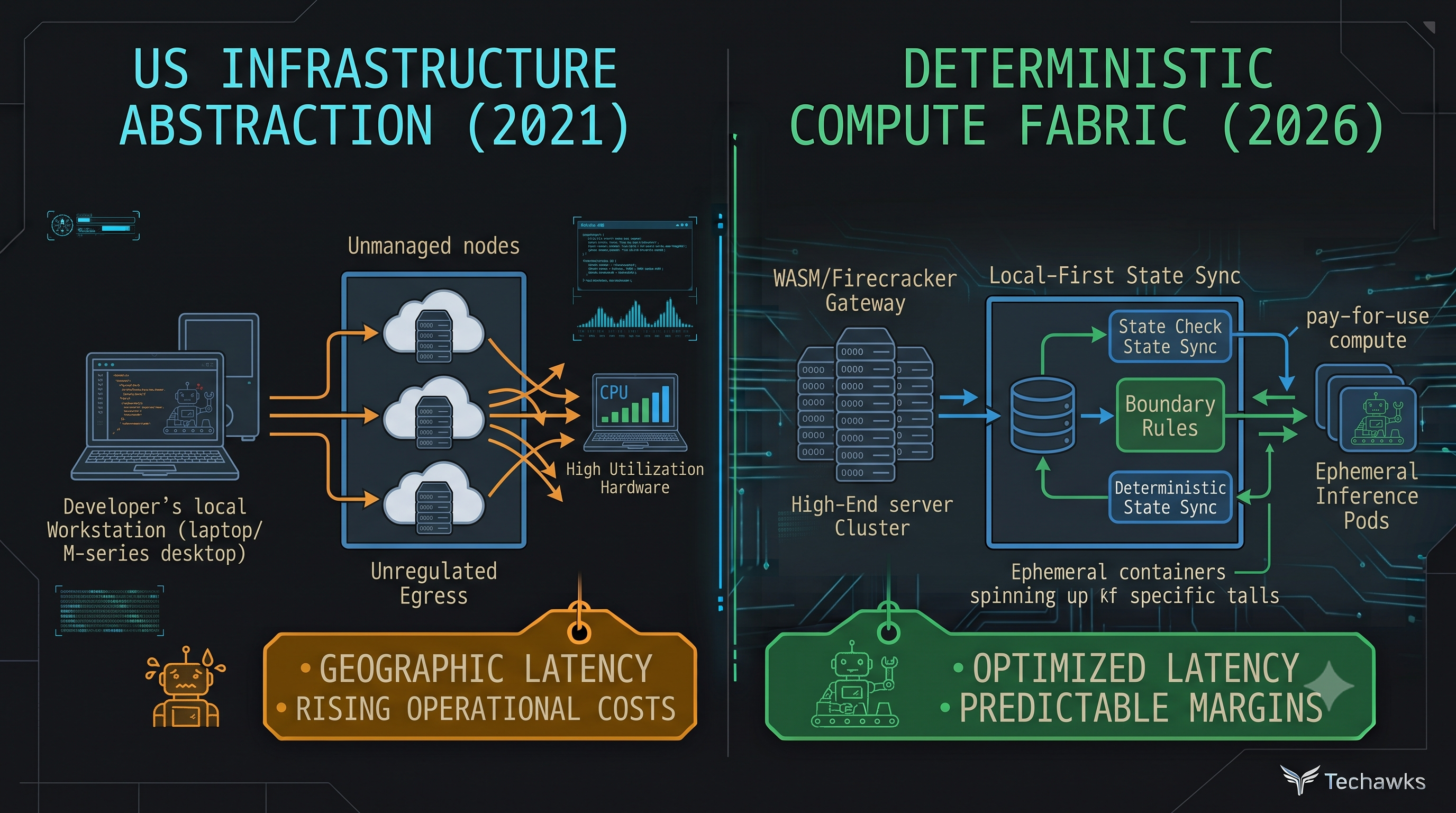
    The legacy promise of US cloud data centers was unlimited scale via geographic abstraction: spin up instances anywhere, pay-for-use, and let the network handle replication. However, the AI-native shift has corrupted this model.


    For critical US workloads, geographic latency and data egress costs are the new performance bottlenecks. High-performing engineering teams are moving beyond region-locking toward Deterministic Compute Fabrics that are local-first.


    In 2026, optimization is defined by removing infrastructure, not adding it. US platform stewards must master three architectural shifts:


    Your 3-Step Local-First Migration Strategy:
    Shift Right, then Shift Left (Boundary Inference)


    Treat developer workstations (especially M-series and high-end RTX rigs) as an extended compute plane. Use containerized local inference gateways. Enforce strict boundary rules: if a query requires fewer than 14B parameters or can be handled by an SLM, drop it from the cloud egress pipeline entirely.


    Move from VMs to Native WASM & MicroVMs
    If an agent workflow must burst to the cloud for validation or state consistency, use highly ephemeral execution environments. Do not spin up a VM or a K8s pod. Use WebAssembly (WASM) runtimes (e.g., Wasmtime) or MicroVMs (e.g., Firecracker) for transactional, low-millisecond agent calls.


    Master Local/Cloud Deterministic Sync
    The bottleneck isn’t compute; it’s state. Implement local-first Conflict-free Replicated Data Types (CRDTs) or robust transactional databases that guarantee state determinism between the localized user session and the cloud control plane.
    Your US cloud strategy is no longer about managing sprawl across 'us-east-1' and 'us-west-2'. It’s about building minimal, deterministic gateways that coordinate execution across decentralized, high-utilization local hardware.


    Discussion Question
    For US-based cloud engineers and platform architects: How are you handling the hybrid AI split—are you using service mesh to route inference locally, containerizing SLMs, or purely optimizing on-demand cloud costs in congested regions? Share your optimization playbook.


    CTA
    Ready to build minimal, scalable, and cost-efficient cloud systems optimized for local-first execution?


    👉 Join Techawks USA to master distributed systems, WASM orchestration, and production engineering alongside US practitioners.
    Beyond the Region Lock: Why US Platform Teams Are Migrating to Local-First AI Architectures in 2026 The legacy promise of US cloud data centers was unlimited scale via geographic abstraction: spin up instances anywhere, pay-for-use, and let the network handle replication. However, the AI-native shift has corrupted this model. For critical US workloads, geographic latency and data egress costs are the new performance bottlenecks. High-performing engineering teams are moving beyond region-locking toward Deterministic Compute Fabrics that are local-first. In 2026, optimization is defined by removing infrastructure, not adding it. US platform stewards must master three architectural shifts: Your 3-Step Local-First Migration Strategy: Shift Right, then Shift Left (Boundary Inference) Treat developer workstations (especially M-series and high-end RTX rigs) as an extended compute plane. Use containerized local inference gateways. Enforce strict boundary rules: if a query requires fewer than 14B parameters or can be handled by an SLM, drop it from the cloud egress pipeline entirely. Move from VMs to Native WASM & MicroVMs If an agent workflow must burst to the cloud for validation or state consistency, use highly ephemeral execution environments. Do not spin up a VM or a K8s pod. Use WebAssembly (WASM) runtimes (e.g., Wasmtime) or MicroVMs (e.g., Firecracker) for transactional, low-millisecond agent calls. Master Local/Cloud Deterministic Sync The bottleneck isn’t compute; it’s state. Implement local-first Conflict-free Replicated Data Types (CRDTs) or robust transactional databases that guarantee state determinism between the localized user session and the cloud control plane. Your US cloud strategy is no longer about managing sprawl across 'us-east-1' and 'us-west-2'. It’s about building minimal, deterministic gateways that coordinate execution across decentralized, high-utilization local hardware. Discussion Question For US-based cloud engineers and platform architects: How are you handling the hybrid AI split—are you using service mesh to route inference locally, containerizing SLMs, or purely optimizing on-demand cloud costs in congested regions? Share your optimization playbook. CTA Ready to build minimal, scalable, and cost-efficient cloud systems optimized for local-first execution? 👉 Join Techawks USA to master distributed systems, WASM orchestration, and production engineering alongside US practitioners.
    0 Commentaires 0 Parts 153 Vue 0 Aperçu
  • The Regulatory Air-Gap: Why UK Engineering Teams Must Decouple Data Residency from Sovereign Execution


    UK tech leaders are navigating a dual operational reality: accelerating agentic AI adoption while aligning with the strict regulatory expectations of the Cyber Security and Resilience Bill, sector-specific FCA/PRA operational resilience mandates, and the ICO's statutory guidance on automated decision-making.


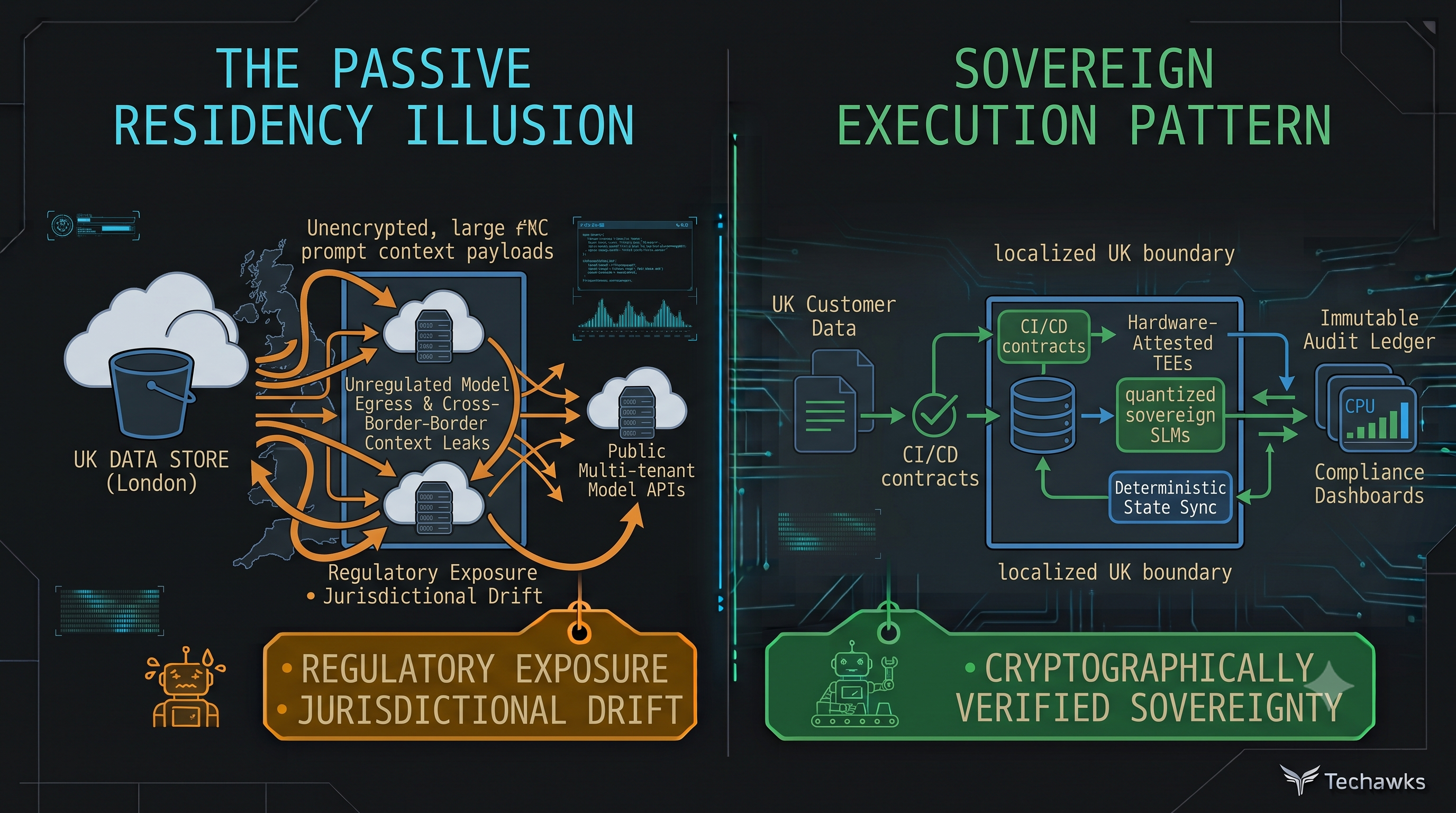
    The classic enterprise response has been Passive Data Residency: store the database inside UK borders, but pipe sensitive customer telemetry, prompt contexts, and operational metadata out to non-sovereign multi-tenant model APIs across external regions.


    Under modern scrutiny, that boundary is untenable. Real resilience requires moving from simple storage residency to Sovereign Execution & Enclave Determinism.


    How to Architect for Sovereign Runtime Compliance:
    Deploy Confidential Computing Enclaves (Hardware Attestation)


    Encrypting data at rest and in transit is baseline hygiene. To protect sensitive customer contexts during inference, isolate model runtimes inside hardware-attested Trusted Execution Environments (TEEs) on UK-domiciled bare metal. This guarantees that host infrastructure administrators and third-party hypervisors cannot inspect memory state during runtime execution.


    Implement Localized Model Distillation & SLM Gateways
    Never send high-compliance transactions (e.g., patient records, credit decisions, identifiable telemetry) to opaque public endpoints. Route in-scope requests to local, quantized Small Language Models (SLMs) running inside air-gapped VPCs. Use deterministic rule-based classifiers to scrub and verify data contracts before any anonymized residual workloads trigger external fallbacks.


    Enforce Immutable Audit Ledgers for Automated Decisions
    The ICO and FCA hold Senior Managers directly accountable for automated decision chains. Replace opaque, non-deterministic agent loops with cryptographically signed execution traces. Record the input context hash, model weight version, state transition, and output payload in an append-only log to ensure forensic auditability on demand.


    Sovereignty isn't a checkmark on a cloud billing dashboard—it is an architectural pattern that guarantees total jurisdictional control over code, context, and compute.


    Discussion Question
    For UK tech leaders, CTOs, and platform architects: How is your team reconciling high-speed agent deployment with strict UK compliance—are you adopting local sovereign SLMs, investing in confidential computing enclaves, or relying on contractual provider assurances? Let's discuss where the practical trade-offs lie.


    CTA
    Ready to build resilient, sovereign, and audit-proof technical systems?


    👉 Join Techawks UK to collaborate with senior engineers, discuss sovereign cloud architecture, and benchmark production frameworks alongside the British tech community.
    The Regulatory Air-Gap: Why UK Engineering Teams Must Decouple Data Residency from Sovereign Execution UK tech leaders are navigating a dual operational reality: accelerating agentic AI adoption while aligning with the strict regulatory expectations of the Cyber Security and Resilience Bill, sector-specific FCA/PRA operational resilience mandates, and the ICO's statutory guidance on automated decision-making. The classic enterprise response has been Passive Data Residency: store the database inside UK borders, but pipe sensitive customer telemetry, prompt contexts, and operational metadata out to non-sovereign multi-tenant model APIs across external regions. Under modern scrutiny, that boundary is untenable. Real resilience requires moving from simple storage residency to Sovereign Execution & Enclave Determinism. How to Architect for Sovereign Runtime Compliance: Deploy Confidential Computing Enclaves (Hardware Attestation) Encrypting data at rest and in transit is baseline hygiene. To protect sensitive customer contexts during inference, isolate model runtimes inside hardware-attested Trusted Execution Environments (TEEs) on UK-domiciled bare metal. This guarantees that host infrastructure administrators and third-party hypervisors cannot inspect memory state during runtime execution. Implement Localized Model Distillation & SLM Gateways Never send high-compliance transactions (e.g., patient records, credit decisions, identifiable telemetry) to opaque public endpoints. Route in-scope requests to local, quantized Small Language Models (SLMs) running inside air-gapped VPCs. Use deterministic rule-based classifiers to scrub and verify data contracts before any anonymized residual workloads trigger external fallbacks. Enforce Immutable Audit Ledgers for Automated Decisions The ICO and FCA hold Senior Managers directly accountable for automated decision chains. Replace opaque, non-deterministic agent loops with cryptographically signed execution traces. Record the input context hash, model weight version, state transition, and output payload in an append-only log to ensure forensic auditability on demand. Sovereignty isn't a checkmark on a cloud billing dashboard—it is an architectural pattern that guarantees total jurisdictional control over code, context, and compute. Discussion Question For UK tech leaders, CTOs, and platform architects: How is your team reconciling high-speed agent deployment with strict UK compliance—are you adopting local sovereign SLMs, investing in confidential computing enclaves, or relying on contractual provider assurances? Let's discuss where the practical trade-offs lie. CTA Ready to build resilient, sovereign, and audit-proof technical systems? 👉 Join Techawks UK to collaborate with senior engineers, discuss sovereign cloud architecture, and benchmark production frameworks alongside the British tech community.
    0 Commentaires 0 Parts 152 Vue 0 Aperçu
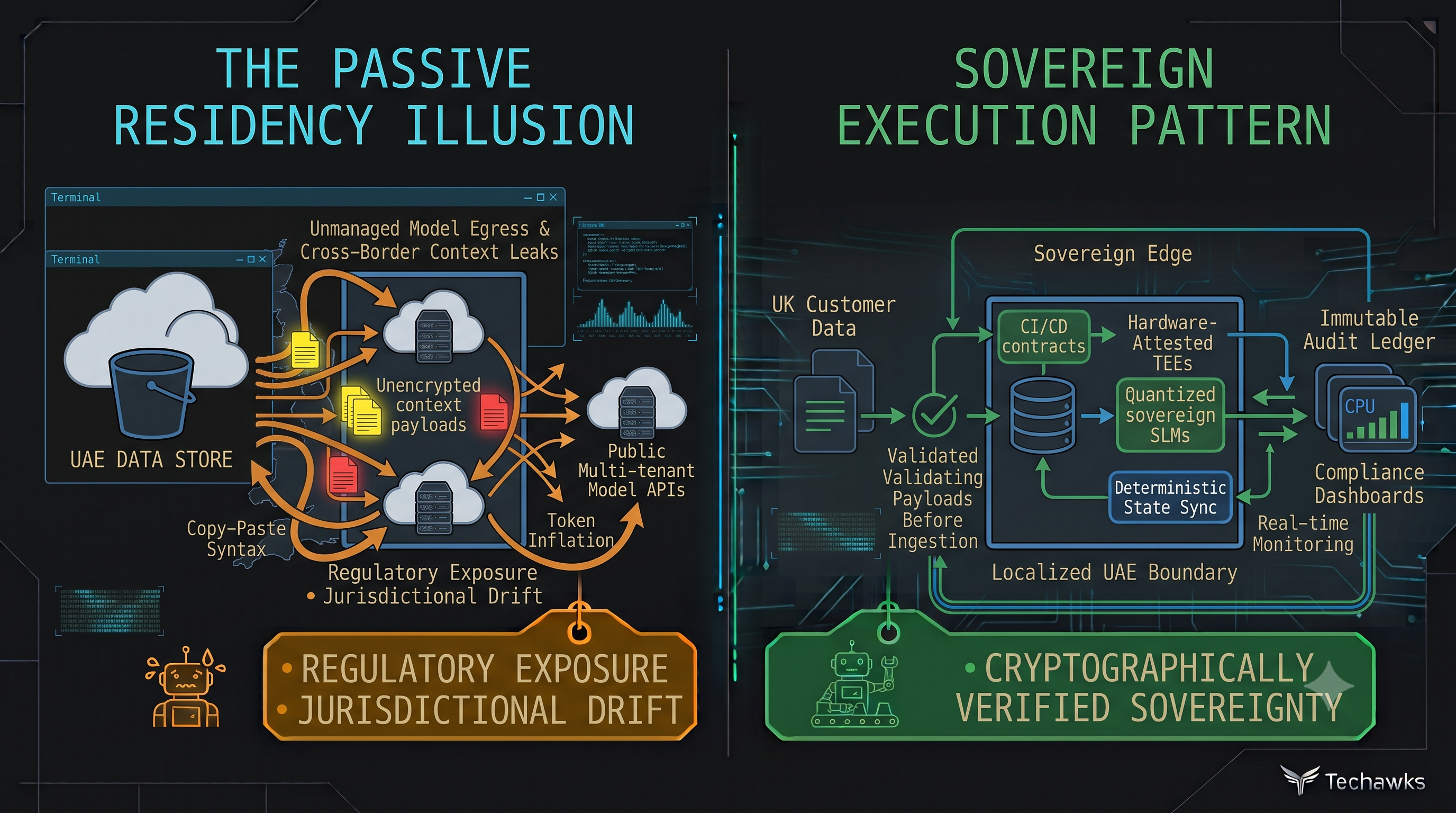
  • Building the Sovereign Edge: Decoupling UAE AI Workflows from Global API Dependency


    The UAE is leading the world in establishing a complete, sovereign AI ecosystem. High-performing engineering teams in Dubai and Abu Dhabi are no longer just "integrating AI"; they are architecting for runtime sovereignty.


    Passive Data Residency—storing data in UAE cloud regions—is only baseline hygiene. True local relevance requires controlling the complete execution path. Real operational resilience requires transitioning from unmanaged remote inference to Sovereign Runtime Isolation & TEE Determinism.


    How to Architect for Sovereign Runtime Compliance:
    Mandate Sovereign Execution in Hardware-Attested TEEs


    Baselines like encryption at rest and in transit are necessary. To protect sensitive telemetry and prompt contexts during active inference, move model runtimes inside Hardware-Attested Trusted Execution Environments (TEEs) on local, UAE-domiciled bare metal. This guarantees that host infrastructure administrators and third-party hypervisors cannot inspect the memory state during execution.


    Deploy Localized Model Distillation & SLM Gateways


    Never pipe high-compliance transactions (e.g., identity data, identifiable citizen telemetry) to external public endpoints. Route in-scope requests to quantized Small Language Models (SLMs) running inside air-gapped UAE VPCs. Use deterministic, rule-based classifiers to scrub and verify data contracts before any anonymized residual workloads are permitted to trigger external fallbacks.


    Establish an Immutable, Verifiable Audit Ledger


    The UAE’s regulatory framework holds data controllers strictly accountable for automated decision chains. Replace opaque, non-deterministic agent loops with cryptographically signed execution traces. Record the input context hash, model weight version, and transaction diff in an append-only log to ensure forensic auditability on demand.


    Sovereignty isn’t a switch you flip on a cloud provider’s billing console; it is an architectural pattern that guarantees total jurisdictional control over code, context, and compute.


    Discussion Question
    For UAE CTOs, Platform Engineers, and Data Privacy Leads: Where is your biggest architectural hurdle today—provisioning high-performance TEE compute locally, managing context drift over sovereign SLMs, or reconciling real-time execution needs with data localization mandates? Let’s benchmark implementation strategies below.


    CTA
    Ready to build resilient, sovereign, and audit-proof AI architectures?


    👉 Join Techawks UAE to collaborate with local practitioners, discuss sovereign cloud architecture, and master production engineering frameworks tailored for the region.
    Building the Sovereign Edge: Decoupling UAE AI Workflows from Global API Dependency The UAE is leading the world in establishing a complete, sovereign AI ecosystem. High-performing engineering teams in Dubai and Abu Dhabi are no longer just "integrating AI"; they are architecting for runtime sovereignty. Passive Data Residency—storing data in UAE cloud regions—is only baseline hygiene. True local relevance requires controlling the complete execution path. Real operational resilience requires transitioning from unmanaged remote inference to Sovereign Runtime Isolation & TEE Determinism. How to Architect for Sovereign Runtime Compliance: Mandate Sovereign Execution in Hardware-Attested TEEs Baselines like encryption at rest and in transit are necessary. To protect sensitive telemetry and prompt contexts during active inference, move model runtimes inside Hardware-Attested Trusted Execution Environments (TEEs) on local, UAE-domiciled bare metal. This guarantees that host infrastructure administrators and third-party hypervisors cannot inspect the memory state during execution. Deploy Localized Model Distillation & SLM Gateways Never pipe high-compliance transactions (e.g., identity data, identifiable citizen telemetry) to external public endpoints. Route in-scope requests to quantized Small Language Models (SLMs) running inside air-gapped UAE VPCs. Use deterministic, rule-based classifiers to scrub and verify data contracts before any anonymized residual workloads are permitted to trigger external fallbacks. Establish an Immutable, Verifiable Audit Ledger The UAE’s regulatory framework holds data controllers strictly accountable for automated decision chains. Replace opaque, non-deterministic agent loops with cryptographically signed execution traces. Record the input context hash, model weight version, and transaction diff in an append-only log to ensure forensic auditability on demand. Sovereignty isn’t a switch you flip on a cloud provider’s billing console; it is an architectural pattern that guarantees total jurisdictional control over code, context, and compute. Discussion Question For UAE CTOs, Platform Engineers, and Data Privacy Leads: Where is your biggest architectural hurdle today—provisioning high-performance TEE compute locally, managing context drift over sovereign SLMs, or reconciling real-time execution needs with data localization mandates? Let’s benchmark implementation strategies below. CTA Ready to build resilient, sovereign, and audit-proof AI architectures? 👉 Join Techawks UAE to collaborate with local practitioners, discuss sovereign cloud architecture, and master production engineering frameworks tailored for the region.
    0 Commentaires 0 Parts 152 Vue 0 Aperçu
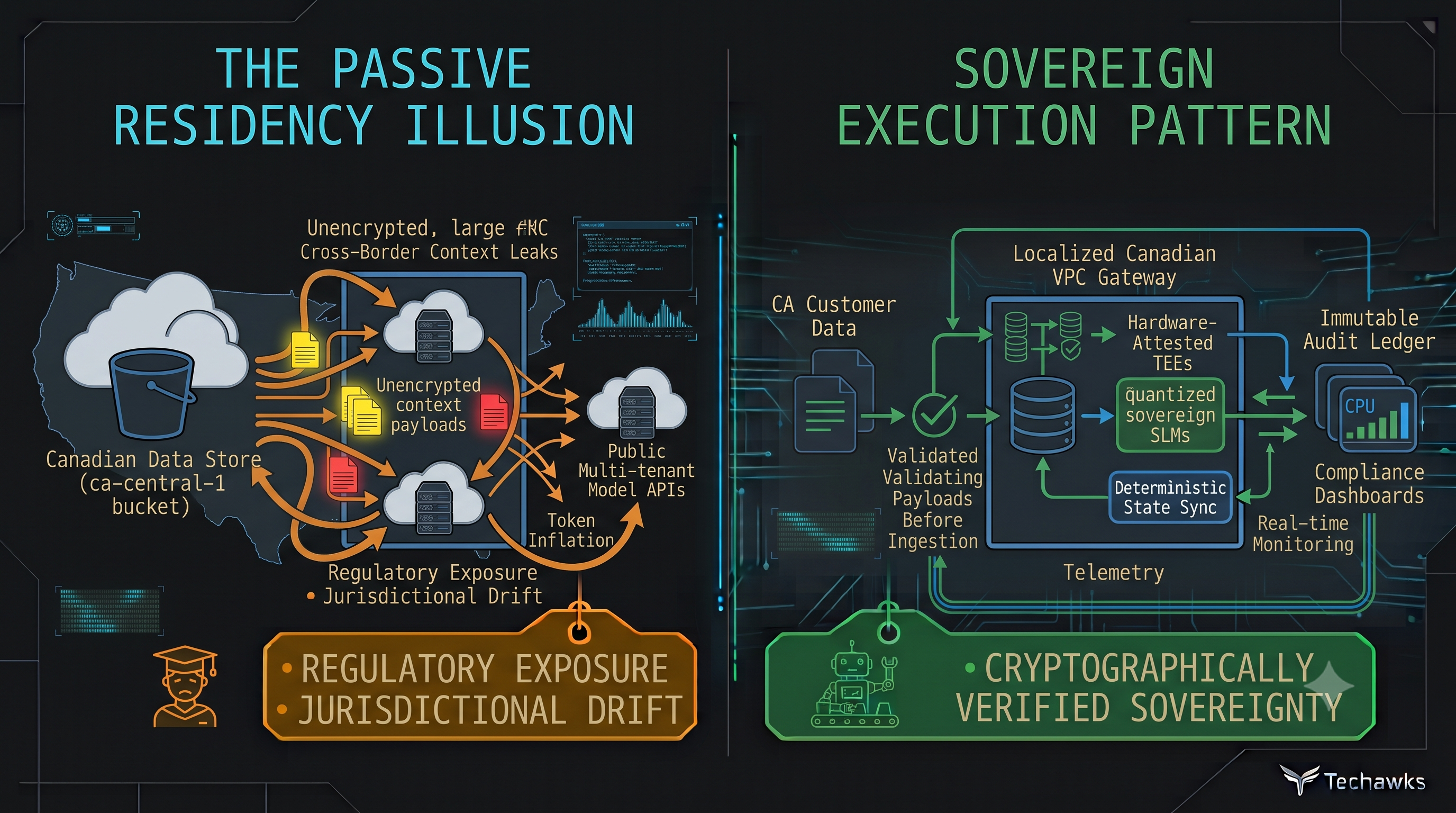
  • Building a Non-Colonized Canadian AI: Why Data Residency Can’t Protect Sovereign Inference


    High-performing engineering teams in Toronto, Vancouver, and Montréal are shifting their effort away from simple AI integration and towards architecting for runtime sovereignty. Passive Data Residency—storing data in ca-central-1 cloud buckets—is baseline hygiene. True local relevance requires controlling the complete execution path. Real operational resilience requires moving from unmanaged remote inference to Sovereign Runtime Isolation & TEE Determinism.


    How to Architect for Sovereign Runtime Compliance:
    Deploy Sovereign Execution in Hardware-Attested TEEs


    To protect sensitive prompt contexts during active inference, move model runtimes inside Hardware-Attested Trusted Execution Environments (TEEs) on localized, Canada-domiciled bare metal. This guarantees that host infrastructure administrators and third-party hypervisors cannot inspect the memory state during active execution.


    Implement Localized Model Distillation & SLM Gateways


    Never pipe high-compliance transactions (e.g., patient records, identity data, identifiable citizen telemetry) to external public endpoints. Route in-scope requests to quantized Small Language Models (SLMs) running inside air-gapped Canadian VPCs. Use deterministic, rule-based classifiers to scrub and verify data contracts before any anonymized residual workloads trigger external fallbacks.


    Establish an Immutable, Verifiable Audit Ledger


    Canada’s regulatory landscape holds data controllers strictly accountable for automated decision chains. Replace opaque, non-deterministic agent loops with cryptographically signed execution traces. Record the input context hash, model weight version, and transaction diff in an append-only log to ensure forensic auditability on demand.


    Sovereignty isn’t a switch you flip on a cloud provider’s billing console; it is an architectural pattern that guarantees total jurisdictional control over code, context, and compute.


    Discussion Question
    For Canadian CTOs, Platform Engineers, and Data Privacy Leads: Where is your biggest architectural hurdle today—provisioning high-performance TEE compute locally, managing context drift over sovereign SLMs, or reconciling real-time execution needs with data localization mandates? Let’s discuss your implementation trade-offs below.


    CTA
    Ready to build resilient, sovereign, and audit-proof technical systems designed for Canada?


    👉 Join Techawks Canada to collaborate with senior practitioners, discuss sovereign cloud architecture, and master production engineering frameworks tailored for the Canadian context.
    Building a Non-Colonized Canadian AI: Why Data Residency Can’t Protect Sovereign Inference High-performing engineering teams in Toronto, Vancouver, and Montréal are shifting their effort away from simple AI integration and towards architecting for runtime sovereignty. Passive Data Residency—storing data in ca-central-1 cloud buckets—is baseline hygiene. True local relevance requires controlling the complete execution path. Real operational resilience requires moving from unmanaged remote inference to Sovereign Runtime Isolation & TEE Determinism. How to Architect for Sovereign Runtime Compliance: Deploy Sovereign Execution in Hardware-Attested TEEs To protect sensitive prompt contexts during active inference, move model runtimes inside Hardware-Attested Trusted Execution Environments (TEEs) on localized, Canada-domiciled bare metal. This guarantees that host infrastructure administrators and third-party hypervisors cannot inspect the memory state during active execution. Implement Localized Model Distillation & SLM Gateways Never pipe high-compliance transactions (e.g., patient records, identity data, identifiable citizen telemetry) to external public endpoints. Route in-scope requests to quantized Small Language Models (SLMs) running inside air-gapped Canadian VPCs. Use deterministic, rule-based classifiers to scrub and verify data contracts before any anonymized residual workloads trigger external fallbacks. Establish an Immutable, Verifiable Audit Ledger Canada’s regulatory landscape holds data controllers strictly accountable for automated decision chains. Replace opaque, non-deterministic agent loops with cryptographically signed execution traces. Record the input context hash, model weight version, and transaction diff in an append-only log to ensure forensic auditability on demand. Sovereignty isn’t a switch you flip on a cloud provider’s billing console; it is an architectural pattern that guarantees total jurisdictional control over code, context, and compute. Discussion Question For Canadian CTOs, Platform Engineers, and Data Privacy Leads: Where is your biggest architectural hurdle today—provisioning high-performance TEE compute locally, managing context drift over sovereign SLMs, or reconciling real-time execution needs with data localization mandates? Let’s discuss your implementation trade-offs below. CTA Ready to build resilient, sovereign, and audit-proof technical systems designed for Canada? 👉 Join Techawks Canada to collaborate with senior practitioners, discuss sovereign cloud architecture, and master production engineering frameworks tailored for the Canadian context.
    0 Commentaires 0 Parts 147 Vue 0 Aperçu
  • RF Reference Source Market: Enabling Accurate Frequency and Signal Control
      Telecommunications is one of the most important application areas. Communication networks rely on accurate frequency and timing to maintain synchronization between equipment. As networks move toward higher frequencies and more complex architectures, reliable reference sources become increasingly important. 5G infrastructure is supporting demand for advanced reference technologies....
    0 Commentaires 0 Parts 102 Vue 0 Aperçu
  • RJ45 Data Connector Market Maintains Demand as Ethernet Connectivity Expands Across Networks
    The continued expansion of wired networking infrastructure is supporting opportunities in the RJ45 Data Connector Market. RJ45 connectors are widely used with Ethernet networking equipment and provide a standardized physical interface for connecting computers, switches, routers, servers, industrial devices, and other networked systems. Enterprise networking is a major application area. Offices,...
    0 Commentaires 0 Parts 96 Vue 0 Aperçu