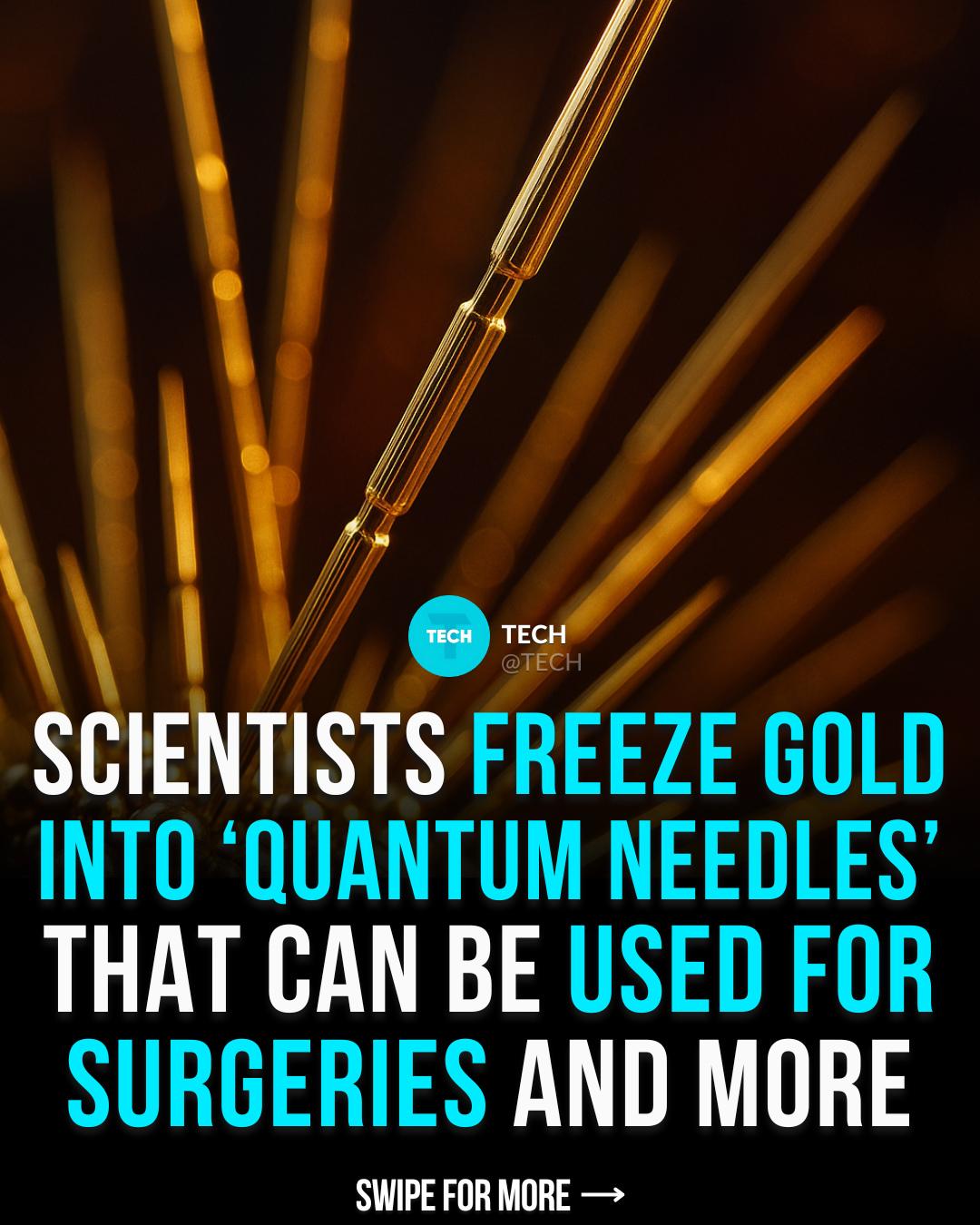
Gold just learned a new trick at the tiniest scale. University of Tokyo chemists froze gold at the first flickers of formation and captured a brand-new shape: “gold quantum needles.” These pencil-thin nanoclusters, only a few dozen atoms across, interact intensely with near-infrared light, which makes them ideal for peering deeper into the body and for squeezing more power from light-harvesting devices. Their optical behavior could open doors to medical diagnostics that are clearer and safer, as well as sustainable energy systems that run more efficiently.
To crack the long-mysterious early stages of nanocluster growth, the team deliberately slowed the reaction and trapped clusters in their earliest states. Single-crystal X-ray diffraction mapped every atom’s position, revealing that growth was anisotropic, meaning it advanced faster in some directions than others instead of swelling evenly like a sphere. This approach offered scientists a rare opportunity to see structures that would normally vanish in an instant.
Out of this controlled chaos emerged the needles: elongated stacks built from repeating three-atom (trimer) and four-atom (tetramer) gold units. Electrons inside these tiny structures occupy only specific energy levels, a hallmark of quantum behavior, giving the needles their unusual optical response. Beyond their novelty, this suggests that deliberate structural design could one day guide the creation of materials that perform functions nature has not yet imagined.
Published in the Journal of the American Chemical Society, the work turns a “black box” into a blueprint. By visualizing how geometry assembles step by step, the team shows a path to targeted synthesis, not just for gold but potentially for other metals. Sharper biomedical imaging in the near-infrared and more efficient light-to-energy conversion are now realistic goals, provided chemists can scale production and fine-tune the needles’ dimensions and surface chemistry.
10.1021/jacs.5c11089
Gold just learned a new trick at the tiniest scale. University of Tokyo chemists froze gold at the first flickers of formation and captured a brand-new shape: “gold quantum needles.” These pencil-thin nanoclusters, only a few dozen atoms across, interact intensely with near-infrared light, which makes them ideal for peering deeper into the body and for squeezing more power from light-harvesting devices. Their optical behavior could open doors to medical diagnostics that are clearer and safer, as well as sustainable energy systems that run more efficiently.
To crack the long-mysterious early stages of nanocluster growth, the team deliberately slowed the reaction and trapped clusters in their earliest states. Single-crystal X-ray diffraction mapped every atom’s position, revealing that growth was anisotropic, meaning it advanced faster in some directions than others instead of swelling evenly like a sphere. This approach offered scientists a rare opportunity to see structures that would normally vanish in an instant.
Out of this controlled chaos emerged the needles: elongated stacks built from repeating three-atom (trimer) and four-atom (tetramer) gold units. Electrons inside these tiny structures occupy only specific energy levels, a hallmark of quantum behavior, giving the needles their unusual optical response. Beyond their novelty, this suggests that deliberate structural design could one day guide the creation of materials that perform functions nature has not yet imagined.
Published in the Journal of the American Chemical Society, the work turns a “black box” into a blueprint. By visualizing how geometry assembles step by step, the team shows a path to targeted synthesis, not just for gold but potentially for other metals. Sharper biomedical imaging in the near-infrared and more efficient light-to-energy conversion are now realistic goals, provided chemists can scale production and fine-tune the needles’ dimensions and surface chemistry.
10.1021/jacs.5c11089
 English
 Arabic
 French
 Spanish
 Portuguese
 Deutsch
 Turkish
 Dutch
Dutch
 Italiano
 Russian
 Romaian
 Portuguese (Brazil)
 Greek
Greek