• Why CVSS 9.8 Scores Fail When Attackers Target the Management Plane: Rethinking Vulnerability Triage
    Today’s security advisories highlight a relentless pattern in modern infrastructure: critical vulnerabilities in enterprise management planes—such as communication gateways, hypervisor orchestrators, and edge appliances—are being weaponized almost immediately upon disclosure.


    When an attacker compromises a management-plane device or exploits an unauthenticated command injection flaw at the network edge, they don't just gain a foothold; they gain administrative visibility and lateral movement control across your entire environment.


    Why CVSS Alone Is Dangerous:
    A Common Vulnerability Scoring System (CVSS) score measures technical severity in a vacuum, not real-world risk in your specific architecture. A CVSS 7.5 vulnerability on an internet-facing authentication gateway that is actively being exploited poses an infinitely higher immediate threat than a theoretical CVSS 9.8 flaw buried behind three layers of internal segmentation.


    How to Triage Like a Security Engineer (The 3-Layer Risk Filter):


    Check Active Exploitation First (KEV Over CVSS): Before looking at severity scores, cross-reference your asset inventory against CISA’s Known Exploited Vulnerabilities (KEV) catalog and live threat intelligence. If a proof-of-concept exploit is public or active exploitation is confirmed, it jumps straight to the top of the queue—regardless of its base score.


    Map Exposure & Blast Radius: Ask two questions: Is this asset reachable from the public internet? and Does it sit on the management plane? Edge appliances, VPNs, and orchestration tools act as high-leverage pivot points for ransomware and espionage groups.


    Verify Patch Completeness: Applying a vendor update isn't always the finish line. Many enterprise flaws require secondary post-patch actions—such as rotating persistent session cookies, revoking API tokens, or running database integrity scripts—to evict attackers who already established persistence before the patch landed.


    True security awareness isn't about memorizing CVE numbers; it's about understanding how attackers chain exposure, privilege, and speed.


    Discussion Question
    When a zero-day or actively exploited management-plane flaw drops mid-week, what is your immediate containment step if your team can't apply the patch right away—isolating the management interface, tightening WAF/firewall ACLs, or rotating credentials? Share your defensive playbook below!


    CTA
    Join Cybersecurity & Ethical Hacking


    Move beyond textbook theory and master real-world threat modeling, vulnerability triage, and defensive architecture alongside global security learners and practitioners in the Techawks community.
    Why CVSS 9.8 Scores Fail When Attackers Target the Management Plane: Rethinking Vulnerability Triage Today’s security advisories highlight a relentless pattern in modern infrastructure: critical vulnerabilities in enterprise management planes—such as communication gateways, hypervisor orchestrators, and edge appliances—are being weaponized almost immediately upon disclosure. When an attacker compromises a management-plane device or exploits an unauthenticated command injection flaw at the network edge, they don't just gain a foothold; they gain administrative visibility and lateral movement control across your entire environment. Why CVSS Alone Is Dangerous: A Common Vulnerability Scoring System (CVSS) score measures technical severity in a vacuum, not real-world risk in your specific architecture. A CVSS 7.5 vulnerability on an internet-facing authentication gateway that is actively being exploited poses an infinitely higher immediate threat than a theoretical CVSS 9.8 flaw buried behind three layers of internal segmentation. How to Triage Like a Security Engineer (The 3-Layer Risk Filter): Check Active Exploitation First (KEV Over CVSS): Before looking at severity scores, cross-reference your asset inventory against CISA’s Known Exploited Vulnerabilities (KEV) catalog and live threat intelligence. If a proof-of-concept exploit is public or active exploitation is confirmed, it jumps straight to the top of the queue—regardless of its base score. Map Exposure & Blast Radius: Ask two questions: Is this asset reachable from the public internet? and Does it sit on the management plane? Edge appliances, VPNs, and orchestration tools act as high-leverage pivot points for ransomware and espionage groups. Verify Patch Completeness: Applying a vendor update isn't always the finish line. Many enterprise flaws require secondary post-patch actions—such as rotating persistent session cookies, revoking API tokens, or running database integrity scripts—to evict attackers who already established persistence before the patch landed. True security awareness isn't about memorizing CVE numbers; it's about understanding how attackers chain exposure, privilege, and speed. Discussion Question When a zero-day or actively exploited management-plane flaw drops mid-week, what is your immediate containment step if your team can't apply the patch right away—isolating the management interface, tightening WAF/firewall ACLs, or rotating credentials? Share your defensive playbook below! CTA Join Cybersecurity & Ethical Hacking Move beyond textbook theory and master real-world threat modeling, vulnerability triage, and defensive architecture alongside global security learners and practitioners in the Techawks community.
    0 Comments 0 Shares 105 Views 0 Reviews
  • Myth vs. Fact: Autonomous AI Agents Do Not Need Continuous Human Oversight to Scale Securely
    The Fallacy of Constant Supervision
    As multi-agent architectures transition into production environments, a persistent misconception is that human-in-the-loop (HITL) oversight must be applied to every intermediate reasoning step. While manual validation is critical for destructive actions or high-stakes financial execution, attempting to manually review high-frequency agent-to-agent communication creates severe operational bottlenecks and defeats the core advantage of autonomous systems.


    Agentic Execution Flow: Anti-Pattern vs. Production Standard
    Plaintext
    [ ANTI-PATTERN: Manual Bottleneck ]
    Agent A ──> [ Human Review Loop ] ──> Agent B ──> [ Human Review Loop ] ──> Action
    (Result: High latency, human fatigue, scaling failure)


    [ RESILIENT PRODUCTION STANDARD: Deterministic Guardrails ]
    Agent A ──> [ State Machine / Policy Enforcer ] ──> Agent B ──> [ Automated Circuit Breaker ] ──> Action
    (Result: Autonomous velocity with programmatic containment)
    Production Principles for Scale
    Implement State-Machine Boundaries: Restrict agents to explicit state transitions rather than open-ended dialogue loops to prevent cascading logic errors and infinite loops.


    Programmatic Circuit Breakers: Replace human approval gates for routine sub-tasks with automated boundary checks (e.g., token limits, semantic similarity bounds, and cost ceilings).


    Deterministic Tool Sandboxing: Isolate agent tool execution within ephemeral, least-privilege containers so that unauthorized API calls or unexpected commands fail securely without manual intervention.


    Asynchronous Audit Trails: Log all agentic interactions immutably for post-hoc forensic analysis instead of blocking synchronous execution pipelines.


    Discussion Question
    How does your engineering team handle guardrails for autonomous agent communication without slowing down system velocity? Drop your architecture patterns below!


    CTA (Join Techawks General Community)
    Ready to build resilient, production-grade systems with top-tier technologists? Join the Techawks General Community today at [Techawks Community Link] and level up your engineering stack.
    Myth vs. Fact: Autonomous AI Agents Do Not Need Continuous Human Oversight to Scale Securely The Fallacy of Constant Supervision As multi-agent architectures transition into production environments, a persistent misconception is that human-in-the-loop (HITL) oversight must be applied to every intermediate reasoning step. While manual validation is critical for destructive actions or high-stakes financial execution, attempting to manually review high-frequency agent-to-agent communication creates severe operational bottlenecks and defeats the core advantage of autonomous systems. Agentic Execution Flow: Anti-Pattern vs. Production Standard Plaintext [ ANTI-PATTERN: Manual Bottleneck ] Agent A ──> [ Human Review Loop ] ──> Agent B ──> [ Human Review Loop ] ──> Action (Result: High latency, human fatigue, scaling failure) [ RESILIENT PRODUCTION STANDARD: Deterministic Guardrails ] Agent A ──> [ State Machine / Policy Enforcer ] ──> Agent B ──> [ Automated Circuit Breaker ] ──> Action (Result: Autonomous velocity with programmatic containment) Production Principles for Scale Implement State-Machine Boundaries: Restrict agents to explicit state transitions rather than open-ended dialogue loops to prevent cascading logic errors and infinite loops. Programmatic Circuit Breakers: Replace human approval gates for routine sub-tasks with automated boundary checks (e.g., token limits, semantic similarity bounds, and cost ceilings). Deterministic Tool Sandboxing: Isolate agent tool execution within ephemeral, least-privilege containers so that unauthorized API calls or unexpected commands fail securely without manual intervention. Asynchronous Audit Trails: Log all agentic interactions immutably for post-hoc forensic analysis instead of blocking synchronous execution pipelines. Discussion Question How does your engineering team handle guardrails for autonomous agent communication without slowing down system velocity? Drop your architecture patterns below! CTA (Join Techawks General Community) Ready to build resilient, production-grade systems with top-tier technologists? Join the Techawks General Community today at [Techawks Community Link] and level up your engineering stack.
    0 Comments 0 Shares 149 Views 0 Reviews
  • Securing the US Critical Infrastructure Edge: A Practical Tool Review of the Zeek Network Security Monitor and the Corelight Sensor Fleet
    Problem Definition & Failure Modes
    US industrial and government networks are increasingly targeted by sophisticated APT actors focused on operational disruption (OT) and intellectual property theft (IT).


    The IT/OT Visibility Gap: Traditional Enterprise EDR often fails to monitor the specialized, often proprietary protocols used in Operational Technology (OT) environments (e.g., Modbus, BACnet, DNP3).


    The 'Log Everything' Anti-Pattern: Ingesting raw full packet capture (PCAP) from every network segment into a SIEM is prohibitively expensive and creates unmanageable noise, leading to alert fatigue and missed adversary dwell time.


    Architectural Workflow
    Plaintext
    [ Fragile Perimeter Architecture ]
    External Threats ──> Legacy IDS / IPS (Signature Match) ──> Air-Gapped? / Blind OT Network


    vs.


    [ Resilient Deep Traffic Analysis Architecture ]
    Industrial Demilitarized Zone (IDMZ) / Core Switch Span Port
    │
    ├───> Zeek Sensor (Network Security Monitoring)
    │ │
    │ └───> Generates Structured Logs (Conn, HTTP, DNS, Modbus)
    │ │
    └───> Corelight Sensor (Encrypted Traffic Analysis / Provenance)
    │
    V
    [ SIEM / SOAR ] <───> Correlation Engine (Threat Intel Feed Integration)
    Production-Grade Engineering Principles
    Deploy Zeek for Transactional Metadata: Instead of storing expensive PCAPs, implement Zeek as an NSM sensor. Zeek reduces high-volume network traffic into concise, structured transaction logs (e.g., a conn.log for every connection, dns.log, http.log, and specialized OT logs), making long-term retention and searching scalable.


    Unlock OT Protocol Analysis: Configure Zeek with specialized protocol analyzers (like ICSN) to deeply inspect traffic for OT/ICS protocols. This allows for real-time detection of anomalous commands (e.g., a PLC write command during off-hours) or unauthorized protocol usage within the control network.


    Leverage Corelight for Encrypted Traffic Insights: Enhance open-source Zeek with Corelight sensors. Corelight provides validated, pre-tuned Zeek configurations and, crucially, performs Encrypted Traffic Analysis (ETA) using machine learning to fingerprint malicious SSL/TLS sessions without decryption, identifying C2 communication hiding in HTTPS.


    Integrate Threat Intelligence Feeds: Feed Zeek/Corelight generated logs into a centralized SIEM or SOAR platform (like Splunk or Cortex XSOAR) and configure real-time correlation against curated threat intelligence feeds (e.g., CISA AIS, Mandiant) for instant validation of high-fidelity alerts.


    Discussion Question
    What is your team's strategy for monitoring legacy Operational Technology (OT) protocols for lateral movement without introducing latency or stability risks to the control plane, and have you successfully deployed Zeek/Corelight in an air-gapped environment?


    CTA (Join Techawks USA)
    Want to master advanced network defense, threat hunting in complex ICS/SCADA environments, and secure your organization's critical edge? Join the Techawks USA community to connect with principal security architects and scale your technical expertise.
    Securing the US Critical Infrastructure Edge: A Practical Tool Review of the Zeek Network Security Monitor and the Corelight Sensor Fleet Problem Definition & Failure Modes US industrial and government networks are increasingly targeted by sophisticated APT actors focused on operational disruption (OT) and intellectual property theft (IT). The IT/OT Visibility Gap: Traditional Enterprise EDR often fails to monitor the specialized, often proprietary protocols used in Operational Technology (OT) environments (e.g., Modbus, BACnet, DNP3). The 'Log Everything' Anti-Pattern: Ingesting raw full packet capture (PCAP) from every network segment into a SIEM is prohibitively expensive and creates unmanageable noise, leading to alert fatigue and missed adversary dwell time. Architectural Workflow Plaintext [ Fragile Perimeter Architecture ] External Threats ──> Legacy IDS / IPS (Signature Match) ──> Air-Gapped? / Blind OT Network vs. [ Resilient Deep Traffic Analysis Architecture ] Industrial Demilitarized Zone (IDMZ) / Core Switch Span Port │ ├───> Zeek Sensor (Network Security Monitoring) │ │ │ └───> Generates Structured Logs (Conn, HTTP, DNS, Modbus) │ │ └───> Corelight Sensor (Encrypted Traffic Analysis / Provenance) │ V [ SIEM / SOAR ] <───> Correlation Engine (Threat Intel Feed Integration) Production-Grade Engineering Principles Deploy Zeek for Transactional Metadata: Instead of storing expensive PCAPs, implement Zeek as an NSM sensor. Zeek reduces high-volume network traffic into concise, structured transaction logs (e.g., a conn.log for every connection, dns.log, http.log, and specialized OT logs), making long-term retention and searching scalable. Unlock OT Protocol Analysis: Configure Zeek with specialized protocol analyzers (like ICSN) to deeply inspect traffic for OT/ICS protocols. This allows for real-time detection of anomalous commands (e.g., a PLC write command during off-hours) or unauthorized protocol usage within the control network. Leverage Corelight for Encrypted Traffic Insights: Enhance open-source Zeek with Corelight sensors. Corelight provides validated, pre-tuned Zeek configurations and, crucially, performs Encrypted Traffic Analysis (ETA) using machine learning to fingerprint malicious SSL/TLS sessions without decryption, identifying C2 communication hiding in HTTPS. Integrate Threat Intelligence Feeds: Feed Zeek/Corelight generated logs into a centralized SIEM or SOAR platform (like Splunk or Cortex XSOAR) and configure real-time correlation against curated threat intelligence feeds (e.g., CISA AIS, Mandiant) for instant validation of high-fidelity alerts. Discussion Question What is your team's strategy for monitoring legacy Operational Technology (OT) protocols for lateral movement without introducing latency or stability risks to the control plane, and have you successfully deployed Zeek/Corelight in an air-gapped environment? CTA (Join Techawks USA) Want to master advanced network defense, threat hunting in complex ICS/SCADA environments, and secure your organization's critical edge? Join the Techawks USA community to connect with principal security architects and scale your technical expertise.
    0 Comments 0 Shares 174 Views 0 Reviews
  • Mastering Lateral Movement: Why Detection is Failing at the Internal Firewall
    The Problem: The Perimeter Myth
    Traditional security focuses heavily on north-south traffic (in and out of the network). However, once inside, attackers exploit the trust inherent in east-west traffic (server-to-server communication within the network). They don't need to bring in obvious malware; they simply use the tools already available on the system.


    Lateral Movement Workflow (Visualized):


    Plaintext
    [ INITIAL ACCESS ] ──► [ RECONNAISSANCE ] ──► [ CREDENTIAL DUMPING ] ──► [ LATERAL MOVEMENT ]
    Phishing / Exploit Port Scans / AD Query Mimikatz / LSA Secrets PsExec / WMI / RDP


    (The "Island Hopping" Phase)
    │
    ┌─────────────────────────────────────────────────┴──────────────────────────────────┐
    ▼ ▼
    [ TARGET A (Workstation) ] ──► [ PIVOT ] ──► [ TARGET B (Admin Workstation) ] ──► [ TARGET C (Domain Controller) ]
    (User context) (Admin Creds found in memory) (DCSync -> Golden Ticket)
    4 Steps to Disrupt Lateral Movement:


    Enforce Micro-Segmentation: Do not treat your internal network as a flat structure. Isolate sensitive servers and databases (e.g., Finance, HR, Domain Controllers) into their own secure zones. Only allow strictly necessary traffic between these zones. Even if an attacker compromises one workstation, they cannot directly access critical infrastructure.


    Implement Just-in-Time (JIT) Administration: Over-privileged accounts are the primary vehicle for lateral movement. Eliminate standing admin rights. Implement JIT access, where administrative privileges are granted only for a specific task and for a limited time, after which they are automatically revoked.


    Monitor Internal Traffic for "Anomalous Beacons": Your internal firewalls and EDR solutions should be configured to alert on unusual east-west activity. Examples include a workstation attempting an RDP connection to a sensitive server, a database server making outbound SMB connections, or internal port scanning activity.


    Deploy Honeytokens and Honeyports: Scatter fake credentials, file shares, and open RDP ports (honeytokens) throughout your network. These services should not be used in normal operations. Any access or authentication attempt against them is an immediate, high-fidelity indicator of compromise and triggers an automated response.


    Discussion Question
    Micro-segmentation is theoretically effective but operationally complex in large, dynamic environments. What are your go-to strategies for balancing granular security controls with the need for DevOps agility and minimizing service disruption?


    CTA
    Join Cybersecurity & Ethical Hacking
    Level up your defensive skills. Connect with fellow security professionals, participate in capture-the-flag (CTF) challenges, and access deep-dive workshops on threat detection and incident response in the official Techawks Cybersecurity community. [Link in Bio / Join Here]
    Mastering Lateral Movement: Why Detection is Failing at the Internal Firewall The Problem: The Perimeter Myth Traditional security focuses heavily on north-south traffic (in and out of the network). However, once inside, attackers exploit the trust inherent in east-west traffic (server-to-server communication within the network). They don't need to bring in obvious malware; they simply use the tools already available on the system. Lateral Movement Workflow (Visualized): Plaintext [ INITIAL ACCESS ] ──► [ RECONNAISSANCE ] ──► [ CREDENTIAL DUMPING ] ──► [ LATERAL MOVEMENT ] Phishing / Exploit Port Scans / AD Query Mimikatz / LSA Secrets PsExec / WMI / RDP (The "Island Hopping" Phase) │ ┌─────────────────────────────────────────────────┴──────────────────────────────────┐ ▼ ▼ [ TARGET A (Workstation) ] ──► [ PIVOT ] ──► [ TARGET B (Admin Workstation) ] ──► [ TARGET C (Domain Controller) ] (User context) (Admin Creds found in memory) (DCSync -> Golden Ticket) 4 Steps to Disrupt Lateral Movement: Enforce Micro-Segmentation: Do not treat your internal network as a flat structure. Isolate sensitive servers and databases (e.g., Finance, HR, Domain Controllers) into their own secure zones. Only allow strictly necessary traffic between these zones. Even if an attacker compromises one workstation, they cannot directly access critical infrastructure. Implement Just-in-Time (JIT) Administration: Over-privileged accounts are the primary vehicle for lateral movement. Eliminate standing admin rights. Implement JIT access, where administrative privileges are granted only for a specific task and for a limited time, after which they are automatically revoked. Monitor Internal Traffic for "Anomalous Beacons": Your internal firewalls and EDR solutions should be configured to alert on unusual east-west activity. Examples include a workstation attempting an RDP connection to a sensitive server, a database server making outbound SMB connections, or internal port scanning activity. Deploy Honeytokens and Honeyports: Scatter fake credentials, file shares, and open RDP ports (honeytokens) throughout your network. These services should not be used in normal operations. Any access or authentication attempt against them is an immediate, high-fidelity indicator of compromise and triggers an automated response. Discussion Question Micro-segmentation is theoretically effective but operationally complex in large, dynamic environments. What are your go-to strategies for balancing granular security controls with the need for DevOps agility and minimizing service disruption? CTA Join Cybersecurity & Ethical Hacking Level up your defensive skills. Connect with fellow security professionals, participate in capture-the-flag (CTF) challenges, and access deep-dive workshops on threat detection and incident response in the official Techawks Cybersecurity community. [Link in Bio / Join Here]
    0 Comments 0 Shares 248 Views 0 Reviews
  • Demystifying Mixture-of-Experts (MoE): How to Achieve GPT-4 Performance with Llama-3 Efficiency
    The Problem with Dense Models:
    Traditional "dense" LLMs (like standard Llama-3 or BERT) activate all parameters for every single token prediction. As models scale, inference becomes computationally prohibitive and slow, even when the query only requires a fraction of the model's total knowledge.


    The Solution: Mixture-of-Experts (MoE):
    MoE decouples model capacity (total parameters) from inference cost (active parameters per token). Instead of one giant brain, an MoE model consists of many smaller, specialized sub-networks (experts) and a trainable gating network.


    How MoE Architecture Works (Visualized):


    Plaintext
    [ INCOMING QUERY Token ]
    │
    ▼
    [ GATING NETWORK / ROUTER ]
    │
    │ (Selects Top-K experts, e.g., Top-2)
    ▼
    ┌───────────────────┐ ┌───────────────────┐
    │ EXPERT 1 │ │ EXPERT 2 │
    │ (Math Specialist) │ │ (Code Specialist) │ (Rest of Experts 3-N remain dormant)
    └───────────────────┘ └───────────────────┘
    │ │
    │ (Weighted sum of outputs)│
    ▼ ▼
    [ COMBINER / OUTPUT LAYER ]
    │
    ▼
    [ FINAL TOKEN PREDICTION ]
    The Gating Network: For every incoming token, the router determines which experts are best suited to process it. It calculates a probability score for each expert and typically selects only the top k (e.g., Top-2 out of 16 experts).


    Expert Specialization: During training, experts naturally specialize. One expert might learn Python syntax, another French grammar, and another molecular biology concepts.


    Sparse Activation: The key efficiency gain. If a model has 100 Billion parameters but the router only activates 2 Billion (2 experts) per token, the inference speed is roughly equivalent to a 2 Billion parameter dense model, while the total knowledge base remains 100 Billion.


    Actionable Engineering Principles for MoE:


    Right-Sizing Granularity: More experts usually increase performance but raise communication overhead between devices (crucial if experts are sharded across GPUs). Fewer, larger experts are often easier to manage but less specialized.


    Addressing Load Balancing: A naive router might send all tokens to the most popular expert, rendering others useless and creating bottlenecks. Implement auxiliary loss functions during training to ensure expert utilization is balanced across the batch.


    Training Dynamics: MoE models can be harder to converge than dense models. Pre-training an MoE from scratch is complex; many practitioners successfully fine-tune existing dense models into MoE structures or use specific distillation techniques.


    Inference Hardware Strategy: Because only a fraction of parameters are active, MoE models require significant GPU VRAM to load the full checkpoint, but significantly less compute (FLOPs) per token generated compared to a dense model of equivalent size. Ensure your hardware plan balances VRAM capacity with memory bandwidth.


    Discussion Question
    MoE architectures excel at generalization but can struggle with fine-tuning for narrow, complex tasks compared to smaller, dense specialized models. What strategies have you used to effectively fine-tune an MoE base model without causing catastrophic forgetting in the router network?


    CTA
    Join AI Builders & Enthusiasts
    Level up your AI engineering skills. Connect with fellow builders, access deep-dive technical workshops, and discuss production-grade LLM architectures in the official Techawks AI community. [Link in Bio / Join Here]
    Demystifying Mixture-of-Experts (MoE): How to Achieve GPT-4 Performance with Llama-3 Efficiency The Problem with Dense Models: Traditional "dense" LLMs (like standard Llama-3 or BERT) activate all parameters for every single token prediction. As models scale, inference becomes computationally prohibitive and slow, even when the query only requires a fraction of the model's total knowledge. The Solution: Mixture-of-Experts (MoE): MoE decouples model capacity (total parameters) from inference cost (active parameters per token). Instead of one giant brain, an MoE model consists of many smaller, specialized sub-networks (experts) and a trainable gating network. How MoE Architecture Works (Visualized): Plaintext [ INCOMING QUERY Token ] │ ▼ [ GATING NETWORK / ROUTER ] │ │ (Selects Top-K experts, e.g., Top-2) ▼ ┌───────────────────┐ ┌───────────────────┐ │ EXPERT 1 │ │ EXPERT 2 │ │ (Math Specialist) │ │ (Code Specialist) │ (Rest of Experts 3-N remain dormant) └───────────────────┘ └───────────────────┘ │ │ │ (Weighted sum of outputs)│ ▼ ▼ [ COMBINER / OUTPUT LAYER ] │ ▼ [ FINAL TOKEN PREDICTION ] The Gating Network: For every incoming token, the router determines which experts are best suited to process it. It calculates a probability score for each expert and typically selects only the top k (e.g., Top-2 out of 16 experts). Expert Specialization: During training, experts naturally specialize. One expert might learn Python syntax, another French grammar, and another molecular biology concepts. Sparse Activation: The key efficiency gain. If a model has 100 Billion parameters but the router only activates 2 Billion (2 experts) per token, the inference speed is roughly equivalent to a 2 Billion parameter dense model, while the total knowledge base remains 100 Billion. Actionable Engineering Principles for MoE: Right-Sizing Granularity: More experts usually increase performance but raise communication overhead between devices (crucial if experts are sharded across GPUs). Fewer, larger experts are often easier to manage but less specialized. Addressing Load Balancing: A naive router might send all tokens to the most popular expert, rendering others useless and creating bottlenecks. Implement auxiliary loss functions during training to ensure expert utilization is balanced across the batch. Training Dynamics: MoE models can be harder to converge than dense models. Pre-training an MoE from scratch is complex; many practitioners successfully fine-tune existing dense models into MoE structures or use specific distillation techniques. Inference Hardware Strategy: Because only a fraction of parameters are active, MoE models require significant GPU VRAM to load the full checkpoint, but significantly less compute (FLOPs) per token generated compared to a dense model of equivalent size. Ensure your hardware plan balances VRAM capacity with memory bandwidth. Discussion Question MoE architectures excel at generalization but can struggle with fine-tuning for narrow, complex tasks compared to smaller, dense specialized models. What strategies have you used to effectively fine-tune an MoE base model without causing catastrophic forgetting in the router network? CTA Join AI Builders & Enthusiasts Level up your AI engineering skills. Connect with fellow builders, access deep-dive technical workshops, and discuss production-grade LLM architectures in the official Techawks AI community. [Link in Bio / Join Here]
    0 Comments 0 Shares 287 Views 0 Reviews
  • The Great Debate: Monolith-First vs. Microservices in Modern Cloud-Native Architectures
    1. The Core DilemmaThe decision between a monolithic architecture and microservices is one of the most consequential choices a CTO or lead architect makes. It’s not just a technical decision; it dictates team structure, hiring, and velocity. In the US tech ecosystem, where engineering time is expensive and speed-to-market is critical, choosing the wrong path early can be fatal.2. Architectural Blueprint ComparisonFeatureMonolith-First (The Pragmatist)Microservices (The Scaler)Development VelocityVery fast early on. Simple tooling, one codebase to manage.Slow initially. High overhead for inter-service communication and CI/CD setup.Team StructureSmall, generalist teams. Everyone works on the same stack.Larger, domain-oriented teams. Conway's Law begins to apply.Scaling StrategyScale vertically (add more power to the single server). Easier to manage early.Scale horizontally (add more instances of specific, high-demand services). More complex.Failure IsolationLow. A single bug can bring down the entire application.High. A failure in the recommendation service shouldn't crash the checkout flow.Operational MaturityModerate. Standard CI/CD, monitoring, and backup strategies.Very High. Requires sophisticated orchestration (Kubernetes), service mesh, and distributed tracing.3. Actionable Engineering PrinciplesDefault to Modular Monolith: Start with a well-structured monolith where modules are clearly defined and separated within the code. This gives you the speed of a monolith with clean boundaries for future extraction.Identify the Extraction Point: Resist microservices until you hit specific, unavoidable pain points: unbearable deployment times, teams constantly stepping on each other's toes in the repo, or a single component (e.g., image processing) requiring vastly different scaling resources.Don't Distributed-Monolith It: If you do split services, avoid the "distributed monolith" anti-pattern. Services must be truly autonomous, owning their own databases and communicating via well-defined APIs (REST, gRPC, or async events).Discussion QuestionFor the engineers, architects, and engineering leaders in our community: What was the biggest "gotcha" moment when your team transitioned from a monolith to microservices? Was it managing data consistency across services, the operational overhead of Kubernetes, or the increased latency? Share your war stories and lessons learned!CTA (Join Techawks USA)Ready to dive deeper into these architectural debates alongside senior leaders from top US tech companies? Join Techawks USA today to share insights, access exclusive content, and help shape the future of engineering in the region.
    The Great Debate: Monolith-First vs. Microservices in Modern Cloud-Native Architectures 1. The Core DilemmaThe decision between a monolithic architecture and microservices is one of the most consequential choices a CTO or lead architect makes. It’s not just a technical decision; it dictates team structure, hiring, and velocity. In the US tech ecosystem, where engineering time is expensive and speed-to-market is critical, choosing the wrong path early can be fatal.2. Architectural Blueprint ComparisonFeatureMonolith-First (The Pragmatist)Microservices (The Scaler)Development VelocityVery fast early on. Simple tooling, one codebase to manage.Slow initially. High overhead for inter-service communication and CI/CD setup.Team StructureSmall, generalist teams. Everyone works on the same stack.Larger, domain-oriented teams. Conway's Law begins to apply.Scaling StrategyScale vertically (add more power to the single server). Easier to manage early.Scale horizontally (add more instances of specific, high-demand services). More complex.Failure IsolationLow. A single bug can bring down the entire application.High. A failure in the recommendation service shouldn't crash the checkout flow.Operational MaturityModerate. Standard CI/CD, monitoring, and backup strategies.Very High. Requires sophisticated orchestration (Kubernetes), service mesh, and distributed tracing.3. Actionable Engineering PrinciplesDefault to Modular Monolith: Start with a well-structured monolith where modules are clearly defined and separated within the code. This gives you the speed of a monolith with clean boundaries for future extraction.Identify the Extraction Point: Resist microservices until you hit specific, unavoidable pain points: unbearable deployment times, teams constantly stepping on each other's toes in the repo, or a single component (e.g., image processing) requiring vastly different scaling resources.Don't Distributed-Monolith It: If you do split services, avoid the "distributed monolith" anti-pattern. Services must be truly autonomous, owning their own databases and communicating via well-defined APIs (REST, gRPC, or async events).Discussion QuestionFor the engineers, architects, and engineering leaders in our community: What was the biggest "gotcha" moment when your team transitioned from a monolith to microservices? Was it managing data consistency across services, the operational overhead of Kubernetes, or the increased latency? Share your war stories and lessons learned!CTA (Join Techawks USA)Ready to dive deeper into these architectural debates alongside senior leaders from top US tech companies? Join Techawks USA today to share insights, access exclusive content, and help shape the future of engineering in the region.
    0 Comments 0 Shares 395 Views 0 Reviews
  • The Architectural Trade-Off: Monolith-First vs. Microservices for the Indian Market
    1. The Core DilemmaThe decision to build on a monolithic architecture or to decompose into microservices is one of the most critical architectural choices a founding team makes. The Indian ecosystem, characterized by rapid scaling, diverse user devices, and cost-conscious engineering, adds unique complexity to this debate.2. Architectural Blueprint ComparisonFeatureMonolith-First (The Pragmatist's Choice)Microservices (The Scaler's Goal)Development VelocityFast. Single codebase, simple deployment. Ideal for finding product-market fit (PMF).Slow initially. High overhead for inter-service communication, CI/CD complexity.Team StructureSmall, agile teams. Full-stack ownership is easier to manage.Larger teams required, aligned by service boundaries (Conway's Law).Scaling StrategyScale vertically (add more RAM/CPU to the single server). Cost-effective early on.Scale horizontally (add more instances of specific, high-demand services). Cost-efficient at massive scale.


    Failure IsolationLow. A single bug in one module can crash the entire application.High. A failure in one service (e.g., recommendations) shouldn't crash critical paths (e.g., checkout).Operational MaturityModerate. Requires standard CI/CD, monitoring, and backup strategies.
    Very High. Requires sophisticated orchestration (Kubernetes), service mesh, distributed tracing, and observability.3. Actionable Engineering PrinciplesDefault to Modular Monolith: Start with a well-structured monolith where modules are logically separated. This gives you the speed of a monolith with the clean boundaries necessary for future extraction.
    Identify the Extraction Point: Resist microservices until you hit specific pain points: unbearable deployment times, teams stepping on each other's toes, or a single component (e.g., payment gateway) requiring independent scaling.
    Prioritize Observability: Whether monolith or microservice, invest in robust monitoring and distributed tracing from Day One. You cannot debug what you cannot see.
    Discussion Question
    For the engineers and architects in our community: What was the biggest "gotcha" moment when your team transitioned from a monolith to microservices? Was it managing data consistency across services, or the operational overhead of Kubernetes? Share your war stories and lessons learned!
    CTA (Join Techawks India)
    Ready to dive deeper into these architectural debates alongside senior leaders from India’s top tech companies? Join Techawks India today to share insights, access exclusive content, and help shape the future of engineering in the region.
    The Architectural Trade-Off: Monolith-First vs. Microservices for the Indian Market 1. The Core DilemmaThe decision to build on a monolithic architecture or to decompose into microservices is one of the most critical architectural choices a founding team makes. The Indian ecosystem, characterized by rapid scaling, diverse user devices, and cost-conscious engineering, adds unique complexity to this debate.2. Architectural Blueprint ComparisonFeatureMonolith-First (The Pragmatist's Choice)Microservices (The Scaler's Goal)Development VelocityFast. Single codebase, simple deployment. Ideal for finding product-market fit (PMF).Slow initially. High overhead for inter-service communication, CI/CD complexity.Team StructureSmall, agile teams. Full-stack ownership is easier to manage.Larger teams required, aligned by service boundaries (Conway's Law).Scaling StrategyScale vertically (add more RAM/CPU to the single server). Cost-effective early on.Scale horizontally (add more instances of specific, high-demand services). Cost-efficient at massive scale. Failure IsolationLow. A single bug in one module can crash the entire application.High. A failure in one service (e.g., recommendations) shouldn't crash critical paths (e.g., checkout).Operational MaturityModerate. Requires standard CI/CD, monitoring, and backup strategies. Very High. Requires sophisticated orchestration (Kubernetes), service mesh, distributed tracing, and observability.3. Actionable Engineering PrinciplesDefault to Modular Monolith: Start with a well-structured monolith where modules are logically separated. This gives you the speed of a monolith with the clean boundaries necessary for future extraction. Identify the Extraction Point: Resist microservices until you hit specific pain points: unbearable deployment times, teams stepping on each other's toes, or a single component (e.g., payment gateway) requiring independent scaling. Prioritize Observability: Whether monolith or microservice, invest in robust monitoring and distributed tracing from Day One. You cannot debug what you cannot see. Discussion Question For the engineers and architects in our community: What was the biggest "gotcha" moment when your team transitioned from a monolith to microservices? Was it managing data consistency across services, or the operational overhead of Kubernetes? Share your war stories and lessons learned! CTA (Join Techawks India) Ready to dive deeper into these architectural debates alongside senior leaders from India’s top tech companies? Join Techawks India today to share insights, access exclusive content, and help shape the future of engineering in the region.
    0 Comments 0 Shares 388 Views 0 Reviews
  • The Hidden Curriculum: Why Hard Skills Get You Hired, But Soft Skills Determine How Fast You Rise
    The Problem: The Technical-Only Myth
    When students enter the tech industry, many believe that writing pristine, bug-free code is the sole ticket to success. This leads to common pitfalls:


    The Isolation Trap: Staying silent for days trying to solve a blocker alone rather than unblocking through strategic communication.


    Defensiveness on Code Reviews: Taking constructive pull request feedback personally rather than seeing it as a collaborative mentorship opportunity.


    Translating Tech to Non-Tech: Failing to explain technical debt or architectural trade-offs in business terms that stakeholders and product managers can understand.


    The Solution: Cultivating the Engineering Soft Skills Stack
    Technical competence gets you through the interview door, but soft skills dictate whether you become a senior engineer, tech lead, or engineering manager.


    +-------------------------------------------------------------+
    | The Career Acceleration Stack |
    | |
    | [ Foundation ] [ Multiplier ] |
    | Hard Skills (Code) ---> Soft Skills (Communication) |
    | Solves syntax bugs Unblocks teams & scales impact |
    +-------------------------------------------------------------+
    4 Actionable Strategies to Master Soft Skills Early
    Master the Art of the "Time-Boxed" Blocker:
    When you hit a technical roadblock, don't spin your wheels silently for 6 hours. Spend 30 to 45 minutes investigating independently, document what you’ve tried, and then reach out to a peer or mentor with a precise question. Showing that you've done your homework respects their time while unblocking your progress.


    De-personalize Code Reviews:
    Treat code reviews as a dialogue, not a critique of your worth. When someone leaves a comment like "Why use a loop here instead of a map?", don't defend your code defensively. Respond with curiosity: "Good catch. I chose a loop for readability, but would map perform better at scale here?"


    Practice Writing Technical Explanations Simply:
    Can you explain a complex concept (like asynchronous execution, database indexing, or state management) to someone outside your major in two sentences? Practice breaking down your project architecture without jargon. This skill is vital when working with product managers, designers, and business stakeholders.


    Over-Communicate Context and Status:
    In remote and hybrid engineering environments, silence is toxic. Proactively communicate what you are working on, when you expect to finish, and if you foresee any risks. Transparency builds immediate trust with senior team members.


    Key Takeaways
    Code is Only Half the Job: Technical mastery must be paired with effective collaboration and communication to drive real career advancement.


    Time-Box Your Struggles: Avoid isolation by balancing independent debugging with structured, respectful requests for help.


    Embrace Code Reviews as Mentorship: View pull request feedback as collaborative growth rather than personal criticism.


    Bridge the Communication Gap: Learn to translate technical challenges into clear business outcomes for non-technical stakeholders.


    Discussion Question
    What is the biggest non-technical shock or lesson you experienced when collaborating on team projects or internships? How did you adapt your communication style? Share your insights below!


    CTA (Join Students in Tech)
    Ready to develop the holistic technical and professional skills that set top-tier engineers apart? Join Students in Tech within the Techawks ecosystem to collaborate on team projects, share career experiences, and grow together!
    The Hidden Curriculum: Why Hard Skills Get You Hired, But Soft Skills Determine How Fast You Rise The Problem: The Technical-Only Myth When students enter the tech industry, many believe that writing pristine, bug-free code is the sole ticket to success. This leads to common pitfalls: The Isolation Trap: Staying silent for days trying to solve a blocker alone rather than unblocking through strategic communication. Defensiveness on Code Reviews: Taking constructive pull request feedback personally rather than seeing it as a collaborative mentorship opportunity. Translating Tech to Non-Tech: Failing to explain technical debt or architectural trade-offs in business terms that stakeholders and product managers can understand. The Solution: Cultivating the Engineering Soft Skills Stack Technical competence gets you through the interview door, but soft skills dictate whether you become a senior engineer, tech lead, or engineering manager. +-------------------------------------------------------------+ | The Career Acceleration Stack | | | | [ Foundation ] [ Multiplier ] | | Hard Skills (Code) ---> Soft Skills (Communication) | | Solves syntax bugs Unblocks teams & scales impact | +-------------------------------------------------------------+ 4 Actionable Strategies to Master Soft Skills Early Master the Art of the "Time-Boxed" Blocker: When you hit a technical roadblock, don't spin your wheels silently for 6 hours. Spend 30 to 45 minutes investigating independently, document what you’ve tried, and then reach out to a peer or mentor with a precise question. Showing that you've done your homework respects their time while unblocking your progress. De-personalize Code Reviews: Treat code reviews as a dialogue, not a critique of your worth. When someone leaves a comment like "Why use a loop here instead of a map?", don't defend your code defensively. Respond with curiosity: "Good catch. I chose a loop for readability, but would map perform better at scale here?" Practice Writing Technical Explanations Simply: Can you explain a complex concept (like asynchronous execution, database indexing, or state management) to someone outside your major in two sentences? Practice breaking down your project architecture without jargon. This skill is vital when working with product managers, designers, and business stakeholders. Over-Communicate Context and Status: In remote and hybrid engineering environments, silence is toxic. Proactively communicate what you are working on, when you expect to finish, and if you foresee any risks. Transparency builds immediate trust with senior team members. Key Takeaways Code is Only Half the Job: Technical mastery must be paired with effective collaboration and communication to drive real career advancement. Time-Box Your Struggles: Avoid isolation by balancing independent debugging with structured, respectful requests for help. Embrace Code Reviews as Mentorship: View pull request feedback as collaborative growth rather than personal criticism. Bridge the Communication Gap: Learn to translate technical challenges into clear business outcomes for non-technical stakeholders. Discussion Question What is the biggest non-technical shock or lesson you experienced when collaborating on team projects or internships? How did you adapt your communication style? Share your insights below! CTA (Join Students in Tech) Ready to develop the holistic technical and professional skills that set top-tier engineers apart? Join Students in Tech within the Techawks ecosystem to collaborate on team projects, share career experiences, and grow together!
    0 Comments 0 Shares 445 Views 0 Reviews
  • The 3-Layer Architecture for Resilient Serverless Functions: Stop Debugging Timeouts and Start Building Observability
    The Monolithic Lambda Anti-Pattern
    Many serverless adoption journeys begin with the "everything inside the handler" approach. While quick to prototype, this tight coupling creates brittle, untestable code. When the database connection fails or the external API is slow, the entire function fails, obscuring the true root cause and making local debugging nearly impossible.


    The 3-Layer Decoupled Approach
    To achieve enterprise-grade resilience and observability, adopt a clean, 3-layer architecture within your serverless functions. This pattern isolates concerns, simplifies testing, and makes failure domains explicit.


    [ External Event ] ──> [ Handler Layer ]
    │
    V
    [ Service/Business Logic Layer ]
    │
    V
    [ Data Access/Infrastructure Layer ] ──> [ Database/API ]
    Actionable Engineering Principles for Serverless
    The Handler Layer: Thin & Stateless (The "Pizza Box")
    Your entry point should do only four things: accept the event, perform basic input validation (e.g., Zod/Joi), inject dependencies, and pass the payload to the service layer. It should know nothing about SQL queries or external API structures. If you are instantiating a database client inside the handler, refactor immediately.


    The Service Layer: Testable Core (The "Chef")
    This layer contains your pure business logic. It is completely isolated from the Lambda runtime environment, making it 100% unit-testable without mocking AWS services. It receives structured data from the handler and returns structured data or a domain error.


    The Data Access Layer: Infrastructure Port (The "Supplier")
    This layer handles all external communications (database, third-party APIs, S3). By using the Repository Pattern, your service layer only calls an interface (e.g., UserRepository.saveUser()). This allows you to swap implementations (e.g., switching from DynamoDB to Postgres) without touching your business logic.


    Discussion Question
    This architecture maximizes testability but can introduce minor latency due to increased modularity. Where do you draw the line between performance optimization and clean code in serverless, and have you ever had to "flatten" a function specifically to meet strict execution time limits?


    Key Takeaways
    Separation of Concerns is Critical: Monolithic serverless functions are technical debt multipliers.


    Unit Testability Outside the Cloud: A 3-layer architecture enables testing business logic locally, reducing reliance on heavy cloud-based testing frameworks.


    Explicit Failure Domains: Decoupled layers make it immediately obvious whether an error originated in the logic, the validation, or the infrastructure.


    CTA (Join Techawks General Community)
    Ready to design scalable, resilient cloud architectures? Join the global Techawks community to discuss production war stories, share architecture diagrams, and level up your engineering game. [Join the Techawks General Community today!]
    The 3-Layer Architecture for Resilient Serverless Functions: Stop Debugging Timeouts and Start Building Observability The Monolithic Lambda Anti-Pattern Many serverless adoption journeys begin with the "everything inside the handler" approach. While quick to prototype, this tight coupling creates brittle, untestable code. When the database connection fails or the external API is slow, the entire function fails, obscuring the true root cause and making local debugging nearly impossible. The 3-Layer Decoupled Approach To achieve enterprise-grade resilience and observability, adopt a clean, 3-layer architecture within your serverless functions. This pattern isolates concerns, simplifies testing, and makes failure domains explicit. [ External Event ] ──> [ Handler Layer ] │ V [ Service/Business Logic Layer ] │ V [ Data Access/Infrastructure Layer ] ──> [ Database/API ] Actionable Engineering Principles for Serverless The Handler Layer: Thin & Stateless (The "Pizza Box") Your entry point should do only four things: accept the event, perform basic input validation (e.g., Zod/Joi), inject dependencies, and pass the payload to the service layer. It should know nothing about SQL queries or external API structures. If you are instantiating a database client inside the handler, refactor immediately. The Service Layer: Testable Core (The "Chef") This layer contains your pure business logic. It is completely isolated from the Lambda runtime environment, making it 100% unit-testable without mocking AWS services. It receives structured data from the handler and returns structured data or a domain error. The Data Access Layer: Infrastructure Port (The "Supplier") This layer handles all external communications (database, third-party APIs, S3). By using the Repository Pattern, your service layer only calls an interface (e.g., UserRepository.saveUser()). This allows you to swap implementations (e.g., switching from DynamoDB to Postgres) without touching your business logic. Discussion Question This architecture maximizes testability but can introduce minor latency due to increased modularity. Where do you draw the line between performance optimization and clean code in serverless, and have you ever had to "flatten" a function specifically to meet strict execution time limits? Key Takeaways Separation of Concerns is Critical: Monolithic serverless functions are technical debt multipliers. Unit Testability Outside the Cloud: A 3-layer architecture enables testing business logic locally, reducing reliance on heavy cloud-based testing frameworks. Explicit Failure Domains: Decoupled layers make it immediately obvious whether an error originated in the logic, the validation, or the infrastructure. CTA (Join Techawks General Community) Ready to design scalable, resilient cloud architectures? Join the global Techawks community to discuss production war stories, share architecture diagrams, and level up your engineering game. [Join the Techawks General Community today!]
    0 Comments 0 Shares 210 Views 0 Reviews
  • The Production-Grade Kubernetes Security Checklist: 8 Hardening Steps Every Platform Engineer Must Enforce
    Why Default Configurations Fall Short
    Out-of-the-box Kubernetes clusters prioritize ease of getting started over security hardening. Without explicit guardrails, default service accounts carry excessive cluster permissions, pods run with root privileges by default, and unencrypted pod-to-pod communication leaves internal traffic exposed to lateral movement.


    [ Insecure Default ] Pod (Root Privileges) ──> Unencrypted Cluster Mesh ──> Compromised Node
    [ Hardened Cluster ] Restricted Context ──> mTLS Network Policies ──> Zero-Trust Boundary
    The Production Hardening Checklist
    Work through these 8 essential verification steps to transition your clusters from development-friendly to enterprise-secure:


    Enforce Non-Root Execution


    Configure Pod Security Standards (restricted profile) to explicitly block containers from running with UID 0 (root).


    Set runAsNonRoot: true and define strict securityContext parameters in your deployment manifests.


    Implement Least-Privilege RBAC


    Audit Role-Based Access Control bindings regularly; completely eliminate wildcard (*) permissions on verbs and resources.


    Bind service accounts strictly to the namespaces and resources required for their specific workload scope.


    Isolate Traffic with Network Policies


    Default-deny all ingress and egress traffic within your namespaces.


    Explicitly allow only required microservice-to-microservice communication channels using granular Kubernetes NetworkPolicies.


    Enable Control Plane Encryption at Rest


    Ensure Kubernetes secrets are encrypted at rest using an external KMS provider or local encryption provider configuration rather than base64-encoding alone.


    Scan Container Images in CI/CD


    Integrate automated vulnerability scanners (e.g., Trivy, Grype) into your build pipelines to block high and critical CVE deployments.


    Sign and verify container images using tools like Cosign to guarantee supply chain integrity.


    Harden the Kubelet and API Server


    Restrict anonymous API server requests and enforce robust token-based or OIDC authentication.


    Disable insecure Kubelet ports and require authenticated, encrypted communication channels (--read-only-port=0).


    Implement Ephemeral Debug Containers


    Strip kubectl exec and shell access privileges from production pods.


    Use ephemeral debug containers for troubleshooting to maintain strict audit logs without persistent shell access.


    Resource Quotas and Limit Ranges


    Prevent noisy-neighbor failures and denial-of-service vectors by enforcing strict CPU and memory requests/limits on every namespace.


    Key Takeaways
    Defense in Depth: Security cannot rely on perimeter protection alone; every layer—from container image to cluster network—must be isolated.


    Automate Enforcement: Use Admission Controllers (such as OPA/Gatekeeper or Kyverno) to enforce this checklist automatically at deployment time.


    Continuous Auditing: Treat cluster hardening as an ongoing verification process rather than a one-time setup task.


    CTA (Join Techawks General Community)
    Ready to level up your infrastructure game? Join the global Techawks community to collaborate with thousands of engineers building secure, scalable cloud architectures. [Join the Techawks General Community today!]
    The Production-Grade Kubernetes Security Checklist: 8 Hardening Steps Every Platform Engineer Must Enforce Why Default Configurations Fall Short Out-of-the-box Kubernetes clusters prioritize ease of getting started over security hardening. Without explicit guardrails, default service accounts carry excessive cluster permissions, pods run with root privileges by default, and unencrypted pod-to-pod communication leaves internal traffic exposed to lateral movement. [ Insecure Default ] Pod (Root Privileges) ──> Unencrypted Cluster Mesh ──> Compromised Node [ Hardened Cluster ] Restricted Context ──> mTLS Network Policies ──> Zero-Trust Boundary The Production Hardening Checklist Work through these 8 essential verification steps to transition your clusters from development-friendly to enterprise-secure: Enforce Non-Root Execution Configure Pod Security Standards (restricted profile) to explicitly block containers from running with UID 0 (root). Set runAsNonRoot: true and define strict securityContext parameters in your deployment manifests. Implement Least-Privilege RBAC Audit Role-Based Access Control bindings regularly; completely eliminate wildcard (*) permissions on verbs and resources. Bind service accounts strictly to the namespaces and resources required for their specific workload scope. Isolate Traffic with Network Policies Default-deny all ingress and egress traffic within your namespaces. Explicitly allow only required microservice-to-microservice communication channels using granular Kubernetes NetworkPolicies. Enable Control Plane Encryption at Rest Ensure Kubernetes secrets are encrypted at rest using an external KMS provider or local encryption provider configuration rather than base64-encoding alone. Scan Container Images in CI/CD Integrate automated vulnerability scanners (e.g., Trivy, Grype) into your build pipelines to block high and critical CVE deployments. Sign and verify container images using tools like Cosign to guarantee supply chain integrity. Harden the Kubelet and API Server Restrict anonymous API server requests and enforce robust token-based or OIDC authentication. Disable insecure Kubelet ports and require authenticated, encrypted communication channels (--read-only-port=0). Implement Ephemeral Debug Containers Strip kubectl exec and shell access privileges from production pods. Use ephemeral debug containers for troubleshooting to maintain strict audit logs without persistent shell access. Resource Quotas and Limit Ranges Prevent noisy-neighbor failures and denial-of-service vectors by enforcing strict CPU and memory requests/limits on every namespace. Key Takeaways Defense in Depth: Security cannot rely on perimeter protection alone; every layer—from container image to cluster network—must be isolated. Automate Enforcement: Use Admission Controllers (such as OPA/Gatekeeper or Kyverno) to enforce this checklist automatically at deployment time. Continuous Auditing: Treat cluster hardening as an ongoing verification process rather than a one-time setup task. CTA (Join Techawks General Community) Ready to level up your infrastructure game? Join the global Techawks community to collaborate with thousands of engineers building secure, scalable cloud architectures. [Join the Techawks General Community today!]
    0 Comments 0 Shares 186 Views 0 Reviews
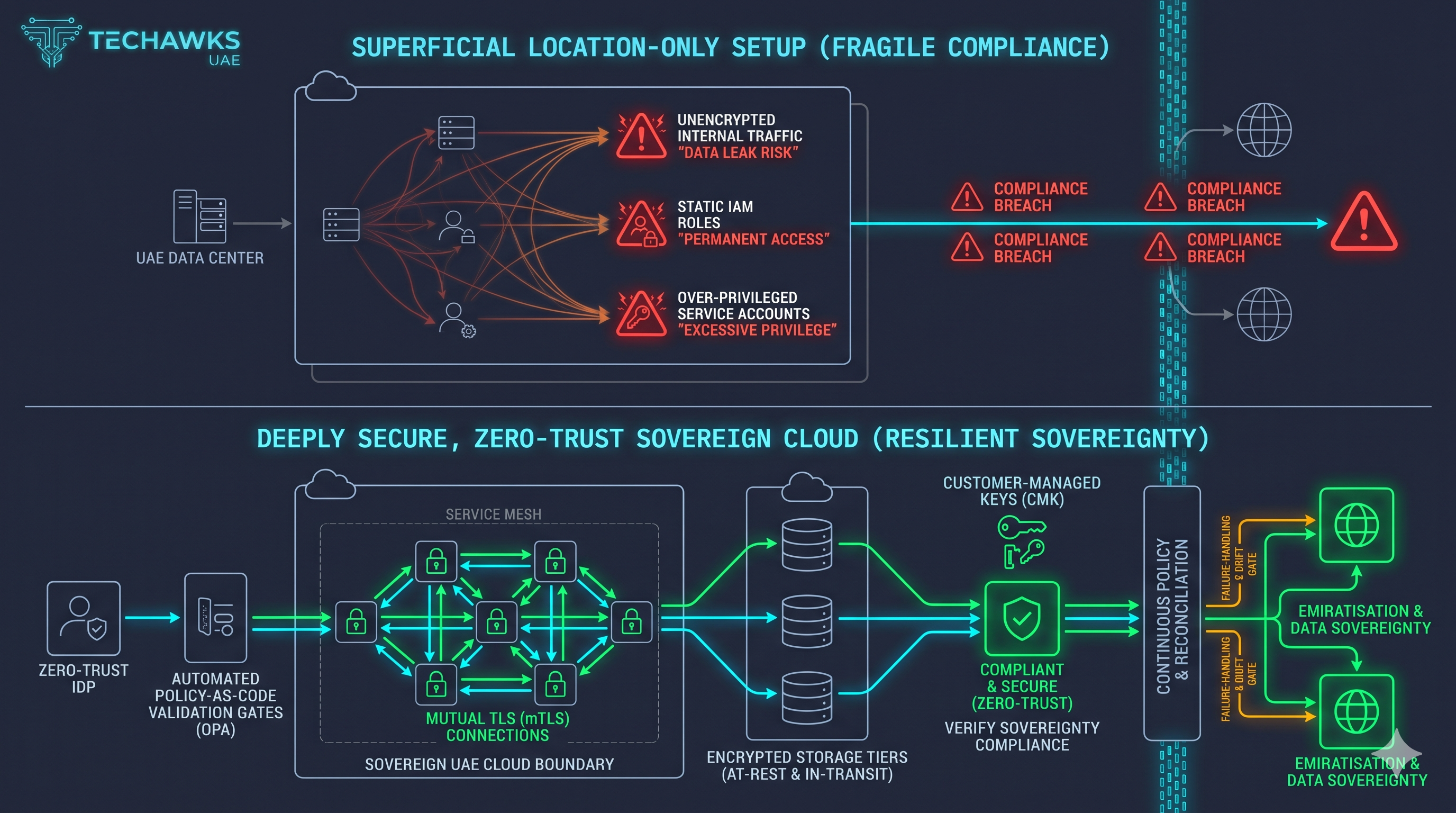
  • The Sovereign Cloud Fallacy: Why Storing Data Locally Doesn't Mean Your Architecture is Secure
    In high-growth digital ecosystems like the UAE, compliance regulations (such as the UAE PDPL) and national cloud security policies rightly emphasize data location, sovereignty, and strict privacy controls.


    However, many engineering teams assume that hosting workloads in a local availability zone automatically guarantees compliance and resilience.


    The reality is that data residency dictates where bits live, but architecture dictates whether those bits are secure. If your microservices rely on hardcoded credentials, unencrypted transit paths across internal VPCs, or over-privileged service accounts, a local perimeter won't stop lateral movement or data exfiltration.


    Plaintext
    [ Compliant Location ≠ Secure Architecture ]
    +------------------------------------------+
    | Local UAE Data Center (Region Locked) |
    | [ Unencrypted Internal Traffic ] |
    | [ Over-Privileged Service Accounts ] |
    | [ Static IAM & Missing Token Scopes ] |
    +------------------------------------------+
    V
    [ Vulnerable to Breach ]
    To bridge the gap between regulatory compliance and true system resilience, engineering teams across the region must enforce these core practices:


    Zero-Trust Internal Mesh: Never trust traffic simply because it originates inside a domestic data center or private cloud. Implement mutual TLS (mTLS) for all service-to-service communication.


    Continuous Data Masking & Tokenization: Comply with privacy laws not just by locking down storage tiers, but by anonymizing and pseudonymizing sensitive personal data before it hits application logs or analytics pipelines.


    Automated Policy-as-Code Guards: Use admission controllers to continuously enforce residency and security constraints (such as preventing accidental cross-border data replication or public S3 bucket configurations) at the pull-request stage.


    Ephemeral Secrets Management: Eliminate static database passwords and hardcoded API tokens. Adopt dynamic secret injection with short-lived leases tied to cryptographic workload identities.


    Discussion Question
    Where has your team experienced friction between meeting strict data localization mandates and designing agile, multi-region or hybrid cloud architectures in the UAE?


    CTA (Join Techawks UAE)
    Engage with software architects, cloud engineers, and technical leaders shaping the future of secure, sovereign infrastructure across the UAE tech ecosystem. Join the Techawks UAE community to debate patterns and share production strategies. Link in bio.
    The Sovereign Cloud Fallacy: Why Storing Data Locally Doesn't Mean Your Architecture is Secure In high-growth digital ecosystems like the UAE, compliance regulations (such as the UAE PDPL) and national cloud security policies rightly emphasize data location, sovereignty, and strict privacy controls. However, many engineering teams assume that hosting workloads in a local availability zone automatically guarantees compliance and resilience. The reality is that data residency dictates where bits live, but architecture dictates whether those bits are secure. If your microservices rely on hardcoded credentials, unencrypted transit paths across internal VPCs, or over-privileged service accounts, a local perimeter won't stop lateral movement or data exfiltration. Plaintext [ Compliant Location ≠ Secure Architecture ] +------------------------------------------+ | Local UAE Data Center (Region Locked) | | [ Unencrypted Internal Traffic ] | | [ Over-Privileged Service Accounts ] | | [ Static IAM & Missing Token Scopes ] | +------------------------------------------+ V [ Vulnerable to Breach ] To bridge the gap between regulatory compliance and true system resilience, engineering teams across the region must enforce these core practices: Zero-Trust Internal Mesh: Never trust traffic simply because it originates inside a domestic data center or private cloud. Implement mutual TLS (mTLS) for all service-to-service communication. Continuous Data Masking & Tokenization: Comply with privacy laws not just by locking down storage tiers, but by anonymizing and pseudonymizing sensitive personal data before it hits application logs or analytics pipelines. Automated Policy-as-Code Guards: Use admission controllers to continuously enforce residency and security constraints (such as preventing accidental cross-border data replication or public S3 bucket configurations) at the pull-request stage. Ephemeral Secrets Management: Eliminate static database passwords and hardcoded API tokens. Adopt dynamic secret injection with short-lived leases tied to cryptographic workload identities. Discussion Question Where has your team experienced friction between meeting strict data localization mandates and designing agile, multi-region or hybrid cloud architectures in the UAE? CTA (Join Techawks UAE) Engage with software architects, cloud engineers, and technical leaders shaping the future of secure, sovereign infrastructure across the UAE tech ecosystem. Join the Techawks UAE community to debate patterns and share production strategies. Link in bio.
    0 Comments 0 Shares 385 Views 0 Reviews
  • Myth vs. Fact: Do You Need to Memorize Every Algorithm Before Your First Tech Internship?
    For computer science students, the fear of the technical interview is real. A pervasive myth suggests that success is purely about encyclopedic recall of data structures and algorithms (DSA). This leads many students to burn out trying to memorize solutions rather than understanding the fundamental problem-solving process.


    Why It Matters
    Believing this myth causes unnecessary anxiety and shifts focus away from what actually matters on the job. While DSA proficiency is important for passing initial screening filters at some companies, real-world engineering success depends far more on adaptability, communication, system thinking, and the ability to learn new technologies quickly.


    Myth vs. Fact
    ❌ The Myth: Successful engineering interns have memorized hundreds of complex algorithms and can reproduce them instantly under pressure. Interviews are a test of perfect recall.


    ✅ The Fact: Top tech companies use technical interviews to evaluate how you think, not what you know. They want to see your approach to an ambiguous problem. Can you break down a large requirement? Do you ask clarifying questions? How do you handle getting stuck? Memorizing an answer to a specific problem ("LeetCode hard") often fails when the interviewer slightly tweaks the parameters. Your ability to communicate your thought process and apply core concepts (like when to use a hash map vs. a tree) is vastly more valuable than memorizing the specific implementation of a segment tree.


    Discussion Question
    What is the single hardest concept you are currently struggling with in your CS curriculum, and how are you approaching learning it beyond just memorizing the definition?


    CTA (Join Students in Tech)
    Ready to navigate the tech industry, connect with peers, and build the skills that actually matter for your career? Join Students in Tech today to share study strategies, get interview prep help, and find internship opportunities.
    Myth vs. Fact: Do You Need to Memorize Every Algorithm Before Your First Tech Internship? For computer science students, the fear of the technical interview is real. A pervasive myth suggests that success is purely about encyclopedic recall of data structures and algorithms (DSA). This leads many students to burn out trying to memorize solutions rather than understanding the fundamental problem-solving process. Why It Matters Believing this myth causes unnecessary anxiety and shifts focus away from what actually matters on the job. While DSA proficiency is important for passing initial screening filters at some companies, real-world engineering success depends far more on adaptability, communication, system thinking, and the ability to learn new technologies quickly. Myth vs. Fact ❌ The Myth: Successful engineering interns have memorized hundreds of complex algorithms and can reproduce them instantly under pressure. Interviews are a test of perfect recall. ✅ The Fact: Top tech companies use technical interviews to evaluate how you think, not what you know. They want to see your approach to an ambiguous problem. Can you break down a large requirement? Do you ask clarifying questions? How do you handle getting stuck? Memorizing an answer to a specific problem ("LeetCode hard") often fails when the interviewer slightly tweaks the parameters. Your ability to communicate your thought process and apply core concepts (like when to use a hash map vs. a tree) is vastly more valuable than memorizing the specific implementation of a segment tree. Discussion Question What is the single hardest concept you are currently struggling with in your CS curriculum, and how are you approaching learning it beyond just memorizing the definition? CTA (Join Students in Tech) Ready to navigate the tech industry, connect with peers, and build the skills that actually matter for your career? Join Students in Tech today to share study strategies, get interview prep help, and find internship opportunities.
    0 Comments 0 Shares 218 Views 0 Reviews
More Results