• Stop Propagating Null: Adopting the Maybe Monad for Safer TypeScript
    In strict TypeScript, null and undefined are often treated as distinct types, but practically, they represent the absence of a value. The traditional approach of using if (value !== null) throughout your codebase leads to verbose, defensive programming and tightly coupled logic.


    The Maybe Monad (often called Option in other languages like Rust or Scala) solves this by wrapping a value that might exist. Instead of asking an object if it's null, you instruct the container holding the object on how to proceed if the value is present.


    Why it matters:


    Compile-Time Safety: The type system forces you to handle the None case, eliminating entire classes of runtime TypeError exceptions.


    Declarative Code: Monads allow for clean, functional pipelines (chaining operations like map and flatMap) instead of nested imperative logic.


    Referential Transparency: Functions become more predictable when they explicitly declare they might return no value, rather than implicitly returning undefined.


    Teach Something Useful (A Basic Maybe Implementation):
    You don't need a heavy library to get started. Here is a simplified implementation of the Maybe pattern in TypeScript:


    TypeScript
    // Define the structure
    type Maybe<T> = Some<T> | None;


    class Some<T> {
    constructor(public readonly value: T) {}
    map<U>(fn: (value: T) => U): Maybe<U> {
    return new Some(fn(this.value));
    }
    // Unwraps safely with a default value
    getOrElse(defaultValue: T): T {
    return this.value;
    }
    }


    class None {
    map<U>(fn: (value: any) => U): Maybe<U> {
    return new None();
    }
    getOrElse<T>(defaultValue: T): T {
    return defaultValue;
    }
    }


    // Factory functions
    const Some = <T>(value: T): Maybe<T> => new Some(value);
    const None = <T>(): Maybe<T> => new None();


    // --- Usage Example ---


    interface User {
    id: number;
    profile?: {
    email?: string;
    };
    }


    // Imagine fetching from an API that might fail
    const findUser = (id: number): Maybe<User> => {
    // Pretend user 1 exists, others don't
    return id === 1 ? Some({id: 1, profile: {email: 'test@example.com'}}) : None();
    };


    // The old way (messy, imperative)
    const oldUser = findUser(2);
    let emailOld = 'default@example.com';
    if (oldUser instanceof Some && oldUser.value.profile && oldUser.value.profile.email) {
    emailOld = oldUser.value.profile.email;
    }


    // The clean way (functional, safe)
    const maybeEmail = findUser(2) // Returns None()
    .map(u => u.profile) // Still None()
    .map(p => p?.email); // Still None()


    // Safely extract value
    const finalEmail = maybeEmail.getOrElse('default@example.com'); // 'default@example.com'


    console.log(`User Email: ${finalEmail}`);
    By treating optional data as a container, your business logic no longer needs to worry about null checks; it only worries about the value if it exists.


    Discussion Question
    Beyond null and undefined, what other JavaScript/TypeScript language features do you find yourself "fighting" daily due to loose typing, and what functional patterns have you adopted to mitigate them?


    CTA (Join Developers & Coding)
    Want to level up your TypeScript game and write more robust, functional applications? Join the Developers & Coding community to exchange best practices, discuss advanced patterns like monads, and tackle complex architectural challenges with peers. [Link to Join]
    Stop Propagating Null: Adopting the Maybe Monad for Safer TypeScript In strict TypeScript, null and undefined are often treated as distinct types, but practically, they represent the absence of a value. The traditional approach of using if (value !== null) throughout your codebase leads to verbose, defensive programming and tightly coupled logic. The Maybe Monad (often called Option in other languages like Rust or Scala) solves this by wrapping a value that might exist. Instead of asking an object if it's null, you instruct the container holding the object on how to proceed if the value is present. Why it matters: Compile-Time Safety: The type system forces you to handle the None case, eliminating entire classes of runtime TypeError exceptions. Declarative Code: Monads allow for clean, functional pipelines (chaining operations like map and flatMap) instead of nested imperative logic. Referential Transparency: Functions become more predictable when they explicitly declare they might return no value, rather than implicitly returning undefined. Teach Something Useful (A Basic Maybe Implementation): You don't need a heavy library to get started. Here is a simplified implementation of the Maybe pattern in TypeScript: TypeScript // Define the structure type Maybe<T> = Some<T> | None; class Some<T> { constructor(public readonly value: T) {} map<U>(fn: (value: T) => U): Maybe<U> { return new Some(fn(this.value)); } // Unwraps safely with a default value getOrElse(defaultValue: T): T { return this.value; } } class None { map<U>(fn: (value: any) => U): Maybe<U> { return new None(); } getOrElse<T>(defaultValue: T): T { return defaultValue; } } // Factory functions const Some = <T>(value: T): Maybe<T> => new Some(value); const None = <T>(): Maybe<T> => new None(); // --- Usage Example --- interface User { id: number; profile?: { email?: string; }; } // Imagine fetching from an API that might fail const findUser = (id: number): Maybe<User> => { // Pretend user 1 exists, others don't return id === 1 ? Some({id: 1, profile: {email: 'test@example.com'}}) : None(); }; // The old way (messy, imperative) const oldUser = findUser(2); let emailOld = 'default@example.com'; if (oldUser instanceof Some && oldUser.value.profile && oldUser.value.profile.email) { emailOld = oldUser.value.profile.email; } // The clean way (functional, safe) const maybeEmail = findUser(2) // Returns None() .map(u => u.profile) // Still None() .map(p => p?.email); // Still None() // Safely extract value const finalEmail = maybeEmail.getOrElse('default@example.com'); // 'default@example.com' console.log(`User Email: ${finalEmail}`); By treating optional data as a container, your business logic no longer needs to worry about null checks; it only worries about the value if it exists. Discussion Question Beyond null and undefined, what other JavaScript/TypeScript language features do you find yourself "fighting" daily due to loose typing, and what functional patterns have you adopted to mitigate them? CTA (Join Developers & Coding) Want to level up your TypeScript game and write more robust, functional applications? Join the Developers & Coding community to exchange best practices, discuss advanced patterns like monads, and tackle complex architectural challenges with peers. [Link to Join]
    0 Comments 0 Shares 85 Views 0 Reviews
  • Why the UK’s "Divergent" AI Strategy is a Game-Changer for Local Devs
    Today, the UK government published its response to the AI White Paper consultation, outlining its official strategy. While the EU is moving toward heavy, horizontal legislation, the UK has chosen a distinctly different path: a pro-innovation, sector-specific approach governed by existing regulators.


    Why it matters locally:
    For the UK tech community, this divergence is massive. It means:


    No New Blanket Legislation (Yet): Instead of a single, massive AI law, guidance will come from sector regulators (CMA for competition, ICO for data privacy, Ofcom for safety).


    Clarity for Adoption: This avoids the "over-compliance" paralysis that threatens innovation in other regions. It allows UK businesses to adopt AI tools with more confidence, provided they operate within existing legal boundaries.


    The "Sandboxing" Strategy: The government is investing in tools like the AI and Digital Hub to help regulators and businesses navigate compliance together.


    Teach something useful: How to "Shift Left" on AI Governance now.
    Even without a new specific "AI Act," your AI deployment must be legally sound. Don't wait for regulators to knock. Start implementing "AI-specific Privacy by Design" principles now.


    If you are building an AI application, ask yourself these three questions before deployment:


    Provenance: Do you have absolute visibility into the data used to train or fine-tune the model?


    Explainability (XAI): If the model makes a decision that affects a UK citizen (e.g., recruitment, loan approval), can you explain how that decision was reached?


    Human Oversight: Is there a human in the loop capable of overriding automated decisions to prevent bias or error?


    By baking these governance layers into your architecture now, you future-proof your innovation against both UK regulatory scrutiny and reputational risk.


    Discussion Question:
    With the UK diverging from the EU's approach to AI regulation, do you believe this pro-innovation stance will accelerate UK tech growth, or will it create eventual friction for companies doing business internationally? Let’s debate below 👇


    CTA (Join Techawks UK):
    Stay ahead of the UK regulatory curve. We distill the noise into actionable, technical strategy for the British tech scene. Follow Techawks UK for daily insights that matter.
    Why the UK’s "Divergent" AI Strategy is a Game-Changer for Local Devs Today, the UK government published its response to the AI White Paper consultation, outlining its official strategy. While the EU is moving toward heavy, horizontal legislation, the UK has chosen a distinctly different path: a pro-innovation, sector-specific approach governed by existing regulators. Why it matters locally: For the UK tech community, this divergence is massive. It means: No New Blanket Legislation (Yet): Instead of a single, massive AI law, guidance will come from sector regulators (CMA for competition, ICO for data privacy, Ofcom for safety). Clarity for Adoption: This avoids the "over-compliance" paralysis that threatens innovation in other regions. It allows UK businesses to adopt AI tools with more confidence, provided they operate within existing legal boundaries. The "Sandboxing" Strategy: The government is investing in tools like the AI and Digital Hub to help regulators and businesses navigate compliance together. Teach something useful: How to "Shift Left" on AI Governance now. Even without a new specific "AI Act," your AI deployment must be legally sound. Don't wait for regulators to knock. Start implementing "AI-specific Privacy by Design" principles now. If you are building an AI application, ask yourself these three questions before deployment: Provenance: Do you have absolute visibility into the data used to train or fine-tune the model? Explainability (XAI): If the model makes a decision that affects a UK citizen (e.g., recruitment, loan approval), can you explain how that decision was reached? Human Oversight: Is there a human in the loop capable of overriding automated decisions to prevent bias or error? By baking these governance layers into your architecture now, you future-proof your innovation against both UK regulatory scrutiny and reputational risk. Discussion Question: With the UK diverging from the EU's approach to AI regulation, do you believe this pro-innovation stance will accelerate UK tech growth, or will it create eventual friction for companies doing business internationally? Let’s debate below 👇 CTA (Join Techawks UK): Stay ahead of the UK regulatory curve. We distill the noise into actionable, technical strategy for the British tech scene. Follow Techawks UK for daily insights that matter.
    0 Comments 0 Shares 165 Views 0 Reviews
  • Running Stateful Workloads (like Databases) on Kubernetes is inherently unsafe and impossible to manage
    The Fallacy of the "Stateless Cluster"
    For years, the conventional wisdom was "pets vs. cattle." Stateless frontends were cattle (disposable), and databases were pets (nurtured, manually managed VMs). Kubernetes was designed exclusively for cattle.


    That conventional wisdom is now obsolete. The introduction of StatefulSets, Persistent Volumes (PVs), Persistent Volume Claims (PVCs), and mature Operator frameworks has fundamentally changed the game. You can have stable network identities, predictable storage, and automated lifecycle management for databases running inside K8s pods.


    Architecture Comparison: Manual VM vs. K8s Operator
    Plaintext
    [ ANTI-PATTERN: Manual DB Management on VMs ]
    Ops Engineer ──> SSH into VM ──> Manual config edit ──> Restart Service
    (Result: Configuration drift, slow disaster recovery, non-standard tooling)


    [ RESILIENT K8s STANDARD: Database Operator Pattern ]
    K8s Custom Resource (YAML) ──> DB Operator ──> Manages StatefulSet & PVCs ──> Automated Health Checks & Failover
    (Result: Infrastructure as Code, self-healing, automated upgrades, consistent backups)
    Actionable Principles for Stateful K8s
    Embrace K8s Operators: Do not try to manage a raw StatefulSet for a complex database. Use production-grade Operators (e.g., Percona Operator for PostgreSQL, Zalando, or the official Elastic Cloud on K8s). The Operator is the expert DBA encoded as software.


    Understand Storage Classes & CSI: Your database performance is only as good as your storage. Learn to use Container Storage Interface (CSI) drivers specific to your cloud (EBS on AWS, PD on GCP) to provision high-performance IOPS volumes automatically via PVCs.


    Node Affinity & Anti-Affinity: Ensure your database pods are spread across different physical nodes (using Pod Anti-Affinity) to survive a single node failure. Conversely, use Node Affinity to pin database workloads to specific high-memory or local-NVMe nodes for performance.


    Externalized Backups are Mandatory: Kubernetes storage is ephemeral in spirit, even with PVs. Always stream database backups (using tools like Velero or the Operator's native backup capabilities) to external object storage (S3/GCS/Azure Blob). Never rely solely on the cluster's persistent volume for disaster recovery.


    Discussion Question
    What was your team’s biggest "oh no" moment when moving stateful workloads to Kubernetes, and what architectural change fixed it?


    CTA (Join Cloud, DevOps & Open Source)
    Ready to master advanced Kubernetes patterns, GitOps workflows, and cloud-native architecture with elite DevOps engineers? Join the Techawks Cloud, DevOps & Open Source community at [Techawks Cloud Community Link] to share war stories, get feedback on your manifests, and access exclusive hands-on labs.
    Running Stateful Workloads (like Databases) on Kubernetes is inherently unsafe and impossible to manage The Fallacy of the "Stateless Cluster" For years, the conventional wisdom was "pets vs. cattle." Stateless frontends were cattle (disposable), and databases were pets (nurtured, manually managed VMs). Kubernetes was designed exclusively for cattle. That conventional wisdom is now obsolete. The introduction of StatefulSets, Persistent Volumes (PVs), Persistent Volume Claims (PVCs), and mature Operator frameworks has fundamentally changed the game. You can have stable network identities, predictable storage, and automated lifecycle management for databases running inside K8s pods. Architecture Comparison: Manual VM vs. K8s Operator Plaintext [ ANTI-PATTERN: Manual DB Management on VMs ] Ops Engineer ──> SSH into VM ──> Manual config edit ──> Restart Service (Result: Configuration drift, slow disaster recovery, non-standard tooling) [ RESILIENT K8s STANDARD: Database Operator Pattern ] K8s Custom Resource (YAML) ──> DB Operator ──> Manages StatefulSet & PVCs ──> Automated Health Checks & Failover (Result: Infrastructure as Code, self-healing, automated upgrades, consistent backups) Actionable Principles for Stateful K8s Embrace K8s Operators: Do not try to manage a raw StatefulSet for a complex database. Use production-grade Operators (e.g., Percona Operator for PostgreSQL, Zalando, or the official Elastic Cloud on K8s). The Operator is the expert DBA encoded as software. Understand Storage Classes & CSI: Your database performance is only as good as your storage. Learn to use Container Storage Interface (CSI) drivers specific to your cloud (EBS on AWS, PD on GCP) to provision high-performance IOPS volumes automatically via PVCs. Node Affinity & Anti-Affinity: Ensure your database pods are spread across different physical nodes (using Pod Anti-Affinity) to survive a single node failure. Conversely, use Node Affinity to pin database workloads to specific high-memory or local-NVMe nodes for performance. Externalized Backups are Mandatory: Kubernetes storage is ephemeral in spirit, even with PVs. Always stream database backups (using tools like Velero or the Operator's native backup capabilities) to external object storage (S3/GCS/Azure Blob). Never rely solely on the cluster's persistent volume for disaster recovery. Discussion Question What was your team’s biggest "oh no" moment when moving stateful workloads to Kubernetes, and what architectural change fixed it? CTA (Join Cloud, DevOps & Open Source) Ready to master advanced Kubernetes patterns, GitOps workflows, and cloud-native architecture with elite DevOps engineers? Join the Techawks Cloud, DevOps & Open Source community at [Techawks Cloud Community Link] to share war stories, get feedback on your manifests, and access exclusive hands-on labs.
    0 Comments 0 Shares 2K Views 0 Reviews
  • Beyond the Buzzwords: Translating Your Skills for the AI-Driven Applicant Tracking System (ATS)
    The Problem: The Silent Filter
    Modern tech hiring is overwhelmed with applications. Recruiters at companies like Google, Microsoft, and Amazon rely on complex ATS platforms (such as Workday, Lever, or Taleo) not just for storage, but for intelligent ranking. An ATS doesn't just look for keywords; it parses your resume into a structured profile, comparing it against the job description's requirements for "matched criteria." If your resume isn't formatted correctly or lacks contextual depth, you are auto-rejected before a human eye ever sees it.


    The Solution: Semantic Optimization
    You cannot "game" the system with keyword stuffing. You must demonstrate competence in context.


    How to Structure Your Resume for ATS Visibility (Visualized):


    Plaintext
    [ RESUME DOCUMENT (Ideally .docx or clean PDF) ]
    │
    ▼
    [ ATS PARSING ENGINE ] (Reads structure and content)
    │
    ┌─────────┴─────────┐
    ▼ ▼
    [ HARD SKILLS ] [ EXPERIENCE & IMPACT ] (Semantic Context)
    - Python "Architected serverless API [Python] on [AWS]...
    - React ...reducing latency by 40% for 10M+ users."
    - AWS (The Engine understands: Python used in Production, at Scale)
    │
    ▼
    [ ATS SCORING ALGORITHM ] (Matches Candidate Profile to Job Description)
    │
    ▼
    [ RECRUITER DASHBOARD ] (Ranked List: High Match -> Low Match)
    3 Actionable Steps to Mastering ATS Compliance:


    Ditch the Graphics, Embrace the Standard: Avoid complex layouts, tables, columns, text boxes, images, and unusual fonts. Use a standard, clean layout (like the Techawks Standard Resume Template). The ATS reads left-to-right, top-to-bottom. If it hits a graphic, it might stop reading. Save the design portfolio for a separate link.


    Contextualize Your Skills (The X-Y-Z Formula): Don't just list "Skills: Java, Spring, Kubernetes." Integrate them into your bullet points using the X-Y-Z formula (Accomplished [X] as measured by [Y], by doing [Z]).


    Weak: "Managed cloud infrastructure."


    Strong: "Orchestrated migration of monolithic apps to microservices on [Kubernetes] and [GCP], reducing deployment time by 60% and infrastructure costs by 25%." (The ATS now knows you have demonstrated experience with K8s and GCP in a high-impact setting.)


    Mirror the Job Description (JD): Analyze the specific job description you are applying to. Identify the top 10 hard skills, tools, and methodologies listed. Ensure every single one of those critical terms appears naturally within your resume's experience section. If the JD asks for "CI/CD Pipeline Management," and your resume says "Release Automation," you must adapt your resume to reflect the language the ATS is programmed to find.


    Discussion Question
    AI screening is becoming increasingly sophisticated, moving from simple keyword matching to semantic analysis (understanding context). What is your primary strategy for adapting your resume between very similar roles (e.g., a "Data Scientist" role vs. a "Machine Learning Engineer" role) to ensure you rank high for both without creating entirely new documents?


    CTA
    Join Tech Jobs & Opportunities
    Navigate the complex tech job market with confidence. Connect with career coaches, get exclusive insights into top hiring companies, and access peer-reviewed resume templates in the official Techawks Careers community. [Link in Bio / Join Here]
    Beyond the Buzzwords: Translating Your Skills for the AI-Driven Applicant Tracking System (ATS) The Problem: The Silent Filter Modern tech hiring is overwhelmed with applications. Recruiters at companies like Google, Microsoft, and Amazon rely on complex ATS platforms (such as Workday, Lever, or Taleo) not just for storage, but for intelligent ranking. An ATS doesn't just look for keywords; it parses your resume into a structured profile, comparing it against the job description's requirements for "matched criteria." If your resume isn't formatted correctly or lacks contextual depth, you are auto-rejected before a human eye ever sees it. The Solution: Semantic Optimization You cannot "game" the system with keyword stuffing. You must demonstrate competence in context. How to Structure Your Resume for ATS Visibility (Visualized): Plaintext [ RESUME DOCUMENT (Ideally .docx or clean PDF) ] │ ▼ [ ATS PARSING ENGINE ] (Reads structure and content) │ ┌─────────┴─────────┐ ▼ ▼ [ HARD SKILLS ] [ EXPERIENCE & IMPACT ] (Semantic Context) - Python "Architected serverless API [Python] on [AWS]... - React ...reducing latency by 40% for 10M+ users." - AWS (The Engine understands: Python used in Production, at Scale) │ ▼ [ ATS SCORING ALGORITHM ] (Matches Candidate Profile to Job Description) │ ▼ [ RECRUITER DASHBOARD ] (Ranked List: High Match -> Low Match) 3 Actionable Steps to Mastering ATS Compliance: Ditch the Graphics, Embrace the Standard: Avoid complex layouts, tables, columns, text boxes, images, and unusual fonts. Use a standard, clean layout (like the Techawks Standard Resume Template). The ATS reads left-to-right, top-to-bottom. If it hits a graphic, it might stop reading. Save the design portfolio for a separate link. Contextualize Your Skills (The X-Y-Z Formula): Don't just list "Skills: Java, Spring, Kubernetes." Integrate them into your bullet points using the X-Y-Z formula (Accomplished [X] as measured by [Y], by doing [Z]). Weak: "Managed cloud infrastructure." Strong: "Orchestrated migration of monolithic apps to microservices on [Kubernetes] and [GCP], reducing deployment time by 60% and infrastructure costs by 25%." (The ATS now knows you have demonstrated experience with K8s and GCP in a high-impact setting.) Mirror the Job Description (JD): Analyze the specific job description you are applying to. Identify the top 10 hard skills, tools, and methodologies listed. Ensure every single one of those critical terms appears naturally within your resume's experience section. If the JD asks for "CI/CD Pipeline Management," and your resume says "Release Automation," you must adapt your resume to reflect the language the ATS is programmed to find. Discussion Question AI screening is becoming increasingly sophisticated, moving from simple keyword matching to semantic analysis (understanding context). What is your primary strategy for adapting your resume between very similar roles (e.g., a "Data Scientist" role vs. a "Machine Learning Engineer" role) to ensure you rank high for both without creating entirely new documents? CTA Join Tech Jobs & Opportunities Navigate the complex tech job market with confidence. Connect with career coaches, get exclusive insights into top hiring companies, and access peer-reviewed resume templates in the official Techawks Careers community. [Link in Bio / Join Here]
    0 Comments 0 Shares 324 Views 0 Reviews
  • The 3-Layer Architecture for Resilient Serverless Functions: Stop Debugging Timeouts and Start Building Observability
    The Monolithic Lambda Anti-Pattern
    Many serverless adoption journeys begin with the "everything inside the handler" approach. While quick to prototype, this tight coupling creates brittle, untestable code. When the database connection fails or the external API is slow, the entire function fails, obscuring the true root cause and making local debugging nearly impossible.


    The 3-Layer Decoupled Approach
    To achieve enterprise-grade resilience and observability, adopt a clean, 3-layer architecture within your serverless functions. This pattern isolates concerns, simplifies testing, and makes failure domains explicit.


    [ External Event ] ──> [ Handler Layer ]
    │
    V
    [ Service/Business Logic Layer ]
    │
    V
    [ Data Access/Infrastructure Layer ] ──> [ Database/API ]
    Actionable Engineering Principles for Serverless
    The Handler Layer: Thin & Stateless (The "Pizza Box")
    Your entry point should do only four things: accept the event, perform basic input validation (e.g., Zod/Joi), inject dependencies, and pass the payload to the service layer. It should know nothing about SQL queries or external API structures. If you are instantiating a database client inside the handler, refactor immediately.


    The Service Layer: Testable Core (The "Chef")
    This layer contains your pure business logic. It is completely isolated from the Lambda runtime environment, making it 100% unit-testable without mocking AWS services. It receives structured data from the handler and returns structured data or a domain error.


    The Data Access Layer: Infrastructure Port (The "Supplier")
    This layer handles all external communications (database, third-party APIs, S3). By using the Repository Pattern, your service layer only calls an interface (e.g., UserRepository.saveUser()). This allows you to swap implementations (e.g., switching from DynamoDB to Postgres) without touching your business logic.


    Discussion Question
    This architecture maximizes testability but can introduce minor latency due to increased modularity. Where do you draw the line between performance optimization and clean code in serverless, and have you ever had to "flatten" a function specifically to meet strict execution time limits?


    Key Takeaways
    Separation of Concerns is Critical: Monolithic serverless functions are technical debt multipliers.


    Unit Testability Outside the Cloud: A 3-layer architecture enables testing business logic locally, reducing reliance on heavy cloud-based testing frameworks.


    Explicit Failure Domains: Decoupled layers make it immediately obvious whether an error originated in the logic, the validation, or the infrastructure.


    CTA (Join Techawks General Community)
    Ready to design scalable, resilient cloud architectures? Join the global Techawks community to discuss production war stories, share architecture diagrams, and level up your engineering game. [Join the Techawks General Community today!]
    The 3-Layer Architecture for Resilient Serverless Functions: Stop Debugging Timeouts and Start Building Observability The Monolithic Lambda Anti-Pattern Many serverless adoption journeys begin with the "everything inside the handler" approach. While quick to prototype, this tight coupling creates brittle, untestable code. When the database connection fails or the external API is slow, the entire function fails, obscuring the true root cause and making local debugging nearly impossible. The 3-Layer Decoupled Approach To achieve enterprise-grade resilience and observability, adopt a clean, 3-layer architecture within your serverless functions. This pattern isolates concerns, simplifies testing, and makes failure domains explicit. [ External Event ] ──> [ Handler Layer ] │ V [ Service/Business Logic Layer ] │ V [ Data Access/Infrastructure Layer ] ──> [ Database/API ] Actionable Engineering Principles for Serverless The Handler Layer: Thin & Stateless (The "Pizza Box") Your entry point should do only four things: accept the event, perform basic input validation (e.g., Zod/Joi), inject dependencies, and pass the payload to the service layer. It should know nothing about SQL queries or external API structures. If you are instantiating a database client inside the handler, refactor immediately. The Service Layer: Testable Core (The "Chef") This layer contains your pure business logic. It is completely isolated from the Lambda runtime environment, making it 100% unit-testable without mocking AWS services. It receives structured data from the handler and returns structured data or a domain error. The Data Access Layer: Infrastructure Port (The "Supplier") This layer handles all external communications (database, third-party APIs, S3). By using the Repository Pattern, your service layer only calls an interface (e.g., UserRepository.saveUser()). This allows you to swap implementations (e.g., switching from DynamoDB to Postgres) without touching your business logic. Discussion Question This architecture maximizes testability but can introduce minor latency due to increased modularity. Where do you draw the line between performance optimization and clean code in serverless, and have you ever had to "flatten" a function specifically to meet strict execution time limits? Key Takeaways Separation of Concerns is Critical: Monolithic serverless functions are technical debt multipliers. Unit Testability Outside the Cloud: A 3-layer architecture enables testing business logic locally, reducing reliance on heavy cloud-based testing frameworks. Explicit Failure Domains: Decoupled layers make it immediately obvious whether an error originated in the logic, the validation, or the infrastructure. CTA (Join Techawks General Community) Ready to design scalable, resilient cloud architectures? Join the global Techawks community to discuss production war stories, share architecture diagrams, and level up your engineering game. [Join the Techawks General Community today!]
    0 Comments 0 Shares 230 Views 0 Reviews
  • The Production-Grade Kubernetes Security Checklist: 8 Hardening Steps Every Platform Engineer Must Enforce
    Why Default Configurations Fall Short
    Out-of-the-box Kubernetes clusters prioritize ease of getting started over security hardening. Without explicit guardrails, default service accounts carry excessive cluster permissions, pods run with root privileges by default, and unencrypted pod-to-pod communication leaves internal traffic exposed to lateral movement.


    [ Insecure Default ] Pod (Root Privileges) ──> Unencrypted Cluster Mesh ──> Compromised Node
    [ Hardened Cluster ] Restricted Context ──> mTLS Network Policies ──> Zero-Trust Boundary
    The Production Hardening Checklist
    Work through these 8 essential verification steps to transition your clusters from development-friendly to enterprise-secure:


    Enforce Non-Root Execution


    Configure Pod Security Standards (restricted profile) to explicitly block containers from running with UID 0 (root).


    Set runAsNonRoot: true and define strict securityContext parameters in your deployment manifests.


    Implement Least-Privilege RBAC


    Audit Role-Based Access Control bindings regularly; completely eliminate wildcard (*) permissions on verbs and resources.


    Bind service accounts strictly to the namespaces and resources required for their specific workload scope.


    Isolate Traffic with Network Policies


    Default-deny all ingress and egress traffic within your namespaces.


    Explicitly allow only required microservice-to-microservice communication channels using granular Kubernetes NetworkPolicies.


    Enable Control Plane Encryption at Rest


    Ensure Kubernetes secrets are encrypted at rest using an external KMS provider or local encryption provider configuration rather than base64-encoding alone.


    Scan Container Images in CI/CD


    Integrate automated vulnerability scanners (e.g., Trivy, Grype) into your build pipelines to block high and critical CVE deployments.


    Sign and verify container images using tools like Cosign to guarantee supply chain integrity.


    Harden the Kubelet and API Server


    Restrict anonymous API server requests and enforce robust token-based or OIDC authentication.


    Disable insecure Kubelet ports and require authenticated, encrypted communication channels (--read-only-port=0).


    Implement Ephemeral Debug Containers


    Strip kubectl exec and shell access privileges from production pods.


    Use ephemeral debug containers for troubleshooting to maintain strict audit logs without persistent shell access.


    Resource Quotas and Limit Ranges


    Prevent noisy-neighbor failures and denial-of-service vectors by enforcing strict CPU and memory requests/limits on every namespace.


    Key Takeaways
    Defense in Depth: Security cannot rely on perimeter protection alone; every layer—from container image to cluster network—must be isolated.


    Automate Enforcement: Use Admission Controllers (such as OPA/Gatekeeper or Kyverno) to enforce this checklist automatically at deployment time.


    Continuous Auditing: Treat cluster hardening as an ongoing verification process rather than a one-time setup task.


    CTA (Join Techawks General Community)
    Ready to level up your infrastructure game? Join the global Techawks community to collaborate with thousands of engineers building secure, scalable cloud architectures. [Join the Techawks General Community today!]
    The Production-Grade Kubernetes Security Checklist: 8 Hardening Steps Every Platform Engineer Must Enforce Why Default Configurations Fall Short Out-of-the-box Kubernetes clusters prioritize ease of getting started over security hardening. Without explicit guardrails, default service accounts carry excessive cluster permissions, pods run with root privileges by default, and unencrypted pod-to-pod communication leaves internal traffic exposed to lateral movement. [ Insecure Default ] Pod (Root Privileges) ──> Unencrypted Cluster Mesh ──> Compromised Node [ Hardened Cluster ] Restricted Context ──> mTLS Network Policies ──> Zero-Trust Boundary The Production Hardening Checklist Work through these 8 essential verification steps to transition your clusters from development-friendly to enterprise-secure: Enforce Non-Root Execution Configure Pod Security Standards (restricted profile) to explicitly block containers from running with UID 0 (root). Set runAsNonRoot: true and define strict securityContext parameters in your deployment manifests. Implement Least-Privilege RBAC Audit Role-Based Access Control bindings regularly; completely eliminate wildcard (*) permissions on verbs and resources. Bind service accounts strictly to the namespaces and resources required for their specific workload scope. Isolate Traffic with Network Policies Default-deny all ingress and egress traffic within your namespaces. Explicitly allow only required microservice-to-microservice communication channels using granular Kubernetes NetworkPolicies. Enable Control Plane Encryption at Rest Ensure Kubernetes secrets are encrypted at rest using an external KMS provider or local encryption provider configuration rather than base64-encoding alone. Scan Container Images in CI/CD Integrate automated vulnerability scanners (e.g., Trivy, Grype) into your build pipelines to block high and critical CVE deployments. Sign and verify container images using tools like Cosign to guarantee supply chain integrity. Harden the Kubelet and API Server Restrict anonymous API server requests and enforce robust token-based or OIDC authentication. Disable insecure Kubelet ports and require authenticated, encrypted communication channels (--read-only-port=0). Implement Ephemeral Debug Containers Strip kubectl exec and shell access privileges from production pods. Use ephemeral debug containers for troubleshooting to maintain strict audit logs without persistent shell access. Resource Quotas and Limit Ranges Prevent noisy-neighbor failures and denial-of-service vectors by enforcing strict CPU and memory requests/limits on every namespace. Key Takeaways Defense in Depth: Security cannot rely on perimeter protection alone; every layer—from container image to cluster network—must be isolated. Automate Enforcement: Use Admission Controllers (such as OPA/Gatekeeper or Kyverno) to enforce this checklist automatically at deployment time. Continuous Auditing: Treat cluster hardening as an ongoing verification process rather than a one-time setup task. CTA (Join Techawks General Community) Ready to level up your infrastructure game? Join the global Techawks community to collaborate with thousands of engineers building secure, scalable cloud architectures. [Join the Techawks General Community today!]
    0 Comments 0 Shares 204 Views 0 Reviews
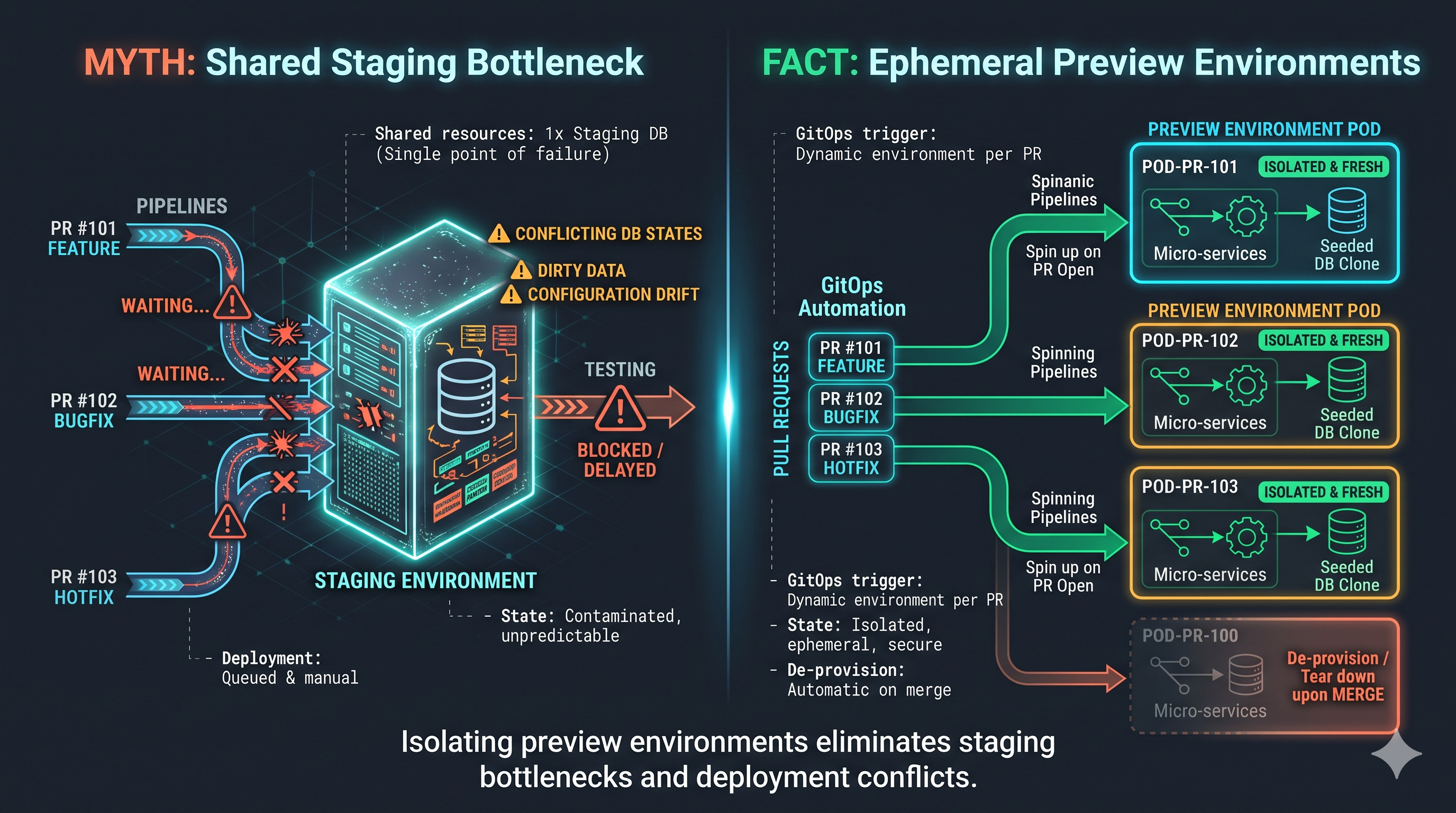
  • Myth vs. Fact: Do Long-Lived Staging Environments Still Guarantee Production Reliability?
    As cloud-native architectures and containerization mature, teams are shifting away from static, always-on staging tiers. Yet, many organizations still treat environment management as a fixed hardware problem rather than a dynamic, automated workflow.


    Myth vs. Fact
    Myth: "We need a persistent, shared Staging environment that mirrors Production 24/7 so we can thoroughly validate integration tests and manual QA before cutting a release."


    Fact: Shared long-lived staging environments invariably accumulate state, experience configuration drift, and suffer from "test pollution"—where one engineer's broken database migration or experimental branch breaks the environment for everyone else. Modern cloud delivery relies on ephemeral environments: isolated, production-like deployments spun up automatically on a per-Pull-Request basis and destroyed the moment code is merged.


    Why It Matters
    When multiple feature teams share a single staging server, testing bottlenecks block release velocity, and debugging regressions becomes a guessing game. Ephemeral environments isolate blast radii, provide full-stack fidelity per feature branch, and drastically cut cloud overhead by treating infrastructure as disposable cattle rather than precious pets.


    What You Can Learn (Cloud-Native Best Practices)
    Declarative Infrastructure Blueprints: Define your environment templates using Infrastructure as Code (Terraform, OpenTofu) or Kubernetes operators so that every ephemeral instance matches production baselines by design.


    GitOps-Driven Lifecycles: Hook your environment creation and teardown directly into your version control triggers—spinning up an isolated cluster namespace on PR open, and executing automated teardown upon merge or closure.


    Dynamic Secret & Data Injection: Avoid hardcoding secrets or bulky static dumps; inject sanitized data and scoped runtime credentials dynamically when the environment initializes.


    Discussion Question
    Is your team still wrestling with a congested shared staging server, or have you transitioned to on-demand ephemeral previews? How do you handle database seeding for short-lived environments?


    CTA (Join Cloud, DevOps & Open Source)
    Want to master modern platform engineering, build automated GitOps pipelines, and design bulletproof cloud architectures? Join Cloud, DevOps & Open Source to level up your engineering practice today.
    Myth vs. Fact: Do Long-Lived Staging Environments Still Guarantee Production Reliability? As cloud-native architectures and containerization mature, teams are shifting away from static, always-on staging tiers. Yet, many organizations still treat environment management as a fixed hardware problem rather than a dynamic, automated workflow. Myth vs. Fact Myth: "We need a persistent, shared Staging environment that mirrors Production 24/7 so we can thoroughly validate integration tests and manual QA before cutting a release." Fact: Shared long-lived staging environments invariably accumulate state, experience configuration drift, and suffer from "test pollution"—where one engineer's broken database migration or experimental branch breaks the environment for everyone else. Modern cloud delivery relies on ephemeral environments: isolated, production-like deployments spun up automatically on a per-Pull-Request basis and destroyed the moment code is merged. Why It Matters When multiple feature teams share a single staging server, testing bottlenecks block release velocity, and debugging regressions becomes a guessing game. Ephemeral environments isolate blast radii, provide full-stack fidelity per feature branch, and drastically cut cloud overhead by treating infrastructure as disposable cattle rather than precious pets. What You Can Learn (Cloud-Native Best Practices) Declarative Infrastructure Blueprints: Define your environment templates using Infrastructure as Code (Terraform, OpenTofu) or Kubernetes operators so that every ephemeral instance matches production baselines by design. GitOps-Driven Lifecycles: Hook your environment creation and teardown directly into your version control triggers—spinning up an isolated cluster namespace on PR open, and executing automated teardown upon merge or closure. Dynamic Secret & Data Injection: Avoid hardcoding secrets or bulky static dumps; inject sanitized data and scoped runtime credentials dynamically when the environment initializes. Discussion Question Is your team still wrestling with a congested shared staging server, or have you transitioned to on-demand ephemeral previews? How do you handle database seeding for short-lived environments? CTA (Join Cloud, DevOps & Open Source) Want to master modern platform engineering, build automated GitOps pipelines, and design bulletproof cloud architectures? Join Cloud, DevOps & Open Source to level up your engineering practice today.
    0 Comments 0 Shares 175 Views 0 Reviews
  • Stop Writing LeetCode in a Vacuum: Why CS Students Must Learn "Memory Locality & Cache Lines"
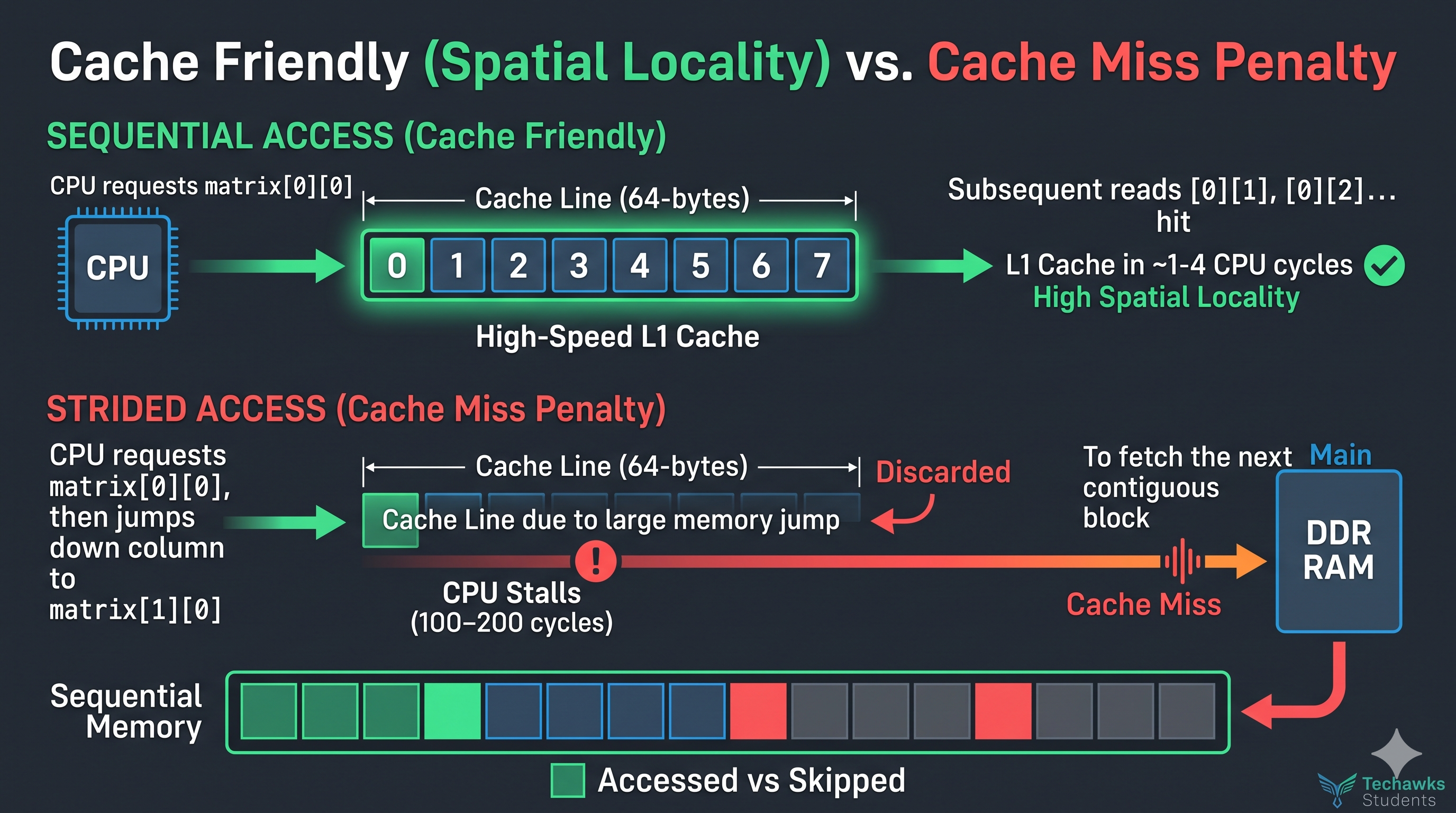
    Most university curricula and interview platforms teach Big-O notation purely through abstract mathematical steps: $O(1)$ access, $O(N)$ traversal, $O(\log N)$ search.While asymptotic complexity matters, modern CPUs spend most of their clock cycles waiting for data to travel from main RAM to registers. To write high-performance code that stands out in technical interviews and production systems, you need to understand Cache Locality.How Hardware Actually Reads MemoryCPUs almost never fetch single bytes or individual integers from RAM. When your program asks for arr[0], the CPU memory controller pulls an entire chunk—known as a Cache Line (standardly 64 bytes)—into L1/L2 hardware caches.Spatial Locality: If your program accesses an address, it will likely access adjacent addresses shortly after.Temporal Locality: If your program accesses an address, it will likely access the exact same address again soon.The Classic Trap: Row-Major vs. Column-Major IterationConsider traversing a 2D matrix ($N \times N$) in languages like C, C++, Python (NumPy), or Go:C// Method A: Cache Friendly (Row-major: sequential memory)
    for (int i = 0; i < N; i++) {
    for (int j = 0; j < N; j++) {
    sum += matrix[i][j]; // Hits adjacent elements already in L1 cache
    }
    }


    // Method B: Cache Destroyer (Column-major: jumping across rows)
    for (int j = 0; j < N; j++) {
    for (int i = 0; i < N; i++) {
    sum += matrix[i][j]; // Strides across rows, triggering continuous cache misses
    }
    }
    Both algorithms have the exact same algorithmic complexity: $O(N^2)$. Yet Method B can run 5x to 15x slower on large matrices because every single inner loop access misses the cache and forces a stall while waiting for main RAM.3 Habits Every Tech Student Should AdoptPrefer Contiguous Arrays over Linked Nodes: While linked lists offer $O(1)$ insertions, their nodes are scattered across arbitrary heap locations (pointer chasing), causing constant cache misses. Flat, sequential vectors or arrays almost always outperform linked lists in real benchmarks.Structure of Arrays (SoA) vs. Array of Structures (AoS): If you are iterating over thousands of game entities or data records just to check one boolean flag or integer state, packing those attributes contiguously prevents loading unused bytes into cache lines.Profile Real Cycles, Don't Just Count Steps: Run your code with performance profilers (like perf on Linux or Instruments on macOS) to track metrics like L1 data cache miss rates (L1-dcache-load-misses).Knowing what happens underneath the abstraction layer is what separates someone who just copies code from a true computer systems engineer.Discussion QuestionCommunity Poll: As a student or learner, which foundational systems concept has been the hardest to bridge between theoretical coursework and real code?A) CPU Cache Locality & Memory Hierarchy (L1/L2/L3 vs. RAM)B) Concurrency, Threading & Race ConditionsC) Operating System Virtual Memory & Page FaultsD) Network Protocols & Socket-level I/O (TCP vs. UDP vs. HTTP)CTAReady to look beyond boilerplate tutorials, master systems fundamentals, and build high-performance software with student builders worldwide?👉 Join Students in Tech to collaborate, share projects, and level up with the Techawks community.
    Stop Writing LeetCode in a Vacuum: Why CS Students Must Learn "Memory Locality & Cache Lines" Most university curricula and interview platforms teach Big-O notation purely through abstract mathematical steps: $O(1)$ access, $O(N)$ traversal, $O(\log N)$ search.While asymptotic complexity matters, modern CPUs spend most of their clock cycles waiting for data to travel from main RAM to registers. To write high-performance code that stands out in technical interviews and production systems, you need to understand Cache Locality.How Hardware Actually Reads MemoryCPUs almost never fetch single bytes or individual integers from RAM. When your program asks for arr[0], the CPU memory controller pulls an entire chunk—known as a Cache Line (standardly 64 bytes)—into L1/L2 hardware caches.Spatial Locality: If your program accesses an address, it will likely access adjacent addresses shortly after.Temporal Locality: If your program accesses an address, it will likely access the exact same address again soon.The Classic Trap: Row-Major vs. Column-Major IterationConsider traversing a 2D matrix ($N \times N$) in languages like C, C++, Python (NumPy), or Go:C// Method A: Cache Friendly (Row-major: sequential memory) for (int i = 0; i < N; i++) { for (int j = 0; j < N; j++) { sum += matrix[i][j]; // Hits adjacent elements already in L1 cache } } // Method B: Cache Destroyer (Column-major: jumping across rows) for (int j = 0; j < N; j++) { for (int i = 0; i < N; i++) { sum += matrix[i][j]; // Strides across rows, triggering continuous cache misses } } Both algorithms have the exact same algorithmic complexity: $O(N^2)$. Yet Method B can run 5x to 15x slower on large matrices because every single inner loop access misses the cache and forces a stall while waiting for main RAM.3 Habits Every Tech Student Should AdoptPrefer Contiguous Arrays over Linked Nodes: While linked lists offer $O(1)$ insertions, their nodes are scattered across arbitrary heap locations (pointer chasing), causing constant cache misses. Flat, sequential vectors or arrays almost always outperform linked lists in real benchmarks.Structure of Arrays (SoA) vs. Array of Structures (AoS): If you are iterating over thousands of game entities or data records just to check one boolean flag or integer state, packing those attributes contiguously prevents loading unused bytes into cache lines.Profile Real Cycles, Don't Just Count Steps: Run your code with performance profilers (like perf on Linux or Instruments on macOS) to track metrics like L1 data cache miss rates (L1-dcache-load-misses).Knowing what happens underneath the abstraction layer is what separates someone who just copies code from a true computer systems engineer.Discussion QuestionCommunity Poll: As a student or learner, which foundational systems concept has been the hardest to bridge between theoretical coursework and real code?A) CPU Cache Locality & Memory Hierarchy (L1/L2/L3 vs. RAM)B) Concurrency, Threading & Race ConditionsC) Operating System Virtual Memory & Page FaultsD) Network Protocols & Socket-level I/O (TCP vs. UDP vs. HTTP)CTAReady to look beyond boilerplate tutorials, master systems fundamentals, and build high-performance software with student builders worldwide?👉 Join Students in Tech to collaborate, share projects, and level up with the Techawks community.
    0 Comments 0 Shares 281 Views 0 Reviews
  • The Metric Drift Illusion: Why Your Dashboards Agree on Nothing and Your AI is Lying
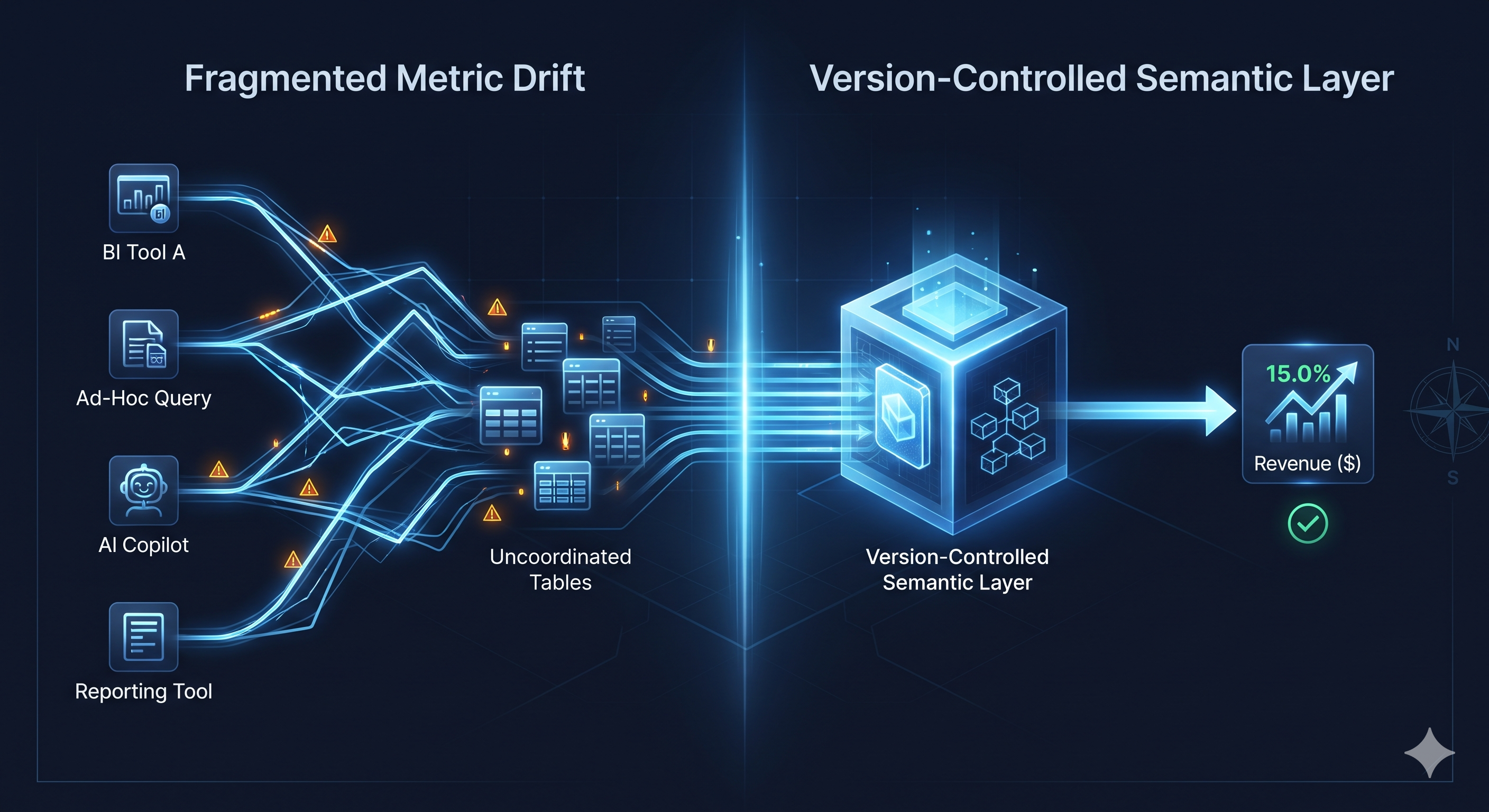
    With modern data architectures shifting toward decentralized domains, semantic layers, and automated AI consumption, data teams face a structural crisis. When every department calculates core metrics independently across disconnected dbt models, looker views, or ad-hoc SQL scripts, you don't have a data-driven culture—you have an organized guessing game.


    Why It Matters
    Traditional reporting treated metrics as UI-level logic inside individual dashboards. When business users or LLM agents query a data warehouse directly, they don't see those dashboard filters or hidden business rules. If your business definitions live inside fragmented tools rather than a centralized governed layer, AI agents will hallucinate metrics, executives will argue over spreadsheet discrepancies in board meetings, and trust in analytics will evaporate.


    What You Need to Know: Engineering a Single Source of Truth
    To eliminate metric drift and make your data stack AI-ready, data professionals must implement rigorous semantic governance:


    Centralize Metric Definitions as Code: Move away from dashboard-locked formulas. Define business-critical metrics (like ARR, churn, or net retention) once in code using version-controlled semantic layers or transformation tools.


    Enforce Grain and Join Boundaries: Clearly document and lock down table grains and foreign-key join paths. Prevent users and AI tools from carelessly performing many-to-many joins that result in silent double-counting and fanouts.


    Expose Governed Context to AI Layers: Never plug an LLM directly into raw, unmapped database schemas. Feed AI tools structured metadata and semantic definitions so natural language queries resolve to the exact same governed SQL every single time.


    Discussion Question
    How does your team currently handle metric definitions? Are you using a centralized semantic layer, or do different departments still maintain their own independent dashboard formulas?


    CTA (Join Data Science & Analytics)
    Want to master advanced data modeling, semantic architecture, and modern analytics engineering patterns? Join Data Science & Analytics to connect with global data professionals building reliable, scalable systems.
    The Metric Drift Illusion: Why Your Dashboards Agree on Nothing and Your AI is Lying With modern data architectures shifting toward decentralized domains, semantic layers, and automated AI consumption, data teams face a structural crisis. When every department calculates core metrics independently across disconnected dbt models, looker views, or ad-hoc SQL scripts, you don't have a data-driven culture—you have an organized guessing game. Why It Matters Traditional reporting treated metrics as UI-level logic inside individual dashboards. When business users or LLM agents query a data warehouse directly, they don't see those dashboard filters or hidden business rules. If your business definitions live inside fragmented tools rather than a centralized governed layer, AI agents will hallucinate metrics, executives will argue over spreadsheet discrepancies in board meetings, and trust in analytics will evaporate. What You Need to Know: Engineering a Single Source of Truth To eliminate metric drift and make your data stack AI-ready, data professionals must implement rigorous semantic governance: Centralize Metric Definitions as Code: Move away from dashboard-locked formulas. Define business-critical metrics (like ARR, churn, or net retention) once in code using version-controlled semantic layers or transformation tools. Enforce Grain and Join Boundaries: Clearly document and lock down table grains and foreign-key join paths. Prevent users and AI tools from carelessly performing many-to-many joins that result in silent double-counting and fanouts. Expose Governed Context to AI Layers: Never plug an LLM directly into raw, unmapped database schemas. Feed AI tools structured metadata and semantic definitions so natural language queries resolve to the exact same governed SQL every single time. Discussion Question How does your team currently handle metric definitions? Are you using a centralized semantic layer, or do different departments still maintain their own independent dashboard formulas? CTA (Join Data Science & Analytics) Want to master advanced data modeling, semantic architecture, and modern analytics engineering patterns? Join Data Science & Analytics to connect with global data professionals building reliable, scalable systems.
    0 Comments 0 Shares 430 Views 0 Reviews
  • Prompt Caching in Production: The 4-Step Checklist to Cut LLM Latency and Costs by 50%+
    As LLM context windows expand into millions of tokens, processing costs and Time-to-First-Token (TTFT) latency can bottleneck user experience. Prompt caching changes the game by storing the prefix blocks of your prompt in GPU memory so the model doesn't have to recompute the attention keys and values for static content.


    When implemented correctly, prompt caching can reduce input token costs by up to 50–90% and slash latency drastically.


    Use this 4-step checklist to optimize your caching strategy:


    Structure for Static Prefixes: Place your invariant data—such as extensive system instructions, API documentation, or few-shot examples—at the absolute beginning of your prompt. Most providers require exact prefix matching to hit the cache.


    Standardize Dynamic Suffixes: Keep user inputs, variable states, and dynamic queries at the very end of the prompt. Any mutation upstream in the sequence invalidates the cached prefix block.


    Monitor Cache Hit Rates: Track your provider's telemetry for cache read vs. write tokens. If your hit rate is low, your prompt structure is likely fluctuating too frequently (e.g., injecting dynamic timestamps or user IDs too early).


    Align Token Block Sizes: Be mindful of provider-specific block alignment rules (e.g., minimum chunk thresholds like 1,024 or 4,096 tokens) to ensure your static assets actually qualify for caching status.


    Discussion Question: What has been your biggest bottleneck when optimizing LLM inference costs? Are you leveraging native provider caching or managing custom semantic caches at the application layer? Let’s discuss below!


    CTA (Join AI Builders & Enthusiasts): Want to build high-performance, cost-efficient AI architectures alongside thousands of developers and researchers? Join the AI Builders & Enthusiasts community:
    Prompt Caching in Production: The 4-Step Checklist to Cut LLM Latency and Costs by 50%+ As LLM context windows expand into millions of tokens, processing costs and Time-to-First-Token (TTFT) latency can bottleneck user experience. Prompt caching changes the game by storing the prefix blocks of your prompt in GPU memory so the model doesn't have to recompute the attention keys and values for static content. When implemented correctly, prompt caching can reduce input token costs by up to 50–90% and slash latency drastically. Use this 4-step checklist to optimize your caching strategy: Structure for Static Prefixes: Place your invariant data—such as extensive system instructions, API documentation, or few-shot examples—at the absolute beginning of your prompt. Most providers require exact prefix matching to hit the cache. Standardize Dynamic Suffixes: Keep user inputs, variable states, and dynamic queries at the very end of the prompt. Any mutation upstream in the sequence invalidates the cached prefix block. Monitor Cache Hit Rates: Track your provider's telemetry for cache read vs. write tokens. If your hit rate is low, your prompt structure is likely fluctuating too frequently (e.g., injecting dynamic timestamps or user IDs too early). Align Token Block Sizes: Be mindful of provider-specific block alignment rules (e.g., minimum chunk thresholds like 1,024 or 4,096 tokens) to ensure your static assets actually qualify for caching status. Discussion Question: What has been your biggest bottleneck when optimizing LLM inference costs? Are you leveraging native provider caching or managing custom semantic caches at the application layer? Let’s discuss below! CTA (Join AI Builders & Enthusiasts): Want to build high-performance, cost-efficient AI architectures alongside thousands of developers and researchers? Join the AI Builders & Enthusiasts community:
    0 Comments 0 Shares 232 Views 0 Reviews
  • Beyond Plug-and-Play APIs: Why Explainable AI Governance is Replacing the "Move Fast" Era of Indian Fintech


    India's tech ecosystem has scaled at a breathtaking pace, shifting from foundational Digital Public Infrastructure (like UPI and Aadhaar rails supporting over a billion citizens) to an advanced frontier of high-velocity fintech and commerce systems. But as generative AI and automated decision engines move into core financial workflows, the rules of the game are changing.


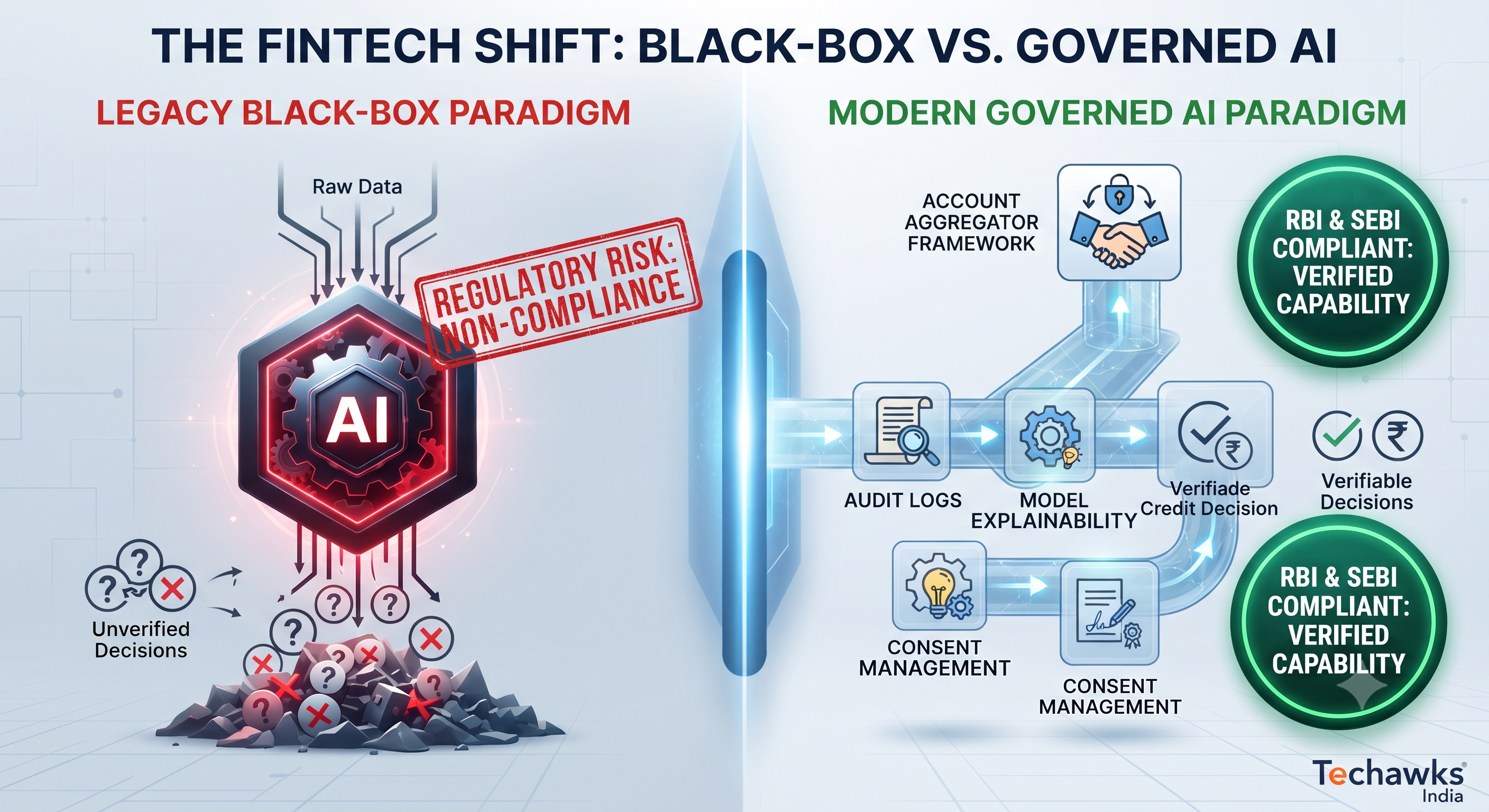
    The era of shipping unexplainable machine learning models simply to move fast is giving way to an era of Explainable AI Accountability. Modern regulatory frameworks require strict audit trails, transparent alternative credit scoring for thin-file borrowers, and verifiable data consent via Account Aggregator frameworks.


    Why it matters: In India's hyper-competitive digital market, scale alone is no longer an adequate defense strategy. Building resilient tech products means baking compliance, auditability, and data trust directly into your architecture from day one.


    Core Architectural Shift:
    Black-Box Automation: Deploying third-party AI models without tracking inference logic; high vulnerability to compliance penalties and unexplainable rejections.


    Governed Explainability: Implementing rigorous audit logs, transparent model governance, and consent-driven data pipelines for sustainable growth.


    Discussion Question
    Is your engineering team factoring explainable AI governance into your deployment pipelines, or are you still relying on black-box models? How are you handling compliance pressures?


    CTA (Join Techawks India)
    Want to stay ahead of India's fast-evolving tech landscape, regulatory shifts, and high-impact engineering strategies? Join Techawks India to connect with local tech leaders and build systems that scale responsibly
    Beyond Plug-and-Play APIs: Why Explainable AI Governance is Replacing the "Move Fast" Era of Indian Fintech India's tech ecosystem has scaled at a breathtaking pace, shifting from foundational Digital Public Infrastructure (like UPI and Aadhaar rails supporting over a billion citizens) to an advanced frontier of high-velocity fintech and commerce systems. But as generative AI and automated decision engines move into core financial workflows, the rules of the game are changing. The era of shipping unexplainable machine learning models simply to move fast is giving way to an era of Explainable AI Accountability. Modern regulatory frameworks require strict audit trails, transparent alternative credit scoring for thin-file borrowers, and verifiable data consent via Account Aggregator frameworks. Why it matters: In India's hyper-competitive digital market, scale alone is no longer an adequate defense strategy. Building resilient tech products means baking compliance, auditability, and data trust directly into your architecture from day one. Core Architectural Shift: Black-Box Automation: Deploying third-party AI models without tracking inference logic; high vulnerability to compliance penalties and unexplainable rejections. Governed Explainability: Implementing rigorous audit logs, transparent model governance, and consent-driven data pipelines for sustainable growth. Discussion Question Is your engineering team factoring explainable AI governance into your deployment pipelines, or are you still relying on black-box models? How are you handling compliance pressures? CTA (Join Techawks India) Want to stay ahead of India's fast-evolving tech landscape, regulatory shifts, and high-impact engineering strategies? Join Techawks India to connect with local tech leaders and build systems that scale responsibly
    0 Comments 0 Shares 291 Views 0 Reviews
  • Beyond Metric Drift: Why Centralized Semantic Layers are Replacing Disconnected BI Dashboards


    For years, the standard analytics workflow involved pushing raw data into a cloud warehouse and letting individual analysts write custom SQL calculations directly inside their BI tools. While this maximized short-term speed, it created a massive long-term liability: metric drift.


    When business logic is hardcoded across multiple dashboards and reports, changing a single definition (like what constitutes an "active user" or a "completed order") requires manually hunting down every single report.


    The industry is standardizing around Centralized Semantic Layers and Metrics Stores (such as the dbt Semantic Layer, Cube, and native semantic views). In this model, metrics, dimensions, entities, and join paths are defined once-as-code near the data pipeline and served consistently to every downstream application.


    Why it matters: AI analytics and automated agents cannot function on chaotic, ungoverned data. If an LLM or text-to-SQL tool queries a warehouse without a semantic layer, it will confidently hallucinate its own metric calculations. A centralized semantic layer provides the rigorous business context required for reliable, trustworthy insights.


    Core Architecture Shift:
    Fragmented BI Logic: Custom SQL and duplicate KPI definitions written independently across every reporting tool; prone to metric drift and conflicting reports.


    Centralized Semantic Layer: Version-controlled metrics-as-code that enforce single-source-of-truth governance across dashboards, APIs, and AI systems.


    Discussion Question
    Are your metrics hardcoded across various BI tools, or have you centralized your business logic into a semantic layer? What's your biggest data consistency headache right now?


    CTA (Join Data Science & Analytics)
    Want to master modern data architecture, streamline analytics engineering, and connect with top data professionals? Join Data Science & Analytics to share technical strategies and elevate your analytics game
    Beyond Metric Drift: Why Centralized Semantic Layers are Replacing Disconnected BI Dashboards For years, the standard analytics workflow involved pushing raw data into a cloud warehouse and letting individual analysts write custom SQL calculations directly inside their BI tools. While this maximized short-term speed, it created a massive long-term liability: metric drift. When business logic is hardcoded across multiple dashboards and reports, changing a single definition (like what constitutes an "active user" or a "completed order") requires manually hunting down every single report. The industry is standardizing around Centralized Semantic Layers and Metrics Stores (such as the dbt Semantic Layer, Cube, and native semantic views). In this model, metrics, dimensions, entities, and join paths are defined once-as-code near the data pipeline and served consistently to every downstream application. Why it matters: AI analytics and automated agents cannot function on chaotic, ungoverned data. If an LLM or text-to-SQL tool queries a warehouse without a semantic layer, it will confidently hallucinate its own metric calculations. A centralized semantic layer provides the rigorous business context required for reliable, trustworthy insights. Core Architecture Shift: Fragmented BI Logic: Custom SQL and duplicate KPI definitions written independently across every reporting tool; prone to metric drift and conflicting reports. Centralized Semantic Layer: Version-controlled metrics-as-code that enforce single-source-of-truth governance across dashboards, APIs, and AI systems. Discussion Question Are your metrics hardcoded across various BI tools, or have you centralized your business logic into a semantic layer? What's your biggest data consistency headache right now? CTA (Join Data Science & Analytics) Want to master modern data architecture, streamline analytics engineering, and connect with top data professionals? Join Data Science & Analytics to share technical strategies and elevate your analytics game
    0 Comments 0 Shares 251 Views 0 Reviews
More Results