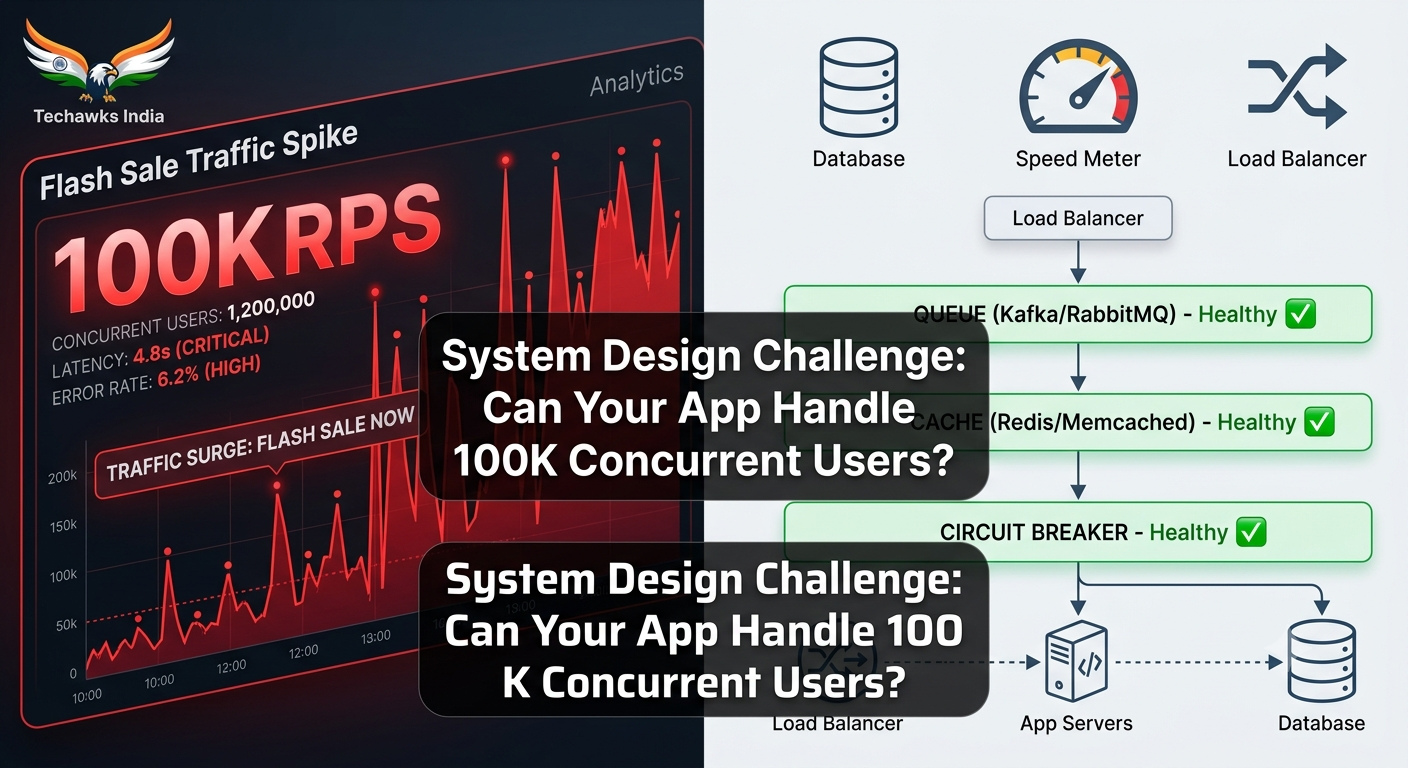
• The System Design Challenge: Can Your App Handle 100K Concurrent Requests During a Peak Flash Sale?
    Surging traffic spikes—common during festival sales, match-day streaming, or viral product launches—test the limits of software architecture. Here is your challenge: evaluate your application stack against this 4-tier stress test to see where your infrastructure breaks first.


    The Challenge Scenario
    Traffic Spike: Normal load is 1,000 requests/sec. Within 10 seconds, traffic surges 100x to 100,000 requests/sec, with 80% of users attempting write operations (e.g., checkout or ticket reservation) simultaneously.
    Evaluate Your Architecture:


    Level 1: The Database Bottleneck
    The Test: Does every incoming request hit your primary relational database directly?
    🛑 Fail: Direct DB writes cause lock contention, connection pool exhaustion, and cascading 504 gateway timeouts.
    🛠️ The Fix: Implement an asynchronous message queue (e.g., Apache Kafka or RabbitMQ) to buffer incoming orders, and use Redis for read-heavy caching.


    Level 2: API Gateway & Rate Limiting
    The Test: What happens when bots or malicious scripts spam your checkout endpoint?
    🛑 Fail: All traffic reaches your application logic, consuming compute resources and starving legitimate users.
    🛠️ The Fix: Enforce token-bucket or leaky-bucket rate limiting at your API Gateway (or CDN edge) based on user ID and IP address.


    Level 3: Session & Cache Management
    The Test: How does your caching layer handle sudden cache invalidation (the "Thundering Herd" problem)?
    🛑 Fail: Expired cache keys cause thousands of concurrent worker threads to query the database simultaneously for the exact same data.
    🛠️ The Fix: Implement mutex locking (like Redis Distributed Locks) or probabilistic early expiration to recompute cached data safely.


    Level 4: Graceful Degradation
    The Test: When downstream microservices fail, does the whole application go down?
    🛑 Fail: Non-critical service outages (e.g., recommendation engine, analytics) crash the main payment flow.
    🛠️ The Fix: Use Circuit Breakers (e.g., Resilience4j) to automatically bypass secondary services and serve fallback UI states.


    Key Takeaways
    Decouple writes from processing: Never force a database to process synchronous spikes; queue incoming workloads to smooth out load curves.
    Protect the core path: Gateways and circuit breakers exist to shield core checkout/booking functionality from secondary system failures.
    Design for failure: System resilience isn't avoiding traffic spikes—it's controlling how your application degrades when overloaded.


    CTA
    🇮🇳 How did your architecture score on the scale test? Drop your system design fixes and strategies in the comments! For more hands-on engineering challenges, tech breakdowns, and developer discussions, join Techawks India.


    👉 [Join Techawks India]
    The System Design Challenge: Can Your App Handle 100K Concurrent Requests During a Peak Flash Sale? Surging traffic spikes—common during festival sales, match-day streaming, or viral product launches—test the limits of software architecture. Here is your challenge: evaluate your application stack against this 4-tier stress test to see where your infrastructure breaks first. The Challenge Scenario Traffic Spike: Normal load is 1,000 requests/sec. Within 10 seconds, traffic surges 100x to 100,000 requests/sec, with 80% of users attempting write operations (e.g., checkout or ticket reservation) simultaneously. Evaluate Your Architecture: Level 1: The Database Bottleneck The Test: Does every incoming request hit your primary relational database directly? 🛑 Fail: Direct DB writes cause lock contention, connection pool exhaustion, and cascading 504 gateway timeouts. 🛠️ The Fix: Implement an asynchronous message queue (e.g., Apache Kafka or RabbitMQ) to buffer incoming orders, and use Redis for read-heavy caching. Level 2: API Gateway & Rate Limiting The Test: What happens when bots or malicious scripts spam your checkout endpoint? 🛑 Fail: All traffic reaches your application logic, consuming compute resources and starving legitimate users. 🛠️ The Fix: Enforce token-bucket or leaky-bucket rate limiting at your API Gateway (or CDN edge) based on user ID and IP address. Level 3: Session & Cache Management The Test: How does your caching layer handle sudden cache invalidation (the "Thundering Herd" problem)? 🛑 Fail: Expired cache keys cause thousands of concurrent worker threads to query the database simultaneously for the exact same data. 🛠️ The Fix: Implement mutex locking (like Redis Distributed Locks) or probabilistic early expiration to recompute cached data safely. Level 4: Graceful Degradation The Test: When downstream microservices fail, does the whole application go down? 🛑 Fail: Non-critical service outages (e.g., recommendation engine, analytics) crash the main payment flow. 🛠️ The Fix: Use Circuit Breakers (e.g., Resilience4j) to automatically bypass secondary services and serve fallback UI states. Key Takeaways Decouple writes from processing: Never force a database to process synchronous spikes; queue incoming workloads to smooth out load curves. Protect the core path: Gateways and circuit breakers exist to shield core checkout/booking functionality from secondary system failures. Design for failure: System resilience isn't avoiding traffic spikes—it's controlling how your application degrades when overloaded. CTA 🇮🇳 How did your architecture score on the scale test? Drop your system design fixes and strategies in the comments! For more hands-on engineering challenges, tech breakdowns, and developer discussions, join Techawks India. 👉 [Join Techawks India]
    0 Commentarios 0 Acciones 1K Views 0 Vista previa
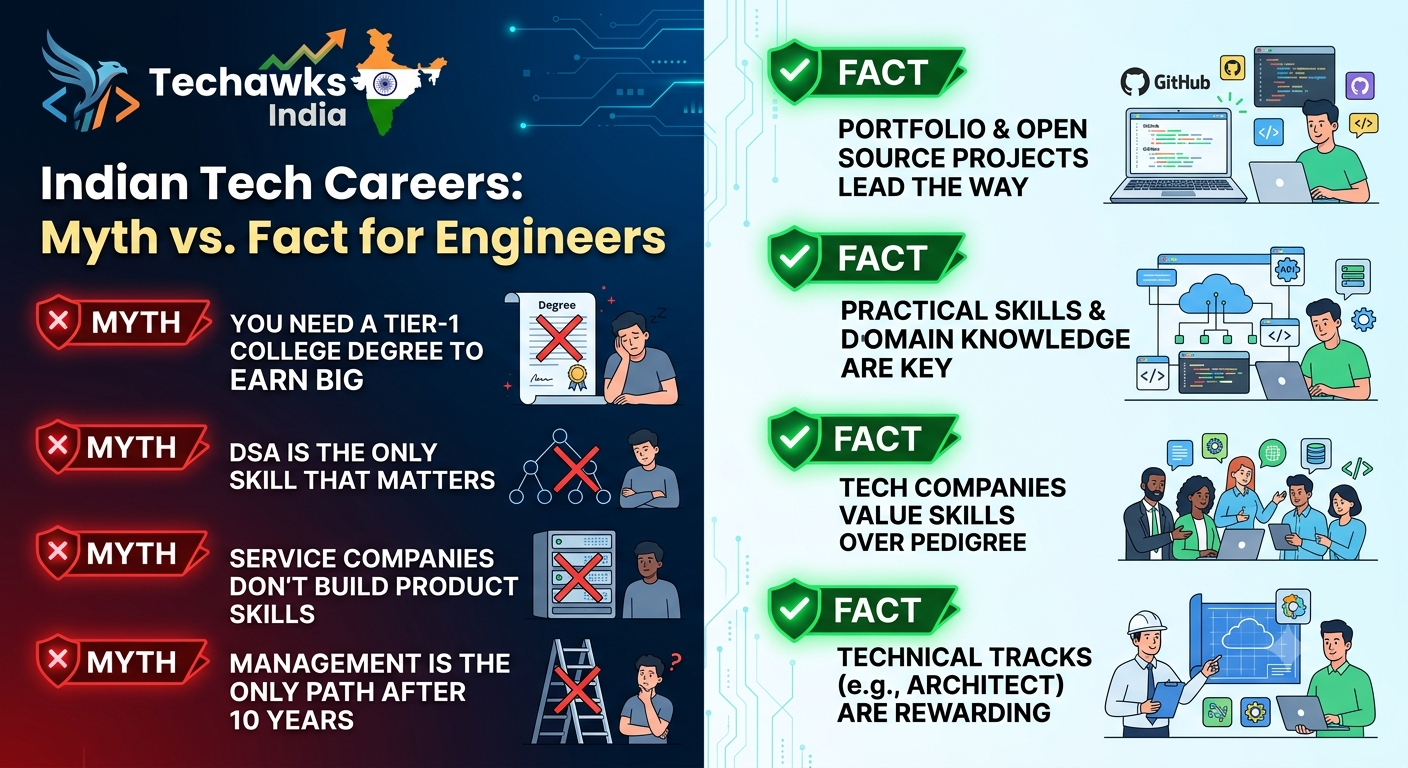
  • Myth vs. Fact: 4 Tech Career Myths Holding Indian Developers Back
    Navigating the Indian tech industry can feel overwhelming with all the conflicting advice on LinkedIn and YouTube. To build a sustainable, high-growth engineering career, you need to separate outdated norms from real-world hiring standards.


    Here are four common myths that hold talented Indian engineers back:


    Myth 1: Competitive Programming (DSA) is All That Matters for Product Companies
    ❌ Myth: Grinding 1,000+ LeetCode problems is the only way to get hired by top product firms and startups in India.
    ✅ Fact: While Data Structures & Algorithms get you through the initial screening, practical system design, clean coding standards, and real-world project execution determine whether you clear system design rounds or land senior roles.
    Actionable Advice: Balance your preparation—spend 40% of your time on problem-solving fundamentals and 60% building production-ready projects with proper logging, testing, and containerization.


    Myth 2: Service-to-Product Company Switching is Impossible
    ❌ Myth: If you start your career in an IT services firm, product-based companies and high-growth startups will automatically reject your resume.
    ✅ Fact: Product companies care about individual capability, system ownership, and domain depth—not your previous employer's business model.
    Actionable Advice: Highlight core engineering outcomes on your resume. Document open-source contributions, build high-concurrency side projects, and showcase public proof of work on GitHub or tech blogs.


    Myth 3: Moving to Management is the Only Way to Scale Salary in India
    ❌ Myth: You must transition into Engineering Manager or Project Manager roles by age 30 to earn a top-tier compensation package.
    ✅ Fact: The Indian tech ecosystem has matured. Individual Contributor (IC) tracks—such as Staff Engineer, Principal Architect, and Specialist—offer equal or higher compensation without requiring people management.
    Actionable Advice: Focus on deepening your domain expertise (e.g., Cloud Architecture, Distributed Systems, AI Infrastructure) if you prefer technical depth over administrative management.


    Myth 4: Notice Periods of 90 Days Render You Unhireable
    ❌ Myth: Having a standard 90-day notice period in India means product startups will never consider your application.
    ✅ Fact: While startups prefer fast joiners, strong candidate evaluations frequently lead companies to buy out notice periods or wait for exceptional talent.
    Actionable Advice: Be upfront during HR screens, keep your technical skills sharp to negotiate buyout terms, and use the last 30 days of your notice period to aggressively interview once your availability is immediate.


    Key Takeaways
    Proof over prestige: Practical project execution and system design skills matter far more than college pedigree or previous company brand.
    Technical depth pays: You don't have to abandon hands-on coding to achieve senior-level compensation in India.
    Control your narrative: Build a public tech presence (GitHub, technical writing) to stand out regardless of your notice period or current company background.


    CTA
    🇮🇳 Ready to cut through the noise and elevate your engineering career? Join the Techawks India community to connect with fellow developers, access system design guides, and attend local tech discussions!


    👉 [Join Techawks India]
    Myth vs. Fact: 4 Tech Career Myths Holding Indian Developers Back Navigating the Indian tech industry can feel overwhelming with all the conflicting advice on LinkedIn and YouTube. To build a sustainable, high-growth engineering career, you need to separate outdated norms from real-world hiring standards. Here are four common myths that hold talented Indian engineers back: Myth 1: Competitive Programming (DSA) is All That Matters for Product Companies ❌ Myth: Grinding 1,000+ LeetCode problems is the only way to get hired by top product firms and startups in India. ✅ Fact: While Data Structures & Algorithms get you through the initial screening, practical system design, clean coding standards, and real-world project execution determine whether you clear system design rounds or land senior roles. Actionable Advice: Balance your preparation—spend 40% of your time on problem-solving fundamentals and 60% building production-ready projects with proper logging, testing, and containerization. Myth 2: Service-to-Product Company Switching is Impossible ❌ Myth: If you start your career in an IT services firm, product-based companies and high-growth startups will automatically reject your resume. ✅ Fact: Product companies care about individual capability, system ownership, and domain depth—not your previous employer's business model. Actionable Advice: Highlight core engineering outcomes on your resume. Document open-source contributions, build high-concurrency side projects, and showcase public proof of work on GitHub or tech blogs. Myth 3: Moving to Management is the Only Way to Scale Salary in India ❌ Myth: You must transition into Engineering Manager or Project Manager roles by age 30 to earn a top-tier compensation package. ✅ Fact: The Indian tech ecosystem has matured. Individual Contributor (IC) tracks—such as Staff Engineer, Principal Architect, and Specialist—offer equal or higher compensation without requiring people management. Actionable Advice: Focus on deepening your domain expertise (e.g., Cloud Architecture, Distributed Systems, AI Infrastructure) if you prefer technical depth over administrative management. Myth 4: Notice Periods of 90 Days Render You Unhireable ❌ Myth: Having a standard 90-day notice period in India means product startups will never consider your application. ✅ Fact: While startups prefer fast joiners, strong candidate evaluations frequently lead companies to buy out notice periods or wait for exceptional talent. Actionable Advice: Be upfront during HR screens, keep your technical skills sharp to negotiate buyout terms, and use the last 30 days of your notice period to aggressively interview once your availability is immediate. Key Takeaways Proof over prestige: Practical project execution and system design skills matter far more than college pedigree or previous company brand. Technical depth pays: You don't have to abandon hands-on coding to achieve senior-level compensation in India. Control your narrative: Build a public tech presence (GitHub, technical writing) to stand out regardless of your notice period or current company background. CTA 🇮🇳 Ready to cut through the noise and elevate your engineering career? Join the Techawks India community to connect with fellow developers, access system design guides, and attend local tech discussions! 👉 [Join Techawks India]
    0 Commentarios 0 Acciones 1K Views 0 Vista previa
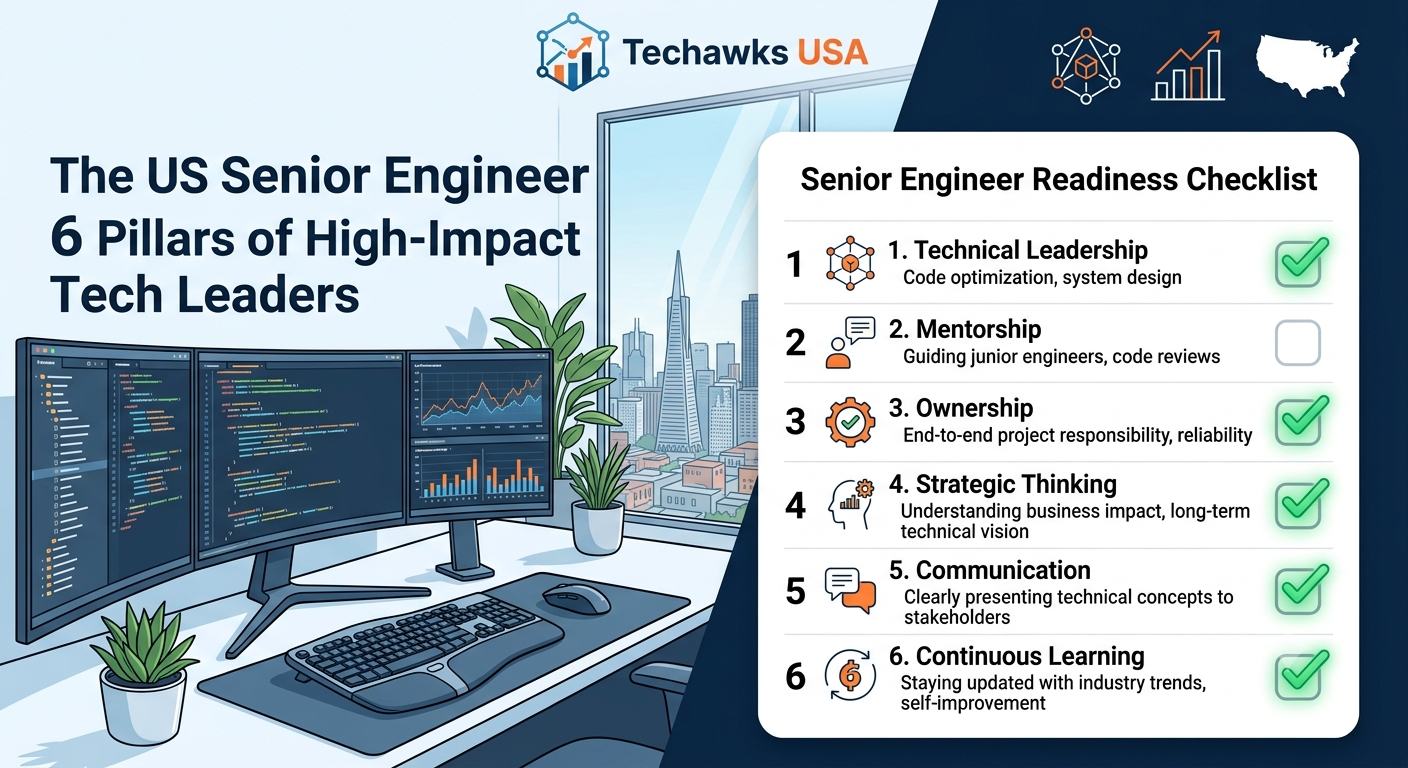
  • The US Senior Engineer Checklist: 6 Things You Must Master to Hit $300k+ TC


    Surpassing the Senior engineering threshold in the US tech ecosystem demands a shift from execution to influence. Use this checklist to evaluate your technical and architectural maturity.


    1. System Design & Architectural Ownership
    RFC / Design Doc Mastery: Author comprehensive Request for Comments (RFCs) that outline trade-offs, capacity planning, and failure modes before writing code.
    Cost-Aware Architecture: Calculate the infrastructure and cloud dollar cost of your system designs (compute, storage, data egress) before proposing them.
    Backward Compatibility: Ensure API changes and database migrations zero-downtime deploy across distributed systems.


    2. Production Readiness & Observability
    SLOs & SLAs: Define clear Service Level Objectives (SLOs) and Service Level Indicators (SLIs) for every microservice you own.
    On-Call Playbooks: Maintain detailed runbooks so any engineer on call can remediate incidents without escalating to you.
    Post-Mortem Culture: Drive blameless post-mortems focused on root-cause prevention rather than surface-level quick fixes.


    3. Cross-Functional Business Impact
    Product Alignment: Translate business metrics (CAC, LTV, churn) into technical key performance indicators (latency, throughput, uptime).
    Stakeholder Management: Explain technical debt and architectural investments in financial and business risk terms to non-technical leaders.


    4. Engineering Velocity & Automation
    CI/CD Optimization: Maintain pipeline build/test speeds so feature branches merge and deploy seamlessly.
    Shift-Left Security: Integrate automated SAST/DAST tools and dependency scanners into early developer workflows.


    5. Mentorship & Team Multiplication
    Code Review Rigor: Provide constructive, high-signal feedback that elevates junior developers without blocking PR velocity.
    Unblocking Others: Actively identify architectural bottlenecks across adjacent engineering pods and help solve them.


    6. Personal Brand & Internal Visibility
    Impact Documentation: Keep a running "Brag Document" tracking project metrics, architectural wins, and revenue impact for performance reviews.


    Technical Sharing: Present internal tech talks or author engineering blog posts highlighting technical wins.


    Key Takeaways
    Influence over execution: Senior-plus roles are defined by multiplying the impact of surrounding engineers, not just solo output.
    Architecture is business strategy: High earners in the US tech market evaluate cloud costs, reliability risks, and velocity trade-offs upfront.
    Document your impact: Quantifying technical wins in business terms is essential for promotions and high-tier compensation negotiations.


    CTA
    🇺🇸 Looking to scale your engineering leadership, master system design, and navigate the US tech industry? Join the Techawks USA community for architecture breakdowns, career strategy guides, and high-signal developer networking!


    👉 [Join Techawks USA]
    The US Senior Engineer Checklist: 6 Things You Must Master to Hit $300k+ TC Surpassing the Senior engineering threshold in the US tech ecosystem demands a shift from execution to influence. Use this checklist to evaluate your technical and architectural maturity. 1. System Design & Architectural Ownership RFC / Design Doc Mastery: Author comprehensive Request for Comments (RFCs) that outline trade-offs, capacity planning, and failure modes before writing code. Cost-Aware Architecture: Calculate the infrastructure and cloud dollar cost of your system designs (compute, storage, data egress) before proposing them. Backward Compatibility: Ensure API changes and database migrations zero-downtime deploy across distributed systems. 2. Production Readiness & Observability SLOs & SLAs: Define clear Service Level Objectives (SLOs) and Service Level Indicators (SLIs) for every microservice you own. On-Call Playbooks: Maintain detailed runbooks so any engineer on call can remediate incidents without escalating to you. Post-Mortem Culture: Drive blameless post-mortems focused on root-cause prevention rather than surface-level quick fixes. 3. Cross-Functional Business Impact Product Alignment: Translate business metrics (CAC, LTV, churn) into technical key performance indicators (latency, throughput, uptime). Stakeholder Management: Explain technical debt and architectural investments in financial and business risk terms to non-technical leaders. 4. Engineering Velocity & Automation CI/CD Optimization: Maintain pipeline build/test speeds so feature branches merge and deploy seamlessly. Shift-Left Security: Integrate automated SAST/DAST tools and dependency scanners into early developer workflows. 5. Mentorship & Team Multiplication Code Review Rigor: Provide constructive, high-signal feedback that elevates junior developers without blocking PR velocity. Unblocking Others: Actively identify architectural bottlenecks across adjacent engineering pods and help solve them. 6. Personal Brand & Internal Visibility Impact Documentation: Keep a running "Brag Document" tracking project metrics, architectural wins, and revenue impact for performance reviews. Technical Sharing: Present internal tech talks or author engineering blog posts highlighting technical wins. Key Takeaways Influence over execution: Senior-plus roles are defined by multiplying the impact of surrounding engineers, not just solo output. Architecture is business strategy: High earners in the US tech market evaluate cloud costs, reliability risks, and velocity trade-offs upfront. Document your impact: Quantifying technical wins in business terms is essential for promotions and high-tier compensation negotiations. CTA 🇺🇸 Looking to scale your engineering leadership, master system design, and navigate the US tech industry? Join the Techawks USA community for architecture breakdowns, career strategy guides, and high-signal developer networking! 👉 [Join Techawks USA]
    0 Commentarios 0 Acciones 1K Views 0 Vista previa
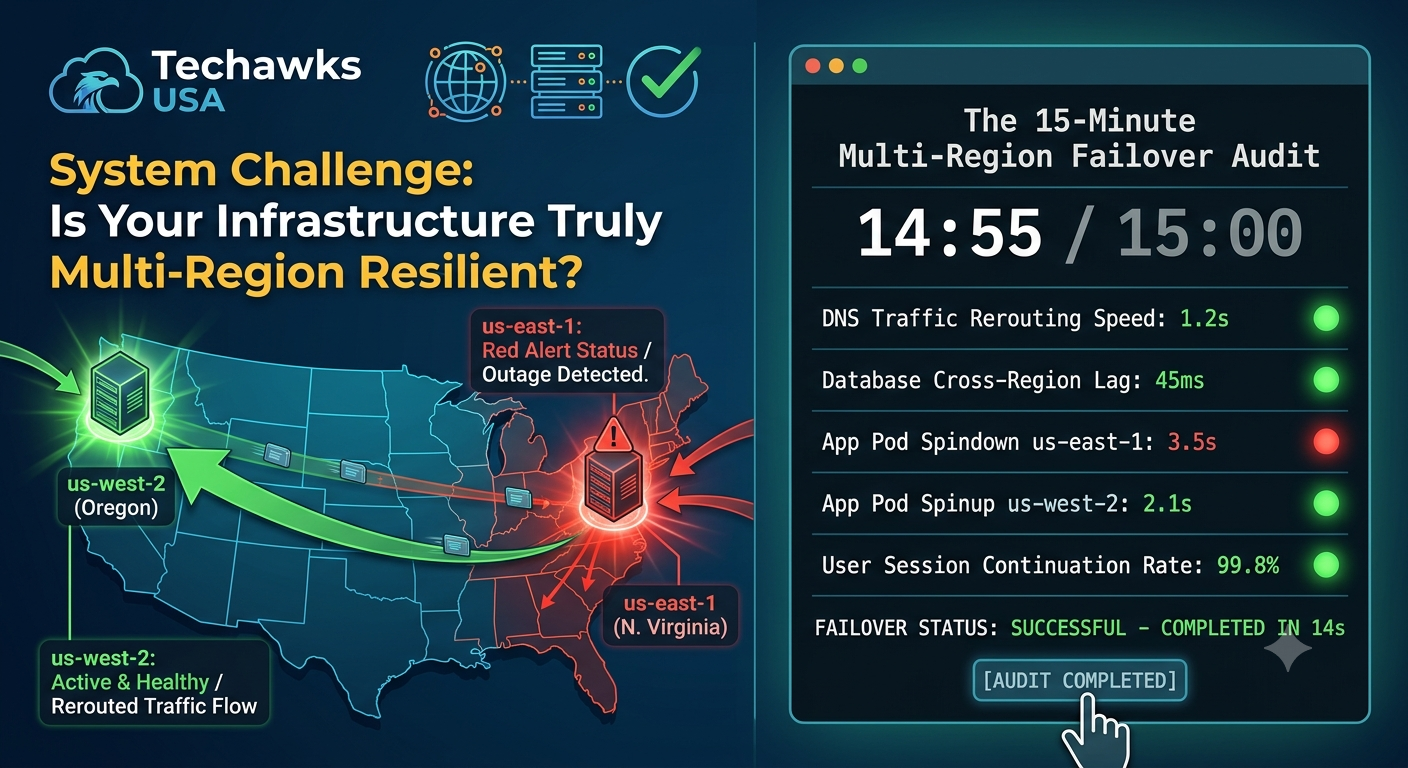
  • The System Architecture Challenge: Can Your Infrastructure Handle a Region-Wide Outage?


    True high availability requires active multi-region or automated cross-region failover design. Take this non-destructive architectural audit to see where your infrastructure breaks when a primary cloud region goes dark.


    The Challenge Scenario
    Condition: Your primary US region (us-east-1) experiences a complete networking black hole. Global DNS routes all traffic to your secondary region (us-west-2).


    Score Your Multi-Region Readiness:
    Level 1: Data Replication & Consistency
    The Test: How are your primary databases configured across regions?
    🛑 Fail: You rely on manual snapshot restores or single-region primary databases, causing hours of downtime and data loss.
    🛠️ The Fix: Implement cross-region asynchronous read replicas with automated failover promotion (e.g., AWS Aurora Global Database or CockroachDB multi-region clusters).


    Level 2: Global Traffic Management
    The Test: How quickly does your DNS/routing layer detect region failure and reroute live traffic?
    🛑 Fail: High DNS Time-To-Live (TTL) values force client devices to cache stale, unreachable IP addresses for 15+ minutes.
    🛠️ The Fix: Use health-checked Anycast DNS or Global Accelerator endpoints with low TTLs (<60 seconds) for automatic traffic steering.


    Level 3: State & Cache Synchronization
    The Test: What happens to active user sessions and cached tokens during failover?
    🛑 Fail: User sessions drop completely, forcing every active user to log in again and overloading downstream authentication services.
    🛠️ The Fix: Use globally distributed session stores (like Redis Enterprise with Active-Active replication) or stateless JWT-based authentication.


    Level 4: Cross-Region Secrets & Config Sync
    The Test: Are environment secrets and feature flags identical and instantly readable in the secondary region?
    🛑 Fail: Secondary app pods crash on boot because secrets or API keys are missing or out of sync.
    🛠️ The Fix: Enforce Infrastructure-as-Code (Terraform/Pulumi) to deploy identical configurations and replicate secrets cross-region via secret management tools.


    Key Takeaways
    Failover must be automated: Manual DNS switches or manual DB promotions during an outage add unnecessary recovery time.
    Watch out for data replication lag: Always design write paths to handle temporary async replication delays between US coasts.
    Treat infrastructure as code: Identical deployment templates across regions are the only way to prevent silent configuration drift.


    CTA
    🇺🇸 How did your system architecture score on the multi-region resilience test? Drop your failover strategies and toolstacks in the comments below! For more hands-on system design challenges, cloud architecture guides, and tech leadership insights, join Techawks USA.


    👉 [Join Techawks USA]
    The System Architecture Challenge: Can Your Infrastructure Handle a Region-Wide Outage? True high availability requires active multi-region or automated cross-region failover design. Take this non-destructive architectural audit to see where your infrastructure breaks when a primary cloud region goes dark. The Challenge Scenario Condition: Your primary US region (us-east-1) experiences a complete networking black hole. Global DNS routes all traffic to your secondary region (us-west-2). Score Your Multi-Region Readiness: Level 1: Data Replication & Consistency The Test: How are your primary databases configured across regions? 🛑 Fail: You rely on manual snapshot restores or single-region primary databases, causing hours of downtime and data loss. 🛠️ The Fix: Implement cross-region asynchronous read replicas with automated failover promotion (e.g., AWS Aurora Global Database or CockroachDB multi-region clusters). Level 2: Global Traffic Management The Test: How quickly does your DNS/routing layer detect region failure and reroute live traffic? 🛑 Fail: High DNS Time-To-Live (TTL) values force client devices to cache stale, unreachable IP addresses for 15+ minutes. 🛠️ The Fix: Use health-checked Anycast DNS or Global Accelerator endpoints with low TTLs (<60 seconds) for automatic traffic steering. Level 3: State & Cache Synchronization The Test: What happens to active user sessions and cached tokens during failover? 🛑 Fail: User sessions drop completely, forcing every active user to log in again and overloading downstream authentication services. 🛠️ The Fix: Use globally distributed session stores (like Redis Enterprise with Active-Active replication) or stateless JWT-based authentication. Level 4: Cross-Region Secrets & Config Sync The Test: Are environment secrets and feature flags identical and instantly readable in the secondary region? 🛑 Fail: Secondary app pods crash on boot because secrets or API keys are missing or out of sync. 🛠️ The Fix: Enforce Infrastructure-as-Code (Terraform/Pulumi) to deploy identical configurations and replicate secrets cross-region via secret management tools. Key Takeaways Failover must be automated: Manual DNS switches or manual DB promotions during an outage add unnecessary recovery time. Watch out for data replication lag: Always design write paths to handle temporary async replication delays between US coasts. Treat infrastructure as code: Identical deployment templates across regions are the only way to prevent silent configuration drift. CTA 🇺🇸 How did your system architecture score on the multi-region resilience test? Drop your failover strategies and toolstacks in the comments below! For more hands-on system design challenges, cloud architecture guides, and tech leadership insights, join Techawks USA. 👉 [Join Techawks USA]
    0 Commentarios 0 Acciones 1K Views 0 Vista previa
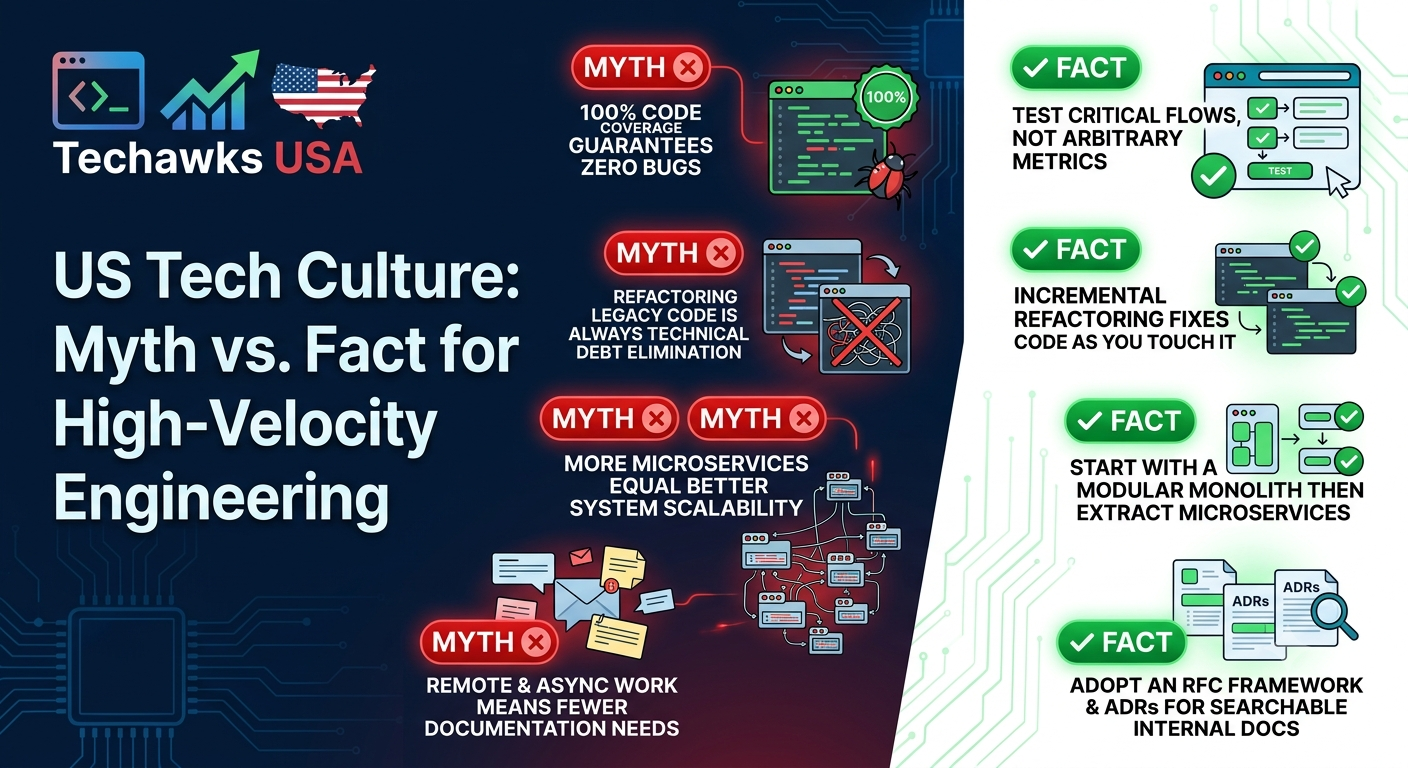
  • Myth vs. Fact: 4 Tech Culture Myths Diluting US Engineering Velocity


    Building scalable software in the US market requires navigating high expectations for speed, compliance, and reliability. To maintain competitive velocity, engineering teams must separate popular tech folklore from battle-tested operational realities.


    Here are four common myths that slow down high-performing engineering teams:


    Myth 1: 100% Code Coverage Guarantees Zero Production Bugs
    ❌ Myth: Striving for 100% unit test coverage in CI/CD pipelines ensures your application won't fail in production.
    ✅ Fact: Unit tests validate isolated code paths, not complex integration points, race conditions, or third-party service failures. High coverage often incentivizes low-quality, trivial assertions just to pass metrics.
    Actionable Advice: Target high-value integration and end-to-end (E2E) tests for critical user flows (e.g., checkout, authentication) instead of chasing arbitrary coverage percentages.


    Myth 2: Refactoring Legacy Code is Always Technical Debt Elimination
    ❌ Myth: Rewriting legacy systems into modern frameworks or microservices always improves overall system health.
    ✅ Fact: Unplanned full rewrites frequently introduce new edge-case bugs and burn engineering quarters without adding direct business value.
    Actionable Advice: Practice incremental refactoring (the Strangler Fig pattern) rather than complete rewrites. Fix code as you touch it for new feature work, and measure refactoring impact against concrete performance metrics.


    Myth 3: More Microservices Equal Better System Scalability
    ❌ Myth: Decomposing every application domain into an independent microservice is the gold standard for high-scale architecture.
    ✅ Fact: Over-splitting domains creates massive operational overhead, complex network latency, and distributed tracing nightmares—often solving scale problems you don't actually have yet.
    Actionable Advice: Start with a modular monolith with clear domain boundaries. Only extract independent microservices when individual component scale or team autonomy strictly demands it.


    Myth 4: Remote & Async Work Means Fewer Documentation Needs
    ❌ Myth: Distributed teams can replace formal documentation with quick Slack messages and ad-hoc Zoom huddles.
    ✅ Fact: Lack of structured, searchable documentation leads to knowledge silos, onboarding friction, and technical decision drift across time zones.
    Actionable Advice: Adopt an RFC (Request for Comments) framework for architectural changes, enforce PR template requirements, and treat internal docs as first-class engineering deliverables.


    Key Takeaways
    Quality over metrics: Meaningful integration tests and real-world observability trump vanity code coverage statistics.
    Evolution over revolution: Incremental refactoring and modular architectures keep delivery velocity predictable while reducing operational risk.
    Documentation is leverage: Asynchronous engineering culture relies on searchable architectural decision records (ADRs) to scale efficiently across distributed US teams.


    CTA
    🇺🇸 Ready to optimize your team's engineering velocity and master modern system design? Join the Techawks USA community to connect with senior engineers, access architecture guides, and join high-signal technical discussions!


    👉 [Join Techawks USA]
    Myth vs. Fact: 4 Tech Culture Myths Diluting US Engineering Velocity Building scalable software in the US market requires navigating high expectations for speed, compliance, and reliability. To maintain competitive velocity, engineering teams must separate popular tech folklore from battle-tested operational realities. Here are four common myths that slow down high-performing engineering teams: Myth 1: 100% Code Coverage Guarantees Zero Production Bugs ❌ Myth: Striving for 100% unit test coverage in CI/CD pipelines ensures your application won't fail in production. ✅ Fact: Unit tests validate isolated code paths, not complex integration points, race conditions, or third-party service failures. High coverage often incentivizes low-quality, trivial assertions just to pass metrics. Actionable Advice: Target high-value integration and end-to-end (E2E) tests for critical user flows (e.g., checkout, authentication) instead of chasing arbitrary coverage percentages. Myth 2: Refactoring Legacy Code is Always Technical Debt Elimination ❌ Myth: Rewriting legacy systems into modern frameworks or microservices always improves overall system health. ✅ Fact: Unplanned full rewrites frequently introduce new edge-case bugs and burn engineering quarters without adding direct business value. Actionable Advice: Practice incremental refactoring (the Strangler Fig pattern) rather than complete rewrites. Fix code as you touch it for new feature work, and measure refactoring impact against concrete performance metrics. Myth 3: More Microservices Equal Better System Scalability ❌ Myth: Decomposing every application domain into an independent microservice is the gold standard for high-scale architecture. ✅ Fact: Over-splitting domains creates massive operational overhead, complex network latency, and distributed tracing nightmares—often solving scale problems you don't actually have yet. Actionable Advice: Start with a modular monolith with clear domain boundaries. Only extract independent microservices when individual component scale or team autonomy strictly demands it. Myth 4: Remote & Async Work Means Fewer Documentation Needs ❌ Myth: Distributed teams can replace formal documentation with quick Slack messages and ad-hoc Zoom huddles. ✅ Fact: Lack of structured, searchable documentation leads to knowledge silos, onboarding friction, and technical decision drift across time zones. Actionable Advice: Adopt an RFC (Request for Comments) framework for architectural changes, enforce PR template requirements, and treat internal docs as first-class engineering deliverables. Key Takeaways Quality over metrics: Meaningful integration tests and real-world observability trump vanity code coverage statistics. Evolution over revolution: Incremental refactoring and modular architectures keep delivery velocity predictable while reducing operational risk. Documentation is leverage: Asynchronous engineering culture relies on searchable architectural decision records (ADRs) to scale efficiently across distributed US teams. CTA 🇺🇸 Ready to optimize your team's engineering velocity and master modern system design? Join the Techawks USA community to connect with senior engineers, access architecture guides, and join high-signal technical discussions! 👉 [Join Techawks USA]
    0 Commentarios 0 Acciones 1K Views 0 Vista previa
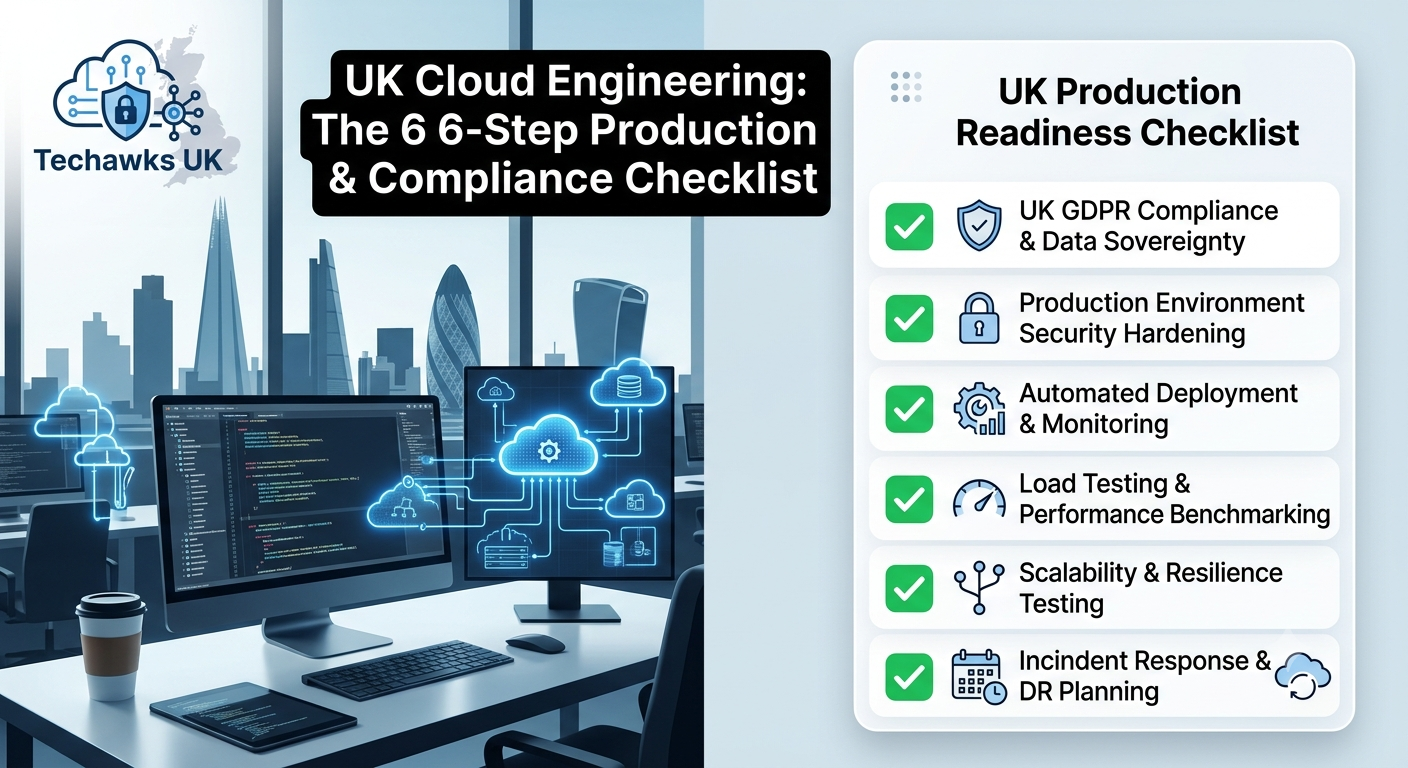
  • The UK Engineering Lead Checklist: 6 Steps to Build GDPR-Compliant, Production-Ready Cloud Systems


    Building resilient, high-performing software for the UK market requires aligning modern cloud architecture with strict data governance standards. Use this checklist to audit your technical stack and team workflows.


    1. Data Governance & UK GDPR Compliance
    Data Residency: Ensure customer PII (Personally Identifiable Information) resides in UK cloud regions (e.g., eu-west-2 London) unless explicit cross-border transfer mechanisms are in place.
    Right to be Forgotten (Data Erasure): Automate data deletion pipelines across both primary relational databases and distributed log streams/backups.
    Data Minimization: Enforce strict schema validation to store only essential user data required for core product functionality.


    2. Security & Access Control
    Zero-Trust Access (RBAC): Restrict developer access to production environments using Role-Based Access Control and time-bound privilege elevation.
    Encryption at Rest & in Transit: Mandate TLS 1.3 for all microservice communication and AES-256 for underlying storage volumes and database snapshots.
    Key Management: Store encryption keys in local region key management services (e.g., AWS KMS or Azure Key Vault in London).


    3. Resilience & Disaster Recovery
    Multi-Availability Zone Redundancy: Deploy application instances and database replicas across at least 3 distinct UK Availability Zones (AZs).
    RTO & RPO Targets: Formally define Recovery Time Objectives (RTO < 15 mins) and Recovery Point Objectives (RPO < 1 min) for critical workloads.


    4. Observability & Audit Trails
    Immutable Audit Logging: Maintain tamper-proof audit trails for administrative actions, access requests, and privilege escalation events.
    PII Scrubbing in Logs: Configure logging agents (e.g., FluentBit, Datadog) to automatically redact email addresses, tokens, and IP addresses before shipping to centralized log sinks.


    5. Sustainable Cloud Operations (Green Ops)
    [ ] Carbon-Aware Workloads: Schedule non-urgent background batch jobs during off-peak hours when the UK National Grid carbon intensity is lowest.
    [ ] Resource Optimization: Scale down non-production environments automatically outside UK business hours (7:00 PM – 7:00 AM BST/GMT).


    6. Incident Response & Reporting
    Breach Notification Protocol: Maintain an automated incident workflow capable of identifying data breaches and notifying compliance officers well within the statutory 72-hour window.
    Blameless Post-Mortems: Conduct structured incident reviews following operational outages to continuously update runbooks.


    Key Takeaways
    Privacy by design: Compliance isn't a post-launch audit requirement—it must be baked directly into database schemas, cloud regions, and API contracts.
    Observe without over-collecting: Scrubbing sensitive data from application logs protects against accidental security leaks and compliance violations.
    Efficiency meets sustainability: Smart resource scheduling reduces both cloud bills and carbon footprints across UK infrastructure.


    CTA
    🇬🇧 Building scalable, secure, and compliant cloud systems in the UK? Join the Techawks UK community to connect with local engineering leads, explore deep-tech architecture guides, and join technical discussions across the UK tech ecosystem!


    👉 [Join Techawks UK]
    The UK Engineering Lead Checklist: 6 Steps to Build GDPR-Compliant, Production-Ready Cloud Systems Building resilient, high-performing software for the UK market requires aligning modern cloud architecture with strict data governance standards. Use this checklist to audit your technical stack and team workflows. 1. Data Governance & UK GDPR Compliance Data Residency: Ensure customer PII (Personally Identifiable Information) resides in UK cloud regions (e.g., eu-west-2 London) unless explicit cross-border transfer mechanisms are in place. Right to be Forgotten (Data Erasure): Automate data deletion pipelines across both primary relational databases and distributed log streams/backups. Data Minimization: Enforce strict schema validation to store only essential user data required for core product functionality. 2. Security & Access Control Zero-Trust Access (RBAC): Restrict developer access to production environments using Role-Based Access Control and time-bound privilege elevation. Encryption at Rest & in Transit: Mandate TLS 1.3 for all microservice communication and AES-256 for underlying storage volumes and database snapshots. Key Management: Store encryption keys in local region key management services (e.g., AWS KMS or Azure Key Vault in London). 3. Resilience & Disaster Recovery Multi-Availability Zone Redundancy: Deploy application instances and database replicas across at least 3 distinct UK Availability Zones (AZs). RTO & RPO Targets: Formally define Recovery Time Objectives (RTO < 15 mins) and Recovery Point Objectives (RPO < 1 min) for critical workloads. 4. Observability & Audit Trails Immutable Audit Logging: Maintain tamper-proof audit trails for administrative actions, access requests, and privilege escalation events. PII Scrubbing in Logs: Configure logging agents (e.g., FluentBit, Datadog) to automatically redact email addresses, tokens, and IP addresses before shipping to centralized log sinks. 5. Sustainable Cloud Operations (Green Ops) [ ] Carbon-Aware Workloads: Schedule non-urgent background batch jobs during off-peak hours when the UK National Grid carbon intensity is lowest. [ ] Resource Optimization: Scale down non-production environments automatically outside UK business hours (7:00 PM – 7:00 AM BST/GMT). 6. Incident Response & Reporting Breach Notification Protocol: Maintain an automated incident workflow capable of identifying data breaches and notifying compliance officers well within the statutory 72-hour window. Blameless Post-Mortems: Conduct structured incident reviews following operational outages to continuously update runbooks. Key Takeaways Privacy by design: Compliance isn't a post-launch audit requirement—it must be baked directly into database schemas, cloud regions, and API contracts. Observe without over-collecting: Scrubbing sensitive data from application logs protects against accidental security leaks and compliance violations. Efficiency meets sustainability: Smart resource scheduling reduces both cloud bills and carbon footprints across UK infrastructure. CTA 🇬🇧 Building scalable, secure, and compliant cloud systems in the UK? Join the Techawks UK community to connect with local engineering leads, explore deep-tech architecture guides, and join technical discussions across the UK tech ecosystem! 👉 [Join Techawks UK]
    0 Commentarios 0 Acciones 1K Views 0 Vista previa
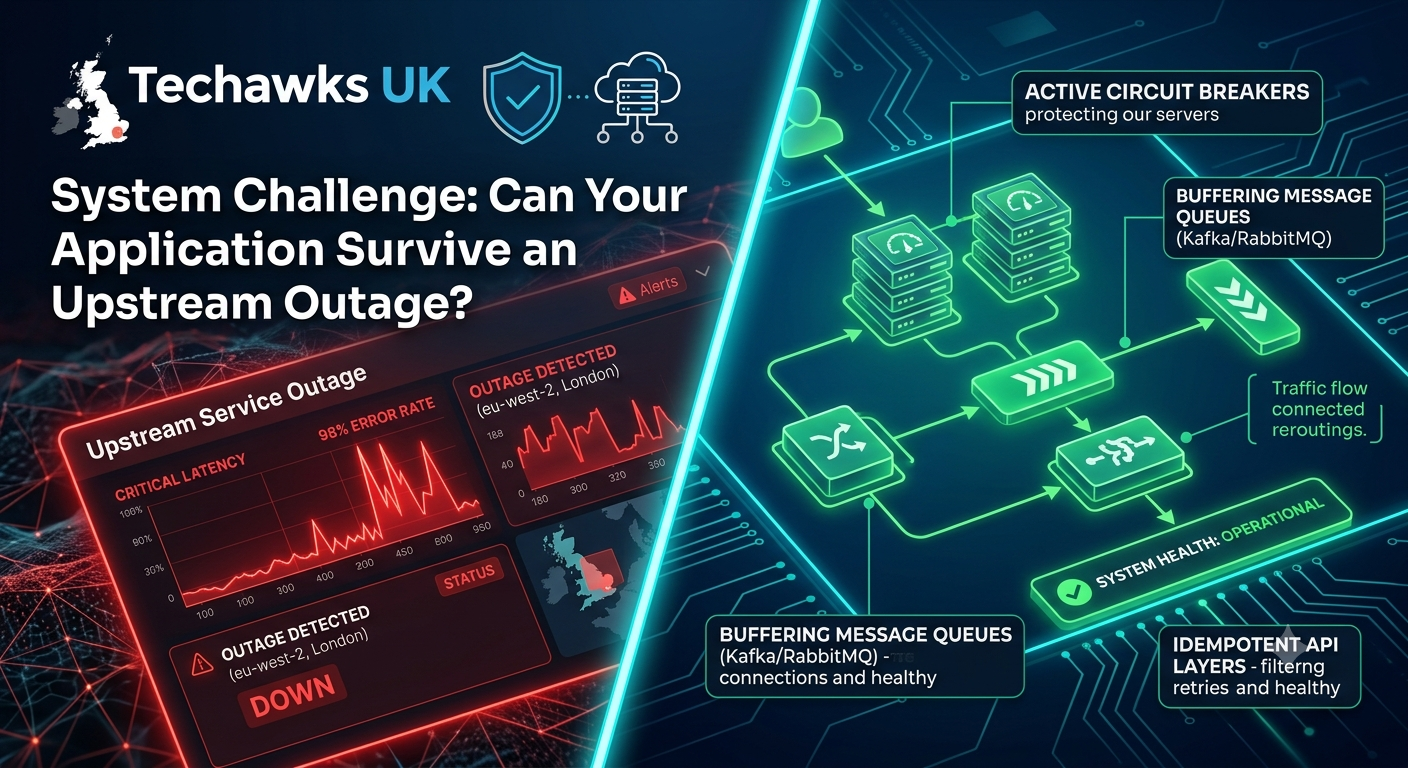
  • The UK Resilience Challenge: Can Your Financial System Survive the Operational Resilience Test?


    With strict standards set by regulators like the FCA and PRA, UK engineering teams must design systems that expect and recover from failure instantly. Put your software architecture through this 4-tier resilience challenge to see where your infrastructure stands.


    The Challenge Scenario
    Scenario: A major upstream banking provider or cloud service provider in the eu-west-2 (London) region experiences a total API outage during peak UK trading/business hours.


    Evaluate Your Architecture:
    Level 1: Graceful Degradation & Fallbacks
    The Test: Does an upstream API outage freeze your entire user interface or payment flow?
    🛑 Fail: Synchronous API calls block client threads, leading to application hangs, high latency, and dropped user requests.
    🛠️ The Fix: Implement asynchronous processing queues and circuit breaker patterns (e.g., using Resilience4j) to fall back to cached states or queued processing mode automatically.


    Level 2: Zero-Downtime Data Synchronization
    The Test: What happens to active database transactions during an availability zone failover?
    🛑 Fail: Uncommitted transactions lead to duplicate charges, corrupted state, or data inconsistencies across microservices.
    🛠️ The Fix: Use the Saga Pattern for distributed transactions combined with idempotency keys on all financial and state-changing API endpoints.


    Level 3: Regulatory Compliance under Outage Conditions
    The Test: Are audit trails and transaction logs preserved if a primary database node crashes mid-operation?
    🛑 Fail: In-flight log buffers in volatile memory are lost, creating gaps in compliance reporting.
    🛠️ The Fix: Stream audit logs asynchronously to write-ahead, multi-AZ persistent storage (e.g., Amazon Kinesis or Managed Kafka) before executing state changes.


    Level 4: Chaos Engineering Readiness
    The Test: Have you actually tested your system by intentionally terminating production container pods or cloud availability zones?
    🛑 Fail: Failover procedures exist only on paper in runbooks and haven't been validated under live traffic.
    🛠️ The Fix: Introduce controlled chaos engineering experiments (e.g., Chaos Mesh or AWS Fault Injection Simulator) in staging/production-like environments quarterly.


    Key Takeaways
    Design for inevitability: Outages will happen; operational resilience measures how seamlessly your system degrades without taking down the core platform.
    Idempotency is mandatory: Safeguard user requests and payments against retry storms using strict idempotency keys across all write endpoints.
    Test chaos in practice: Disaster recovery plans are unproven hypotheses until validated by automated fault injection.


    CTA
    🇬🇧 How did your system architecture score on the resilience test? Share your system design strategies, circuit breaker setups, or chaos engineering practices in the comments below! For more hands-on technical challenges, cloud architecture breakdowns, and UK developer discussions, join Techawks UK.


    👉 [Join Techawks UK]
    The UK Resilience Challenge: Can Your Financial System Survive the Operational Resilience Test? With strict standards set by regulators like the FCA and PRA, UK engineering teams must design systems that expect and recover from failure instantly. Put your software architecture through this 4-tier resilience challenge to see where your infrastructure stands. The Challenge Scenario Scenario: A major upstream banking provider or cloud service provider in the eu-west-2 (London) region experiences a total API outage during peak UK trading/business hours. Evaluate Your Architecture: Level 1: Graceful Degradation & Fallbacks The Test: Does an upstream API outage freeze your entire user interface or payment flow? 🛑 Fail: Synchronous API calls block client threads, leading to application hangs, high latency, and dropped user requests. 🛠️ The Fix: Implement asynchronous processing queues and circuit breaker patterns (e.g., using Resilience4j) to fall back to cached states or queued processing mode automatically. Level 2: Zero-Downtime Data Synchronization The Test: What happens to active database transactions during an availability zone failover? 🛑 Fail: Uncommitted transactions lead to duplicate charges, corrupted state, or data inconsistencies across microservices. 🛠️ The Fix: Use the Saga Pattern for distributed transactions combined with idempotency keys on all financial and state-changing API endpoints. Level 3: Regulatory Compliance under Outage Conditions The Test: Are audit trails and transaction logs preserved if a primary database node crashes mid-operation? 🛑 Fail: In-flight log buffers in volatile memory are lost, creating gaps in compliance reporting. 🛠️ The Fix: Stream audit logs asynchronously to write-ahead, multi-AZ persistent storage (e.g., Amazon Kinesis or Managed Kafka) before executing state changes. Level 4: Chaos Engineering Readiness The Test: Have you actually tested your system by intentionally terminating production container pods or cloud availability zones? 🛑 Fail: Failover procedures exist only on paper in runbooks and haven't been validated under live traffic. 🛠️ The Fix: Introduce controlled chaos engineering experiments (e.g., Chaos Mesh or AWS Fault Injection Simulator) in staging/production-like environments quarterly. Key Takeaways Design for inevitability: Outages will happen; operational resilience measures how seamlessly your system degrades without taking down the core platform. Idempotency is mandatory: Safeguard user requests and payments against retry storms using strict idempotency keys across all write endpoints. Test chaos in practice: Disaster recovery plans are unproven hypotheses until validated by automated fault injection. CTA 🇬🇧 How did your system architecture score on the resilience test? Share your system design strategies, circuit breaker setups, or chaos engineering practices in the comments below! For more hands-on technical challenges, cloud architecture breakdowns, and UK developer discussions, join Techawks UK. 👉 [Join Techawks UK]
    0 Commentarios 0 Acciones 858 Views 0 Vista previa
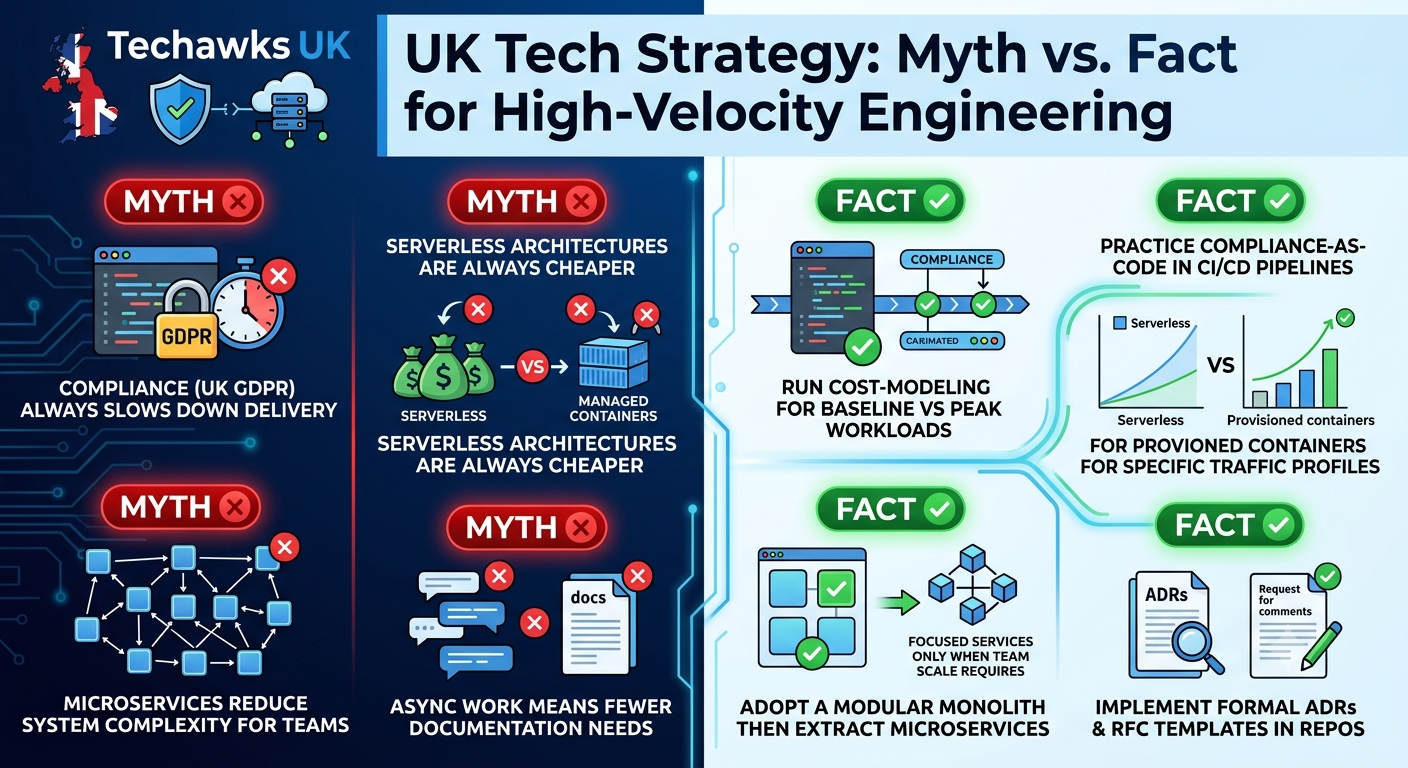
  • Myth vs. Fact: 4 Tech Myths Holding UK Software Teams Back
    Building world-class software in the UK tech ecosystem requires balancing rapid execution with strict regulatory frameworks and modern cloud architecture. To keep your team performing at peak velocity, you need to separate persistent engineering myths from operational reality.


    Here are four common myths impacting UK development teams:


    Myth 1: Compliance (UK GDPR & DORA) is an Afterthought for the Security Team
    ❌ Myth: Developers can build features freely, and compliance/legal teams will audit data privacy and security controls right before release.
    ✅ Fact: Retrofitting data governance, encryption, and audit logging into completed software architectures creates massive engineering bottlenecks and delays releases by weeks.
    Actionable Advice: Practice Compliance-as-Code. Define data classification schemas, field-level encryption, and automated compliance checks directly inside your CI/CD pipelines during initial development.


    Myth 2: Serverless Architectures are Always Cheaper Than Provisioned Containers
    ❌ Myth: Moving microservices entirely to Serverless (e.g., AWS Lambda, Azure Functions) will automatically cut cloud infrastructure costs across all workloads.
    ✅ Fact: While serverless excels for unpredictable or low-volume traffic, steady-state, high-concurrency microservices can quickly become significantly more expensive on pay-per-execution models compared to managed Kubernetes (EKS/AKS) or ECS clusters.
    Actionable Advice: Run cost-modeling calculations for baseline vs. peak workloads. Use Serverless for event-driven processing and API gateways, while keeping core high-throughput microservices on auto-scaling containerized nodes.


    Myth 3: Microservices Reduce System Complexity for Growing Teams
    ❌ Myth: Breaking an application into dozens of small services makes system management and feature development simpler for medium-sized engineering teams.
    ✅ Fact: Without mature platform engineering, microservices shift complexity from application code to operational infrastructure—leading to service sprawl, distributed tracing headaches, and deployment friction.
    Actionable Advice: Adopt a Modular Monolith first with well-defined domain boundaries. Extract individual domains into standalone microservices only when team scale or independent resource deployment strictly requires it.


    Myth 4: Async Work Means Fewer Documentation Standards
    ❌ Myth: Distributed or hybrid teams operating across UK time zones can rely on quick Slack/Teams messages rather than writing structured documentation.
    ✅ Fact: Ad-hoc communication leads to fragmented knowledge, context switching, and architectural decision drift, which slows down developer onboarding.
    Actionable Advice: Implement a formal Architecture Decision Record (ADR) process and RFC templates stored directly in your primary code repositories to track decisions asynchronously.


    Key Takeaways
    Shift security and compliance left: Automating privacy checks early in development prevents release delays and costly structural redesigns.
    Match architecture to workload profile: Don't assume serverless or microservices fit every use case; base infrastructure choices on actual throughput patterns.
    Document for async efficiency: Centralized, repository-backed documentation reduces context switching and empowers remote teams across the UK.


    CTA
    🇬🇧 Looking to streamline your engineering practices and build resilient, compliant cloud systems in the UK? Join the Techawks UK community to connect with senior developers, access technical guides, and lead the conversation!


    👉 [Join Techawks UK]
    Myth vs. Fact: 4 Tech Myths Holding UK Software Teams Back Building world-class software in the UK tech ecosystem requires balancing rapid execution with strict regulatory frameworks and modern cloud architecture. To keep your team performing at peak velocity, you need to separate persistent engineering myths from operational reality. Here are four common myths impacting UK development teams: Myth 1: Compliance (UK GDPR & DORA) is an Afterthought for the Security Team ❌ Myth: Developers can build features freely, and compliance/legal teams will audit data privacy and security controls right before release. ✅ Fact: Retrofitting data governance, encryption, and audit logging into completed software architectures creates massive engineering bottlenecks and delays releases by weeks. Actionable Advice: Practice Compliance-as-Code. Define data classification schemas, field-level encryption, and automated compliance checks directly inside your CI/CD pipelines during initial development. Myth 2: Serverless Architectures are Always Cheaper Than Provisioned Containers ❌ Myth: Moving microservices entirely to Serverless (e.g., AWS Lambda, Azure Functions) will automatically cut cloud infrastructure costs across all workloads. ✅ Fact: While serverless excels for unpredictable or low-volume traffic, steady-state, high-concurrency microservices can quickly become significantly more expensive on pay-per-execution models compared to managed Kubernetes (EKS/AKS) or ECS clusters. Actionable Advice: Run cost-modeling calculations for baseline vs. peak workloads. Use Serverless for event-driven processing and API gateways, while keeping core high-throughput microservices on auto-scaling containerized nodes. Myth 3: Microservices Reduce System Complexity for Growing Teams ❌ Myth: Breaking an application into dozens of small services makes system management and feature development simpler for medium-sized engineering teams. ✅ Fact: Without mature platform engineering, microservices shift complexity from application code to operational infrastructure—leading to service sprawl, distributed tracing headaches, and deployment friction. Actionable Advice: Adopt a Modular Monolith first with well-defined domain boundaries. Extract individual domains into standalone microservices only when team scale or independent resource deployment strictly requires it. Myth 4: Async Work Means Fewer Documentation Standards ❌ Myth: Distributed or hybrid teams operating across UK time zones can rely on quick Slack/Teams messages rather than writing structured documentation. ✅ Fact: Ad-hoc communication leads to fragmented knowledge, context switching, and architectural decision drift, which slows down developer onboarding. Actionable Advice: Implement a formal Architecture Decision Record (ADR) process and RFC templates stored directly in your primary code repositories to track decisions asynchronously. Key Takeaways Shift security and compliance left: Automating privacy checks early in development prevents release delays and costly structural redesigns. Match architecture to workload profile: Don't assume serverless or microservices fit every use case; base infrastructure choices on actual throughput patterns. Document for async efficiency: Centralized, repository-backed documentation reduces context switching and empowers remote teams across the UK. CTA 🇬🇧 Looking to streamline your engineering practices and build resilient, compliant cloud systems in the UK? Join the Techawks UK community to connect with senior developers, access technical guides, and lead the conversation! 👉 [Join Techawks UK]
    0 Commentarios 0 Acciones 779 Views 0 Vista previa
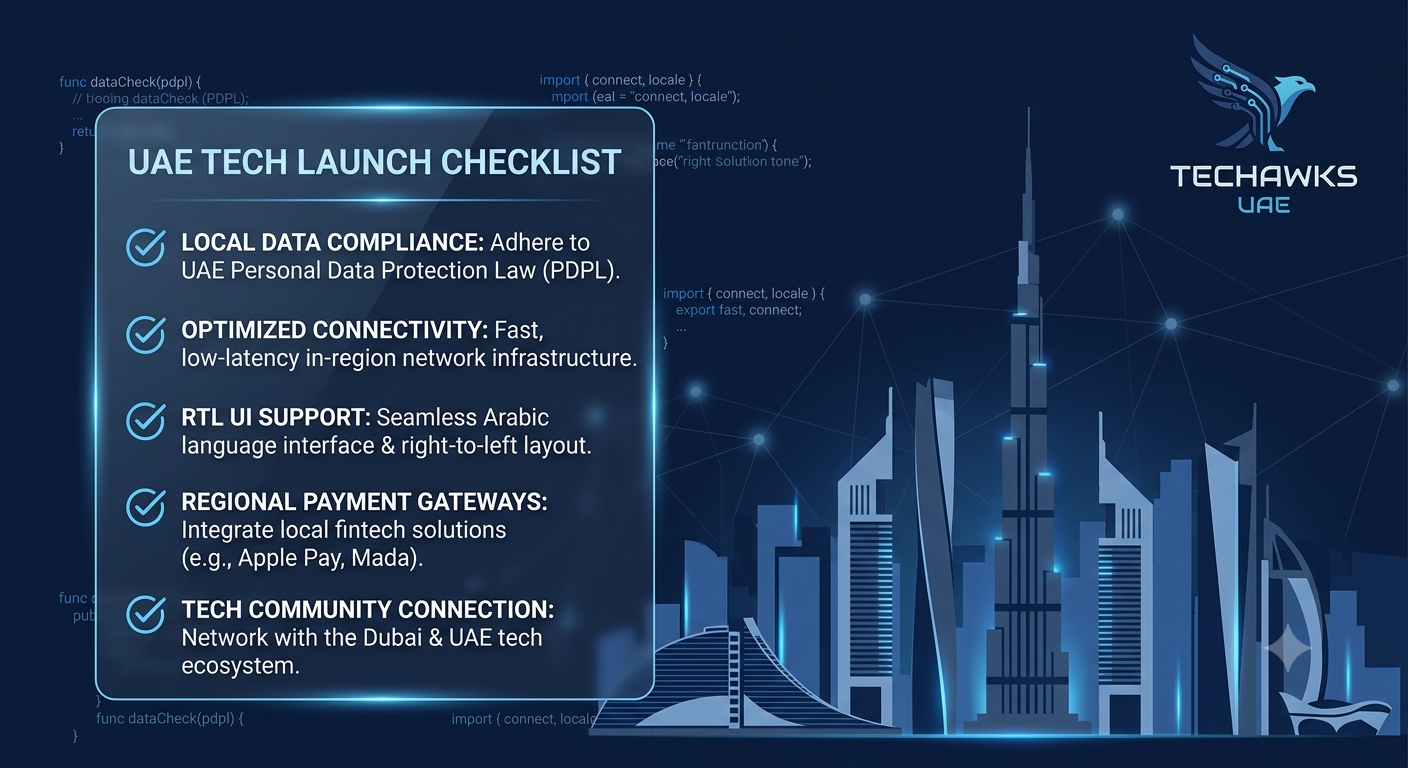
  • The Ultimate UAE Tech Professional’s Onboarding & Setup Checklist
    Setting up for success in the local ecosystem requires balancing technical efficiency with regional compliance. Go through this step-by-step checklist to ensure you haven’t missed a beat:


    1. Data Governance & Legal Compliance
    Review UAE Data Protection Laws: Ensure your data architecture complies with UAE Federal Decree-Law No. 45/2021 regarding Personal Data Protection (PDPL).
    In-Region Hosting: Check if your application handles sensitive user data that requires local data residency (e.g., hosted on AWS me-central-1 in UAE or local Azure regions).


    2. Infrastructure & Connectivity
    VoIP & Collaboration Readiness: Set up business-grade VPNs and communication tools approved for enterprise use in the UAE to keep your remote or hybrid team seamlessly connected.
    Latency Optimization: Configure local Content Delivery Network (CDN) edge locations across Middle East nodes to keep latency low for regional users.


    3. Regionalization & UX
    RTL (Right-to-Left) UI Support: Verify that your web or mobile applications natively support Arabic UI layout rendering without breaking components.
    Local Payment Gateway Integration: Integrate popular regional payment options (e.g., Apple Pay, local debit networks/cards, and Buy-Now-Pay-Later options).


    4. Community & Professional Setup
    Local Tech Licensing & Freelance Permits: Ensure all software, platforms, and professional operations align with local free-zone or mainland tech licensing regulations.
    Networking Integration: Connect with local developer circles and tech communities to stay updated on regional industry standards.


    Key Takeaways
    Compliance First: Architect your systems with local UAE data residency laws in mind right from day one.
    Localization Matters: True regional tech readiness requires proper RTL interface support and local payment solutions.
    Reliable Connectivity: Proactively configure enterprise-ready infrastructure to maintain uninterrupted team workflows.


    CTA
    Building or scaling tech in the Emirates? Join Techawks UAE today to connect with local engineers, founders, and tech professionals driving innovation across the region!
    The Ultimate UAE Tech Professional’s Onboarding & Setup Checklist Setting up for success in the local ecosystem requires balancing technical efficiency with regional compliance. Go through this step-by-step checklist to ensure you haven’t missed a beat: 1. Data Governance & Legal Compliance Review UAE Data Protection Laws: Ensure your data architecture complies with UAE Federal Decree-Law No. 45/2021 regarding Personal Data Protection (PDPL). In-Region Hosting: Check if your application handles sensitive user data that requires local data residency (e.g., hosted on AWS me-central-1 in UAE or local Azure regions). 2. Infrastructure & Connectivity VoIP & Collaboration Readiness: Set up business-grade VPNs and communication tools approved for enterprise use in the UAE to keep your remote or hybrid team seamlessly connected. Latency Optimization: Configure local Content Delivery Network (CDN) edge locations across Middle East nodes to keep latency low for regional users. 3. Regionalization & UX RTL (Right-to-Left) UI Support: Verify that your web or mobile applications natively support Arabic UI layout rendering without breaking components. Local Payment Gateway Integration: Integrate popular regional payment options (e.g., Apple Pay, local debit networks/cards, and Buy-Now-Pay-Later options). 4. Community & Professional Setup Local Tech Licensing & Freelance Permits: Ensure all software, platforms, and professional operations align with local free-zone or mainland tech licensing regulations. Networking Integration: Connect with local developer circles and tech communities to stay updated on regional industry standards. Key Takeaways Compliance First: Architect your systems with local UAE data residency laws in mind right from day one. Localization Matters: True regional tech readiness requires proper RTL interface support and local payment solutions. Reliable Connectivity: Proactively configure enterprise-ready infrastructure to maintain uninterrupted team workflows. CTA Building or scaling tech in the Emirates? Join Techawks UAE today to connect with local engineers, founders, and tech professionals driving innovation across the region!
    0 Commentarios 0 Acciones 1K Views 0 Vista previa
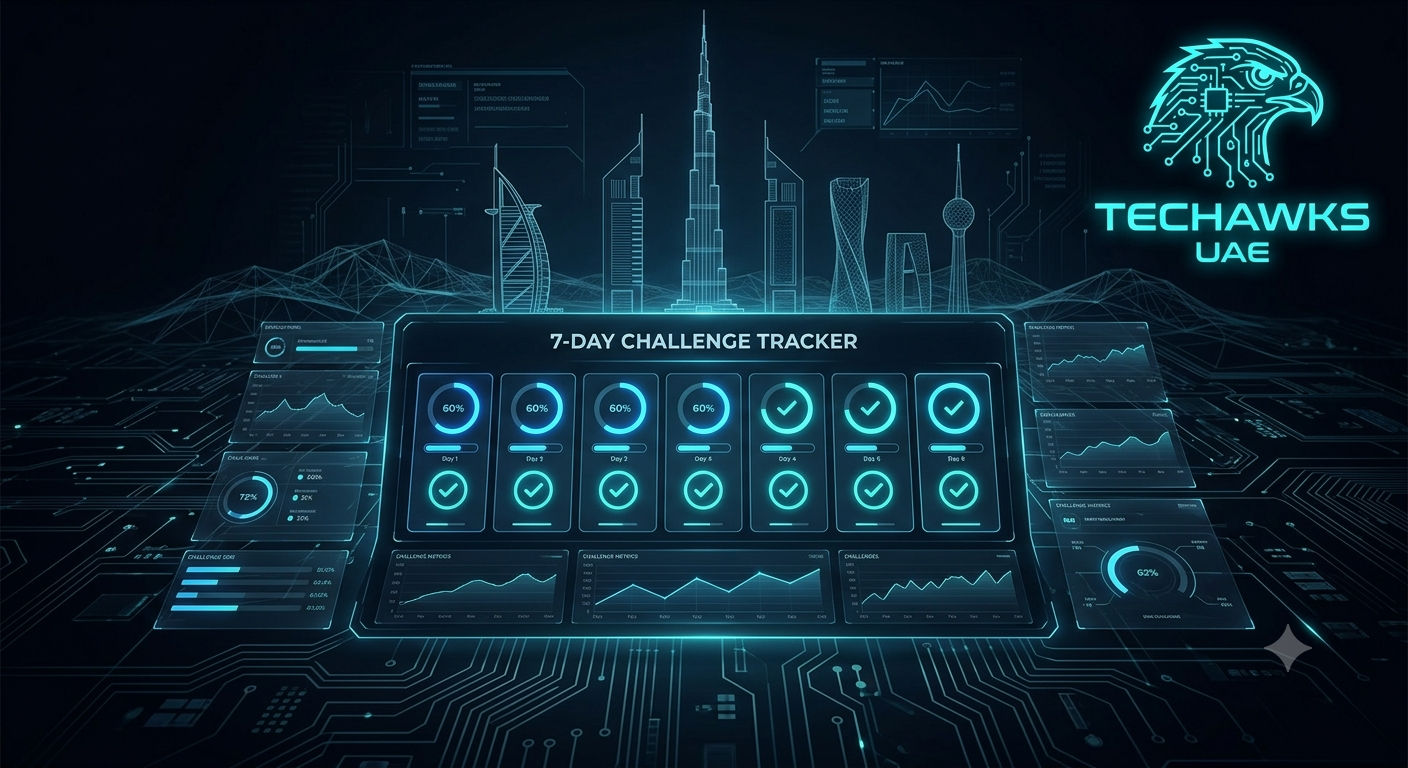
  • The 7-Day UAE Tech Optimization Challenge: Upgrade Your Stack & Operations


    Are you ready to step up? Complete one actionable micro-task each day this week to level up your regional tech game:


    Day 1: The Local Compliance Audit
    The Task: Review your data pipelines against UAE Federal Decree-Law No. 45/2021 (PDPL).
    Action: Ensure any personally identifiable information (PII) collected from UAE users is properly categorized, encrypted, and mapped to compliant regional hosting zones.


    Day 2: The RTL & Typography Stress Test
    The Task: Test your primary web or mobile app in Right-to-Left (RTL) mode.
    Action: Toggle your UI to Arabic. Fix overlapping components, broken navigation flows, and poor font rendering to deliver a native Arabic user experience.


    Day 3: The Latency Benchmark
    The Task: Measure end-to-end response times for regional users.
    Action: Run performance tests from Middle Eastern nodes (e.g., AWS me-central-1). Ensure your CDN caching strategies and edge configurations are serving local users with sub-100ms latency.


    Day 4: The Payment Flow Friction Check
    The Task: Audit your checkout or subscription funnel.
    Action: Test integration points for localized payment solutions (Apple Pay, regional debit networks, and local BNPL options). Identify and eliminate at least one point of drop-off.


    Day 5: The Infrastructure Redundancy Drill
    The Task: Validate your failover and communication tools.
    Action: Ensure your enterprise VoIP, collaboration tools, and VPN setups are fully compliant with local telecom regulations and remain resilient during peak traffic.


    Day 6: The Security & Access Review
    The Task: Lock down production environments.
    Action: Audit access permissions across your cloud architecture. Enforce multi-factor authentication (MFA) and revoke stale access credentials for offboarded team members or contractors.


    Day 7: The Knowledge Sharing Sentry
    The Task: Document your findings.
    Action: Turn the fixes from this week into an internal standard operating procedure (SOP) so your entire team maintains these local best practices moving forward.


    Key Takeaways
    Proactive over Reactive: Regular micro-audits prevent massive compliance and technical debt down the line.
    User Experience Wins: Seamless RTL interfaces and local payment options significantly improve regional conversion rates.
    Continuous Improvement: Engineering excellence in the UAE market requires continuous alignment with local standards and infrastructure.


    CTA
    Did you complete all 7 days of the challenge? Join Techawks UAE today to share your audit wins, exchange practical advice with peer engineers, and collaborate with the brightest tech minds across the Emirates!
    The 7-Day UAE Tech Optimization Challenge: Upgrade Your Stack & Operations Are you ready to step up? Complete one actionable micro-task each day this week to level up your regional tech game: Day 1: The Local Compliance Audit The Task: Review your data pipelines against UAE Federal Decree-Law No. 45/2021 (PDPL). Action: Ensure any personally identifiable information (PII) collected from UAE users is properly categorized, encrypted, and mapped to compliant regional hosting zones. Day 2: The RTL & Typography Stress Test The Task: Test your primary web or mobile app in Right-to-Left (RTL) mode. Action: Toggle your UI to Arabic. Fix overlapping components, broken navigation flows, and poor font rendering to deliver a native Arabic user experience. Day 3: The Latency Benchmark The Task: Measure end-to-end response times for regional users. Action: Run performance tests from Middle Eastern nodes (e.g., AWS me-central-1). Ensure your CDN caching strategies and edge configurations are serving local users with sub-100ms latency. Day 4: The Payment Flow Friction Check The Task: Audit your checkout or subscription funnel. Action: Test integration points for localized payment solutions (Apple Pay, regional debit networks, and local BNPL options). Identify and eliminate at least one point of drop-off. Day 5: The Infrastructure Redundancy Drill The Task: Validate your failover and communication tools. Action: Ensure your enterprise VoIP, collaboration tools, and VPN setups are fully compliant with local telecom regulations and remain resilient during peak traffic. Day 6: The Security & Access Review The Task: Lock down production environments. Action: Audit access permissions across your cloud architecture. Enforce multi-factor authentication (MFA) and revoke stale access credentials for offboarded team members or contractors. Day 7: The Knowledge Sharing Sentry The Task: Document your findings. Action: Turn the fixes from this week into an internal standard operating procedure (SOP) so your entire team maintains these local best practices moving forward. Key Takeaways Proactive over Reactive: Regular micro-audits prevent massive compliance and technical debt down the line. User Experience Wins: Seamless RTL interfaces and local payment options significantly improve regional conversion rates. Continuous Improvement: Engineering excellence in the UAE market requires continuous alignment with local standards and infrastructure. CTA Did you complete all 7 days of the challenge? Join Techawks UAE today to share your audit wins, exchange practical advice with peer engineers, and collaborate with the brightest tech minds across the Emirates!
    0 Commentarios 0 Acciones 1K Views 0 Vista previa