


Techawks Data & Analytics is a community for data enthusiasts, analysts, scientists, engineers, business intelligence professionals, students, and AI innovators who want to learn, share, and grow together. Whether you're just starting with spreadsheets or building advanced machine learning models, you'll find valuable discussions and resources here.
Discover tutorials, industry trends, real-world projects, SQL and Python tips, visualization techniques, dashboard design, AI-powered analytics, career guidance, interview preparation, certifications, and networking opportunities. Connect with professionals worldwide and turn data into meaningful insights.
Discover tutorials, industry trends, real-world projects, SQL and Python tips, visualization techniques, dashboard design, AI-powered analytics, career guidance, interview preparation, certifications, and networking opportunities. Connect with professionals worldwide and turn data into meaningful insights.
-
PBID: 0230001500000009
-
1 Leute mögen auch
-
59 Beiträge
-
59 Fotos
-
0 Videos
-
Bewertungen
-
Science and Technology
Suche

 English
 Arabic
 French
 Spanish
 Portuguese
 Turkish
 Dutch
Dutch
 Italiano
 Russian
 Romaian
 Portuguese (Brazil)
 Greek
Greek
Neueste Updates
-
The Lakehouse Illusion: Why Open Table Formats Won’t Fix Broken Data Modeling
As open lakehouse architectures become the enterprise standard, a pervasive misconception has spread across analytics teams:
❌ The Myth: "Just dump raw Parquet into an open table format like Apache Iceberg. With ACID transactions, hidden partitioning, and zero-copy engine interoperability, you don't need dimensional modeling or structured semantic layers anymore."
✅ The Reality: Open formats solve file-level coordination and catalog lock-in, but querying unmodeled data lakes creates compute-heavy runtimes, runaway cloud bills, and conflicting business metrics.
Where the "Format Fixes All" Mindset Fails:
The Join Explosion Tax: Open table formats track file manifests and column min/max statistics with high efficiency. However, when analysts run 8-way joins across raw nested event logs to calculate simple churn rates, the underlying compute engine (whether Trino, DuckDB, or Snowflake) still burns through memory and network bandwidth shuffling unindexed petabytes.
Metadata Bloat & Small File Creep: Without disciplined compaction and scheduled snapshot expiration, append-heavy streaming pipelines cause metadata trees to explode. Query engines end up spending more time traversing JSON/Avro manifest lists during scan planning than reading actual Parquet records.
Metric Drift Across Engines: The promise of open formats is engine neutrality (e.g., query the same table via Spark, DuckDB, or a cloud warehouse). But without a standardized semantic layer on top, three different teams will write three variations of the same business metric across those engines—returning conflicting numbers to leadership.
The Analytics Architecture That Actually Scales:
Decouple Storage Standards from Semantic Truth: Use open formats (like Iceberg) to prevent vendor lock-in at the storage layer, but enforce strict Medallion principles (Bronze >>> Silver >>> Gold) with curated dimensional schemas (Kimball star schemas or One Big Table designs) for the presentation layer.
utomate Storage Hygiene: Schedule recurring background compaction (bin-packing small Parquet files into optimal 128MB–512MB chunks) and purge historical snapshots to keep manifest scan planning O(1).
Enforce Upstream Data Contracts: Catch schema drift, null violations, and type mismatches at the ingestion boundary before malformed records pollute downstream silver and gold layers.
The takeaway: A high-performance storage format only changes how data is stored and committed; it doesn't change what questions your business can ask efficiently. Without structured modeling, you haven't built a modern lakehouse—you've just organized your data swamp.
Discussion Question
Is your team managing lakehouse performance at the storage level (file compaction, partitioning) or through upstream data modeling and semantic layers? Where do your bottlenecks hit hardest?
CTA (Join Data Science & Analytics)
Join the Data Science & Analytics community to compare modern lakehouse architectures, master advanced SQL/modeling patterns, and build reliable analytics pipelines alongside global practitioners.The Lakehouse Illusion: Why Open Table Formats Won’t Fix Broken Data Modeling As open lakehouse architectures become the enterprise standard, a pervasive misconception has spread across analytics teams: ❌ The Myth: "Just dump raw Parquet into an open table format like Apache Iceberg. With ACID transactions, hidden partitioning, and zero-copy engine interoperability, you don't need dimensional modeling or structured semantic layers anymore." ✅ The Reality: Open formats solve file-level coordination and catalog lock-in, but querying unmodeled data lakes creates compute-heavy runtimes, runaway cloud bills, and conflicting business metrics. Where the "Format Fixes All" Mindset Fails: The Join Explosion Tax: Open table formats track file manifests and column min/max statistics with high efficiency. However, when analysts run 8-way joins across raw nested event logs to calculate simple churn rates, the underlying compute engine (whether Trino, DuckDB, or Snowflake) still burns through memory and network bandwidth shuffling unindexed petabytes. Metadata Bloat & Small File Creep: Without disciplined compaction and scheduled snapshot expiration, append-heavy streaming pipelines cause metadata trees to explode. Query engines end up spending more time traversing JSON/Avro manifest lists during scan planning than reading actual Parquet records. Metric Drift Across Engines: The promise of open formats is engine neutrality (e.g., query the same table via Spark, DuckDB, or a cloud warehouse). But without a standardized semantic layer on top, three different teams will write three variations of the same business metric across those engines—returning conflicting numbers to leadership. The Analytics Architecture That Actually Scales: Decouple Storage Standards from Semantic Truth: Use open formats (like Iceberg) to prevent vendor lock-in at the storage layer, but enforce strict Medallion principles (Bronze >>> Silver >>> Gold) with curated dimensional schemas (Kimball star schemas or One Big Table designs) for the presentation layer. utomate Storage Hygiene: Schedule recurring background compaction (bin-packing small Parquet files into optimal 128MB–512MB chunks) and purge historical snapshots to keep manifest scan planning O(1). Enforce Upstream Data Contracts: Catch schema drift, null violations, and type mismatches at the ingestion boundary before malformed records pollute downstream silver and gold layers. The takeaway: A high-performance storage format only changes how data is stored and committed; it doesn't change what questions your business can ask efficiently. Without structured modeling, you haven't built a modern lakehouse—you've just organized your data swamp. Discussion Question Is your team managing lakehouse performance at the storage level (file compaction, partitioning) or through upstream data modeling and semantic layers? Where do your bottlenecks hit hardest? CTA (Join Data Science & Analytics) Join the Data Science & Analytics community to compare modern lakehouse architectures, master advanced SQL/modeling patterns, and build reliable analytics pipelines alongside global practitioners.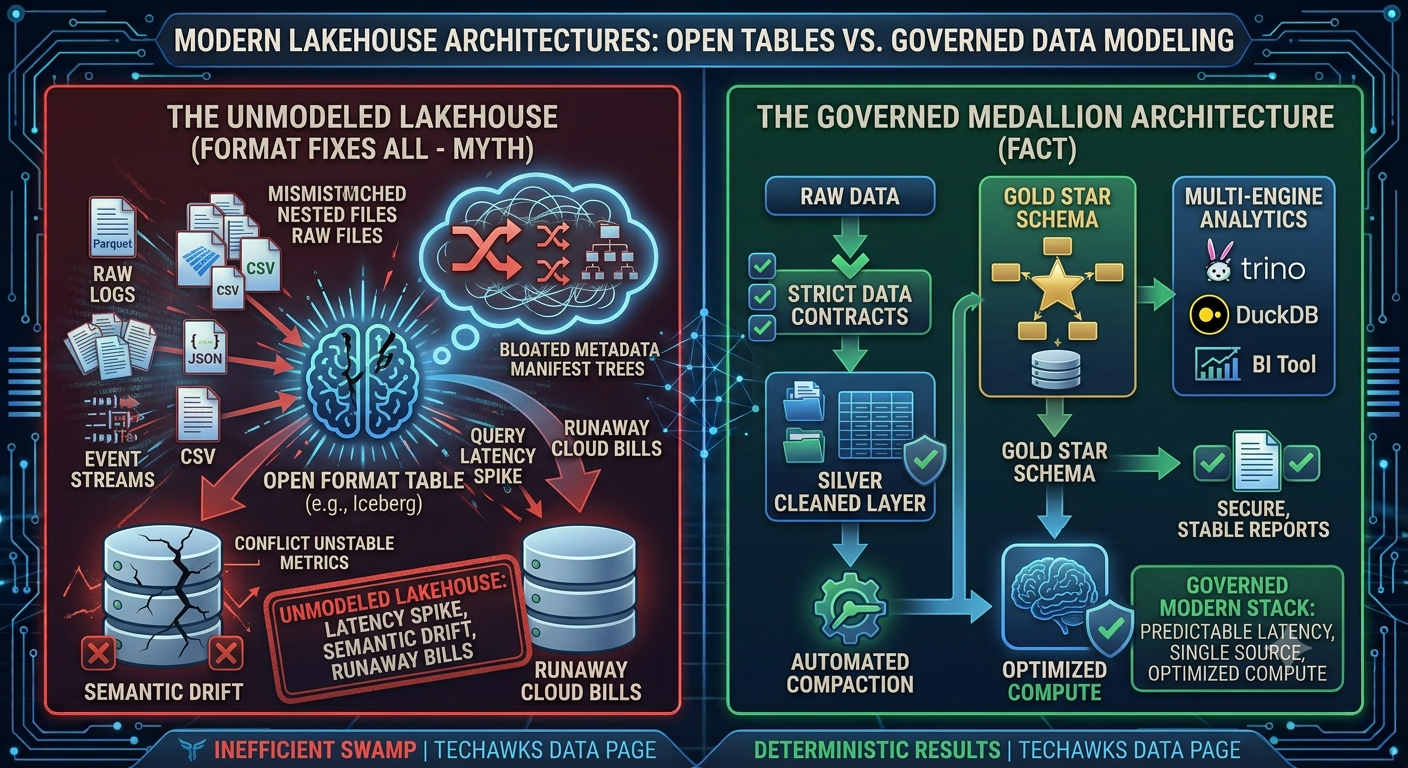 0 Kommentare 0 Geteilt 151 Ansichten 0 Bewertungen
 -
The Metric Drift Disaster: Why Your Data Warehouse Is Just a Fragmented Math Engine
Modern analytics stacks made data ingestion and physical storage cheap, but they spawned a quiet crisis: distributed metric logic.
When organizations give every team their own BI tool, notebook instance, or downstream dashboard, business logic naturally scatters across hundreds of un-versioned SQL models. Finance calculates "Revenue" excluding pending refunds, Sales calculates it including pipeline promises, and Product filters out internal trial accounts via an undocumented WHERE clause.
The result is metric drift: data teams spend up to 40% of their time reconciling why downstream numbers don't match, eroding stakeholder trust in the warehouse.
The Fix: Elevate the Universal Semantic Layer
Stop embedding mission-critical KPI formulas inside individual BI dashboard queries or one-off dbt models. Decouple your business logic from both your physical storage and your presentation layer:
Centralize Semantics as Code: Treat definitions like software. Write your dimensions and measures once into a governed semantic catalog (using tools like Cube, dbt Semantic Layer, or headless metrics layers) backed by Git version control.
Decouple Presentation from Aggregation: Ban raw SQL aggregation inside BI tools. Your dashboards, AI agents, and notebooks should query standard APIs that resolve against the central semantic contract, guaranteeing identical calculations everywhere.
Enforce Upstream Data Contracts: Combine semantic definitions with data contracts at the ingestion boundary. When upstream application schemas change, automated CI pipelines must block breaking shifts before they silently invalidate downstream metric models.
Dashboards are just viewing panes. If your metrics aren't governed in an explicit layer between your warehouse and your users, you aren't building a single source of truth—you are running an unverified calculation factory.
Discussion Question
How does your team eliminate metric discrepancies: do you enforce a centralized semantic layer, or are you still chasing down divergent SQL queries across multiple dashboards?
CTA
Master modern analytics architecture, build unified semantic models, and eliminate data fragmentation. Join Data Science & Analytics at Techawks Data & Analytics.The Metric Drift Disaster: Why Your Data Warehouse Is Just a Fragmented Math Engine Modern analytics stacks made data ingestion and physical storage cheap, but they spawned a quiet crisis: distributed metric logic. When organizations give every team their own BI tool, notebook instance, or downstream dashboard, business logic naturally scatters across hundreds of un-versioned SQL models. Finance calculates "Revenue" excluding pending refunds, Sales calculates it including pipeline promises, and Product filters out internal trial accounts via an undocumented WHERE clause. The result is metric drift: data teams spend up to 40% of their time reconciling why downstream numbers don't match, eroding stakeholder trust in the warehouse. The Fix: Elevate the Universal Semantic Layer Stop embedding mission-critical KPI formulas inside individual BI dashboard queries or one-off dbt models. Decouple your business logic from both your physical storage and your presentation layer: Centralize Semantics as Code: Treat definitions like software. Write your dimensions and measures once into a governed semantic catalog (using tools like Cube, dbt Semantic Layer, or headless metrics layers) backed by Git version control. Decouple Presentation from Aggregation: Ban raw SQL aggregation inside BI tools. Your dashboards, AI agents, and notebooks should query standard APIs that resolve against the central semantic contract, guaranteeing identical calculations everywhere. Enforce Upstream Data Contracts: Combine semantic definitions with data contracts at the ingestion boundary. When upstream application schemas change, automated CI pipelines must block breaking shifts before they silently invalidate downstream metric models. Dashboards are just viewing panes. If your metrics aren't governed in an explicit layer between your warehouse and your users, you aren't building a single source of truth—you are running an unverified calculation factory. Discussion Question How does your team eliminate metric discrepancies: do you enforce a centralized semantic layer, or are you still chasing down divergent SQL queries across multiple dashboards? CTA Master modern analytics architecture, build unified semantic models, and eliminate data fragmentation. Join Data Science & Analytics at Techawks Data & Analytics.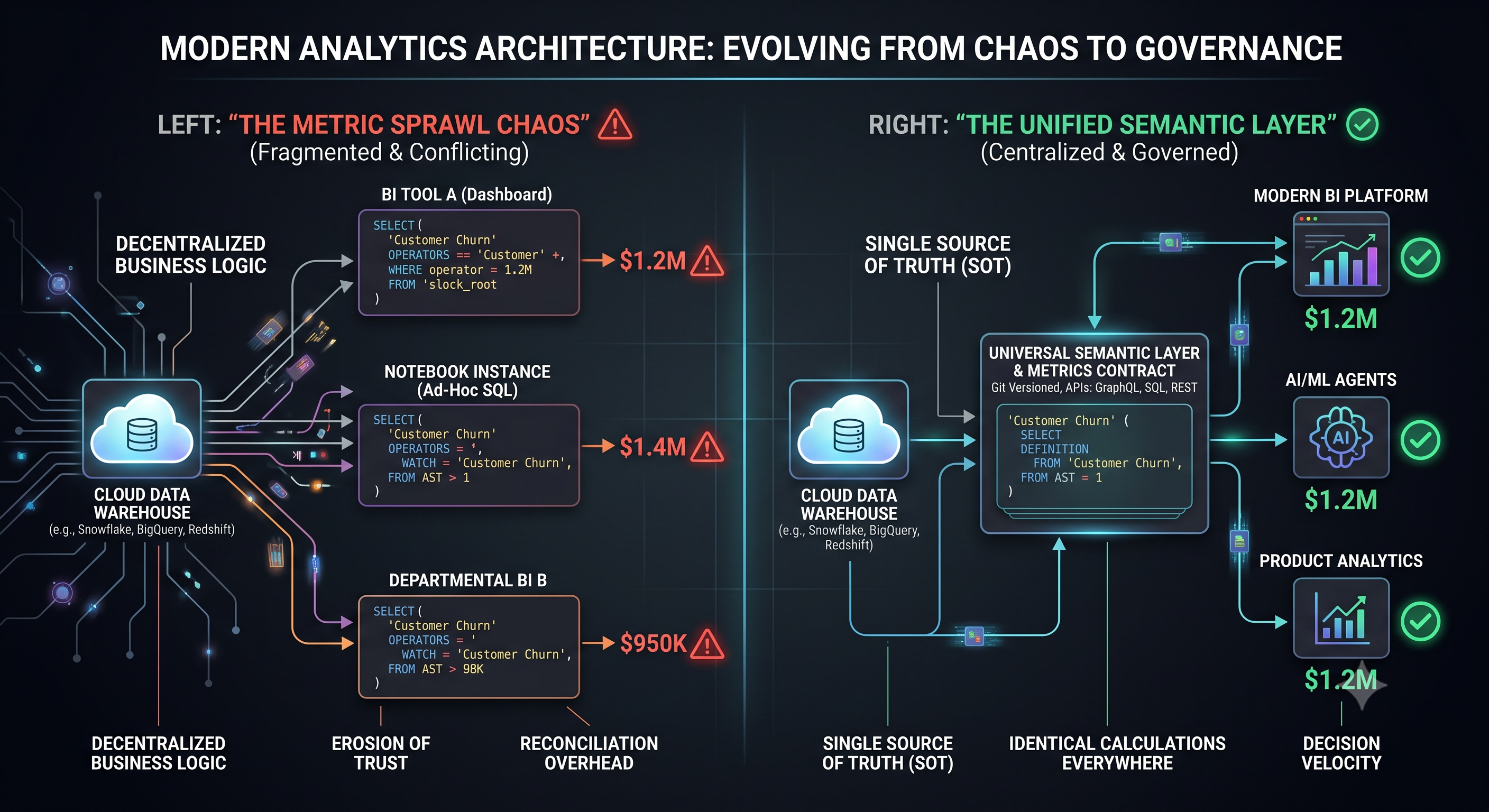 0 Kommentare 0 Geteilt 143 Ansichten 0 Bewertungen
 -
Your LLM Writes Flawless SQL—and Completely Fabricates Your Business Numbers
Data teams are rushing to bolt conversational AI interfaces directly onto their raw data lakehouses. The executive pitch sounds like a dream: non-technical operators can query data warehouses using plain English, skipping dashboard bottlenecks entirely.
Here is the production reality: the queries compile perfectly, return clean tabular data, and are catastrophically wrong.
Text-to-SQL does not fail because models lack SQL syntax skills; it fails because database schemas possess zero business semantics. A PostgreSQL catalog or Snowflake information schema cannot tell an LLM:
Which of five distinct revenue columns accounts for customer refunds, churn credits, or tax deferrals.
Whether "Q3 Sales" is measured by order timestamp, warehouse dispatch, or cash settlement date.
Which join path triggers many-to-many fan-outs and silently inflates financial metrics by3\X
When you feed raw table schemas directly into an LLM prompt, you aren't doing analytics—you are letting a statistical model hallucinate corporate accounting logic.
The Real Architecture: LLM Chooses, Semantic Engine Executes
To deploy reliable AI data access, separate semantic intent from query execution:
Kill Direct Raw-Table Access: Never give an LLM prompt raw DDL access across uncurated warehouse tables. If a table isn't governed in an explicit data mart, the model shouldn't see it.
Decouple Metric Calculation from Natural Language: The LLM's job is simply to map the user's intent to certified dimensions and standardized metrics (e.g., metric: net_mrr, dimension: cohort_month).
Let the Semantic Layer Compile the SQL: Pass those parsed parameters to a deterministic semantic engine (such as dbt Semantic Layer, Cube, or governed BI models). The semantic layer resolves table joins, fan-outs, and business filters deterministically.
If your company's revenue definitions aren't unified in code, an AI query interface will only automate the spread of bad data.
Discussion Question
Has your analytics team integrated a governed semantic layer between your AI query assistants and warehouse tables, or is your LLM still free-handing raw SQL against your databases?
CTA (Join Data Science & Analytics)
Tired of fragile dashboards and hallucinated metric queries?
👉 Join the Techawks Data Science & Analytics Community to master governed semantic layers, robust data engineering architectures, and production-grade data pipelines:Your LLM Writes Flawless SQL—and Completely Fabricates Your Business Numbers Data teams are rushing to bolt conversational AI interfaces directly onto their raw data lakehouses. The executive pitch sounds like a dream: non-technical operators can query data warehouses using plain English, skipping dashboard bottlenecks entirely. Here is the production reality: the queries compile perfectly, return clean tabular data, and are catastrophically wrong. Text-to-SQL does not fail because models lack SQL syntax skills; it fails because database schemas possess zero business semantics. A PostgreSQL catalog or Snowflake information schema cannot tell an LLM: Which of five distinct revenue columns accounts for customer refunds, churn credits, or tax deferrals. Whether "Q3 Sales" is measured by order timestamp, warehouse dispatch, or cash settlement date. Which join path triggers many-to-many fan-outs and silently inflates financial metrics by3\X When you feed raw table schemas directly into an LLM prompt, you aren't doing analytics—you are letting a statistical model hallucinate corporate accounting logic. The Real Architecture: LLM Chooses, Semantic Engine Executes To deploy reliable AI data access, separate semantic intent from query execution: Kill Direct Raw-Table Access: Never give an LLM prompt raw DDL access across uncurated warehouse tables. If a table isn't governed in an explicit data mart, the model shouldn't see it. Decouple Metric Calculation from Natural Language: The LLM's job is simply to map the user's intent to certified dimensions and standardized metrics (e.g., metric: net_mrr, dimension: cohort_month). Let the Semantic Layer Compile the SQL: Pass those parsed parameters to a deterministic semantic engine (such as dbt Semantic Layer, Cube, or governed BI models). The semantic layer resolves table joins, fan-outs, and business filters deterministically. If your company's revenue definitions aren't unified in code, an AI query interface will only automate the spread of bad data. Discussion Question Has your analytics team integrated a governed semantic layer between your AI query assistants and warehouse tables, or is your LLM still free-handing raw SQL against your databases? CTA (Join Data Science & Analytics) Tired of fragile dashboards and hallucinated metric queries? 👉 Join the Techawks Data Science & Analytics Community to master governed semantic layers, robust data engineering architectures, and production-grade data pipelines: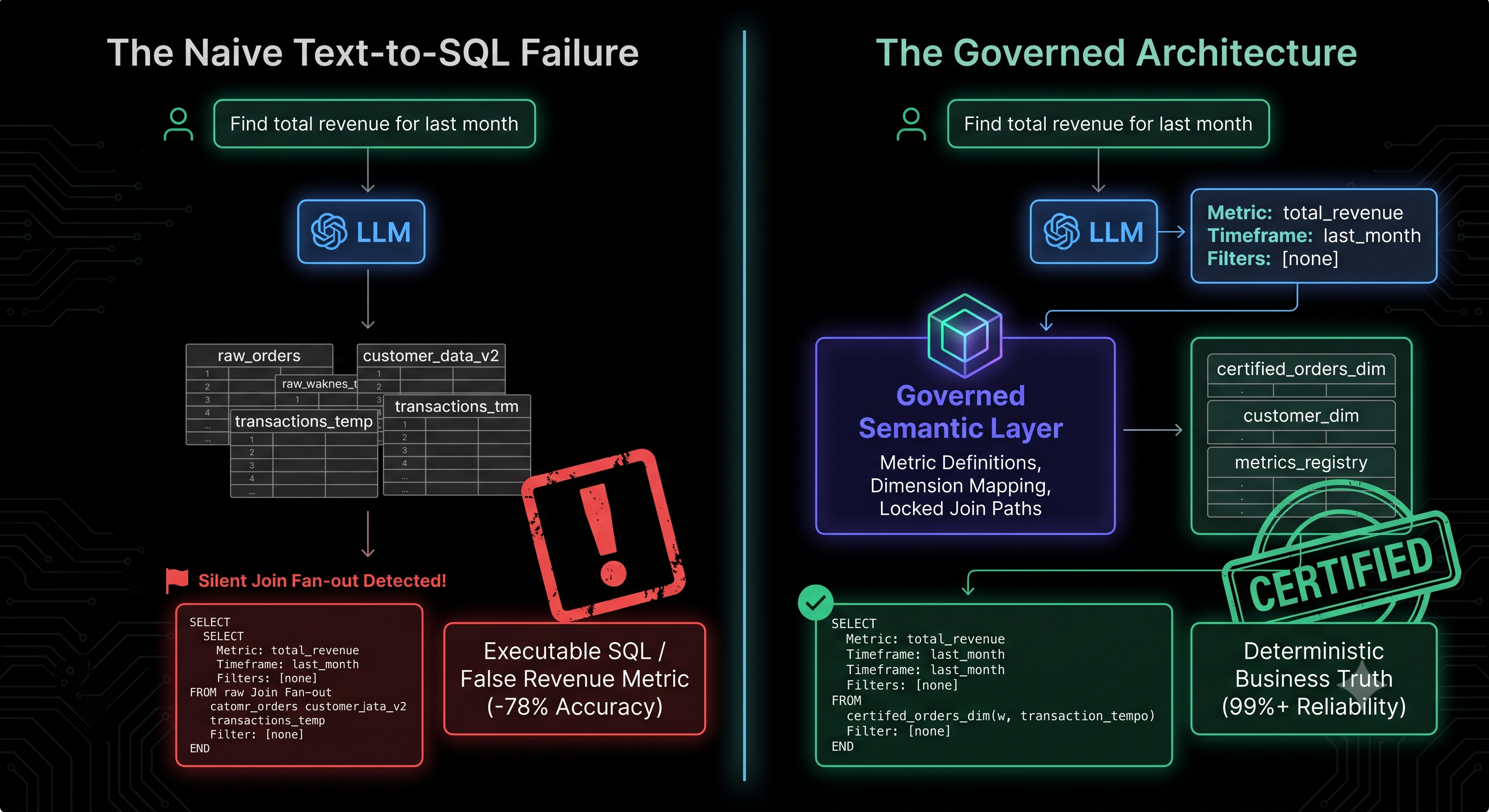 0 Kommentare 0 Geteilt 160 Ansichten 0 Bewertungen
 -
Stop Hardcoding Metrics in BI Dashboards: The 4-Step Semantic Layer Checklist for Modern Data Teams
As organizations adopt multi-cloud data warehouses and generative AI agents, relying on fragmented, tool-specific metric definitions leads to widespread data drift and conflicting business logic. To establish a single source of truth, modern data teams are shifting away from siloed reporting toward centralized, version-controlled semantic layers (such as dbt Semantic Layer, Cube, or native warehouse metadata catalogs).
To eliminate metric discrepancies and build an architecture that both humans and AI applications can trust, use this actionable semantic modeling checklist:
Centralize Metric Definitions: Move business logic—like Monthly Recurring Revenue (MRR) or Churn Rate—out of individual BI workbooks and define them as code in a single, version-controlled repository.
Standardize Dimensions and Entities: Ensure consistent primary keys and dimensional joins across all datasets so that cross-functional reporting across sales, product, and finance always joins cleanly.
Incorporate Automated Data Observability: Implement continuous validation checks and data contracts to catch upstream schema changes or pipeline breaks before they corrupt downstream metrics.
Expose Governed APIs for AI Consumption: Equip your LLMs and text-to-SQL agents with a standardized semantic API so autonomous systems query approved business metrics instead of guessing raw table structures.
Discussion Question: What is your team's biggest bottleneck when standardizing metrics—disagreements across departments on what definitions mean, or technical friction when syncing the semantic layer across multiple BI tools? Drop your insights below!
CTA (Join Data Science & Analytics): Ready to build scalable, production-grade data systems? Join Data Science & Analytics to access advanced architecture breakdowns, peer discussions, and top-tier career opportunities.Stop Hardcoding Metrics in BI Dashboards: The 4-Step Semantic Layer Checklist for Modern Data Teams As organizations adopt multi-cloud data warehouses and generative AI agents, relying on fragmented, tool-specific metric definitions leads to widespread data drift and conflicting business logic. To establish a single source of truth, modern data teams are shifting away from siloed reporting toward centralized, version-controlled semantic layers (such as dbt Semantic Layer, Cube, or native warehouse metadata catalogs). To eliminate metric discrepancies and build an architecture that both humans and AI applications can trust, use this actionable semantic modeling checklist: Centralize Metric Definitions: Move business logic—like Monthly Recurring Revenue (MRR) or Churn Rate—out of individual BI workbooks and define them as code in a single, version-controlled repository. Standardize Dimensions and Entities: Ensure consistent primary keys and dimensional joins across all datasets so that cross-functional reporting across sales, product, and finance always joins cleanly. Incorporate Automated Data Observability: Implement continuous validation checks and data contracts to catch upstream schema changes or pipeline breaks before they corrupt downstream metrics. Expose Governed APIs for AI Consumption: Equip your LLMs and text-to-SQL agents with a standardized semantic API so autonomous systems query approved business metrics instead of guessing raw table structures. Discussion Question: What is your team's biggest bottleneck when standardizing metrics—disagreements across departments on what definitions mean, or technical friction when syncing the semantic layer across multiple BI tools? Drop your insights below! CTA (Join Data Science & Analytics): Ready to build scalable, production-grade data systems? Join Data Science & Analytics to access advanced architecture breakdowns, peer discussions, and top-tier career opportunities.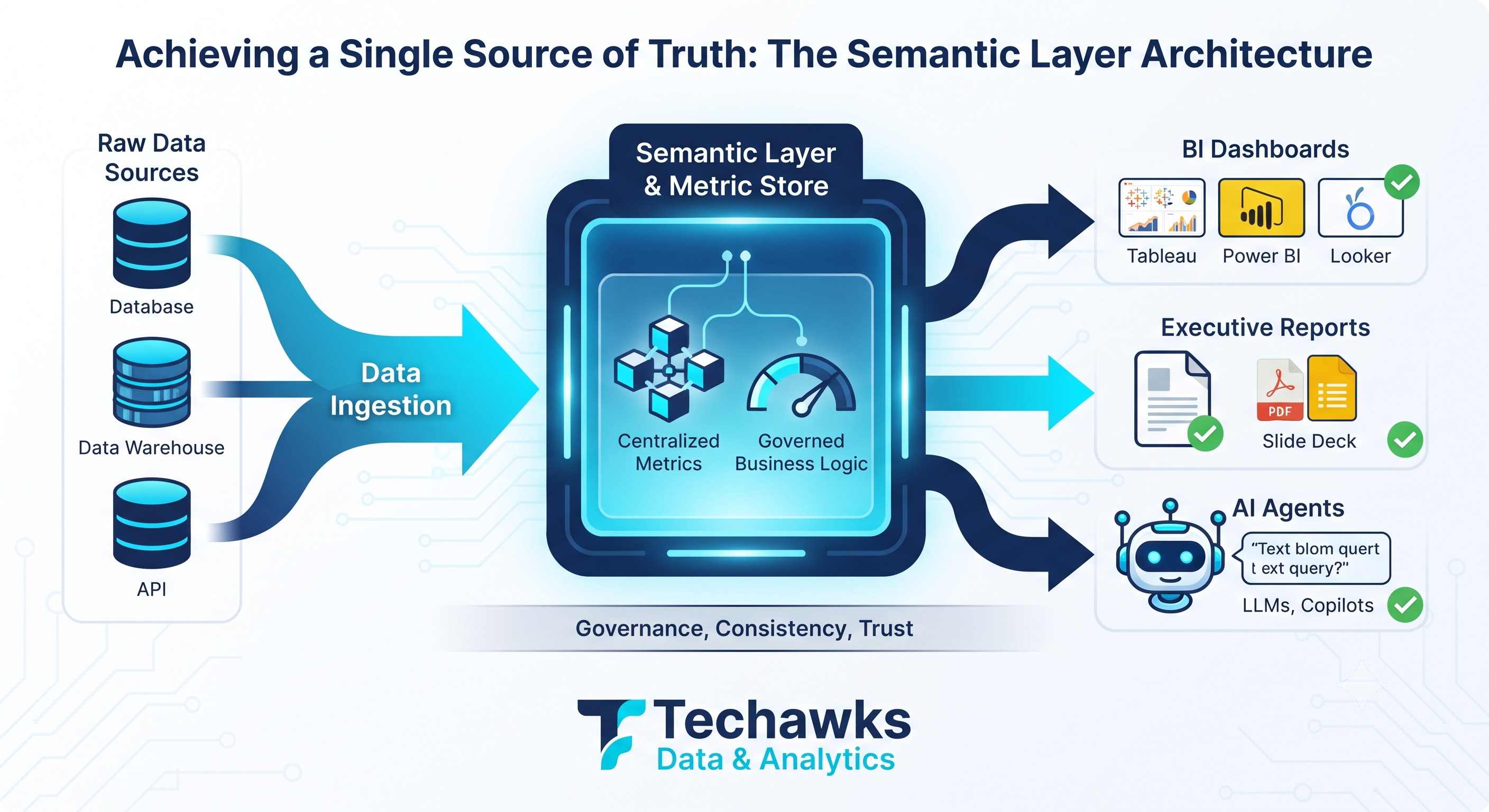 0 Kommentare 0 Geteilt 171 Ansichten 0 Bewertungen
 -
The Metric Discrepancy Trap: Why the Modern Data Stack Replaced Warehouse SQL with Data Contracts and Semantic Layers
For years, data engineering prioritized raw pipeline speed and warehouse centralization: ingest raw data as fast as possible via ELT, dump it into the lakehouse or warehouse, and let downstream analysts write custom transformation logic.
The result is Metric Drift & Upstream Schema Chaos:
A software engineer renames a column in an operational database, silently breaking downstream dbt models and dashboard extracts.
Marketing defines an "active customer" as someone who opened an email within 30 days, while Finance defines it as someone who completed a paid transaction in the last quarter.
When AI query agents or executive dashboards read from conflicting transformation tables, hallucinations and misaligned business decisions multiply.
To build trustworthy analytics, high-performing data teams are deprecating ad-hoc warehouse SQL and adopting Upstream Data Contracts paired with a Governed Semantic Layer.
The Two Pillars of Architectural Data Integrity:
Shift Left: Enforce Upstream Data Contracts
Treat data as a production API contract between software engineers producing data and data teams consuming it.
Define schemas, freshness guarantees, and nullability constraints in version-controlled declarations (YAML/Protobuf) at the service boundary.
Run schema change checks inside CI/CD pipelines. If a software deploy breaks a declared downstream contract, the deployment fails before it corrupts your data lakehouse.
Decouple Metric Logic from the BI Dashboard (The Semantic Layer)
Never calculate core KPIs inside proprietary BI tools or isolated SQL scripts.
Define dimension relationships, aggregations, and business metrics (e.g., Net Churn, ARR, Customer Lifetime Value) once in a unified, version-controlled semantic layer.
Whether an analyst queries via Tableau, a software engineer hits an API, or an AI agent queries via natural language, every tool points to the identical semantic abstraction.
Pipelines transport data, but data contracts and semantic definitions ensure that data actually means what you think it means.
Discussion Question
For data engineers and analytics leads: Where is your biggest architectural headache right now—upstream source schema changes breaking your ingestion pipelines, or metric definitions diverging across BI tools and AI agents? How are you enforcing consistency?
CTA
Ready to build reliable data architectures, robust pipelines, and production-grade analytics?
👉 Join the Techawks Data Science & Analytics Community to exchange lakehouse design patterns, discuss data modeling, and master the modern data stack alongside industry practitioners.The Metric Discrepancy Trap: Why the Modern Data Stack Replaced Warehouse SQL with Data Contracts and Semantic Layers For years, data engineering prioritized raw pipeline speed and warehouse centralization: ingest raw data as fast as possible via ELT, dump it into the lakehouse or warehouse, and let downstream analysts write custom transformation logic. The result is Metric Drift & Upstream Schema Chaos: A software engineer renames a column in an operational database, silently breaking downstream dbt models and dashboard extracts. Marketing defines an "active customer" as someone who opened an email within 30 days, while Finance defines it as someone who completed a paid transaction in the last quarter. When AI query agents or executive dashboards read from conflicting transformation tables, hallucinations and misaligned business decisions multiply. To build trustworthy analytics, high-performing data teams are deprecating ad-hoc warehouse SQL and adopting Upstream Data Contracts paired with a Governed Semantic Layer. The Two Pillars of Architectural Data Integrity: Shift Left: Enforce Upstream Data Contracts Treat data as a production API contract between software engineers producing data and data teams consuming it. Define schemas, freshness guarantees, and nullability constraints in version-controlled declarations (YAML/Protobuf) at the service boundary. Run schema change checks inside CI/CD pipelines. If a software deploy breaks a declared downstream contract, the deployment fails before it corrupts your data lakehouse. Decouple Metric Logic from the BI Dashboard (The Semantic Layer) Never calculate core KPIs inside proprietary BI tools or isolated SQL scripts. Define dimension relationships, aggregations, and business metrics (e.g., Net Churn, ARR, Customer Lifetime Value) once in a unified, version-controlled semantic layer. Whether an analyst queries via Tableau, a software engineer hits an API, or an AI agent queries via natural language, every tool points to the identical semantic abstraction. Pipelines transport data, but data contracts and semantic definitions ensure that data actually means what you think it means. Discussion Question For data engineers and analytics leads: Where is your biggest architectural headache right now—upstream source schema changes breaking your ingestion pipelines, or metric definitions diverging across BI tools and AI agents? How are you enforcing consistency? CTA Ready to build reliable data architectures, robust pipelines, and production-grade analytics? 👉 Join the Techawks Data Science & Analytics Community to exchange lakehouse design patterns, discuss data modeling, and master the modern data stack alongside industry practitioners.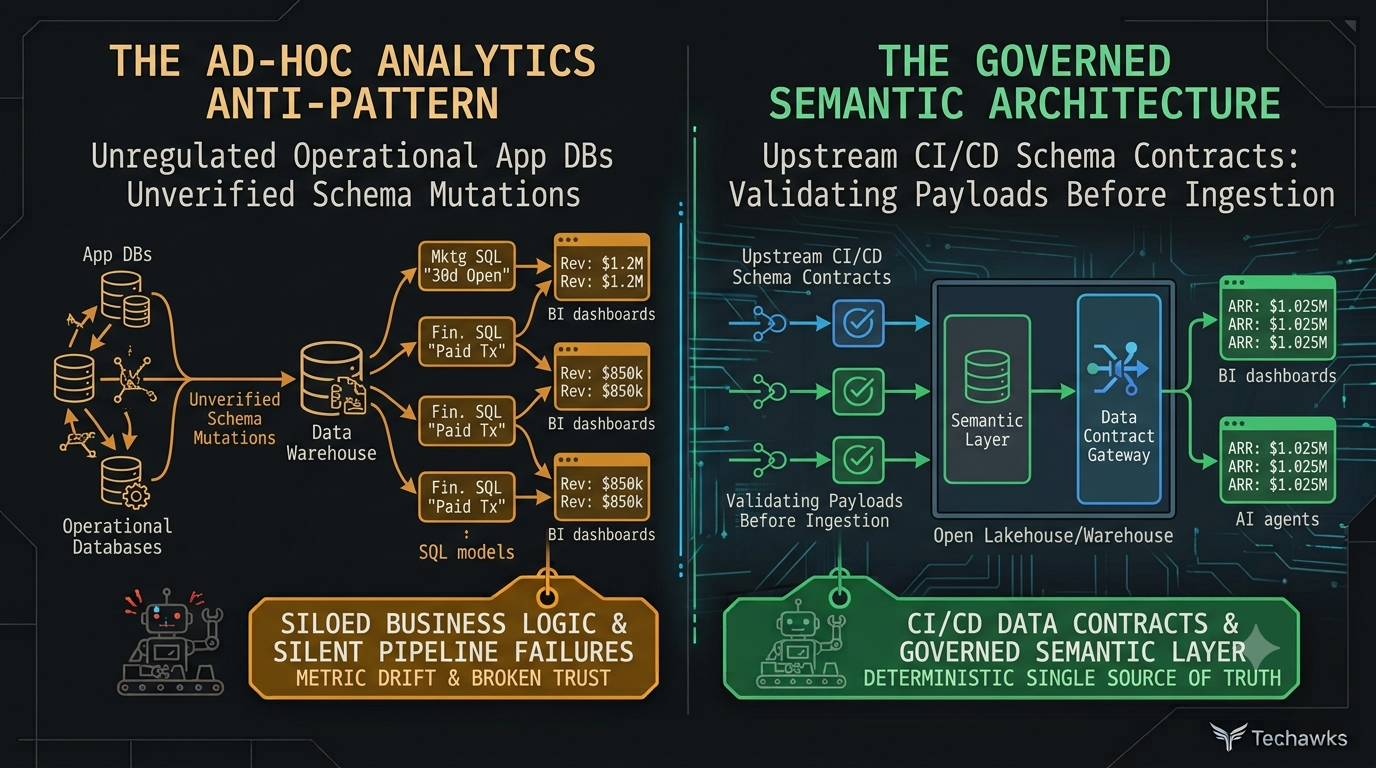 0 Kommentare 0 Geteilt 1KB Ansichten 0 Bewertungen
 -
Why the Open REST Catalog Is Killing Proprietary Data Warehouse Lock-In
For years, the modern data stack pushed centralization: ingest everything into one proprietary cloud data warehouse, convert it into proprietary internal storage formats, and use that vendor's compute engine for every analytical workload.
The consequences were predictable:
Compute Monopolies: You paid premium compute credits for simple queries that lightweight open-source engines could run for pennies.
Data Duplication: Teams spun up brittle sync pipelines and reverse-ETL jobs just to shuttle data between different analytics platforms.
Engine Incompatibility: A machine learning team using PySpark or DuckDB couldn't query tables locked inside an analytical warehouse without slow export stages.
The Architectural Shift: Decoupling Storage, Metadata, and Compute via REST Catalogs
Modern lakehouse design separates the stack into three independent tiers:
Storage Layer: Raw immutable columnar files (Parquet) sitting on cheap object storage (S3, ADLS, GCS).
Open Table Format: Apache Iceberg, which turns physical Parquet files into ACID-compliant tables with point-in-time snapshots, schema evolution, and hidden partitioning.
The REST Catalog Standard: An OpenAPI-standardized HTTP interface (such as Apache Polaris, Project Nessie, or cloud-native REST endpoints) that acts as the single source of truth for metadata pointers.
Instead of an engine owning your data, the REST Catalog becomes the central registry.
When a query arrives, whether from Snowflake, Databricks, Trino, StarRocks, or PyIceberg:
The engine queries the REST Catalog via standard HTTP to fetch the current snapshot metadata.
The engine prunes manifest lists in memory based on partition and column statistics.
The engine reads only the relevant Parquet bytes directly from object storage.
Zero vendor data lock-in. Zero cross-warehouse copying. You pick the most cost-effective compute engine for the job—batch ETL on Spark, ad-hoc BI on Trino, interactive dashboards on ClickHouse, and data science on DuckDB—all querying the exact same physical dataset with full ACID isolation.
Discussion Question
Is your organization still consolidating data inside a single proprietary data warehouse, or have you started decoupling compute from storage using Apache Iceberg and an open catalog? What has been the biggest migration hurdle?
CTA
Stop overpaying for compute and build vendor-agnostic, high-performance data architectures. Join data engineers, analytics leads, and BI architects inside Data Science & Analytics to share lakehouse migration blueprints, benchmark catalogs, and master modern data engineering.Why the Open REST Catalog Is Killing Proprietary Data Warehouse Lock-In For years, the modern data stack pushed centralization: ingest everything into one proprietary cloud data warehouse, convert it into proprietary internal storage formats, and use that vendor's compute engine for every analytical workload. The consequences were predictable: Compute Monopolies: You paid premium compute credits for simple queries that lightweight open-source engines could run for pennies. Data Duplication: Teams spun up brittle sync pipelines and reverse-ETL jobs just to shuttle data between different analytics platforms. Engine Incompatibility: A machine learning team using PySpark or DuckDB couldn't query tables locked inside an analytical warehouse without slow export stages. The Architectural Shift: Decoupling Storage, Metadata, and Compute via REST Catalogs Modern lakehouse design separates the stack into three independent tiers: Storage Layer: Raw immutable columnar files (Parquet) sitting on cheap object storage (S3, ADLS, GCS). Open Table Format: Apache Iceberg, which turns physical Parquet files into ACID-compliant tables with point-in-time snapshots, schema evolution, and hidden partitioning. The REST Catalog Standard: An OpenAPI-standardized HTTP interface (such as Apache Polaris, Project Nessie, or cloud-native REST endpoints) that acts as the single source of truth for metadata pointers. Instead of an engine owning your data, the REST Catalog becomes the central registry. When a query arrives, whether from Snowflake, Databricks, Trino, StarRocks, or PyIceberg: The engine queries the REST Catalog via standard HTTP to fetch the current snapshot metadata. The engine prunes manifest lists in memory based on partition and column statistics. The engine reads only the relevant Parquet bytes directly from object storage. Zero vendor data lock-in. Zero cross-warehouse copying. You pick the most cost-effective compute engine for the job—batch ETL on Spark, ad-hoc BI on Trino, interactive dashboards on ClickHouse, and data science on DuckDB—all querying the exact same physical dataset with full ACID isolation. Discussion Question Is your organization still consolidating data inside a single proprietary data warehouse, or have you started decoupling compute from storage using Apache Iceberg and an open catalog? What has been the biggest migration hurdle? CTA Stop overpaying for compute and build vendor-agnostic, high-performance data architectures. Join data engineers, analytics leads, and BI architects inside Data Science & Analytics to share lakehouse migration blueprints, benchmark catalogs, and master modern data engineering. 0 Kommentare 0 Geteilt 197 Ansichten 0 Bewertungen
 -
Stop Re-Writing Parquet Files: How Apache Iceberg Deletion Vectors Fix Lakehouse Thrashing
For years, the standard approach to updating or deleting records in Parquet-backed data lakes (like AWS S3, GCS, or ADLS) was Copy-on-Write (CoW).
When a customer executed a "right-to-be-forgotten" request or an upstream database issued an UPDATE via CDC:
The engine scanned the existing 512MB Parquet data file.
It dropped or updated the single matching row.
It serialized and wrote a completely new 511.9MB Parquet file to cloud storage.
It committed a new table snapshot and flagged the old file as orphaned.
Multiply that by thousands of CDC micro-batches or compliance sweeps, and your data lake suffers from massive write amplification, wasted I/O, and explosive compute bills.
The Breakthrough: Deletion Vectors
Modern open table formats (standardized in Apache Iceberg v3) solve this with Deletion Vectors.
Instead of rewriting the entire physical Parquet file when a row changes:
Target Identification: The engine locates the target row by its internal file-relative row offset.
Bit-Level Marking: Rather than creating a full file clone or expensive equality delete logs, the system writes a compressed Roaring Bitmap (stored in a lightweight Puffin auxiliary file).
Atomic Pointer Swap: The bitmap acts as a mask: Bit = 1 means the row at that specific position is dead. The engine attaches this lightweight vector to the existing Parquet file via metadata commit.
Traditional Copy-on-Write:
[ 10,000 Rows in File A (500MB) ] ──(Delete 1 Row)──> [ Rewrite 9,999 Rows in File B (499.9MB) ] 💥 Massive I/O
Deletion Vector (Merge-on-Read):
[ File A Remains Untouched (500MB) ] + [ Deletion Vector: Bitmask 00100... (few bytes) ] ⚡ Zero Rewrites
Why This Changes Data Engineering Architecture:
Near Real-Time Ingestion (CDC): Streaming engines like Apache Flink or Kafka Connect sinks can land continuous updates/deletes in seconds without locking tables or degrading pipeline throughput.
Separation of Mutation and Compaction: You decouple operational changes from expensive physical data layout tasks. Let your ingestion pipeline emit Deletion Vectors cheaply; schedule background asynchronous compaction (bin-packing) during low-utilization windows to merge vectors into clean, contiguous files.
Engine Interoperability: Because Deletion Vectors conform to open table specifications, multiple compute layers—whether you run distributed queries in Trino/Spark or localized in-process analytics in DuckDB—read the same masked data without vendor lock-in.
The hallmark of mature data engineering isn't just knowing how to write SQL queries; it's understanding how storage layers layout bytes on object storage to minimize execution overhead.
Discussion Question
Is your team still running classic Copy-on-Write (CoW) tables for your updates and deletes, or have you migrated your lakehouse pipelines to Merge-on-Read with Deletion Vectors? What impact have you measured on your storage write amplification?
CTA (Join Data Science & Analytics)
Master the architecture behind high-performance data lakes, modern query engines, and production analytics systems. Join the Data Science & Analytics community to collaborate on query optimization, lakehouse patterns, and large-scale data engineering.Stop Re-Writing Parquet Files: How Apache Iceberg Deletion Vectors Fix Lakehouse Thrashing For years, the standard approach to updating or deleting records in Parquet-backed data lakes (like AWS S3, GCS, or ADLS) was Copy-on-Write (CoW). When a customer executed a "right-to-be-forgotten" request or an upstream database issued an UPDATE via CDC: The engine scanned the existing 512MB Parquet data file. It dropped or updated the single matching row. It serialized and wrote a completely new 511.9MB Parquet file to cloud storage. It committed a new table snapshot and flagged the old file as orphaned. Multiply that by thousands of CDC micro-batches or compliance sweeps, and your data lake suffers from massive write amplification, wasted I/O, and explosive compute bills. The Breakthrough: Deletion Vectors Modern open table formats (standardized in Apache Iceberg v3) solve this with Deletion Vectors. Instead of rewriting the entire physical Parquet file when a row changes: Target Identification: The engine locates the target row by its internal file-relative row offset. Bit-Level Marking: Rather than creating a full file clone or expensive equality delete logs, the system writes a compressed Roaring Bitmap (stored in a lightweight Puffin auxiliary file). Atomic Pointer Swap: The bitmap acts as a mask: Bit = 1 means the row at that specific position is dead. The engine attaches this lightweight vector to the existing Parquet file via metadata commit. Traditional Copy-on-Write: [ 10,000 Rows in File A (500MB) ] ──(Delete 1 Row)──> [ Rewrite 9,999 Rows in File B (499.9MB) ] 💥 Massive I/O Deletion Vector (Merge-on-Read): [ File A Remains Untouched (500MB) ] + [ Deletion Vector: Bitmask 00100... (few bytes) ] ⚡ Zero Rewrites Why This Changes Data Engineering Architecture: Near Real-Time Ingestion (CDC): Streaming engines like Apache Flink or Kafka Connect sinks can land continuous updates/deletes in seconds without locking tables or degrading pipeline throughput. Separation of Mutation and Compaction: You decouple operational changes from expensive physical data layout tasks. Let your ingestion pipeline emit Deletion Vectors cheaply; schedule background asynchronous compaction (bin-packing) during low-utilization windows to merge vectors into clean, contiguous files. Engine Interoperability: Because Deletion Vectors conform to open table specifications, multiple compute layers—whether you run distributed queries in Trino/Spark or localized in-process analytics in DuckDB—read the same masked data without vendor lock-in. The hallmark of mature data engineering isn't just knowing how to write SQL queries; it's understanding how storage layers layout bytes on object storage to minimize execution overhead. Discussion Question Is your team still running classic Copy-on-Write (CoW) tables for your updates and deletes, or have you migrated your lakehouse pipelines to Merge-on-Read with Deletion Vectors? What impact have you measured on your storage write amplification? CTA (Join Data Science & Analytics) Master the architecture behind high-performance data lakes, modern query engines, and production analytics systems. Join the Data Science & Analytics community to collaborate on query optimization, lakehouse patterns, and large-scale data engineering. 0 Kommentare 0 Geteilt 156 Ansichten 0 Bewertungen
 -
The Death of Vendor Storage Lock-In: Why Data Architecture Shifted to the Open REST Catalog Layer
The modern data stack has passed an irreversible milestone. Open table formats—led decisively by Apache Iceberg and open metadata standards—have decoupled storage from query compute across Snowflake, Databricks, BigQuery, and Trino.
For years, analytics leaders were forced into a binary trade-off:
Store files in a cheap, brittle data lake (struggling with slow listings, schema drifts, and corrupt partial writes).
Lock data entirely inside a proprietary warehouse (paying steep compute premiums just to run basic BI and transformations).
Today, the standard enterprise architecture is store once in open Parquet/Iceberg on your own object storage, and point whichever compute engine you need at the table.
However, format convergence does not mean operational simplicity. The new battleground for data engineers and architects has migrated from "Which table format?" to "How do we govern the catalog layer?"
3 Modern Rules for Building an Open Lakehouse
1. Standardize on the Apache Iceberg REST Catalog Spec
Don't bind your lakehouse to an engine-specific metastore. The Iceberg REST Catalog specification provides an HTTP interface that decouples catalog operations from underlying Java runtimes.
Whether you query via Python, DuckDB, Trino, or a managed cloud engine, every client interacts through the same metadata spec.
It enables server-side credential vending, ensuring query engines receive short-lived, scoped cloud storage tokens per query rather than persistent IAM roles.
2. Leverage Deletion Vectors and Row Lineage (Iceberg v3)
Earlier lakehouse implementations suffered from write amplification during merges and updates (rewriting an entire Parquet file just to update one row).
Modern open formats utilize deletion vectors (compact positional bitmaps stored in Puffin files) to register deletes instantly at read time without full data rewrites.
Pair this with row-level lineage to execute streaming Change Data Capture (CDC) pipelines directly on analytical tables without spinning up separate staging layers.
3. Enforce Engine-Agnostic Compaction & Maintenance
When data is written by multiple distributed engines (e.g., Spark for batch ingestion, Apache Flink for real-time streaming, and Trino for ad-hoc queries), file compaction can degrade rapidly.
Run an independent orchestration layer (via dbt, scheduled serverless tasks, or catalog-native maintenance) to run periodic OPTIMIZE and bin-packing routines.
Never rely on an ad-hoc warehouse session to clean up your metadata trees.
The Strategic Takeaway: Data compute is becoming a commodity; data gravity and metadata governance are the assets. When you own your catalog and table format, your business negotiates cloud compute on its terms.
Discussion Question
Is your organization migrating toward open table formats (Apache Iceberg) with independent REST catalogs, or are you still committed to proprietary warehouse storage layers? What has been your biggest hurdle in production?
CTA
Join Data Science & Analytics
Connect with data architects, analytics engineers, and machine learning practitioners. Access technical frameworks, lakehouse architectures, and modern data stack playbooks. Join Techawks Data & Analytics todayThe Death of Vendor Storage Lock-In: Why Data Architecture Shifted to the Open REST Catalog Layer The modern data stack has passed an irreversible milestone. Open table formats—led decisively by Apache Iceberg and open metadata standards—have decoupled storage from query compute across Snowflake, Databricks, BigQuery, and Trino. For years, analytics leaders were forced into a binary trade-off: Store files in a cheap, brittle data lake (struggling with slow listings, schema drifts, and corrupt partial writes). Lock data entirely inside a proprietary warehouse (paying steep compute premiums just to run basic BI and transformations). Today, the standard enterprise architecture is store once in open Parquet/Iceberg on your own object storage, and point whichever compute engine you need at the table. However, format convergence does not mean operational simplicity. The new battleground for data engineers and architects has migrated from "Which table format?" to "How do we govern the catalog layer?" 3 Modern Rules for Building an Open Lakehouse 1. Standardize on the Apache Iceberg REST Catalog Spec Don't bind your lakehouse to an engine-specific metastore. The Iceberg REST Catalog specification provides an HTTP interface that decouples catalog operations from underlying Java runtimes. Whether you query via Python, DuckDB, Trino, or a managed cloud engine, every client interacts through the same metadata spec. It enables server-side credential vending, ensuring query engines receive short-lived, scoped cloud storage tokens per query rather than persistent IAM roles. 2. Leverage Deletion Vectors and Row Lineage (Iceberg v3) Earlier lakehouse implementations suffered from write amplification during merges and updates (rewriting an entire Parquet file just to update one row). Modern open formats utilize deletion vectors (compact positional bitmaps stored in Puffin files) to register deletes instantly at read time without full data rewrites. Pair this with row-level lineage to execute streaming Change Data Capture (CDC) pipelines directly on analytical tables without spinning up separate staging layers. 3. Enforce Engine-Agnostic Compaction & Maintenance When data is written by multiple distributed engines (e.g., Spark for batch ingestion, Apache Flink for real-time streaming, and Trino for ad-hoc queries), file compaction can degrade rapidly. Run an independent orchestration layer (via dbt, scheduled serverless tasks, or catalog-native maintenance) to run periodic OPTIMIZE and bin-packing routines. Never rely on an ad-hoc warehouse session to clean up your metadata trees. The Strategic Takeaway: Data compute is becoming a commodity; data gravity and metadata governance are the assets. When you own your catalog and table format, your business negotiates cloud compute on its terms. Discussion Question Is your organization migrating toward open table formats (Apache Iceberg) with independent REST catalogs, or are you still committed to proprietary warehouse storage layers? What has been your biggest hurdle in production? CTA Join Data Science & Analytics Connect with data architects, analytics engineers, and machine learning practitioners. Access technical frameworks, lakehouse architectures, and modern data stack playbooks. Join Techawks Data & Analytics today 0 Kommentare 0 Geteilt 162 Ansichten 0 Bewertungen
 -
The Distributed Query Fallacy: Why Your Analytics Pipeline Doesn’t Need Spark Anymore
For over a decade, data engineering followed a reflexive rule: as soon as a dataset outgrew a local pandas dataframe, you deployed distributed compute (Spark, EMR, or managed cloud warehouses).
In modern data architectures, that operational overhead has become an anti-pattern.
A large share of production analytical jobs operate on datasets between 5 GB and 200 GB. Running these across distributed worker nodes incurs high network serialization penalties, partition shuffles, and complex cluster lifecycle management. With modern high-memory VM instances, vectorized execution engines, and open table formats, in-process analytical engines (like DuckDB and Apache DataFusion) running directly against open Parquet/Iceberg storage routinely outperform multi-node clusters at a fraction of the cost.
Here is how modern data teams re-architect their query workloads for maximum performance and cost efficiency:
Storage Decoupling via Open Table Formats: Stop locking data into proprietary warehouse storage tiers. Writing directly to Apache Iceberg or Delta Lake on object storage preserves ACID transactions, hidden partitioning, and snapshot isolation without requiring a running warehouse cluster just to store tables.
Right-Sized In-Process Execution: For intermediate transformations, sub-terabyte aggregations, and embedded customer-facing dashboards, leverage in-process vectorized engines. Running vectorized SQL inside a single container reads Parquet files from cloud buckets with zero IPC serialization and zero cluster orchestration.
Partition Pruning Over Horizontal Scaling: 80% of query latency comes from scanning irrelevant rows. Utilizing metadata-level min/max column pruning, deletion vectors, and Z-order clustering eliminates the need to throw more distributed cores at raw brute-force scans.
Distributed systems are built to solve physical hardware limits, not software configuration issues. Before you scale horizontally, make sure you’ve exhausted single-node vertical efficiency.
Discussion Question
POLL: Where does the majority of your team's analytical compute spend go today?
Proprietary cloud data warehouses (Snowflake / BigQuery / Redshift)
Distributed Spark clusters (Databricks / EMR / self-managed)
In-process / Embedded engines (DuckDB / DataFusion on Parquet & Iceberg)
Traditional relational databases (Postgres / MySQL read-replicas)
Cast your vote below and share your biggest data-pipeline optimization win this quarter!
CTA
Ready to modernize your data stack, optimize query performance, and discuss lakehouse architectures with top data practitioners?
👉 Join Data Science & Analytics [link in bio/comments] to trade real production benchmarks, schema designs, and pipeline teardowns.The Distributed Query Fallacy: Why Your Analytics Pipeline Doesn’t Need Spark Anymore For over a decade, data engineering followed a reflexive rule: as soon as a dataset outgrew a local pandas dataframe, you deployed distributed compute (Spark, EMR, or managed cloud warehouses). In modern data architectures, that operational overhead has become an anti-pattern. A large share of production analytical jobs operate on datasets between 5 GB and 200 GB. Running these across distributed worker nodes incurs high network serialization penalties, partition shuffles, and complex cluster lifecycle management. With modern high-memory VM instances, vectorized execution engines, and open table formats, in-process analytical engines (like DuckDB and Apache DataFusion) running directly against open Parquet/Iceberg storage routinely outperform multi-node clusters at a fraction of the cost. Here is how modern data teams re-architect their query workloads for maximum performance and cost efficiency: Storage Decoupling via Open Table Formats: Stop locking data into proprietary warehouse storage tiers. Writing directly to Apache Iceberg or Delta Lake on object storage preserves ACID transactions, hidden partitioning, and snapshot isolation without requiring a running warehouse cluster just to store tables. Right-Sized In-Process Execution: For intermediate transformations, sub-terabyte aggregations, and embedded customer-facing dashboards, leverage in-process vectorized engines. Running vectorized SQL inside a single container reads Parquet files from cloud buckets with zero IPC serialization and zero cluster orchestration. Partition Pruning Over Horizontal Scaling: 80% of query latency comes from scanning irrelevant rows. Utilizing metadata-level min/max column pruning, deletion vectors, and Z-order clustering eliminates the need to throw more distributed cores at raw brute-force scans. Distributed systems are built to solve physical hardware limits, not software configuration issues. Before you scale horizontally, make sure you’ve exhausted single-node vertical efficiency. Discussion Question POLL: Where does the majority of your team's analytical compute spend go today? Proprietary cloud data warehouses (Snowflake / BigQuery / Redshift) Distributed Spark clusters (Databricks / EMR / self-managed) In-process / Embedded engines (DuckDB / DataFusion on Parquet & Iceberg) Traditional relational databases (Postgres / MySQL read-replicas) Cast your vote below and share your biggest data-pipeline optimization win this quarter! CTA Ready to modernize your data stack, optimize query performance, and discuss lakehouse architectures with top data practitioners? 👉 Join Data Science & Analytics [link in bio/comments] to trade real production benchmarks, schema designs, and pipeline teardowns. 0 Kommentare 0 Geteilt 189 Ansichten 0 Bewertungen
 -
Stop Writing Ad-Hoc SQL for Dashboards: The Skill That Protects Data Careers in the Agentic AI Era
With AI agents and text-to-SQL copilots advancing into production environments, business leaders can increasingly generate standard aggregations and charts on demand.
Yet, enterprise rollouts face a consistent roadblock: hallucinated business logic and metric drift.
When an LLM queries raw tables directly, it often guesses the correct table grain, picks the wrong join path, or computes "Revenue" using five conflicting definitions.
The industry solved this with an abstraction layer: The Modern Semantic Layer (via frameworks like dbt Semantic Layer, Cube, or metric-tree architectures).
Why This Shift Matters for Your Career:
Writing ad-hoc queries makes you a human API router. Modeling governed semantics transforms you into a systems architect.
AI tools cannot independently resolve domain ambiguity without strict constraints. High-earning data practitioners spend less time resolving ad-hoc Slack tickets and more time codifying deterministic business logic.
The Lesson: Build a Governed Semantic Metric
Instead of scattering metric logic across disparate dashboard calculated fields, define metrics centrally using a standard metric specification pattern (such as MetricFlow or YAML-based semantic declarations):
# Example: Defining deterministic logic so both AI & humans compute the identical KPI
metrics:
- name: net_retained_revenue
label: "Net Retained Revenue (NRR)"
description: "Expansion revenue minus churn, divided by starting base."
type: ratio
type_params:
numerator: ending_mrr_retained
denominator: starting_mrr_base
filter: |
customer_tier != 'internal_test'
How to Pivot Your Day-to-Day:
Audit your calculation debt: Identify KPIs currently computed in three separate BI tools with conflicting totals.
Abstract before you visualize: Stop building one-off CTEs. Consolidate your core business entities (Dimensions) and aggregations (Measures) into code-reviewed, version-controlled repository models.
Become the validator of truth: Position yourself as the interface owner who evaluates, tests, and ensures agentic analytics remain reliable and grounded.
Discussion Question
Is your team already centralizing metrics into a standalone semantic layer, or are your critical business definitions still living inside scattered BI dashboards and manual SQL scripts? Let’s talk architecture in the comments.
CTA
Ready to level up from query-runner to data architect? Join Data Science & Analytics at Techawks for hands-on labs, architectural teardowns, and modern data career roadmaps.Stop Writing Ad-Hoc SQL for Dashboards: The Skill That Protects Data Careers in the Agentic AI Era With AI agents and text-to-SQL copilots advancing into production environments, business leaders can increasingly generate standard aggregations and charts on demand. Yet, enterprise rollouts face a consistent roadblock: hallucinated business logic and metric drift. When an LLM queries raw tables directly, it often guesses the correct table grain, picks the wrong join path, or computes "Revenue" using five conflicting definitions. The industry solved this with an abstraction layer: The Modern Semantic Layer (via frameworks like dbt Semantic Layer, Cube, or metric-tree architectures). Why This Shift Matters for Your Career: Writing ad-hoc queries makes you a human API router. Modeling governed semantics transforms you into a systems architect. AI tools cannot independently resolve domain ambiguity without strict constraints. High-earning data practitioners spend less time resolving ad-hoc Slack tickets and more time codifying deterministic business logic. The Lesson: Build a Governed Semantic Metric Instead of scattering metric logic across disparate dashboard calculated fields, define metrics centrally using a standard metric specification pattern (such as MetricFlow or YAML-based semantic declarations): # Example: Defining deterministic logic so both AI & humans compute the identical KPI metrics: - name: net_retained_revenue label: "Net Retained Revenue (NRR)" description: "Expansion revenue minus churn, divided by starting base." type: ratio type_params: numerator: ending_mrr_retained denominator: starting_mrr_base filter: | customer_tier != 'internal_test' How to Pivot Your Day-to-Day: Audit your calculation debt: Identify KPIs currently computed in three separate BI tools with conflicting totals. Abstract before you visualize: Stop building one-off CTEs. Consolidate your core business entities (Dimensions) and aggregations (Measures) into code-reviewed, version-controlled repository models. Become the validator of truth: Position yourself as the interface owner who evaluates, tests, and ensures agentic analytics remain reliable and grounded. Discussion Question Is your team already centralizing metrics into a standalone semantic layer, or are your critical business definitions still living inside scattered BI dashboards and manual SQL scripts? Let’s talk architecture in the comments. CTA Ready to level up from query-runner to data architect? Join Data Science & Analytics at Techawks for hands-on labs, architectural teardowns, and modern data career roadmaps.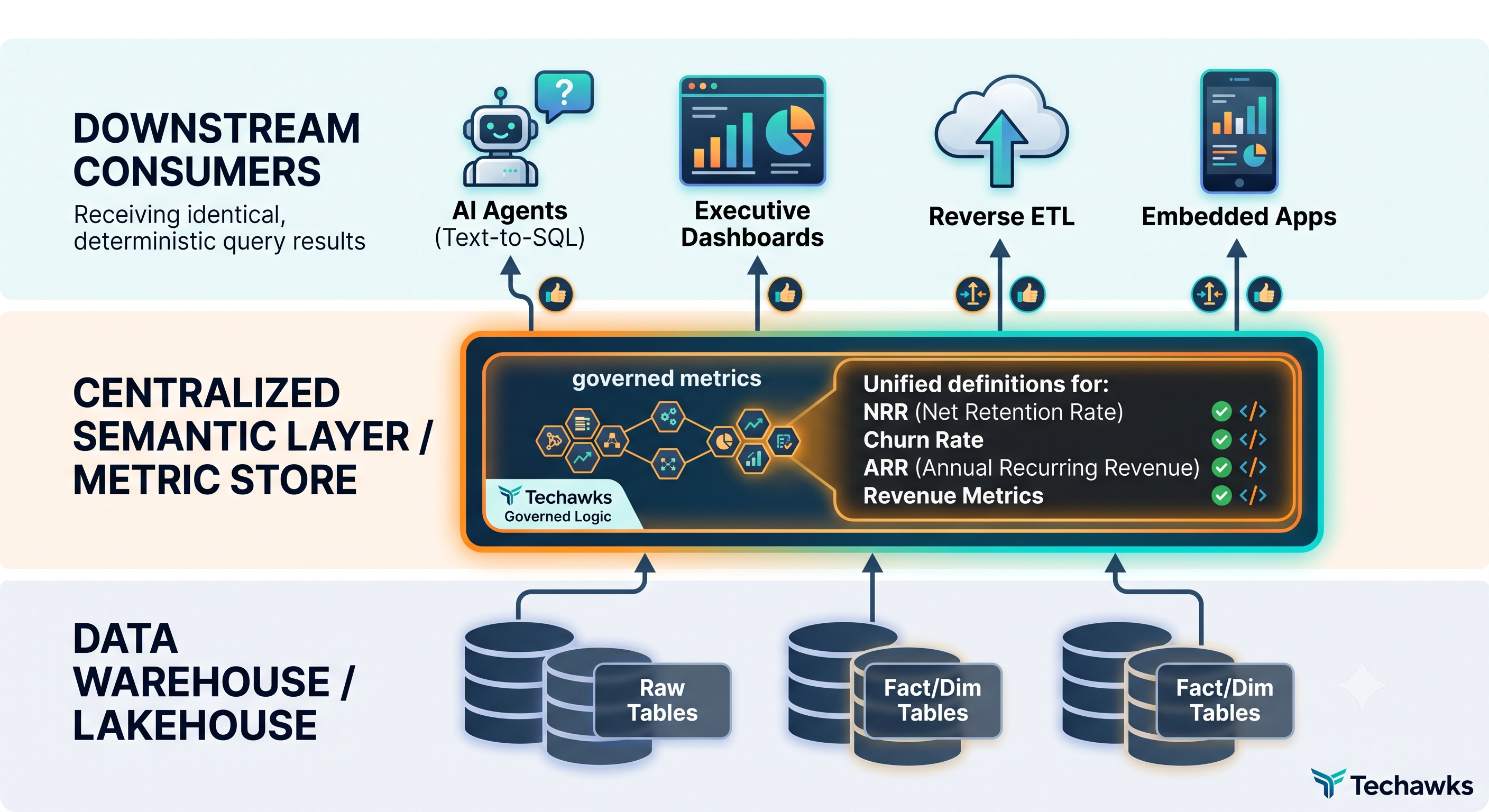 0 Kommentare 0 Geteilt 458 Ansichten 0 Bewertungen
 -
Vector Search vs. Exact Match: The Enterprise RAG Reality Check
As enterprise teams race to integrate large reasoning models and contextual retrieval into structured reporting, vector databases have become the default answer for data discovery. But treating semantic similarity as a silver bullet reveals a fundamental misunderstanding of high-dimensional geometry and business data retrieval.
Myth: Vector search completely replaces lexical and structured querying because semantic embeddings capture "true context."
Fact: Vector search calculates mathematical distance, not logical conditions. It excels at conceptual similarity ("find customer complaints regarding shipping delays"), but it consistently fails at deterministic enterprise queries ("return customer ID 88412 where transaction amount > $500 in Q3").
Why relying purely on vector embeddings fails in production analytics:
The Exact-Token Blind Spot: Embeddings project words into probabilistic dense vectors. They often confuse critical enterprise identifiers like part numbers, error codes, SKUs, and regulatory compliance IDs because two completely different serial codes share nearly identical vector distances.
The Memory Tax of HNSW: Graph-based Approximate Nearest Neighbor (ANN) indexes (such as HNSW) must typically reside in memory (RAM) to maintain sub-50ms query latency, creating severe infrastructure cost spikes as dataset scale expands.
Embedding Drift: When your underlying domain corpus evolves or upstream embedding models are updated, vector representations shift. Unlike SQL queries that throw syntax or index errors when broken, vector drift silently degrades retrieval relevance without alerting the operations team.
How to Engineer Robust Retrieval Today:
Implement Hybrid Search (Dense + Sparse): Combine vector embeddings (dense) with BM25 or full-text inverted indexes (sparse) using Reciprocal Rank Fusion (RRF) to capture both high-level intent and exact nomenclature.
Pre-Filter with Metadata: Never let a vector index scan an entire database when structured filters (dates, tenant IDs, regions) can instantly reduce the search space using standard relational or columnar indexes.
Track Semantic Drift: Build automated relevance evaluations (e.g., Mean Reciprocal Rank on golden prompt sets) instead of monitoring only system uptime and latency.
Discussion Question
Where has pure semantic vector retrieval failed most noticeably in your internal pipelines: numerical precision, filtered aggregations, or specialized domain acronyms?
CTA
Ready to build reliable, high-performance data architectures that bridge modern AI with rigorous enterprise analytics? Join the Data Science & Analytics community to collaborate on hybrid retrieval pipelines, data engineering best practices, and production analytics frameworks.Vector Search vs. Exact Match: The Enterprise RAG Reality Check As enterprise teams race to integrate large reasoning models and contextual retrieval into structured reporting, vector databases have become the default answer for data discovery. But treating semantic similarity as a silver bullet reveals a fundamental misunderstanding of high-dimensional geometry and business data retrieval. Myth: Vector search completely replaces lexical and structured querying because semantic embeddings capture "true context." Fact: Vector search calculates mathematical distance, not logical conditions. It excels at conceptual similarity ("find customer complaints regarding shipping delays"), but it consistently fails at deterministic enterprise queries ("return customer ID 88412 where transaction amount > $500 in Q3"). Why relying purely on vector embeddings fails in production analytics: The Exact-Token Blind Spot: Embeddings project words into probabilistic dense vectors. They often confuse critical enterprise identifiers like part numbers, error codes, SKUs, and regulatory compliance IDs because two completely different serial codes share nearly identical vector distances. The Memory Tax of HNSW: Graph-based Approximate Nearest Neighbor (ANN) indexes (such as HNSW) must typically reside in memory (RAM) to maintain sub-50ms query latency, creating severe infrastructure cost spikes as dataset scale expands. Embedding Drift: When your underlying domain corpus evolves or upstream embedding models are updated, vector representations shift. Unlike SQL queries that throw syntax or index errors when broken, vector drift silently degrades retrieval relevance without alerting the operations team. How to Engineer Robust Retrieval Today: Implement Hybrid Search (Dense + Sparse): Combine vector embeddings (dense) with BM25 or full-text inverted indexes (sparse) using Reciprocal Rank Fusion (RRF) to capture both high-level intent and exact nomenclature. Pre-Filter with Metadata: Never let a vector index scan an entire database when structured filters (dates, tenant IDs, regions) can instantly reduce the search space using standard relational or columnar indexes. Track Semantic Drift: Build automated relevance evaluations (e.g., Mean Reciprocal Rank on golden prompt sets) instead of monitoring only system uptime and latency. Discussion Question Where has pure semantic vector retrieval failed most noticeably in your internal pipelines: numerical precision, filtered aggregations, or specialized domain acronyms? CTA Ready to build reliable, high-performance data architectures that bridge modern AI with rigorous enterprise analytics? Join the Data Science & Analytics community to collaborate on hybrid retrieval pipelines, data engineering best practices, and production analytics frameworks.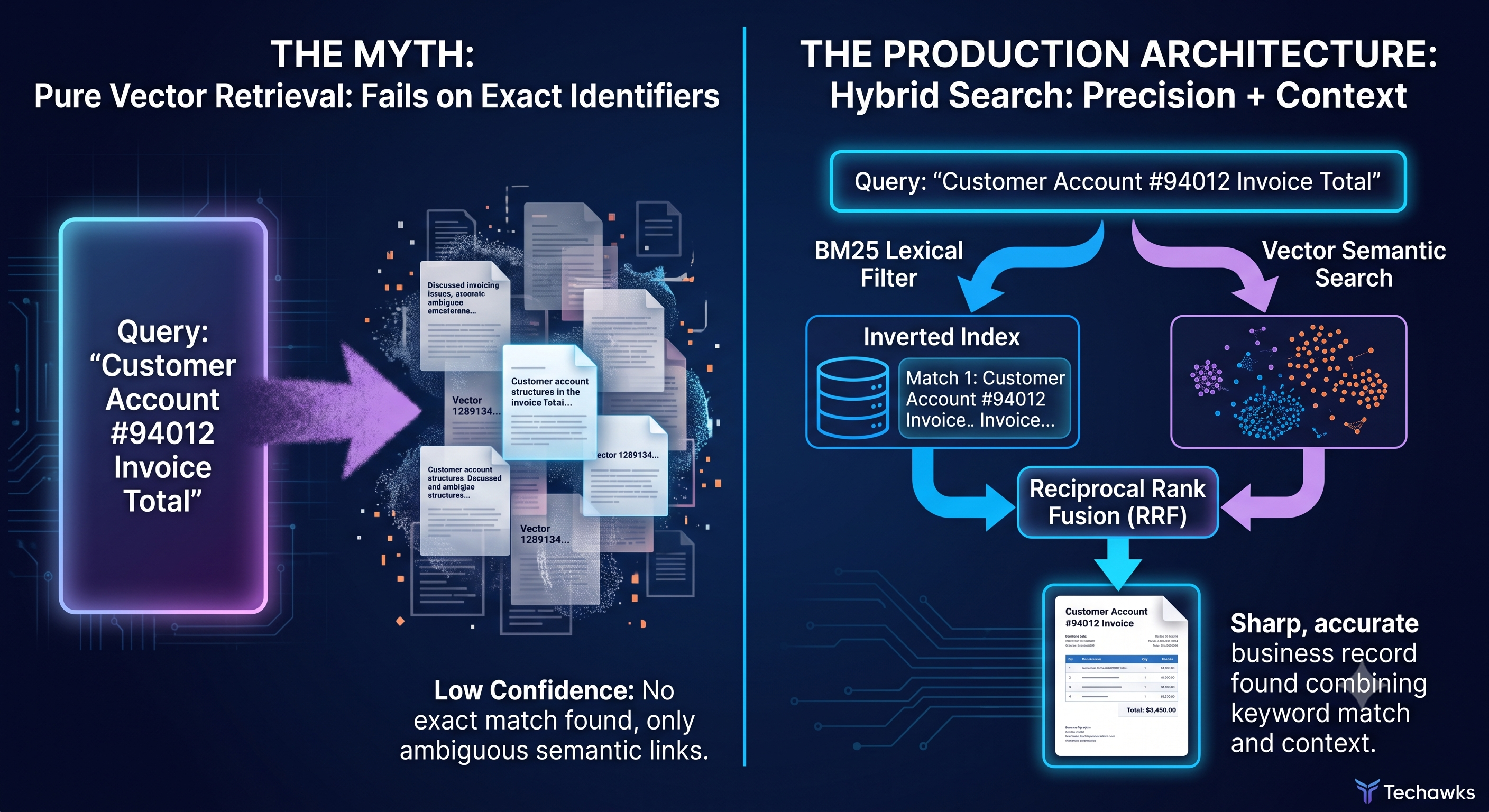 0 Kommentare 0 Geteilt 159 Ansichten 0 Bewertungen
 -
Stop Defaulting to Accuracy: The 7-Day Precision-Recall Audit
High overall accuracy is often the easiest metric to achieve and the quickest way to fail in production. When 99% of your transactions are legitimate and 1% are fraudulent, a model that predicts "legitimate" every single time will report 99% accuracy while catching zero fraud.
Evaluating models using the wrong aggregate metrics obscures critical blind spots:
The Asymmetry of Error: A false positive (flagging a valid transaction) causes minor customer friction. A false negative (missing actual fraud) causes direct financial loss. Standard accuracy treats both outcomes as identical.
Class Imbalance Masking: High-frequency classes overwhelm minority classes in loss functions, rewarding algorithms that simply guess the majority label.
Probability Miscalibration: Relying strictly on default 0.5 classification thresholds ignores the trade-off curve between precision (how many flagged items were truly positive) and recall (how many actual positives were found).
The 7-Day Precision-Recall Challenge:
Pick one production or development classification model currently evaluated on aggregate accuracy and run this audit:
Step 1: Compute the Confusion Matrix. Separate your validation outcomes into True Positives, False Positives, True Negatives, and False Negatives. Identify your single most expensive error type.
Step 2: Plot the PR (Precision-Recall) Curve. Move away from ROC-AUC when positive class prevalence is low (under 10%). A PR curve reveals model degradation that ROC curves hide.
Step 3: Shift the Decision Threshold. Move your threshold off the default 0.5. Measure the impact on both precision and recall. Find the operational cutoff that minimizes expected business cost rather than maximizing raw hits.
Step 4: Establish a New Primary Metric. Re-evaluate model iterations against F-beta (weighting recall over precision, or vice versa) or PR-AUC rather than raw accuracy.
Key Takeaways
Accuracy hides imbalance: High accuracy on rare-event detection usually means the model has learned to ignore the event entirely.
ROC-AUC flatters; PR-AUC clarifies: In skewed datasets, use Precision-Recall curves to get a realistic picture of positive-class performance.
Thresholds are business decisions: A 0.5 probability cutoff is an arbitrary default. Set classification boundaries based on the real-world cost of false positives versus false negatives.
CTA
Ready to move beyond textbook metrics and build production-grade analytical models? Join the Data Science & Analytics community to collaborate on real-world workflows, architecture, and deployment strategies.Stop Defaulting to Accuracy: The 7-Day Precision-Recall Audit High overall accuracy is often the easiest metric to achieve and the quickest way to fail in production. When 99% of your transactions are legitimate and 1% are fraudulent, a model that predicts "legitimate" every single time will report 99% accuracy while catching zero fraud. Evaluating models using the wrong aggregate metrics obscures critical blind spots: The Asymmetry of Error: A false positive (flagging a valid transaction) causes minor customer friction. A false negative (missing actual fraud) causes direct financial loss. Standard accuracy treats both outcomes as identical. Class Imbalance Masking: High-frequency classes overwhelm minority classes in loss functions, rewarding algorithms that simply guess the majority label. Probability Miscalibration: Relying strictly on default 0.5 classification thresholds ignores the trade-off curve between precision (how many flagged items were truly positive) and recall (how many actual positives were found). The 7-Day Precision-Recall Challenge: Pick one production or development classification model currently evaluated on aggregate accuracy and run this audit: Step 1: Compute the Confusion Matrix. Separate your validation outcomes into True Positives, False Positives, True Negatives, and False Negatives. Identify your single most expensive error type. Step 2: Plot the PR (Precision-Recall) Curve. Move away from ROC-AUC when positive class prevalence is low (under 10%). A PR curve reveals model degradation that ROC curves hide. Step 3: Shift the Decision Threshold. Move your threshold off the default 0.5. Measure the impact on both precision and recall. Find the operational cutoff that minimizes expected business cost rather than maximizing raw hits. Step 4: Establish a New Primary Metric. Re-evaluate model iterations against F-beta (weighting recall over precision, or vice versa) or PR-AUC rather than raw accuracy. Key Takeaways Accuracy hides imbalance: High accuracy on rare-event detection usually means the model has learned to ignore the event entirely. ROC-AUC flatters; PR-AUC clarifies: In skewed datasets, use Precision-Recall curves to get a realistic picture of positive-class performance. Thresholds are business decisions: A 0.5 probability cutoff is an arbitrary default. Set classification boundaries based on the real-world cost of false positives versus false negatives. CTA Ready to move beyond textbook metrics and build production-grade analytical models? Join the Data Science & Analytics community to collaborate on real-world workflows, architecture, and deployment strategies.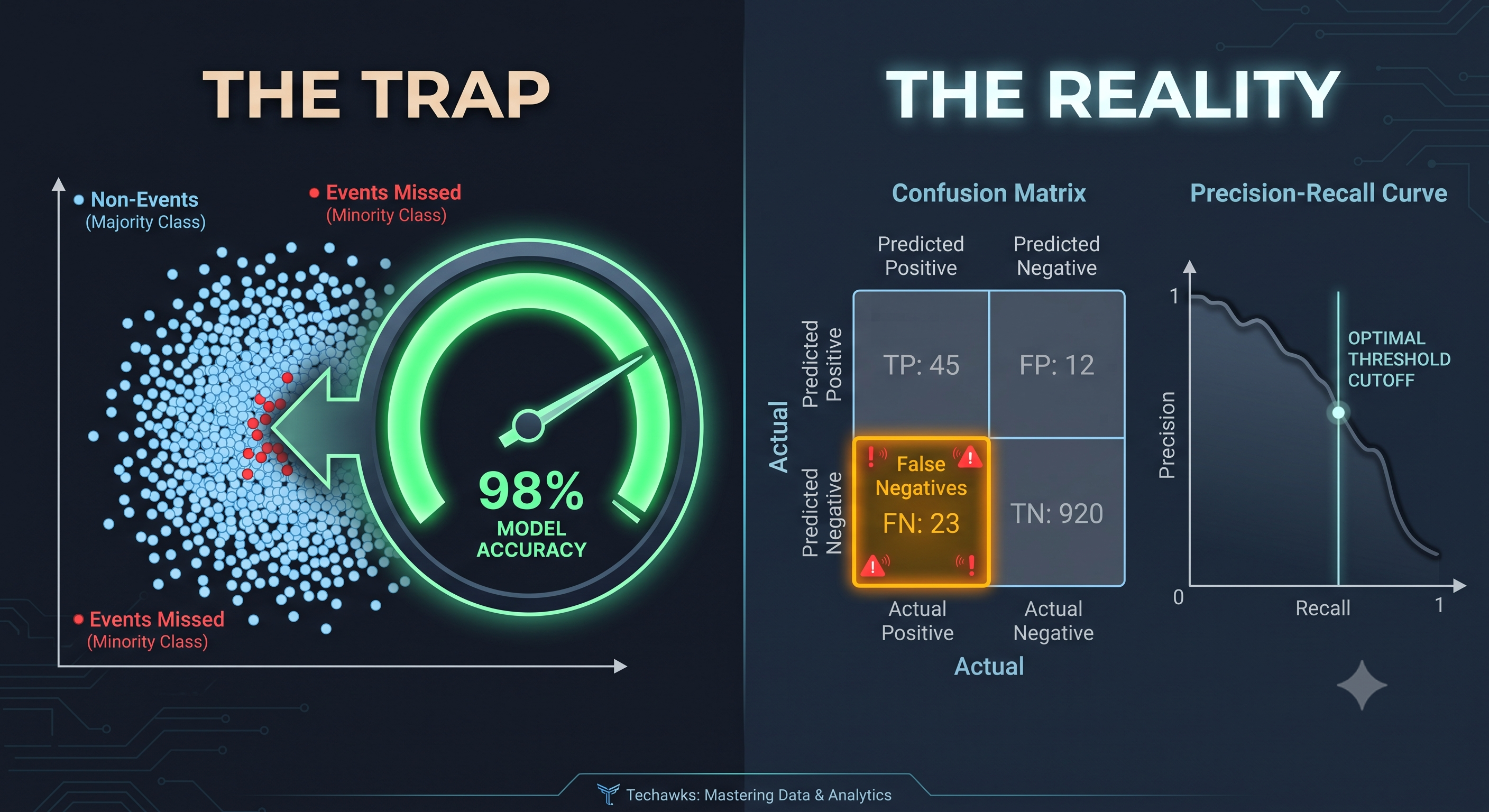 0 Kommentare 0 Geteilt 166 Ansichten 0 Bewertungen
Mehr Storys