English
 Arabic
 French
 Spanish
 Portuguese
 Deutsch
 Turkish
 Dutch
Dutch
 Italiano
 Russian
 Romaian
 Portuguese (Brazil)
 Greek
Greek
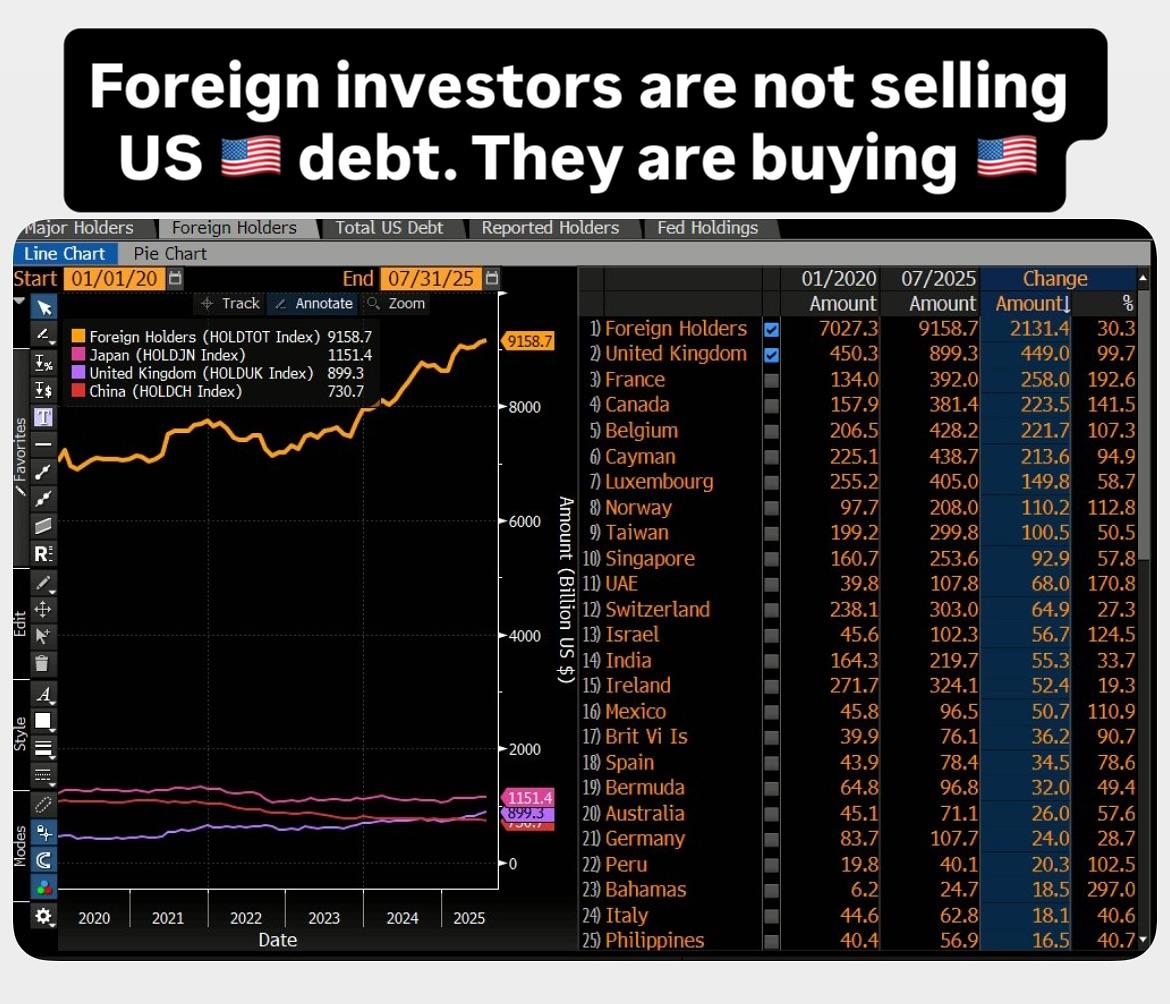
Foreign investors are not selling US debt. They are buying.
Total foreign holdings: $9.16T (July 2025), up from $7.0T in Jan 2020.
The U.K. doubled its exposure → $899B today vs. $450B in 2020.
France, Canada, Belgium, and Luxembourg also posted significant increases.
Japan remains the largest single holder at $1.15T, while China has reduced but still holds $730B.
This suggests that U.S. Treasuries are still viewed globally as the ultimate safe haven even in a high rate, high debt world.
#bloomberg #USTreasuries #GlobalMarkets #Macro #Investing #Geopolitics #DebtMarket #SafeHaven #Bonds #USDebt #macroeconomics
Total foreign holdings: $9.16T (July 2025), up from $7.0T in Jan 2020.
The U.K. doubled its exposure → $899B today vs. $450B in 2020.
France, Canada, Belgium, and Luxembourg also posted significant increases.
Japan remains the largest single holder at $1.15T, while China has reduced but still holds $730B.
This suggests that U.S. Treasuries are still viewed globally as the ultimate safe haven even in a high rate, high debt world.
#bloomberg #USTreasuries #GlobalMarkets #Macro #Investing #Geopolitics #DebtMarket #SafeHaven #Bonds #USDebt #macroeconomics
Foreign investors are not selling US 🇺🇸debt. They are buying.
Total foreign holdings: $9.16T (July 2025), up from $7.0T in Jan 2020.
The U.K. doubled its exposure → $899B today vs. $450B in 2020.
France, Canada, Belgium, and Luxembourg also posted significant increases.
Japan remains the largest single holder at $1.15T, while China has reduced but still holds $730B.
👉 This suggests that U.S. Treasuries are still viewed globally as the ultimate safe haven even in a high rate, high debt world.
#bloomberg #USTreasuries #GlobalMarkets #Macro #Investing #Geopolitics #DebtMarket #SafeHaven #Bonds #USDebt #macroeconomics
·536 Visualizações
·0 Anterior