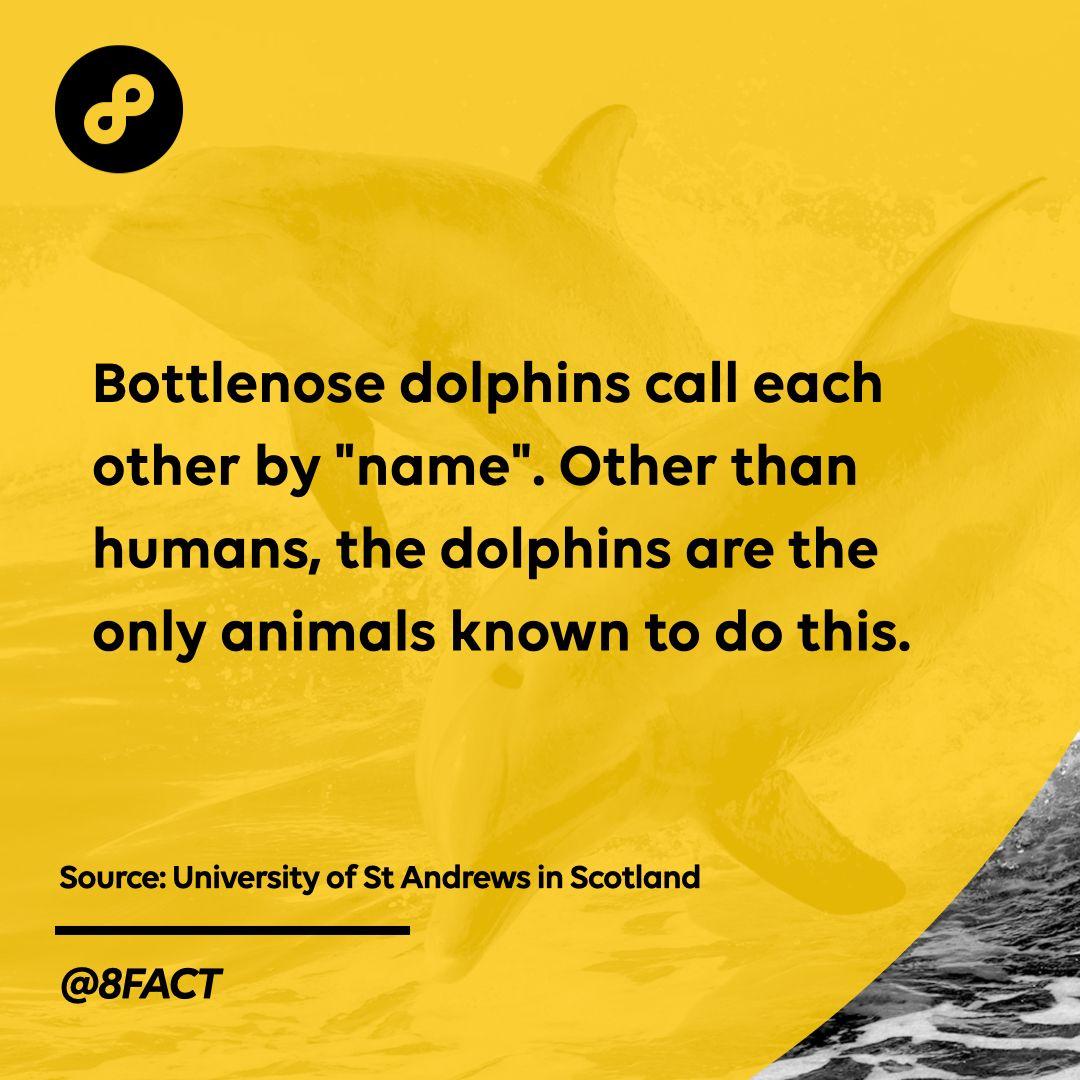
• The big difference with bottlenose dolphins is that these communications consist of whistles, not words.
    The big difference with bottlenose dolphins is that these communications consist of whistles, not words.
    ·33 Views ·0 Anteprima
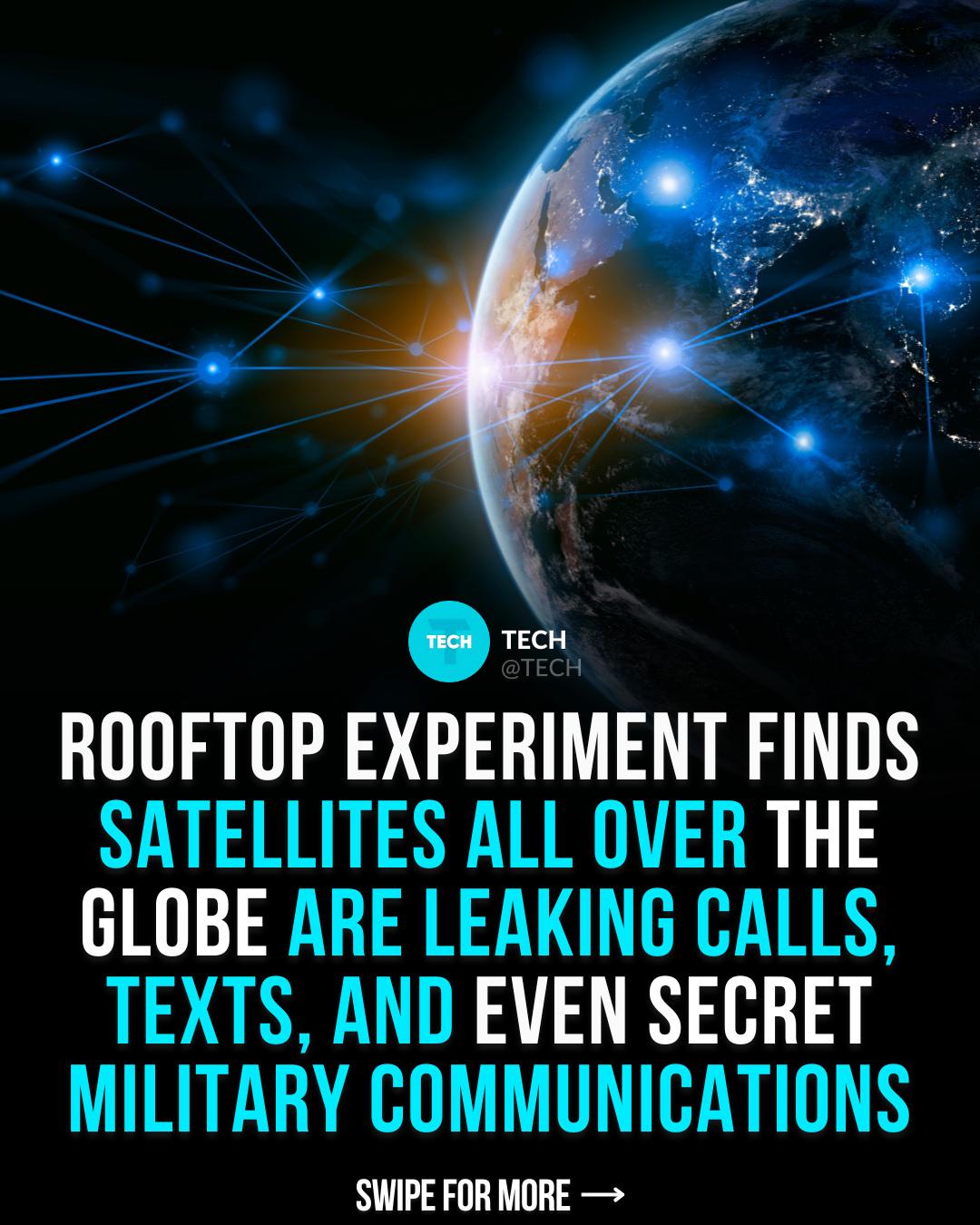
  • In San Diego, a small research team pointed a cheap residential satellite dish at the sky and watched the world's private traffic pour in. Using about $800 of off the shelf hardware and open source tools, they spent three years sweeping geostationary satellites that sit 22,000 miles above Earth and still quietly handle backhaul for airlines, remote cell towers, oil rigs, utilities, and governments. Instead of hardened, encrypted links, they kept finding raw, readable data flowing straight into their receiver.⁠

    From just 39 satellites, only a slice of the global geostationary fleet, the team captured private phone calls, text messages, in flight Wi Fi sessions, and internal corporate and government communications. A nine hour recording of T Mobile satellite backhaul revealed more than 2,700 phone numbers plus one side of users’ calls and SMS. Other links exposed browsing activity from passengers on commercial flights and traffic from rural internet customers whose data had been routed skyward without proper protection.⁠

    The leaks went far beyond consumer chatter. Mexican military and police units were broadcasting mission details, asset locations, and helicopter maintenance logs in the clear. U.S. vessels were transmitting unencrypted internal traffic that revealed ship identities and movements. Operators of critical infrastructure, including a major Latin American electric utility, were sending status reports, customer records, and failure alerts with no end to end encryption at all, creating an easy starting point for espionage or disruption.⁠

    After quiet disclosure, some firms, including T Mobile and AT&T, scrambled to add encryption, while others lagged behind. The researchers are now preparing an open source toolkit, named after their paper “Don’t Look Up,” so regulators, defenders, and operators can see for themselves what is leaking from orbit. The larger lesson is blunt, security by hoping nobody looks up is not security, it is an invitation.⁠

    #satellites #cybersecurity #encryption #infosec #space #communications #datasecurity #privacy #technology
    In San Diego, a small research team pointed a cheap residential satellite dish at the sky and watched the world's private traffic pour in. Using about $800 of off the shelf hardware and open source tools, they spent three years sweeping geostationary satellites that sit 22,000 miles above Earth and still quietly handle backhaul for airlines, remote cell towers, oil rigs, utilities, and governments. Instead of hardened, encrypted links, they kept finding raw, readable data flowing straight into their receiver.⁠ ⁠ From just 39 satellites, only a slice of the global geostationary fleet, the team captured private phone calls, text messages, in flight Wi Fi sessions, and internal corporate and government communications. A nine hour recording of T Mobile satellite backhaul revealed more than 2,700 phone numbers plus one side of users’ calls and SMS. Other links exposed browsing activity from passengers on commercial flights and traffic from rural internet customers whose data had been routed skyward without proper protection.⁠ ⁠ The leaks went far beyond consumer chatter. Mexican military and police units were broadcasting mission details, asset locations, and helicopter maintenance logs in the clear. U.S. vessels were transmitting unencrypted internal traffic that revealed ship identities and movements. Operators of critical infrastructure, including a major Latin American electric utility, were sending status reports, customer records, and failure alerts with no end to end encryption at all, creating an easy starting point for espionage or disruption.⁠ ⁠ After quiet disclosure, some firms, including T Mobile and AT&T, scrambled to add encryption, while others lagged behind. The researchers are now preparing an open source toolkit, named after their paper “Don’t Look Up,” so regulators, defenders, and operators can see for themselves what is leaking from orbit. The larger lesson is blunt, security by hoping nobody looks up is not security, it is an invitation.⁠ ⁠ #satellites #cybersecurity #encryption #infosec #space #communications #datasecurity #privacy #technology
    ·272 Views ·0 Anteprima
  • It began as an accident. Columbia University engineers were tuning laser chips for LiDAR when one prototype started behaving strangely, spitting out light that wasn’t just powerful—it was organized. Instead of a single color, the laser split into dozens of perfectly spaced hues, a “frequency comb” that could carry many data streams at once. One laser had become a rainbow of information.⁠

    Ordinarily, that kind of light requires bulky, power-hungry lab gear. But the Columbia team, led by Michal Lipson, managed to do it all on a chip. They used a multimode laser diode, the same kind found in industrial cutters, then cleaned its messy output with a self-injection locking mechanism built into a silicon photonics circuit. The system purified the beam, creating a stable, coherent light that naturally split into precise frequency bands.⁠

    Each band acts as a separate communication channel, allowing dozens of data streams to move in parallel through a single fiber. The result, published in *Nature Photonics*, is a compact, high-efficiency light source that replaces racks of lasers with one fingernail-sized chip. Lead author Andres Gil-Molina says it turns “a very powerful laser into dozens of clean, high-power channels,” cutting cost, power use, and space.⁠

    The timing is perfect. Data centers powering artificial intelligence are straining under massive data demands, most still using single-wavelength lasers. This “rainbow-on-a-chip” brings lab-grade optics to the hardware backbone of the internet—and could soon reshape everything from optical clocks and quantum networks to LiDAR and spectrometers.⁠

    #tech #ai #frequencycomb #photonics #datacenters #siliconphotonics #opticalcommunications #quantum #innovation
    It began as an accident. Columbia University engineers were tuning laser chips for LiDAR when one prototype started behaving strangely, spitting out light that wasn’t just powerful—it was organized. Instead of a single color, the laser split into dozens of perfectly spaced hues, a “frequency comb” that could carry many data streams at once. One laser had become a rainbow of information.⁠ ⁠ Ordinarily, that kind of light requires bulky, power-hungry lab gear. But the Columbia team, led by Michal Lipson, managed to do it all on a chip. They used a multimode laser diode, the same kind found in industrial cutters, then cleaned its messy output with a self-injection locking mechanism built into a silicon photonics circuit. The system purified the beam, creating a stable, coherent light that naturally split into precise frequency bands.⁠ ⁠ Each band acts as a separate communication channel, allowing dozens of data streams to move in parallel through a single fiber. The result, published in *Nature Photonics*, is a compact, high-efficiency light source that replaces racks of lasers with one fingernail-sized chip. Lead author Andres Gil-Molina says it turns “a very powerful laser into dozens of clean, high-power channels,” cutting cost, power use, and space.⁠ ⁠ The timing is perfect. Data centers powering artificial intelligence are straining under massive data demands, most still using single-wavelength lasers. This “rainbow-on-a-chip” brings lab-grade optics to the hardware backbone of the internet—and could soon reshape everything from optical clocks and quantum networks to LiDAR and spectrometers.⁠ ⁠ #tech #ai #frequencycomb #photonics #datacenters #siliconphotonics #opticalcommunications #quantum #innovation
    ·153 Views ·0 Anteprima
  • It began as an effort to clean up landfills, and now it could transform the skies. Scientists at the University of Illinois Urbana-Champaign have developed a process that converts food waste into sustainable aviation fuel, jet fuel that meets every U.S. aviation standard without needing to be blended with fossil fuels.⁠

    The method, published in Nature Communications, relies on a reaction called hydrothermal liquefaction, which mimics the geological forces that create crude oil. Under extreme heat and pressure, leftover food scraps from processing plants are transformed into a biocrude. That crude is then purified and refined through catalytic hydrotreating, a step that removes oxygen, nitrogen, and sulfur, leaving behind hydrocarbons that are chemically identical to those in conventional jet fuel.⁠

    The researchers discovered that cobalt–molybdenum catalysts performed best for this conversion, producing a fuel that passed all ASTM and FAA prescreening tests with no additives. In trials, the food based fuel met every criterion for use in commercial aircraft engines, a rare feat for any renewable energy source.⁠

    Scaling up will not be easy. Moving from lab batches to airport production will require reliable waste collection streams, new HTL facilities near population centers, and buy in from airlines already experimenting with SAF. The good news is that the science is largely solved, leaving industry to focus on financing, logistics, and certification.⁠

    Globally, over 30 percent of food is wasted each year, and when it decomposes in landfills, it emits greenhouse gases. This process closes that loop, turning waste into a resource while supporting aviation’s push toward net zero carbon emissions by 2050. Lead researcher Yuanhui Zhang calls it a missing link in the circular economy, a system that reclaims value from waste.
    It began as an effort to clean up landfills, and now it could transform the skies. Scientists at the University of Illinois Urbana-Champaign have developed a process that converts food waste into sustainable aviation fuel, jet fuel that meets every U.S. aviation standard without needing to be blended with fossil fuels.⁠ ⁠ The method, published in Nature Communications, relies on a reaction called hydrothermal liquefaction, which mimics the geological forces that create crude oil. Under extreme heat and pressure, leftover food scraps from processing plants are transformed into a biocrude. That crude is then purified and refined through catalytic hydrotreating, a step that removes oxygen, nitrogen, and sulfur, leaving behind hydrocarbons that are chemically identical to those in conventional jet fuel.⁠ ⁠ The researchers discovered that cobalt–molybdenum catalysts performed best for this conversion, producing a fuel that passed all ASTM and FAA prescreening tests with no additives. In trials, the food based fuel met every criterion for use in commercial aircraft engines, a rare feat for any renewable energy source.⁠ ⁠ Scaling up will not be easy. Moving from lab batches to airport production will require reliable waste collection streams, new HTL facilities near population centers, and buy in from airlines already experimenting with SAF. The good news is that the science is largely solved, leaving industry to focus on financing, logistics, and certification.⁠ ⁠ Globally, over 30 percent of food is wasted each year, and when it decomposes in landfills, it emits greenhouse gases. This process closes that loop, turning waste into a resource while supporting aviation’s push toward net zero carbon emissions by 2050. Lead researcher Yuanhui Zhang calls it a missing link in the circular economy, a system that reclaims value from waste.
    ·219 Views ·0 Anteprima
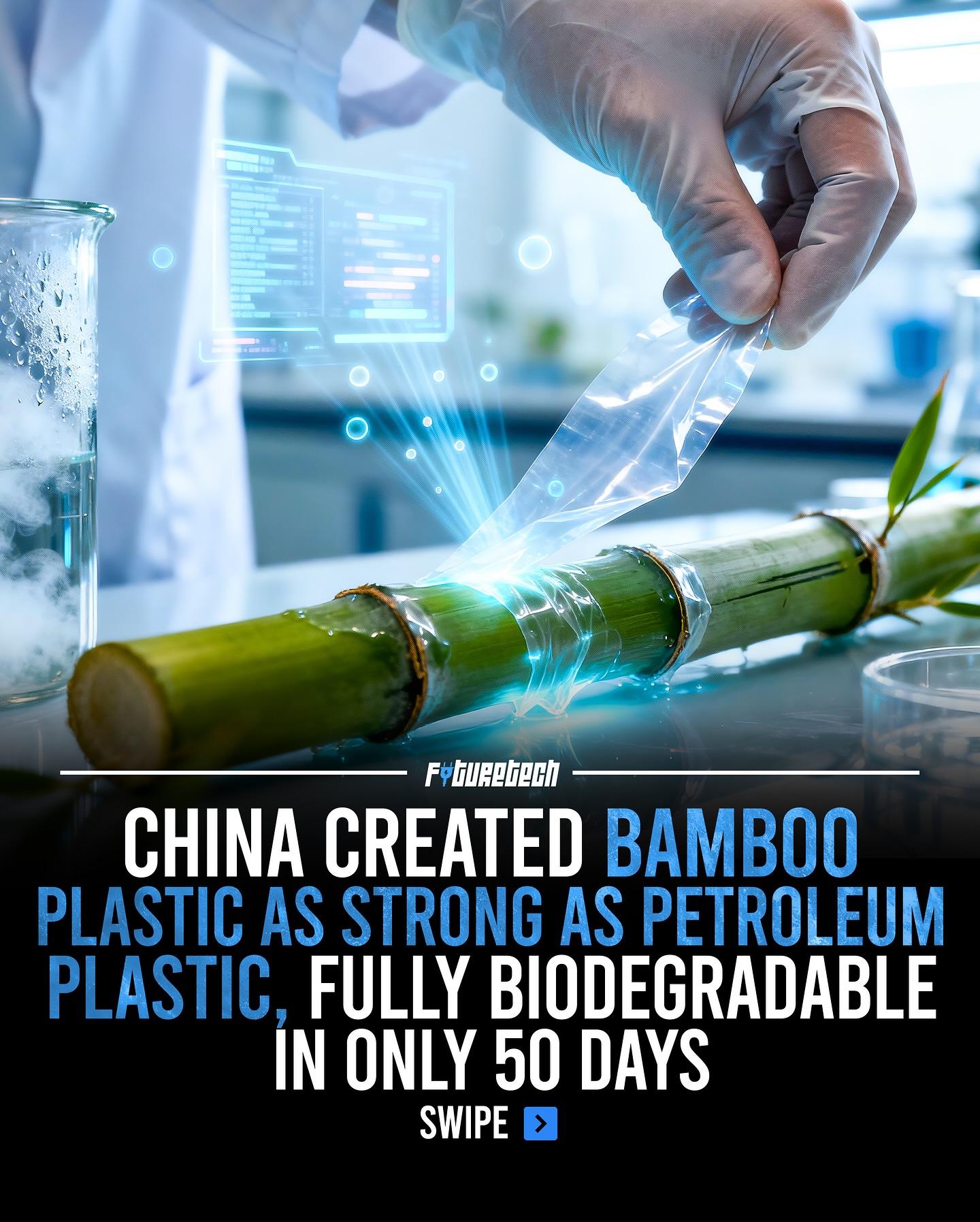
  • China has introduced a groundbreaking bamboo-based plastic that matches the strength and heat resistance of traditional petroleum plastics, but fully biodegrades within just 50 days.

    Created by scientists at Northeast Forestry University, the material derives its durability from bamboo cellulose while remaining completely non-toxic as it breaks down naturally in soil.

    Published in Nature Communications, the research represents a major leap in sustainable materials science. With large-scale production, this bamboo plastic could soon replace conventional plastics in packaging, furniture, and electronics – offering a practical path toward a cleaner, plastic-free future.

    Source: Nature Communications, Northeast Forestry University

    Follow us @FutureTech for more!
    China has introduced a groundbreaking bamboo-based plastic that matches the strength and heat resistance of traditional petroleum plastics, but fully biodegrades within just 50 days. 🌿♻️ Created by scientists at Northeast Forestry University, the material derives its durability from bamboo cellulose while remaining completely non-toxic as it breaks down naturally in soil. Published in Nature Communications, the research represents a major leap in sustainable materials science. With large-scale production, this bamboo plastic could soon replace conventional plastics in packaging, furniture, and electronics – offering a practical path toward a cleaner, plastic-free future. Source: Nature Communications, Northeast Forestry University Follow us @FutureTech for more! 🔌
    ·147 Views ·0 Anteprima
  • BMW’s icon just got a 2025 tune-up

    Spotted on the new iX3 at the Munich show, the refreshed roundel trims chrome and drops the inner ring for a cleaner read that still feels familiar.

    It follows the 2020 shift to a transparent, two-dimensional logo used on the Concept i4 and in BMW’s communications, a move aimed at digital clarity.

    Love learning? Follow @Wealth

    #BMW #Logo #Design #NeueKlasse #EVs
    BMW’s icon just got a 2025 tune-up 🔥 Spotted on the new iX3 at the Munich show, the refreshed roundel trims chrome and drops the inner ring for a cleaner read that still feels familiar. It follows the 2020 shift to a transparent, two-dimensional logo used on the Concept i4 and in BMW’s communications, a move aimed at digital clarity. Love learning? Follow @Wealth ⭐ #BMW #Logo #Design #NeueKlasse #EVs
    ·168 Views ·0 Anteprima
  • The Department of Telecommunications has sought an explanation from telecom majors Jio and Airtel on discontinuing the entry-level 1GB mobile data plans, as per a Mint report, noting that the move comes amid affordability concerns after the two biggest telecom operators withdrew their cheapest data plans and hiked tariffs.

    #Techinformer #Jio #Trai #Airtel
    The Department of Telecommunications has sought an explanation from telecom majors Jio and Airtel on discontinuing the entry-level 1GB mobile data plans, as per a Mint report, noting that the move comes amid affordability concerns after the two biggest telecom operators withdrew their cheapest data plans and hiked tariffs. #Techinformer #Jio #Trai #Airtel
    ·143 Views ·0 Anteprima
  • Australia is taking a bold and unprecedented step to protect young minds online, by banning teens under 16 from holding accounts on nearly every major social media platform, including YouTube. Once considered an exception, the world’s largest video-sharing site is now being swept into the crackdown, following government findings that it exposes children to the highest levels of harmful content.⁠

    Set to take effect December 10, the legislation targets platforms like TikTok, Instagram, Snapchat, Facebook, X, and now YouTube, requiring them to block underage accounts or face fines of up to A$50 million. Teens will still be able to view videos, but uploading content, commenting, or subscribing will be off limits.⁠

    YouTube had argued it’s a video library, not social media. But Australia’s eSafety Commissioner found otherwise, pointing to autoplay, algorithmic feeds, and “infinite scroll” as clear signs of persuasive design aimed at youth. One in four Australian children reported their last online harm occurred on YouTube, with content ranging from misogynistic speech to dangerous online challenges.⁠

    Communications Minister Anika Wells called the platform’s features “predatory,” likening the online environment to an ocean filled with rips and sharks. “We can’t control the ocean, but we can police the sharks,” she said. Despite threats of legal action from Google, the government isn’t backing down.⁠

    The law doesn’t mandate ID uploads but does require tech firms to take “reasonable steps” for age checks, including AI-based tools and behavior analysis. Trials are underway to assess the most effective methods. Messaging, gaming, health, and education apps are exempt.⁠

    “This isn’t perfect,” said PM Albanese. “But it’s a start, and we have to start somewhere.”
    Australia is taking a bold and unprecedented step to protect young minds online, by banning teens under 16 from holding accounts on nearly every major social media platform, including YouTube. Once considered an exception, the world’s largest video-sharing site is now being swept into the crackdown, following government findings that it exposes children to the highest levels of harmful content.⁠ ⁠ Set to take effect December 10, the legislation targets platforms like TikTok, Instagram, Snapchat, Facebook, X, and now YouTube, requiring them to block underage accounts or face fines of up to A$50 million. Teens will still be able to view videos, but uploading content, commenting, or subscribing will be off limits.⁠ ⁠ YouTube had argued it’s a video library, not social media. But Australia’s eSafety Commissioner found otherwise, pointing to autoplay, algorithmic feeds, and “infinite scroll” as clear signs of persuasive design aimed at youth. One in four Australian children reported their last online harm occurred on YouTube, with content ranging from misogynistic speech to dangerous online challenges.⁠ ⁠ Communications Minister Anika Wells called the platform’s features “predatory,” likening the online environment to an ocean filled with rips and sharks. “We can’t control the ocean, but we can police the sharks,” she said. Despite threats of legal action from Google, the government isn’t backing down.⁠ ⁠ The law doesn’t mandate ID uploads but does require tech firms to take “reasonable steps” for age checks, including AI-based tools and behavior analysis. Trials are underway to assess the most effective methods. Messaging, gaming, health, and education apps are exempt.⁠ ⁠ “This isn’t perfect,” said PM Albanese. “But it’s a start, and we have to start somewhere.”
    ·228 Views ·0 Anteprima
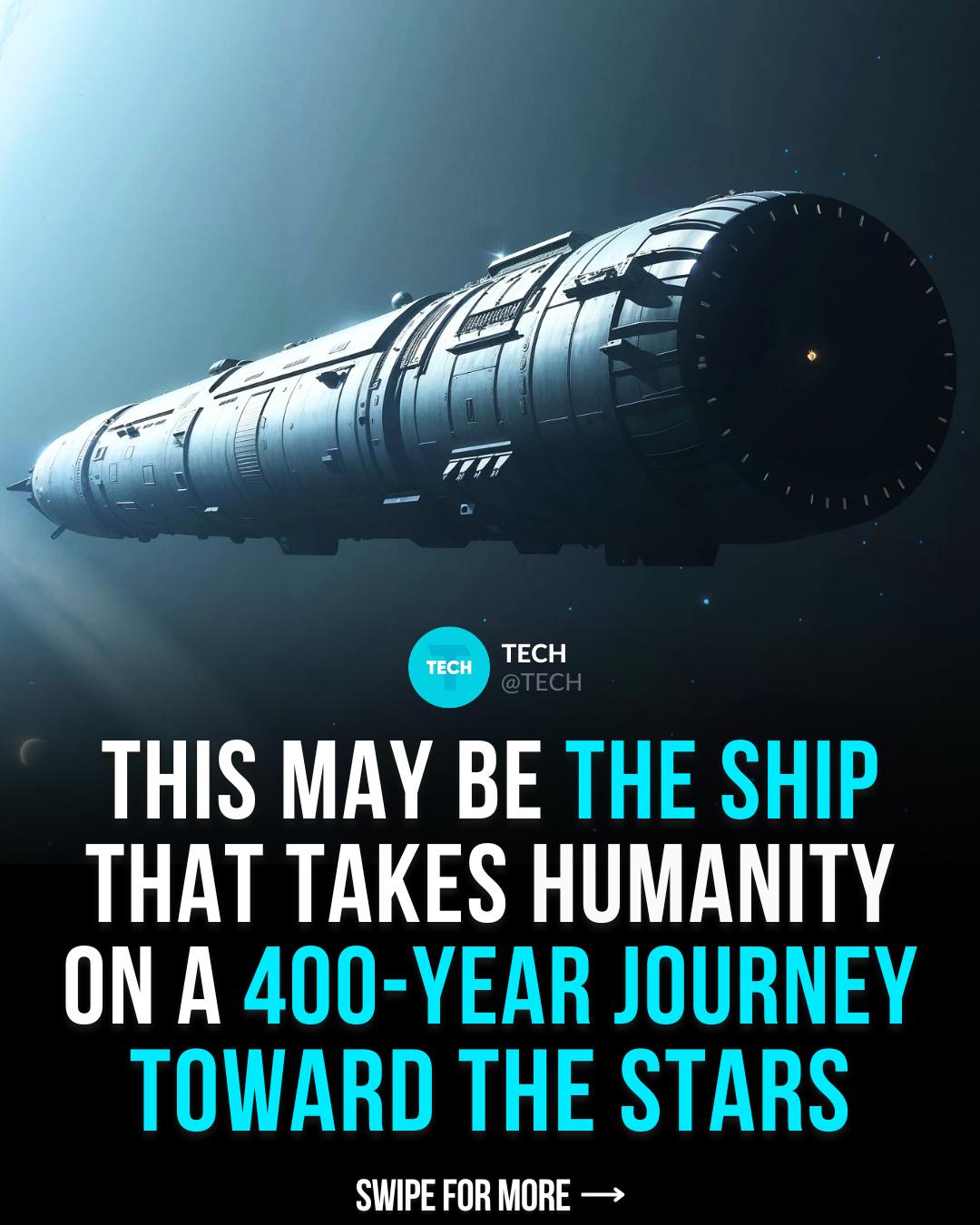
  • Italian researchers have unveiled Chrysalis, an ambitious generation-ship concept that could ferry humanity to Proxima b, a potentially habitable world 4.24 light-years away, in a 400-year voyage. Winner of the Project Hyperion design competition, Chrysalis is a 58-kilometer-long rotating cylinder built to sustain up to 2,400 passengers, though its population would be carefully managed to around 1,500 for resource balance.⁠

    The vessel is arranged like a colossal Russian nesting doll, with concentric shells serving distinct purposes. The outermost layer shields against radiation and micrometeoroids, doubling as a robotic-run warehouse. Moving inward, zones house industrial facilities, residential districts, communal parks, schools, and medical centers. A dedicated agricultural shell sustains biodiverse ecosystems, from tropical forests to boreal zones, alongside closed-loop systems for air, water, and nutrient recycling that could keep the ship habitable for centuries without resupply.⁠

    At its core, Chrysalis carries shuttles for planetfall and vital communications gear. A striking “Cosmo Dome” at the bow offers a weightless, panoramic view of deep space, hosting annual gatherings and symbolically facing back toward Earth. Artificial gravity comes from constant rotation, while propulsion would rely on a Direct Fusion Drive using helium-3 and deuterium, a technology still in development but capable of reaching one-tenth light speed.⁠

    Crew preparation is as crucial as engineering: the first generation would train for decades in an isolated Antarctic habitat to master self-sufficiency, cultural continuity, and psychological resilience. Governance blends human leadership with AI oversight to preserve knowledge, stability, and adaptability over centuries.⁠

    While purely conceptual, Chrysalis addresses the daunting technical, ecological, and social challenges of interstellar migration, and hints at how humanity might one day watch another sun rise over alien skies, carrying Earth’s heritage into the cosmic frontier.⁠

    Image Source: Project Hyperion/Chrysalis Planning and Design Team
    Italian researchers have unveiled Chrysalis, an ambitious generation-ship concept that could ferry humanity to Proxima b, a potentially habitable world 4.24 light-years away, in a 400-year voyage. Winner of the Project Hyperion design competition, Chrysalis is a 58-kilometer-long rotating cylinder built to sustain up to 2,400 passengers, though its population would be carefully managed to around 1,500 for resource balance.⁠ ⁠ The vessel is arranged like a colossal Russian nesting doll, with concentric shells serving distinct purposes. The outermost layer shields against radiation and micrometeoroids, doubling as a robotic-run warehouse. Moving inward, zones house industrial facilities, residential districts, communal parks, schools, and medical centers. A dedicated agricultural shell sustains biodiverse ecosystems, from tropical forests to boreal zones, alongside closed-loop systems for air, water, and nutrient recycling that could keep the ship habitable for centuries without resupply.⁠ ⁠ At its core, Chrysalis carries shuttles for planetfall and vital communications gear. A striking “Cosmo Dome” at the bow offers a weightless, panoramic view of deep space, hosting annual gatherings and symbolically facing back toward Earth. Artificial gravity comes from constant rotation, while propulsion would rely on a Direct Fusion Drive using helium-3 and deuterium, a technology still in development but capable of reaching one-tenth light speed.⁠ ⁠ Crew preparation is as crucial as engineering: the first generation would train for decades in an isolated Antarctic habitat to master self-sufficiency, cultural continuity, and psychological resilience. Governance blends human leadership with AI oversight to preserve knowledge, stability, and adaptability over centuries.⁠ ⁠ While purely conceptual, Chrysalis addresses the daunting technical, ecological, and social challenges of interstellar migration, and hints at how humanity might one day watch another sun rise over alien skies, carrying Earth’s heritage into the cosmic frontier.⁠ ⁠ Image Source: Project Hyperion/Chrysalis Planning and Design Team
    ·314 Views ·0 Anteprima
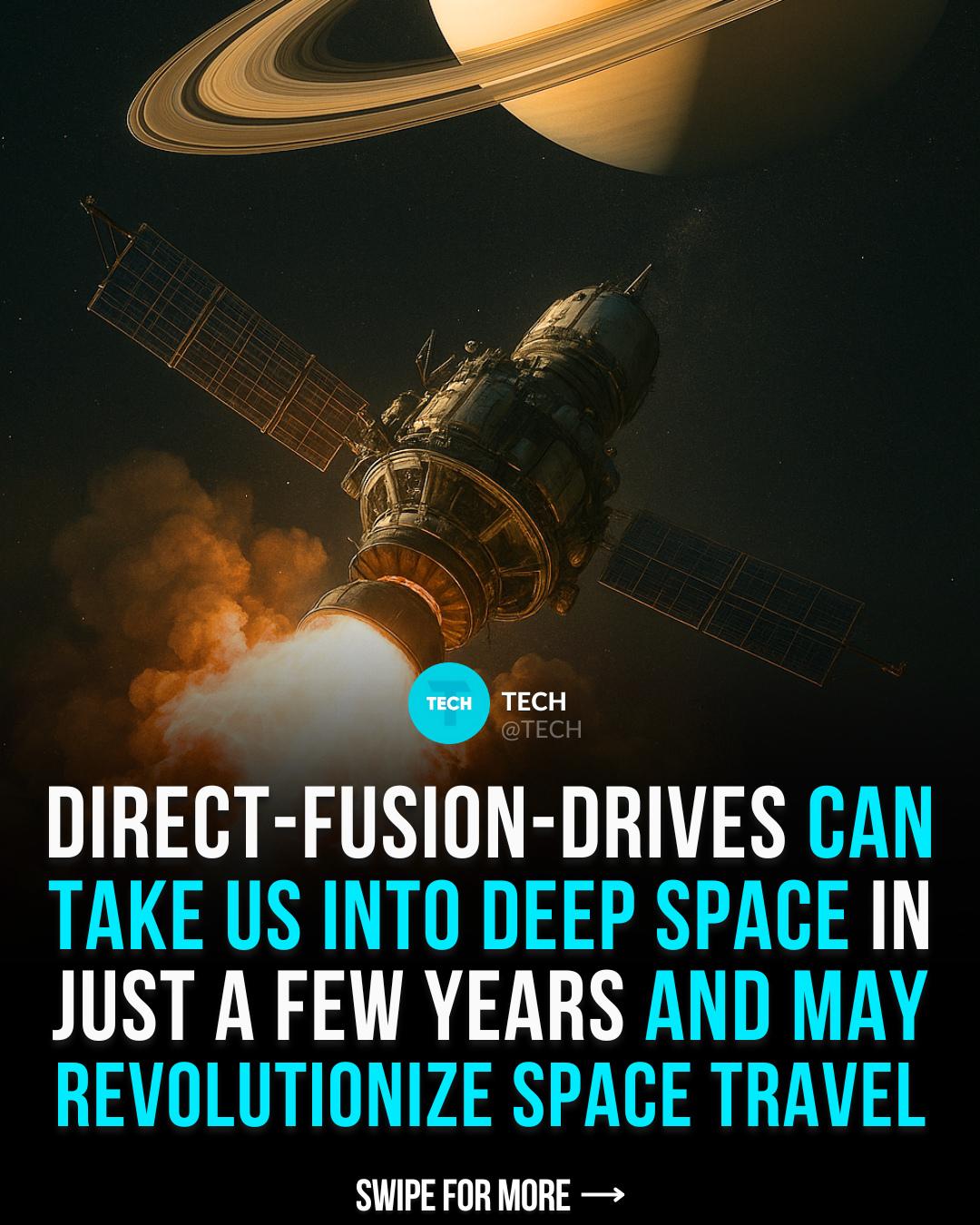
  • A century-old dream in propulsion is edging closer to reality, spacecraft powered by nuclear fusion engines. At the heart of this vision is the Direct Fusion Drive (DFD), a reactor that heats plasma with radio waves, fuses helium-3 and deuterium, and channels the reaction’s energy through an open nozzle to generate thrust. Compact and clean-burning, these engines could also power a ship’s internal systems, combining efficiency with versatility.⁠

    The payoff would be extraordinary. Saturn, nearly a billion miles away, could be reached in just two years, less than a third of the Cassini probe’s seven-year journey. Titan, Saturn’s largest moon, with methane seas and rich hydrocarbons, could become not only a target of exploration but a potential refueling hub in a future interplanetary network. Pluto could be reached in under five years, and even Sedna, a distant dwarf planet nearing its 11,000-year closest pass to the Sun, could be visited within a decade.⁠

    Unlike chemical rockets that demand vast fuel mass or solar sails limited by tiny payloads, DFDs promise both thrust and endurance. Each 1–10 megawatt reactor would be small enough for human and robotic missions, powerful enough to halve journey times, and efficient enough to support long-duration science operations once the destination is reached.⁠

    Engineers are mapping practical profiles now, including constant-thrust and thrust-coast-thrust modes that trade a bit of time for payload. A key window to Saturn’s system arrives in 2046, offering a concrete target for flight planning. And because DFDs generate abundant electrical power, they would run life support, instruments, and high-bandwidth communications from the same core that propels the craft.⁠

    Challenges remain steep, fusion is notoriously difficult to sustain, and prototype testing is still years away. But whether through NASA-backed PFRC experiments or ambitious private projects like Pulsar Fusion’s proposed Sunbird tugs, the race is on. If successful, fusion propulsion could compress the vastness of the solar system into reachable neighborhoods.⁠

    Source: 2506.17732
    A century-old dream in propulsion is edging closer to reality, spacecraft powered by nuclear fusion engines. At the heart of this vision is the Direct Fusion Drive (DFD), a reactor that heats plasma with radio waves, fuses helium-3 and deuterium, and channels the reaction’s energy through an open nozzle to generate thrust. Compact and clean-burning, these engines could also power a ship’s internal systems, combining efficiency with versatility.⁠ ⁠ The payoff would be extraordinary. Saturn, nearly a billion miles away, could be reached in just two years, less than a third of the Cassini probe’s seven-year journey. Titan, Saturn’s largest moon, with methane seas and rich hydrocarbons, could become not only a target of exploration but a potential refueling hub in a future interplanetary network. Pluto could be reached in under five years, and even Sedna, a distant dwarf planet nearing its 11,000-year closest pass to the Sun, could be visited within a decade.⁠ ⁠ Unlike chemical rockets that demand vast fuel mass or solar sails limited by tiny payloads, DFDs promise both thrust and endurance. Each 1–10 megawatt reactor would be small enough for human and robotic missions, powerful enough to halve journey times, and efficient enough to support long-duration science operations once the destination is reached.⁠ ⁠ Engineers are mapping practical profiles now, including constant-thrust and thrust-coast-thrust modes that trade a bit of time for payload. A key window to Saturn’s system arrives in 2046, offering a concrete target for flight planning. And because DFDs generate abundant electrical power, they would run life support, instruments, and high-bandwidth communications from the same core that propels the craft.⁠ ⁠ Challenges remain steep, fusion is notoriously difficult to sustain, and prototype testing is still years away. But whether through NASA-backed PFRC experiments or ambitious private projects like Pulsar Fusion’s proposed Sunbird tugs, the race is on. If successful, fusion propulsion could compress the vastness of the solar system into reachable neighborhoods.⁠ ⁠ Source: 2506.17732
    ·256 Views ·0 Anteprima
Pagine in Evidenza
Techawks - Powered By Pantrade Blockchain https://techawks.com