• The DPDP Compliance Mirage: Why a Privacy Policy Update Won’t Save Indian Startups from ₹250 Crore Penalties


    Across the Indian tech ecosystem—from Bengaluru SaaS ventures to Mumbai fintechs—a dangerous misconception has set in:


    ❌ The Myth: "DPDP compliance is a legal check-the-box exercise. Just update terms, publish a grievance officer email, and show a 'By signing up, you agree' consent banner."


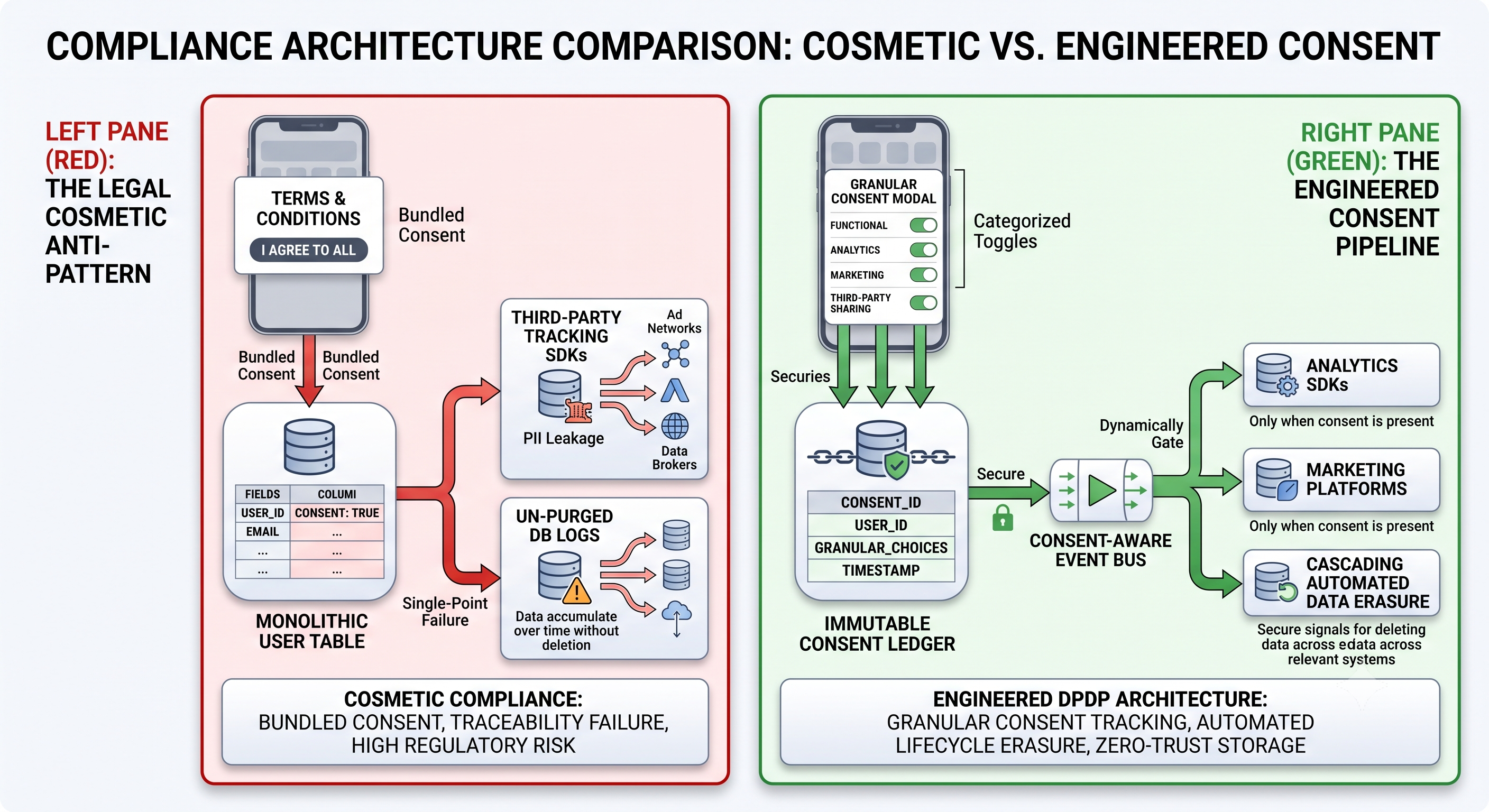
    ✅ The Reality: India’s Digital Personal Data Protection framework strictly bans bundled consent, pre-ticked checkboxes, and unconditional terms of service. True compliance requires granular consent ledgers, purpose-limited data lifecycles, and automated Right-to-Erasure workflows.


    Where Legacy Indian Tech Architectures Will Break:
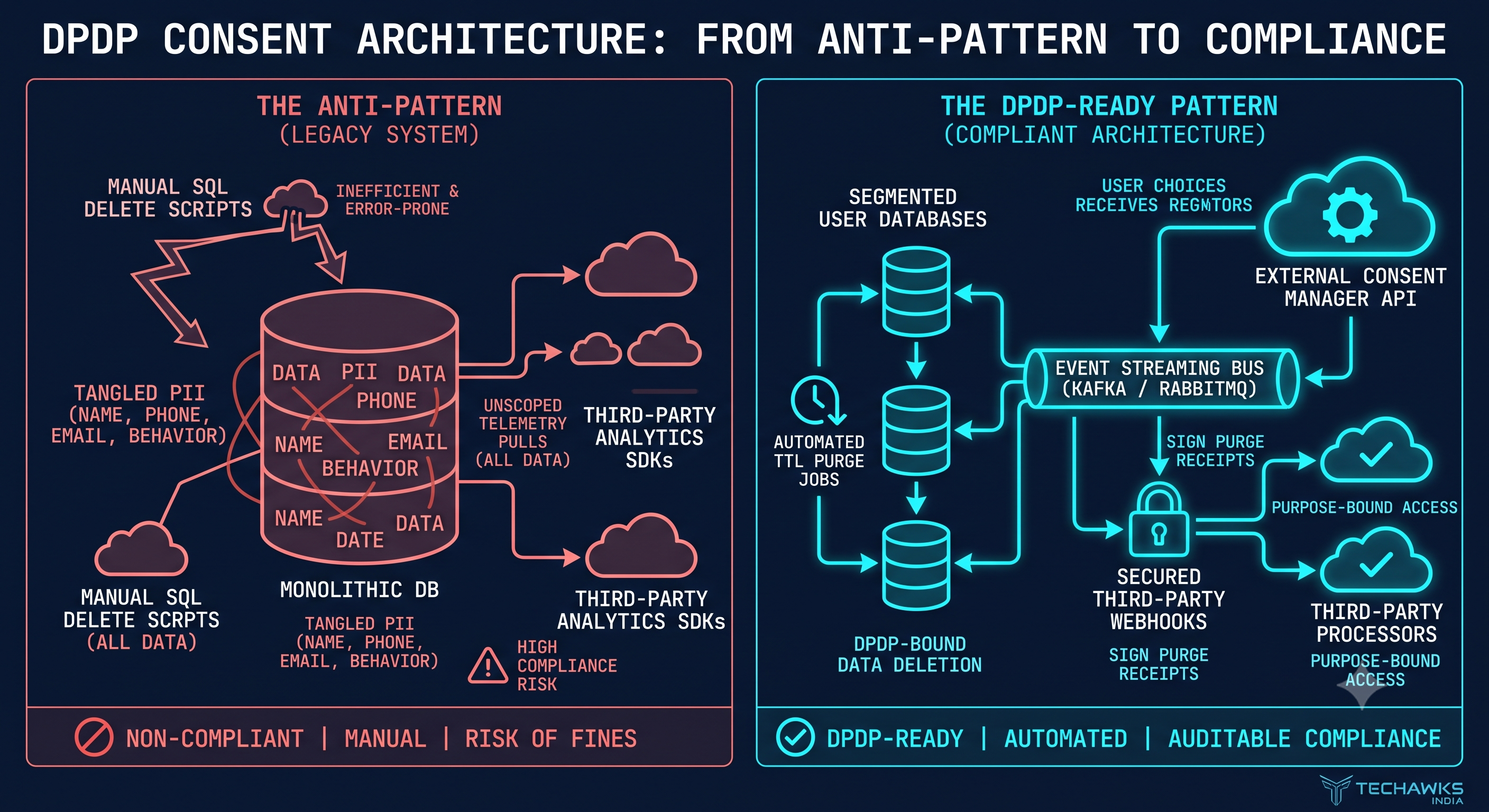
    The Single-Boolean Consent Flaw: Storing is_consent_given = true on your users table will fail compliance scrutiny. The law mandates granular, unbundled consent across specific processing purposes (e.g., core fulfillment vs. promotional analytics vs. third-party SDK sharing). If challenged, you must provide verifiable proof of the exact policy version and granular permissions granted at that timestamp.


    The "Soft-Delete" Illusion: In most Indian codebases, user deletion is merely setting is_deleted = true. Under DPDP’s Right to Erasure, holding plaintext personally identifiable information (PII) indefinitely across transaction logs, read replicas, and vector embeddings without an ongoing lawful purpose creates direct legal exposure.


    Third-Party Telemetry Leaks: When an app initializes third-party analytics, crash reporting, or advertising SDKs before explicit consent is granted, customer PII and device fingerprints get transmitted externally. Under the Act, the data fiduciary remains strictly liable for processors down the pipeline.


    The Engineering Blueprint for DPDP Readiness:
    Build an Immutable Consent Ledger: Implement a dedicated event log tracking User_ID, Purpose_Category, Policy_Version_Hash, and Timestamp. Every state change (opt-in or revocation) must publish an event to message brokers.


    Implement Dynamic Feature Gating: Decouple third-party trackers and non-essential APIs from initial app boot. Gate non-essential SDK network calls behind dynamic consent flags queried at runtime.


    Automate Cascading Erasure Pipelines: Build asynchronous workers (Kafka/SQS) that listen for withdrawal/deletion events to purge or irreversibly cryptographically tokenize customer PII across caching layers, data warehouses, and downstream microservices.


    The takeaway: A privacy policy written by a top law firm cannot compensate for an un-auditable database. If your engineering schema cannot programmatically trace and revoke consent per data field, your platform remains exposed.


    Discussion Question
    Has your team audited third-party analytics and ad SDKs for DPDP compliance, or are trackers still firing before explicit user consent is registered?


    CTA (Join Techawks India)
    Join Techawks India to discuss local engineering regulations, dissect sovereign tech architectures, and scale resilient products with India’s leading technologists.
    The DPDP Compliance Mirage: Why a Privacy Policy Update Won’t Save Indian Startups from ₹250 Crore Penalties Across the Indian tech ecosystem—from Bengaluru SaaS ventures to Mumbai fintechs—a dangerous misconception has set in: ❌ The Myth: "DPDP compliance is a legal check-the-box exercise. Just update terms, publish a grievance officer email, and show a 'By signing up, you agree' consent banner." ✅ The Reality: India’s Digital Personal Data Protection framework strictly bans bundled consent, pre-ticked checkboxes, and unconditional terms of service. True compliance requires granular consent ledgers, purpose-limited data lifecycles, and automated Right-to-Erasure workflows. Where Legacy Indian Tech Architectures Will Break: The Single-Boolean Consent Flaw: Storing is_consent_given = true on your users table will fail compliance scrutiny. The law mandates granular, unbundled consent across specific processing purposes (e.g., core fulfillment vs. promotional analytics vs. third-party SDK sharing). If challenged, you must provide verifiable proof of the exact policy version and granular permissions granted at that timestamp. The "Soft-Delete" Illusion: In most Indian codebases, user deletion is merely setting is_deleted = true. Under DPDP’s Right to Erasure, holding plaintext personally identifiable information (PII) indefinitely across transaction logs, read replicas, and vector embeddings without an ongoing lawful purpose creates direct legal exposure. Third-Party Telemetry Leaks: When an app initializes third-party analytics, crash reporting, or advertising SDKs before explicit consent is granted, customer PII and device fingerprints get transmitted externally. Under the Act, the data fiduciary remains strictly liable for processors down the pipeline. The Engineering Blueprint for DPDP Readiness: Build an Immutable Consent Ledger: Implement a dedicated event log tracking User_ID, Purpose_Category, Policy_Version_Hash, and Timestamp. Every state change (opt-in or revocation) must publish an event to message brokers. Implement Dynamic Feature Gating: Decouple third-party trackers and non-essential APIs from initial app boot. Gate non-essential SDK network calls behind dynamic consent flags queried at runtime. Automate Cascading Erasure Pipelines: Build asynchronous workers (Kafka/SQS) that listen for withdrawal/deletion events to purge or irreversibly cryptographically tokenize customer PII across caching layers, data warehouses, and downstream microservices. The takeaway: A privacy policy written by a top law firm cannot compensate for an un-auditable database. If your engineering schema cannot programmatically trace and revoke consent per data field, your platform remains exposed. Discussion Question Has your team audited third-party analytics and ad SDKs for DPDP compliance, or are trackers still firing before explicit user consent is registered? CTA (Join Techawks India) Join Techawks India to discuss local engineering regulations, dissect sovereign tech architectures, and scale resilient products with India’s leading technologists.
    0 Kommentare 0 Geteilt 315 Ansichten 0 Bewertungen
  • The "Autocomplete Trap": Why Passing Your Programming Lab Isn't the Same as Learning to Code


    Computer science students and self-taught learners are falling into a deceptive educational trap:


    ❌ The Myth: "Using an AI assistant to write functions and fix runtime bugs helps me learn faster because I see working code immediately."


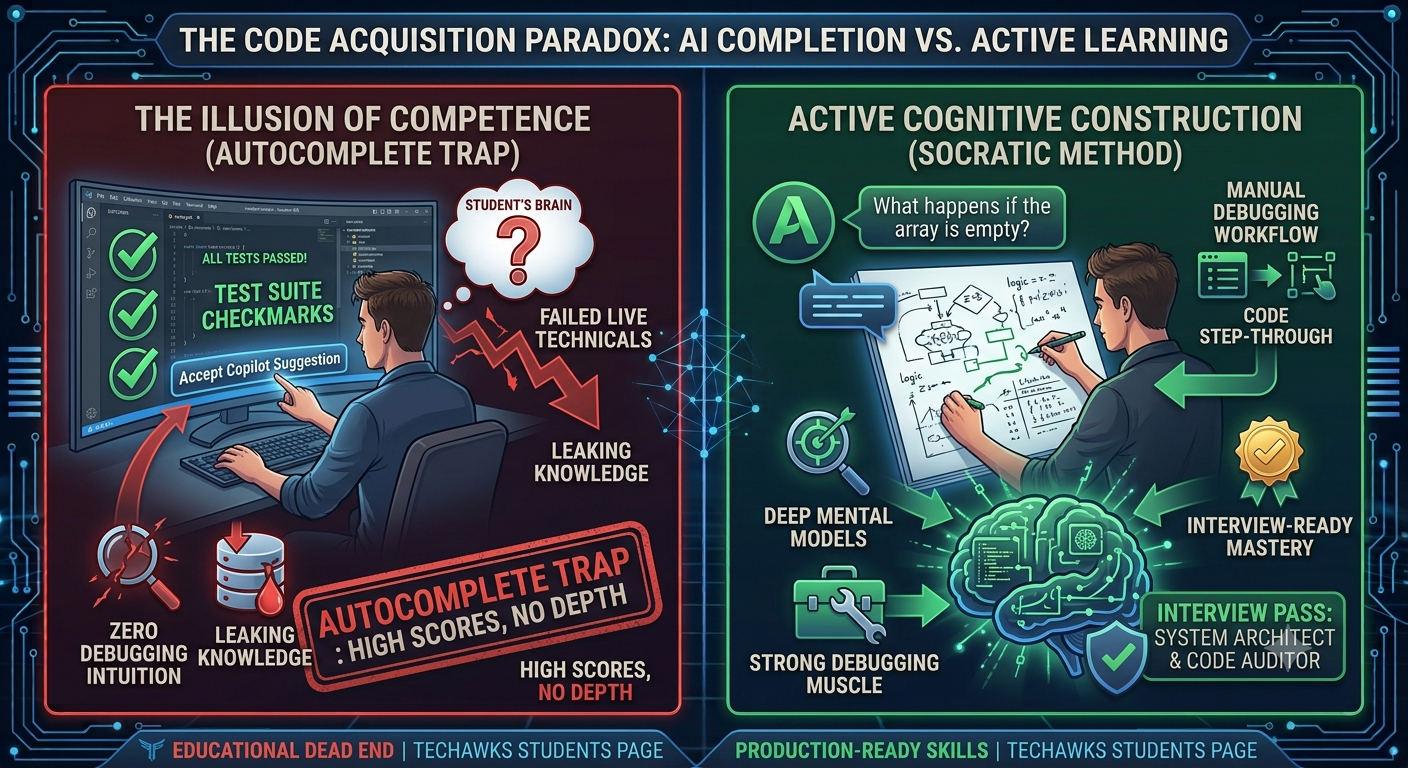
    ✅ The Reality: Completing an assignment quickly is not evidence of learning. Empirical research reveals that heavy AI code generation leads to cognitive offloading—students complete tasks with higher initial scores, but perform up to nearly two letter grades lower on independent conceptual and debugging tests.


    Why Copy-Pasting AI Code Blocks Deep Learning
    The Short-Circuit of the "Generation Effect": Long-term retention requires your brain to actively retrieve principles from memory. When an AI provides the solution, your brain switches to passive recognition, mistaking ease of reading for genuine comprehension.


    Atrophied Debugging Intuition: Research shows the steepest drop in unaided student performance happens in debugging. Stepping through a stack trace, forming hypotheses, and isolating a broken pointer are where core systems knowledge is forged. Offloading debugging to a chatbot eliminates the very feedback loop that makes you an engineer.


    The Blind Spot for Architecture: AI defaults to isolated, localized fixes. Relying on it prevents students from grasping how modules interact, how memory is allocated, and how algorithmic complexity scales.


    How High-Performing Students Use AI as a Socratic Tutor
    Stop treating AI like an oracle that produces the final answer. Turn it into a personal professor:


    The "Don't Give Me the Code" Prompt: Before asking a question, explicitly instruct the model: "Explain the concept or bug conceptually using pseudocode and analogies, but do not write any executable code for me."


    The Rubber-Duck Inversion: Write the code yourself, then paste it into the AI and prompt: "Critique my time/space complexity and point out potential edge-case failures without fixing them."


    The Pen-and-Paper Check: Before typing a single line into your IDE, trace your logic on paper with sample inputs. If you cannot trace your algorithm manually, you are relying on autocomplete rather than understanding.


    The takeaway: Anyone can prompt a model to write a binary search. The industry pays engineers who understand memory layouts, race conditions, and edge cases when the AI gets it wrong.


    Discussion Question
    When you run into a compiler error or logic bug, what is your immediate instinct—step through the debugger manually, or paste the error directly into an AI chat?


    CTA (Join Students in Tech)
    Join the Students in Tech community to exchange study roadmaps, collaborate on genuine open-source projects, and build rock-solid computer science fundamentals.
    The "Autocomplete Trap": Why Passing Your Programming Lab Isn't the Same as Learning to Code Computer science students and self-taught learners are falling into a deceptive educational trap: ❌ The Myth: "Using an AI assistant to write functions and fix runtime bugs helps me learn faster because I see working code immediately." ✅ The Reality: Completing an assignment quickly is not evidence of learning. Empirical research reveals that heavy AI code generation leads to cognitive offloading—students complete tasks with higher initial scores, but perform up to nearly two letter grades lower on independent conceptual and debugging tests. Why Copy-Pasting AI Code Blocks Deep Learning The Short-Circuit of the "Generation Effect": Long-term retention requires your brain to actively retrieve principles from memory. When an AI provides the solution, your brain switches to passive recognition, mistaking ease of reading for genuine comprehension. Atrophied Debugging Intuition: Research shows the steepest drop in unaided student performance happens in debugging. Stepping through a stack trace, forming hypotheses, and isolating a broken pointer are where core systems knowledge is forged. Offloading debugging to a chatbot eliminates the very feedback loop that makes you an engineer. The Blind Spot for Architecture: AI defaults to isolated, localized fixes. Relying on it prevents students from grasping how modules interact, how memory is allocated, and how algorithmic complexity scales. How High-Performing Students Use AI as a Socratic Tutor Stop treating AI like an oracle that produces the final answer. Turn it into a personal professor: The "Don't Give Me the Code" Prompt: Before asking a question, explicitly instruct the model: "Explain the concept or bug conceptually using pseudocode and analogies, but do not write any executable code for me." The Rubber-Duck Inversion: Write the code yourself, then paste it into the AI and prompt: "Critique my time/space complexity and point out potential edge-case failures without fixing them." The Pen-and-Paper Check: Before typing a single line into your IDE, trace your logic on paper with sample inputs. If you cannot trace your algorithm manually, you are relying on autocomplete rather than understanding. The takeaway: Anyone can prompt a model to write a binary search. The industry pays engineers who understand memory layouts, race conditions, and edge cases when the AI gets it wrong. Discussion Question When you run into a compiler error or logic bug, what is your immediate instinct—step through the debugger manually, or paste the error directly into an AI chat? CTA (Join Students in Tech) Join the Students in Tech community to exchange study roadmaps, collaborate on genuine open-source projects, and build rock-solid computer science fundamentals.
    0 Kommentare 0 Geteilt 153 Ansichten 0 Bewertungen
  • The HPA Thrashing Trap: Why Your Autoscaling Loop Is Bleeding Cloud Capital and Causing Outages


    A hidden reliability killer is quietly draining production clusters: autoscaling oscillation (thrashing).


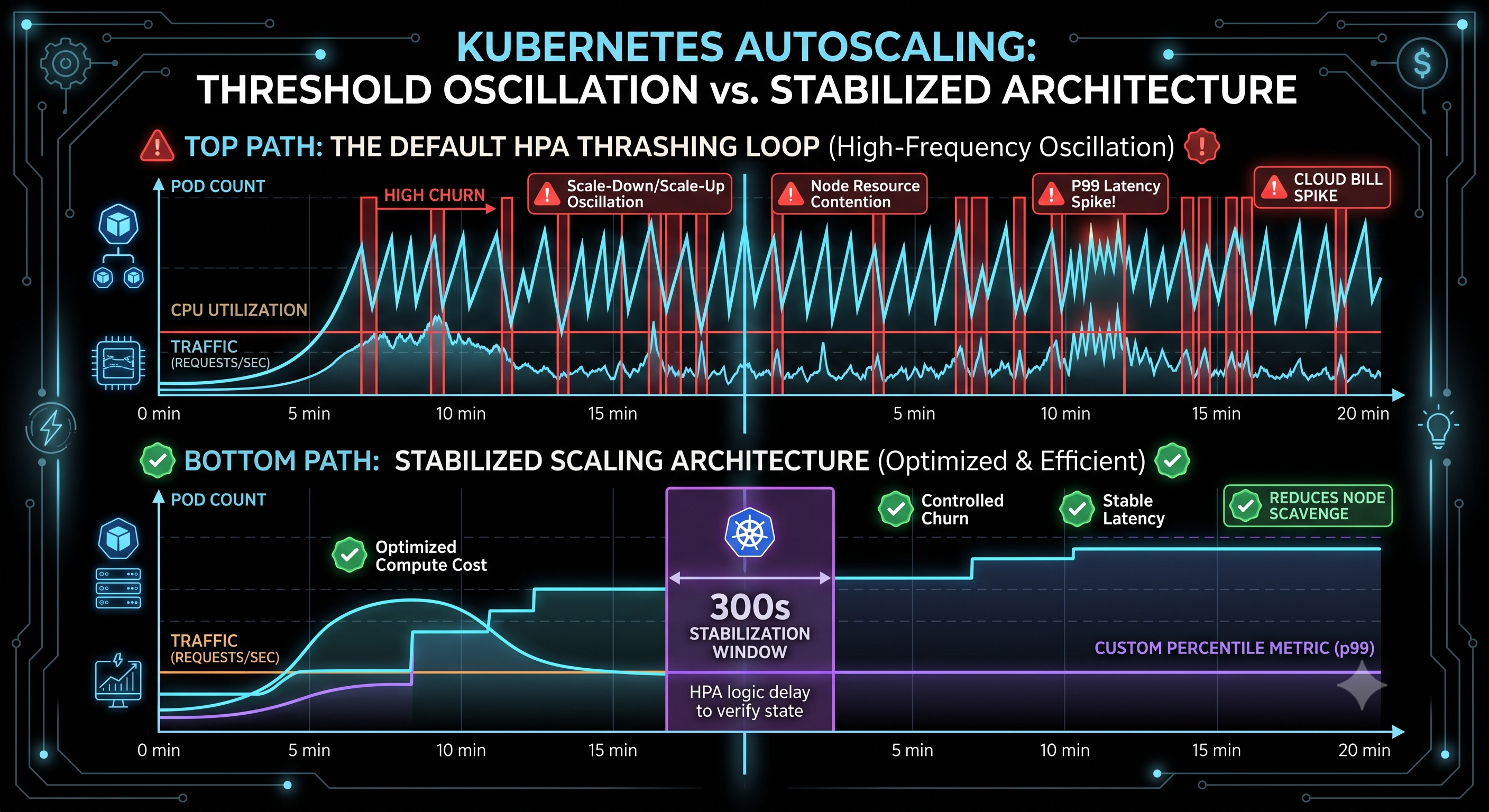
    When an application experiences variable traffic, default HPA configurations react instantaneously to raw metric spikes (like CPU usage crossing a 75% threshold). Pods spin up, pull heavy initial loads, cause resource contention on worker nodes, trigger a sudden metric drop, scale down pods, and immediately face a new traffic wave that forces another scale-up.


    This destructive cycle creates three severe production failures:


    The Orchestration Churn Tax: Rapidly provisioning and terminating pods floods the Kubernetes control plane with API requests, forces kubelet to constantly manage container lifecycle overhead, and saturates container network interfaces.
    Cascading P99 Latency Spikes: Cold starts, un-warmed connection pools, and database connection storms triggered by hundreds of short-lived pods simultaneously initializing degrade tail latencies far worse than handling peak load with a stable fleet.
    Cloud Cost Amplification: Managed Kubernetes node autoscalers (EKS, GKE, AKS) interpret pod scheduling pressure as a demand for more underlying VM instances, locking you into hourly billing for idle nodes provisioned during brief traffic spikes.
    The Architectural Fix: Implement Stabilization and Granular Metric Smoothing


    Stop letting raw, unfiltered metrics dictate cluster state. Reshape your autoscaling architecture with these three controls:


    Configure Scale-Down Stabilization Windows: Add explicit stabilization windows to your HPA manifest to delay scale-down actions (e.g., evaluating a 5-minute rolling window), preventing transient traffic dips from killing active pods prematurely:


    YAML
    behavior:
    scaleDown:
    stabilizationWindowSeconds: 300
    policies:
    - type: Percent
    value: 10
    periodSeconds: 60


    Switch to Custom Percentile Metrics: Raw average CPU or memory metrics can be easily skewed by a single runaway thread. Use Prometheus adapters to scale based on p95 or p99 request latency rather than raw node resource consumption.


    Enforce Pod Disruption Budgets (PDBs): Pair HPA rules with strict PDBs to ensure that automated scaling events never compromise minimum available replica counts during high-churn deployments.


    Elasticity without boundaries is just unmanaged chaos. Design your control loops to absorb volatility, not amplify it.


    Discussion Question
    How do your teams tune HPA cooldown windows and metric thresholds to prevent pod thrashing under unpredictable traffic surges?


    CTA
    Master resilient cloud-native architectures, optimize production workloads, and conquer infrastructure scale. Join Cloud, DevOps & Open Source at Techawks Cloud & DevOps.
    The HPA Thrashing Trap: Why Your Autoscaling Loop Is Bleeding Cloud Capital and Causing Outages A hidden reliability killer is quietly draining production clusters: autoscaling oscillation (thrashing). When an application experiences variable traffic, default HPA configurations react instantaneously to raw metric spikes (like CPU usage crossing a 75% threshold). Pods spin up, pull heavy initial loads, cause resource contention on worker nodes, trigger a sudden metric drop, scale down pods, and immediately face a new traffic wave that forces another scale-up. This destructive cycle creates three severe production failures: The Orchestration Churn Tax: Rapidly provisioning and terminating pods floods the Kubernetes control plane with API requests, forces kubelet to constantly manage container lifecycle overhead, and saturates container network interfaces. Cascading P99 Latency Spikes: Cold starts, un-warmed connection pools, and database connection storms triggered by hundreds of short-lived pods simultaneously initializing degrade tail latencies far worse than handling peak load with a stable fleet. Cloud Cost Amplification: Managed Kubernetes node autoscalers (EKS, GKE, AKS) interpret pod scheduling pressure as a demand for more underlying VM instances, locking you into hourly billing for idle nodes provisioned during brief traffic spikes. The Architectural Fix: Implement Stabilization and Granular Metric Smoothing Stop letting raw, unfiltered metrics dictate cluster state. Reshape your autoscaling architecture with these three controls: Configure Scale-Down Stabilization Windows: Add explicit stabilization windows to your HPA manifest to delay scale-down actions (e.g., evaluating a 5-minute rolling window), preventing transient traffic dips from killing active pods prematurely: YAML behavior: scaleDown: stabilizationWindowSeconds: 300 policies: - type: Percent value: 10 periodSeconds: 60 Switch to Custom Percentile Metrics: Raw average CPU or memory metrics can be easily skewed by a single runaway thread. Use Prometheus adapters to scale based on p95 or p99 request latency rather than raw node resource consumption. Enforce Pod Disruption Budgets (PDBs): Pair HPA rules with strict PDBs to ensure that automated scaling events never compromise minimum available replica counts during high-churn deployments. Elasticity without boundaries is just unmanaged chaos. Design your control loops to absorb volatility, not amplify it. Discussion Question How do your teams tune HPA cooldown windows and metric thresholds to prevent pod thrashing under unpredictable traffic surges? CTA Master resilient cloud-native architectures, optimize production workloads, and conquer infrastructure scale. Join Cloud, DevOps & Open Source at Techawks Cloud & DevOps.
    0 Kommentare 0 Geteilt 191 Ansichten 0 Bewertungen
  • Stop Writing Dual-Write Microservices: The Outbox Pattern You Should Be Implementing


    Here is a classic anti-pattern found in backend services:


    TypeScript
    // The dangerous "Dual-Write"
    async function createOrder(orderData) {
    const order = await db.orders.insert(orderData); // Step 1: DB write succeeds
    await eventBus.publish("OrderCreated", order); // Step 2: Network partition / Crash happens here!
    return order;
    }
    If the application crashes, network drops, or the broker rejects the event after Step 1, your database committed state that downstream systems will never know about.


    Wrapping both in a distributed transaction (2PC) hurts latency and throughput. Swapping the order—publishing the event first—is worse, because a database write failure leaves phantom events in your event stream.


    The Fix: The Transactional Outbox Pattern


    Instead of calling your message broker over the network in your application request lifecycle, leverage the ACID guarantees of your primary database:


    Atomic Dual-Write in a Single Engine: Create an outbox table in the same database schema as your domain tables. When mutating data, insert your business entity and write the corresponding integration event into the outbox table within the same local database transaction:


    SQL
    BEGIN TRANSACTION;
    INSERT INTO orders (id, customer_id, total) VALUES ('ord_101', 'cust_42', 150.00);
    INSERT INTO outbox (id, aggregate_type, payload, status)
    VALUES ('evt_201', 'Order', '{"id":"ord_101","total":150.00}', 'PENDING');
    COMMIT;
    Decoupled Asynchronous Relay: A separate asynchronous worker reads events from the outbox table and publishes them to the broker. You can implement this via:


    Polling Publisher: A scheduled query with SELECT ... FOR UPDATE SKIP LOCKED for low-to-medium scale.


    Change Data Capture (CDC): Tools like Debezium reading the database write-ahead log (WAL) directly for ultra-low latency and zero database read overhead.


    Guaranteed At-Least-Once Delivery: Because your database guarantees the transaction either commits both the entity and the outbox event or rolls back both, you eliminate silent data corruption at the root.


    Discussion Question
    When decoupling services, do you rely on Change Data Capture (CDC) against the WAL, polling-based outbox processors, or idempotent consumer retries to handle split-brain events?


    CTA
    Level up your backend architectures and write production-grade code. Join thousands of backend engineers, system designers, and software craftspeople in Developers & Coding.
    Stop Writing Dual-Write Microservices: The Outbox Pattern You Should Be Implementing Here is a classic anti-pattern found in backend services: TypeScript // The dangerous "Dual-Write" async function createOrder(orderData) { const order = await db.orders.insert(orderData); // Step 1: DB write succeeds await eventBus.publish("OrderCreated", order); // Step 2: Network partition / Crash happens here! return order; } If the application crashes, network drops, or the broker rejects the event after Step 1, your database committed state that downstream systems will never know about. Wrapping both in a distributed transaction (2PC) hurts latency and throughput. Swapping the order—publishing the event first—is worse, because a database write failure leaves phantom events in your event stream. The Fix: The Transactional Outbox Pattern Instead of calling your message broker over the network in your application request lifecycle, leverage the ACID guarantees of your primary database: Atomic Dual-Write in a Single Engine: Create an outbox table in the same database schema as your domain tables. When mutating data, insert your business entity and write the corresponding integration event into the outbox table within the same local database transaction: SQL BEGIN TRANSACTION; INSERT INTO orders (id, customer_id, total) VALUES ('ord_101', 'cust_42', 150.00); INSERT INTO outbox (id, aggregate_type, payload, status) VALUES ('evt_201', 'Order', '{"id":"ord_101","total":150.00}', 'PENDING'); COMMIT; Decoupled Asynchronous Relay: A separate asynchronous worker reads events from the outbox table and publishes them to the broker. You can implement this via: Polling Publisher: A scheduled query with SELECT ... FOR UPDATE SKIP LOCKED for low-to-medium scale. Change Data Capture (CDC): Tools like Debezium reading the database write-ahead log (WAL) directly for ultra-low latency and zero database read overhead. Guaranteed At-Least-Once Delivery: Because your database guarantees the transaction either commits both the entity and the outbox event or rolls back both, you eliminate silent data corruption at the root. Discussion Question When decoupling services, do you rely on Change Data Capture (CDC) against the WAL, polling-based outbox processors, or idempotent consumer retries to handle split-brain events? CTA Level up your backend architectures and write production-grade code. Join thousands of backend engineers, system designers, and software craftspeople in Developers & Coding.
    0 Kommentare 0 Geteilt 245 Ansichten 0 Bewertungen
  • Killing the Chatbot Shell: The Rise of Generative & Intent-Driven UI


    When generative AI first entered enterprise software, teams defaulted to conversational interfaces. But chat is fundamentally one-dimensional: it has high cognitive load, lacks spatial affordance, and destroys scannability.


    In product design, Generative UI represents the true paradigm shift: instead of returning unstructured markdown, the model selects and renders functional, stateful components directly out of your existing design system.


    The Fundamental Shift: From Fixed Screens to Assembled Moments
    Traditional UX design requires mapping every static screen and edge-case state beforehand. Generative UI flips this:


    The Designer’s New Scope: Designers stop delivering fixed 50-screen Figma user journeys. Instead, they design strict constraint systems, layout heuristics, atomic design tokens, and modular UI primitives (cards, micro-filters, confirmation blocks).


    Runtime Assembly: Based on user intent and context, the orchestration layer dynamically selects the right primitives, populates the schema, and renders an ephemeral, interactive micro-view.


    Three UX Principles for Generative Interfaces:
    Interactive Summaries Over Prose Walls: If a user queries "Compare Q3 churn across European enterprise accounts," the system shouldn’t stream three paragraphs. It should generate an interactive, sortable data grid with active inline filters and a visual sparkline.


    Shared Autonomy & Staged Execution: For agentic actions, never hide intent behind a generic "working..." spinner. Use Checkpoint UX: render an explicit preview card showing exactly what parameters the agent staged (e.g., recipient list, payload diff), allowing the human to approve, reject, or edit in place before execution.


    Transparent Layout Attribution: When an interface dynamically rearranges its layout or promotes specific widgets, explain why. A simple ambient cue—"Arranged based on your recent sprint review priorities"—preserves the mental model and prevents the user from feeling disoriented by shifting navigation.


    The most intuitive AI products will not look like chat apps. They will look like dynamic software that re-engineers its own canvas around the user's immediate intent.


    Discussion Question
    Is your product team moving beyond generic text-based chat towards rendering dynamic, typed UI components? What guardrails have you built into your design system to keep generative layouts coherent?


    CTA (Join Product, UX & Design)
    Ready to transition from static screen design to building generative, agentic user experiences? Join the Product, UX & Design community to discuss design system constraints, AI interaction heuristics, and practical product teardowns.
    Killing the Chatbot Shell: The Rise of Generative & Intent-Driven UI When generative AI first entered enterprise software, teams defaulted to conversational interfaces. But chat is fundamentally one-dimensional: it has high cognitive load, lacks spatial affordance, and destroys scannability. In product design, Generative UI represents the true paradigm shift: instead of returning unstructured markdown, the model selects and renders functional, stateful components directly out of your existing design system. The Fundamental Shift: From Fixed Screens to Assembled Moments Traditional UX design requires mapping every static screen and edge-case state beforehand. Generative UI flips this: The Designer’s New Scope: Designers stop delivering fixed 50-screen Figma user journeys. Instead, they design strict constraint systems, layout heuristics, atomic design tokens, and modular UI primitives (cards, micro-filters, confirmation blocks). Runtime Assembly: Based on user intent and context, the orchestration layer dynamically selects the right primitives, populates the schema, and renders an ephemeral, interactive micro-view. Three UX Principles for Generative Interfaces: Interactive Summaries Over Prose Walls: If a user queries "Compare Q3 churn across European enterprise accounts," the system shouldn’t stream three paragraphs. It should generate an interactive, sortable data grid with active inline filters and a visual sparkline. Shared Autonomy & Staged Execution: For agentic actions, never hide intent behind a generic "working..." spinner. Use Checkpoint UX: render an explicit preview card showing exactly what parameters the agent staged (e.g., recipient list, payload diff), allowing the human to approve, reject, or edit in place before execution. Transparent Layout Attribution: When an interface dynamically rearranges its layout or promotes specific widgets, explain why. A simple ambient cue—"Arranged based on your recent sprint review priorities"—preserves the mental model and prevents the user from feeling disoriented by shifting navigation. The most intuitive AI products will not look like chat apps. They will look like dynamic software that re-engineers its own canvas around the user's immediate intent. Discussion Question Is your product team moving beyond generic text-based chat towards rendering dynamic, typed UI components? What guardrails have you built into your design system to keep generative layouts coherent? CTA (Join Product, UX & Design) Ready to transition from static screen design to building generative, agentic user experiences? Join the Product, UX & Design community to discuss design system constraints, AI interaction heuristics, and practical product teardowns.
    0 Kommentare 0 Geteilt 238 Ansichten 0 Bewertungen
  • Stop Trusting "It Works in Staging": The Zero-Click Cloud Drift Audit


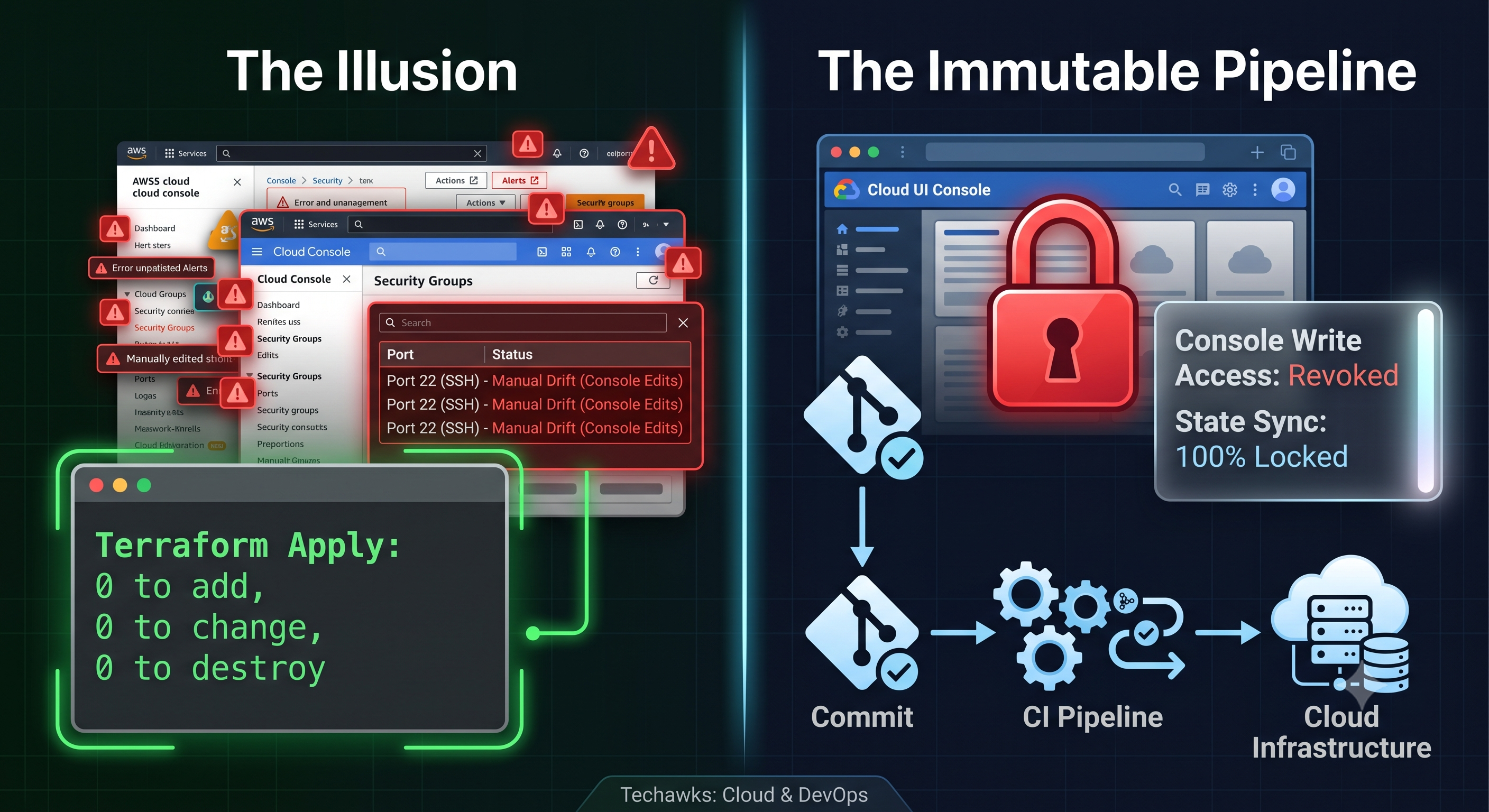
    Configuration drift is the silent killer of cloud reliability. It rarely starts with malicious intent; it begins with an emergency 2:00 AM hotfix, a temporary security group rule opened for debugging, or an unrecorded manual instance resize.


    When your real infrastructure diverges from your declarative code, you inherit major vulnerabilities:
    The Phantom Rollback: The next automated CI/CD pipeline run will either silently overwrite the emergency hotfix (re-breaking production) or fail entirely due to state mismatch.
    Security Blind Spots: Console-applied ingress rules bypass automated policy-as-code scanners (like tfsec or Checkov), leaving unauthorized ports open to the public internet.
    Non-Reproducible Environments: Disaster recovery plans collapse because your code can only spin up a fraction of the actual operational architecture.


    The 7-Day Zero-Click Infrastructure Challenge:
    Select one non-critical production workload or tier-2 microservice and execute this audit:
    Step 1: Run an Unscheduled Drift Detection. Trigger a clean terraform plan or equivalent state-refresh against live cloud state. Catalogue every single resource showing unexpected additions, modifications, or deletions outside of Git commits.
    Step 2: Codify or Terminate. For every drifted attribute found: either formalize it into your version-controlled templates with a proper pull request, or destroy it immediately to align with the true state.
    Step 3: Revoke Console Write Access. Strip interactive write/admin permissions for human operators in that target environment. Route all modifications—including environment variables and scaling policies—through peer-reviewed pull requests and automated pipelines.
    Step 4: Implement Automated Drift Alarms. Set up a scheduled, read-only pipeline run (e.g., every 6 hours) that alerts directly to your on-call channel whenever real-world infrastructure deviates from state files.


    Key Takeaways
    Console fixes are technical debt: A manual change in a cloud dashboard solves a symptom today while guaranteeing a deployment failure tomorrow.
    State files lie when humans have write access: Strict Least Privilege must apply to engineers, not just services; production changes belong exclusively in automated pipelines.
    Drift detection is preventive maintenance: Catching infrastructure deltas continuously prevents catastrophic surprises during critical disaster-recovery events.


    CTA
    Ready to build resilient, immutable infrastructure that eliminates drift and operational overhead? Join the Cloud, DevOps & Open Source community to exchange proven IaC workflows, GitOps pipelines, and multi-cloud architectures.
    Stop Trusting "It Works in Staging": The Zero-Click Cloud Drift Audit Configuration drift is the silent killer of cloud reliability. It rarely starts with malicious intent; it begins with an emergency 2:00 AM hotfix, a temporary security group rule opened for debugging, or an unrecorded manual instance resize. When your real infrastructure diverges from your declarative code, you inherit major vulnerabilities: The Phantom Rollback: The next automated CI/CD pipeline run will either silently overwrite the emergency hotfix (re-breaking production) or fail entirely due to state mismatch. Security Blind Spots: Console-applied ingress rules bypass automated policy-as-code scanners (like tfsec or Checkov), leaving unauthorized ports open to the public internet. Non-Reproducible Environments: Disaster recovery plans collapse because your code can only spin up a fraction of the actual operational architecture. The 7-Day Zero-Click Infrastructure Challenge: Select one non-critical production workload or tier-2 microservice and execute this audit: Step 1: Run an Unscheduled Drift Detection. Trigger a clean terraform plan or equivalent state-refresh against live cloud state. Catalogue every single resource showing unexpected additions, modifications, or deletions outside of Git commits. Step 2: Codify or Terminate. For every drifted attribute found: either formalize it into your version-controlled templates with a proper pull request, or destroy it immediately to align with the true state. Step 3: Revoke Console Write Access. Strip interactive write/admin permissions for human operators in that target environment. Route all modifications—including environment variables and scaling policies—through peer-reviewed pull requests and automated pipelines. Step 4: Implement Automated Drift Alarms. Set up a scheduled, read-only pipeline run (e.g., every 6 hours) that alerts directly to your on-call channel whenever real-world infrastructure deviates from state files. Key Takeaways Console fixes are technical debt: A manual change in a cloud dashboard solves a symptom today while guaranteeing a deployment failure tomorrow. State files lie when humans have write access: Strict Least Privilege must apply to engineers, not just services; production changes belong exclusively in automated pipelines. Drift detection is preventive maintenance: Catching infrastructure deltas continuously prevents catastrophic surprises during critical disaster-recovery events. CTA Ready to build resilient, immutable infrastructure that eliminates drift and operational overhead? Join the Cloud, DevOps & Open Source community to exchange proven IaC workflows, GitOps pipelines, and multi-cloud architectures.
    0 Kommentare 0 Geteilt 243 Ansichten 0 Bewertungen
  • The Seat-Based SaaS Trap: Why Per-User Pricing Destroys AI Startup Margins
    For over a decade, early-stage founders inherited a default playbook: build a B2B SaaS product, charge $30/seat/month, and expand revenue by convincing enterprises to add more employees to the dashboard.
    With AI-native automation and autonomous agent workflows, that pricing model is structurally broken.
    Myth: Charging per seat is the safest, most predictable pricing model for modern B2B tech startups.
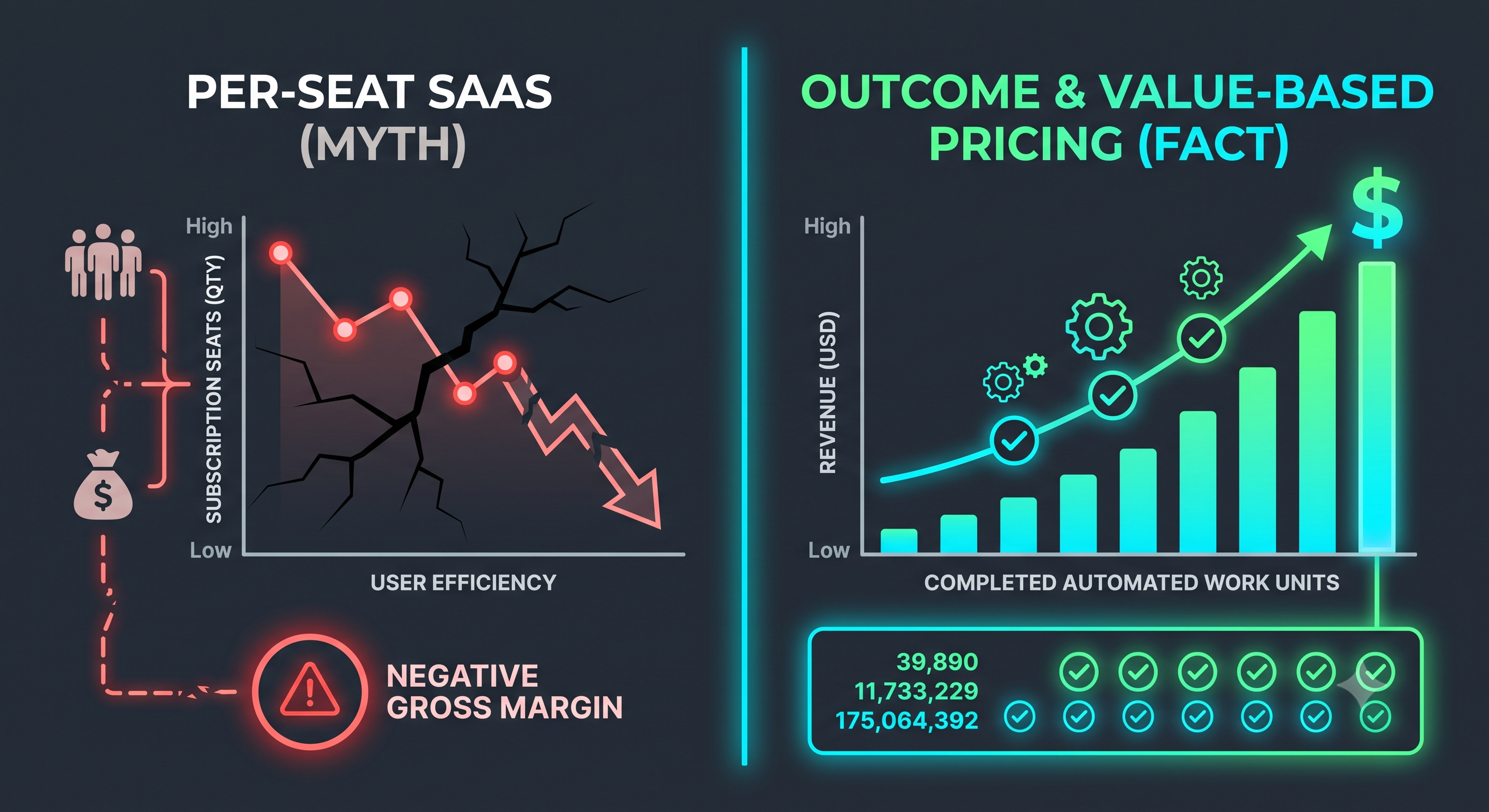
    Fact: Seat-based pricing penalizes software that automates labor. If your product successfully reduces the time a team spends on a task by 80%, the enterprise needs fewer headcount and fewer licenses—meaning higher product efficiency directly cannibalizes your expansion revenue.


    Why this matters for your startup economics:
    Traditional software had near-zero marginal cost of goods sold (COGS) per query. AI-native applications carry real variable compute costs (token inference, external tool calls, vector retrieval) alongside deterministic backend infrastructure.
    If a power user consumes $200 worth of model compute in a month under a flat $40/user seat plan, you have negative gross margins disguised as product adoption.


    How to architect sustainable, scalable pricing:


    Anchor Pricing to Work Units, Not Logins
    Price on work delivered: reconciled invoices, resolved support tickets, generated regulatory filings, or executed database migrations. Customers happily pay for completed outcomes that replace external service contracts or manual labor hours.


    Implement a Platform Floor + Usage Burndown
    Protect baseline unit economics. Charge a recurring base platform fee that covers baseline hosting and core infrastructure, bundled with a predetermined quota of outcome credits. Allow variable overages to burn against prepaid credit tiers.


    Decouple Access from Billing
    Encourage enterprise-wide team adoption by offering unlimited observer seats and collaboration access for free. The wider your software spreads across an organization, the more high-leverage workflows it triggers—scaling your outcome-based billable events without friction.
    Sustainable startup growth isn't about selling software licenses to human operators. It is about capturing a percentage of the economic value your automation creates.


    Discussion Question
    If your product cut customer workflow time by 90% tomorrow, would your existing pricing model gain more revenue or lose customer seats?


    CTA
    Ready to build resilient business models and scale past early-stage traps? Join the Startup Founders & Entrepreneurs community to dissect unit economics, trade go-to-market strategies, and scale with fellow operators
    The Seat-Based SaaS Trap: Why Per-User Pricing Destroys AI Startup Margins For over a decade, early-stage founders inherited a default playbook: build a B2B SaaS product, charge $30/seat/month, and expand revenue by convincing enterprises to add more employees to the dashboard. With AI-native automation and autonomous agent workflows, that pricing model is structurally broken. Myth: Charging per seat is the safest, most predictable pricing model for modern B2B tech startups. Fact: Seat-based pricing penalizes software that automates labor. If your product successfully reduces the time a team spends on a task by 80%, the enterprise needs fewer headcount and fewer licenses—meaning higher product efficiency directly cannibalizes your expansion revenue. Why this matters for your startup economics: Traditional software had near-zero marginal cost of goods sold (COGS) per query. AI-native applications carry real variable compute costs (token inference, external tool calls, vector retrieval) alongside deterministic backend infrastructure. If a power user consumes $200 worth of model compute in a month under a flat $40/user seat plan, you have negative gross margins disguised as product adoption. How to architect sustainable, scalable pricing: Anchor Pricing to Work Units, Not Logins Price on work delivered: reconciled invoices, resolved support tickets, generated regulatory filings, or executed database migrations. Customers happily pay for completed outcomes that replace external service contracts or manual labor hours. Implement a Platform Floor + Usage Burndown Protect baseline unit economics. Charge a recurring base platform fee that covers baseline hosting and core infrastructure, bundled with a predetermined quota of outcome credits. Allow variable overages to burn against prepaid credit tiers. Decouple Access from Billing Encourage enterprise-wide team adoption by offering unlimited observer seats and collaboration access for free. The wider your software spreads across an organization, the more high-leverage workflows it triggers—scaling your outcome-based billable events without friction. Sustainable startup growth isn't about selling software licenses to human operators. It is about capturing a percentage of the economic value your automation creates. Discussion Question If your product cut customer workflow time by 90% tomorrow, would your existing pricing model gain more revenue or lose customer seats? CTA Ready to build resilient business models and scale past early-stage traps? Join the Startup Founders & Entrepreneurs community to dissect unit economics, trade go-to-market strategies, and scale with fellow operators
    0 Kommentare 0 Geteilt 170 Ansichten 0 Bewertungen
  • The DPDP Consent Architecture Deadline: An Indian Tech Lead’s Production Readiness Checklist
    Most technical teams assume compliance begins and ends with updated privacy policy checkboxes and cookie banners. Under the DPDP framework and its Consent Manager rules, compliance is not a legal document—it is a distributed systems problem.


    Why It Matters to Indian Tech TeamsWith the operational rollout of the statutory Consent Manager Framework and the Data Protection Board's enforcement mechanisms, data handling requires auditable state machines. If a user revokes consent via an external interoperable Consent Manager, that revocation must propagate deterministically across your microservices, cache layers, and downstream analytics pipelines.


    Failure to prove cryptographic verification and purposive data isolation risks penalties reaching up to ₹250 crore per violation.


    The Production Readiness Checklist for Engineering Teams
    [ ] 1. Decouple User Identity from Behavioral Schemas
    └─ Store PII and transactional data in segregated, encrypted partitions.
    └─ Enforce cryptographic pseudonymization before piping events to telemetry or training clusters.


    [ ] 2. Implement a Real-Time Consent Invalidation Bus
    └─ Treat consent state as an event stream (e.g., Kafka topic) rather than a static DB boolean.
    └─ Propagate consent withdrawal webhooks downstream with bounded SLA (< 1 hour across active sessions).


    [ ] 3. Audit Purpose-Bound API Payloads
    └─ Strip all blanket "read-all" scopes across internal microservices.
    └─ Gate endpoints using attribute-based access controls (ABAC) tied strictly to active, granular consent IDs.


    [ ] 4. Enforce Retention Schedules at the Storage Engine Level
    └─ Transition from manual DB cleanup scripts to TTL-based automatic purge policies in primary and secondary stores.
    └─ Verify cold-storage archive purges and 7-year audit log retention for consent trails.


    [ ] 5. Standardize Data Processor (Vendor) Webhook Protocols
    └─ Map every external SDK (analytics, CRM, payment aggregators) handling Indian user telemetry.
    └─ Establish signed purge receipts from third-party processors whenever an erasure request is executed.


    Compliance isn't solved by adding terms to a signup page—it's solved by how reliably your architecture handles data isolation and deletion requests.


    Discussion Question
    How is your engineering team currently architecting downstream consent revocation across your caching and asynchronous worker layers?


    CTA (Join Techawks India)
    Follow Techawks India for real-world engineering blueprints, regulatory architecture breakdowns, and actionable tech insights built for the Indian developer ecosystem.
    The DPDP Consent Architecture Deadline: An Indian Tech Lead’s Production Readiness Checklist Most technical teams assume compliance begins and ends with updated privacy policy checkboxes and cookie banners. Under the DPDP framework and its Consent Manager rules, compliance is not a legal document—it is a distributed systems problem. Why It Matters to Indian Tech TeamsWith the operational rollout of the statutory Consent Manager Framework and the Data Protection Board's enforcement mechanisms, data handling requires auditable state machines. If a user revokes consent via an external interoperable Consent Manager, that revocation must propagate deterministically across your microservices, cache layers, and downstream analytics pipelines. Failure to prove cryptographic verification and purposive data isolation risks penalties reaching up to ₹250 crore per violation. The Production Readiness Checklist for Engineering Teams [ ] 1. Decouple User Identity from Behavioral Schemas └─ Store PII and transactional data in segregated, encrypted partitions. └─ Enforce cryptographic pseudonymization before piping events to telemetry or training clusters. [ ] 2. Implement a Real-Time Consent Invalidation Bus └─ Treat consent state as an event stream (e.g., Kafka topic) rather than a static DB boolean. └─ Propagate consent withdrawal webhooks downstream with bounded SLA (< 1 hour across active sessions). [ ] 3. Audit Purpose-Bound API Payloads └─ Strip all blanket "read-all" scopes across internal microservices. └─ Gate endpoints using attribute-based access controls (ABAC) tied strictly to active, granular consent IDs. [ ] 4. Enforce Retention Schedules at the Storage Engine Level └─ Transition from manual DB cleanup scripts to TTL-based automatic purge policies in primary and secondary stores. └─ Verify cold-storage archive purges and 7-year audit log retention for consent trails. [ ] 5. Standardize Data Processor (Vendor) Webhook Protocols └─ Map every external SDK (analytics, CRM, payment aggregators) handling Indian user telemetry. └─ Establish signed purge receipts from third-party processors whenever an erasure request is executed. Compliance isn't solved by adding terms to a signup page—it's solved by how reliably your architecture handles data isolation and deletion requests. Discussion Question How is your engineering team currently architecting downstream consent revocation across your caching and asynchronous worker layers? CTA (Join Techawks India) Follow Techawks India for real-world engineering blueprints, regulatory architecture breakdowns, and actionable tech insights built for the Indian developer ecosystem.
    0 Kommentare 0 Geteilt 482 Ansichten 0 Bewertungen
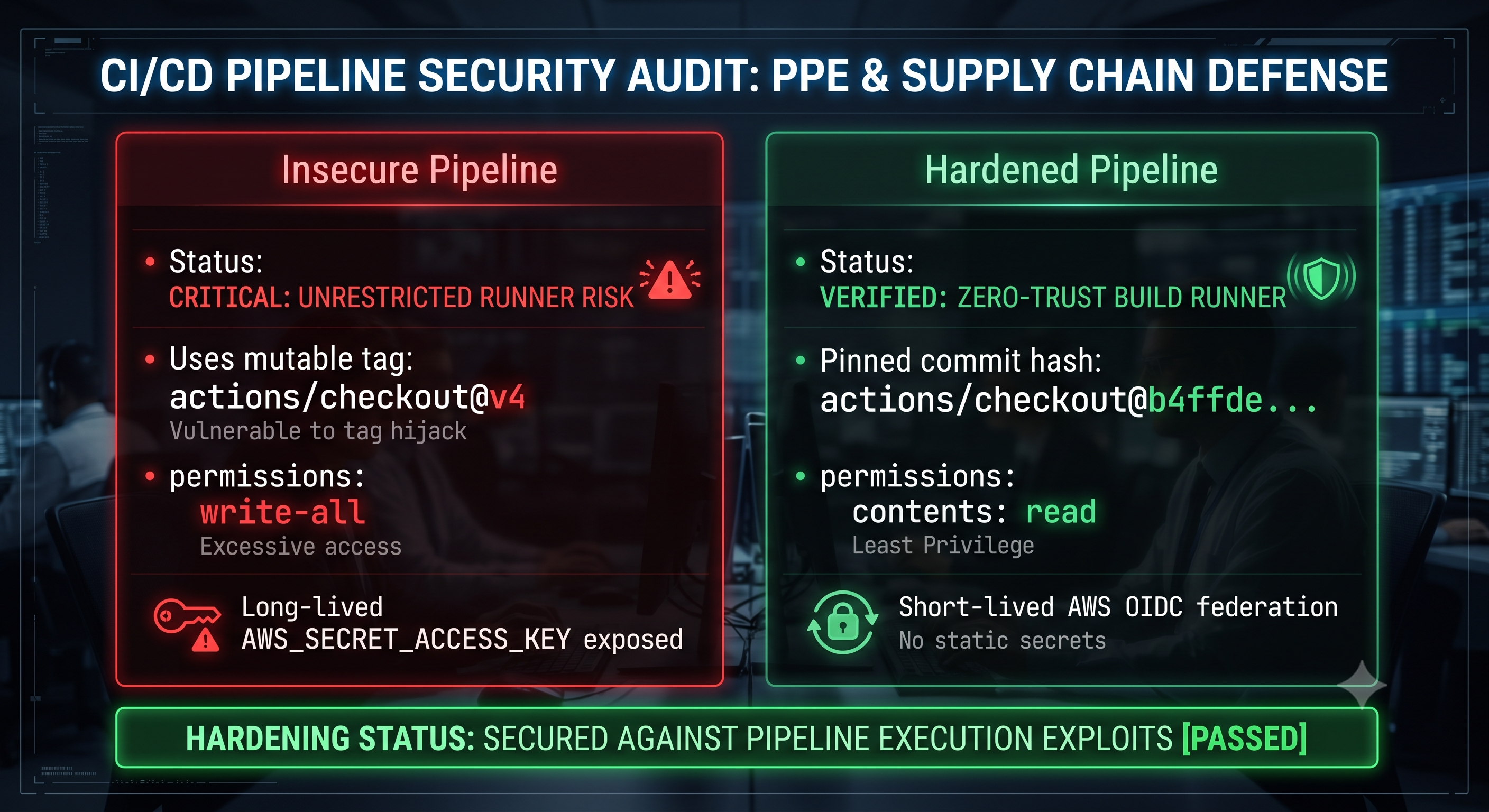
  • The CI/CD Supply Chain Hardening Checklist: Defending Against Poisoned Pipeline Execution


    Software supply chain attacks have fundamentally shifted. Adversaries are no longer focusing purely on runtime zero-days—they are targeting the automated build pipelines connecting developer pull requests directly to production.


    Between Poisoned Pipeline Execution (PPE) and compromised third-party GitHub Actions, insecure automation scripts often run with privileged execution rights, exposing cloud credentials and injecting backdoors into release artifacts before anyone notices.
    Securing source code isn't enough; you must secure the build environment itself.


    Audit your deployment and workflow configurations against this 5-Point CI/CD Pipeline Hardening Checklist:


    Markdown
    [ ] 1. WORKFLOW TRIGGER ISOLATION (ANTI-PPE)
    - [ ] Audit `pull_request_target`: Never check out untrusted PR head code in privileged `pull_request_target` workflows (prevents "Pwn Request" injection).
    - [ ] Dynamic Input Sanitization: Eliminate inline bash evaluation of untrusted parameters:
    # Critical Vulnerability
    run: echo "Processing ${{ github.event.issue.title }}"
    # Hardened Pattern
    env:
    TITLE: ${{ github.event.issue.title }}
    run: echo "Processing $TITLE"


    [ ] 2. THIRD-PARTY ACTION PINNING & PROVENANCE
    - [ ] Pin by Full Commit SHA: Replace mutable release tags (`@v3` or `@main`) with immutable 40-character commit SHAs (`@a1b2c3d...`) to neutralize tag-tampering attacks.
    - [ ] Automated SHA Renovate/Dependabot: Pair pinned SHAs with automated dependency update bots to keep pinned actions patched against upstream CVEs.
    - [ ] Restrict Action Origins: Enforce organization policies permitting only verified marketplace publishers and internal reusable workflows.


    [ ] 3. LEAST PRIVILEGE IDENTITY (ZERO STATIC SECRETS)
    - [ ] Restrict Default `GITHUB_TOKEN`: Explicitly declare top-level workflow permissions as `permissions: contents: read` instead of inheriting broad read/write defaults.
    - [ ] Migrate to OpenID Connect (OIDC): Eliminate long-lived AWS/GCP/Azure access keys stored in pipeline secrets; issue short-lived, cryptographically signed OIDC identity tokens.
    - [ ] Ephemeral Secrets Scoping: Restrict deployment credentials strictly to protected production environments requiring manual review gates.


    [ ] 4. RUNNER ISOLATION & EGRESS CONTROL
    - [ ] Ephemeral, Single-Use Runners: Run build jobs on isolated ephemeral container VMs destroyed immediately upon job completion to eliminate cross-build persistence.
    - [ ] Outbound Network Egress Filtering: Block unmonitored outbound internet traffic from build runners to prevent reverse shells and credential exfiltration to untrusted C2 endpoints.
    - [ ] Memory Inspection Defense: Disallow runner containers from running in unconfined `--privileged` mode or exposing host `/proc` file systems.


    [ ] 5. ARTIFACT INTEGRITY & BUILD PROVENANCE
    - [ ] Cryptographic Signing: Sign generated binaries, wheels, and container images using Sigstore/Cosign before publishing to registries.
    - [ ] Software Bill of Materials (SBOM): Automatically generate and cryptographically attach an SBOM (SPDX/CycloneDX) to every released build artifact.
    Rule of Thumb: Treat your CI/CD runners like internet-exposed production nodes: minimize their privileges, monitor their outbound egress, and assume third-party build actions could be untrusted.


    Discussion Question
    What is your organization's biggest blind spot in CI/CD pipelines right now: pinning third-party actions to immutable SHAs, or eliminating long-lived cloud keys in favor of OIDC?


    CTA (Join Cybersecurity & Ethical Hacking)
    Looking to stay ahead of software supply chain threats, cloud exploits, and red team defense tactics? Join Cybersecurity & Ethical Hacking by Techawks to dissect real-world threat vectors and harden modern infrastructure with top security practitioners.
    The CI/CD Supply Chain Hardening Checklist: Defending Against Poisoned Pipeline Execution Software supply chain attacks have fundamentally shifted. Adversaries are no longer focusing purely on runtime zero-days—they are targeting the automated build pipelines connecting developer pull requests directly to production. Between Poisoned Pipeline Execution (PPE) and compromised third-party GitHub Actions, insecure automation scripts often run with privileged execution rights, exposing cloud credentials and injecting backdoors into release artifacts before anyone notices. Securing source code isn't enough; you must secure the build environment itself. Audit your deployment and workflow configurations against this 5-Point CI/CD Pipeline Hardening Checklist: Markdown [ ] 1. WORKFLOW TRIGGER ISOLATION (ANTI-PPE) - [ ] Audit `pull_request_target`: Never check out untrusted PR head code in privileged `pull_request_target` workflows (prevents "Pwn Request" injection). - [ ] Dynamic Input Sanitization: Eliminate inline bash evaluation of untrusted parameters: # Critical Vulnerability run: echo "Processing ${{ github.event.issue.title }}" # Hardened Pattern env: TITLE: ${{ github.event.issue.title }} run: echo "Processing $TITLE" [ ] 2. THIRD-PARTY ACTION PINNING & PROVENANCE - [ ] Pin by Full Commit SHA: Replace mutable release tags (`@v3` or `@main`) with immutable 40-character commit SHAs (`@a1b2c3d...`) to neutralize tag-tampering attacks. - [ ] Automated SHA Renovate/Dependabot: Pair pinned SHAs with automated dependency update bots to keep pinned actions patched against upstream CVEs. - [ ] Restrict Action Origins: Enforce organization policies permitting only verified marketplace publishers and internal reusable workflows. [ ] 3. LEAST PRIVILEGE IDENTITY (ZERO STATIC SECRETS) - [ ] Restrict Default `GITHUB_TOKEN`: Explicitly declare top-level workflow permissions as `permissions: contents: read` instead of inheriting broad read/write defaults. - [ ] Migrate to OpenID Connect (OIDC): Eliminate long-lived AWS/GCP/Azure access keys stored in pipeline secrets; issue short-lived, cryptographically signed OIDC identity tokens. - [ ] Ephemeral Secrets Scoping: Restrict deployment credentials strictly to protected production environments requiring manual review gates. [ ] 4. RUNNER ISOLATION & EGRESS CONTROL - [ ] Ephemeral, Single-Use Runners: Run build jobs on isolated ephemeral container VMs destroyed immediately upon job completion to eliminate cross-build persistence. - [ ] Outbound Network Egress Filtering: Block unmonitored outbound internet traffic from build runners to prevent reverse shells and credential exfiltration to untrusted C2 endpoints. - [ ] Memory Inspection Defense: Disallow runner containers from running in unconfined `--privileged` mode or exposing host `/proc` file systems. [ ] 5. ARTIFACT INTEGRITY & BUILD PROVENANCE - [ ] Cryptographic Signing: Sign generated binaries, wheels, and container images using Sigstore/Cosign before publishing to registries. - [ ] Software Bill of Materials (SBOM): Automatically generate and cryptographically attach an SBOM (SPDX/CycloneDX) to every released build artifact. Rule of Thumb: Treat your CI/CD runners like internet-exposed production nodes: minimize their privileges, monitor their outbound egress, and assume third-party build actions could be untrusted. Discussion Question What is your organization's biggest blind spot in CI/CD pipelines right now: pinning third-party actions to immutable SHAs, or eliminating long-lived cloud keys in favor of OIDC? CTA (Join Cybersecurity & Ethical Hacking) Looking to stay ahead of software supply chain threats, cloud exploits, and red team defense tactics? Join Cybersecurity & Ethical Hacking by Techawks to dissect real-world threat vectors and harden modern infrastructure with top security practitioners.
    0 Kommentare 0 Geteilt 232 Ansichten 0 Bewertungen
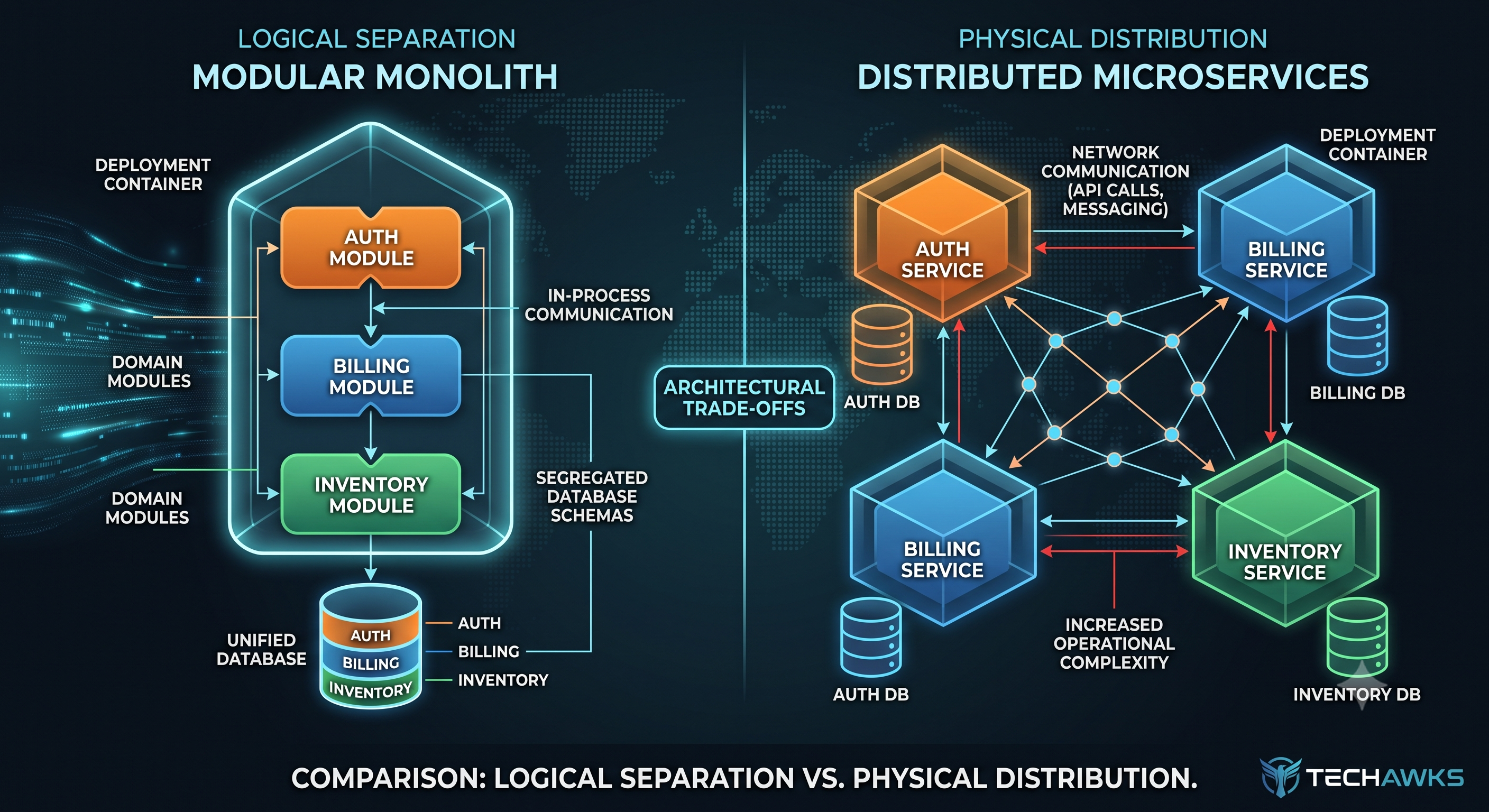
  • The Hidden Architecture Cost: Choosing Between Microservices and a Modular Monolith


    When scaling a system, the reflex is often to decompose everything into independent services. On paper, it promises autonomous teams, isolated deployments, and independent scaling.


    In production, microservices introduce severe operational overhead before most teams actually need them:


    Network Latency & Failure Modes: Local in-memory function calls turn into network hops with retries, timeouts, circuit breakers, and partial failure states.
    Distributed Data Consistency: Transactions across domain boundaries require saga patterns or two-phase commits instead of simple ACID guarantees.
    Observability Tax: Tracing a single user action requires dedicated telemetry infrastructure, distributed log aggregation, and complex correlation IDs.
    Before splitting your application across repository and network boundaries, consider the Modular Monolith:


    Define Strict Domain Boundaries: Enforce module isolation at the folder or package level. Modules should interact only through explicit public interfaces, never by reaching directly into another module’s database models.
    Isolate Data Ownership: Even within a single database, assign specific tables to specific modules. Disallow cross-domain foreign keys and direct cross-table joins.
    Decouple via Domain Events: Use an in-process event bus for asynchronous communication between modules. This prepares your architecture for external message brokers (e.g., Kafka, RabbitMQ) later without changing business logic.


    If a specific bounded context eventually outgrows the shared infrastructure due to unique CPU, memory, or scaling requirements, you can carve it out into a standalone microservice in days—because the boundary is already clean.


    Key Takeaways
    Premature microservices replace code complexity with network and operational complexity.
    A modular monolith enforces bounded contexts and domain separation within a single deployment unit.
    True architectural decoupling happens at the data and interface layer, not the deployment layer.


    CTA
    Where does your team currently stand on the monolith vs. microservices spectrum? Have you ever had to migrate back to a monolith, or did microservices solve your scaling bottlenecks?


    Share your real-world architecture tradeoffs below, and join the Techawks General Community to connect with engineers solving distributed systems challenges daily: [Link to Community]
    The Hidden Architecture Cost: Choosing Between Microservices and a Modular Monolith When scaling a system, the reflex is often to decompose everything into independent services. On paper, it promises autonomous teams, isolated deployments, and independent scaling. In production, microservices introduce severe operational overhead before most teams actually need them: Network Latency & Failure Modes: Local in-memory function calls turn into network hops with retries, timeouts, circuit breakers, and partial failure states. Distributed Data Consistency: Transactions across domain boundaries require saga patterns or two-phase commits instead of simple ACID guarantees. Observability Tax: Tracing a single user action requires dedicated telemetry infrastructure, distributed log aggregation, and complex correlation IDs. Before splitting your application across repository and network boundaries, consider the Modular Monolith: Define Strict Domain Boundaries: Enforce module isolation at the folder or package level. Modules should interact only through explicit public interfaces, never by reaching directly into another module’s database models. Isolate Data Ownership: Even within a single database, assign specific tables to specific modules. Disallow cross-domain foreign keys and direct cross-table joins. Decouple via Domain Events: Use an in-process event bus for asynchronous communication between modules. This prepares your architecture for external message brokers (e.g., Kafka, RabbitMQ) later without changing business logic. If a specific bounded context eventually outgrows the shared infrastructure due to unique CPU, memory, or scaling requirements, you can carve it out into a standalone microservice in days—because the boundary is already clean. Key Takeaways Premature microservices replace code complexity with network and operational complexity. A modular monolith enforces bounded contexts and domain separation within a single deployment unit. True architectural decoupling happens at the data and interface layer, not the deployment layer. CTA Where does your team currently stand on the monolith vs. microservices spectrum? Have you ever had to migrate back to a monolith, or did microservices solve your scaling bottlenecks? Share your real-world architecture tradeoffs below, and join the Techawks General Community to connect with engineers solving distributed systems challenges daily: [Link to Community]
    0 Kommentare 0 Geteilt 112 Ansichten 0 Bewertungen
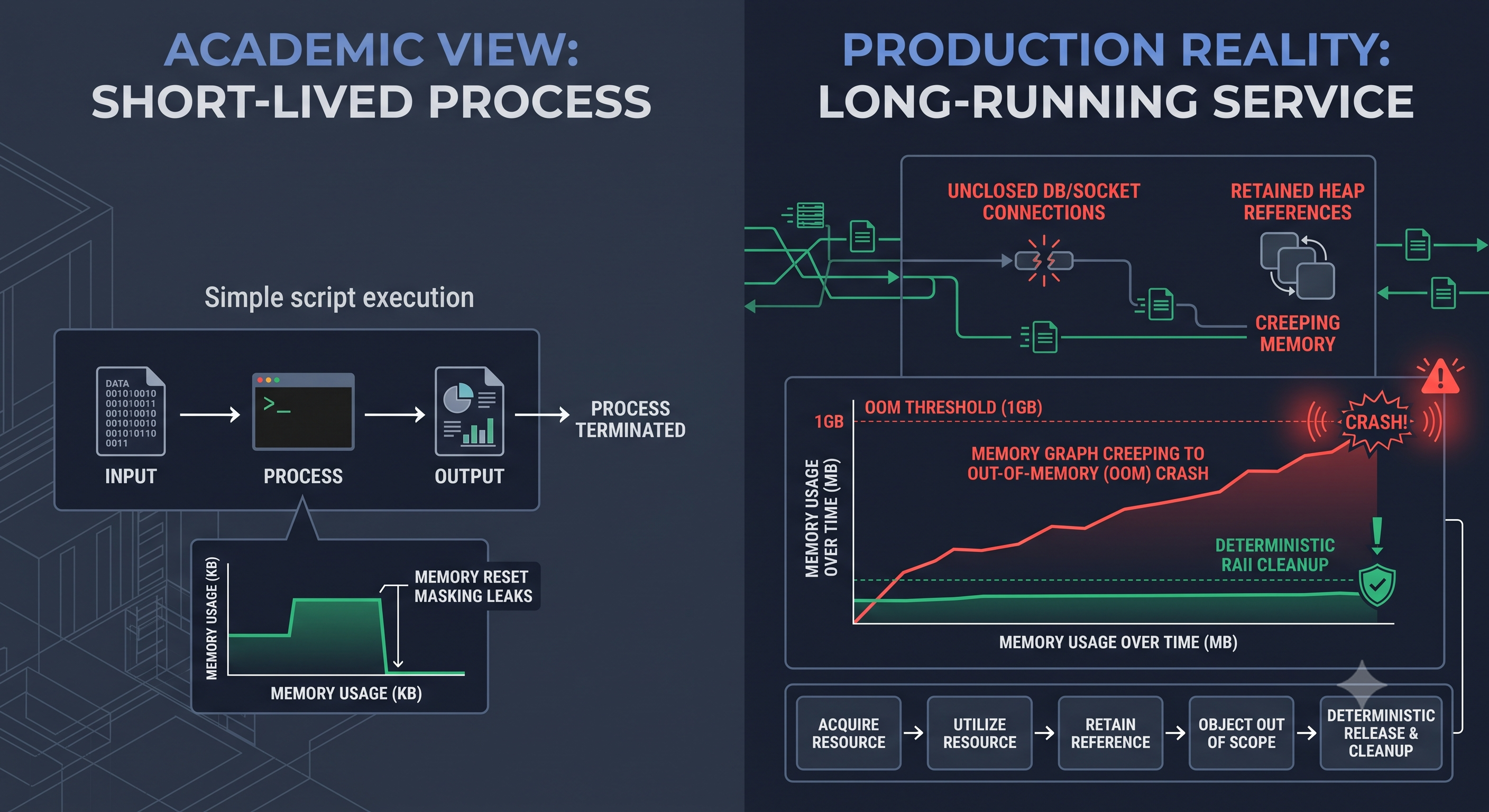
  • Why "It Runs Locally" Isn’t Enough: The CS Student’s Guide to Memory Leaks and Deterministic Resource Lifecycles


    When studying Computer Science, coursework often rewards raw functional correctness: pass the autograder test cases, print the expected output, and submit.
    Because student test environments run short-lived processes, unmanaged resource consumption remains completely hidden. But when your application transitions to an always-on production service, naive resource handling leads directly to memory leaks, connection pool exhaustion, and cascading system crashes.


    Understanding deterministic resource management turns theoretical CS concepts into real engineering authority:
    Stack vs. Heap Awareness:
    High-level languages manage memory with automatic Garbage Collection (GC), but GC does not mean "free memory." Holding onto object references in global state, event listeners, or unclosed closures prevents garbage collection, resulting in creeping memory fragmentation.


    Deterministic Teardown & Scope Guards:
    Every opened resource—database connection, file descriptor, TCP socket, or thread worker—must have a guaranteed exit path. Use language constructs like try-with-resources (Java), context managers with (Python), or RAII patterns (C++/Rust) to guarantee cleanup even when unhandled exceptions occur.


    Observing State Under Load:
    Never test only with single-execution runs. Profile your services using memory profilers, stress-test your endpoints with concurrent simulated requests, and inspect memory allocation graphs before declaring an application "done."


    The Student Takeaway:
    Writing code that works for 5 seconds is easy. Engineering systems that remain stable under 100,000 requests over 30 continuous days is what separates a student from a hired engineer.


    Discussion Question
    When building your course or personal projects, how do you handle resource cleanup and error boundaries? Have you ever run into a memory leak or connection limit in your own code?


    CTA
    Ready to bridge the gap between academic theory and real-world software engineering?


    👉 Join Students in Tech at Techawks to learn system design, master foundational engineering practices, and build alongside peers worldwide.
    Why "It Runs Locally" Isn’t Enough: The CS Student’s Guide to Memory Leaks and Deterministic Resource Lifecycles When studying Computer Science, coursework often rewards raw functional correctness: pass the autograder test cases, print the expected output, and submit. Because student test environments run short-lived processes, unmanaged resource consumption remains completely hidden. But when your application transitions to an always-on production service, naive resource handling leads directly to memory leaks, connection pool exhaustion, and cascading system crashes. Understanding deterministic resource management turns theoretical CS concepts into real engineering authority: Stack vs. Heap Awareness: High-level languages manage memory with automatic Garbage Collection (GC), but GC does not mean "free memory." Holding onto object references in global state, event listeners, or unclosed closures prevents garbage collection, resulting in creeping memory fragmentation. Deterministic Teardown & Scope Guards: Every opened resource—database connection, file descriptor, TCP socket, or thread worker—must have a guaranteed exit path. Use language constructs like try-with-resources (Java), context managers with (Python), or RAII patterns (C++/Rust) to guarantee cleanup even when unhandled exceptions occur. Observing State Under Load: Never test only with single-execution runs. Profile your services using memory profilers, stress-test your endpoints with concurrent simulated requests, and inspect memory allocation graphs before declaring an application "done." The Student Takeaway: Writing code that works for 5 seconds is easy. Engineering systems that remain stable under 100,000 requests over 30 continuous days is what separates a student from a hired engineer. Discussion Question When building your course or personal projects, how do you handle resource cleanup and error boundaries? Have you ever run into a memory leak or connection limit in your own code? CTA Ready to bridge the gap between academic theory and real-world software engineering? 👉 Join Students in Tech at Techawks to learn system design, master foundational engineering practices, and build alongside peers worldwide.
    0 Kommentare 0 Geteilt 185 Ansichten 0 Bewertungen
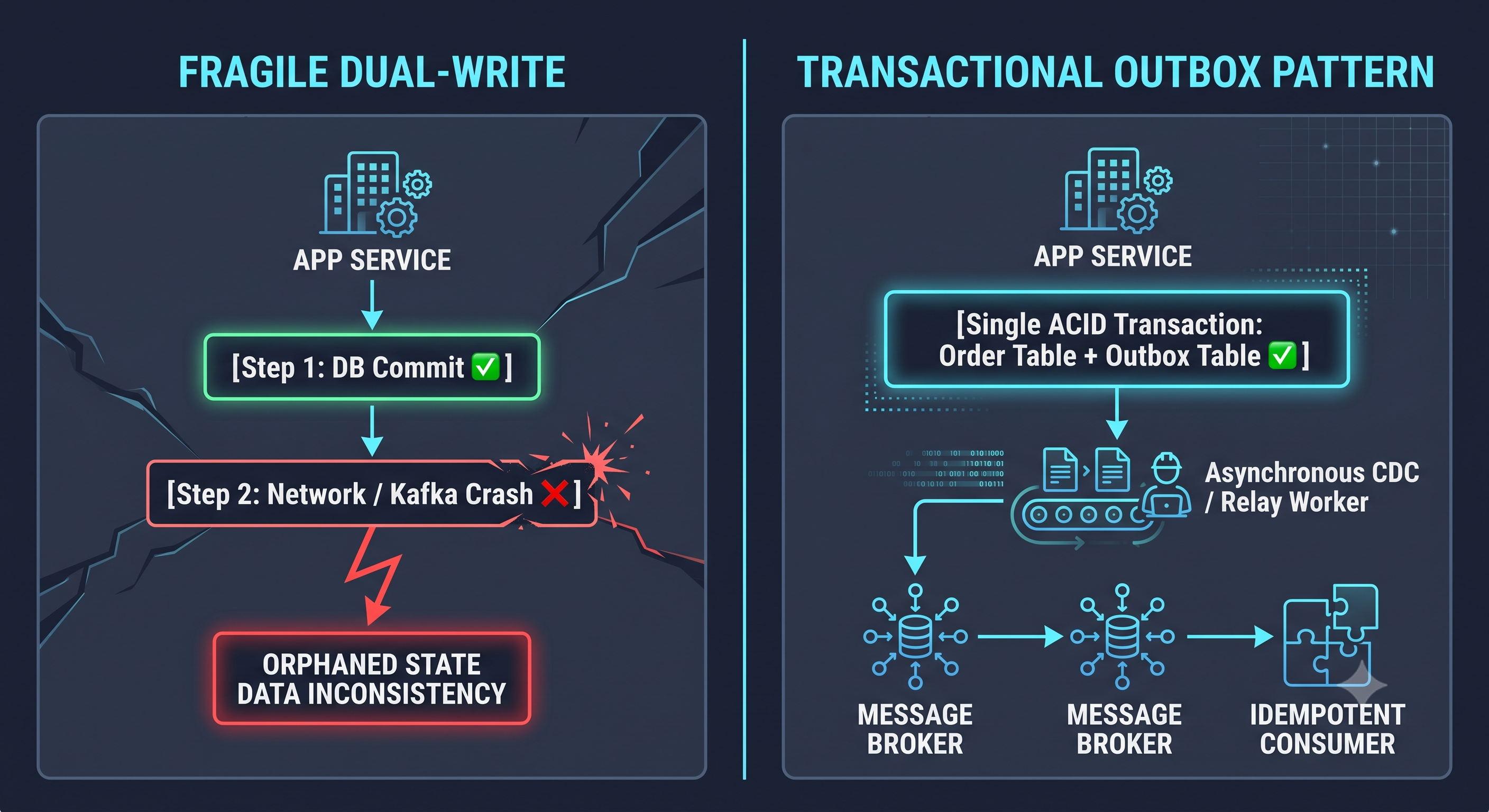
  • Stop Writing Naive Retries: Why Distributed Systems Need Idempotent Outbox Transactions


    Most backend engineers implement asynchronous event delivery using a standard "dual-write" pattern:
    TypeScript
    // The Anti-Pattern (Dual Write)
    await db.orders.create({ data: orderPayload });
    await messageBroker.publish("order.created", orderPayload);


    This creates an irreconcilable distributed state problem:
    If the database commit succeeds but the message broker call crashes or times out, downstream consumers never receive the event (silent data loss).
    If you flip the order and emit the event first, a failed DB write means downstream services act on phantom records.
    If you wrap the broker publish in a naive retry loop, network jitter causes cascading retry storms and duplicated side-effects.
    To build zero-data-loss event streaming, modern backend architectures rely on the Transactional Outbox Pattern paired with Idempotent Consumer Keys:


    Atomic Dual-Write via Single DB Transaction:
    Write your domain state change and your outbound event payload into an outbox_events table within the same local database transaction. Both succeed or both roll back together.


    Decoupled Asynchronous Polling / CDC:
    Use a dedicated background worker or a Change Data Capture (CDC) stream (e.g., Debezium) to tail the outbox_events table and push records to your message broker with at-least-once delivery guarantees.


    Consumer-Side Idempotency Keys:
    Enforce deterministic idempotency on consumers by storing a unique event_id or transaction hash in a fast cache (like Redis) or database unique constraint before executing business logic.


    The Engineering Takeaway:
    Network boundaries are inherently unreliable. Never cross an external network boundary inside a critical database lifecycle; decouple persistence from propagation.


    Discussion Question
    How does your team handle the dual-write problem across distributed microservices? Are you using CDC-driven Transactional Outbox, two-phase commits, or relying on consumer-side reconciliation scripts?


    CTA
    Looking to master high-throughput backend patterns, distributed systems, and clean architecture?


    👉 Join Developers & Coding at Techawks to level up your engineering skills with developers worldwide.
    Stop Writing Naive Retries: Why Distributed Systems Need Idempotent Outbox Transactions Most backend engineers implement asynchronous event delivery using a standard "dual-write" pattern: TypeScript // The Anti-Pattern (Dual Write) await db.orders.create({ data: orderPayload }); await messageBroker.publish("order.created", orderPayload); This creates an irreconcilable distributed state problem: If the database commit succeeds but the message broker call crashes or times out, downstream consumers never receive the event (silent data loss). If you flip the order and emit the event first, a failed DB write means downstream services act on phantom records. If you wrap the broker publish in a naive retry loop, network jitter causes cascading retry storms and duplicated side-effects. To build zero-data-loss event streaming, modern backend architectures rely on the Transactional Outbox Pattern paired with Idempotent Consumer Keys: Atomic Dual-Write via Single DB Transaction: Write your domain state change and your outbound event payload into an outbox_events table within the same local database transaction. Both succeed or both roll back together. Decoupled Asynchronous Polling / CDC: Use a dedicated background worker or a Change Data Capture (CDC) stream (e.g., Debezium) to tail the outbox_events table and push records to your message broker with at-least-once delivery guarantees. Consumer-Side Idempotency Keys: Enforce deterministic idempotency on consumers by storing a unique event_id or transaction hash in a fast cache (like Redis) or database unique constraint before executing business logic. The Engineering Takeaway: Network boundaries are inherently unreliable. Never cross an external network boundary inside a critical database lifecycle; decouple persistence from propagation. Discussion Question How does your team handle the dual-write problem across distributed microservices? Are you using CDC-driven Transactional Outbox, two-phase commits, or relying on consumer-side reconciliation scripts? CTA Looking to master high-throughput backend patterns, distributed systems, and clean architecture? 👉 Join Developers & Coding at Techawks to level up your engineering skills with developers worldwide.
    0 Kommentare 0 Geteilt 166 Ansichten 0 Bewertungen
Weitere Ergebnisse