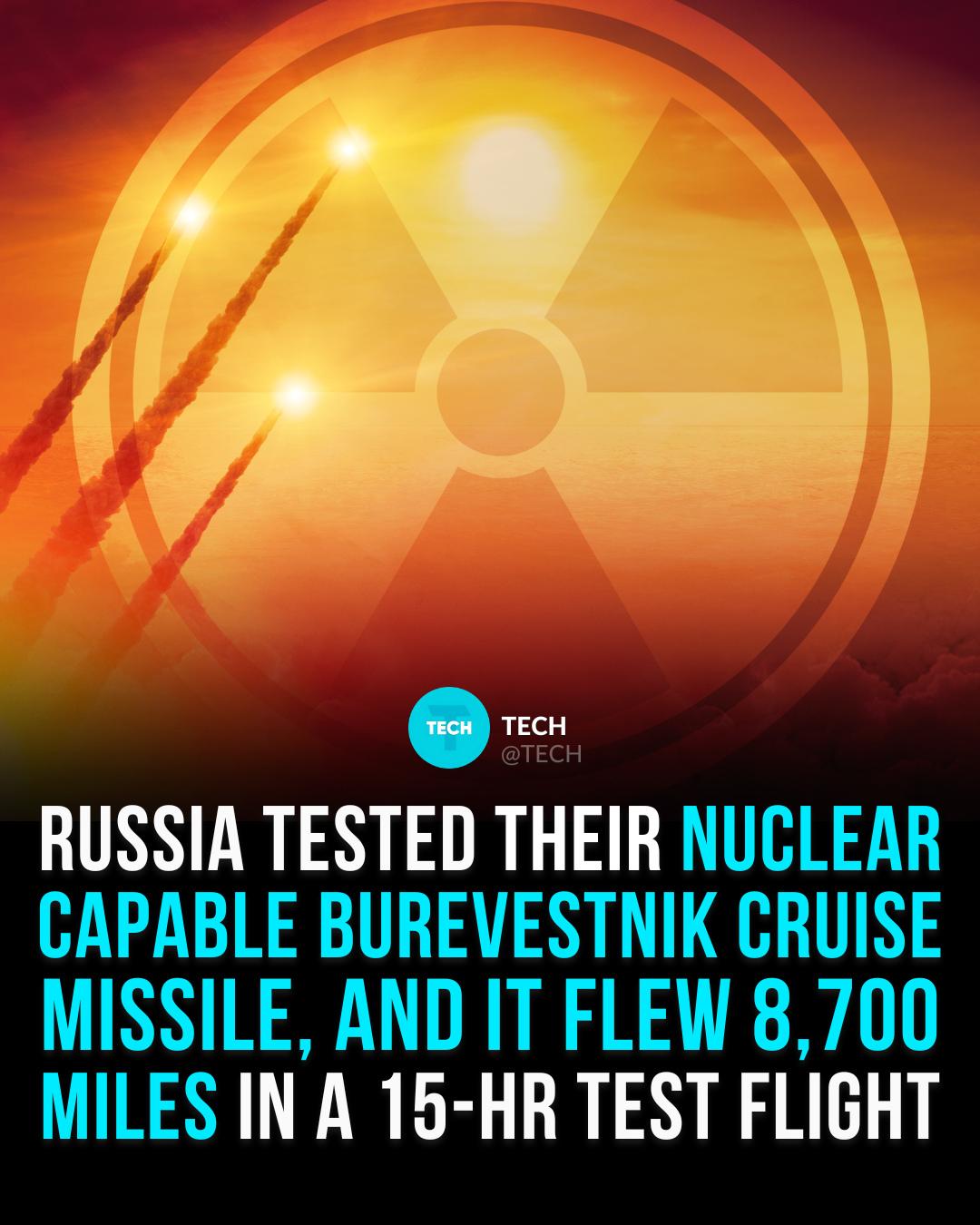
Russia is openly bragging about a cruise missile powered by a miniature nuclear reactor. The weapon, called Burevestnik and nicknamed “Skyfall” by NATO, was presented by Vladimir Putin as something no one else has: a low-flying missile with “unlimited range” that can dodge missile defenses. Russia’s top general, Valery Gerasimov, told Putin that in an October 21 test the missile stayed in the air for 15 hours and flew about 14,000 kilometers, roughly 8,700 miles, which he said is still not the limit.
If that flight happened the way Moscow describes it, it would mark one of the longest demonstrations of nuclear propulsion ever reported in a cruise missile. The idea dates back to the U.S. Project Pluto of the 1950s, which explored nuclear-powered ramjet weapons before being shut down in 1964 over safety, cost, and the rise of ICBMs. Those same concerns are still here. A reactor that heats incoming air for thrust also risks spraying radioactive exhaust, and past Russian tests have already ended in deadly accidents and localized radiation spikes.
Western defense analysts are openly skeptical. Independent verification of the 15-hour test has not been produced, and past Burevestnik launches have mostly failed or only partially worked. Critics say the missile is technically extreme, strategically awkward, and environmentally reckless.
The politics are immediate. Donald Trump responded by downplaying the threat, saying the U.S. has nuclear submarines near Russia and telling Putin to end the war in Ukraine instead of advertising new doomsday weapons.
#tech #military #defense #nuclear #russia #ukraine #security #aerospaceRussia is openly bragging about a cruise missile powered by a miniature nuclear reactor. The weapon, called Burevestnik and nicknamed “Skyfall” by NATO, was presented by Vladimir Putin as something no one else has: a low-flying missile with “unlimited range” that can dodge missile defenses. Russia’s top general, Valery Gerasimov, told Putin that in an October 21 test the missile stayed in the air for 15 hours and flew about 14,000 kilometers, roughly 8,700 miles, which he said is still not the limit.
If that flight happened the way Moscow describes it, it would mark one of the longest demonstrations of nuclear propulsion ever reported in a cruise missile. The idea dates back to the U.S. Project Pluto of the 1950s, which explored nuclear-powered ramjet weapons before being shut down in 1964 over safety, cost, and the rise of ICBMs. Those same concerns are still here. A reactor that heats incoming air for thrust also risks spraying radioactive exhaust, and past Russian tests have already ended in deadly accidents and localized radiation spikes.
Western defense analysts are openly skeptical. Independent verification of the 15-hour test has not been produced, and past Burevestnik launches have mostly failed or only partially worked. Critics say the missile is technically extreme, strategically awkward, and environmentally reckless.
The politics are immediate. Donald Trump responded by downplaying the threat, saying the U.S. has nuclear submarines near Russia and telling Putin to end the war in Ukraine instead of advertising new doomsday weapons.
#tech #military #defense #nuclear #russia #ukraine #security #aerospace
 English
 Arabic
 French
 Spanish
 Portuguese
 Deutsch
 Turkish
 Dutch
Dutch
 Italiano
 Russian
 Romaian
 Portuguese (Brazil)
 Greek
Greek