



Policy-as-Code & Sovereign Data Routing: Architecting Auditable AI Systems for the UAE
Across Dubai and Abu Dhabi, organizations are rapidly moving beyond experimental chatbots to autonomous AI workflows powering government portals, banking, healthcare, and enterprise operations. With the UAE’s unified Federal Authority for Artificial Intelligence and Data and overlapping mainland, DIFC, and ADGM data protection regimes, untraceable "black-box" AI decisions and unmanaged cross-border inference are major architectural liabilities.
When an AI system flags an application, routes a citizen request, or underwrites a customer, stakeholders need deterministic answers: Which exact policy rule governed that decision, and did sensitive data stay inside sovereign boundaries?
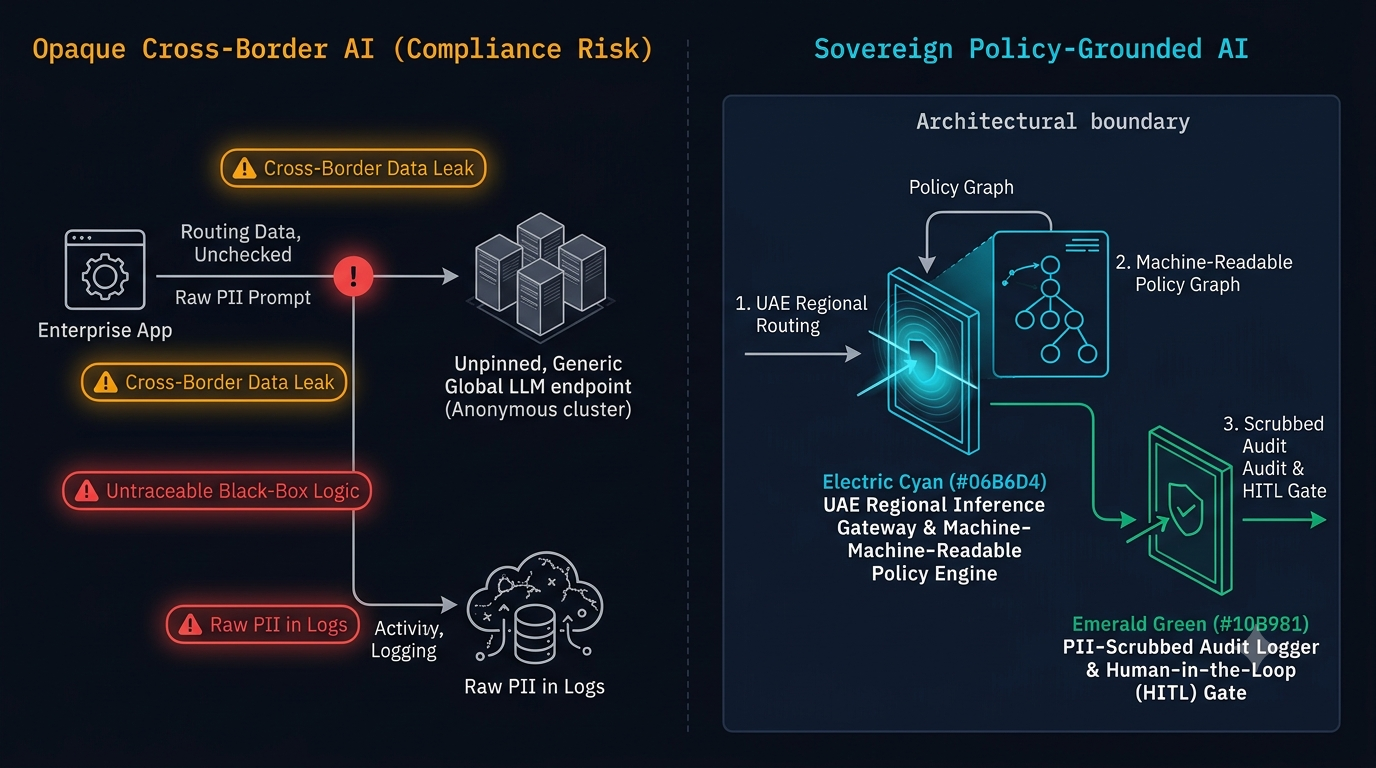
Use this 3-layer Sovereign & Auditable AI Architecture to build production-grade systems in the UAE:
1. Pin Inference & Vector Storage to Regional UAE Nodes
Routing prompts containing Emirates IDs, financial records, or customer transcripts to default global API endpoints triggers immediate cross-border data transfer obligations. Configure your API gateway to enforce strict regional routing (e.g., UAE North / UAE Central cloud regions or local sovereign inference clusters) and block fallback routing to non-UAE endpoints at the network level.
2. Ground Decisions in Machine-Readable Policy-as-Code
Never rely on an LLM's parametric memory to interpret local regulations or corporate eligibility rules. Encode regulatory clauses and business policies as versioned, structured rules (e.g., JSON/YAML policy graphs or OPA/Rego rules) so every automated recommendation links directly to an explicit rule citation:
JSON
{
"decision_id": "uae-gov-2026-4419",
"outcome": "REQUIRES_MANUAL_REVIEW",
"matched_policy_ref": "ADGM-AML-RULE-4.2.1",
"data_residency_region": "uae-north-1",
"human_accountable_owner": "compliance_officer_id_88"
}
3. Sanitize Prompt Logs & Bind Human Accountability
Standard LLM observability tools silently store raw user prompts—turning your telemetry database into an unencrypted PII repository. Scrub personal identifiers before writing audit traces, enforce strict TTL retention windows, and require human-in-the-loop sign-off for any consequential decision affecting individuals.
Discussion Question
For engineers and architects building in the UAE: what has been your biggest technical hurdle when deploying production AI—enforcing strict UAE data residency across third-party model APIs, navigating mainland vs. DIFC/ADGM compliance boundaries, or making LLM decisions auditable? Share your architecture tips below!
CTA (Join Techawks UAE)
Building sovereign cloud infrastructure, enterprise AI platforms, or scalable digital products across Dubai, Abu Dhabi, and the wider Emirates? Join Techawks UAE to connect with fellow engineers, architects, and tech leaders solving regional production challenges. [Join the Group]
Policy-as-Code & Sovereign Data Routing: Architecting Auditable AI Systems for the UAE
Across Dubai and Abu Dhabi, organizations are rapidly moving beyond experimental chatbots to autonomous AI workflows powering government portals, banking, healthcare, and enterprise operations. With the UAE’s unified Federal Authority for Artificial Intelligence and Data and overlapping mainland, DIFC, and ADGM data protection regimes, untraceable "black-box" AI decisions and unmanaged cross-border inference are major architectural liabilities.
When an AI system flags an application, routes a citizen request, or underwrites a customer, stakeholders need deterministic answers: Which exact policy rule governed that decision, and did sensitive data stay inside sovereign boundaries?
Use this 3-layer Sovereign & Auditable AI Architecture to build production-grade systems in the UAE:
1. Pin Inference & Vector Storage to Regional UAE Nodes
Routing prompts containing Emirates IDs, financial records, or customer transcripts to default global API endpoints triggers immediate cross-border data transfer obligations. Configure your API gateway to enforce strict regional routing (e.g., UAE North / UAE Central cloud regions or local sovereign inference clusters) and block fallback routing to non-UAE endpoints at the network level.
2. Ground Decisions in Machine-Readable Policy-as-Code
Never rely on an LLM's parametric memory to interpret local regulations or corporate eligibility rules. Encode regulatory clauses and business policies as versioned, structured rules (e.g., JSON/YAML policy graphs or OPA/Rego rules) so every automated recommendation links directly to an explicit rule citation:
JSON
{
"decision_id": "uae-gov-2026-4419",
"outcome": "REQUIRES_MANUAL_REVIEW",
"matched_policy_ref": "ADGM-AML-RULE-4.2.1",
"data_residency_region": "uae-north-1",
"human_accountable_owner": "compliance_officer_id_88"
}
3. Sanitize Prompt Logs & Bind Human Accountability
Standard LLM observability tools silently store raw user prompts—turning your telemetry database into an unencrypted PII repository. Scrub personal identifiers before writing audit traces, enforce strict TTL retention windows, and require human-in-the-loop sign-off for any consequential decision affecting individuals.
Discussion Question
For engineers and architects building in the UAE: what has been your biggest technical hurdle when deploying production AI—enforcing strict UAE data residency across third-party model APIs, navigating mainland vs. DIFC/ADGM compliance boundaries, or making LLM decisions auditable? Share your architecture tips below!
CTA (Join Techawks UAE)
Building sovereign cloud infrastructure, enterprise AI platforms, or scalable digital products across Dubai, Abu Dhabi, and the wider Emirates? Join Techawks UAE to connect with fellow engineers, architects, and tech leaders solving regional production challenges. [Join the Group]


 English
 Arabic
 Spanish
 Portuguese
 Deutsch
 Turkish
 Dutch
 Italiano
 Russian
 Romaian
 Portuguese (Brazil)
 Greek