• Architecting for India's DPDP Act: Why Your Consent Layer Can't Just Be an Afterthought in a Modal
    As India solidifies its compliance roadmap for the DPDP Act alongside sectoral mandates (RBI payment localization, SEBI frameworks, and UIDAI data vaults), engineering orgs across Bengaluru, Hyderabad, Pune, and NCR are facing a major architectural overhaul.


    Consent under DPDP must be free, specific, informed, unconditional, and unambiguously revocable with an easy withdrawal mechanism. For developers building high-throughput consumer tech, fintech, or SaaS platforms, this makes treating user consent as a static boolean flag (is_consented: true) in your SQL users table completely obsolete.


    Here is how systems architects are structuring a modern Consent-Aware Data Pipeline:


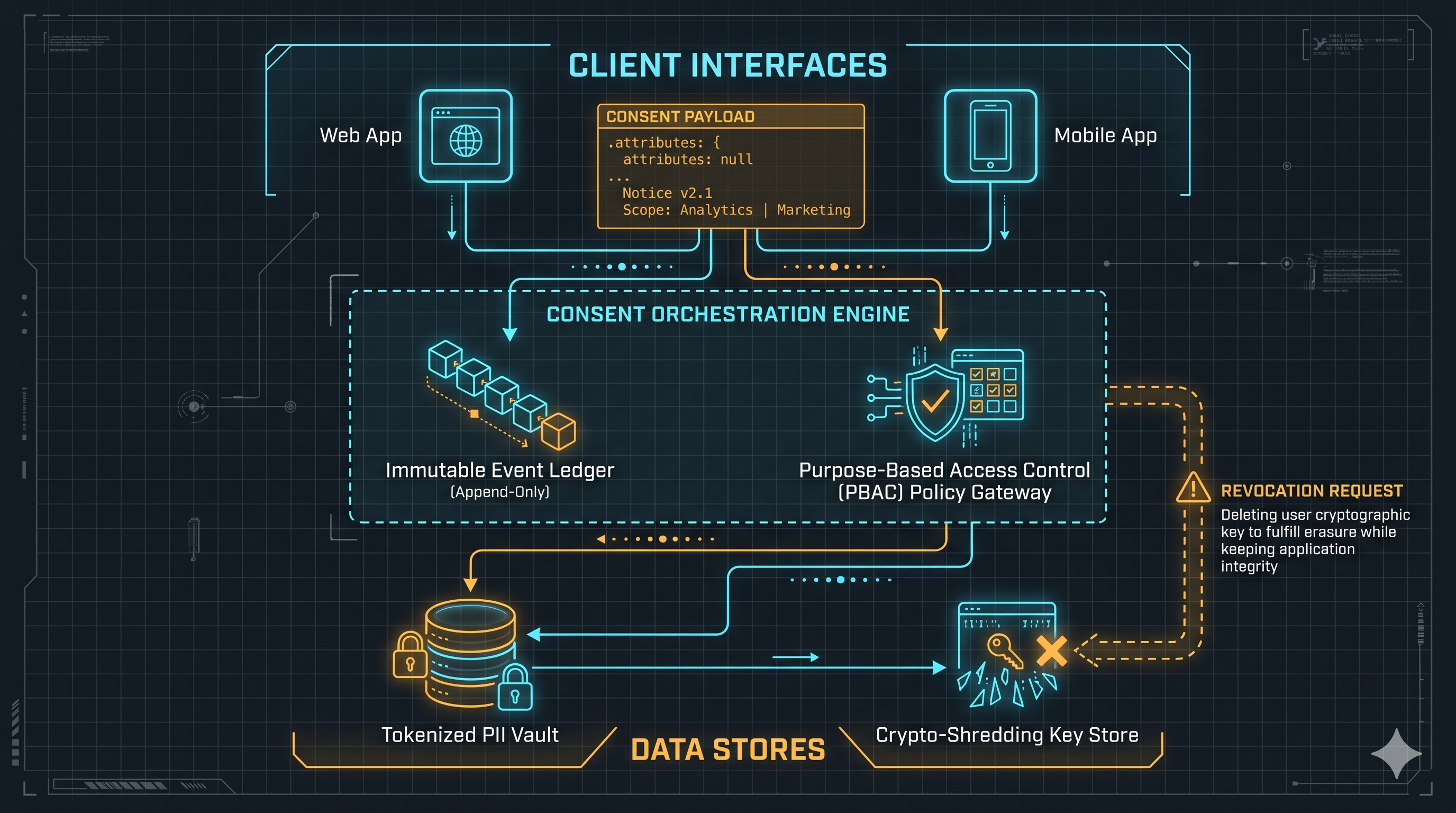
    Decouple Consent into an Event-Driven Audit Ledger:


    Treat consent as an immutable time-series event, not mutable user state.


    When a user opts in or revokes consent for a specific processing purpose (e.g., promotional profiling vs. transactional telemetry), publish an event (ConsentUpdatedEvent) to an event stream (such as Kafka or Redpanda).


    Persist every state change with the exact notice version, scope timestamp, and identity hash into an append-only consent registry.


    Downstream Tokenization & Purpose-Based Access Control (PBAC):


    Decouple raw PII from application processing layers using internal tokenization services.


    Inject purpose context into your data access calls:


    Python
    # Enforce purpose-scoped retrieval at the data gateway
    def get_user_profile(user_id, purpose="order_fulfillment"):
    consent_status = consent_service.verify(user_id, purpose)
    if not consent_status.is_valid():
    raise PermissionError("DPDP: Purpose consent missing or revoked")
    return token_vault.resolve_pii(user_id, fields=consent_status.permitted_fields)
    Handling the "Right to Erasure" Across Distributed Systems:


    When an Indian data principal requests data deletion or withdraws consent, your architecture must reliably propagate that deletion to replica stores, analytics data lakes, and vector indices.


    Avoid full table rebuilds by employing cryptographic erasure (crypto-shredding): encrypt individual user records with unique per-user keys. Deleting the specific user's encryption key renders their distributed data unrecoverable, fulfilling compliance without breaking immutable event stores.


    Discussion Question
    For engineering teams and CTOs building for the Indian ecosystem: How is your team handling consent revocation downstream in your analytics lakes and caching layers? Have you opted for crypto-shredding, modular microservices with dedicated consent tokens, or external consent management platforms?


    CTA
    Join Techawks India: Connect with our nationwide network of engineering leads, security researchers, and systems architects as we break down deep-dive engineering patterns, compliance blueprints, and tech innovations shaping the Indian ecosystem. Drop your thoughts below and subscribe to the page!
    Architecting for India's DPDP Act: Why Your Consent Layer Can't Just Be an Afterthought in a Modal As India solidifies its compliance roadmap for the DPDP Act alongside sectoral mandates (RBI payment localization, SEBI frameworks, and UIDAI data vaults), engineering orgs across Bengaluru, Hyderabad, Pune, and NCR are facing a major architectural overhaul. Consent under DPDP must be free, specific, informed, unconditional, and unambiguously revocable with an easy withdrawal mechanism. For developers building high-throughput consumer tech, fintech, or SaaS platforms, this makes treating user consent as a static boolean flag (is_consented: true) in your SQL users table completely obsolete. Here is how systems architects are structuring a modern Consent-Aware Data Pipeline: Decouple Consent into an Event-Driven Audit Ledger: Treat consent as an immutable time-series event, not mutable user state. When a user opts in or revokes consent for a specific processing purpose (e.g., promotional profiling vs. transactional telemetry), publish an event (ConsentUpdatedEvent) to an event stream (such as Kafka or Redpanda). Persist every state change with the exact notice version, scope timestamp, and identity hash into an append-only consent registry. Downstream Tokenization & Purpose-Based Access Control (PBAC): Decouple raw PII from application processing layers using internal tokenization services. Inject purpose context into your data access calls: Python # Enforce purpose-scoped retrieval at the data gateway def get_user_profile(user_id, purpose="order_fulfillment"): consent_status = consent_service.verify(user_id, purpose) if not consent_status.is_valid(): raise PermissionError("DPDP: Purpose consent missing or revoked") return token_vault.resolve_pii(user_id, fields=consent_status.permitted_fields) Handling the "Right to Erasure" Across Distributed Systems: When an Indian data principal requests data deletion or withdraws consent, your architecture must reliably propagate that deletion to replica stores, analytics data lakes, and vector indices. Avoid full table rebuilds by employing cryptographic erasure (crypto-shredding): encrypt individual user records with unique per-user keys. Deleting the specific user's encryption key renders their distributed data unrecoverable, fulfilling compliance without breaking immutable event stores. Discussion Question For engineering teams and CTOs building for the Indian ecosystem: How is your team handling consent revocation downstream in your analytics lakes and caching layers? Have you opted for crypto-shredding, modular microservices with dedicated consent tokens, or external consent management platforms? CTA Join Techawks India: Connect with our nationwide network of engineering leads, security researchers, and systems architects as we break down deep-dive engineering patterns, compliance blueprints, and tech innovations shaping the Indian ecosystem. Drop your thoughts below and subscribe to the page!
    0 Comments 0 Shares 47 Views 0 Reviews
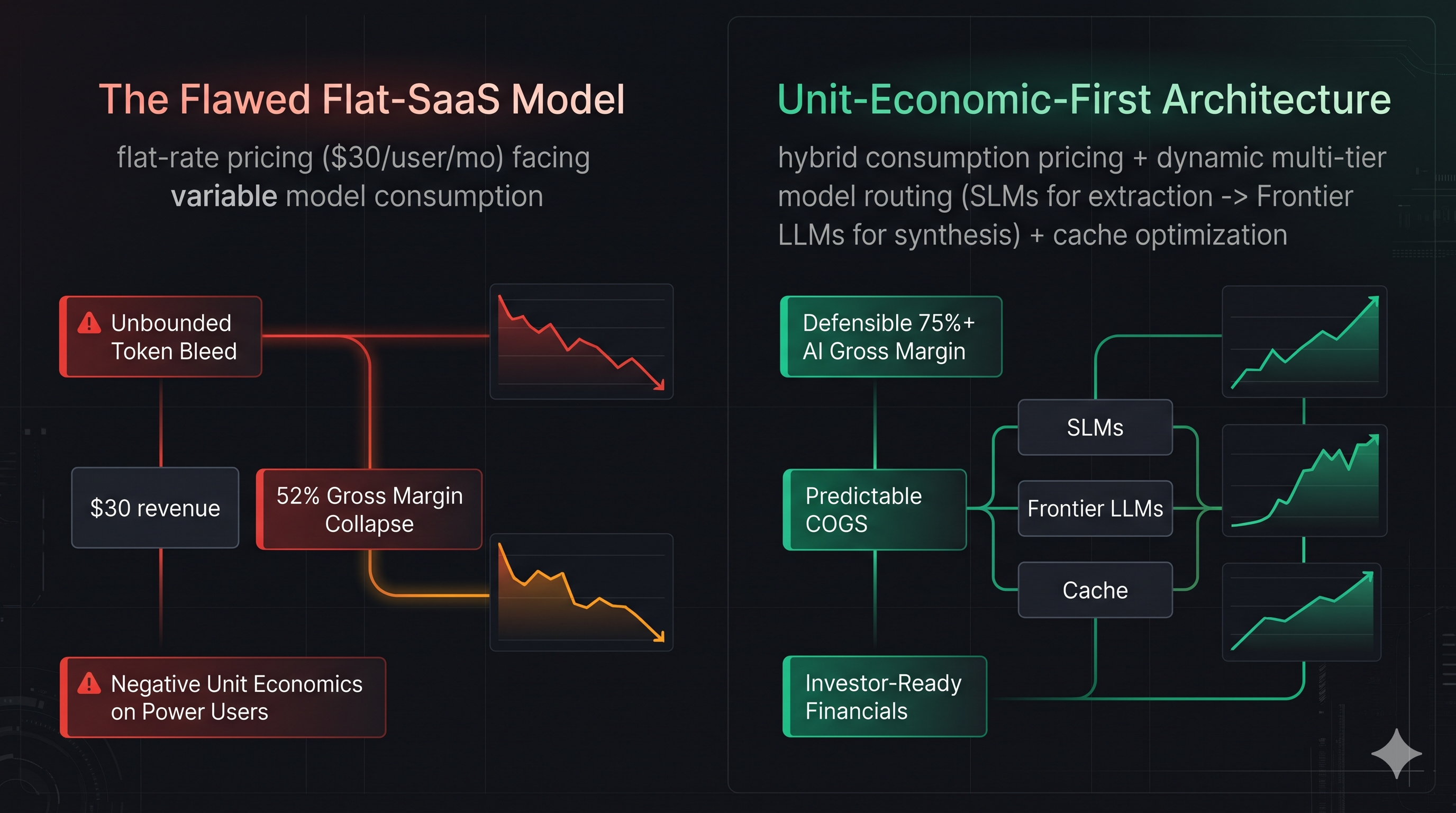
  • The SaaS Margin Collapse: Why AI Startups Face an "Inference COGS" Crisis (And How to Architect Around It)
    For two decades, software startups raised capital on the back of 75% to 85% gross margins: once code was deployed, serving an additional user cost fractions of a cent.


    In AI-first software, every user action triggers an inference compute cycle. AI startup gross margins hover closer to 50% to 60%, with some high-growth wrappers dipping as low as 25% to 30%. When your pricing is fixed per seat ($30/seat/month) but your heavy users consume $70 in token passes, scale doesn't create operating leverage—it accelerates cash burn.


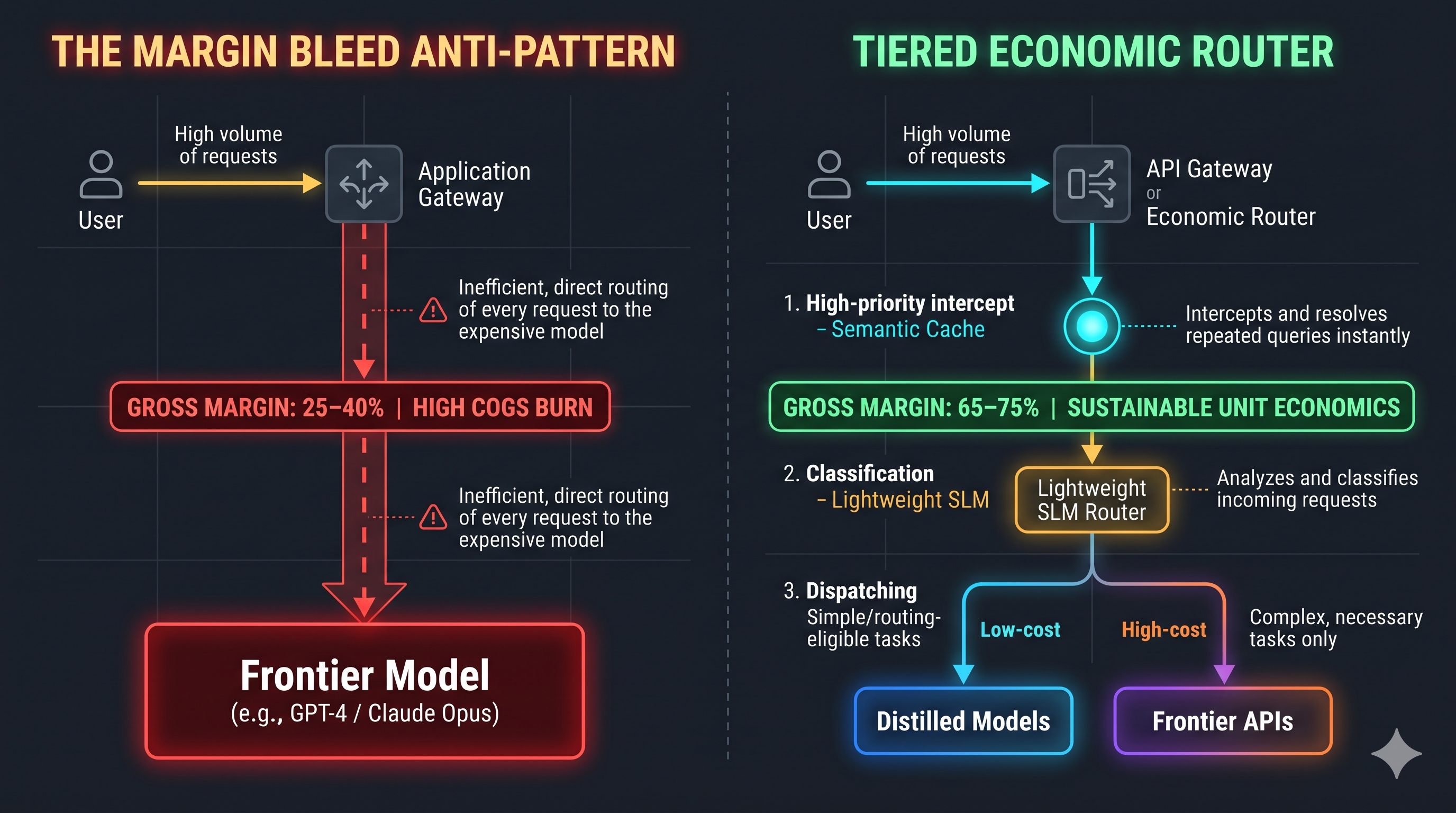
    Founders must shift from naive API proxy wrappers to a tiered model-routing architecture.


    The Margin-Killing Anti-Pattern vs. Tiered Inference
    Margin Trap (Naive Proxy):
    [User Request] ➔ Universal Frontier Model ($$$$) ➔ Static Output
    Margin: ~25-45% (Every token hits the most expensive provider)


    Sustainable Margin Architecture:
    [User Request]
    │
    ├──> [Semantic Cache (Redis)] ──────────────> Fast Return ($0)
    │
    ├──> [Rule / Complexity Classifier (1B/3B)]
    │
    ├── Simple/Structured ──> [Self-Hosted SLM / Distilled Model] ($)
    └── Deep Multi-Step ───> [Frontier Reasoning API] ($$$$)
    Margin: 65-75% (Targeted compute allocation)
    3 Architectural Rules to Protect Startup Gross Margins
    Implement Aggressive Semantic Caching at the Gateway


    Between 20% and 40% of queries within specific verticals (e.g., customer support, document parsing, boilerplate drafting) share semantic intent. Serving cached vector similarity matches from an in-memory cache directly eliminates 100% of LLM compute costs on repeated workflows.


    Decouple "Thinking" from "Synthesizing" (Cascade Routing)


    Use compact, distilled models (1B to 8B parameter models running on cost-effective cloud or edge instances) for classification, extraction, and JSON schema formatting. Route tasks to flagship foundation models only when deep synthetic reasoning or multi-hop evaluation is strictly required.


    Align Pricing with Compute Units (Kill Naive Flat-Rate Tiers)


    If your product involves agentic workflows or open-ended code generation, pure per-seat flat pricing exposes you to tail-risk power users. Move to hybrid pricing: a base platform fee combined with credit allowances or outcome-based micro-metering that protects your floor gross margin.


    Discussion Question


    For founders building AI products: What is your current blended gross margin, and at what monthly query volume did you find it economically viable to switch from closed frontier APIs to self-hosted open-weight SLMs?


    CTA (Join Startup Founders & Entrepreneurs)


    Build defensible products, fix your unit economics, and scale capital-efficient startups alongside venture-backed founders.


    👉 Join Startup Founders & Entrepreneurs: [techawks.io/founders-community]
    The SaaS Margin Collapse: Why AI Startups Face an "Inference COGS" Crisis (And How to Architect Around It) For two decades, software startups raised capital on the back of 75% to 85% gross margins: once code was deployed, serving an additional user cost fractions of a cent. In AI-first software, every user action triggers an inference compute cycle. AI startup gross margins hover closer to 50% to 60%, with some high-growth wrappers dipping as low as 25% to 30%. When your pricing is fixed per seat ($30/seat/month) but your heavy users consume $70 in token passes, scale doesn't create operating leverage—it accelerates cash burn. Founders must shift from naive API proxy wrappers to a tiered model-routing architecture. The Margin-Killing Anti-Pattern vs. Tiered Inference Margin Trap (Naive Proxy): [User Request] ➔ Universal Frontier Model ($$$$) ➔ Static Output Margin: ~25-45% (Every token hits the most expensive provider) Sustainable Margin Architecture: [User Request] │ ├──> [Semantic Cache (Redis)] ──────────────> Fast Return ($0) │ ├──> [Rule / Complexity Classifier (1B/3B)] │ ├── Simple/Structured ──> [Self-Hosted SLM / Distilled Model] ($) └── Deep Multi-Step ───> [Frontier Reasoning API] ($$$$) Margin: 65-75% (Targeted compute allocation) 3 Architectural Rules to Protect Startup Gross Margins Implement Aggressive Semantic Caching at the Gateway Between 20% and 40% of queries within specific verticals (e.g., customer support, document parsing, boilerplate drafting) share semantic intent. Serving cached vector similarity matches from an in-memory cache directly eliminates 100% of LLM compute costs on repeated workflows. Decouple "Thinking" from "Synthesizing" (Cascade Routing) Use compact, distilled models (1B to 8B parameter models running on cost-effective cloud or edge instances) for classification, extraction, and JSON schema formatting. Route tasks to flagship foundation models only when deep synthetic reasoning or multi-hop evaluation is strictly required. Align Pricing with Compute Units (Kill Naive Flat-Rate Tiers) If your product involves agentic workflows or open-ended code generation, pure per-seat flat pricing exposes you to tail-risk power users. Move to hybrid pricing: a base platform fee combined with credit allowances or outcome-based micro-metering that protects your floor gross margin. Discussion Question For founders building AI products: What is your current blended gross margin, and at what monthly query volume did you find it economically viable to switch from closed frontier APIs to self-hosted open-weight SLMs? CTA (Join Startup Founders & Entrepreneurs) Build defensible products, fix your unit economics, and scale capital-efficient startups alongside venture-backed founders. 👉 Join Startup Founders & Entrepreneurs: [techawks.io/founders-community]
    0 Comments 0 Shares 59 Views 0 Reviews
  • The Consent Boundary Collapse: Why Indian Engineering Stacks Need Cryptographic Consent Artifacts for DPDP Compliance
    India's data architecture landscape is experiencing its most radical transformation since the rollout of UPI.


    Between the enforcement of the Digital Personal Data Protection Act (DPDP Act) and the nationwide expansion of the Data Empowerment and Protection Architecture (DEPA) (anchored by the RBI Account Aggregator ecosystem), data ownership is shifting from proprietary corporate silos to citizen-centric consent protocols.


    Most consumer applications, fintechs, and SaaS backends built in India still rely on The Boolean Consent Anti-Pattern:


    A user checks a bundled modal on signup.


    The backend stamps is_consented = 1 in the users table.


    Telemetry, analytics, and CRM workers read customer PII across microservices with zero purpose validation or scope lifecycle checks.


    Under DPDP audit, a boolean flag is indefensible. The law demands unbundled, purpose-limited, itemized, and revocable consent. If a user consents to loan underwriting but revokes marketing outreach, or revokes processing entirely after 90 days, your downstream data pipelines, analytics lakes, and third-party webhooks must execute cryptographic erasure and purpose-fencing automatically.


    To build compliant, population-scale Indian tech backends, engineering teams must transition to Cryptographic Consent Artefacts & Purpose-Fenced Ingress.


    Plaintext
    [ ANTI-PATTERN: THE UNGOVERNED BOOLEAN CONSENT ]
    User Signup ──► Bundled "Agree All" Modal ──► users.has_consented = true ──► Unrestricted Downstream Pipeline (Analytics / Marketing / Models) ──► Non-Compliance Audit (Penalties up to ₹250 Cr)


    [ PRODUCTION ARCHITECTURE: DEPA-COMPLIANT CONSENT ARTEFACT ENGINE ]
    Data Principal ──► Registered Consent Manager / Granular UI
    │
    ▼
    Signed Digital Consent Artefact (W3C / MeitY Machine-Readable XML/JSON)
    [Scope: Financial / Purpose: CreditUnderwrite / Expiry: 30D / Revocable: Yes]
    │
    ▼
    Consent Verification API Gateway
    │
    ┌───────────────────┴───────────────────┐
    ▼ ▼
    Authorized Pipeline Automated Revocation Bus
    (Purpose: Underwriting) (Kafka / EventBridge Deletion Hook)
    │ │
    ▼ ▼
    Ephemereal Data Vault (Encrypted) Zero-Copy Lakehouse Purge / Shard Erasure
    Here are three core architectural shifts Indian software engineers and platform architects must implement today:


    1. Adopt Machine-Readable, Signed Consent Artefacts
    Replace static database booleans with structured, cryptographic consent artefacts (mirroring the Electronic Consent specifications of MeitY and DEPA):


    A consent record must specify:


    purpose_code: The exact legal and operational reason for data capture (e.g., IN.GOV.KYC_VERIFICATION).


    data_fields: Explicit itemization of fields accessed (e.g., ["pan", "bank_statement_summary"]).


    expiry_timestamp: Concrete TTL after which data retention is illegal without affirmative renewal.


    digital_signature: Asymmetric cryptographic signature generated by the Data Principal or registered Consent Manager.


    2. Implement Purpose-Fenced Ingress at the API Gateway
    Do not trust internal microservices to voluntarily respect user consent parameters.


    3. Engineer Automated Consent Revocation Webhooks
    The DPDP Act guarantees Data Principals the right to withdraw consent with the same ease it was granted.


    This event fans out to internal microservices, triggering:


    Invalidation of cached identity claims.


    Discussion Question
    For Indian backend engineers, CTOs, and platform leads: How is your team adapting its data pipelines for DPDP Act compliance—have you decoupled consent into dedicated microservices/artefacts, and how are you handling user consent revocation across your cold storage and analytics data lakes?


    CTA
    Building the next generation of high-scale, resilient tech systems in India?
    👉 Join the Techawks India community to collaborate with top engineers, CTOs, and systems architects shaping India's tech ecosystem!
    The Consent Boundary Collapse: Why Indian Engineering Stacks Need Cryptographic Consent Artifacts for DPDP Compliance India's data architecture landscape is experiencing its most radical transformation since the rollout of UPI. Between the enforcement of the Digital Personal Data Protection Act (DPDP Act) and the nationwide expansion of the Data Empowerment and Protection Architecture (DEPA) (anchored by the RBI Account Aggregator ecosystem), data ownership is shifting from proprietary corporate silos to citizen-centric consent protocols. Most consumer applications, fintechs, and SaaS backends built in India still rely on The Boolean Consent Anti-Pattern: A user checks a bundled modal on signup. The backend stamps is_consented = 1 in the users table. Telemetry, analytics, and CRM workers read customer PII across microservices with zero purpose validation or scope lifecycle checks. Under DPDP audit, a boolean flag is indefensible. The law demands unbundled, purpose-limited, itemized, and revocable consent. If a user consents to loan underwriting but revokes marketing outreach, or revokes processing entirely after 90 days, your downstream data pipelines, analytics lakes, and third-party webhooks must execute cryptographic erasure and purpose-fencing automatically. To build compliant, population-scale Indian tech backends, engineering teams must transition to Cryptographic Consent Artefacts & Purpose-Fenced Ingress. Plaintext [ ANTI-PATTERN: THE UNGOVERNED BOOLEAN CONSENT ] User Signup ──► Bundled "Agree All" Modal ──► users.has_consented = true ──► Unrestricted Downstream Pipeline (Analytics / Marketing / Models) ──► Non-Compliance Audit (Penalties up to ₹250 Cr) [ PRODUCTION ARCHITECTURE: DEPA-COMPLIANT CONSENT ARTEFACT ENGINE ] Data Principal ──► Registered Consent Manager / Granular UI │ ▼ Signed Digital Consent Artefact (W3C / MeitY Machine-Readable XML/JSON) [Scope: Financial / Purpose: CreditUnderwrite / Expiry: 30D / Revocable: Yes] │ ▼ Consent Verification API Gateway │ ┌───────────────────┴───────────────────┐ ▼ ▼ Authorized Pipeline Automated Revocation Bus (Purpose: Underwriting) (Kafka / EventBridge Deletion Hook) │ │ ▼ ▼ Ephemereal Data Vault (Encrypted) Zero-Copy Lakehouse Purge / Shard Erasure Here are three core architectural shifts Indian software engineers and platform architects must implement today: 1. Adopt Machine-Readable, Signed Consent Artefacts Replace static database booleans with structured, cryptographic consent artefacts (mirroring the Electronic Consent specifications of MeitY and DEPA): A consent record must specify: purpose_code: The exact legal and operational reason for data capture (e.g., IN.GOV.KYC_VERIFICATION). data_fields: Explicit itemization of fields accessed (e.g., ["pan", "bank_statement_summary"]). expiry_timestamp: Concrete TTL after which data retention is illegal without affirmative renewal. digital_signature: Asymmetric cryptographic signature generated by the Data Principal or registered Consent Manager. 2. Implement Purpose-Fenced Ingress at the API Gateway Do not trust internal microservices to voluntarily respect user consent parameters. 3. Engineer Automated Consent Revocation Webhooks The DPDP Act guarantees Data Principals the right to withdraw consent with the same ease it was granted. This event fans out to internal microservices, triggering: Invalidation of cached identity claims. Discussion Question For Indian backend engineers, CTOs, and platform leads: How is your team adapting its data pipelines for DPDP Act compliance—have you decoupled consent into dedicated microservices/artefacts, and how are you handling user consent revocation across your cold storage and analytics data lakes? CTA Building the next generation of high-scale, resilient tech systems in India? 👉 Join the Techawks India community to collaborate with top engineers, CTOs, and systems architects shaping India's tech ecosystem!
    0 Comments 0 Shares 32 Views 0 Reviews
  • The Blind Rolling Update Trap: Why Production Kubernetes Requires Automated Metric-Driven Rollbacks
    Most DevOps teams rely on native Deployment strategies: bump the image tag, watch pods transition to Running, and assume the release succeeded.


    Here is the operational reality: a broken microservice can pass an HTTP /healthz liveness probe with a 200 OK while failing 40% of database queries, throwing downstream 502s, or spiking P99 latency past 3,000 ms. Under a standard rolling update, Kubernetes continues terminating healthy older pods until 100% of your cluster is serving degraded traffic.


    By the time an engineer wakes up, logs in through VPN, checks telemetry, and runs kubectl rollout undo, your SLA is already breached.


    To run resilient cloud systems, platform and DevOps teams must replace blind rolling updates with Progressive Delivery paired with Automated Metric-Driven Rollbacks.


    Plaintext
    [ ANTI-PATTERN: BLIND ROLLING UPDATE ]
    Git Commit ──► CI Build ──► kubectl set image ──► Basic Health Check (200 OK) ──► Full Pod Replacement ──► P99 Latency & 5xx Spikes ──► Manual Emergency Triage


    [ PRODUCTION PATTERN: PROGRESSIVE CANARY WITH TELEMETRY GUARDRAILS ]
    GitOps Commit ──► Canary Ingress (5% Traffic) ──► Continuous PromQL Evaluation ──► Step Increment (25% ➔ 50%) ──► Automated Rollback IF Error Budget Degrades
    │
    └──► Latency / Error Violation Detected ──► Instant Zero-Touch Traffic Reversion (< 15s)
    Here are the three engineering primitives required to automate deployment safety:


    1. Decouple Deployment from Release via Traffic Shaping
    Pods being scheduled on nodes (deployment) should never automatically mean all end users hit that code (release).


    Utilize a service mesh (Istio/Linkerd) or advanced ingress controller (Traefik/Envoy/ALB) managed by a progressive delivery controller (such as Argo Rollouts or Flagger).


    Route a precise slice of production traffic—starting at 2% to 5%—to the canary replica while keeping 95% of traffic safely anchored on the known-stable revision.


    2. Replace Manual Checks with In-Flight Metric Analysis
    Define declarative AnalysisTemplates that query your Prometheus/OpenTelemetry backend directly during the rollout:


    Failure Condition: http_requests_5xx_rate > 0.01 or histogram_quantile(0.99, rate(http_request_duration_seconds_bucket[2m])) > 0.5.


    If consecutive analysis runs breach these thresholds, the controller immediately cuts ingress traffic back to 100% stable, scales down the canary pods, and marks the rollout as aborted—all within 15 to 30 seconds.


    3. Standardize "SLO-as-Code" Inside Golden Path Templates
    Do not let individual application squads write one-off rollout scripts.


    Platform engineers should bake baseline progressive deployment manifests into Internal Developer Platform (IDP) templates.


    Every newly scaffolded microservice automatically inherits standardized error-budget analysis rules, OpenTelemetry trace propagation, and automated rollback policies out of the box.


    DevOps maturity isn’t measured by how quickly you can push code into a cluster; it’s measured by how autonomously your infrastructure can detect, contain, and rollback a regression without human intervention.


    Discussion Question
    For Cloud and DevOps engineers: What progressive delivery tooling do you run in production (Argo Rollouts, Flagger, or custom service mesh routing), and what is the primary metric (e.g., P99 latency, 5xx rate, or custom business KPI) that triggers your automated abort?


    CTA
    Ready to level up your Kubernetes architecture, GitOps pipelines, and cloud platform engineering?
    👉 Join Cloud, DevOps & Open Source to exchange real-world infrastructure patterns with platform engineers and DevOps builders across the Techawks community.
    The Blind Rolling Update Trap: Why Production Kubernetes Requires Automated Metric-Driven Rollbacks Most DevOps teams rely on native Deployment strategies: bump the image tag, watch pods transition to Running, and assume the release succeeded. Here is the operational reality: a broken microservice can pass an HTTP /healthz liveness probe with a 200 OK while failing 40% of database queries, throwing downstream 502s, or spiking P99 latency past 3,000 ms. Under a standard rolling update, Kubernetes continues terminating healthy older pods until 100% of your cluster is serving degraded traffic. By the time an engineer wakes up, logs in through VPN, checks telemetry, and runs kubectl rollout undo, your SLA is already breached. To run resilient cloud systems, platform and DevOps teams must replace blind rolling updates with Progressive Delivery paired with Automated Metric-Driven Rollbacks. Plaintext [ ANTI-PATTERN: BLIND ROLLING UPDATE ] Git Commit ──► CI Build ──► kubectl set image ──► Basic Health Check (200 OK) ──► Full Pod Replacement ──► P99 Latency & 5xx Spikes ──► Manual Emergency Triage [ PRODUCTION PATTERN: PROGRESSIVE CANARY WITH TELEMETRY GUARDRAILS ] GitOps Commit ──► Canary Ingress (5% Traffic) ──► Continuous PromQL Evaluation ──► Step Increment (25% ➔ 50%) ──► Automated Rollback IF Error Budget Degrades │ └──► Latency / Error Violation Detected ──► Instant Zero-Touch Traffic Reversion (< 15s) Here are the three engineering primitives required to automate deployment safety: 1. Decouple Deployment from Release via Traffic Shaping Pods being scheduled on nodes (deployment) should never automatically mean all end users hit that code (release). Utilize a service mesh (Istio/Linkerd) or advanced ingress controller (Traefik/Envoy/ALB) managed by a progressive delivery controller (such as Argo Rollouts or Flagger). Route a precise slice of production traffic—starting at 2% to 5%—to the canary replica while keeping 95% of traffic safely anchored on the known-stable revision. 2. Replace Manual Checks with In-Flight Metric Analysis Define declarative AnalysisTemplates that query your Prometheus/OpenTelemetry backend directly during the rollout: Failure Condition: http_requests_5xx_rate > 0.01 or histogram_quantile(0.99, rate(http_request_duration_seconds_bucket[2m])) > 0.5. If consecutive analysis runs breach these thresholds, the controller immediately cuts ingress traffic back to 100% stable, scales down the canary pods, and marks the rollout as aborted—all within 15 to 30 seconds. 3. Standardize "SLO-as-Code" Inside Golden Path Templates Do not let individual application squads write one-off rollout scripts. Platform engineers should bake baseline progressive deployment manifests into Internal Developer Platform (IDP) templates. Every newly scaffolded microservice automatically inherits standardized error-budget analysis rules, OpenTelemetry trace propagation, and automated rollback policies out of the box. DevOps maturity isn’t measured by how quickly you can push code into a cluster; it’s measured by how autonomously your infrastructure can detect, contain, and rollback a regression without human intervention. Discussion Question For Cloud and DevOps engineers: What progressive delivery tooling do you run in production (Argo Rollouts, Flagger, or custom service mesh routing), and what is the primary metric (e.g., P99 latency, 5xx rate, or custom business KPI) that triggers your automated abort? CTA Ready to level up your Kubernetes architecture, GitOps pipelines, and cloud platform engineering? 👉 Join Cloud, DevOps & Open Source to exchange real-world infrastructure patterns with platform engineers and DevOps builders across the Techawks community.
    0 Comments 0 Shares 52 Views 0 Reviews
  • The Conversational Interface Fallacy: Why Chatbots Are the Worst Pattern for Complex User Workflows
    When generative AI arrived, the immediate design reflex across B2B software was universal: replace dashboards, forms, and workflows with an omnipresent chatbot window.


    Two years into deploying AI-native products, the user feedback is clear: pure conversational interfaces create severe interaction fatigue.


    Chat introduces friction:


    The "Blank Canvas" Paradox: Users must guess what the system can and cannot do.


    Invisible State: You cannot scan, filter, or reorder outputs cleanly inside a sequential vertical chat log.


    Low Information Density: Chat is synchronous and transient, whereas complex decision-making requires persistent spatial context.


    The most resilient AI products aren't replacing graphical interfaces with natural language—they are adopting Hybrid Canvas Architectures (Intent Scaffolding + Generative UI).


    Plaintext
    [ ANTI-PATTERN: THE UNBOUNDED CHAT WRAPPER ]
    User Intent ──► Open Text Box ("What can you do?") ──► High Prompt Friction ──► Wall of Text Output ──► Low Interaction / Drop-off


    [ PRODUCTION PATTERN: HYBRID CANVAS & GENERATIVE UI ]
    Action Trigger ──► Contextual Intent Chips ──► Dynamic Visual Component (Data Table / Form / Canvas) ──► Direct Spatial Manipulation ──► State Persistence
    Here is how modern product managers and UX architects design generative experiences that drive real product adoption:


    1. Shift from Open Prompts to "Scaffolded Intent"
    Never make the user initiate from zero. Replace bare text prompts with contextual, dynamic affordances:


    Contextual Suggestions: Display intent "chips" or micro-actions based on where the user is in their journey (e.g., "Filter outliers", "Summarize anomalies", "Draft response to client").


    Constrained Inputs: Combine natural language input with structured UI pickers, dropdowns, and sliders to eliminate syntax ambiguity before sending instructions to the model.


    2. Implement Dynamic Generative UI (Component-Driven Responses)
    Text is an output anti-pattern for structured tasks. If a user asks an AI to compare pricing plans, prioritize features, or triage bug reports:


    Anti-pattern: Generating five paragraphs of narrative text.


    Production Pattern: Render dynamic, interactive components—such as sortable data tables, diff-viewers, or interactive toggle cards. Users should be able to click, re-sort, and approve states visually without typing back-and-forth prompts.


    3. Anchor on Persistent Dual-Pane Workspaces (Canvas over Chat)
    High-leverage tasks require side-by-side execution:


    Left Pane (The Copilot / Command Layer): Handles intent generation, prompt variations, and version rollback commands.


    Right Pane (The Artifact / Canvas): Houses the persistent document, code block, dashboard, or design asset where the user retains direct editing control.


    This separates temporary conversational deliberation from the permanent artifact being built.


    Great AI product design isn't about proving how well an LLM can mimic a human conversation. It’s about building an interface that compresses cognitive load, preserves user agency, and gets the user to their desired outcome with the least amount of effort.


    Discussion Question
    For PMs and Product Designers: Where in your product workflow has a chat interface failed, and how did you pivot toward structured or canvas-based visual UI?


    CTA
    Ready to dive deep into modern AI UX patterns, product strategy, and next-generation design systems?
    👉 Join Product, UX & Design to collaborate with product managers, UX researchers, and interface designers across the Techawks community.
    The Conversational Interface Fallacy: Why Chatbots Are the Worst Pattern for Complex User Workflows When generative AI arrived, the immediate design reflex across B2B software was universal: replace dashboards, forms, and workflows with an omnipresent chatbot window. Two years into deploying AI-native products, the user feedback is clear: pure conversational interfaces create severe interaction fatigue. Chat introduces friction: The "Blank Canvas" Paradox: Users must guess what the system can and cannot do. Invisible State: You cannot scan, filter, or reorder outputs cleanly inside a sequential vertical chat log. Low Information Density: Chat is synchronous and transient, whereas complex decision-making requires persistent spatial context. The most resilient AI products aren't replacing graphical interfaces with natural language—they are adopting Hybrid Canvas Architectures (Intent Scaffolding + Generative UI). Plaintext [ ANTI-PATTERN: THE UNBOUNDED CHAT WRAPPER ] User Intent ──► Open Text Box ("What can you do?") ──► High Prompt Friction ──► Wall of Text Output ──► Low Interaction / Drop-off [ PRODUCTION PATTERN: HYBRID CANVAS & GENERATIVE UI ] Action Trigger ──► Contextual Intent Chips ──► Dynamic Visual Component (Data Table / Form / Canvas) ──► Direct Spatial Manipulation ──► State Persistence Here is how modern product managers and UX architects design generative experiences that drive real product adoption: 1. Shift from Open Prompts to "Scaffolded Intent" Never make the user initiate from zero. Replace bare text prompts with contextual, dynamic affordances: Contextual Suggestions: Display intent "chips" or micro-actions based on where the user is in their journey (e.g., "Filter outliers", "Summarize anomalies", "Draft response to client"). Constrained Inputs: Combine natural language input with structured UI pickers, dropdowns, and sliders to eliminate syntax ambiguity before sending instructions to the model. 2. Implement Dynamic Generative UI (Component-Driven Responses) Text is an output anti-pattern for structured tasks. If a user asks an AI to compare pricing plans, prioritize features, or triage bug reports: Anti-pattern: Generating five paragraphs of narrative text. Production Pattern: Render dynamic, interactive components—such as sortable data tables, diff-viewers, or interactive toggle cards. Users should be able to click, re-sort, and approve states visually without typing back-and-forth prompts. 3. Anchor on Persistent Dual-Pane Workspaces (Canvas over Chat) High-leverage tasks require side-by-side execution: Left Pane (The Copilot / Command Layer): Handles intent generation, prompt variations, and version rollback commands. Right Pane (The Artifact / Canvas): Houses the persistent document, code block, dashboard, or design asset where the user retains direct editing control. This separates temporary conversational deliberation from the permanent artifact being built. Great AI product design isn't about proving how well an LLM can mimic a human conversation. It’s about building an interface that compresses cognitive load, preserves user agency, and gets the user to their desired outcome with the least amount of effort. Discussion Question For PMs and Product Designers: Where in your product workflow has a chat interface failed, and how did you pivot toward structured or canvas-based visual UI? CTA Ready to dive deep into modern AI UX patterns, product strategy, and next-generation design systems? 👉 Join Product, UX & Design to collaborate with product managers, UX researchers, and interface designers across the Techawks community.
    0 Comments 0 Shares 32 Views 0 Reviews
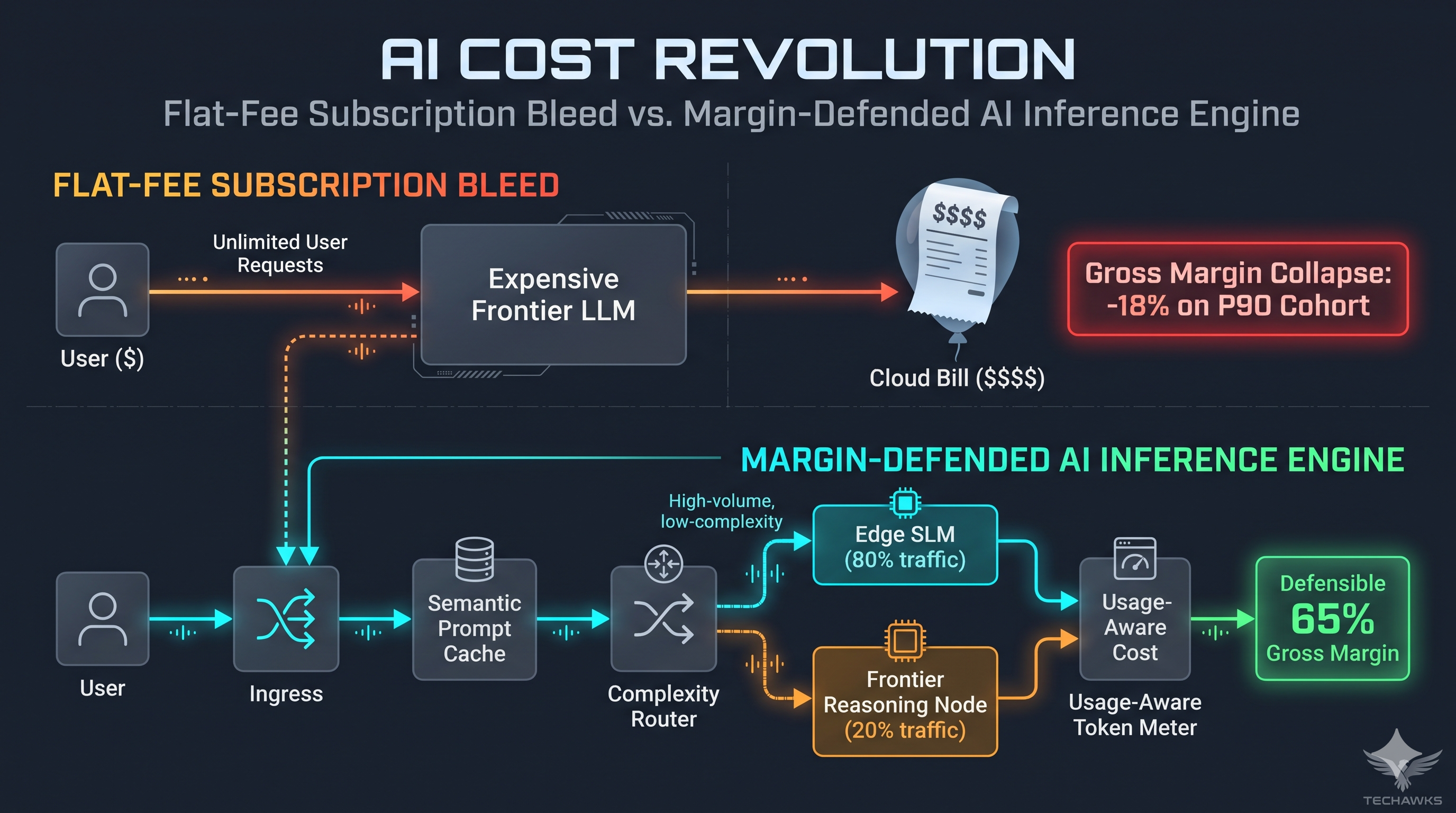
  • The 80% Gross Margin Illusion: Why AI Startups Are Quietly Bleeding Runway
    For fifteen years, B2B software companies traded on a single fundamental assumption: an 80%+ gross margin. You wrote the code once, hosted it on commodity cloud VMs, and served millions of requests for fractions of a cent.In AI products, this assumption has collapsed.
    Recent enterprise benchmark data reveals that AI software operates at an average gross margin of 50% to 60% (with unoptimized architectures dipping below 40%). The culprit isn't marketing spend or customer acquisition—it is treating non-deterministic model inference like general operating expenses (OpEx) instead of direct Cost of Goods Sold (COGS).Plaintext[ ANTI-PATTERN: FLAT-FEE SUBSCRIPTION SQUEEZE ]
    User Subscribes ($49/mo) ──► Unbounded LLM Calls ──► Top 10% Power Users (10x Token Load) ──► Serving Cost ($68/mo) ──► Negative Gross Margin / Cash Bleed


    [ PRODUCTION PATTERN: MARGIN-DEFENDED VALUE ENGINE ]
    User Ingress ──► Semantic Cache (Free Hit) ──► Complexity Classifier ──► Tiered Routing (SLM vs Frontier) ──► Usage-Aware Pricing Floor ──► Defensible 65%+ Margin
    If you are building an AI startup, you cannot wait until your Series A data room to fix unit economics. Here is the operational framework to defend your margins from day one:
    1. Measure AI-Adjusted Gross Margin (COGS Separation)Stop burying LLM API bills, fine-tuning compute, and vector database queries inside general cloud infrastructure.
    Calculate your Inference Cost Ratio ($\frac{\text{Direct Inference Costs}}{\text{Gross Revenue}}$) per customer cohort.
    Isolate your P90 and P99 users. In unmetered flat-fee models, the top decile of power users routinely consumes 10x the median token volume, turning enterprise contract wins into net-negative margin liabilities.
    2. Implement Dynamic Cascading Model RoutingNever hit an expensive frontier model (e.g., $5 to $15 per million tokens) for tasks that a distilled, specialized small language model (SLM) can handle at a 90% discount.
    Tier 1 (Deterministic/Cached): Semantic caching handles recurring user queries and system prompts before touching a model bus.
    Tier 2 (Classification & Extraction): Lightweight, fine-tuned 1B–8B parameter models handle structural parsing, entity extraction, and intent classification.
    Tier 3 (Complex Synthesis): Frontier models are invoked strictly for complex multi-hop reasoning or ambiguous edge cases.3. Shift from Seat-Based to Value-Metric & Hybrid BillingFlat per-seat pricing with uncapped generative capabilities is an open-ended liability. The SaaS pricing playbook has changed:
    Transition to a base platform fee + consumption-aware credit tiers.Set strict internal soft-caps or token allowances tied directly to the contract price.
    Anchor pricing on delivered customer value (e.g., per resolved ticket, per qualified lead, or per verified workflow) rather than passing raw token consumption through to the customer.
    In the current funding climate, investors don't reward vanity top-line growth backed by subsidizing model compute. The founders who build resilient, lasting companies will be those who can defend durable unit economics at scale.
    Discussion Question
    Founders: How are you managing inference unit economics today—pure flat tiers with fair-use limits, credits-based billing, or dynamic model routing under the hood? What surprised you most about your P90 user costs?
    CTA
    Scaling an AI venture and navigating early-stage product economics, fundraising, and architecture?
    👉 Join Startup Founders & Entrepreneurs to share playbooks, benchmark metrics, and build alongside fellow tech founders in the Techawks network.
    The 80% Gross Margin Illusion: Why AI Startups Are Quietly Bleeding Runway For fifteen years, B2B software companies traded on a single fundamental assumption: an 80%+ gross margin. You wrote the code once, hosted it on commodity cloud VMs, and served millions of requests for fractions of a cent.In AI products, this assumption has collapsed. Recent enterprise benchmark data reveals that AI software operates at an average gross margin of 50% to 60% (with unoptimized architectures dipping below 40%). The culprit isn't marketing spend or customer acquisition—it is treating non-deterministic model inference like general operating expenses (OpEx) instead of direct Cost of Goods Sold (COGS).Plaintext[ ANTI-PATTERN: FLAT-FEE SUBSCRIPTION SQUEEZE ] User Subscribes ($49/mo) ──► Unbounded LLM Calls ──► Top 10% Power Users (10x Token Load) ──► Serving Cost ($68/mo) ──► Negative Gross Margin / Cash Bleed [ PRODUCTION PATTERN: MARGIN-DEFENDED VALUE ENGINE ] User Ingress ──► Semantic Cache (Free Hit) ──► Complexity Classifier ──► Tiered Routing (SLM vs Frontier) ──► Usage-Aware Pricing Floor ──► Defensible 65%+ Margin If you are building an AI startup, you cannot wait until your Series A data room to fix unit economics. Here is the operational framework to defend your margins from day one: 1. Measure AI-Adjusted Gross Margin (COGS Separation)Stop burying LLM API bills, fine-tuning compute, and vector database queries inside general cloud infrastructure. Calculate your Inference Cost Ratio ($\frac{\text{Direct Inference Costs}}{\text{Gross Revenue}}$) per customer cohort. Isolate your P90 and P99 users. In unmetered flat-fee models, the top decile of power users routinely consumes 10x the median token volume, turning enterprise contract wins into net-negative margin liabilities. 2. Implement Dynamic Cascading Model RoutingNever hit an expensive frontier model (e.g., $5 to $15 per million tokens) for tasks that a distilled, specialized small language model (SLM) can handle at a 90% discount. Tier 1 (Deterministic/Cached): Semantic caching handles recurring user queries and system prompts before touching a model bus. Tier 2 (Classification & Extraction): Lightweight, fine-tuned 1B–8B parameter models handle structural parsing, entity extraction, and intent classification. Tier 3 (Complex Synthesis): Frontier models are invoked strictly for complex multi-hop reasoning or ambiguous edge cases.3. Shift from Seat-Based to Value-Metric & Hybrid BillingFlat per-seat pricing with uncapped generative capabilities is an open-ended liability. The SaaS pricing playbook has changed: Transition to a base platform fee + consumption-aware credit tiers.Set strict internal soft-caps or token allowances tied directly to the contract price. Anchor pricing on delivered customer value (e.g., per resolved ticket, per qualified lead, or per verified workflow) rather than passing raw token consumption through to the customer. In the current funding climate, investors don't reward vanity top-line growth backed by subsidizing model compute. The founders who build resilient, lasting companies will be those who can defend durable unit economics at scale. Discussion Question Founders: How are you managing inference unit economics today—pure flat tiers with fair-use limits, credits-based billing, or dynamic model routing under the hood? What surprised you most about your P90 user costs? CTA Scaling an AI venture and navigating early-stage product economics, fundraising, and architecture? 👉 Join Startup Founders & Entrepreneurs to share playbooks, benchmark metrics, and build alongside fellow tech founders in the Techawks network.
    0 Comments 0 Shares 43 Views 0 Reviews
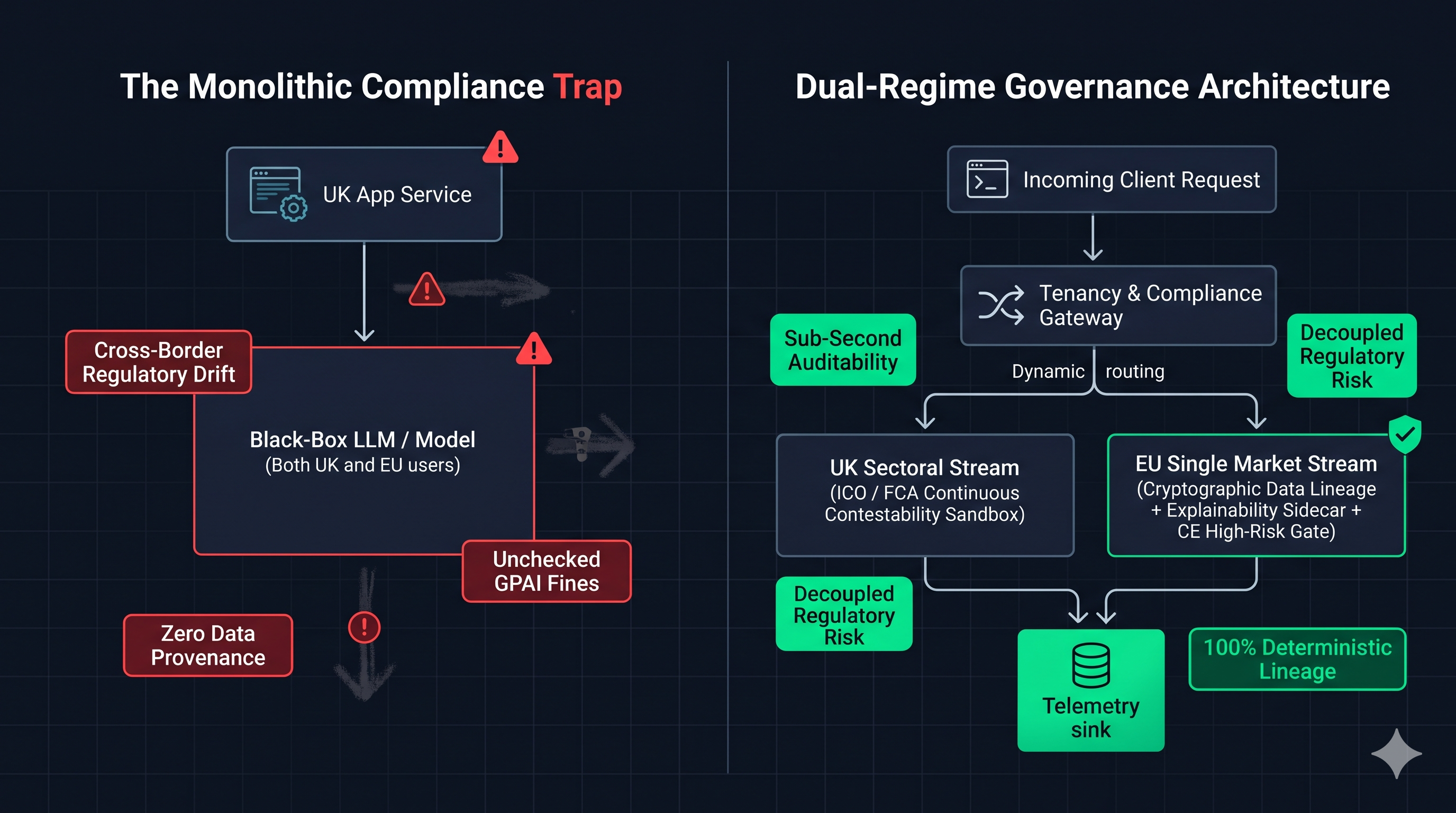
  • The UK-EU AI Divide: Why Engineering Teams Must Architect Dual-Regime Model Governance
    The United Kingdom and the European Union have taken fundamentally opposing paths to artificial intelligence oversight:


    The UK’s Sectoral, Principles-Led Model: The UK deliberately avoided an omnibus horizontal AI statute, instead distributing oversight across established statutory regulators (FCA, ICO, CMA, Ofcom) coordinated via the Digital Regulation Cooperation Forum (DRCF) and DSIT’s central risk functions. It prioritizes outcomes, contextual safety, and sandboxes over blanket technical mandates.


    The EU AI Act’s Strict Classification: The EU enforces horizontal risk tiers with severe penalties (up to €35 million or 7% of global turnover) for high-risk and general-purpose AI (GPAI) systems.


    Here is the engineering reality for UK tech companies: regulatory jurisdiction attaches to user impact, not deployment origin.


    If a UK-headquartered fintech, healthtech, or SaaS product processes inputs or delivers automated decisions impacting users inside the EU single market, your pipeline immediately falls under the EU AI Act’s high-risk obligations. Treating compliance as an afterthought handled by legal teams creates architectural gridlock.


    The Technical Solution: Dual-Regime Telemetry & Lineage Gates
    Forward-thinking UK software architects are decoupling regional compliance into deterministic system abstractions:


    Deterministic Data Lineage & Training Governance:


    High-risk classifications require rigorous data provenance. Implement cryptographic data hashing and metadata tracing across datasets (capturing demographic distribution, synthetic data ratios, and curation flags).


    If a model variant serves an EU endpoint, the ingestion pipeline must deterministically verify that training data governance meets strict accuracy, statistical representation, and bias audits before inference promotion.


    Decoupled Explainability & Continuous Drift Probes:


    The UK's ICO guidelines and the FCA’s AI experimentation frameworks emphasize contestability and transparency—requiring clear auditability for automated financial and identity profiling.


    Do not rely on black-box model outputs. Integrate decoupled feature attribution modules (e.g., integrated gradients or TreeSHAP sidecars) that emit machine-readable rationale logs for every automated classification, enabling sub-second audit reconstruction.


    Runtime Geo-Partitioning & Model Tiering:


    Route user queries through an API gateway middleware that evaluates geographic tenancy and regulatory classification.


    An identical user request originating from Manchester vs. Dublin can be dynamically routed to different backend model checkpoints or policy-enforced guardrail nodes—satisfying strict EU CE-marking and technical documentation gates while taking full advantage of UK sandbox iterations.


    In modern systems engineering, compliance cannot be a periodic manual audit. It must be built directly into your CI/CD pipelines, telemetry schemas, and routing layers.


    Discussion Question
    For UK software teams serving both domestic and European users: are you maintaining unified model pipelines with the strictest common denominator compliance, or have you architected dual-regime routing and automated data lineage gates?


    CTA
    Join Techawks UK: Connect with leading British software architects, fintech engineering leads, and technical founders discussing resilient distributed architectures, AI governance, and UK-global scaling inside the Techawks UK community. Link in bio/comments.
    The UK-EU AI Divide: Why Engineering Teams Must Architect Dual-Regime Model Governance The United Kingdom and the European Union have taken fundamentally opposing paths to artificial intelligence oversight: The UK’s Sectoral, Principles-Led Model: The UK deliberately avoided an omnibus horizontal AI statute, instead distributing oversight across established statutory regulators (FCA, ICO, CMA, Ofcom) coordinated via the Digital Regulation Cooperation Forum (DRCF) and DSIT’s central risk functions. It prioritizes outcomes, contextual safety, and sandboxes over blanket technical mandates. The EU AI Act’s Strict Classification: The EU enforces horizontal risk tiers with severe penalties (up to €35 million or 7% of global turnover) for high-risk and general-purpose AI (GPAI) systems. Here is the engineering reality for UK tech companies: regulatory jurisdiction attaches to user impact, not deployment origin. If a UK-headquartered fintech, healthtech, or SaaS product processes inputs or delivers automated decisions impacting users inside the EU single market, your pipeline immediately falls under the EU AI Act’s high-risk obligations. Treating compliance as an afterthought handled by legal teams creates architectural gridlock. The Technical Solution: Dual-Regime Telemetry & Lineage Gates Forward-thinking UK software architects are decoupling regional compliance into deterministic system abstractions: Deterministic Data Lineage & Training Governance: High-risk classifications require rigorous data provenance. Implement cryptographic data hashing and metadata tracing across datasets (capturing demographic distribution, synthetic data ratios, and curation flags). If a model variant serves an EU endpoint, the ingestion pipeline must deterministically verify that training data governance meets strict accuracy, statistical representation, and bias audits before inference promotion. Decoupled Explainability & Continuous Drift Probes: The UK's ICO guidelines and the FCA’s AI experimentation frameworks emphasize contestability and transparency—requiring clear auditability for automated financial and identity profiling. Do not rely on black-box model outputs. Integrate decoupled feature attribution modules (e.g., integrated gradients or TreeSHAP sidecars) that emit machine-readable rationale logs for every automated classification, enabling sub-second audit reconstruction. Runtime Geo-Partitioning & Model Tiering: Route user queries through an API gateway middleware that evaluates geographic tenancy and regulatory classification. An identical user request originating from Manchester vs. Dublin can be dynamically routed to different backend model checkpoints or policy-enforced guardrail nodes—satisfying strict EU CE-marking and technical documentation gates while taking full advantage of UK sandbox iterations. In modern systems engineering, compliance cannot be a periodic manual audit. It must be built directly into your CI/CD pipelines, telemetry schemas, and routing layers. Discussion Question For UK software teams serving both domestic and European users: are you maintaining unified model pipelines with the strictest common denominator compliance, or have you architected dual-regime routing and automated data lineage gates? CTA Join Techawks UK: Connect with leading British software architects, fintech engineering leads, and technical founders discussing resilient distributed architectures, AI governance, and UK-global scaling inside the Techawks UK community. Link in bio/comments.
    0 Comments 0 Shares 41 Views 0 Reviews
  • The 2 Gigawatt Grid Ceiling: Why US Cloud Architects Are Designing for Carbon-Aware Spatial Load Shifting
    For the past decade, cloud system architecture treated power and cooling as infinite abstract utilities managed by AWS, Azure, or GCP. You provisioned instances, autoscale groups expanded, and the underlying datacenter absorbed the draw.


    In the US tech corridor, that abstraction has broken down.


    With PJM Interconnection facing over 70 GW of prospective large-load requests and regional transmission queues stretching 5 to 7 years, regulatory bodies (FERC) and regional transmission organizations (RTOs) are capping unbacked firm grid access. The limiting constraint on US enterprise AI compute is no longer chip availability—it is electrical grid interconnects and substation thermal limits.


    Engineering teams scaling massive AI pipelines cannot wait for multi-year transmission line overhauls. Instead, top infrastructure architects are transitioning from static, monolithic datacenter footprints to Grid-Aware Spatial Load Shifting:


    1. Decoupling Batch Pre-training from Real-Time Inference
    Inference workloads require strict low-latency proximity to end users (e.g., US-East / US-West metros). Massive batch jobs—such as fine-tuning, synthetic data generation, and offline embedding runs—do not.


    System schedulers must treat electrical grid marginal emissions and real-time megawatt pricing (locational marginal pricing, or LMP) as dynamic orchestration parameters.


    When grid reserve margins tighten in PJM (Mid-Atlantic) during peak summer or winter heating alerts, control planes must automatically throttle or migrate non-urgent checkpoint jobs to regions with surplus renewable generation (such as ERCOT wind during off-peak hours or MISO hydro/solar).


    2. Hardware-Aware Dynamic Power Throttling
    Training clusters generate extreme step-function load spikes during distributed all-reduce synchronization barriers.


    Instead of designing power delivery strictly for unmitigated peak wattage (which drives up capacity interconnection costs), modern orchestrators enforce dynamic power-capping at the server baseboard management controller (BMC) level.


    By shaving off the top 10% of transient power spikes via micro-throttling clock frequencies during communication phases, facilities fit up to 20% more accelerator density within existing utility interconnection limits.


    3. Ephemeral Cross-Region Checkpointing (Disaster & Curtailment Recovery)
    As grid operators debate conditional curtailment rules for unsupported high-density loads, applications must treat cluster power as potentially non-firm.


    Production distributed training jobs must implement sub-minute distributed checkpointing to asynchronous object stores. If a facility receives a Demand Response (DR) signal, workloads pause cleanly, state flushes, and worker pools rehydrate in alternative geographic zones without corrupted weights.


    Software engineers used to optimize for bytes and cycles. The next generation of lead cloud architects must master megawatt curves, transmission topology, and grid elasticity.


    Discussion Question
    As US power constraints reshape datacenter capacity across major tech hubs, is your team actively engineering carbon-aware or energy-scheduled workload migration across cloud regions, or are you still relying on single-region multi-zone provisioning?


    CTA
    Join Techawks USA: Connect with lead cloud infrastructure architects, principal systems engineers, and DevOps directors discussing large-scale cloud resilience, power-constrained architectures, and next-gen US tech infrastructure. Link in bio/comments.
    The 2 Gigawatt Grid Ceiling: Why US Cloud Architects Are Designing for Carbon-Aware Spatial Load Shifting For the past decade, cloud system architecture treated power and cooling as infinite abstract utilities managed by AWS, Azure, or GCP. You provisioned instances, autoscale groups expanded, and the underlying datacenter absorbed the draw. In the US tech corridor, that abstraction has broken down. With PJM Interconnection facing over 70 GW of prospective large-load requests and regional transmission queues stretching 5 to 7 years, regulatory bodies (FERC) and regional transmission organizations (RTOs) are capping unbacked firm grid access. The limiting constraint on US enterprise AI compute is no longer chip availability—it is electrical grid interconnects and substation thermal limits. Engineering teams scaling massive AI pipelines cannot wait for multi-year transmission line overhauls. Instead, top infrastructure architects are transitioning from static, monolithic datacenter footprints to Grid-Aware Spatial Load Shifting: 1. Decoupling Batch Pre-training from Real-Time Inference Inference workloads require strict low-latency proximity to end users (e.g., US-East / US-West metros). Massive batch jobs—such as fine-tuning, synthetic data generation, and offline embedding runs—do not. System schedulers must treat electrical grid marginal emissions and real-time megawatt pricing (locational marginal pricing, or LMP) as dynamic orchestration parameters. When grid reserve margins tighten in PJM (Mid-Atlantic) during peak summer or winter heating alerts, control planes must automatically throttle or migrate non-urgent checkpoint jobs to regions with surplus renewable generation (such as ERCOT wind during off-peak hours or MISO hydro/solar). 2. Hardware-Aware Dynamic Power Throttling Training clusters generate extreme step-function load spikes during distributed all-reduce synchronization barriers. Instead of designing power delivery strictly for unmitigated peak wattage (which drives up capacity interconnection costs), modern orchestrators enforce dynamic power-capping at the server baseboard management controller (BMC) level. By shaving off the top 10% of transient power spikes via micro-throttling clock frequencies during communication phases, facilities fit up to 20% more accelerator density within existing utility interconnection limits. 3. Ephemeral Cross-Region Checkpointing (Disaster & Curtailment Recovery) As grid operators debate conditional curtailment rules for unsupported high-density loads, applications must treat cluster power as potentially non-firm. Production distributed training jobs must implement sub-minute distributed checkpointing to asynchronous object stores. If a facility receives a Demand Response (DR) signal, workloads pause cleanly, state flushes, and worker pools rehydrate in alternative geographic zones without corrupted weights. Software engineers used to optimize for bytes and cycles. The next generation of lead cloud architects must master megawatt curves, transmission topology, and grid elasticity. Discussion Question As US power constraints reshape datacenter capacity across major tech hubs, is your team actively engineering carbon-aware or energy-scheduled workload migration across cloud regions, or are you still relying on single-region multi-zone provisioning? CTA Join Techawks USA: Connect with lead cloud infrastructure architects, principal systems engineers, and DevOps directors discussing large-scale cloud resilience, power-constrained architectures, and next-gen US tech infrastructure. Link in bio/comments.
    0 Comments 0 Shares 52 Views 0 Reviews
  • The Death of the Sidecar Proxy: Why eBPF & Kernel-Bypass Networking Are Rewriting Kubernetes Architecture
    The sidecar model was the defining architectural pattern of early cloud-native service meshes. To enforce mutual TLS (mTLS), collect L7 metrics, or implement canary traffic shifting, platforms injected a proxy container into every application pod.


    While conceptually clean, at enterprise scale the sidecar pattern introduces severe operational friction:


    The Memory & CPU Tax: Multiplying proxy overhead across 5,000 pods consumes hundreds of gigabytes of RAM strictly on infrastructure plumbing.


    Connection Lifecycle Hazards: Application containers frequently crash on startup or fail health checks because their co-located sidecar hasn't finished initializing its listener sockets.


    Triple TCP Stack Traversal: A single intra-node packet traverses the Linux networking stack three times: Pod A userspace ➔ Node kernel ➔ Sidecar userspace ➔ Node kernel ➔ Pod B userspace. This ping-pong traversal introduces measurable latency tails at p99.


    The Architectural Shift: In-Kernel Processing via eBPF
    Modern cloud-native networking (spearheaded by Cilium and sidecarless mesh architectures like Istio Ambient) moves traffic routing, telemetry, and L4/L7 policies directly into the Linux kernel using extended Berkeley Packet Filter (eBPF):


    Socket-Level Redirection (sockops): When two containers communicate on the same node, eBPF programs intercept the payload at the socket layer (sock_ops), directly short-circuiting the network stack. Packets bypass TCP/IP stack evaluation and userspace transitions entirely, cutting intra-node latency by 30% to 40%.


    Node-Level Ambient Proxies (ztunnel): Rather than running thousands of redundant micro-proxies, deploy a single shared, highly optimized L4 transport tunnel per node. Application pods stay lean and untainted, while mTLS encryption and cryptographic identities are handled transparently at the node boundary.


    Zero-Instrumentation Continuous Observability: Instead of manually configuring OpenTelemetry exporters or injecting tracing libraries into application runtimes, kernel probes observe all syscalls (connect, accept, sendto) without restarting pods or modifying a single line of application source code.


    The future of infrastructure resilience is not about adding more middleware layers on top of Kubernetes. It is about pushing policy and telemetry down into the kernel, where it executes with deterministic, native efficiency.


    Discussion Question
    For DevOps, SRE, and platform teams operating large Kubernetes fleets: has your team evaluated migrating from sidecar-based service meshes to eBPF-driven networking or ambient mesh patterns, and what has been your biggest hurdle regarding Linux kernel upgrades or security approval policies?


    CTA
    Join Cloud, DevOps & Open Source: Connect with lead SREs, Kubernetes platform architects, and cloud-native infrastructure engineers debating high-throughput networking, eBPF, and resilient cluster architectures inside the Techawks Cloud & DevOps community. Link in bio/comments.
    The Death of the Sidecar Proxy: Why eBPF & Kernel-Bypass Networking Are Rewriting Kubernetes Architecture The sidecar model was the defining architectural pattern of early cloud-native service meshes. To enforce mutual TLS (mTLS), collect L7 metrics, or implement canary traffic shifting, platforms injected a proxy container into every application pod. While conceptually clean, at enterprise scale the sidecar pattern introduces severe operational friction: The Memory & CPU Tax: Multiplying proxy overhead across 5,000 pods consumes hundreds of gigabytes of RAM strictly on infrastructure plumbing. Connection Lifecycle Hazards: Application containers frequently crash on startup or fail health checks because their co-located sidecar hasn't finished initializing its listener sockets. Triple TCP Stack Traversal: A single intra-node packet traverses the Linux networking stack three times: Pod A userspace ➔ Node kernel ➔ Sidecar userspace ➔ Node kernel ➔ Pod B userspace. This ping-pong traversal introduces measurable latency tails at p99. The Architectural Shift: In-Kernel Processing via eBPF Modern cloud-native networking (spearheaded by Cilium and sidecarless mesh architectures like Istio Ambient) moves traffic routing, telemetry, and L4/L7 policies directly into the Linux kernel using extended Berkeley Packet Filter (eBPF): Socket-Level Redirection (sockops): When two containers communicate on the same node, eBPF programs intercept the payload at the socket layer (sock_ops), directly short-circuiting the network stack. Packets bypass TCP/IP stack evaluation and userspace transitions entirely, cutting intra-node latency by 30% to 40%. Node-Level Ambient Proxies (ztunnel): Rather than running thousands of redundant micro-proxies, deploy a single shared, highly optimized L4 transport tunnel per node. Application pods stay lean and untainted, while mTLS encryption and cryptographic identities are handled transparently at the node boundary. Zero-Instrumentation Continuous Observability: Instead of manually configuring OpenTelemetry exporters or injecting tracing libraries into application runtimes, kernel probes observe all syscalls (connect, accept, sendto) without restarting pods or modifying a single line of application source code. The future of infrastructure resilience is not about adding more middleware layers on top of Kubernetes. It is about pushing policy and telemetry down into the kernel, where it executes with deterministic, native efficiency. Discussion Question For DevOps, SRE, and platform teams operating large Kubernetes fleets: has your team evaluated migrating from sidecar-based service meshes to eBPF-driven networking or ambient mesh patterns, and what has been your biggest hurdle regarding Linux kernel upgrades or security approval policies? CTA Join Cloud, DevOps & Open Source: Connect with lead SREs, Kubernetes platform architects, and cloud-native infrastructure engineers debating high-throughput networking, eBPF, and resilient cluster architectures inside the Techawks Cloud & DevOps community. Link in bio/comments.
    0 Comments 0 Shares 54 Views 0 Reviews
  • The Chatbot Interface Trap: Why Generative UI & Scaffolding Are Replacing the Text Box
    The conversational chatbot UI was a helpful transition bridge, but in enterprise workflows, a blank prompt input is one of the highest-friction interfaces ever designed.


    A blank text box forces users to confront the "Prompting Paradox":


    Users must guess what the underlying system is capable of doing.


    Users must guess the exact syntax or structure required to produce an accurate result.


    Users must manually review walls of unstructured markdown text to verify correctness.


    When an interface hides its functional boundaries behind a cursor, users don't feel empowered—they feel uncertain.


    Product managers and product designers are actively abandoning static chat overlays for Generative UI (GenUI) and Structured Scaffolding:


    1. Inverting Autonomy from "Chat" to "Staged Action Cards"
    Autonomous agents should never simply output conversational text stating what they did. Instead of: "I analyzed the dataset and can update your inventory levels," the interface should render a deterministic, interactive Action Preview Card.


    The card displays the precise database mutation payload, highlights affected records, and provides an editable preview with explicit Confirm, Edit, or Reject controls.


    Keep the human in the loop at the point of irreversible impact, not as an afterthought in chat text.


    2. Deterministic Component Rendering (Generative UI)
    Rather than streaming conversational paragraphs, modern agentic systems stream structured JSON to the client, which dynamically hydrates pre-built design system components (e.g., interactive data tables, comparison split-views, or multi-select filters).


    The AI dynamically orchestrates which components appear based on intent, but the components themselves obey strict design tokens, accessibility constraints, and deterministic click interactions.


    3. Progressive Disclosure Over Monolithic Output
    Do not dump multi-step agent reasoning logs into user-facing viewports. Expose high-level milestones by default (e.g., "Parsed 12 schemas ➔ Validated payment intent"), allowing curious power users to expand technical execution traces on demand.


    The goal of AI UX is not to simulate human conversation. The goal is to accelerate user intent while providing radical visibility, predictable recovery states, and zero-ambiguity control.


    Discussion Question
    For PMs and product designers shipping agentic and AI-native workflows: how is your team transitioning away from conversational text threads toward structured, dynamic UI components—and where have you encountered the biggest friction in your design systems?


    CTA
    Join Product, UX & Design: Connect with lead product managers, principal product designers, and design system architects mastering AI interaction patterns, Generative UI, and user experience strategy inside the Techawks Product & UX community. Link in bio/comments.
    The Chatbot Interface Trap: Why Generative UI & Scaffolding Are Replacing the Text Box The conversational chatbot UI was a helpful transition bridge, but in enterprise workflows, a blank prompt input is one of the highest-friction interfaces ever designed. A blank text box forces users to confront the "Prompting Paradox": Users must guess what the underlying system is capable of doing. Users must guess the exact syntax or structure required to produce an accurate result. Users must manually review walls of unstructured markdown text to verify correctness. When an interface hides its functional boundaries behind a cursor, users don't feel empowered—they feel uncertain. Product managers and product designers are actively abandoning static chat overlays for Generative UI (GenUI) and Structured Scaffolding: 1. Inverting Autonomy from "Chat" to "Staged Action Cards" Autonomous agents should never simply output conversational text stating what they did. Instead of: "I analyzed the dataset and can update your inventory levels," the interface should render a deterministic, interactive Action Preview Card. The card displays the precise database mutation payload, highlights affected records, and provides an editable preview with explicit Confirm, Edit, or Reject controls. Keep the human in the loop at the point of irreversible impact, not as an afterthought in chat text. 2. Deterministic Component Rendering (Generative UI) Rather than streaming conversational paragraphs, modern agentic systems stream structured JSON to the client, which dynamically hydrates pre-built design system components (e.g., interactive data tables, comparison split-views, or multi-select filters). The AI dynamically orchestrates which components appear based on intent, but the components themselves obey strict design tokens, accessibility constraints, and deterministic click interactions. 3. Progressive Disclosure Over Monolithic Output Do not dump multi-step agent reasoning logs into user-facing viewports. Expose high-level milestones by default (e.g., "Parsed 12 schemas ➔ Validated payment intent"), allowing curious power users to expand technical execution traces on demand. The goal of AI UX is not to simulate human conversation. The goal is to accelerate user intent while providing radical visibility, predictable recovery states, and zero-ambiguity control. Discussion Question For PMs and product designers shipping agentic and AI-native workflows: how is your team transitioning away from conversational text threads toward structured, dynamic UI components—and where have you encountered the biggest friction in your design systems? CTA Join Product, UX & Design: Connect with lead product managers, principal product designers, and design system architects mastering AI interaction patterns, Generative UI, and user experience strategy inside the Techawks Product & UX community. Link in bio/comments.
    0 Comments 0 Shares 46 Views 0 Reviews
  • The 80% SaaS Margin Era Is Dead: Why Unit-Economics-First Founders Are Winning Seed & Series A
    For nearly two decades, traditional software thrived on near-zero marginal cost: build the product once, serve the next million users for pennies on the dollar, and bank 75% to 85% gross margins.


    That playbook has officially expired.


    Industry benchmarks reveal that average gross margins for AI software products hover between 50% and 53%—and in uncontrolled agentic applications, margins can plunge below 30%.


    The cause is not poor product-market fit; it is untracked variable COGS. In an AI-native stack, model inference, vector database lookups, self-critique loops, and recursive tool calls are not operational expenses—they are direct Costs of Goods Sold (COGS). When a heavy user triggers an autonomous workflow that makes 15 calls to resolve a query, a flat $30/month seat fee quietly turns into a money-losing account.


    Founders raising institutional rounds today are being evaluated on AI-Adjusted Gross Margin and unit defensibility. Here is how top-tier founders protect their margin profile:


    Decouple Billing from Flat Seats to Hybrid Consumption: Eliminate all-inclusive flat enterprise tiers for autonomous features. Shift to hybrid models: base platform access + metered credit allowances with automatic usage-based overages.


    Implement Dynamic Inference Routing: Never send a classification, extraction, or summarization task to a flagship frontier model. Route 70%+ of standard utility tasks through specialized, small language models (SLMs) or quantized local endpoints, reserving high-tier reasoning engines strictly for complex multi-hop tasks.


    Audit Per-Cohort Marginal Cost: Stop relying on blended platform-wide compute averages. Track unit margins per customer and per feature. If your top 5% power users are responsible for 60% of your inference spend, your pricing model has a structural leak.


    Vanity ARR will get you upvotes; unit-economic discipline gets your company funded and keeps it solvent.


    Discussion Question
    For founders running AI products: have you shifted from flat-rate pricing to hybrid usage/outcome-based billing, and what has been the customer pushback during contract negotiations?


    CTA
    Join Startup Founders & Entrepreneurs: Discuss unit economics, pricing architecture, go-to-market strategies, and fundraising playbooks with active venture-backed founders inside the Techawks Startups community. Link in bio/comments.
    The 80% SaaS Margin Era Is Dead: Why Unit-Economics-First Founders Are Winning Seed & Series A For nearly two decades, traditional software thrived on near-zero marginal cost: build the product once, serve the next million users for pennies on the dollar, and bank 75% to 85% gross margins. That playbook has officially expired. Industry benchmarks reveal that average gross margins for AI software products hover between 50% and 53%—and in uncontrolled agentic applications, margins can plunge below 30%. The cause is not poor product-market fit; it is untracked variable COGS. In an AI-native stack, model inference, vector database lookups, self-critique loops, and recursive tool calls are not operational expenses—they are direct Costs of Goods Sold (COGS). When a heavy user triggers an autonomous workflow that makes 15 calls to resolve a query, a flat $30/month seat fee quietly turns into a money-losing account. Founders raising institutional rounds today are being evaluated on AI-Adjusted Gross Margin and unit defensibility. Here is how top-tier founders protect their margin profile: Decouple Billing from Flat Seats to Hybrid Consumption: Eliminate all-inclusive flat enterprise tiers for autonomous features. Shift to hybrid models: base platform access + metered credit allowances with automatic usage-based overages. Implement Dynamic Inference Routing: Never send a classification, extraction, or summarization task to a flagship frontier model. Route 70%+ of standard utility tasks through specialized, small language models (SLMs) or quantized local endpoints, reserving high-tier reasoning engines strictly for complex multi-hop tasks. Audit Per-Cohort Marginal Cost: Stop relying on blended platform-wide compute averages. Track unit margins per customer and per feature. If your top 5% power users are responsible for 60% of your inference spend, your pricing model has a structural leak. Vanity ARR will get you upvotes; unit-economic discipline gets your company funded and keeps it solvent. Discussion Question For founders running AI products: have you shifted from flat-rate pricing to hybrid usage/outcome-based billing, and what has been the customer pushback during contract negotiations? CTA Join Startup Founders & Entrepreneurs: Discuss unit economics, pricing architecture, go-to-market strategies, and fundraising playbooks with active venture-backed founders inside the Techawks Startups community. Link in bio/comments.
    0 Comments 0 Shares 45 Views 0 Reviews
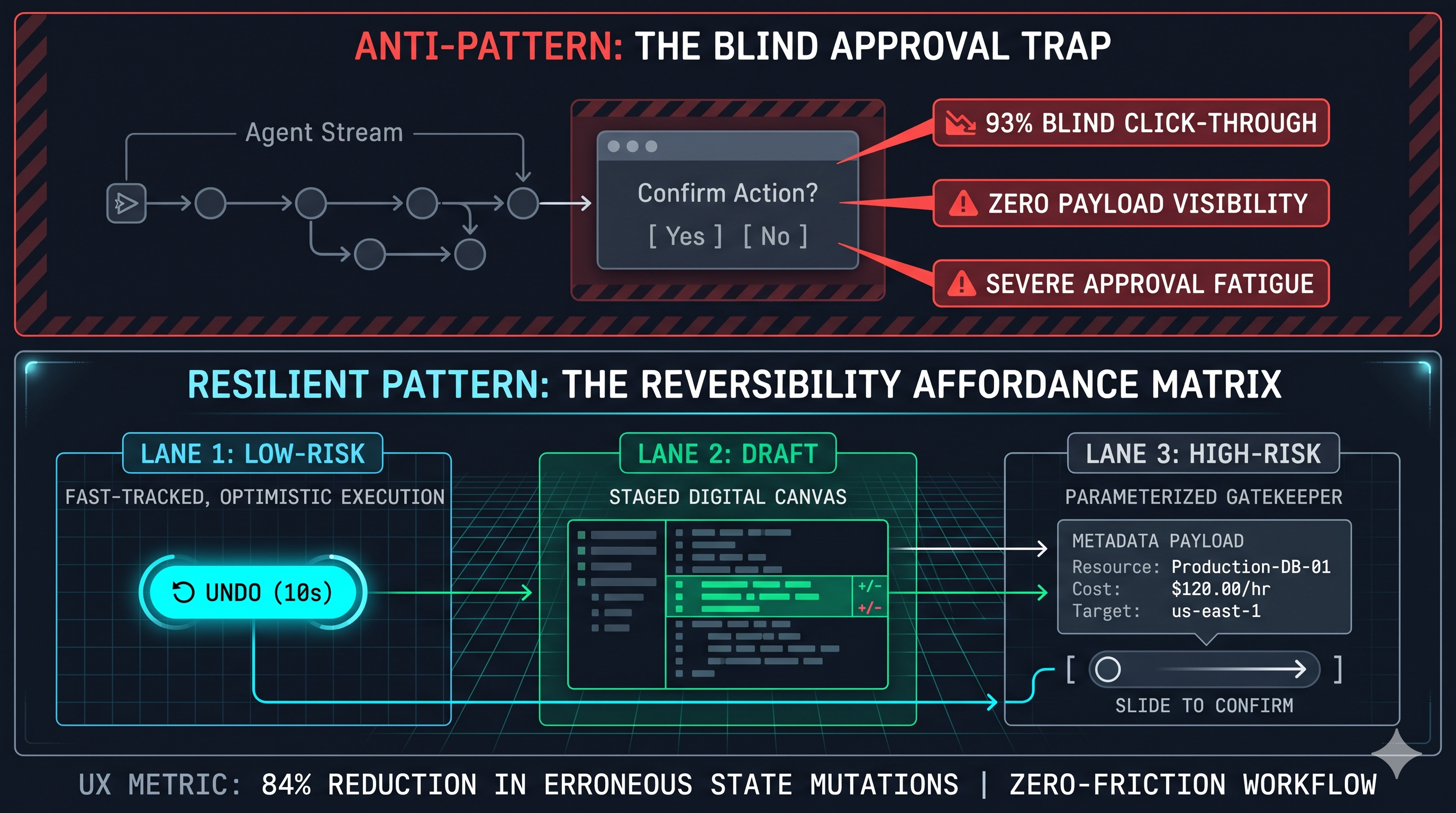
  • The Death of the Chat Box: Designing Reversible Affordances for Agentic AI Workflows
    Traditional UX assumes deterministic interaction: clicking a button always triggers an identical, predictable state mutation.


    Agentic AI breaks this paradigm. Because multi-step agents are non-deterministic, open-ended, and act directly on external environments (executing API calls, sending communications, modifying database records), applying conventional form validations or linear dialog boxes creates dangerous UX failure modes:


    The Interruption Bottleneck: Forcing users to approve every tiny autonomous step completely ruins the agent's core value proposition.


    The Blind-Approval Anti-Pattern: Generic modal dialogues ("Agent wants to proceed: OK / Cancel") obscure the underlying payload, training users to skim and accept without verifying.


    Product managers and product designers must transition from "Chat Interfaces" to Tiered Autonomy and Reversibility Affordances.


    [❌ The Broken Interaction: Generic Confirmation Modal]
    Agent Action ──> [Modal: "Are you sure you want to proceed? [Yes/No]"]
    Outcome: 93% blind approval rate; user fatigue; high disaster blast radius.


    [✅ Modern Agentic UX: The Reversibility Matrix]
    Action Type Interaction Pattern UX Affordance
    ────────────────────────────────────────────────────────────────────────────────────────
    Low-Risk / Reversible │ Optimistic Execution + Undo │ Temporary Toast (5-10s) + Rollback
    Draft / Staged Artifact │ Inline Diff & Direct Canvas Edit │ Shaded Canvas + Single-Key Accept
    High-Risk / Irreversible │ Parameterized Gatekeeper │ Explicit Payload Diff + Dual Approver
    To build agentic products users can genuinely rely on, apply this 3-step UX framework:


    1. Categorize Every Tool Action by Blast Radius and Reversibility
    Never treat all agent tool invocations equally:


    Low Blast Radius / High Reversibility: Tagging tickets, reordering lists, generating draft summaries. Pattern: Execute optimistically without blocking the user, while surfacing a persistent 10-second undo toast.


    High Blast Radius / Irreversible: Transacting payments, altering production infrastructure, deleting customer datasets. Pattern: Full execution freeze with explicit payload inspections.


    2. Design Structured Staging Canvases, Not Conversational Transcripts
    Users cannot parse complex structural changes inside a narrow scrolling chat transcript.


    When an agent drafts a workflow, document, or architecture, render it inside a dedicated Staging Canvas using inline diffing (visual green/red delta highlighting).


    Provide Inline Tweak Affordances: allow the user to click and edit specific hallucinated parameters directly on the canvas without reprompting the agent from scratch.


    3. Transform "Confirmation Modals" into "Parameterized Gatekeepers"
    Eliminate generic alert dialogues. An enterprise approval checkpoint must clearly display:


    The explicit external target (e.g., "Deploying branch 'staging-v2' to AWS us-east-1").


    The exact financial or state delta (e.g., "Estimated monthly compute: +$340/mo").


    A granular fallback toggle allowing the user to approve a subset of actions while rejecting risky tool parameters.


    Designing for autonomous systems is not about getting out of the user's way completely; it is about calibrating load-bearing friction so human oversight feels empowering rather than bureaucratic.


    Discussion Question
    In your product, what criteria separates an action executed autonomously with an "Undo" affordance from one that mandates a blocking Human-in-the-Loop approval gate?


    CTA
    Join Product, UX & Design to unpack real-world design systems, agentic interaction patterns, and product frameworks with designers and product leaders building next-generation interfaces.
    The Death of the Chat Box: Designing Reversible Affordances for Agentic AI Workflows Traditional UX assumes deterministic interaction: clicking a button always triggers an identical, predictable state mutation. Agentic AI breaks this paradigm. Because multi-step agents are non-deterministic, open-ended, and act directly on external environments (executing API calls, sending communications, modifying database records), applying conventional form validations or linear dialog boxes creates dangerous UX failure modes: The Interruption Bottleneck: Forcing users to approve every tiny autonomous step completely ruins the agent's core value proposition. The Blind-Approval Anti-Pattern: Generic modal dialogues ("Agent wants to proceed: OK / Cancel") obscure the underlying payload, training users to skim and accept without verifying. Product managers and product designers must transition from "Chat Interfaces" to Tiered Autonomy and Reversibility Affordances. [❌ The Broken Interaction: Generic Confirmation Modal] Agent Action ──> [Modal: "Are you sure you want to proceed? [Yes/No]"] Outcome: 93% blind approval rate; user fatigue; high disaster blast radius. [✅ Modern Agentic UX: The Reversibility Matrix] Action Type Interaction Pattern UX Affordance ──────────────────────────────────────────────────────────────────────────────────────── Low-Risk / Reversible │ Optimistic Execution + Undo │ Temporary Toast (5-10s) + Rollback Draft / Staged Artifact │ Inline Diff & Direct Canvas Edit │ Shaded Canvas + Single-Key Accept High-Risk / Irreversible │ Parameterized Gatekeeper │ Explicit Payload Diff + Dual Approver To build agentic products users can genuinely rely on, apply this 3-step UX framework: 1. Categorize Every Tool Action by Blast Radius and Reversibility Never treat all agent tool invocations equally: Low Blast Radius / High Reversibility: Tagging tickets, reordering lists, generating draft summaries. Pattern: Execute optimistically without blocking the user, while surfacing a persistent 10-second undo toast. High Blast Radius / Irreversible: Transacting payments, altering production infrastructure, deleting customer datasets. Pattern: Full execution freeze with explicit payload inspections. 2. Design Structured Staging Canvases, Not Conversational Transcripts Users cannot parse complex structural changes inside a narrow scrolling chat transcript. When an agent drafts a workflow, document, or architecture, render it inside a dedicated Staging Canvas using inline diffing (visual green/red delta highlighting). Provide Inline Tweak Affordances: allow the user to click and edit specific hallucinated parameters directly on the canvas without reprompting the agent from scratch. 3. Transform "Confirmation Modals" into "Parameterized Gatekeepers" Eliminate generic alert dialogues. An enterprise approval checkpoint must clearly display: The explicit external target (e.g., "Deploying branch 'staging-v2' to AWS us-east-1"). The exact financial or state delta (e.g., "Estimated monthly compute: +$340/mo"). A granular fallback toggle allowing the user to approve a subset of actions while rejecting risky tool parameters. Designing for autonomous systems is not about getting out of the user's way completely; it is about calibrating load-bearing friction so human oversight feels empowering rather than bureaucratic. Discussion Question In your product, what criteria separates an action executed autonomously with an "Undo" affordance from one that mandates a blocking Human-in-the-Loop approval gate? CTA Join Product, UX & Design to unpack real-world design systems, agentic interaction patterns, and product frameworks with designers and product leaders building next-generation interfaces.
    0 Comments 0 Shares 195 Views 0 Reviews
More Results