


Context Drift Is Killing Production Agents: Why Context Engineering Replaced Prompt Engineering
Most AI builders start by stuffing the prompt: instructions, system schemas, retrieved vector chunks, and conversation history all dumped into one context window.
In production, this triggers Context Rot:
Unstructured conversation history inflates token cost linearly.
Irrelevant retrieved chunks dilute the model's attention weights on system instructions.
Latency scales, while reasoning precision drops.
The shift in 2026 isn't about larger token budgets—it is about transitioning from Prompt Engineering (crafting instructions) to Context Engineering (managing the dynamic information ecosystem at runtime).
The 3 Rules of Context Hygiene for Builders:
Context Pruning via Semantic Delta Updates
Never pass raw back-and-forth chat history to reasoning agents. Maintain an external key-value state store. At each turn, compute the delta (only what changed, what was decided, and the immediate target payload) and pass only structured summaries back into the model's scratchpad.
Decouple Retrieval from Inference (Agentic RAG)
Naive vector search brings back "semantically similar" noise that pollutes context. Use a lightweight router agent to grade retrieved documents before they touch the inference context. If a retrieved chunk does not contain a verifiable entity needed for the query, drop it at the retrieval gateway.
Strict Schema Boundaries (Enforced Structured Outputs)
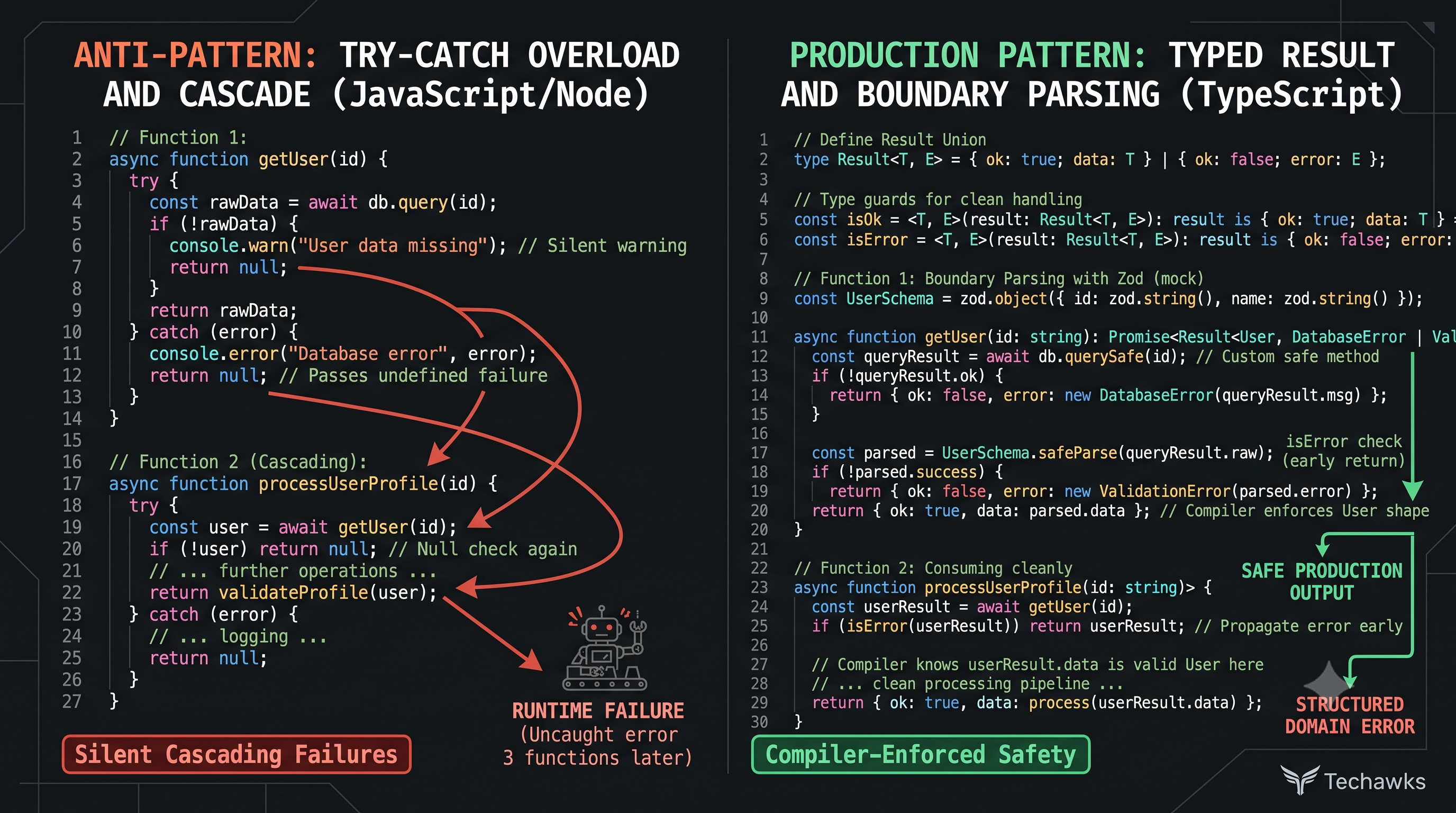
Free-text agent communication is fragile. Bind every inter-agent call and tool invocation to strict schemas (Pydantic / Zod). This keeps payloads compact, eliminates markdown-parsing overhead, and guarantees deterministic downstream parsing.
Prompt engineering tells the model how to think. Context engineering controls what the model can see. The best AI engineers obsess over what to keep out of the prompt.
Discussion Question
When scaling multi-turn reasoning pipelines: How are you handling memory degradation—summarization passes, sliding window truncation, or external state machines with semantic diffs? What’s your preferred stack?
CTA
Level up your AI engineering and architecture game.
👉 Join the Techawks AI Builders & Enthusiasts Community to collaborate, share production architectures, and debug real-world pipelines with fellow developers.
Most AI builders start by stuffing the prompt: instructions, system schemas, retrieved vector chunks, and conversation history all dumped into one context window.
In production, this triggers Context Rot:
Unstructured conversation history inflates token cost linearly.
Irrelevant retrieved chunks dilute the model's attention weights on system instructions.
Latency scales, while reasoning precision drops.
The shift in 2026 isn't about larger token budgets—it is about transitioning from Prompt Engineering (crafting instructions) to Context Engineering (managing the dynamic information ecosystem at runtime).
The 3 Rules of Context Hygiene for Builders:
Context Pruning via Semantic Delta Updates
Never pass raw back-and-forth chat history to reasoning agents. Maintain an external key-value state store. At each turn, compute the delta (only what changed, what was decided, and the immediate target payload) and pass only structured summaries back into the model's scratchpad.
Decouple Retrieval from Inference (Agentic RAG)
Naive vector search brings back "semantically similar" noise that pollutes context. Use a lightweight router agent to grade retrieved documents before they touch the inference context. If a retrieved chunk does not contain a verifiable entity needed for the query, drop it at the retrieval gateway.
Strict Schema Boundaries (Enforced Structured Outputs)
Free-text agent communication is fragile. Bind every inter-agent call and tool invocation to strict schemas (Pydantic / Zod). This keeps payloads compact, eliminates markdown-parsing overhead, and guarantees deterministic downstream parsing.
Prompt engineering tells the model how to think. Context engineering controls what the model can see. The best AI engineers obsess over what to keep out of the prompt.
Discussion Question
When scaling multi-turn reasoning pipelines: How are you handling memory degradation—summarization passes, sliding window truncation, or external state machines with semantic diffs? What’s your preferred stack?
CTA
Level up your AI engineering and architecture game.
👉 Join the Techawks AI Builders & Enthusiasts Community to collaborate, share production architectures, and debug real-world pipelines with fellow developers.
Context Drift Is Killing Production Agents: Why Context Engineering Replaced Prompt Engineering
Most AI builders start by stuffing the prompt: instructions, system schemas, retrieved vector chunks, and conversation history all dumped into one context window.
In production, this triggers Context Rot:
Unstructured conversation history inflates token cost linearly.
Irrelevant retrieved chunks dilute the model's attention weights on system instructions.
Latency scales, while reasoning precision drops.
The shift in 2026 isn't about larger token budgets—it is about transitioning from Prompt Engineering (crafting instructions) to Context Engineering (managing the dynamic information ecosystem at runtime).
The 3 Rules of Context Hygiene for Builders:
Context Pruning via Semantic Delta Updates
Never pass raw back-and-forth chat history to reasoning agents. Maintain an external key-value state store. At each turn, compute the delta (only what changed, what was decided, and the immediate target payload) and pass only structured summaries back into the model's scratchpad.
Decouple Retrieval from Inference (Agentic RAG)
Naive vector search brings back "semantically similar" noise that pollutes context. Use a lightweight router agent to grade retrieved documents before they touch the inference context. If a retrieved chunk does not contain a verifiable entity needed for the query, drop it at the retrieval gateway.
Strict Schema Boundaries (Enforced Structured Outputs)
Free-text agent communication is fragile. Bind every inter-agent call and tool invocation to strict schemas (Pydantic / Zod). This keeps payloads compact, eliminates markdown-parsing overhead, and guarantees deterministic downstream parsing.
Prompt engineering tells the model how to think. Context engineering controls what the model can see. The best AI engineers obsess over what to keep out of the prompt.
Discussion Question
When scaling multi-turn reasoning pipelines: How are you handling memory degradation—summarization passes, sliding window truncation, or external state machines with semantic diffs? What’s your preferred stack?
CTA
Level up your AI engineering and architecture game.
👉 Join the Techawks AI Builders & Enthusiasts Community to collaborate, share production architectures, and debug real-world pipelines with fellow developers.





 English
 Arabic
 French
 Spanish
 Portuguese
 Deutsch
 Turkish
 Italiano
 Russian
 Romaian
 Portuguese (Brazil)
 Greek
Greek