• Context Drift Is Killing Production Agents: Why Context Engineering Replaced Prompt Engineering


    Most AI builders start by stuffing the prompt: instructions, system schemas, retrieved vector chunks, and conversation history all dumped into one context window.


    In production, this triggers Context Rot:
    Unstructured conversation history inflates token cost linearly.
    Irrelevant retrieved chunks dilute the model's attention weights on system instructions.


    Latency scales, while reasoning precision drops.
    The shift in 2026 isn't about larger token budgets—it is about transitioning from Prompt Engineering (crafting instructions) to Context Engineering (managing the dynamic information ecosystem at runtime).


    The 3 Rules of Context Hygiene for Builders:
    Context Pruning via Semantic Delta Updates
    Never pass raw back-and-forth chat history to reasoning agents. Maintain an external key-value state store. At each turn, compute the delta (only what changed, what was decided, and the immediate target payload) and pass only structured summaries back into the model's scratchpad.


    Decouple Retrieval from Inference (Agentic RAG)
    Naive vector search brings back "semantically similar" noise that pollutes context. Use a lightweight router agent to grade retrieved documents before they touch the inference context. If a retrieved chunk does not contain a verifiable entity needed for the query, drop it at the retrieval gateway.


    Strict Schema Boundaries (Enforced Structured Outputs)
    Free-text agent communication is fragile. Bind every inter-agent call and tool invocation to strict schemas (Pydantic / Zod). This keeps payloads compact, eliminates markdown-parsing overhead, and guarantees deterministic downstream parsing.


    Prompt engineering tells the model how to think. Context engineering controls what the model can see. The best AI engineers obsess over what to keep out of the prompt.


    Discussion Question
    When scaling multi-turn reasoning pipelines: How are you handling memory degradation—summarization passes, sliding window truncation, or external state machines with semantic diffs? What’s your preferred stack?


    CTA
    Level up your AI engineering and architecture game.


    👉 Join the Techawks AI Builders & Enthusiasts Community to collaborate, share production architectures, and debug real-world pipelines with fellow developers.
    Context Drift Is Killing Production Agents: Why Context Engineering Replaced Prompt Engineering Most AI builders start by stuffing the prompt: instructions, system schemas, retrieved vector chunks, and conversation history all dumped into one context window. In production, this triggers Context Rot: Unstructured conversation history inflates token cost linearly. Irrelevant retrieved chunks dilute the model's attention weights on system instructions. Latency scales, while reasoning precision drops. The shift in 2026 isn't about larger token budgets—it is about transitioning from Prompt Engineering (crafting instructions) to Context Engineering (managing the dynamic information ecosystem at runtime). The 3 Rules of Context Hygiene for Builders: Context Pruning via Semantic Delta Updates Never pass raw back-and-forth chat history to reasoning agents. Maintain an external key-value state store. At each turn, compute the delta (only what changed, what was decided, and the immediate target payload) and pass only structured summaries back into the model's scratchpad. Decouple Retrieval from Inference (Agentic RAG) Naive vector search brings back "semantically similar" noise that pollutes context. Use a lightweight router agent to grade retrieved documents before they touch the inference context. If a retrieved chunk does not contain a verifiable entity needed for the query, drop it at the retrieval gateway. Strict Schema Boundaries (Enforced Structured Outputs) Free-text agent communication is fragile. Bind every inter-agent call and tool invocation to strict schemas (Pydantic / Zod). This keeps payloads compact, eliminates markdown-parsing overhead, and guarantees deterministic downstream parsing. Prompt engineering tells the model how to think. Context engineering controls what the model can see. The best AI engineers obsess over what to keep out of the prompt. Discussion Question When scaling multi-turn reasoning pipelines: How are you handling memory degradation—summarization passes, sliding window truncation, or external state machines with semantic diffs? What’s your preferred stack? CTA Level up your AI engineering and architecture game. 👉 Join the Techawks AI Builders & Enthusiasts Community to collaborate, share production architectures, and debug real-world pipelines with fellow developers.
    0 Comentários 0 Compartilhamentos 24 Visualizações 0 Anterior
  • Stop Writing Brittle Code: Why Defensive Design Beats Endless Try-Catch Blocks


    Most developers are taught error handling as an afterthought: wrap the risky operation, log an error string, and return null or an empty object.


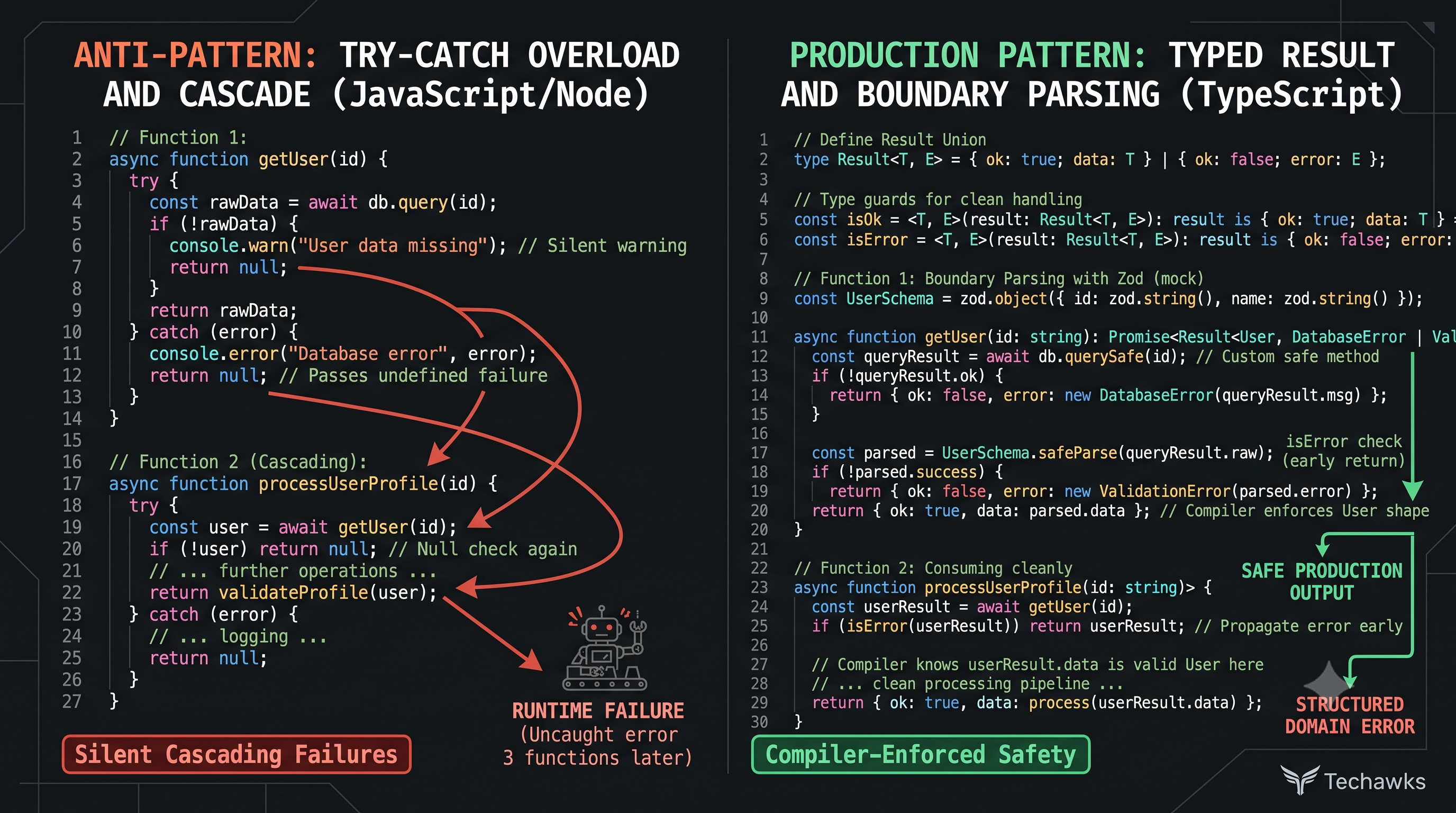
    In production systems, this creates Silent State Corruption. When a function returns null, every caller up the stack must remember to check for it. Forget one check, and you trigger an unhandled runtime failure three services away.


    The industry standard for resilient systems is moving away from exception-driven flow control toward Result Type Modeling and Parse, Don't Validate.


    TypeScript
    // ❌ ANTI-PATTERN: Exception-driven flow control
    async function getUser(id: string): Promise<User | null> {
    try {
    const raw = await db.query(id);
    return raw as User; // Blind type assertion
    } catch (err) {
    console.error(err);
    return null; // Passes undefined failure state upstream
    }
    }


    // ✅ PRODUCTION READY: Typed Result Pattern + Runtime Parsing
    type Result<T, E> = { ok: true; data: T } | { ok: false; error: E };


    async function getUserSafe(id: string): Promise<Result<User, DatabaseError | ValidationError>> {
    const queryResult = await db.safeQuery(id);
    if (!queryResult.ok) {
    return { ok: false, error: new DatabaseError(queryResult.msg) };
    }


    // Parse schema at the boundary; never trust raw inputs
    const parsed = UserSchema.safeParse(queryResult.raw);
    if (!parsed.success) {
    return { ok: false, error: new ValidationError(parsed.error) };
    }


    return { ok: true, data: parsed.data };
    }


    Why This Changes Your Codebase:
    Compile-Time Enforcement: Callers cannot access result.data without narrowing result.ok === true. The compiler forces you to handle failure explicitly before runtime.


    Boundary Validation: By validating data shape immediately at the boundary (API responses, DB queries, message queues) using schemas like Zod or TypeBox, inner domain logic never has to check if properties exist.


    Traceable Domain Errors: Instead of generic Error instances, return tagged union error types that document exactly what failure modes an operation can trigger.


    Exceptions should be reserved for truly exceptional conditions (e.g., out-of-memory or dropped socket connections), not expected domain states like missing records or invalid inputs.


    Discussion Question
    How does your team handle domain error propagation in production—Result/Either types, explicit custom exception hierarchies, or middleware-level error boundaries? What trade-offs have you seen in developer velocity?


    CTA
    Ready to write cleaner, production-grade code that doesn't break at 3 AM?


    👉 Join the Techawks Developers & Coding Community to exchange code reviews, architectural design patterns, and engineering practices with active builders.
    Stop Writing Brittle Code: Why Defensive Design Beats Endless Try-Catch Blocks Most developers are taught error handling as an afterthought: wrap the risky operation, log an error string, and return null or an empty object. In production systems, this creates Silent State Corruption. When a function returns null, every caller up the stack must remember to check for it. Forget one check, and you trigger an unhandled runtime failure three services away. The industry standard for resilient systems is moving away from exception-driven flow control toward Result Type Modeling and Parse, Don't Validate. TypeScript // ❌ ANTI-PATTERN: Exception-driven flow control async function getUser(id: string): Promise<User | null> { try { const raw = await db.query(id); return raw as User; // Blind type assertion } catch (err) { console.error(err); return null; // Passes undefined failure state upstream } } // ✅ PRODUCTION READY: Typed Result Pattern + Runtime Parsing type Result<T, E> = { ok: true; data: T } | { ok: false; error: E }; async function getUserSafe(id: string): Promise<Result<User, DatabaseError | ValidationError>> { const queryResult = await db.safeQuery(id); if (!queryResult.ok) { return { ok: false, error: new DatabaseError(queryResult.msg) }; } // Parse schema at the boundary; never trust raw inputs const parsed = UserSchema.safeParse(queryResult.raw); if (!parsed.success) { return { ok: false, error: new ValidationError(parsed.error) }; } return { ok: true, data: parsed.data }; } Why This Changes Your Codebase: Compile-Time Enforcement: Callers cannot access result.data without narrowing result.ok === true. The compiler forces you to handle failure explicitly before runtime. Boundary Validation: By validating data shape immediately at the boundary (API responses, DB queries, message queues) using schemas like Zod or TypeBox, inner domain logic never has to check if properties exist. Traceable Domain Errors: Instead of generic Error instances, return tagged union error types that document exactly what failure modes an operation can trigger. Exceptions should be reserved for truly exceptional conditions (e.g., out-of-memory or dropped socket connections), not expected domain states like missing records or invalid inputs. Discussion Question How does your team handle domain error propagation in production—Result/Either types, explicit custom exception hierarchies, or middleware-level error boundaries? What trade-offs have you seen in developer velocity? CTA Ready to write cleaner, production-grade code that doesn't break at 3 AM? 👉 Join the Techawks Developers & Coding Community to exchange code reviews, architectural design patterns, and engineering practices with active builders.
    0 Comentários 0 Compartilhamentos 23 Visualizações 0 Anterior
  • The "Code-Writer" Trap: Why Hiring Teams Are Pivoting from Syntax to Systems Auditing


    AI autocomplete and code-generation tools have reduced the marginal cost of writing boilerplate code to near zero. As a result, engineering leads are no longer struggling to find developers who can generate code; they are desperate for engineers who can evaluate, debug, and safely integrate it.
    The tech hiring benchmark has shifted from Code Production to Systems Stewardship.
    If you want to stand out to hiring managers and technical interviewers today, here is how you translate your projects from "toy status" to production authority:


    1. Shift Your Project Narratives to "Evaluation First"
    Before: "Built a full-stack e-commerce app with Node, React, and MongoDB."


    Now: "Architected a microservice with strict boundary schema validation, reducing API contract mismatches by 40% and cutting edge-case runtime failures."


    Why it matters: Anyone can scaffold a full-stack template with an LLM. Highlighting your validation harness, error telemetry, and failure-mode handling proves you understand the realities of production.


    2. Master "Code Auditing" Over Blind Copy-Pasting
    During technical screens, interviewers increasingly test your ability to debug complex, AI-generated edge cases rather than write standard algorithms from scratch. Focus your prep on:


    Identifying subtle concurrency hazards and race conditions.
    Spotting memory leaks and unindexed database queries.
    Explaining the architectural trade-offs between stateless processing and persistent caching.


    3. Demonstrate Business-Context Architecture
    Junior engineers ask: "How do I implement this function?"


    Staff-level engineers ask: "What happens when this service times out, how much does this call cost in token/compute overhead, and who monitors the failure?"


    The engineers securing offers right now aren't competing with AI to generate syntax—they are positioning themselves as the critical reasoning layer that directs and validates it.


    Discussion Question
    Job seekers and engineers currently interviewing: Have you noticed interview loops changing—are companies leaning harder into debugging and system architecture, or are you still seeing traditional whiteboard DSA rounds? Share your recent interview experiences below.


    CTA
    Ready to navigate the evolving hiring landscape and stand out in modern tech interviews?


    👉 Join the Techawks Tech Jobs & Opportunities Community to access curated roles, resume teardowns, and direct interview prep strategies.
    The "Code-Writer" Trap: Why Hiring Teams Are Pivoting from Syntax to Systems Auditing AI autocomplete and code-generation tools have reduced the marginal cost of writing boilerplate code to near zero. As a result, engineering leads are no longer struggling to find developers who can generate code; they are desperate for engineers who can evaluate, debug, and safely integrate it. The tech hiring benchmark has shifted from Code Production to Systems Stewardship. If you want to stand out to hiring managers and technical interviewers today, here is how you translate your projects from "toy status" to production authority: 1. Shift Your Project Narratives to "Evaluation First" Before: "Built a full-stack e-commerce app with Node, React, and MongoDB." Now: "Architected a microservice with strict boundary schema validation, reducing API contract mismatches by 40% and cutting edge-case runtime failures." Why it matters: Anyone can scaffold a full-stack template with an LLM. Highlighting your validation harness, error telemetry, and failure-mode handling proves you understand the realities of production. 2. Master "Code Auditing" Over Blind Copy-Pasting During technical screens, interviewers increasingly test your ability to debug complex, AI-generated edge cases rather than write standard algorithms from scratch. Focus your prep on: Identifying subtle concurrency hazards and race conditions. Spotting memory leaks and unindexed database queries. Explaining the architectural trade-offs between stateless processing and persistent caching. 3. Demonstrate Business-Context Architecture Junior engineers ask: "How do I implement this function?" Staff-level engineers ask: "What happens when this service times out, how much does this call cost in token/compute overhead, and who monitors the failure?" The engineers securing offers right now aren't competing with AI to generate syntax—they are positioning themselves as the critical reasoning layer that directs and validates it. Discussion Question Job seekers and engineers currently interviewing: Have you noticed interview loops changing—are companies leaning harder into debugging and system architecture, or are you still seeing traditional whiteboard DSA rounds? Share your recent interview experiences below. CTA Ready to navigate the evolving hiring landscape and stand out in modern tech interviews? 👉 Join the Techawks Tech Jobs & Opportunities Community to access curated roles, resume teardowns, and direct interview prep strategies.
    0 Comentários 0 Compartilhamentos 78 Visualizações 0 Anterior
  • The 80% Gross Margin Illusion: Why AI-Native Startups Must Redesign Their Unit Economics


    For fifteen years, cloud software enjoyed an economic cheat code: near-zero marginal cost of distribution. Once the code was deployed, serving user #10,000 cost virtually the same as serving user #100.


    In the AI-native wave, that rule no longer applies.
    Every user action triggers an inference call, data retrieval loop, or context-evaluation pipeline. As usage scales, compute costs scale linearly alongside it. When AI companies price like traditional SaaS—charging a flat $29 or $49/seat/month while offering unmetered reasoning—power users quickly consume $50+ in monthly cloud and model inference.


    The result is Inference Margin Decay: high top-line ARR growth hiding 35% to 55% blended gross margins.


    The 3 Pillars of AI Unit Economics for Founders:
    Incorporate Compute Directly into COGS
    Treating GPU tokens and model API calls as discretionary R&D or operational overhead masks your true unit profitability. Compute must sit inside Cost of Goods Sold (COGS). Your key metric isn't just gross margin; it is Gross Margin After Compute (GMAC). Sustainable AI startups target a 60%–70% GMAC by Series A.


    Move from Per-Seat to Outcome or Work-Unit Pricing
    Flat seat licenses incentivize users to maximize heavy agent workflows on fixed fees. Transition to hybrid pricing: a base platform fee for UI/access paired with consumption credits or outcome-based billing (e.g., per resolved ticket, per audited contract, or per completed reconciliation). Align your revenue directly with the compute intensity of the task.


    Establish Semantic Cache & Model Tiering Gateways
    Route queries dynamically. Don't hit an expensive frontier reasoning model for intent classification or deterministic formatting. Use small, fine-tuned open models (SLMs) or vector caches for 70% of routine workflows, reserving large reasoning models strictly for complex synthesis.
    A high-growth startup with 40% gross margins is not a software company—it's an IT consultancy disguised as software. Real venture defensibility is building high-margin workflow software around optimized, cost-controlled inference.


    Discussion Question
    Founders building AI products: How are you managing inference unit economics—are you passing usage directly via hybrid token/credit pricing, caching aggressively, or absorbing the margins until you hit scale? Drop your pricing lessons below.


    CTA
    Ready to build sustainable venture-scale companies with airtight fundamentals?


    👉 Join the Techawks Startup Founders & Entrepreneurs Community to discuss unit economics, go-to-market strategies, and fundraising playbooks with fellow operators.
    The 80% Gross Margin Illusion: Why AI-Native Startups Must Redesign Their Unit Economics For fifteen years, cloud software enjoyed an economic cheat code: near-zero marginal cost of distribution. Once the code was deployed, serving user #10,000 cost virtually the same as serving user #100. In the AI-native wave, that rule no longer applies. Every user action triggers an inference call, data retrieval loop, or context-evaluation pipeline. As usage scales, compute costs scale linearly alongside it. When AI companies price like traditional SaaS—charging a flat $29 or $49/seat/month while offering unmetered reasoning—power users quickly consume $50+ in monthly cloud and model inference. The result is Inference Margin Decay: high top-line ARR growth hiding 35% to 55% blended gross margins. The 3 Pillars of AI Unit Economics for Founders: Incorporate Compute Directly into COGS Treating GPU tokens and model API calls as discretionary R&D or operational overhead masks your true unit profitability. Compute must sit inside Cost of Goods Sold (COGS). Your key metric isn't just gross margin; it is Gross Margin After Compute (GMAC). Sustainable AI startups target a 60%–70% GMAC by Series A. Move from Per-Seat to Outcome or Work-Unit Pricing Flat seat licenses incentivize users to maximize heavy agent workflows on fixed fees. Transition to hybrid pricing: a base platform fee for UI/access paired with consumption credits or outcome-based billing (e.g., per resolved ticket, per audited contract, or per completed reconciliation). Align your revenue directly with the compute intensity of the task. Establish Semantic Cache & Model Tiering Gateways Route queries dynamically. Don't hit an expensive frontier reasoning model for intent classification or deterministic formatting. Use small, fine-tuned open models (SLMs) or vector caches for 70% of routine workflows, reserving large reasoning models strictly for complex synthesis. A high-growth startup with 40% gross margins is not a software company—it's an IT consultancy disguised as software. Real venture defensibility is building high-margin workflow software around optimized, cost-controlled inference. Discussion Question Founders building AI products: How are you managing inference unit economics—are you passing usage directly via hybrid token/credit pricing, caching aggressively, or absorbing the margins until you hit scale? Drop your pricing lessons below. CTA Ready to build sustainable venture-scale companies with airtight fundamentals? 👉 Join the Techawks Startup Founders & Entrepreneurs Community to discuss unit economics, go-to-market strategies, and fundraising playbooks with fellow operators.
    0 Comentários 0 Compartilhamentos 86 Visualizações 0 Anterior
  • The "Tutorial Hell" Trap: Why Building Systems Beats Collecting Certificates


    Many students believe landing their first software role requires knowing five different programming languages and stacking online course certificates.
    With modern code generation and assisted tooling readily available, knowing raw syntax is no longer a differentiator. What hiring teams and senior engineers evaluate is first-principles mental models: understanding what happens underneath the abstraction layer.
    If you want your projects to stand out and build real technical confidence, shift your study habits from Surface-Level Frameworks to Core Systems Fundamentals:


    1. Stop Building Clones—Build Instrumentation
    Instead of: Another clone of a social media feed or todo app.
    Build: An HTTP rate-limiter middleware from scratch using a token-bucket algorithm, or a small key-value store that persists records to disk using append-only logs.


    Why it matters: Building low-level utilities forces you to confront concurrency, disk I/O, serialization, and memory management—the exact challenges production software handles daily.


    2. Trace the Complete Request Lifecycle
    Pick one stack you already know (e.g., Python, Node.js, or Go) and write down the journey of a single byte:
    What happens at the DNS resolution level?
    How does TLS handshaking establish encryption?
    How does the OS kernel allocate a socket buffer?
    How does your database engine use a B-Tree index to avoid scanning millions of rows?
    When you can explain the mechanics behind an API call, technical interviews stop feeling like trivia games and start feeling like architecture discussions.


    3. Break Things on Purpose (Chaos Debugging)
    Don't stop once your project passes the "happy path." Intentionally introduce failure modes:
    Drop your database connection mid-transaction: Does your code corrupt data or roll back gracefully?
    Flood your backend with 500 concurrent requests: Does memory spike or crash the process?
    Simulate high network latency: Does your frontend hang forever or time out cleanly?
    Syntax changes every two years; systems fundamentals haven't changed in four decades. Master how computers move, store, and process data, and you will never fear a new framework again.


    Discussion Question
    For students and early career devs: What core concept felt most like a "black box" until you built it yourself—database indexes, networking protocols, async event loops, or memory pointers? Share what finally made it click for you.


    CTA
    Ready to move past tutorial hell and master real-world engineering fundamentals?


    👉 Join the Techawks Students in Tech Community to collaborate on projects, review code with mentors, and level up your software craft.
    The "Tutorial Hell" Trap: Why Building Systems Beats Collecting Certificates Many students believe landing their first software role requires knowing five different programming languages and stacking online course certificates. With modern code generation and assisted tooling readily available, knowing raw syntax is no longer a differentiator. What hiring teams and senior engineers evaluate is first-principles mental models: understanding what happens underneath the abstraction layer. If you want your projects to stand out and build real technical confidence, shift your study habits from Surface-Level Frameworks to Core Systems Fundamentals: 1. Stop Building Clones—Build Instrumentation Instead of: Another clone of a social media feed or todo app. Build: An HTTP rate-limiter middleware from scratch using a token-bucket algorithm, or a small key-value store that persists records to disk using append-only logs. Why it matters: Building low-level utilities forces you to confront concurrency, disk I/O, serialization, and memory management—the exact challenges production software handles daily. 2. Trace the Complete Request Lifecycle Pick one stack you already know (e.g., Python, Node.js, or Go) and write down the journey of a single byte: What happens at the DNS resolution level? How does TLS handshaking establish encryption? How does the OS kernel allocate a socket buffer? How does your database engine use a B-Tree index to avoid scanning millions of rows? When you can explain the mechanics behind an API call, technical interviews stop feeling like trivia games and start feeling like architecture discussions. 3. Break Things on Purpose (Chaos Debugging) Don't stop once your project passes the "happy path." Intentionally introduce failure modes: Drop your database connection mid-transaction: Does your code corrupt data or roll back gracefully? Flood your backend with 500 concurrent requests: Does memory spike or crash the process? Simulate high network latency: Does your frontend hang forever or time out cleanly? Syntax changes every two years; systems fundamentals haven't changed in four decades. Master how computers move, store, and process data, and you will never fear a new framework again. Discussion Question For students and early career devs: What core concept felt most like a "black box" until you built it yourself—database indexes, networking protocols, async event loops, or memory pointers? Share what finally made it click for you. CTA Ready to move past tutorial hell and master real-world engineering fundamentals? 👉 Join the Techawks Students in Tech Community to collaborate on projects, review code with mentors, and level up your software craft.
    0 Comentários 0 Compartilhamentos 180 Visualizações 0 Anterior
  • The Identity Perimeter: Why Network Firewalls Can’t Protect Against Session Token Theft


    For years, security teams treated multi-factor authentication (MFA) as the ultimate wall. Push notifications, hardware keys, and OTPs stopped brute-force credential stuffing in its tracks.


    However, attackers have shifted their attack vectors from obtaining passwords to acquiring the post-authentication credential: Session Tokens.
    Through adversary-in-the-middle (AiTM) phishing proxies and infostealer malware, attackers bypass MFA entirely. Once an authenticated session token is extracted from memory or persistent browser storage, the attacker replay-injects it into their own browser. To your identity provider (IdP), that attacker isn't an intruder—they are an authenticated employee.


    How to Defend the Post-Auth Boundary:
    Enforce Token Binding (DPoP):
    Transition from bearer tokens to cryptographic proof-of-possession schemes like Demonstrating Proof-of-Possession (DPoP) at the application layer. DPoP binds access and refresh tokens to a private key held by the client, rendering stolen tokens useless on third-party machines.


    Implement Continuous Access Evaluation (CAE):
    Static token expiration intervals (e.g., 8-hour or 24-hour lifetimes) give adversaries massive attack windows. Use CAE protocols that dynamically revoke session tokens the instant telemetry signals change (e.g., sudden IP/ASN subnet shift, abnormal device health status, or user role change).


    Restructure Secret and Cookie Hygiene:
    Ensure all authentication cookies use HttpOnly, Secure, and SameSite=Strict attributes to block client-side JavaScript execution (XSS exfiltration). For native applications and developer tools, eliminate persistent plain-text API credentials on local disk by utilizing OS-level secure enclaves and keyrings.


    MFA proves who you are at the front door. Token security and continuous evaluation verify that you are still the one walking the halls.


    Discussion Question
    For security engineers and analysts: How is your team tackling session hijacking—are you enforcing strict short-lived tokens with CAE, mandating device-bound cryptographic keys, or relying on anomaly detection rules? Share your implementation hurdles below.


    CTA
    Ready to understand modern attack surfaces and master defensive engineering?


    👉 Join the Techawks Cybersecurity & Ethical Hacking Community to dissect threat vectors, participate in capture-the-flag challenges, and learn from security practitioners.
    The Identity Perimeter: Why Network Firewalls Can’t Protect Against Session Token Theft For years, security teams treated multi-factor authentication (MFA) as the ultimate wall. Push notifications, hardware keys, and OTPs stopped brute-force credential stuffing in its tracks. However, attackers have shifted their attack vectors from obtaining passwords to acquiring the post-authentication credential: Session Tokens. Through adversary-in-the-middle (AiTM) phishing proxies and infostealer malware, attackers bypass MFA entirely. Once an authenticated session token is extracted from memory or persistent browser storage, the attacker replay-injects it into their own browser. To your identity provider (IdP), that attacker isn't an intruder—they are an authenticated employee. How to Defend the Post-Auth Boundary: Enforce Token Binding (DPoP): Transition from bearer tokens to cryptographic proof-of-possession schemes like Demonstrating Proof-of-Possession (DPoP) at the application layer. DPoP binds access and refresh tokens to a private key held by the client, rendering stolen tokens useless on third-party machines. Implement Continuous Access Evaluation (CAE): Static token expiration intervals (e.g., 8-hour or 24-hour lifetimes) give adversaries massive attack windows. Use CAE protocols that dynamically revoke session tokens the instant telemetry signals change (e.g., sudden IP/ASN subnet shift, abnormal device health status, or user role change). Restructure Secret and Cookie Hygiene: Ensure all authentication cookies use HttpOnly, Secure, and SameSite=Strict attributes to block client-side JavaScript execution (XSS exfiltration). For native applications and developer tools, eliminate persistent plain-text API credentials on local disk by utilizing OS-level secure enclaves and keyrings. MFA proves who you are at the front door. Token security and continuous evaluation verify that you are still the one walking the halls. Discussion Question For security engineers and analysts: How is your team tackling session hijacking—are you enforcing strict short-lived tokens with CAE, mandating device-bound cryptographic keys, or relying on anomaly detection rules? Share your implementation hurdles below. CTA Ready to understand modern attack surfaces and master defensive engineering? 👉 Join the Techawks Cybersecurity & Ethical Hacking Community to dissect threat vectors, participate in capture-the-flag challenges, and learn from security practitioners.
    0 Comentários 0 Compartilhamentos 186 Visualizações 0 Anterior
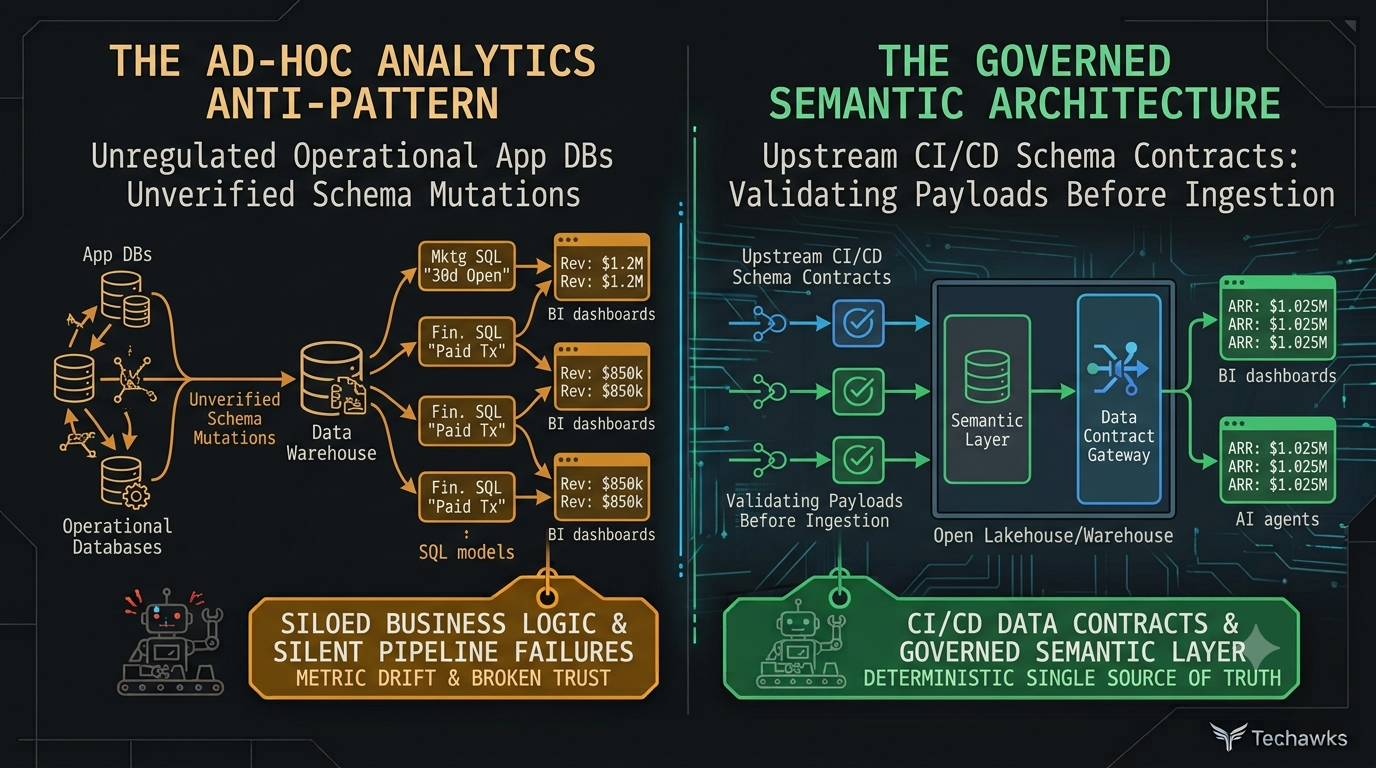
  • The Metric Discrepancy Trap: Why the Modern Data Stack Replaced Warehouse SQL with Data Contracts and Semantic Layers


    For years, data engineering prioritized raw pipeline speed and warehouse centralization: ingest raw data as fast as possible via ELT, dump it into the lakehouse or warehouse, and let downstream analysts write custom transformation logic.


    The result is Metric Drift & Upstream Schema Chaos:
    A software engineer renames a column in an operational database, silently breaking downstream dbt models and dashboard extracts.
    Marketing defines an "active customer" as someone who opened an email within 30 days, while Finance defines it as someone who completed a paid transaction in the last quarter.
    When AI query agents or executive dashboards read from conflicting transformation tables, hallucinations and misaligned business decisions multiply.
    To build trustworthy analytics, high-performing data teams are deprecating ad-hoc warehouse SQL and adopting Upstream Data Contracts paired with a Governed Semantic Layer.


    The Two Pillars of Architectural Data Integrity:
    Shift Left: Enforce Upstream Data Contracts
    Treat data as a production API contract between software engineers producing data and data teams consuming it.
    Define schemas, freshness guarantees, and nullability constraints in version-controlled declarations (YAML/Protobuf) at the service boundary.
    Run schema change checks inside CI/CD pipelines. If a software deploy breaks a declared downstream contract, the deployment fails before it corrupts your data lakehouse.
    Decouple Metric Logic from the BI Dashboard (The Semantic Layer)
    Never calculate core KPIs inside proprietary BI tools or isolated SQL scripts.
    Define dimension relationships, aggregations, and business metrics (e.g., Net Churn, ARR, Customer Lifetime Value) once in a unified, version-controlled semantic layer.
    Whether an analyst queries via Tableau, a software engineer hits an API, or an AI agent queries via natural language, every tool points to the identical semantic abstraction.


    Pipelines transport data, but data contracts and semantic definitions ensure that data actually means what you think it means.


    Discussion Question
    For data engineers and analytics leads: Where is your biggest architectural headache right now—upstream source schema changes breaking your ingestion pipelines, or metric definitions diverging across BI tools and AI agents? How are you enforcing consistency?


    CTA
    Ready to build reliable data architectures, robust pipelines, and production-grade analytics?


    👉 Join the Techawks Data Science & Analytics Community to exchange lakehouse design patterns, discuss data modeling, and master the modern data stack alongside industry practitioners.
    The Metric Discrepancy Trap: Why the Modern Data Stack Replaced Warehouse SQL with Data Contracts and Semantic Layers For years, data engineering prioritized raw pipeline speed and warehouse centralization: ingest raw data as fast as possible via ELT, dump it into the lakehouse or warehouse, and let downstream analysts write custom transformation logic. The result is Metric Drift & Upstream Schema Chaos: A software engineer renames a column in an operational database, silently breaking downstream dbt models and dashboard extracts. Marketing defines an "active customer" as someone who opened an email within 30 days, while Finance defines it as someone who completed a paid transaction in the last quarter. When AI query agents or executive dashboards read from conflicting transformation tables, hallucinations and misaligned business decisions multiply. To build trustworthy analytics, high-performing data teams are deprecating ad-hoc warehouse SQL and adopting Upstream Data Contracts paired with a Governed Semantic Layer. The Two Pillars of Architectural Data Integrity: Shift Left: Enforce Upstream Data Contracts Treat data as a production API contract between software engineers producing data and data teams consuming it. Define schemas, freshness guarantees, and nullability constraints in version-controlled declarations (YAML/Protobuf) at the service boundary. Run schema change checks inside CI/CD pipelines. If a software deploy breaks a declared downstream contract, the deployment fails before it corrupts your data lakehouse. Decouple Metric Logic from the BI Dashboard (The Semantic Layer) Never calculate core KPIs inside proprietary BI tools or isolated SQL scripts. Define dimension relationships, aggregations, and business metrics (e.g., Net Churn, ARR, Customer Lifetime Value) once in a unified, version-controlled semantic layer. Whether an analyst queries via Tableau, a software engineer hits an API, or an AI agent queries via natural language, every tool points to the identical semantic abstraction. Pipelines transport data, but data contracts and semantic definitions ensure that data actually means what you think it means. Discussion Question For data engineers and analytics leads: Where is your biggest architectural headache right now—upstream source schema changes breaking your ingestion pipelines, or metric definitions diverging across BI tools and AI agents? How are you enforcing consistency? CTA Ready to build reliable data architectures, robust pipelines, and production-grade analytics? 👉 Join the Techawks Data Science & Analytics Community to exchange lakehouse design patterns, discuss data modeling, and master the modern data stack alongside industry practitioners.
    0 Comentários 0 Compartilhamentos 183 Visualizações 0 Anterior
  • Beyond Feature-Factorying: The Rise of Deterministic Workflow Stewardship


    We are moving past the novelty phase of AI in product development. High-performing teams are shifting their engineering effort away from open-ended, non-deterministic "Generative AI" features towards Agentic Choreography & Workflow Stewardship.


    This means transitioning from merely predicting text to executing state-safe business logic.


    For Product Managers and Designers, this requires a fundamental architectural rethink: stop trying to build autonomous agents that automate broken processes, and start designing Deterministic Systems that safely coordinate LLMs for high-reliability outputs.


    The 2 Principles of Agentic Stewardship for PMs & Designers:
    Shift Focus from Prompts to Bounded State Machines (FSMs)


    Open-ended agent loops (ReAct) fail in production because they get caught in token recursion or cannot reliably execute safe database transactions.


    Design Action: Mandate that your engineering teams isolate LLM reasoning steps from deterministic action steps. Every agent action (like database writes or API calls) must be bound by a finite-state machine with a hard exit strategy (e.g., maximum of three retry loops before human escalation). Your PRDs should now require deterministic failure mode definitions, not just acceptance criteria.


    Isolate State from Inference (Stateless Agents Pattern)


    Don't pass raw conversation history between multi-turn agent calls. It causes context drift, linear token cost inflation, and high latency.


    Design Action: Treat your LLM as a stateless task processor. Maintain system state in structured, key-value external caches. Only pass transaction "diffs" (only the specific state change needed for the immediate task) between agent turns, rather than bloating the reasoning context with raw chat logs.


    AI should not be the product; AI should be the high-fidelity orchestration mechanism that makes the product's underlying, reliable data layers accessible. The product stewardship of 2026 is about engineering reliability into a probabilistic world.


    Discussion Question
    For PMs and Engineers currently deploying agents: Where is your biggest bottleneck to reliability—is it context drift over multi-turn interactions, agents failing to adhere to structured JSON schemas, or managing token budgets with long-context windows? Let's discuss architecture patterns below.


    CTA
    Ready to build reliable, scalable AI systems?


    👉 Join the Techawks Product, UX & Design Community to master deterministic system design, agent orchestration, and production-grade product thinking Alongside industry practitioners.
    Beyond Feature-Factorying: The Rise of Deterministic Workflow Stewardship We are moving past the novelty phase of AI in product development. High-performing teams are shifting their engineering effort away from open-ended, non-deterministic "Generative AI" features towards Agentic Choreography & Workflow Stewardship. This means transitioning from merely predicting text to executing state-safe business logic. For Product Managers and Designers, this requires a fundamental architectural rethink: stop trying to build autonomous agents that automate broken processes, and start designing Deterministic Systems that safely coordinate LLMs for high-reliability outputs. The 2 Principles of Agentic Stewardship for PMs & Designers: Shift Focus from Prompts to Bounded State Machines (FSMs) Open-ended agent loops (ReAct) fail in production because they get caught in token recursion or cannot reliably execute safe database transactions. Design Action: Mandate that your engineering teams isolate LLM reasoning steps from deterministic action steps. Every agent action (like database writes or API calls) must be bound by a finite-state machine with a hard exit strategy (e.g., maximum of three retry loops before human escalation). Your PRDs should now require deterministic failure mode definitions, not just acceptance criteria. Isolate State from Inference (Stateless Agents Pattern) Don't pass raw conversation history between multi-turn agent calls. It causes context drift, linear token cost inflation, and high latency. Design Action: Treat your LLM as a stateless task processor. Maintain system state in structured, key-value external caches. Only pass transaction "diffs" (only the specific state change needed for the immediate task) between agent turns, rather than bloating the reasoning context with raw chat logs. AI should not be the product; AI should be the high-fidelity orchestration mechanism that makes the product's underlying, reliable data layers accessible. The product stewardship of 2026 is about engineering reliability into a probabilistic world. Discussion Question For PMs and Engineers currently deploying agents: Where is your biggest bottleneck to reliability—is it context drift over multi-turn interactions, agents failing to adhere to structured JSON schemas, or managing token budgets with long-context windows? Let's discuss architecture patterns below. CTA Ready to build reliable, scalable AI systems? 👉 Join the Techawks Product, UX & Design Community to master deterministic system design, agent orchestration, and production-grade product thinking Alongside industry practitioners.
    0 Comentários 0 Compartilhamentos 176 Visualizações 0 Anterior
  • The 80% Idle Trap: Why 2026 Belongs to Local-First AI & Minimalist Cloud Infrastructure


    The original promise of cloud computing was variable cost control: burst compute when needed, pay-for-use, and minimize idle overhead. However, the AI-native shift has corrupted this model.


    High-performing teams are no longer just "cloud-native"; they are local-first.


    In 2026, the most significant performance and cost optimization is removing infrastructure, not adding it. High-end workstations and M-series chips now handle heavy agentic reasoning loops and local SLM (Small Language Model) inference at the source boundary.


    Your 3-Step DevOps Optimization Strategy:
    Shift Right, then Shift Left (Boundary Inference)


    Treat local machines as an extended compute plane. Use containerized local inference gateways. Before sending a workload to the cloud, enforce a boundary rule: if the query requires fewer than 7B parameters or can be semantic-cached locally, drop it from the cloud egress pipeline entirely.


    Move from VMs to Native WASM & Containers


    If an agent workflow requires cloud validation, execute it in a highly ephemeral environment. Do not spin up a K8s pod or a VM. Use WebAssembly (WASM) or lightweight native containers (like Firecracker/gVisor) for transactional, low-millisecond agent calls.


    Establish Local/Cloud Deterministic Sync


    The bottleneck isn’t compute; it’s state. Implement local-first CRDT (Conflict-free Replicated Data Type) or robust transactional databases that keep state deterministic between the developer workstation and the cloud control plane.


    Your cloud strategy should not be about managing massive clusters; it should be about building minimal, deterministic gateways that coordinate execution across decentralized, high-utilization hardware.


    Discussion Question
    For cloud and platform engineers optimizing AI architecture: How are you handling the hybrid split—are you using service mesh to route inference, containerizing local runtimes, or purely optimizing on-demand cloud costs? Share your optimization playbook.


    CTA
    Ready to build minimal, scalable, and cost-efficient cloud systems?


    👉 Join the Techawks Cloud, DevOps & Open Source Community to master distributed systems, local-first architecture, and production engineering Alongside industry practitioners.
    The 80% Idle Trap: Why 2026 Belongs to Local-First AI & Minimalist Cloud Infrastructure The original promise of cloud computing was variable cost control: burst compute when needed, pay-for-use, and minimize idle overhead. However, the AI-native shift has corrupted this model. High-performing teams are no longer just "cloud-native"; they are local-first. In 2026, the most significant performance and cost optimization is removing infrastructure, not adding it. High-end workstations and M-series chips now handle heavy agentic reasoning loops and local SLM (Small Language Model) inference at the source boundary. Your 3-Step DevOps Optimization Strategy: Shift Right, then Shift Left (Boundary Inference) Treat local machines as an extended compute plane. Use containerized local inference gateways. Before sending a workload to the cloud, enforce a boundary rule: if the query requires fewer than 7B parameters or can be semantic-cached locally, drop it from the cloud egress pipeline entirely. Move from VMs to Native WASM & Containers If an agent workflow requires cloud validation, execute it in a highly ephemeral environment. Do not spin up a K8s pod or a VM. Use WebAssembly (WASM) or lightweight native containers (like Firecracker/gVisor) for transactional, low-millisecond agent calls. Establish Local/Cloud Deterministic Sync The bottleneck isn’t compute; it’s state. Implement local-first CRDT (Conflict-free Replicated Data Type) or robust transactional databases that keep state deterministic between the developer workstation and the cloud control plane. Your cloud strategy should not be about managing massive clusters; it should be about building minimal, deterministic gateways that coordinate execution across decentralized, high-utilization hardware. Discussion Question For cloud and platform engineers optimizing AI architecture: How are you handling the hybrid split—are you using service mesh to route inference, containerizing local runtimes, or purely optimizing on-demand cloud costs? Share your optimization playbook. CTA Ready to build minimal, scalable, and cost-efficient cloud systems? 👉 Join the Techawks Cloud, DevOps & Open Source Community to master distributed systems, local-first architecture, and production engineering Alongside industry practitioners.
    0 Comentários 0 Compartilhamentos 179 Visualizações 0 Anterior
  • The 80% Idle Trap: How Local-First AI & Minimizing Cloud Infrastructure Will Define the Indian Tech Stack in 2026


    The original promise of cloud computing was variable cost control: burst compute when needed, pay-for-use, and minimize idle overhead. However, the AI-native shift has corrupted this model. High-performing teams are no longer just "cloud-native"; they are local-first.


    In 2026, the most significant performance and cost optimization is removing infrastructure, not adding it. High-end workstations and M-series chips now handle heavy agentic reasoning loops and local SLM (Small Language Model) inference at the source boundary. This is especially critical in India, where data sovereignty and latency to global cloud regions are constant hurdles.


    Your 3-Step DevOps Optimization Strategy:
    Shift Right, then Shift Left (Boundary Inference)
    Treat local machines as an extended compute plane. Use containerized local inference gateways. Before sending a workload to the cloud, enforce a boundary rule: if the query requires fewer than 7B parameters or can be semantic-cached locally, drop it from the cloud egress pipeline entirely. This dramatically reduces data egress charges.


    Move from VMs to Native WASM & Containers
    If an agent workflow requires cloud validation, execute it in a highly ephemeral environment. Do not spin up a K8s pod or a VM. Use WebAssembly (WASM) or lightweight native containers (like Firecracker/gVisor) for transactional, low-millisecond agent calls.


    Establish Local/Cloud Deterministic Sync
    The bottleneck isn’t compute; it’s state. Implement local-first CRDT (Conflict-free Replicated Data Type) or robust transactional databases that keep state deterministic between the developer workstation and the cloud control plane.


    Your cloud strategy should not be about managing massive clusters; it should be about building minimal, deterministic gateways that coordinate execution across decentralized, high-utilization hardware.


    Discussion Question
    For cloud engineers and platform architects optimizing AI architecture: How are you handling the hybrid split—are you using service mesh to route inference, containerizing local runtimes, or optimizing on-demand cloud costs? Share your optimization playbook.


    CTA
    Ready to build minimal, scalable, and cost-efficient cloud systems optimized for the Indian context?
    👉 Join Techawks India to master distributed systems, local-first architecture, and production engineering alongside local practitioners.
    The 80% Idle Trap: How Local-First AI & Minimizing Cloud Infrastructure Will Define the Indian Tech Stack in 2026 The original promise of cloud computing was variable cost control: burst compute when needed, pay-for-use, and minimize idle overhead. However, the AI-native shift has corrupted this model. High-performing teams are no longer just "cloud-native"; they are local-first. In 2026, the most significant performance and cost optimization is removing infrastructure, not adding it. High-end workstations and M-series chips now handle heavy agentic reasoning loops and local SLM (Small Language Model) inference at the source boundary. This is especially critical in India, where data sovereignty and latency to global cloud regions are constant hurdles. Your 3-Step DevOps Optimization Strategy: Shift Right, then Shift Left (Boundary Inference) Treat local machines as an extended compute plane. Use containerized local inference gateways. Before sending a workload to the cloud, enforce a boundary rule: if the query requires fewer than 7B parameters or can be semantic-cached locally, drop it from the cloud egress pipeline entirely. This dramatically reduces data egress charges. Move from VMs to Native WASM & Containers If an agent workflow requires cloud validation, execute it in a highly ephemeral environment. Do not spin up a K8s pod or a VM. Use WebAssembly (WASM) or lightweight native containers (like Firecracker/gVisor) for transactional, low-millisecond agent calls. Establish Local/Cloud Deterministic Sync The bottleneck isn’t compute; it’s state. Implement local-first CRDT (Conflict-free Replicated Data Type) or robust transactional databases that keep state deterministic between the developer workstation and the cloud control plane. Your cloud strategy should not be about managing massive clusters; it should be about building minimal, deterministic gateways that coordinate execution across decentralized, high-utilization hardware. Discussion Question For cloud engineers and platform architects optimizing AI architecture: How are you handling the hybrid split—are you using service mesh to route inference, containerizing local runtimes, or optimizing on-demand cloud costs? Share your optimization playbook. CTA Ready to build minimal, scalable, and cost-efficient cloud systems optimized for the Indian context? 👉 Join Techawks India to master distributed systems, local-first architecture, and production engineering alongside local practitioners.
    0 Comentários 0 Compartilhamentos 175 Visualizações 0 Anterior