



Why the UK’s "Divergent" AI Strategy is a Game-Changer for Local Devs
Today, the UK government published its response to the AI White Paper consultation, outlining its official strategy. While the EU is moving toward heavy, horizontal legislation, the UK has chosen a distinctly different path: a pro-innovation, sector-specific approach governed by existing regulators.
Why it matters locally:
For the UK tech community, this divergence is massive. It means:
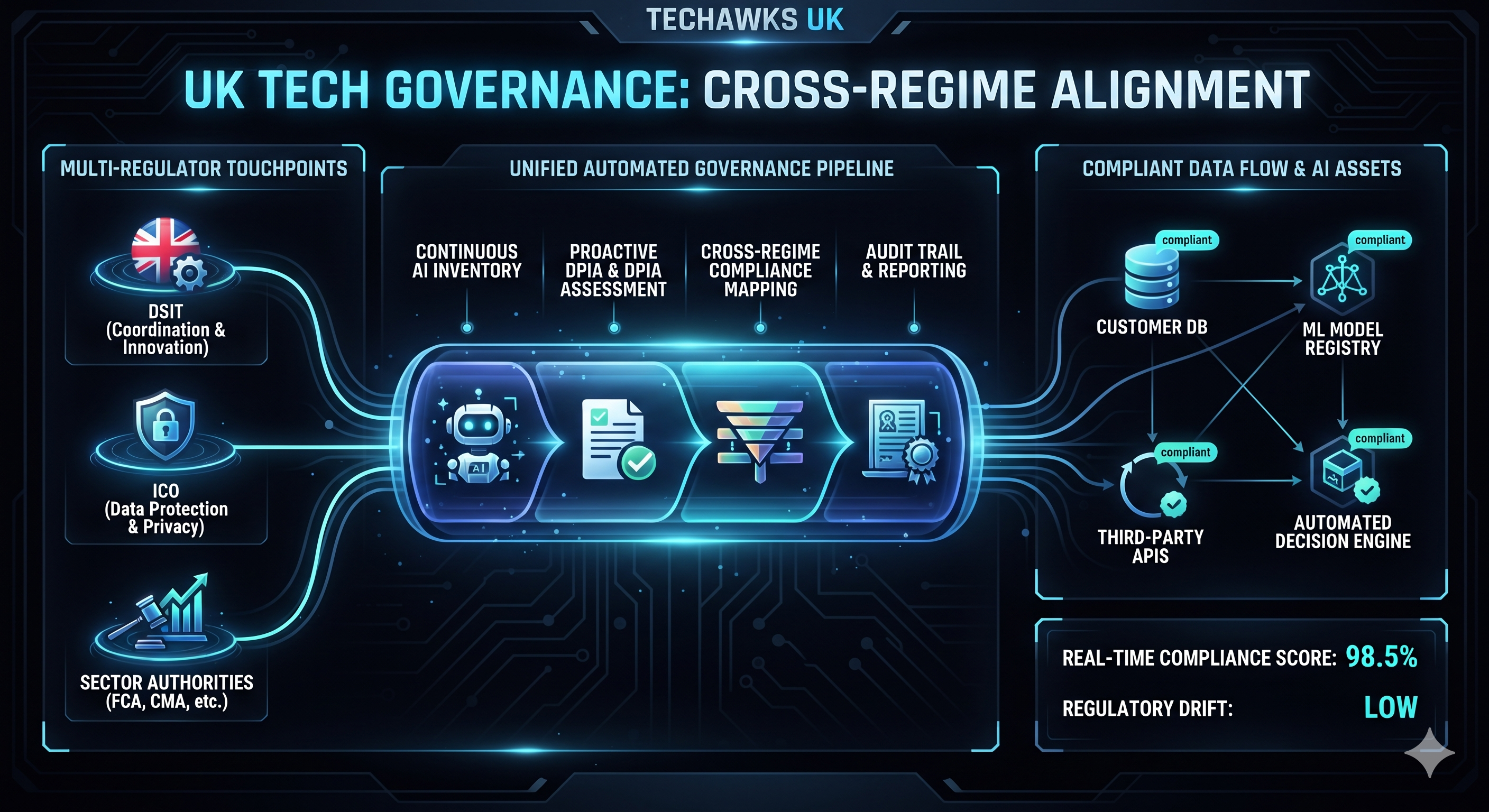
No New Blanket Legislation (Yet): Instead of a single, massive AI law, guidance will come from sector regulators (CMA for competition, ICO for data privacy, Ofcom for safety).
Clarity for Adoption: This avoids the "over-compliance" paralysis that threatens innovation in other regions. It allows UK businesses to adopt AI tools with more confidence, provided they operate within existing legal boundaries.
The "Sandboxing" Strategy: The government is investing in tools like the AI and Digital Hub to help regulators and businesses navigate compliance together.
Teach something useful: How to "Shift Left" on AI Governance now.
Even without a new specific "AI Act," your AI deployment must be legally sound. Don't wait for regulators to knock. Start implementing "AI-specific Privacy by Design" principles now.
If you are building an AI application, ask yourself these three questions before deployment:
Provenance: Do you have absolute visibility into the data used to train or fine-tune the model?
Explainability (XAI): If the model makes a decision that affects a UK citizen (e.g., recruitment, loan approval), can you explain how that decision was reached?
Human Oversight: Is there a human in the loop capable of overriding automated decisions to prevent bias or error?
By baking these governance layers into your architecture now, you future-proof your innovation against both UK regulatory scrutiny and reputational risk.
Discussion Question:
With the UK diverging from the EU's approach to AI regulation, do you believe this pro-innovation stance will accelerate UK tech growth, or will it create eventual friction for companies doing business internationally? Let’s debate below 👇
CTA (Join Techawks UK):
Stay ahead of the UK regulatory curve. We distill the noise into actionable, technical strategy for the British tech scene. Follow Techawks UK for daily insights that matter.
Why the UK’s "Divergent" AI Strategy is a Game-Changer for Local Devs
Today, the UK government published its response to the AI White Paper consultation, outlining its official strategy. While the EU is moving toward heavy, horizontal legislation, the UK has chosen a distinctly different path: a pro-innovation, sector-specific approach governed by existing regulators.
Why it matters locally:
For the UK tech community, this divergence is massive. It means:
No New Blanket Legislation (Yet): Instead of a single, massive AI law, guidance will come from sector regulators (CMA for competition, ICO for data privacy, Ofcom for safety).
Clarity for Adoption: This avoids the "over-compliance" paralysis that threatens innovation in other regions. It allows UK businesses to adopt AI tools with more confidence, provided they operate within existing legal boundaries.
The "Sandboxing" Strategy: The government is investing in tools like the AI and Digital Hub to help regulators and businesses navigate compliance together.
Teach something useful: How to "Shift Left" on AI Governance now.
Even without a new specific "AI Act," your AI deployment must be legally sound. Don't wait for regulators to knock. Start implementing "AI-specific Privacy by Design" principles now.
If you are building an AI application, ask yourself these three questions before deployment:
Provenance: Do you have absolute visibility into the data used to train or fine-tune the model?
Explainability (XAI): If the model makes a decision that affects a UK citizen (e.g., recruitment, loan approval), can you explain how that decision was reached?
Human Oversight: Is there a human in the loop capable of overriding automated decisions to prevent bias or error?
By baking these governance layers into your architecture now, you future-proof your innovation against both UK regulatory scrutiny and reputational risk.
Discussion Question:
With the UK diverging from the EU's approach to AI regulation, do you believe this pro-innovation stance will accelerate UK tech growth, or will it create eventual friction for companies doing business internationally? Let’s debate below 👇
CTA (Join Techawks UK):
Stay ahead of the UK regulatory curve. We distill the noise into actionable, technical strategy for the British tech scene. Follow Techawks UK for daily insights that matter.








 English
 Arabic
 French
 Spanish
 Portuguese
 Turkish
 Dutch
 Italiano
 Russian
 Romaian
 Portuguese (Brazil)
 Greek