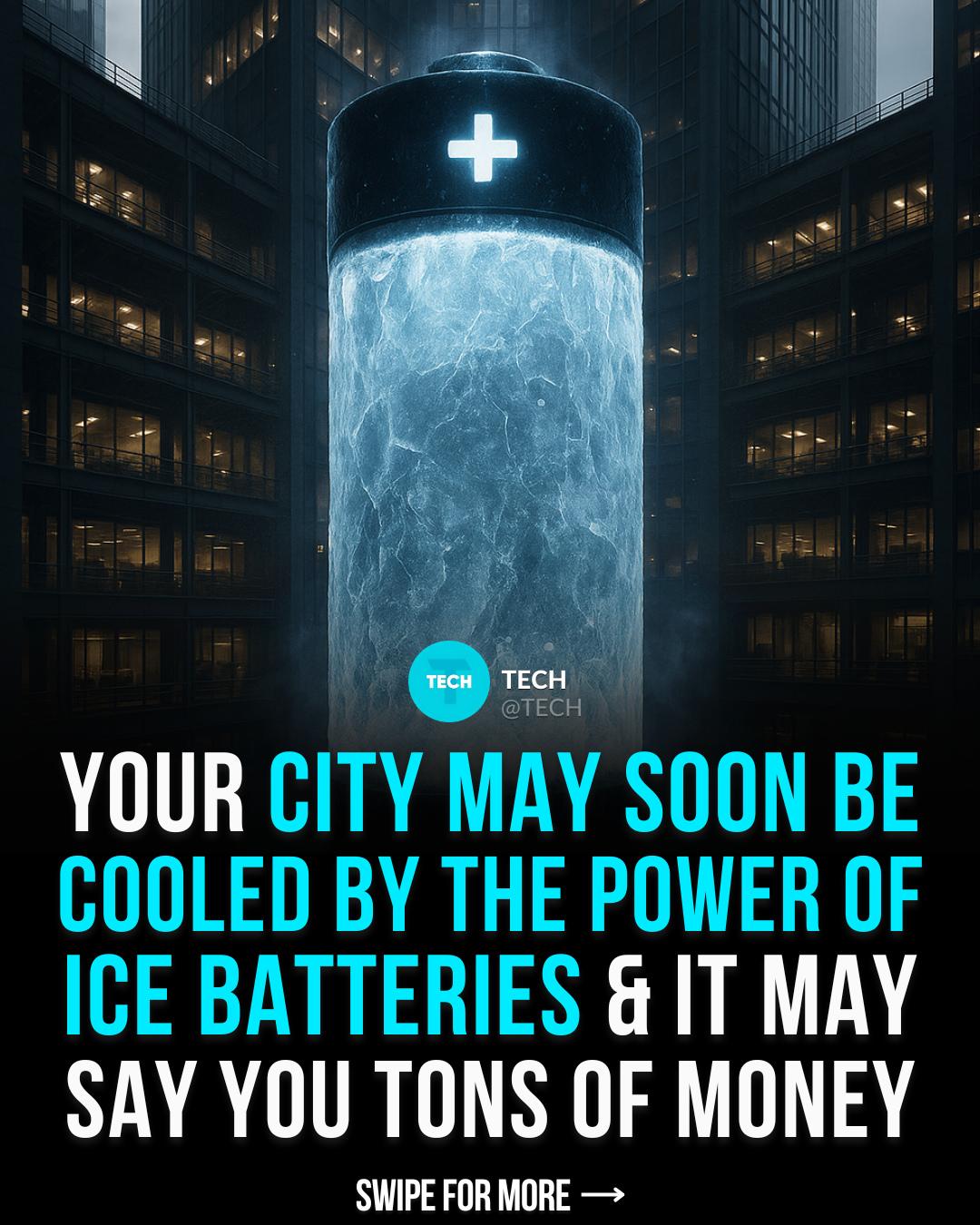
Cities are learning to cool with time, not just power. So-called ice batteries, thermal energy storage tanks that freeze liquid overnight, let buildings ride the next day’s heat on yesterday’s cold. Shifting chillers to off-peak hours trims grid stress when temperatures spike and electricity is priciest, creating a smoother balance between supply and demand.
The numbers are real, not theoretical. Manhattan’s 30-story Eleven Madison freezes roughly 500,000 pounds of ice each night and reports up to a 40% cut in cooling costs. Trane and others have installed more than 4,000 systems worldwide, a tiny slice of six million U.S. commercial buildings but a proof that scaling is possible and increasingly attractive in hotter climates.
The tech is getting smarter at the material level. In The Journal of Physical Chemistry C, a Texas A&M team led by Patrick Shamberger tuned salt hydrates, salts that lock in water molecules, to freeze and thaw at HVAC-friendly temperatures without degrading. Their focus is phase segregation, the tendency for the material to split into solid and liquid zones over many cycles. By optimizing “nucleation particles,” especially those containing barium, the system triggers cleaner, repeatable freezing with higher efficiency.
Why this matters now: cooling already eats about 20% of building electricity, and AI data centers are adding heavy, always-on thermal loads. Ice batteries do not eliminate energy use, but they move it to when power is cleaner and cheaper, lowering peak demand and postponing the need for new plants.
A century after barges hauled river ice down the Hudson, engineered ice may again be the quiet workhorse that keeps modern life comfortable, only this time with chemistry doing the steering and research ensuring decades of reliable performance.
#tech #energy #hvac #buildings #energystorage #grid #climate #datacenters #materialsCities are learning to cool with time, not just power. So-called ice batteries, thermal energy storage tanks that freeze liquid overnight, let buildings ride the next day’s heat on yesterday’s cold. Shifting chillers to off-peak hours trims grid stress when temperatures spike and electricity is priciest, creating a smoother balance between supply and demand.
The numbers are real, not theoretical. Manhattan’s 30-story Eleven Madison freezes roughly 500,000 pounds of ice each night and reports up to a 40% cut in cooling costs. Trane and others have installed more than 4,000 systems worldwide, a tiny slice of six million U.S. commercial buildings but a proof that scaling is possible and increasingly attractive in hotter climates.
The tech is getting smarter at the material level. In The Journal of Physical Chemistry C, a Texas A&M team led by Patrick Shamberger tuned salt hydrates, salts that lock in water molecules, to freeze and thaw at HVAC-friendly temperatures without degrading. Their focus is phase segregation, the tendency for the material to split into solid and liquid zones over many cycles. By optimizing “nucleation particles,” especially those containing barium, the system triggers cleaner, repeatable freezing with higher efficiency.
Why this matters now: cooling already eats about 20% of building electricity, and AI data centers are adding heavy, always-on thermal loads. Ice batteries do not eliminate energy use, but they move it to when power is cleaner and cheaper, lowering peak demand and postponing the need for new plants.
A century after barges hauled river ice down the Hudson, engineered ice may again be the quiet workhorse that keeps modern life comfortable, only this time with chemistry doing the steering and research ensuring decades of reliable performance.
#tech #energy #hvac #buildings #energystorage #grid #climate #datacenters #materials
·110 Visualizações
·0 Anterior
 English
 Arabic
 French
 Spanish
 Portuguese
 Deutsch
 Turkish
 Dutch
Dutch
 Italiano
 Russian
 Romaian
 Portuguese (Brazil)
 Greek
Greek