• New York is not just rising in the skyline, it is very slowly sinking too

    Scientists estimate New York City has over a million buildings weighing roughly 1.7 trillion pounds. That kind of load helps pull the city down around 1 to 2 millimeters each year, on top of natural subsidence and rising seas.

    When you stack that much concrete, steel, and wealth on a city, it slowly starts to sink into the ground.

    #NewYork #ClimateRisk #CityFacts #UrbanWealth #FutureProof
    New York is not just rising in the skyline, it is very slowly sinking too 🤯 Scientists estimate New York City has over a million buildings weighing roughly 1.7 trillion pounds. That kind of load helps pull the city down around 1 to 2 millimeters each year, on top of natural subsidence and rising seas. When you stack that much concrete, steel, and wealth on a city, it slowly starts to sink into the ground. #NewYork #ClimateRisk #CityFacts #UrbanWealth #FutureProof
    ·88 Views ·0 Reviews
  • German startup SWARM Biotactics just secured €13 million in funding to turn live Madagascar hissing cockroaches into AI-powered spy robots equipped with miniature backpacks containing cameras, sensors, and neural stimulators that allow remote control for covert surveillance missions. The Kassel-based company represents the world's first commercial effort to create "biologically integrated, AI-enabled, and mass-deployable systems" that can infiltrate environments where traditional drones and ground robots completely fail.⁠

    CEO Stefan Wilhelm revealed that each cockroach carries a lightweight backpack weighing up to 3 grams that includes tiny cameras for real-time reconnaissance, environmental sensors to detect gas or radiation, and neural stimulators that send electrical impulses to the insect's nervous system to control movement. The technology allows military operators to guide individual cockroaches through rubble, tight spaces, or hostile territories, or deploy entire swarms that operate autonomously using artificial intelligence coordination.⁠

    The breakthrough addresses fundamental limitations of conventional surveillance technology in cluttered, GPS-denied environments like urban combat zones, collapsed buildings, or disaster areas. Unlike mechanical robots that require significant power and sophisticated navigation systems, cockroaches naturally excel at navigating complex terrain while requiring zero energy input for locomotion, making them ideal biological platforms for persistent intelligence gathering.⁠

    These living surveillance systems could provide unprecedented tactical advantages in scenarios where conventional technology proves inadequate or too conspicuous for effective intelligence gathering.
    German startup SWARM Biotactics just secured €13 million in funding to turn live Madagascar hissing cockroaches into AI-powered spy robots equipped with miniature backpacks containing cameras, sensors, and neural stimulators that allow remote control for covert surveillance missions. The Kassel-based company represents the world's first commercial effort to create "biologically integrated, AI-enabled, and mass-deployable systems" that can infiltrate environments where traditional drones and ground robots completely fail.⁠ ⁠ CEO Stefan Wilhelm revealed that each cockroach carries a lightweight backpack weighing up to 3 grams that includes tiny cameras for real-time reconnaissance, environmental sensors to detect gas or radiation, and neural stimulators that send electrical impulses to the insect's nervous system to control movement. The technology allows military operators to guide individual cockroaches through rubble, tight spaces, or hostile territories, or deploy entire swarms that operate autonomously using artificial intelligence coordination.⁠ ⁠ The breakthrough addresses fundamental limitations of conventional surveillance technology in cluttered, GPS-denied environments like urban combat zones, collapsed buildings, or disaster areas. Unlike mechanical robots that require significant power and sophisticated navigation systems, cockroaches naturally excel at navigating complex terrain while requiring zero energy input for locomotion, making them ideal biological platforms for persistent intelligence gathering.⁠ ⁠ These living surveillance systems could provide unprecedented tactical advantages in scenarios where conventional technology proves inadequate or too conspicuous for effective intelligence gathering.
    ·69 Views ·0 Reviews
  • Cities are learning to cool with time, not just power. So-called ice batteries, thermal energy storage tanks that freeze liquid overnight, let buildings ride the next day’s heat on yesterday’s cold. Shifting chillers to off-peak hours trims grid stress when temperatures spike and electricity is priciest, creating a smoother balance between supply and demand.⁠

    The numbers are real, not theoretical. Manhattan’s 30-story Eleven Madison freezes roughly 500,000 pounds of ice each night and reports up to a 40% cut in cooling costs. Trane and others have installed more than 4,000 systems worldwide, a tiny slice of six million U.S. commercial buildings but a proof that scaling is possible and increasingly attractive in hotter climates.⁠

    The tech is getting smarter at the material level. In The Journal of Physical Chemistry C, a Texas A&M team led by Patrick Shamberger tuned salt hydrates, salts that lock in water molecules, to freeze and thaw at HVAC-friendly temperatures without degrading. Their focus is phase segregation, the tendency for the material to split into solid and liquid zones over many cycles. By optimizing “nucleation particles,” especially those containing barium, the system triggers cleaner, repeatable freezing with higher efficiency.⁠

    Why this matters now: cooling already eats about 20% of building electricity, and AI data centers are adding heavy, always-on thermal loads. Ice batteries do not eliminate energy use, but they move it to when power is cleaner and cheaper, lowering peak demand and postponing the need for new plants.⁠

    A century after barges hauled river ice down the Hudson, engineered ice may again be the quiet workhorse that keeps modern life comfortable, only this time with chemistry doing the steering and research ensuring decades of reliable performance.⁠

    #tech #energy #hvac #buildings #energystorage #grid #climate #datacenters #materials
    Cities are learning to cool with time, not just power. So-called ice batteries, thermal energy storage tanks that freeze liquid overnight, let buildings ride the next day’s heat on yesterday’s cold. Shifting chillers to off-peak hours trims grid stress when temperatures spike and electricity is priciest, creating a smoother balance between supply and demand.⁠ ⁠ The numbers are real, not theoretical. Manhattan’s 30-story Eleven Madison freezes roughly 500,000 pounds of ice each night and reports up to a 40% cut in cooling costs. Trane and others have installed more than 4,000 systems worldwide, a tiny slice of six million U.S. commercial buildings but a proof that scaling is possible and increasingly attractive in hotter climates.⁠ ⁠ The tech is getting smarter at the material level. In The Journal of Physical Chemistry C, a Texas A&M team led by Patrick Shamberger tuned salt hydrates, salts that lock in water molecules, to freeze and thaw at HVAC-friendly temperatures without degrading. Their focus is phase segregation, the tendency for the material to split into solid and liquid zones over many cycles. By optimizing “nucleation particles,” especially those containing barium, the system triggers cleaner, repeatable freezing with higher efficiency.⁠ ⁠ Why this matters now: cooling already eats about 20% of building electricity, and AI data centers are adding heavy, always-on thermal loads. Ice batteries do not eliminate energy use, but they move it to when power is cleaner and cheaper, lowering peak demand and postponing the need for new plants.⁠ ⁠ A century after barges hauled river ice down the Hudson, engineered ice may again be the quiet workhorse that keeps modern life comfortable, only this time with chemistry doing the steering and research ensuring decades of reliable performance.⁠ ⁠ #tech #energy #hvac #buildings #energystorage #grid #climate #datacenters #materials
    ·118 Views ·0 Reviews
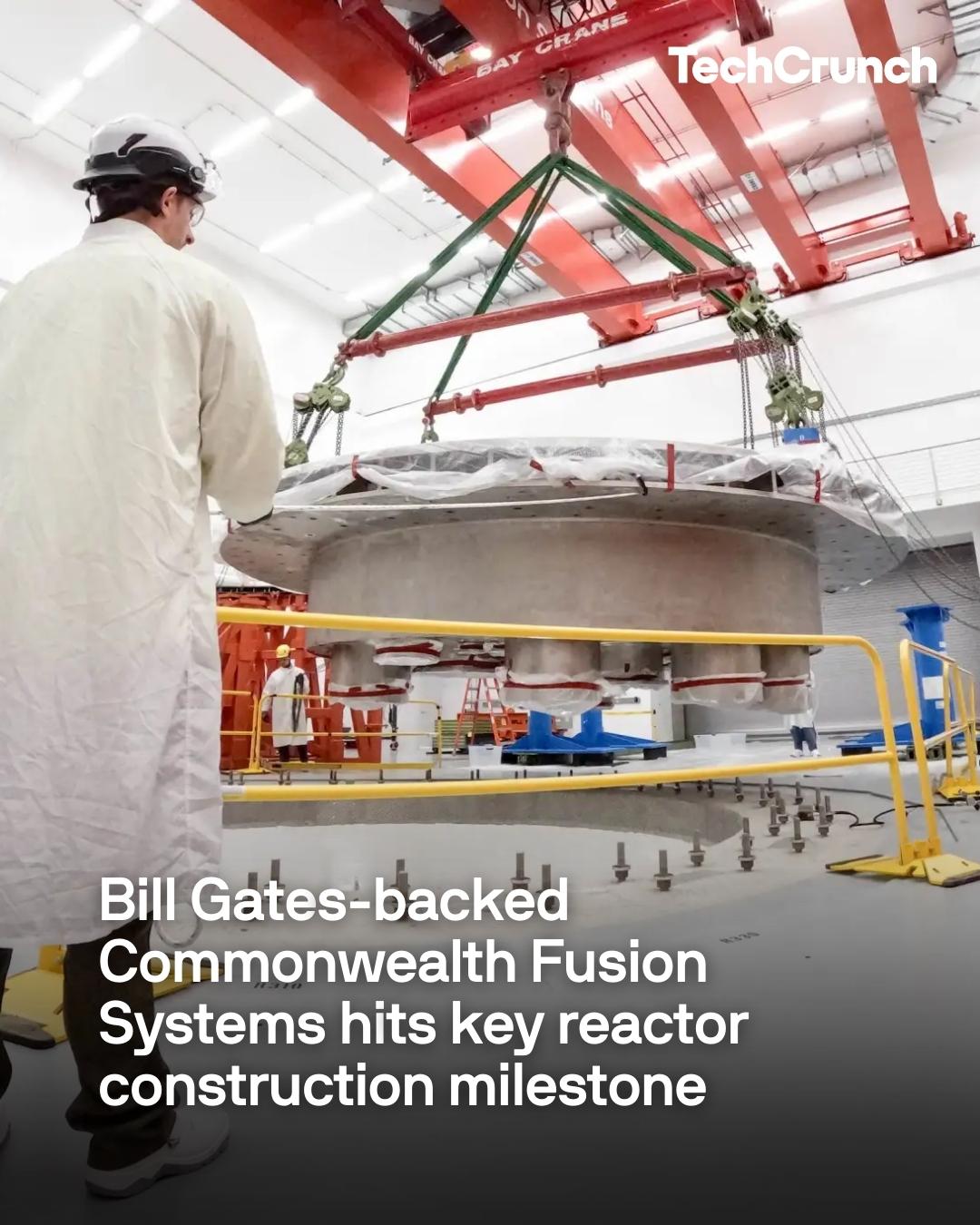
  • Commonwealth Fusion Systems marked a major milestone Tuesday morning, announcing the installation of a key component of its Sparc demonstration reactor.

    The new part is a 24-foot wide, 75-ton stainless steel circle that forms the foundation of the tokamak, the doughnut-shaped heart of a fusion reactor that CFS hopes will be the first of its kind to generate more power than it consumes.

    Called the cryostat base, it was made in Italy and shipped halfway around the world to CFS’s site in Devens, Massachusetts.

    “It is the first piece of the actual fusion machine,” Alex Creely, director of tokamak operations at CFS, told TechCrunch. Work at the site has been underway now for more than three years as the company constructs the buildings and machinery that will support the reactor’s core.

    Read more on the cryostat base at the link in the bio

    Article by Tim De Chant

    Image Credits: Commonwealth Fusion Systems

    #TechCrunch #technews #climatetech #fusionpower #nuclearpower
    Commonwealth Fusion Systems marked a major milestone Tuesday morning, announcing the installation of a key component of its Sparc demonstration reactor. The new part is a 24-foot wide, 75-ton stainless steel circle that forms the foundation of the tokamak, the doughnut-shaped heart of a fusion reactor that CFS hopes will be the first of its kind to generate more power than it consumes. Called the cryostat base, it was made in Italy and shipped halfway around the world to CFS’s site in Devens, Massachusetts. “It is the first piece of the actual fusion machine,” Alex Creely, director of tokamak operations at CFS, told TechCrunch. Work at the site has been underway now for more than three years as the company constructs the buildings and machinery that will support the reactor’s core. Read more on the cryostat base at the link in the bio 👆 Article by Tim De Chant Image Credits: Commonwealth Fusion Systems #TechCrunch #technews #climatetech #fusionpower #nuclearpower
    ·134 Views ·0 Reviews
  • First, a fridge without the fumes. Scientists at Lawrence Berkeley National Laboratory have built a new “ionocaloric” cycle that cools by moving ions through a material to shift its melting point, the same physics behind road salt melting ice. In lab tests, a sodium–iodine salt and ethylene carbonate delivered a 25 °C temperature swing using under one volt, a bigger lift than most solid-state “caloric” approaches and without hydrofluorocarbon refrigerants.⁠

    Because it toggles a solid–liquid phase change, the working fluid can be pumped, avoiding compressors and complex valves. The team’s models suggest efficiency on par with, or better than, today’s vapor-compression systems. Using ethylene carbonate, which can be synthesized from captured CO₂, the refrigerant footprint could be not just low but potentially carbon-negative. If prototypes scale, the same cycle could also supply efficient water and process heating, trimming emissions from buildings and industry that are notoriously hard to decarbonize.⁠

    Now, a data center that chills with the sea. Off Shanghai, Hailanyun’s first commercial underwater AI facility places sealed server pods beneath offshore wind turbines and circulates seawater across radiators to carry heat away. Internal assessments with a Chinese institute report at least 30% lower electricity use for cooling compared with land sites, and the company says the farm is powered 97% by the nearby wind array.⁠

    One operational pod holds 198 racks, enough for roughly 396–792 AI-ready servers, and the company claims capacity to train a GPT-3.5-class model in a day. Microsoft’s earlier Project Natick found submerged servers can fail less often, but scaling raises new risks, including thermal plumes, acoustic sabotage, corrosion, biofouling, and slow maintenance cycles. From ions to oceans, cooling is being rewired for an AI-hungry, climate-strained future.⁠

    #tech #ai #cooling #climate #datacenters #materials #energy #sustainability #berkeleylab

    Source: 10.1126/science.ade1696
    First, a fridge without the fumes. Scientists at Lawrence Berkeley National Laboratory have built a new “ionocaloric” cycle that cools by moving ions through a material to shift its melting point, the same physics behind road salt melting ice. In lab tests, a sodium–iodine salt and ethylene carbonate delivered a 25 °C temperature swing using under one volt, a bigger lift than most solid-state “caloric” approaches and without hydrofluorocarbon refrigerants.⁠ ⁠ Because it toggles a solid–liquid phase change, the working fluid can be pumped, avoiding compressors and complex valves. The team’s models suggest efficiency on par with, or better than, today’s vapor-compression systems. Using ethylene carbonate, which can be synthesized from captured CO₂, the refrigerant footprint could be not just low but potentially carbon-negative. If prototypes scale, the same cycle could also supply efficient water and process heating, trimming emissions from buildings and industry that are notoriously hard to decarbonize.⁠ ⁠ Now, a data center that chills with the sea. Off Shanghai, Hailanyun’s first commercial underwater AI facility places sealed server pods beneath offshore wind turbines and circulates seawater across radiators to carry heat away. Internal assessments with a Chinese institute report at least 30% lower electricity use for cooling compared with land sites, and the company says the farm is powered 97% by the nearby wind array.⁠ ⁠ One operational pod holds 198 racks, enough for roughly 396–792 AI-ready servers, and the company claims capacity to train a GPT-3.5-class model in a day. Microsoft’s earlier Project Natick found submerged servers can fail less often, but scaling raises new risks, including thermal plumes, acoustic sabotage, corrosion, biofouling, and slow maintenance cycles. From ions to oceans, cooling is being rewired for an AI-hungry, climate-strained future.⁠ ⁠ #tech #ai #cooling #climate #datacenters #materials #energy #sustainability #berkeleylab⁠ ⁠ Source: 10.1126/science.ade1696
    ·170 Views ·0 Reviews
  • Lomanstraat in Amsterdam is a charming, photogenic street known for its vibrant murals and picturesque canalside views. Its colorful buildings and cozy atmosphere make it the perfect spot for those looking to capture the essence of Amsterdam’s artistic spirit. Wander through this hidden gem and experience a blend of modern street art and classic Dutch architecture.
    Photos by: @when.in.amsterdam
    .
    .
    #thenetherlands #netherlands #amsterdam #tree #trees #art #amsterdam_streets #amsterdamnoord #moodygrams #autumn #vacations
    Lomanstraat in Amsterdam is a charming, photogenic street known for its vibrant murals and picturesque canalside views. Its colorful buildings and cozy atmosphere make it the perfect spot for those looking to capture the essence of Amsterdam’s artistic spirit. Wander through this hidden gem and experience a blend of modern street art and classic Dutch architecture. Photos by: @when.in.amsterdam . . #thenetherlands #netherlands #amsterdam #tree #trees #art #amsterdam_streets #amsterdamnoord #moodygrams #autumn #vacations
    ·1K Views ·0 Reviews
  • At first glance, this might look like a modern AI rendering of New York City—but it’s the real deal.

    In the early 1930s, photographer Andreas Feininger built his own telephoto lens to capture this rare shot of the freshly completed Empire State Building rising high above a low-rise Manhattan. Taken from across the Hudson River in New Jersey, the photo shows a city still in transition—townhouses and small buildings dominating the skyline while the Empire State looked almost out of place.

    Standing 1,454 feet tall, it was the world’s tallest building for nearly 40 years. Yet during the Great Depression, it sat so empty that locals nicknamed it the “Empty State Building.”

    Feininger’s ingenuity gave us one of the clearest glimpses of New York’s skyline at a moment when the Empire State truly stood alone.

    #viral #history #empirestatebuilding #manhattan #newyork #architecture #ny #nyc #newyorkcity
    At first glance, this might look like a modern AI rendering of New York City—but it’s the real deal. 📸 In the early 1930s, photographer Andreas Feininger built his own telephoto lens to capture this rare shot of the freshly completed Empire State Building rising high above a low-rise Manhattan. Taken from across the Hudson River in New Jersey, the photo shows a city still in transition—townhouses and small buildings dominating the skyline while the Empire State looked almost out of place. Standing 1,454 feet tall, it was the world’s tallest building for nearly 40 years. Yet during the Great Depression, it sat so empty that locals nicknamed it the “Empty State Building.” Feininger’s ingenuity gave us one of the clearest glimpses of New York’s skyline at a moment when the Empire State truly stood alone. 🏙️✨ #viral #history #empirestatebuilding #manhattan #newyork #architecture #ny #nyc #newyorkcity
    ·1K Views ·0 Reviews
  • Stadiums cost more than any skyscraper ever built

    Modern arenas have become mega-projects with city-scale budgets.

    SoFi Stadium tops the list at about $5.5 billion, a single venue that cost more than many museums and concert halls combined.

    Most entries sit in the U.S., where year-round events turn these buildings into cash engines for teams and cities.

    Love learning? Follow @Wealth

    #Stadiums #SportsBusiness #Infrastructure #MegaProjects #Wealth
    Stadiums cost more than any skyscraper ever built 🏟️ Modern arenas have become mega-projects with city-scale budgets. SoFi Stadium tops the list at about $5.5 billion, a single venue that cost more than many museums and concert halls combined. Most entries sit in the U.S., where year-round events turn these buildings into cash engines for teams and cities. Love learning? Follow @Wealth ⭐ #Stadiums #SportsBusiness #Infrastructure #MegaProjects #Wealth
    ·473 Views ·0 Reviews
  • The 450 km border between the Netherlands and Belgium is famously irregular, especially in the town of Baarle, where it creates a bizarre patchwork of enclaves and counter-enclaves. In Baarle, parts of Belgium (Baarle-Hertog) are scattered inside the Dutch town of Baarle-Nassau, with even smaller Dutch parcels nested within those Belgian pieces. As a result, homes, shops, and streets are often split between the two countries, with some buildings literally divided by the border. Each property displays a marker showing which country it belongs to, and residents may deal with two sets of laws, taxes, and services. This peculiar arrangement stems from feudal-era land agreements that were preserved when modern borders were drawn, making Baarle one of the most complex border zones in the world.
    The 450 km border between the Netherlands and Belgium is famously irregular, especially in the town of Baarle, where it creates a bizarre patchwork of enclaves and counter-enclaves. In Baarle, parts of Belgium (Baarle-Hertog) are scattered inside the Dutch town of Baarle-Nassau, with even smaller Dutch parcels nested within those Belgian pieces. As a result, homes, shops, and streets are often split between the two countries, with some buildings literally divided by the border. Each property displays a marker showing which country it belongs to, and residents may deal with two sets of laws, taxes, and services. This peculiar arrangement stems from feudal-era land agreements that were preserved when modern borders were drawn, making Baarle one of the most complex border zones in the world.
    ·141 Views ·0 Reviews
  • Hidden inside one of the most secretive buildings in the world—CIA headquarters in Langley, Virginia—is a Starbucks unlike any other. Known simply as “Store Number 1,” this café serves agents, analysts, and intelligence officers under a strict set of covert rules!

    Most notably, baristas are prohibited from asking for names. Forget hearing “latte for Jason!”—many of the customers are undercover operatives, and even a name on a coffee cup could compromise national security.

    Security protocols are intense: baristas undergo background checks, are escorted in and out daily, and aren’t even allowed to keep their receipts. Despite the secrecy, it’s reportedly one of the busiest Starbucks locations in the country—keeping America’s top spies fueled with caffeine, not classified intel.

    It’s perhaps the most clandestine place in the world to order a caramel macchiato. And no, they don’t write “007” on the cup either.

    -
    #history #starbucks #photography #didyouknow #facts #explore #trending
    Hidden inside one of the most secretive buildings in the world—CIA headquarters in Langley, Virginia—is a Starbucks unlike any other. Known simply as “Store Number 1,” this café serves agents, analysts, and intelligence officers under a strict set of covert rules! Most notably, baristas are prohibited from asking for names. Forget hearing “latte for Jason!”—many of the customers are undercover operatives, and even a name on a coffee cup could compromise national security. Security protocols are intense: baristas undergo background checks, are escorted in and out daily, and aren’t even allowed to keep their receipts. Despite the secrecy, it’s reportedly one of the busiest Starbucks locations in the country—keeping America’s top spies fueled with caffeine, not classified intel. It’s perhaps the most clandestine place in the world to order a caramel macchiato. And no, they don’t write “007” on the cup either. - #history #starbucks #photography #didyouknow #facts #explore #trending
    ·332 Views ·0 Reviews
More Results
Techawks - Powered By Pantrade Blockchain https://techawks.com