• Detroit has a road that literally charges electric cars while they roll over it ⚡️

    On a quarter mile of 14th Street in Detroit, copper coils under the asphalt turn an ordinary lane into North America’s first public electric road that can charge EVs while they move. The pilot uses special receivers in test vehicles to pull in about 16 kilowatts of power while driving, so Michigan can learn how to scale the tech to buses, shuttles, and busy city routes.

    If roads can charge cars in motion, the real advantage goes to the places that build this grid, not the people stressing about range.

    #ElectricVehicles #DetroitInnovation #FutureOfCities #TechAndWealth #SustainableMobility

    Detroit has a road that literally charges electric cars while they roll over it ⚡️ On a quarter mile of 14th Street in Detroit, copper coils under the asphalt turn an ordinary lane into North America’s first public electric road that can charge EVs while they move. The pilot uses special receivers in test vehicles to pull in about 16 kilowatts of power while driving, so Michigan can learn how to scale the tech to buses, shuttles, and busy city routes. If roads can charge cars in motion, the real advantage goes to the places that build this grid, not the people stressing about range. #ElectricVehicles #DetroitInnovation #FutureOfCities #TechAndWealth #SustainableMobility
    ·151 مشاهدة ·0 معاينة

  • When Fernando Ortiz Monasterio first gazed at the gray forest of highway pillars choking Mexico City’s Periférico, he saw potential. Not concrete. Not gridlock. But a vertical garden—one that would breathe life into one of the world’s most polluted capitals.⁠

    What followed was a transformation both literal and symbolic. Today, more than 1,000 columns of the Anillo Periférico are wrapped in dense, vibrant greenery. Dubbed Vía Verde, the project spans over 60,000 square meters of vertical gardens, irrigated by reclaimed water and sustained by recycled materials. No soil required—just innovation, textile, and hydroponics.⁠

    The system is intelligent. Each pillar contains sensors that monitor light, temperature, and moisture. They communicate in real time, triggering precision irrigation to conserve resources while maximizing plant health. These aren’t just decorative installations—they’re engineered ecosystems.⁠

    Ambitious by design, Vía Verde claims to filter 27,000 tons of air pollutants a year, trap heavy metals, and generate clean oxygen for tens of thousands. But the benefits go beyond air quality. The gardens reduce urban heat, dampen traffic noise, and even provide jobs—many filled by community workers and rehabilitating inmates.⁠

    Still, not everyone is convinced. Critics argue the project is more about aesthetics than impact. Replacing smog with succulents, they say, doesn’t address the core issue: car dependency. For the cost of one vertical column, the city could plant 300 trees.⁠

    Even Ortiz admits this is just a beginning. His firm is pushing to expand Vía Verde across rooftops, bridges, and tunnels—10 million square meters by 2030. But that would still fall short of WHO’s recommended green space per resident.⁠

    The vision is bold. The execution, ongoing. But even in a city of concrete and chaos, it’s possible to grow something green.⁠
    When Fernando Ortiz Monasterio first gazed at the gray forest of highway pillars choking Mexico City’s Periférico, he saw potential. Not concrete. Not gridlock. But a vertical garden—one that would breathe life into one of the world’s most polluted capitals.⁠ ⁠ What followed was a transformation both literal and symbolic. Today, more than 1,000 columns of the Anillo Periférico are wrapped in dense, vibrant greenery. Dubbed Vía Verde, the project spans over 60,000 square meters of vertical gardens, irrigated by reclaimed water and sustained by recycled materials. No soil required—just innovation, textile, and hydroponics.⁠ ⁠ The system is intelligent. Each pillar contains sensors that monitor light, temperature, and moisture. They communicate in real time, triggering precision irrigation to conserve resources while maximizing plant health. These aren’t just decorative installations—they’re engineered ecosystems.⁠ ⁠ Ambitious by design, Vía Verde claims to filter 27,000 tons of air pollutants a year, trap heavy metals, and generate clean oxygen for tens of thousands. But the benefits go beyond air quality. The gardens reduce urban heat, dampen traffic noise, and even provide jobs—many filled by community workers and rehabilitating inmates.⁠ ⁠ Still, not everyone is convinced. Critics argue the project is more about aesthetics than impact. Replacing smog with succulents, they say, doesn’t address the core issue: car dependency. For the cost of one vertical column, the city could plant 300 trees.⁠ ⁠ Even Ortiz admits this is just a beginning. His firm is pushing to expand Vía Verde across rooftops, bridges, and tunnels—10 million square meters by 2030. But that would still fall short of WHO’s recommended green space per resident.⁠ ⁠ The vision is bold. The execution, ongoing. But even in a city of concrete and chaos, it’s possible to grow something green.⁠ ⁠
    ·104 مشاهدة ·0 معاينة
  • Cities are learning to cool with time, not just power. So-called ice batteries, thermal energy storage tanks that freeze liquid overnight, let buildings ride the next day’s heat on yesterday’s cold. Shifting chillers to off-peak hours trims grid stress when temperatures spike and electricity is priciest, creating a smoother balance between supply and demand.⁠

    The numbers are real, not theoretical. Manhattan’s 30-story Eleven Madison freezes roughly 500,000 pounds of ice each night and reports up to a 40% cut in cooling costs. Trane and others have installed more than 4,000 systems worldwide, a tiny slice of six million U.S. commercial buildings but a proof that scaling is possible and increasingly attractive in hotter climates.⁠

    The tech is getting smarter at the material level. In The Journal of Physical Chemistry C, a Texas A&M team led by Patrick Shamberger tuned salt hydrates, salts that lock in water molecules, to freeze and thaw at HVAC-friendly temperatures without degrading. Their focus is phase segregation, the tendency for the material to split into solid and liquid zones over many cycles. By optimizing “nucleation particles,” especially those containing barium, the system triggers cleaner, repeatable freezing with higher efficiency.⁠

    Why this matters now: cooling already eats about 20% of building electricity, and AI data centers are adding heavy, always-on thermal loads. Ice batteries do not eliminate energy use, but they move it to when power is cleaner and cheaper, lowering peak demand and postponing the need for new plants.⁠

    A century after barges hauled river ice down the Hudson, engineered ice may again be the quiet workhorse that keeps modern life comfortable, only this time with chemistry doing the steering and research ensuring decades of reliable performance.⁠

    #tech #energy #hvac #buildings #energystorage #grid #climate #datacenters #materials
    Cities are learning to cool with time, not just power. So-called ice batteries, thermal energy storage tanks that freeze liquid overnight, let buildings ride the next day’s heat on yesterday’s cold. Shifting chillers to off-peak hours trims grid stress when temperatures spike and electricity is priciest, creating a smoother balance between supply and demand.⁠ ⁠ The numbers are real, not theoretical. Manhattan’s 30-story Eleven Madison freezes roughly 500,000 pounds of ice each night and reports up to a 40% cut in cooling costs. Trane and others have installed more than 4,000 systems worldwide, a tiny slice of six million U.S. commercial buildings but a proof that scaling is possible and increasingly attractive in hotter climates.⁠ ⁠ The tech is getting smarter at the material level. In The Journal of Physical Chemistry C, a Texas A&M team led by Patrick Shamberger tuned salt hydrates, salts that lock in water molecules, to freeze and thaw at HVAC-friendly temperatures without degrading. Their focus is phase segregation, the tendency for the material to split into solid and liquid zones over many cycles. By optimizing “nucleation particles,” especially those containing barium, the system triggers cleaner, repeatable freezing with higher efficiency.⁠ ⁠ Why this matters now: cooling already eats about 20% of building electricity, and AI data centers are adding heavy, always-on thermal loads. Ice batteries do not eliminate energy use, but they move it to when power is cleaner and cheaper, lowering peak demand and postponing the need for new plants.⁠ ⁠ A century after barges hauled river ice down the Hudson, engineered ice may again be the quiet workhorse that keeps modern life comfortable, only this time with chemistry doing the steering and research ensuring decades of reliable performance.⁠ ⁠ #tech #energy #hvac #buildings #energystorage #grid #climate #datacenters #materials
    ·115 مشاهدة ·0 معاينة
  • The Arc Prize Foundation, a nonprofit co-founded by prominent AI researcher François Chollet, announced in a blog post on Monday that it has created a new, challenging test to measure the general intelligence of leading AI models.

    So far, the new test, called ARC-AGI-2, has stumped most models.

    “Reasoning” AI models like OpenAI’s o1-pro and DeepSeek’s R1 score between 1% and 1.3% on ARC-AGI-2, according to the Arc Prize leaderboard. Powerful non-reasoning models including GPT-4.5, Claude 3.7 Sonnet, and Gemini 2.0 Flash score around 1%.

    The ARC-AGI tests consist of puzzle-like problems where an AI has to identify visual patterns from a collection of different-colored squares, and generate the correct “answer” grid.

    The problems were designed to force an AI to adapt to new problems it hasn’t seen before.

    Read more on the ARC-AGI tests at the link in the bio

    Article by Maxwell Zeff

    Image Credits: Boris SV / Getty Images; Arc Prize

    #TechCrunch #technews #artificialintelligence #AGI #AI
    The Arc Prize Foundation, a nonprofit co-founded by prominent AI researcher François Chollet, announced in a blog post on Monday that it has created a new, challenging test to measure the general intelligence of leading AI models. So far, the new test, called ARC-AGI-2, has stumped most models. “Reasoning” AI models like OpenAI’s o1-pro and DeepSeek’s R1 score between 1% and 1.3% on ARC-AGI-2, according to the Arc Prize leaderboard. Powerful non-reasoning models including GPT-4.5, Claude 3.7 Sonnet, and Gemini 2.0 Flash score around 1%. The ARC-AGI tests consist of puzzle-like problems where an AI has to identify visual patterns from a collection of different-colored squares, and generate the correct “answer” grid. The problems were designed to force an AI to adapt to new problems it hasn’t seen before. Read more on the ARC-AGI tests at the link in the bio 👆 Article by Maxwell Zeff Image Credits: Boris SV / Getty Images; Arc Prize #TechCrunch #technews #artificialintelligence #AGI #AI
    ·164 مشاهدة ·0 معاينة
  • Baldness might soon meet its match in a patch made from sugar. Scientists have engineered a dissolving microneedle system that fuses minoxidil, the main ingredient in Rogaine, with stevioside, the natural sweetener from the Stevia plant. The result is a tiny grid of microscopic spikes that melt into the scalp, releasing medication directly to the roots of hair growth.⁠

    Developed by teams in China and Australia and published in *Advanced Healthcare Materials*, the invention solves two of minoxidil’s biggest problems: it doesn’t dissolve well in water, and it barely seeps through skin. By building the microneedles out of stevioside, researchers found a way to make the drug more soluble, more absorbable, and far more effective than traditional topical solutions.⁠

    Microneedles work by creating painless channels through the skin’s outer layer, then dissolving to deliver their contents exactly where hair follicles lie. Stevioside, a molecule with both water-loving and water-repelling sides, behaves like a natural carrier, wrapping around minoxidil and ferrying it deep into the epidermis without the sting or irritation of alcohol-based treatments.⁠

    In lab tests using pig ear tissue, more than 85% of the drug penetrated the skin, with nearly 20% staying in place, over twice the amount seen with regular liquid minoxidil. When tested on mice bred to mimic pattern baldness, the patch spurred regrowth in roughly 67% of the treated area within 35 days, compared to just 25% for standard applications.⁠

    The technology could streamline hair restoration routines, reducing the need for daily treatments and avoiding messy solvents. Still, human biology remains the ultimate test, since hair growth cycles in people are slower and influenced by many factors. Clinical trials will determine whether this sweet innovation can turn a pantry staple into the next revolution in hair loss therapy.⁠

    #tech #biotech #dermatology #hairloss #minoxidil #microneedles #stevia #regenerativemedicine #innovation

    Source: 10.1002/adhm.202503575
    Baldness might soon meet its match in a patch made from sugar. Scientists have engineered a dissolving microneedle system that fuses minoxidil, the main ingredient in Rogaine, with stevioside, the natural sweetener from the Stevia plant. The result is a tiny grid of microscopic spikes that melt into the scalp, releasing medication directly to the roots of hair growth.⁠ ⁠ Developed by teams in China and Australia and published in *Advanced Healthcare Materials*, the invention solves two of minoxidil’s biggest problems: it doesn’t dissolve well in water, and it barely seeps through skin. By building the microneedles out of stevioside, researchers found a way to make the drug more soluble, more absorbable, and far more effective than traditional topical solutions.⁠ ⁠ Microneedles work by creating painless channels through the skin’s outer layer, then dissolving to deliver their contents exactly where hair follicles lie. Stevioside, a molecule with both water-loving and water-repelling sides, behaves like a natural carrier, wrapping around minoxidil and ferrying it deep into the epidermis without the sting or irritation of alcohol-based treatments.⁠ ⁠ In lab tests using pig ear tissue, more than 85% of the drug penetrated the skin, with nearly 20% staying in place, over twice the amount seen with regular liquid minoxidil. When tested on mice bred to mimic pattern baldness, the patch spurred regrowth in roughly 67% of the treated area within 35 days, compared to just 25% for standard applications.⁠ ⁠ The technology could streamline hair restoration routines, reducing the need for daily treatments and avoiding messy solvents. Still, human biology remains the ultimate test, since hair growth cycles in people are slower and influenced by many factors. Clinical trials will determine whether this sweet innovation can turn a pantry staple into the next revolution in hair loss therapy.⁠ ⁠ #tech #biotech #dermatology #hairloss #minoxidil #microneedles #stevia #regenerativemedicine #innovation⁠ ⁠ Source: 10.1002/adhm.202503575
    ·210 مشاهدة ·0 معاينة
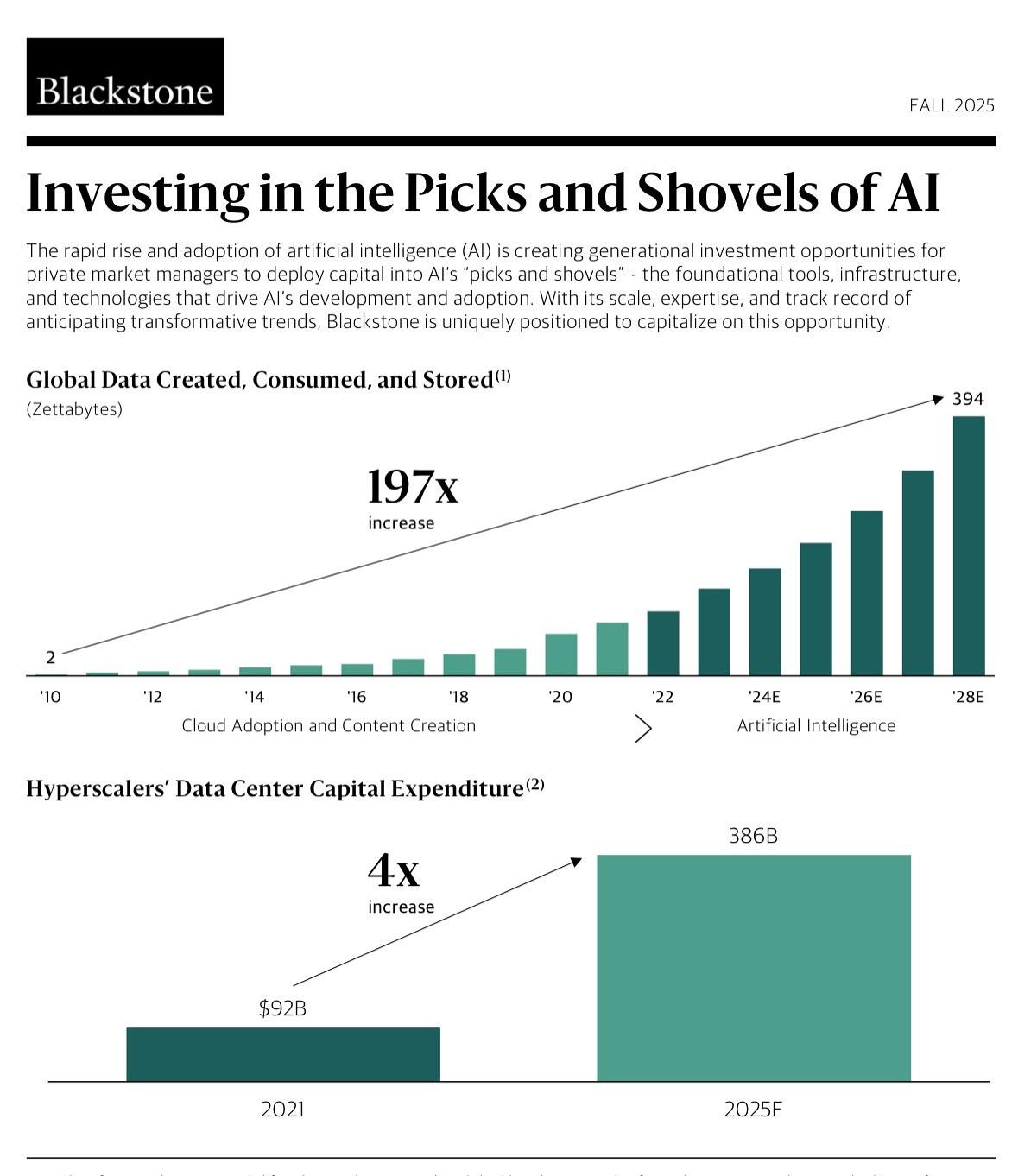
  • Investing in the Picks and Shovels of AI AI isn’t just about chatbots and cool demos. Behind the scenes, a massive buildout is underway:

    Data: Hyperscalers are set to invest $2T in infrastructure over the next 5 years.

    Power: AI’s electricity demand could rise 40% in the next decade, pushing investment into renewables and grid upgrades.

    Compute: The cost of AI compute has dropped 99% since 2023, fueling exponential adoption.

    Blackstone is betting on the “picks & shovels” of AI data centers, chips, energy, cooling, and networking rather than chasing high-risk startups. With a $100B global data center portfolio, they’re positioning themselves as the backbone of the AI revolution.

    This is the real infrastructure layer of AI. Whoever controls cheap energy + data + compute will own the future.

    #AI #investing101 #ArtificialIntelligence #Blackstone #DataCenters #Investing #TechInfrastructure #ainews #energy #DigitalEconomy
    Investing in the Picks and Shovels of AI AI isn’t just about chatbots and cool demos. Behind the scenes, a massive buildout is underway: Data: Hyperscalers are set to invest $2T in infrastructure over the next 5 years. Power: AI’s electricity demand could rise 40% in the next decade, pushing investment into renewables and grid upgrades. Compute: The cost of AI compute has dropped 99% since 2023, fueling exponential adoption. 📈 Blackstone is betting on the “picks & shovels” of AI data centers, chips, energy, cooling, and networking rather than chasing high-risk startups. With a $100B global data center portfolio, they’re positioning themselves as the backbone of the AI revolution. This is the real infrastructure layer of AI. Whoever controls cheap energy + data + compute will own the future. #AI #investing101 #ArtificialIntelligence #Blackstone #DataCenters #Investing #TechInfrastructure #ainews #energy #DigitalEconomy
    ·524 مشاهدة ·0 معاينة
  • With all eyes on how a new Trump administration in the U.S. will interface with China Tech in the years ahead, its neighbor to the north has leveled a blow to one of the biggest apps to come out of the country.

    Canada has ordered the closure of ByteDance’s operations in Canada — specifically the offices of TikTok Technology Canada, Inc. — citing national security risks. Those risks do not extend to the app itself: consumers can still download, use, and create content for TikTok, and businesses can still advertise on it.

    “The decision to use a social media application or platform is a personal choice,” said François-Philippe Champagne, the country’s Minister of Innovation, Science and Industry, in a statement.

    Read more on Canada ordering the shutdown of TikTok offices at the link in the bio

    Article by Ingrid Lunden

    Image Credits: Jakub Porzycki / NurPhoto / Getty Images

    #TechCrunch #technews #TikTok #socialmedia #ByteDance
    With all eyes on how a new Trump administration in the U.S. will interface with China Tech in the years ahead, its neighbor to the north has leveled a blow to one of the biggest apps to come out of the country. Canada has ordered the closure of ByteDance’s operations in Canada — specifically the offices of TikTok Technology Canada, Inc. — citing national security risks. Those risks do not extend to the app itself: consumers can still download, use, and create content for TikTok, and businesses can still advertise on it. “The decision to use a social media application or platform is a personal choice,” said François-Philippe Champagne, the country’s Minister of Innovation, Science and Industry, in a statement. Read more on Canada ordering the shutdown of TikTok offices at the link in the bio 👆 Article by Ingrid Lunden Image Credits: Jakub Porzycki / NurPhoto / Getty Images #TechCrunch #technews #TikTok #socialmedia #ByteDance
    ·386 مشاهدة ·0 معاينة
  • Meta, the parent of Facebook, Instagram and WhatsApp, has been hit with yet another huge regulatory fine in Europe, this time over abusive practices related to Facebook Marketplace.

    The European Commission announced that it would fine Meta €797.72 million — nearly $840 million — for breaching EU antitrust rules connected to how it ties its online classified ads service, Facebook Marketplace, to Facebook itself, creating “unfair trading conditions” for other providers of classifieds online.

    The fine is the latest installment of a case that dates back to June 2021. In December 2022, the regulators had determined that Facebook Marketplace violated antitrust rules. Today, it’s issuing the penalty for that violation.

    Read more on Meta's €798M fine at the link in the bio

    Article by Ingrid Lunden

    Image Credits: Jens Büttner / picture alliance / Getty Images

    #TechCrunch #technews #Meta #MarkZuckerberg #socialmedia
    Meta, the parent of Facebook, Instagram and WhatsApp, has been hit with yet another huge regulatory fine in Europe, this time over abusive practices related to Facebook Marketplace. The European Commission announced that it would fine Meta €797.72 million — nearly $840 million — for breaching EU antitrust rules connected to how it ties its online classified ads service, Facebook Marketplace, to Facebook itself, creating “unfair trading conditions” for other providers of classifieds online. The fine is the latest installment of a case that dates back to June 2021. In December 2022, the regulators had determined that Facebook Marketplace violated antitrust rules. Today, it’s issuing the penalty for that violation. Read more on Meta's €798M fine at the link in the bio 👆 Article by Ingrid Lunden Image Credits: Jens Büttner / picture alliance / Getty Images #TechCrunch #technews #Meta #MarkZuckerberg #socialmedia
    ·558 مشاهدة ·0 معاينة
  • Just in time for the holidays

    Amazon has rolled out its answer to the discounted, low-cost storefronts of Temu and Shein.

    The Amazon Haul store, currently available on the mobile app or mobile web browser exclusively, offers similar mass-produced, discounted items, most of which ship from China. It’s a departure from Amazon’s long-established reputation as a powerhouse of rapid delivery times since even Amazon can’t reduce the time it takes to get these overseas goods.

    The landing page for Amazon Haul is reminiscent of Shein and Temu even in its design: Items appear in grids, rather than Amazon’s typical list, and shipping times and star ratings aren’t visible unless you click on an item.

    Read more on Amazon Haul at the link in the bio

    Article by Amanda Silberling

    Image Credits: PATRICK T. FALLON / Contributor / Getty Images; Amazon

    #TechCrunch #technews #Amazon #fastfashion #Shein #Temu #JeffBezos
    Just in time for the holidays 🎁 Amazon has rolled out its answer to the discounted, low-cost storefronts of Temu and Shein. The Amazon Haul store, currently available on the mobile app or mobile web browser exclusively, offers similar mass-produced, discounted items, most of which ship from China. It’s a departure from Amazon’s long-established reputation as a powerhouse of rapid delivery times since even Amazon can’t reduce the time it takes to get these overseas goods. The landing page for Amazon Haul is reminiscent of Shein and Temu even in its design: Items appear in grids, rather than Amazon’s typical list, and shipping times and star ratings aren’t visible unless you click on an item. Read more on Amazon Haul at the link in the bio 👆 Article by Amanda Silberling Image Credits: PATRICK T. FALLON / Contributor / Getty Images; Amazon #TechCrunch #technews #Amazon #fastfashion #Shein #Temu #JeffBezos
    ·235 مشاهدة ·0 معاينة
  • AI experts warn that the U.S. power grid could be the biggest obstacle to America’s leadership in AI.

    Unlike China, which overbuilt its energy infrastructure and now treats electricity as a solved problem with surplus capacity, the U.S. operates grids near their limits, pushing tech companies to build private plants and raising consumer costs.

    Goldman Sachs notes that AI’s soaring power needs are outpacing grid upgrades, while McKinsey forecasts $6.7 trillion in data center investments by 2030.

    China can quickly tap idle coal plants or expand solar, but the U.S. struggles with permitting delays, local opposition, and short-term investment pressures.

    Experts emphasize this is a structural issue: China builds for the future, while the U.S. reacts after demand emerges, risking its position in the AI race.

    #ai #artificialintelligence #aitools #aihacks #chatgpt #tech #technology
    🚨🇺🇸 AI experts warn that the U.S. power grid could be the biggest obstacle to America’s leadership in AI. Unlike China, which overbuilt its energy infrastructure and now treats electricity as a solved problem with surplus capacity, the U.S. operates grids near their limits, pushing tech companies to build private plants and raising consumer costs. Goldman Sachs notes that AI’s soaring power needs are outpacing grid upgrades, while McKinsey forecasts $6.7 trillion in data center investments by 2030. China can quickly tap idle coal plants or expand solar, but the U.S. struggles with permitting delays, local opposition, and short-term investment pressures. Experts emphasize this is a structural issue: China builds for the future, while the U.S. reacts after demand emerges, risking its position in the AI race. #ai #artificialintelligence #aitools #aihacks #chatgpt #tech #technology
    ·180 مشاهدة ·0 معاينة
الصفحات المعززة
Techawks - Powered By Pantrade Blockchain https://techawks.com